
A Unified Framework for Benchmarking Generative Electrocardiogram-Language Models (ELMs)
Python
50
533 commits
updated Feb 23, 2026
README
A Unified Framework for Benchmarking Generative Electrocardiogram-Language Models (ELMs)

News
- [February 23, 2026] We have migrated and refactored the repository permanently to https://github.com/ELM-Research/ELM. https://github.com/willxxy/ECG-Bench will be archived.
- [February 19, 2026] We will change this repository to be exclusively for training ELMs and remove ECG encoder pretraining. We have created a separate repository for ECG encoder pretraining. Feel free to check it out!
- [February 17, 2026] We are currently going under another refactor for easier use of the repository. We thank you for your patience and will update once its done!
- [November 13, 2025] We have created a new baselines using variants of the GPT model through the OpenAI API on our splits of the ECG-QA PTB-XL and MIMIC-IV-ECG dataset in
tests/test_openai.py. Feel free to run the baseline by executingpython -m tests.test_openaifrom the root dir ofECG-Bench! - [November 7, 2025] We have created a new baseline using the OpenTSLM model on our splits of the ECG-QA PTB-XL and MIMIC-IV-ECG dataset in
tests/test_opentslm.py. First git clone the OpenTSLM repo inside of thetests/folder and runpython -m tests.test_opentslmfrom the root dir ofECG-Bench! - [November 7, 2025] We have developed a naive analysis of the Platonic Representation Hypothesis for ELMs. Please see
scripts/run_plat_rep.shfor running the analysis. - [November 7, 2025] We have implemented Signal2Vec, to create embeddings for ECG-Byte, and implemented the corresponding ELM architecture utilizing the learned embeddings! Check out the
scripts/train_signal2vec.shscript for training the Signal2Vec embeddings for your ECG-Byte tokenizer. To train an ELM with Signal2Vec, specify the--encoder=signal2vecand--signal2vec_embeddings=$PATH_TO_PT_FILE. - [October 18, 2025] We have released preprocessed ECG files, such that you do not have to do the preprocessing yourself.
Show Older News
- [October 16, 2025] We have finished the refactor, for new and old users, please refer to the documentation below and the brief release notes.
- [October 3, 2025] We are currently going under a big refactor for easier use of the repository. We thank you for your patience and will update once its done!
- [October 3, 2025] We have released our paper Retrieval-Augmented Generation for Electrocardiogram-Language Models. There is currently a pull request for the updated integration of RAG utilized with ELMs in the paper. Feel free to check it out.
- [August 5, 2025] We released official splits of ELM datasets on Hugging Face. Feel free to check them out here!
- [May 24, 2025] We release our paper "Signal, Image, or Symbolic: Exploring the Best Input Representation for Electrocardiogram-Language Models Through a Unified Framework" with some interesting results when comparing input representations and training paradigms for ELMs! Check it out.
- [April 5, 2025] We open source ECG-Bench for training and evaluating ELMs!
Table of Contents
- Overview
- Installation
- ECG Datasets
- Main Methods
- Known Issues + Tips
- Contributions
- TODO
- Acknowledgements
- License
- Citations
Overview
This repository provides a unified framework for training and evaluating electrocardiogram–language models (ELMs). It is intended for researchers developing ELMs, with an emphasis on ECG representations and training paradigms. We aim to have the codebase be modular and extensible, enabling rapid experimentation and easy integration of new ideas. While the framework is still quite beta, we are actively improving its design and stability. Please note that performance may vary as the codebase continues to change.
We hope to continuously update the repository to support more features, ELMs, and datasets. Please feel free to contribute to the repository! If there are any questions or bugs, please do not hesitate to reach out to wjhan{@}andrew{dot}cmu{edu} or submit an issue with corresponding details.
ECG Input Representations
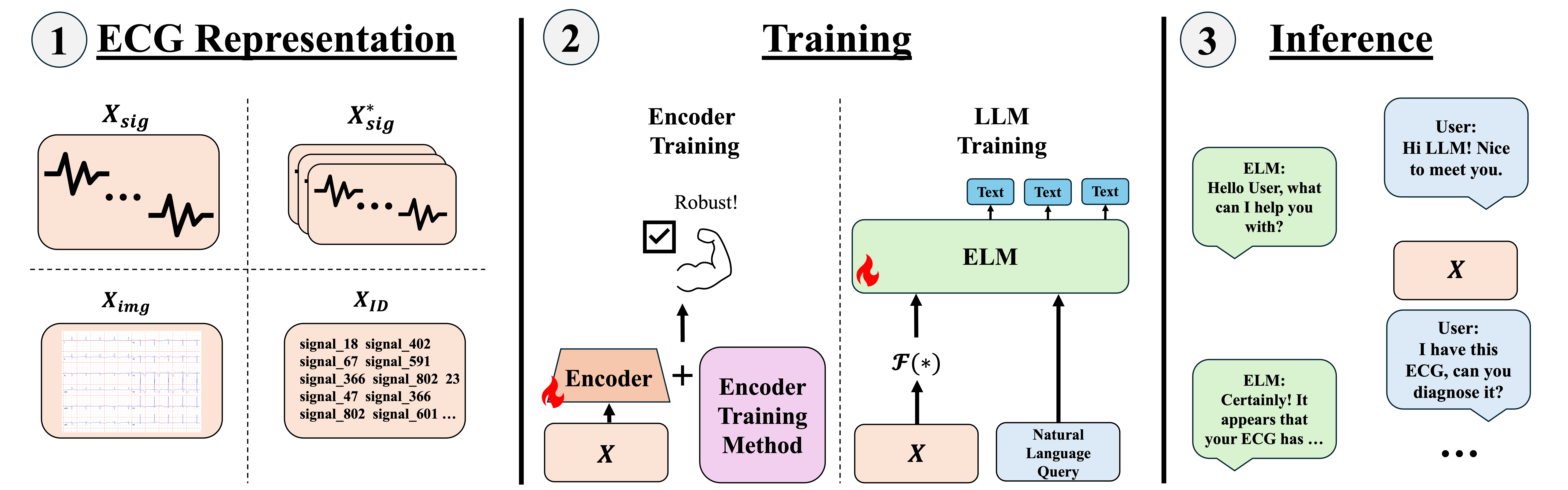
This current repository considers 4 input representations of ECGs as defined below:
ECG Signal (--ecg_signal):
The raw ECG signal is represented as a matrix X_sig $\in$ R^(C x L), where C denotes the number of leads and L is the number of time samples per lead. All other modalities are derived from X_sig.
ECG Image (--ecg_image):
An ECG image is derived from X_sig via plotting and is represented as a tensor X_img $\in$ R^(H x W x C′), where H and W denote the image height and width, respectively, and C′ is the number of color channels.
Stacked ECG Signal (--ecg_stacked_signal):
We also create a synthetic three-channel version of X_sig, denoted X_sig* $\in$ R^(C x L x 3), by stacking X_sig three times along the color dimension (as seen in ECG Image).
ECG Symbol (--ecg_token):
We use ECG-Byte’s compression schema to convert ECG signals into text. First, a normalized and discretized ECG signal X_sig is mapped to a symbolic sequence using a set of symbols A = {a, b, …, z}. This sequence is then flattened into a one-dimensional array X_symb $\in$ A^(C * L). Finally, a byte-pair encoding (BPE) process compresses X_symb into a sequence of tokens from an extended vocabulary V, resulting in the final textual representation X_ID $\in$ V^(m), where m is the length of the token sequence.
ELMs and Their Components
We implement the following ELMs:
- ECG-Byte: A Tokenizer for End-to-End Electrocardiogram Language Modeling
- LLaVA-like ELMs (e.g., neural network encoder + projection layer+ LLM)
- Encoder-free ELMs (e.g., projection layer + LLM)
We also provide implementations of the following ECG-specific encoders:
- Guiding Masked Representation Learning to Capture Spatio-Temporal Relationship of Electrocardiogram
- Zero-Shot ECG Classification with Multimodal Learning and Test-time Clinical Knowledge Enhancement
- MaeFE: Masked Autoencoders Family of Electrocardiogram for Self-Supervised Pretraining and Transfer Learning
Utilizing HuggingFace, we also provide general, pretrained models to serve as ECG encoders:
We utilize the HuggingFace API to create wrappers around the following pretrained LLMs:
We also have GPT 2 and OPT LLMs, however, we do not have chat tempaltes for them yet.
Installation
All installations and experiments were completed on Ubuntu 20.04.5 LTS with NVIDIA A5000 and A6000 GPUs.
-
To install Rust:
curl --proto '=https' --tlsv1.2 -sSf https://sh.rustup.rs | sh -s -- --default-toolchain=1.82.0 -y -
Open a new terminal to set PATH for Rust installation.
-
After opening a new terminal, check the Rust installation by running
rustc --version. -
Create the conda virtual environment via
conda create -n ecg python=3.10. -
Activate the environment
conda activate ecg -
Install the
uvpackage manager viapip install uv. -
git clone https://github.com/willxxy/ECG-Bench.git -
cd ECG-Bench -
For base installation
uv pip install -e . -
For installation with flash attention
uv pip install -e ".[flash]" --no-build-isolation -
For installation with judge
uv pip install -e ".[judge]" -
For installation of all packages
uv pip install -e ".[all]" --no-build-isolation -
Optionally, run
pre-commit installto install the pre-commit hooks. -
cdintoECG-Bench/ecg_bench/ecg_tokenizers/ecg_byteand executematurin develop --releaseto compile the ECG-Byte tokenizer. -
Run all the tests by executing
bash scripts/run_tests.sh. -
Another consideration is that we use gated models (e.g., Llama 3.2, Gemma) from HuggingFace, therefore you will need to get an api key and export the environment variable
export HF_TOKEN=$API_KEY.
NOTE: The working directory is the root (ECG-Bench) directory of the repository.
ECG Datasets
We also provide preprocessing pipelines for various datasets in this repository.
Note that one can skip the entire preprocessing section by downloading our preprocessed ECG files and skip to the main methods section.
We provide preprocessed ECGs at 2, 5, and 10 second recordings sampled at 250 Hz.
The structure in which the data folder should be in is the following:
ECG-Bench
└── ecg_bench
    └── data
        ├── csn
        │   ├── preprocessed_1250_250
        │   ├── preprocessed_500_250
        │   └── preprocessed_2500_250
        ├── cpsc
        │   └── ...
        ├── ptb
        │   └── ...
        ├── mimic
        │   └── ...
        └── code15
            └── ...
where ... denotes the same preprocessed_1250_250, preprocessed_500_250, preprocessed_2500_250 folders.
The .zip file should unzip the data name folder and the corresponding preprocessed folders already.
Datasets:
- PTB-XL, a large publicly available electrocardiography dataset
- MIMIC-IV-ECG: Diagnostic Electrocardiogram Matched Subset
- CODE-15%: a large scale annotated dataset of 12-lead ECGs
- CPSC from Classification of 12-lead ECGs: The PhysioNet/Computing in Cardiology Challenge 2020
- CSN from A large scale 12-lead electrocardiogram database for arrhythmia study
- MIMIC-IV and PTB-XL variants of ECG-QA: A Comprehensive Question Answering Dataset Combined With Electrocardiogram
- Pretrain MIMIC-IV and ECG Instruct 45K from ECG-Chat: A Large ECG-Language Model for Cardiac Disease Diagnosis
- ECG Instruct Pulse and ECG Bench Pulse from Teach Multimodal LLMs to Comprehend Electrocardiographic Images
- ECG Grounding Datasets from GEM: Empowering MLLM for Grounded ECG Understanding with Time Series and Images
Hugging Face Dataset 5-Fold Stratified Splits
On Hugging Face, we provide 5-fold datasets stratified by patient, with zero patient overlap between training and testing splits. We have released the following so far:
250 Hz Sampling Rate
| Dataset | 2s | 5s | 10s |
|---|---|---|---|
| ECG-QA PTB-XL | URL | URL | URL |
| ECG-QA MIMIC-IV-ECG | URL | URL | URL |
| Pretrain MIMIC | URL | URL | URL |
| ECG Instruct 45K | URL | URL | URL |
| ECG Bench Pulse | URL | URL | URL |
| ECG Instruct Pulse | URL | URL | URL |
We encourage researchers to use these splits to ensure fair baselines. Note that you will still have to download and preprocess the datasets, thus we recommend using the preprocessing pipeline below.
Base Datasets
We regard base datasets as datasets that are solely used for later mapping of external datasets.
PTB-XL
-
Please download the PTB-XL dataset through this link.
-
Please create a
datafolder, unzip the zip file inside thedatafolder and rename the folder asptb.
MIMIC
-
Please download the Mimic IV ECG dataset through this link.
-
Unzip the zip file inside the
datadirectory and rename the unzipped directory asmimic.
Code-15
-
First create a
code15folder inside thedatadirectory. -
Then inside
data/code15execute the following bash script to download the data and unzip it:
#!/bin/bash

for i in {0..17}; do
    echo "Downloading part ${i}..."
    wget -O "exams_part${i}.zip" "https://zenodo.org/records/4916206/files/exams_part${i}.zip?download=1"

    if [ $? -eq 0 ]; then
        echo "Successfully downloaded part ${i}"

        echo "Extracting part ${i}..."
        unzip -q "exams_part${i}.zip"

        if [ $? -eq 0 ]; then
            echo "Successfully extracted part ${i}"
            rm "exams_part${i}.zip"
        else
            echo "Error extracting part ${i}"
        fi
    else
        echo "Error downloading part ${i}"
    fi
done

echo "All downloads and extractions completed"
CSN
-
Create a
csnfolder inside thedatadirectory. -
Inside
data/csnexecute the following command in the terminal:
wget https://physionet.org/static/published-projects/ecg-arrhythmia/a-large-scale-12-lead-electrocardiogram-database-for-arrhythmia-study-1.0.0.zip
- Unzip the file and inside of
data/csn/a-large-scale-12-lead-electrocardiogram-database-for-arrhythmia-study-1.0.0move all of the contents outside todata/csn. Then you may delete thea-large-scale-12-lead-electrocardiogram-database-for-arrhythmia-study-1.0.0folder.
CPSC
-
Create a
cpscfolder inside thedatadirectory. -
Inside
data/cpscexecute the following command in the terminal:
wget https://physionet.org/static/published-projects/challenge-2020/classification-of-12-lead-ecgs-the-physionetcomputing-in-cardiology-challenge-2020-1.0.2.zip
- Unzip the file and inside of
data/cpsc/classification-of-12-lead-ecgs-the-physionetcomputing-in-cardiology-challenge-2020-1.0.2/trainingmove thecpsc_2018andcpsc_2018_extrafolders into thedata/cpscdirectory. Then delete theclassification-of-12-lead-ecgs-the-physionetcomputing-in-cardiology-challenge-2020-1.0.2folder.
Preprocessing
- Execute the preprocessing script by
bash scripts/preprocess.sh. We have provided default configurations for all the datasets used in our study but feel free to experiment with others!
Main Methods
We simplify the categorization of ELMs not by their training procedure but their architecture.
Simply run with the corresponding flags for the desired ELM (e.g., --encoder=$ENCODER, --llm=$LLM) and ECG representation (e.g., --ecg_signal, --ecg_image, --ecg_stacked_signal, --ecg_token).
Note that specific ELMs may require specific ECG representations as seen in the assert_data_model_match() function in ecg_bench/dataloaders/build_dataloader.py.
We provide examples in the scripts directory.
Known Issues + Tips
We encountered some issues during development of ECG-Bench (mostly taken from ECG-Byte) and hope to contribute to the open source community by reporting them here and adding any tips if possible. If you happen to know a good solution to any of them, please do not hesitate to open an issue or pull request!
-
tqdmbar freezing script with multiprocessing - We noticed that the tqdm bar freezes sometimes when we put it inside a multiprocessing job (especially during preprocessing). We recommend adding print statements before and after the main operations inside the tqdm loop to ensure the operations are being executed. This is a thread of the issue from the tqdm repository. Please feel free to look at it! -
Nan values during preprocessing - We noticed that the MIMIC-IV ECG dataset has many nan values during preprocessing so we workaround this by skipping them.
-
Non-determinimsm via CuDNN/cuBLAS despite seeding - During evaluation, we observed run-to-run variation due to CuDNN/cuBLAS nondeterminism. Certain GPU kernels have nondeterministic implementations unless explicitly told otherwise. To reduce this variability, add the deterministic flags below before any model creation:
torch.backends.cudnn.deterministic = True
torch.backends.cudnn.benchmark = False
torch.use_deterministic_algorithms(True)
And in the bash launch script, set the cuBLAS workspace variable export CUBLAS_WORKSPACE_CONFIG=":4096:8".
Note that these settings can slow training/inference and may fall back to less-efficient kernels.
-
Non-determinism via GPUs - Read this.
-
ECG-Byte Signal Tokens: Do we train them? - Marking the newly added ECG tokens in the LLM embedding table as trainable has harmed performance in our tests. Currently, ECG-Byte produces ECG tokens that we concatenate with text tokens; these tokens are added to the tokenizer and initialized in the LLM’s embedding table. In our default setup we apply LoRA and keep the embedding table frozen, so these new token vectors are not updated. We ran preliminary experiments in two settings: 1. full fine-tuning (including the LLM embedding layer with the added ECG tokens), 2. LoRA fine-tuning with only the newly added ECG token rows set as trainable. Both settings performed substantially worse than our baseline (LoRA with the LLM embedding table frozen, including the new ECG tokens). We did not deeply investigate the cause; exploring this is an interesting direction for future work.
Contributions
We welcome contributions to the repository! Please feel free to open an issue or pull request for any bugs or features you would like to add. We are always looking for new ECG datasets to benchmark our methods on. If you have any recommendations, please let us know! Also, a good place to start is by looking at the TODO section.
For most processes, we have a --dev flag to run in a smaller scale and add some verbosity for debugging. Feel free to add this flag when needed!
Contributors
We thank the following people for their contributions to the repository:
TODO
This is a list of TODOs for the repository. If you are interested in contributing, please feel free to look at the list and open a PR! We are always looking for ways to add more documentation, examples, tests, and workflows for the codebase. Lastly, general improvements to the codebase are always welcome!
- Add default chat templates for LLMs without chat templates (e.g., GPT 2, OPT).
- Add GEM model
- Add ECG-Expert-QA dataset
- Add ECG-Grounding Dataset
- Provide HuggingFace model card push ability.
- Provide HuggingFace dataset card push ability.
- Create an offline demo for ELMs with unified preference collection.
- Retrieval-Augmented Generation
- Make RAG searching faster.
- Make training with RAG faster.
- Add encoder-free VLMs such as Fuyu-8B, Vision as LoRA, and/or Unveiling Encoder-Free Vision-Language Models for ECGs. This could be extended for all training methods.
- Naive encoder-free method supported.
- Add Sparsely-Gated Mixture-of-Experts ELM
- Addition for new input representation: ECG features
- Reasoning ability for ELMs (akin to OpenAI o1, Deepseek R1, etc.).
- Curate higher quality instruction tuning and reasoning datasets for ELMs.
- Expand upon current naive distributed training setting to include more efficient and explicit distributed training strategies (i.e., data, tensor, context, pipeline, and expert parallelism as noted in here).
- Add option for data mixing.
- For preprocessing, stratify based on patient, such that no overlapping patients between train and test.
- Add official splits for benchmarking.
- Upload to huggingface datasets and use huggingface datasets data loading in main.
Acknowledgements
This work is done in collaboration with the Mario Lemieux Center for Heart Rhythm Care at Allegheny General Hospital.
We thank Chaojing Duan, Michael A. Rosenberg, Emerson Liu, Ding Zhao, Hyoeun Kang, Wenhao Ding, Haohong Lin, Shiqi Liu, Xiaoyu (Simon) Song, Tony Chen, Atharva Mhaskar, Zhepeng Cen, Yihang Yao, and Dylan Leong for their helpful discussions, feedbacks, and support in developing ECG-Bench.
We thank the authors of ECG-Byte, MERL, ST-MEM, ECG-QA, ECG-Chat, PULSE, and GEM for their code and publicly released datasets.
Lastly, we thank HuggingFace for providing the APIs for the models.
License
This repository contains code licensed under the MIT License, except for the following .py files in the ecg_bench/models/encoder directory: st_mem.py, mlae.py, mtae.py. These files are licensed under the Creative Commons Attribution-NonCommercial 4.0 International License. Please view the original license in their respective repository for more details.
Citations
If this codebase or work has helped you please cite the following:
@misc{han2025signalimagesymbolicexploring,
      title={Signal, Image, or Symbolic: Exploring the Best Input Representation for Electrocardiogram-Language Models Through a Unified Framework},
      author={William Han and Chaojing Duan and Zhepeng Cen and Yihang Yao and Xiaoyu Song and Atharva Mhaskar and Dylan Leong and Michael A. Rosenberg and Emerson Liu and Ding Zhao},
      year={2025},
      eprint={2505.18847},
      archivePrefix={arXiv},
      primaryClass={cs.AI},
      url={https://arxiv.org/abs/2505.18847},
}

@misc{han2024ecgbytetokenizerendtoendgenerative,
      title={ECG-Byte: A Tokenizer for End-to-End Generative Electrocardiogram Language Modeling},
      author={William Han and Chaojing Duan and Michael A. Rosenberg and Emerson Liu and Ding Zhao},
      year={2024},
      eprint={2412.14373},
      archivePrefix={arXiv},
      primaryClass={cs.CL},
      url={https://arxiv.org/abs/2412.14373},
}

@software{willxxy_2025_15299518,
  author       = {willxxy},
  title        = {willxxy/ECG-Bench: 0.0.2},
  month        = apr,
  year         = 2025,
  publisher    = {Zenodo},
  version      = {0.0.2},
  doi          = {10.5281/zenodo.15299518},
  url          = {https://doi.org/10.5281/zenodo.15299518},
  swhid        = {swh:1:dir:f7d66c050e58e1cee773d062aaac90d59001933c
                   ;origin=https://doi.org/10.5281/zenodo.15299517;vi
                   sit=swh:1:snp:b747c15550c41fac7ecb66f5802fc239911b
                   d2c9;anchor=swh:1:rel:3c046172cae8f0fc9e2cff952897
                   97d670c749f8;path=willxxy-ECG-Bench-898547b
                  },
}


Similar repos



Languages
Python
95.3%
Shell
3.1%
Rust
1.6%
A Unified Framework for Benchmarking Generative Electrocardiogram-Language Models (ELMs)
Python
50
533 commits
updated Feb 23, 2026
README
A Unified Framework for Benchmarking Generative Electrocardiogram-Language Models (ELMs)
News
- [February 23, 2026] We have migrated and refactored the repository permanently to https://github.com/ELM-Research/ELM. https://github.com/willxxy/ECG-Bench will be archived.
- [February 19, 2026] We will change this repository to be exclusively for training ELMs and remove ECG encoder pretraining. We have created a separate repository for ECG encoder pretraining. Feel free to check it out!
- [February 17, 2026] We are currently going under another refactor for easier use of the repository. We thank you for your patience and will update once its done!
- [November 13, 2025] We have created a new baselines using variants of the GPT model through the OpenAI API on our splits of the ECG-QA PTB-XL and MIMIC-IV-ECG dataset in
tests/test_openai.py. Feel free to run the baseline by executingpython -m tests.test_openaifrom the root dir ofECG-Bench! - [November 7, 2025] We have created a new baseline using the OpenTSLM model on our splits of the ECG-QA PTB-XL and MIMIC-IV-ECG dataset in
tests/test_opentslm.py. First git clone the OpenTSLM repo inside of thetests/folder and runpython -m tests.test_opentslmfrom the root dir ofECG-Bench! - [November 7, 2025] We have developed a naive analysis of the Platonic Representation Hypothesis for ELMs. Please see
scripts/run_plat_rep.shfor running the analysis. - [November 7, 2025] We have implemented Signal2Vec, to create embeddings for ECG-Byte, and implemented the corresponding ELM architecture utilizing the learned embeddings! Check out the
scripts/train_signal2vec.shscript for training the Signal2Vec embeddings for your ECG-Byte tokenizer. To train an ELM with Signal2Vec, specify the--encoder=signal2vecand--signal2vec_embeddings=$PATH_TO_PT_FILE. - [October 18, 2025] We have released preprocessed ECG files, such that you do not have to do the preprocessing yourself.
Show Older News
- [October 16, 2025] We have finished the refactor, for new and old users, please refer to the documentation below and the brief release notes.
- [October 3, 2025] We are currently going under a big refactor for easier use of the repository. We thank you for your patience and will update once its done!
- [October 3, 2025] We have released our paper Retrieval-Augmented Generation for Electrocardiogram-Language Models. There is currently a pull request for the updated integration of RAG utilized with ELMs in the paper. Feel free to check it out.
- [August 5, 2025] We released official splits of ELM datasets on Hugging Face. Feel free to check them out here!
- [May 24, 2025] We release our paper "Signal, Image, or Symbolic: Exploring the Best Input Representation for Electrocardiogram-Language Models Through a Unified Framework" with some interesting results when comparing input representations and training paradigms for ELMs! Check it out.
- [April 5, 2025] We open source ECG-Bench for training and evaluating ELMs!
Table of Contents
- Overview
- Installation
- ECG Datasets
- Main Methods
- Known Issues + Tips
- Contributions
- TODO
- Acknowledgements
- License
- Citations
Overview
This repository provides a unified framework for training and evaluating electrocardiogram–language models (ELMs). It is intended for researchers developing ELMs, with an emphasis on ECG representations and training paradigms. We aim to have the codebase be modular and extensible, enabling rapid experimentation and easy integration of new ideas. While the framework is still quite beta, we are actively improving its design and stability. Please note that performance may vary as the codebase continues to change.
We hope to continuously update the repository to support more features, ELMs, and datasets. Please feel free to contribute to the repository! If there are any questions or bugs, please do not hesitate to reach out to wjhan{@}andrew{dot}cmu{edu} or submit an issue with corresponding details.
ECG Input Representations
This current repository considers 4 input representations of ECGs as defined below:
ECG Signal (--ecg_signal):
The raw ECG signal is represented as a matrix X_sig $\in$ R^(C x L), where C denotes the number of leads and L is the number of time samples per lead. All other modalities are derived from X_sig.
ECG Image (--ecg_image):
An ECG image is derived from X_sig via plotting and is represented as a tensor X_img $\in$ R^(H x W x C′), where H and W denote the image height and width, respectively, and C′ is the number of color channels.
Stacked ECG Signal (--ecg_stacked_signal):
We also create a synthetic three-channel version of X_sig, denoted X_sig* $\in$ R^(C x L x 3), by stacking X_sig three times along the color dimension (as seen in ECG Image).
ECG Symbol (--ecg_token):
We use ECG-Byte’s compression schema to convert ECG signals into text. First, a normalized and discretized ECG signal X_sig is mapped to a symbolic sequence using a set of symbols A = {a, b, …, z}. This sequence is then flattened into a one-dimensional array X_symb $\in$ A^(C * L). Finally, a byte-pair encoding (BPE) process compresses X_symb into a sequence of tokens from an extended vocabulary V, resulting in the final textual representation X_ID $\in$ V^(m), where m is the length of the token sequence.
ELMs and Their Components
We implement the following ELMs:
- ECG-Byte: A Tokenizer for End-to-End Electrocardiogram Language Modeling
- LLaVA-like ELMs (e.g., neural network encoder + projection layer+ LLM)
- Encoder-free ELMs (e.g., projection layer + LLM)
We also provide implementations of the following ECG-specific encoders:
- Guiding Masked Representation Learning to Capture Spatio-Temporal Relationship of Electrocardiogram
- Zero-Shot ECG Classification with Multimodal Learning and Test-time Clinical Knowledge Enhancement
- MaeFE: Masked Autoencoders Family of Electrocardiogram for Self-Supervised Pretraining and Transfer Learning
Utilizing HuggingFace, we also provide general, pretrained models to serve as ECG encoders:
We utilize the HuggingFace API to create wrappers around the following pretrained LLMs:
We also have GPT 2 and OPT LLMs, however, we do not have chat tempaltes for them yet.
Installation
All installations and experiments were completed on Ubuntu 20.04.5 LTS with NVIDIA A5000 and A6000 GPUs.
-
To install Rust:
curl --proto '=https' --tlsv1.2 -sSf https://sh.rustup.rs | sh -s -- --default-toolchain=1.82.0 -y -
Open a new terminal to set PATH for Rust installation.
-
After opening a new terminal, check the Rust installation by running
rustc --version. -
Create the conda virtual environment via
conda create -n ecg python=3.10. -
Activate the environment
conda activate ecg -
Install the
uvpackage manager viapip install uv. -
git clone https://github.com/willxxy/ECG-Bench.git -
cd ECG-Bench -
For base installation
uv pip install -e . -
For installation with flash attention
uv pip install -e ".[flash]" --no-build-isolation -
For installation with judge
uv pip install -e ".[judge]" -
For installation of all packages
uv pip install -e ".[all]" --no-build-isolation -
Optionally, run
pre-commit installto install the pre-commit hooks. -
cdintoECG-Bench/ecg_bench/ecg_tokenizers/ecg_byteand executematurin develop --releaseto compile the ECG-Byte tokenizer. -
Run all the tests by executing
bash scripts/run_tests.sh. -
Another consideration is that we use gated models (e.g., Llama 3.2, Gemma) from HuggingFace, therefore you will need to get an api key and export the environment variable
export HF_TOKEN=$API_KEY.
NOTE: The working directory is the root (ECG-Bench) directory of the repository.
ECG Datasets
We also provide preprocessing pipelines for various datasets in this repository.
Note that one can skip the entire preprocessing section by downloading our preprocessed ECG files and skip to the main methods section.
We provide preprocessed ECGs at 2, 5, and 10 second recordings sampled at 250 Hz.
The structure in which the data folder should be in is the following:
ECG-Bench
└── ecg_bench
    └── data
        ├── csn
        │   ├── preprocessed_1250_250
        │   ├── preprocessed_500_250
        │   └── preprocessed_2500_250
        ├── cpsc
        │   └── ...
        ├── ptb
        │   └── ...
        ├── mimic
        │   └── ...
        └── code15
            └── ...
where ... denotes the same preprocessed_1250_250, preprocessed_500_250, preprocessed_2500_250 folders.
The .zip file should unzip the data name folder and the corresponding preprocessed folders already.
Datasets:
- PTB-XL, a large publicly available electrocardiography dataset
- MIMIC-IV-ECG: Diagnostic Electrocardiogram Matched Subset
- CODE-15%: a large scale annotated dataset of 12-lead ECGs
- CPSC from Classification of 12-lead ECGs: The PhysioNet/Computing in Cardiology Challenge 2020
- CSN from A large scale 12-lead electrocardiogram database for arrhythmia study
- MIMIC-IV and PTB-XL variants of ECG-QA: A Comprehensive Question Answering Dataset Combined With Electrocardiogram
- Pretrain MIMIC-IV and ECG Instruct 45K from ECG-Chat: A Large ECG-Language Model for Cardiac Disease Diagnosis
- ECG Instruct Pulse and ECG Bench Pulse from Teach Multimodal LLMs to Comprehend Electrocardiographic Images
- ECG Grounding Datasets from GEM: Empowering MLLM for Grounded ECG Understanding with Time Series and Images
Hugging Face Dataset 5-Fold Stratified Splits
On Hugging Face, we provide 5-fold datasets stratified by patient, with zero patient overlap between training and testing splits. We have released the following so far:
250 Hz Sampling Rate
| Dataset | 2s | 5s | 10s |
|---|---|---|---|
| ECG-QA PTB-XL | URL | URL | URL |
| ECG-QA MIMIC-IV-ECG | URL | URL | URL |
| Pretrain MIMIC | URL | URL | URL |
| ECG Instruct 45K | URL | URL | URL |
| ECG Bench Pulse | URL | URL | URL |
| ECG Instruct Pulse | URL | URL | URL |
We encourage researchers to use these splits to ensure fair baselines. Note that you will still have to download and preprocess the datasets, thus we recommend using the preprocessing pipeline below.
Base Datasets
We regard base datasets as datasets that are solely used for later mapping of external datasets.
PTB-XL
-
Please download the PTB-XL dataset through this link.
-
Please create a
datafolder, unzip the zip file inside thedatafolder and rename the folder asptb.
MIMIC
-
Please download the Mimic IV ECG dataset through this link.
-
Unzip the zip file inside the
datadirectory and rename the unzipped directory asmimic.
Code-15
-
First create a
code15folder inside thedatadirectory. -
Then inside
data/code15execute the following bash script to download the data and unzip it:
#!/bin/bash

for i in {0..17}; do
    echo "Downloading part ${i}..."
    wget -O "exams_part${i}.zip" "https://zenodo.org/records/4916206/files/exams_part${i}.zip?download=1"

    if [ $? -eq 0 ]; then
        echo "Successfully downloaded part ${i}"

        echo "Extracting part ${i}..."
        unzip -q "exams_part${i}.zip"

        if [ $? -eq 0 ]; then
            echo "Successfully extracted part ${i}"
            rm "exams_part${i}.zip"
        else
            echo "Error extracting part ${i}"
        fi
    else
        echo "Error downloading part ${i}"
    fi
done

echo "All downloads and extractions completed"
CSN
-
Create a
csnfolder inside thedatadirectory. -
Inside
data/csnexecute the following command in the terminal:
wget https://physionet.org/static/published-projects/ecg-arrhythmia/a-large-scale-12-lead-electrocardiogram-database-for-arrhythmia-study-1.0.0.zip
- Unzip the file and inside of
data/csn/a-large-scale-12-lead-electrocardiogram-database-for-arrhythmia-study-1.0.0move all of the contents outside todata/csn. Then you may delete thea-large-scale-12-lead-electrocardiogram-database-for-arrhythmia-study-1.0.0folder.
CPSC
-
Create a
cpscfolder inside thedatadirectory. -
Inside
data/cpscexecute the following command in the terminal:
wget https://physionet.org/static/published-projects/challenge-2020/classification-of-12-lead-ecgs-the-physionetcomputing-in-cardiology-challenge-2020-1.0.2.zip
- Unzip the file and inside of
data/cpsc/classification-of-12-lead-ecgs-the-physionetcomputing-in-cardiology-challenge-2020-1.0.2/trainingmove thecpsc_2018andcpsc_2018_extrafolders into thedata/cpscdirectory. Then delete theclassification-of-12-lead-ecgs-the-physionetcomputing-in-cardiology-challenge-2020-1.0.2folder.
Preprocessing
- Execute the preprocessing script by
bash scripts/preprocess.sh. We have provided default configurations for all the datasets used in our study but feel free to experiment with others!
Main Methods
We simplify the categorization of ELMs not by their training procedure but their architecture.
Simply run with the corresponding flags for the desired ELM (e.g., --encoder=$ENCODER, --llm=$LLM) and ECG representation (e.g., --ecg_signal, --ecg_image, --ecg_stacked_signal, --ecg_token).
Note that specific ELMs may require specific ECG representations as seen in the assert_data_model_match() function in ecg_bench/dataloaders/build_dataloader.py.
We provide examples in the scripts directory.
Known Issues + Tips
We encountered some issues during development of ECG-Bench (mostly taken from ECG-Byte) and hope to contribute to the open source community by reporting them here and adding any tips if possible. If you happen to know a good solution to any of them, please do not hesitate to open an issue or pull request!
-
tqdmbar freezing script with multiprocessing - We noticed that the tqdm bar freezes sometimes when we put it inside a multiprocessing job (especially during preprocessing). We recommend adding print statements before and after the main operations inside the tqdm loop to ensure the operations are being executed. This is a thread of the issue from the tqdm repository. Please feel free to look at it! -
Nan values during preprocessing - We noticed that the MIMIC-IV ECG dataset has many nan values during preprocessing so we workaround this by skipping them.
-
Non-determinimsm via CuDNN/cuBLAS despite seeding - During evaluation, we observed run-to-run variation due to CuDNN/cuBLAS nondeterminism. Certain GPU kernels have nondeterministic implementations unless explicitly told otherwise. To reduce this variability, add the deterministic flags below before any model creation:
torch.backends.cudnn.deterministic = True
torch.backends.cudnn.benchmark = False
torch.use_deterministic_algorithms(True)
And in the bash launch script, set the cuBLAS workspace variable export CUBLAS_WORKSPACE_CONFIG=":4096:8".
Note that these settings can slow training/inference and may fall back to less-efficient kernels.
-
Non-determinism via GPUs - Read this.
-
ECG-Byte Signal Tokens: Do we train them? - Marking the newly added ECG tokens in the LLM embedding table as trainable has harmed performance in our tests. Currently, ECG-Byte produces ECG tokens that we concatenate with text tokens; these tokens are added to the tokenizer and initialized in the LLM’s embedding table. In our default setup we apply LoRA and keep the embedding table frozen, so these new token vectors are not updated. We ran preliminary experiments in two settings: 1. full fine-tuning (including the LLM embedding layer with the added ECG tokens), 2. LoRA fine-tuning with only the newly added ECG token rows set as trainable. Both settings performed substantially worse than our baseline (LoRA with the LLM embedding table frozen, including the new ECG tokens). We did not deeply investigate the cause; exploring this is an interesting direction for future work.
Contributions
We welcome contributions to the repository! Please feel free to open an issue or pull request for any bugs or features you would like to add. We are always looking for new ECG datasets to benchmark our methods on. If you have any recommendations, please let us know! Also, a good place to start is by looking at the TODO section.
For most processes, we have a --dev flag to run in a smaller scale and add some verbosity for debugging. Feel free to add this flag when needed!
Contributors
We thank the following people for their contributions to the repository:
TODO
This is a list of TODOs for the repository. If you are interested in contributing, please feel free to look at the list and open a PR! We are always looking for ways to add more documentation, examples, tests, and workflows for the codebase. Lastly, general improvements to the codebase are always welcome!
- Add default chat templates for LLMs without chat templates (e.g., GPT 2, OPT).
- Add GEM model
- Add ECG-Expert-QA dataset
- Add ECG-Grounding Dataset
- Provide HuggingFace model card push ability.
- Provide HuggingFace dataset card push ability.
- Create an offline demo for ELMs with unified preference collection.
- Retrieval-Augmented Generation
- Make RAG searching faster.
- Make training with RAG faster.
- Add encoder-free VLMs such as Fuyu-8B, Vision as LoRA, and/or Unveiling Encoder-Free Vision-Language Models for ECGs. This could be extended for all training methods.
- Naive encoder-free method supported.
- Add Sparsely-Gated Mixture-of-Experts ELM
- Addition for new input representation: ECG features
- Reasoning ability for ELMs (akin to OpenAI o1, Deepseek R1, etc.).
- Curate higher quality instruction tuning and reasoning datasets for ELMs.
- Expand upon current naive distributed training setting to include more efficient and explicit distributed training strategies (i.e., data, tensor, context, pipeline, and expert parallelism as noted in here).
- Add option for data mixing.
- For preprocessing, stratify based on patient, such that no overlapping patients between train and test.
- Add official splits for benchmarking.
- Upload to huggingface datasets and use huggingface datasets data loading in main.
Acknowledgements
This work is done in collaboration with the Mario Lemieux Center for Heart Rhythm Care at Allegheny General Hospital.
We thank Chaojing Duan, Michael A. Rosenberg, Emerson Liu, Ding Zhao, Hyoeun Kang, Wenhao Ding, Haohong Lin, Shiqi Liu, Xiaoyu (Simon) Song, Tony Chen, Atharva Mhaskar, Zhepeng Cen, Yihang Yao, and Dylan Leong for their helpful discussions, feedbacks, and support in developing ECG-Bench.
We thank the authors of ECG-Byte, MERL, ST-MEM, ECG-QA, ECG-Chat, PULSE, and GEM for their code and publicly released datasets.
Lastly, we thank HuggingFace for providing the APIs for the models.
License
This repository contains code licensed under the MIT License, except for the following .py files in the ecg_bench/models/encoder directory: st_mem.py, mlae.py, mtae.py. These files are licensed under the Creative Commons Attribution-NonCommercial 4.0 International License. Please view the original license in their respective repository for more details.
Citations
If this codebase or work has helped you please cite the following:
@misc{han2025signalimagesymbolicexploring,
      title={Signal, Image, or Symbolic: Exploring the Best Input Representation for Electrocardiogram-Language Models Through a Unified Framework},
      author={William Han and Chaojing Duan and Zhepeng Cen and Yihang Yao and Xiaoyu Song and Atharva Mhaskar and Dylan Leong and Michael A. Rosenberg and Emerson Liu and Ding Zhao},
      year={2025},
      eprint={2505.18847},
      archivePrefix={arXiv},
      primaryClass={cs.AI},
      url={https://arxiv.org/abs/2505.18847},
}

@misc{han2024ecgbytetokenizerendtoendgenerative,
      title={ECG-Byte: A Tokenizer for End-to-End Generative Electrocardiogram Language Modeling},
      author={William Han and Chaojing Duan and Michael A. Rosenberg and Emerson Liu and Ding Zhao},
      year={2024},
      eprint={2412.14373},
      archivePrefix={arXiv},
      primaryClass={cs.CL},
      url={https://arxiv.org/abs/2412.14373},
}

@software{willxxy_2025_15299518,
  author       = {willxxy},
  title        = {willxxy/ECG-Bench: 0.0.2},
  month        = apr,
  year         = 2025,
  publisher    = {Zenodo},
  version      = {0.0.2},
  doi          = {10.5281/zenodo.15299518},
  url          = {https://doi.org/10.5281/zenodo.15299518},
  swhid        = {swh:1:dir:f7d66c050e58e1cee773d062aaac90d59001933c
                   ;origin=https://doi.org/10.5281/zenodo.15299517;vi
                   sit=swh:1:snp:b747c15550c41fac7ecb66f5802fc239911b
                   d2c9;anchor=swh:1:rel:3c046172cae8f0fc9e2cff952897
                   97d670c749f8;path=willxxy-ECG-Bench-898547b
                  },
}
Similar repos
Languages
Python
95.3%
Shell
3.1%
Rust
1.6%