Claude Code guide in three levels, with hands-on lessons, checked exercises and cited facts. Independent community guide.
JavaScript
3,329
139 commits
updated Oct 11, 2026

Learn Claude Code in three levels, from your first session to unattended multi-agent runs.
You learn by doing: every core lesson and capstone ends with a check you run in your own practice copy, and every Beginner lesson and the capstone run step by step in a terminal app beside Claude Code.
Try it now · Pick your level · Every page




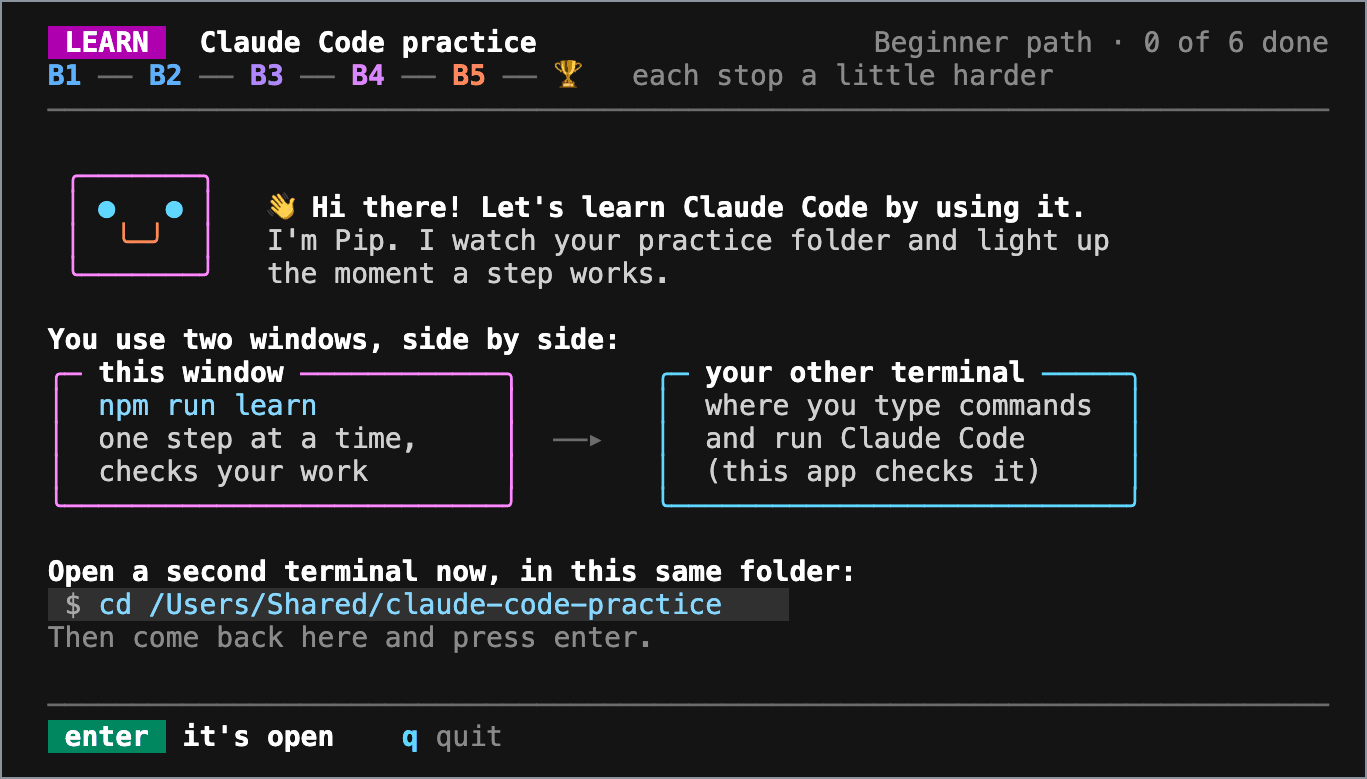
The learning app, npm run learn, on its first run.
You need a paid Claude plan (Pro, Max, Team or Enterprise), a Claude Console account, or a supported cloud provider (Quickstart), plus Node.js LTS and git.
Make your practice copy: open claude-code-practice, select Use this template > Create a new repository, and clone your copy. Or open your copy in a Codespace, where Node.js and Claude Code come preinstalled.
In your copy, start the app:
npm run learn
Open a second terminal in the same folder. The app tells you what to type there, starting with installing Claude Code, and checks your work as you go.
The app teaches every Beginner lesson and the capstone. It has no AI in it and changes none of your work.
For Intermediate and Advanced, or if you prefer to read, every lesson works from its page alone. Each core lesson ends with a check you run from your practice copy, for example npm run check -- b-1: each item prints PASS or FAIL, with a hint for what to fix.
The help shrinks as you get better: GUIDED shows every command, HINTED gives the goal and a hint each time you press h, and CHALLENGE gives just the goal.
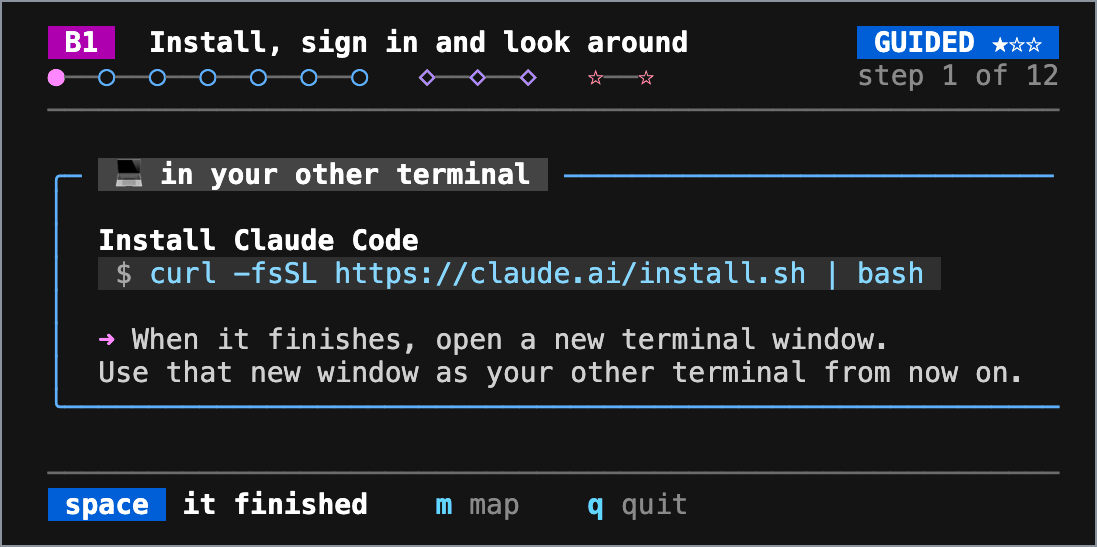 | 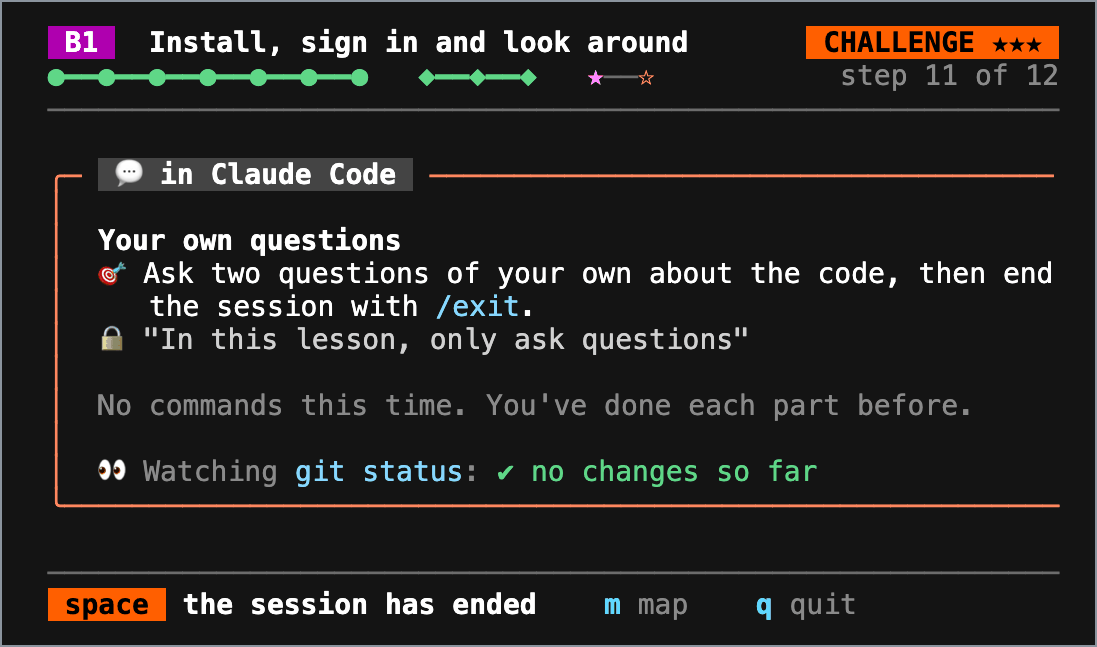 |
| Step 1 of 12, GUIDED: the exact command, and the window to type it in. | Step 11 of 12, CHALLENGE: the goal alone, while the app watches your copy. |
Beginner lesson 1, steps 1 and 11.
For you if you're new to Claude Code and comfortable with a terminal and git.
You'll take one change from request to commit, safely, and give your project a memory. About 2½ hours: 5 lessons, a capstone and 3 Electives.
Start Beginner
Ready if you can plan a change in plan mode, review the diff and commit it, and keep a long session on track.
You'll shape Claude Code to your project with skills, hooks, subagents, MCP and plugins. About 3 hours: 8 lessons, a capstone and 4 Electives.
Start Intermediate
Ready if you can write a project skill, enforce a rule with a hook, delegate to a subagent and connect an MCP server.
You'll run Claude Code in parallel, unattended in CI, and for a team, within limits you set. About 3 hours 20 minutes, plus run time: 7 lessons, a capstone and 5 Electives.
Start Advanced
Beginner: Level index · Install, sign in and look around · Permission modes and plan mode · Your first change, from request to commit · Keep a session on track · Project memory with CLAUDE.md · Capstone
Beginner Electives: IDE extensions · Screenshots and images · The built-in teachers
Intermediate: Level index · Turn a repeated workflow into a skill · Organize project memory and see what loaded · Pick the model and effort · Permissions, settings scopes and the sandbox · Enforce a rule with a hook · Delegate to a custom subagent · Connect a tool with MCP · Install and manage plugins · Capstone
Intermediate Electives: Skill patterns · Claude in Chrome · The status line · Fast mode
Advanced: Level index · Parallel sessions with worktrees · Choose an orchestration pattern · Run and save a dynamic workflow · Script Claude Code with claude -p · GitHub Actions · Share your setup with a team · Put bounds on autonomous runs · Capstone · Beyond this guide
Advanced Electives: Agent teams · Agent view · /goal, /loop and routines · Testing and publishing a plugin · Dev containers
Topics: All topics · Permissions and safety · Memory and context · Models, effort and cost · Skills · Hooks · Subagents and parallel work · MCP · Plugins · Automation
Reference: Reference index · Models and effort · Commands by level · Feature map · Further learning · Glossary · Changelog
Examples: How to use the examples
stable version its claims were checked against, and the date (The stamp).main branch, where no exercise is done, and passing on its reference solutions (Assert checks).stable releases weekly, expiry markers daily, and the app's quotes of the lessons weekly. Each opens a tracking issue (Maintainer routine).Found something stale? Report it with a source. Stuck on a lesson? Use the link at the bottom of that lesson. Claude Code is a product of Anthropic; this is an independent community guide, not affiliated with or endorsed by Anthropic.
If the guide helped you, a star helps other learners find it.
MIT License · Contributing · Changelog · Security
Mascot: assets/brand/claude-jumping.svg comes from shanraisshan/claude-code-best-practice, Copyright (c) 2025-2026 Shayan Rais, used under the MIT License.
The previous edition's README sections moved:
218 followers · starred Mar 2026
153 followers · starred Jan 2026
139 followers · starred Mar 2026
201 followers · starred Oct 2025
Claude Code guide in three levels, with hands-on lessons, checked exercises and cited facts. Independent community guide.
JavaScript
3,329
139 commits
updated Oct 11, 2026
Learn Claude Code in three levels, from your first session to unattended multi-agent runs.
You learn by doing: every core lesson and capstone ends with a check you run in your own practice copy, and every Beginner lesson and the capstone run step by step in a terminal app beside Claude Code.
Try it now · Pick your level · Every page
The learning app, npm run learn, on its first run.
You need a paid Claude plan (Pro, Max, Team or Enterprise), a Claude Console account, or a supported cloud provider (Quickstart), plus Node.js LTS and git.
Make your practice copy: open claude-code-practice, select Use this template > Create a new repository, and clone your copy. Or open your copy in a Codespace, where Node.js and Claude Code come preinstalled.
In your copy, start the app:
npm run learn
Open a second terminal in the same folder. The app tells you what to type there, starting with installing Claude Code, and checks your work as you go.
The app teaches every Beginner lesson and the capstone. It has no AI in it and changes none of your work.
For Intermediate and Advanced, or if you prefer to read, every lesson works from its page alone. Each core lesson ends with a check you run from your practice copy, for example npm run check -- b-1: each item prints PASS or FAIL, with a hint for what to fix.
The help shrinks as you get better: GUIDED shows every command, HINTED gives the goal and a hint each time you press h, and CHALLENGE gives just the goal.
| |
| Step 1 of 12, GUIDED: the exact command, and the window to type it in. | Step 11 of 12, CHALLENGE: the goal alone, while the app watches your copy. |
Beginner lesson 1, steps 1 and 11.
For you if you're new to Claude Code and comfortable with a terminal and git.
You'll take one change from request to commit, safely, and give your project a memory. About 2½ hours: 5 lessons, a capstone and 3 Electives.
Start Beginner
Ready if you can plan a change in plan mode, review the diff and commit it, and keep a long session on track.
You'll shape Claude Code to your project with skills, hooks, subagents, MCP and plugins. About 3 hours: 8 lessons, a capstone and 4 Electives.
Start Intermediate
Ready if you can write a project skill, enforce a rule with a hook, delegate to a subagent and connect an MCP server.
You'll run Claude Code in parallel, unattended in CI, and for a team, within limits you set. About 3 hours 20 minutes, plus run time: 7 lessons, a capstone and 5 Electives.
Start Advanced
Beginner: Level index · Install, sign in and look around · Permission modes and plan mode · Your first change, from request to commit · Keep a session on track · Project memory with CLAUDE.md · Capstone
Beginner Electives: IDE extensions · Screenshots and images · The built-in teachers
Intermediate: Level index · Turn a repeated workflow into a skill · Organize project memory and see what loaded · Pick the model and effort · Permissions, settings scopes and the sandbox · Enforce a rule with a hook · Delegate to a custom subagent · Connect a tool with MCP · Install and manage plugins · Capstone
Intermediate Electives: Skill patterns · Claude in Chrome · The status line · Fast mode
Advanced: Level index · Parallel sessions with worktrees · Choose an orchestration pattern · Run and save a dynamic workflow · Script Claude Code with claude -p · GitHub Actions · Share your setup with a team · Put bounds on autonomous runs · Capstone · Beyond this guide
Advanced Electives: Agent teams · Agent view · /goal, /loop and routines · Testing and publishing a plugin · Dev containers
Topics: All topics · Permissions and safety · Memory and context · Models, effort and cost · Skills · Hooks · Subagents and parallel work · MCP · Plugins · Automation
Reference: Reference index · Models and effort · Commands by level · Feature map · Further learning · Glossary · Changelog
Examples: How to use the examples
stable version its claims were checked against, and the date (The stamp).main branch, where no exercise is done, and passing on its reference solutions (Assert checks).stable releases weekly, expiry markers daily, and the app's quotes of the lessons weekly. Each opens a tracking issue (Maintainer routine).Found something stale? Report it with a source. Stuck on a lesson? Use the link at the bottom of that lesson. Claude Code is a product of Anthropic; this is an independent community guide, not affiliated with or endorsed by Anthropic.
If the guide helped you, a star helps other learners find it.
MIT License · Contributing · Changelog · Security
Mascot: assets/brand/claude-jumping.svg comes from shanraisshan/claude-code-best-practice, Copyright (c) 2025-2026 Shayan Rais, used under the MIT License.
The previous edition's README sections moved:
218 followers · starred Mar 2026
153 followers · starred Jan 2026
139 followers · starred Mar 2026
201 followers · starred Oct 2025