
Pure Rust Luau compiler, register VM, and type checker
See the codeSee what people are saying
README




ulua
ulua is a Rust implementation of Luau. 🎮 Live Playground: webc-site.github.io/ulua — Run and type-check Luau in your browser.
This project is a comprehensive refactor based on luau-rs/luau. Upstream luau-rs/luau translated Roblox's original C++ implementation luau-lang/luau into Rust.
Building upon that foundation, this project conducts a deep idiomatic refactor and codebase modernization:
-
Removed all
allowattributes: Eliminated all#![allow(...)]warning suppressions and resolved the underlying issues; -
Rewritten in idiomatic Rust: Replaced transliterated C-style code with idiomatic Rust patterns;
-
Clean Clippy checks: Strictly adhered to Rust best practices to avoid and eliminate Clippy warnings;
-
Reduced
unsafe: Minimizedunsafeblocks to shrink the trusted base and enhance memory safety.
Features Overview
ulua translates Roblox's Luau language directly from C++ into Rust without foreign function bindings or C toolchain dependencies.
The system encompasses the complete Luau pipeline: lexical analysis, AST parsing, bytecode compilation, register virtual machine execution, static bidirectional type inference, and native machine code generation.
In addition to faithful language execution, ulua delivers a safe high-level embedding layer designed for ergonomic Rust integration, offering memory safety, panic insulation, and WebAssembly compatibility.
Usage Demonstration
Direct Script & Bytecode Execution
Execute Luau code and run precompiled bytecode directly through high-level helper functions:
use ulua::{compile, eval, eval_bytecode};

fn main() -> Result<(), Box<dyn std::error::Error>> {
  // Directly evaluate source code
  eval("assert(1 + 1 == 2)")?;

  // Compile source code to raw binary bytecode
  let bytecode = compile("assert(10 * 20 == 200)")?;
  assert!(!bytecode.is_empty());

  // Directly execute precompiled bytecode
  eval_bytecode(&bytecode)?;

  Ok(())
}
JIT Native Acceleration & Switching
ulua supports both pure register virtual machine interpretation and pure Rust native machine code compilation (CodeGen JIT), with full switching capabilities in both CLI and Rust API:
1. Rust API Control
After instantiating Lua, you can enable or disable native code generation at any time:
use ulua::prelude::*;

fn main() -> Result<()> {
  let lua = Lua::new();

  // 1. By default: pure interpretation (zero JIT) - instant startup, lightweight, and deterministic
  assert!(!lua.is_jit_enabled());
  lua.load("print('Running in Interpreter')").exec()?;

  // 2. Enable JIT native compilation (A64 / X64)
  lua.enable_jit(true)?;
  assert!(lua.is_jit_enabled());

  // Once enabled, code loaded with `lua.load(...)` compiles directly into native machine code
  let result: i64 = lua.load(r#"
    local sum = 0
    for i = 1, 1000000 do
      sum += i
    end
    return sum
  "#).eval()?;
  assert_eq!(result, 500000500000);

  // 3. Dynamically disable JIT to fall back to the interpreter at any time
  lua.enable_jit(false)?;
  assert!(!lua.is_jit_enabled());

  Ok(())
}
[!NOTE] JIT native code generation supports Apple Silicon (AArch64) and x86_64 architectures. Enable it with
features = ["jit"](opt-in, not part ofulua's default features).
2. CLI Command-Line Control
Use the --codegen flag to toggle JIT execution:
- Interpreter (Default):
ulua script.luau # Pure interpretation ulua-repl-cli # Interactive REPL (interpreter mode) - JIT Native Acceleration:
ulua --codegen script.luau     # A64/X64 JIT compilation and execution
ulua-repl-cli --codegen        # Interactive REPL (JIT mode)
LUAU_CODEGEN=1 ulua script.luau # Enable via environment variable
3. JIT Control Comparison with Major Lua Runtimes
| Runtime / Library | Enable JIT | Disable JIT (Pure Interpretation) |
|---|---|---|
ulua (This Project) | lua.enable_jit(true) / CLI --codegen | lua.enable_jit(false) / Default without flag |
mlua (Luau C++) | lua.enable_jit(true) | lua.enable_jit(false) |
| LuaJIT 2.1 | jit.on() / CLI -jon | jit.off() / CLI -joff |
Rust Calling Lua Functions (Arguments & Multi-Return)
Obtain function handles ([Function]) from the script environment, supporting single values, multi-argument tuples, multiple return values, and collections ([Vec]):
use ulua::prelude::*;

fn main() -> Result<()> {
  let lua = Lua::new();

  // 1. Define Lua function and retrieve handle in Rust
  lua
    .load(
      r#"
        function div_rem(n, d)
          return math.floor(n / d), n % d
        end
      "#,
    )
    .exec()?;

  let div_rem: Function = lua.globals().get("div_rem")?;

  // 2. Multi-argument passing and multi-return reception (Tuple <-> Lua Multi-Return)
  let (quotient, remainder): (i64, i64) = div_rem.call((17, 5))?;
  assert_eq!((quotient, remainder), (3, 2));

  // 3. Passing collections: Rust Vec automatically maps to Lua sequence tables
  let sum: Function = lua
    .load(
      r#"
        function(nums)
          local total = 0
          for _, n in ipairs(nums) do total += n end
          return total
        end
      "#,
    )
    .eval()?;

  let total: i64 = sum.call(vec![10, 20, 30])?;
  assert_eq!(total, 60);

  Ok(())
}
Lua Calling Rust Functions & Closures
Inject Rust native functions and stateful closures into the script environment, supporting parameter unpacking, multiple return values, state capture, and error insulation:
use std::sync::{
  Arc,
  atomic::{AtomicI64, Ordering},
};
use ulua::prelude::*;

fn main() -> Result<()> {
  let lua = Lua::new();

  // 1. Register Rust function: unpack multiple arguments and return multiple values
  let split = lua.create_function(|_, (s, sep): (String, String)| {
    let (left, right) = s.split_once(&sep).unwrap_or((&s, ""));
    Ok((left.to_string(), right.to_string()))
  })?;
  lua.globals().set("split", split)?;

  let (a, b): (String, String) = lua.load(r#"split("hello:world", ":")"#).eval()?;
  assert_eq!((a.as_str(), b.as_str()), ("hello", "world"));

  // 2. Stateful closure capturing environment
  let counter = Arc::new(AtomicI64::new(0));
  let c = counter.clone();
  let next_id = lua.create_function(move |_, ()| Ok(c.fetch_add(1, Ordering::SeqCst) + 1))?;
  lua.globals().set("next_id", next_id)?;

  lua.load("next_id(); next_id()").exec()?;
  assert_eq!(counter.load(Ordering::SeqCst), 2);

  // 3. Cross-language error propagation: Rust Err surfaces as Lua error caught by pcall
  let safe_div = lua.create_function(|_, (a, b): (f64, f64)| {
    if b == 0.0 {
      return Err(Error::runtime("division by zero"));
    }
    Ok(a / b)
  })?;
  lua.globals().set("safe_div", safe_div)?;

  let (ok, err_msg): (bool, String) = lua
    .load(
      r#"
        local ok, res = pcall(safe_div, 1, 0)
        return ok, tostring(res)
      "#,
    )
    .eval()?;
  assert!(!ok);
  assert!(err_msg.contains("division by zero"));

  Ok(())
}
Host Objects & UserData (Methods & Metamethods)
Bind native Rust structs to the script environment, exposing immutable (&this), mutable (&mut this), and operator metamethods:
use ulua::prelude::*;

struct Player {
  name: String,
  score: i64,
}

impl UserData for Player {
  fn add_methods<M: UserDataMethods<Self>>(methods: &mut M) {
    // Read-only method
    methods.add_method("get_score", |_, this, ()| Ok(this.score));

    // In-place mutation method
    methods.add_method_mut("add_score", |_, this, points: i64| {
      this.score += points;
      Ok(())
    });

    // Metamethod overload (e.g. __tostring)
    methods.add_meta_method("__tostring", |_, this, ()| {
      Ok(format!("Player({}, score={})", this.name, this.score))
    });
  }
}

fn main() -> Result<()> {
  let lua = Lua::new();

  let player = lua.create_userdata(Player {
    name: "Player1".to_string(),
    score: 100,
  })?;
  lua.globals().set("player", player)?;

  lua.load("player:add_score(50)").exec()?;
  let final_score: i64 = lua.load("return player:get_score()").eval()?;
  assert_eq!(final_score, 150);

  let repr: String = lua.load("return tostring(player)").eval()?;
  assert_eq!(repr, "Player(Player1, score=150)");

  Ok(())
}
Static Type Checking
Perform static type analysis ahead of runtime execution:
use ulua::{check, check_with_definitions};

fn main() {
  let valid_script = "local total: number = 42";
  assert!(check(valid_script).is_ok());

  let host_script = "local res = add(10, 20)";
  let defs = "declare function add(a: number, b: number): number";
  assert!(check_with_definitions(host_script, defs).is_ok());
}
Performance Benchmarks
ulua matches official C++ Luau throughput in pure interpretation (zero JIT), while unleashing the extreme speed of native machine code generation when JIT is enabled.
Benchmarks are performed using an in-memory pure Rust harness (eliminating child process spawn overhead and terminal I/O latency), evaluating 8 compute-heavy algorithms (recursive Fibonacci, N-Body celestial mechanics, Mandelbrot fractals, matrix multiplication, quicksort, mass string concatenation, binary tree allocation, and Spectral Norm) with multiple iterations to compute medians on Apple Silicon (arm64).
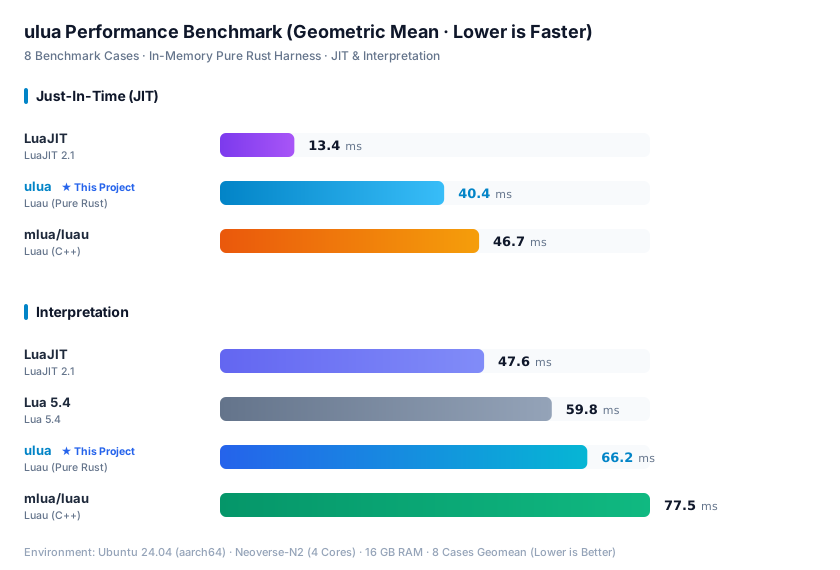
[!TIP] Run
./bench.shto reproduce the benchmarks and regenerate the chart locally.
Key Features
- Pure Rust Implementation: Zero C/C++ compilation toolchains or external system libraries required; runs on standard targets and WebAssembly environments.
- Safe High-Level Ergonomics: Familiar resource-managed handles for state management, tables, functions, and userdata with automatic cleanup.
- Static Type Verification: Integrated bidirectional type inference engine supporting declaration files and structured error diagnostics.
- Robust Panic Insulation: Translates Rust panics and errors across callback boundaries into catchable Luau runtime errors without unwinding aborts.
- Compile-Time Macro Validation: Syntax and type verification of embedded scripts and module dependencies during Rust compilation via procedural macros.
- Asynchronous Runtime Integration: Cooperative Luau coroutines integrate with Rust futures and streams alongside Serde serialization.
Differences Between Luau and Lua
Luau originates from Roblox's extensive evolution and modernization of Lua 5.1. While maintaining backwards compatibility with Lua 5.1 syntax, Luau is heavily re-engineered for high concurrency, game engine performance, large-scale software engineering, and strict sandboxing.
Key distinctions include:
1. Gradual Static Type System
Vanilla Lua is entirely dynamically typed; Luau provides an industrial-grade bidirectional gradual type system and static analysis suite:
- Type Annotations & Signatures: Supports explicit static type annotations on variables, function parameters, and return types (e.g.
local x: number = 42,function add(a: number, b: number): number). - Rich Type Modeling: Built-in type aliases (
type Point = { x: number, y: number }), generics (type List<T> = { [number]: T }), union types (number | string), intersection types (A & B), and optional types (T?). - Cross-Module Type Export: Enables
export typeacross modules viarequire, delivering end-to-end type contracts across large codebases. - Static Analysis & LSP: Complete subtype constraint solver and language server protocol (LSP) providing diagnostics, hover tooltips, and autocompletion before runtime.
2. Modern Syntax Ergonomics
Building upon Lua 5.1 baseline syntax, Luau incorporates modern language features:
- String Interpolation: Backtick template syntax
`Hello, {name}!`with embedded expressions, eliminating verbosestring.formatcalls. - Compound Assignment:
+=,-=,*=,/=,//=,%=,^=,..=, with single evaluation of the left-hand side (e.g.t[func()] += 1). continueControl Flow: Nativecontinuekeyword infor,while, andrepeatloops (contextual keyword, preserving backwards compatibility).constLocal Bindings:const x = 1prevents variable rebinding, protecting local invariants.if-then-elseExpressions: Ternary-style condition expressionslocal val = if cond then a else b, avoiding the insidious pitfalls of Lua'scond and a or bidiom whenais false.- Generalized Iteration: Iterate over tables directly with
for k, v in t dowithout needingpairsoripairs; extensible via the__itermetamethod. - Literal Enhancements: Binary literals (
0b0101), hexadecimal literals (0xABC), and numeric underscore separators (1_000_000).
3. Standard Library & Data Structures
- Immutable Table Freezing:
table.freeze(t)andtable.isfrozen(t)provide first-class read-only tables for tamper-proofing and data safety. - Optimized Table Allocation:
table.create(size, [val])preallocates array capacity to avoid incremental resizing; addstable.find,table.move, andtable.clear. - Native Buffer Memory: The
bufferlibrary offers fast, contiguous byte buffers with zero-copy read/write operations (buffer.create,buffer.readu8,buffer.writef32, etc.). - Built-in Vector3: Native 3-wide SIMD vector primitive type optimized for 3D mathematics and spatial calculations.
- VM-Level Fastcall Builtins: The
mathandbit32libraries are compiled into specialized VM opcodes (Fastcalls) rather than costly function dispatch frames.
4. Intentional Deviations & Design Trade-offs
Luau is not a blind superset of Lua 5.x, but makes deliberate architectural trade-offs:
- Unified Number Representation: Preserves a single 64-bit IEEE 754 double precision float (exact integer representation up to $2^{53}$), deliberately omitting Lua 5.3's integer/float bifurcation to eliminate undefined overflow semantics and optimize JIT compilation.
- Hardened Sandboxing: Strips unsandboxed
io, OS command execution (os.execute), dynamic library loading (package), and dangerousdebuginspection hooks from the base environment. - No Tail Call Elimination: Disallows tail calls by design to maintain predictable, faithful debug stack traces and enable deep caller authentication.
- Structured Control Flow: Rejects
gotostatements and Lua 5.4's<close>variables to maintain predictable control flow and compact compiler passes; tables omit__gcfinalizers to eliminate destructor re-entrancy and GC stalls.
Design Architecture & Execution Pipeline
1. Core Execution Pipeline
The Luau runtime is dynamically typed; the core compilation and VM execution pipeline relies on type erasure and is completely decoupled from static type analysis:
graph TD
  Source["Source Code (.luau)"] --> AST["ulua-ast (Parser & AST)"]
  AST --> Compiler["ulua-compiler (Compiler)"]
  Compiler --> CodeGen["ulua-code-gen (CodeGen Backend)"]
  CodeGen --> Bytecode["ulua-bytecode (Bytecode Format)"]
  Bytecode --> VM["ulua-vm (Register VM & GC)"]
  VM --> RT["ulua-rt (Safe Host Encapsulation)"]
  RT --> Umbrella["ulua (Unified Facade)"]

  subgraph Core Foundation
    Common["ulua-common (Data Structures)"] -.-> AST
    Common -.-> VM
    Config["ulua-config (Configuration)"] -.-> RT
    Require["ulua-require (Module Loader)"] -.-> VM
  end

  subgraph Out-of-Core Analysis & Tooling [Decoupled · On-Demand]
    AST -.-> Analysis["ulua-analysis (Bidirectional Type Inference/LSP)"]
    Analysis -.-> CLI_Analyze["ulua-analyze-cli"]
  end

  subgraph Out-of-Core Bindings
    VM -.-> CAPI["ulua-capi (C ABI Shared Shell)"]
    VM -.-> Web["ulua-web (WASM Browser Target)"]
  end
- Lexical & Syntax Parsing (
ulua-ast): Converts source code into an arena-allocated abstract syntax tree. - Bytecode Compilation & Optimization (
ulua-compiler+ulua-code-gen+ulua-bytecode): Applies constant folding, liveness analysis, and register allocation to generate compact bytecode instructions. - Register VM Execution (
ulua-vm): Loads bytecode streams and drives register-based dispatch with generational garbage collection and built-in standard libraries. - Safe Host Runtime (
ulua-rt): Provides ergonomic RAII handles (Lua,Table,Function,UserData), managing references, lifetimes, and panic boundaries. - Architectural Decoupling:
- Core Packages: Minimal, robust execution engine with zero redundant dependencies and minimal unsafe footprint.
ulua-analysis: Dedicated offline static type checker and LSP language server (completion, hover, go-to-definition, linting); completely optional at runtime.ulua-capi/ulua-web: Boundary wrappers exporting C ABI symbols and WebAssembly bindings.
Module Architecture
Target Standard: Luau 0.737 compatible specification.
1. Core Execution Engine (Core)
ulua: Unified umbrella entry point providing top-level APIs.ulua-ast: Lexer, parser, arena memory allocator, and AST definitions.ulua-compiler: Bytecode compiler and multi-pass optimizer.ulua-code-gen: Low-level bytecode generation and platform backend.ulua-bytecode: Instruction definitions, bytecode packaging, serialization, and decoding.ulua-vm: Register-based virtual machine, garbage collector, and standard libraries.ulua-rt: Ergonomic safe runtime abstractions, UserData binding, and panic protection.ulua-common: Cross-module utilities, DenseHashTable, SBO vectors, and FastFlags.ulua-config: Hierarchical.luau.tomlconfiguration parser.ulua-require: String-based module resolution and alias resolution.ulua-checked-macros: Compile-time syntax/type verification procedural macros.ulua-rt-derive: Derive procedural macros forUserDataandFromLua.
2. Analysis & Bindings
ulua-analysis: Bidirectional static type inference, constraint solver, subtyping engine, and LSP language server support (offline/development tooling, not required for execution).ulua-capi: Pure C ABI symbol export shell for dynamic linking from C/C++.ulua-web: WebAssembly browser environment integration for web execution and playgrounds.
3. Command-Line Tools (CLI)
ulua-repl-cli: Interactive REPL command-line terminal.ulua-analyze-cli: Static type analysis and syntax diagnostics CLI.ulua-compile-cli: Standalone bytecode compiler binary.ulua-bytecode-cli: Bytecode disassembler and inspection tool.ulua-ast-cli: Abstract syntax tree inspector.ulua-reduce-cli: Luau code test-case reduction tool.ulua-cli-lib: Shared foundation for CLI binaries.
4. Test Suites
ulua-unit-test: Upstream unit test suite translated from C++.ulua-conformance: Upstream specification conformance and behavioral test suite.ulua-cli-test: End-to-end integration test runner for CLI binaries.ulua-e2e: Comprehensive end-to-end integration tests.
API Reference
Top-Level Helper Functions
compile(source: &str) -> Result<Vec<u8>, Error>: Compiles Luau source code into raw bytecode bytes.eval(source: &str) -> Result<(), Error>: Instantiates an isolated VM state, loads the standard library, executes code, and returns execution status.eval_bytecode(bytecode: &[u8]) -> Result<(), Error>: Instantiates an isolated VM state, loads the standard library, directly executes precompiled bytecode, and returns execution status.check(source: &str) -> Result<(), Vec<TypeDiagnostic>>: Performs static type checking and returns diagnostics on failure.check_with_definitions(source: &str, defs: &str) -> Result<(), Vec<TypeDiagnostic>>: Validates source against external declaration definitions.check_modules(...)/check_modules_with_definitions(...): Validates multiple interconnected scripts across a module dependency tree.
Procedural Macros
ulua!: Validates embedded script syntax and type correctness during Rust compilation.ulua_file!: Validates filesystem script files and dependency graphs at compile time.
Core Runtime Types and Traits
Lua: Primary virtual machine handle governing state lifecycle, global environments, and resource creation, providingload(source) andload_bytecode(precompiled bytecode) loaders, withenable_jit(bool)andis_jit_enabled()to dynamically toggle native JIT execution.Table: Luau table handle providing key-value access, iteration, and array sequence operations.Function: Executable function reference supporting invocation with variable argument and return types.UserData: Trait enabling Rust structs to be passed to and manipulated by Luau scripts.UserDataMethods: Method builder for registering immutable, mutable, and meta-methods on custom userdata.Value: Dynamic enum representing all valid Luau value variants.Chunk: Execution wrapper for scripts and precompiled bytecode supporting evaluation, execution, and type checking.FromLua/IntoLua: Conversion traits for bidirectional data marshaling between Rust and Luau.TypeDiagnostic: Structured diagnostic item indicating line, column, and description of static type violations.Error/Result: Unified error types encompassing syntax, runtime, memory, and type failure states.
Similar repos


Languages
Rust
90.0%
Luau
6.2%
JavaScript
2.8%
Pure Rust Luau compiler, register VM, and type checker
See the codeSee what people are saying
README
ulua
ulua is a Rust implementation of Luau. 🎮 Live Playground: webc-site.github.io/ulua — Run and type-check Luau in your browser.
This project is a comprehensive refactor based on luau-rs/luau. Upstream luau-rs/luau translated Roblox's original C++ implementation luau-lang/luau into Rust.
Building upon that foundation, this project conducts a deep idiomatic refactor and codebase modernization:
-
Removed all
allowattributes: Eliminated all#![allow(...)]warning suppressions and resolved the underlying issues; -
Rewritten in idiomatic Rust: Replaced transliterated C-style code with idiomatic Rust patterns;
-
Clean Clippy checks: Strictly adhered to Rust best practices to avoid and eliminate Clippy warnings;
-
Reduced
unsafe: Minimizedunsafeblocks to shrink the trusted base and enhance memory safety.
Features Overview
ulua translates Roblox's Luau language directly from C++ into Rust without foreign function bindings or C toolchain dependencies.
The system encompasses the complete Luau pipeline: lexical analysis, AST parsing, bytecode compilation, register virtual machine execution, static bidirectional type inference, and native machine code generation.
In addition to faithful language execution, ulua delivers a safe high-level embedding layer designed for ergonomic Rust integration, offering memory safety, panic insulation, and WebAssembly compatibility.
Usage Demonstration
Direct Script & Bytecode Execution
Execute Luau code and run precompiled bytecode directly through high-level helper functions:
use ulua::{compile, eval, eval_bytecode};

fn main() -> Result<(), Box<dyn std::error::Error>> {
  // Directly evaluate source code
  eval("assert(1 + 1 == 2)")?;

  // Compile source code to raw binary bytecode
  let bytecode = compile("assert(10 * 20 == 200)")?;
  assert!(!bytecode.is_empty());

  // Directly execute precompiled bytecode
  eval_bytecode(&bytecode)?;

  Ok(())
}
JIT Native Acceleration & Switching
ulua supports both pure register virtual machine interpretation and pure Rust native machine code compilation (CodeGen JIT), with full switching capabilities in both CLI and Rust API:
1. Rust API Control
After instantiating Lua, you can enable or disable native code generation at any time:
use ulua::prelude::*;

fn main() -> Result<()> {
  let lua = Lua::new();

  // 1. By default: pure interpretation (zero JIT) - instant startup, lightweight, and deterministic
  assert!(!lua.is_jit_enabled());
  lua.load("print('Running in Interpreter')").exec()?;

  // 2. Enable JIT native compilation (A64 / X64)
  lua.enable_jit(true)?;
  assert!(lua.is_jit_enabled());

  // Once enabled, code loaded with `lua.load(...)` compiles directly into native machine code
  let result: i64 = lua.load(r#"
    local sum = 0
    for i = 1, 1000000 do
      sum += i
    end
    return sum
  "#).eval()?;
  assert_eq!(result, 500000500000);

  // 3. Dynamically disable JIT to fall back to the interpreter at any time
  lua.enable_jit(false)?;
  assert!(!lua.is_jit_enabled());

  Ok(())
}
[!NOTE] JIT native code generation supports Apple Silicon (AArch64) and x86_64 architectures. Enable it with
features = ["jit"](opt-in, not part ofulua's default features).
2. CLI Command-Line Control
Use the --codegen flag to toggle JIT execution:
- Interpreter (Default):
ulua script.luau # Pure interpretation ulua-repl-cli # Interactive REPL (interpreter mode) - JIT Native Acceleration:
ulua --codegen script.luau     # A64/X64 JIT compilation and execution
ulua-repl-cli --codegen        # Interactive REPL (JIT mode)
LUAU_CODEGEN=1 ulua script.luau # Enable via environment variable
3. JIT Control Comparison with Major Lua Runtimes
| Runtime / Library | Enable JIT | Disable JIT (Pure Interpretation) |
|---|---|---|
ulua (This Project) | lua.enable_jit(true) / CLI --codegen | lua.enable_jit(false) / Default without flag |
mlua (Luau C++) | lua.enable_jit(true) | lua.enable_jit(false) |
| LuaJIT 2.1 | jit.on() / CLI -jon | jit.off() / CLI -joff |
Rust Calling Lua Functions (Arguments & Multi-Return)
Obtain function handles ([Function]) from the script environment, supporting single values, multi-argument tuples, multiple return values, and collections ([Vec]):
use ulua::prelude::*;

fn main() -> Result<()> {
  let lua = Lua::new();

  // 1. Define Lua function and retrieve handle in Rust
  lua
    .load(
      r#"
        function div_rem(n, d)
          return math.floor(n / d), n % d
        end
      "#,
    )
    .exec()?;

  let div_rem: Function = lua.globals().get("div_rem")?;

  // 2. Multi-argument passing and multi-return reception (Tuple <-> Lua Multi-Return)
  let (quotient, remainder): (i64, i64) = div_rem.call((17, 5))?;
  assert_eq!((quotient, remainder), (3, 2));

  // 3. Passing collections: Rust Vec automatically maps to Lua sequence tables
  let sum: Function = lua
    .load(
      r#"
        function(nums)
          local total = 0
          for _, n in ipairs(nums) do total += n end
          return total
        end
      "#,
    )
    .eval()?;

  let total: i64 = sum.call(vec![10, 20, 30])?;
  assert_eq!(total, 60);

  Ok(())
}
Lua Calling Rust Functions & Closures
Inject Rust native functions and stateful closures into the script environment, supporting parameter unpacking, multiple return values, state capture, and error insulation:
use std::sync::{
  Arc,
  atomic::{AtomicI64, Ordering},
};
use ulua::prelude::*;

fn main() -> Result<()> {
  let lua = Lua::new();

  // 1. Register Rust function: unpack multiple arguments and return multiple values
  let split = lua.create_function(|_, (s, sep): (String, String)| {
    let (left, right) = s.split_once(&sep).unwrap_or((&s, ""));
    Ok((left.to_string(), right.to_string()))
  })?;
  lua.globals().set("split", split)?;

  let (a, b): (String, String) = lua.load(r#"split("hello:world", ":")"#).eval()?;
  assert_eq!((a.as_str(), b.as_str()), ("hello", "world"));

  // 2. Stateful closure capturing environment
  let counter = Arc::new(AtomicI64::new(0));
  let c = counter.clone();
  let next_id = lua.create_function(move |_, ()| Ok(c.fetch_add(1, Ordering::SeqCst) + 1))?;
  lua.globals().set("next_id", next_id)?;

  lua.load("next_id(); next_id()").exec()?;
  assert_eq!(counter.load(Ordering::SeqCst), 2);

  // 3. Cross-language error propagation: Rust Err surfaces as Lua error caught by pcall
  let safe_div = lua.create_function(|_, (a, b): (f64, f64)| {
    if b == 0.0 {
      return Err(Error::runtime("division by zero"));
    }
    Ok(a / b)
  })?;
  lua.globals().set("safe_div", safe_div)?;

  let (ok, err_msg): (bool, String) = lua
    .load(
      r#"
        local ok, res = pcall(safe_div, 1, 0)
        return ok, tostring(res)
      "#,
    )
    .eval()?;
  assert!(!ok);
  assert!(err_msg.contains("division by zero"));

  Ok(())
}
Host Objects & UserData (Methods & Metamethods)
Bind native Rust structs to the script environment, exposing immutable (&this), mutable (&mut this), and operator metamethods:
use ulua::prelude::*;

struct Player {
  name: String,
  score: i64,
}

impl UserData for Player {
  fn add_methods<M: UserDataMethods<Self>>(methods: &mut M) {
    // Read-only method
    methods.add_method("get_score", |_, this, ()| Ok(this.score));

    // In-place mutation method
    methods.add_method_mut("add_score", |_, this, points: i64| {
      this.score += points;
      Ok(())
    });

    // Metamethod overload (e.g. __tostring)
    methods.add_meta_method("__tostring", |_, this, ()| {
      Ok(format!("Player({}, score={})", this.name, this.score))
    });
  }
}

fn main() -> Result<()> {
  let lua = Lua::new();

  let player = lua.create_userdata(Player {
    name: "Player1".to_string(),
    score: 100,
  })?;
  lua.globals().set("player", player)?;

  lua.load("player:add_score(50)").exec()?;
  let final_score: i64 = lua.load("return player:get_score()").eval()?;
  assert_eq!(final_score, 150);

  let repr: String = lua.load("return tostring(player)").eval()?;
  assert_eq!(repr, "Player(Player1, score=150)");

  Ok(())
}
Static Type Checking
Perform static type analysis ahead of runtime execution:
use ulua::{check, check_with_definitions};

fn main() {
  let valid_script = "local total: number = 42";
  assert!(check(valid_script).is_ok());

  let host_script = "local res = add(10, 20)";
  let defs = "declare function add(a: number, b: number): number";
  assert!(check_with_definitions(host_script, defs).is_ok());
}
Performance Benchmarks
ulua matches official C++ Luau throughput in pure interpretation (zero JIT), while unleashing the extreme speed of native machine code generation when JIT is enabled.
Benchmarks are performed using an in-memory pure Rust harness (eliminating child process spawn overhead and terminal I/O latency), evaluating 8 compute-heavy algorithms (recursive Fibonacci, N-Body celestial mechanics, Mandelbrot fractals, matrix multiplication, quicksort, mass string concatenation, binary tree allocation, and Spectral Norm) with multiple iterations to compute medians on Apple Silicon (arm64).
[!TIP] Run
./bench.shto reproduce the benchmarks and regenerate the chart locally.
Key Features
- Pure Rust Implementation: Zero C/C++ compilation toolchains or external system libraries required; runs on standard targets and WebAssembly environments.
- Safe High-Level Ergonomics: Familiar resource-managed handles for state management, tables, functions, and userdata with automatic cleanup.
- Static Type Verification: Integrated bidirectional type inference engine supporting declaration files and structured error diagnostics.
- Robust Panic Insulation: Translates Rust panics and errors across callback boundaries into catchable Luau runtime errors without unwinding aborts.
- Compile-Time Macro Validation: Syntax and type verification of embedded scripts and module dependencies during Rust compilation via procedural macros.
- Asynchronous Runtime Integration: Cooperative Luau coroutines integrate with Rust futures and streams alongside Serde serialization.
Differences Between Luau and Lua
Luau originates from Roblox's extensive evolution and modernization of Lua 5.1. While maintaining backwards compatibility with Lua 5.1 syntax, Luau is heavily re-engineered for high concurrency, game engine performance, large-scale software engineering, and strict sandboxing.
Key distinctions include:
1. Gradual Static Type System
Vanilla Lua is entirely dynamically typed; Luau provides an industrial-grade bidirectional gradual type system and static analysis suite:
- Type Annotations & Signatures: Supports explicit static type annotations on variables, function parameters, and return types (e.g.
local x: number = 42,function add(a: number, b: number): number). - Rich Type Modeling: Built-in type aliases (
type Point = { x: number, y: number }), generics (type List<T> = { [number]: T }), union types (number | string), intersection types (A & B), and optional types (T?). - Cross-Module Type Export: Enables
export typeacross modules viarequire, delivering end-to-end type contracts across large codebases. - Static Analysis & LSP: Complete subtype constraint solver and language server protocol (LSP) providing diagnostics, hover tooltips, and autocompletion before runtime.
2. Modern Syntax Ergonomics
Building upon Lua 5.1 baseline syntax, Luau incorporates modern language features:
- String Interpolation: Backtick template syntax
`Hello, {name}!`with embedded expressions, eliminating verbosestring.formatcalls. - Compound Assignment:
+=,-=,*=,/=,//=,%=,^=,..=, with single evaluation of the left-hand side (e.g.t[func()] += 1). continueControl Flow: Nativecontinuekeyword infor,while, andrepeatloops (contextual keyword, preserving backwards compatibility).constLocal Bindings:const x = 1prevents variable rebinding, protecting local invariants.if-then-elseExpressions: Ternary-style condition expressionslocal val = if cond then a else b, avoiding the insidious pitfalls of Lua'scond and a or bidiom whenais false.- Generalized Iteration: Iterate over tables directly with
for k, v in t dowithout needingpairsoripairs; extensible via the__itermetamethod. - Literal Enhancements: Binary literals (
0b0101), hexadecimal literals (0xABC), and numeric underscore separators (1_000_000).
3. Standard Library & Data Structures
- Immutable Table Freezing:
table.freeze(t)andtable.isfrozen(t)provide first-class read-only tables for tamper-proofing and data safety. - Optimized Table Allocation:
table.create(size, [val])preallocates array capacity to avoid incremental resizing; addstable.find,table.move, andtable.clear. - Native Buffer Memory: The
bufferlibrary offers fast, contiguous byte buffers with zero-copy read/write operations (buffer.create,buffer.readu8,buffer.writef32, etc.). - Built-in Vector3: Native 3-wide SIMD vector primitive type optimized for 3D mathematics and spatial calculations.
- VM-Level Fastcall Builtins: The
mathandbit32libraries are compiled into specialized VM opcodes (Fastcalls) rather than costly function dispatch frames.
4. Intentional Deviations & Design Trade-offs
Luau is not a blind superset of Lua 5.x, but makes deliberate architectural trade-offs:
- Unified Number Representation: Preserves a single 64-bit IEEE 754 double precision float (exact integer representation up to $2^{53}$), deliberately omitting Lua 5.3's integer/float bifurcation to eliminate undefined overflow semantics and optimize JIT compilation.
- Hardened Sandboxing: Strips unsandboxed
io, OS command execution (os.execute), dynamic library loading (package), and dangerousdebuginspection hooks from the base environment. - No Tail Call Elimination: Disallows tail calls by design to maintain predictable, faithful debug stack traces and enable deep caller authentication.
- Structured Control Flow: Rejects
gotostatements and Lua 5.4's<close>variables to maintain predictable control flow and compact compiler passes; tables omit__gcfinalizers to eliminate destructor re-entrancy and GC stalls.
Design Architecture & Execution Pipeline
1. Core Execution Pipeline
The Luau runtime is dynamically typed; the core compilation and VM execution pipeline relies on type erasure and is completely decoupled from static type analysis:
graph TD
  Source["Source Code (.luau)"] --> AST["ulua-ast (Parser & AST)"]
  AST --> Compiler["ulua-compiler (Compiler)"]
  Compiler --> CodeGen["ulua-code-gen (CodeGen Backend)"]
  CodeGen --> Bytecode["ulua-bytecode (Bytecode Format)"]
  Bytecode --> VM["ulua-vm (Register VM & GC)"]
  VM --> RT["ulua-rt (Safe Host Encapsulation)"]
  RT --> Umbrella["ulua (Unified Facade)"]

  subgraph Core Foundation
    Common["ulua-common (Data Structures)"] -.-> AST
    Common -.-> VM
    Config["ulua-config (Configuration)"] -.-> RT
    Require["ulua-require (Module Loader)"] -.-> VM
  end

  subgraph Out-of-Core Analysis & Tooling [Decoupled · On-Demand]
    AST -.-> Analysis["ulua-analysis (Bidirectional Type Inference/LSP)"]
    Analysis -.-> CLI_Analyze["ulua-analyze-cli"]
  end

  subgraph Out-of-Core Bindings
    VM -.-> CAPI["ulua-capi (C ABI Shared Shell)"]
    VM -.-> Web["ulua-web (WASM Browser Target)"]
  end
- Lexical & Syntax Parsing (
ulua-ast): Converts source code into an arena-allocated abstract syntax tree. - Bytecode Compilation & Optimization (
ulua-compiler+ulua-code-gen+ulua-bytecode): Applies constant folding, liveness analysis, and register allocation to generate compact bytecode instructions. - Register VM Execution (
ulua-vm): Loads bytecode streams and drives register-based dispatch with generational garbage collection and built-in standard libraries. - Safe Host Runtime (
ulua-rt): Provides ergonomic RAII handles (Lua,Table,Function,UserData), managing references, lifetimes, and panic boundaries. - Architectural Decoupling:
- Core Packages: Minimal, robust execution engine with zero redundant dependencies and minimal unsafe footprint.
ulua-analysis: Dedicated offline static type checker and LSP language server (completion, hover, go-to-definition, linting); completely optional at runtime.ulua-capi/ulua-web: Boundary wrappers exporting C ABI symbols and WebAssembly bindings.
Module Architecture
Target Standard: Luau 0.737 compatible specification.
1. Core Execution Engine (Core)
ulua: Unified umbrella entry point providing top-level APIs.ulua-ast: Lexer, parser, arena memory allocator, and AST definitions.ulua-compiler: Bytecode compiler and multi-pass optimizer.ulua-code-gen: Low-level bytecode generation and platform backend.ulua-bytecode: Instruction definitions, bytecode packaging, serialization, and decoding.ulua-vm: Register-based virtual machine, garbage collector, and standard libraries.ulua-rt: Ergonomic safe runtime abstractions, UserData binding, and panic protection.ulua-common: Cross-module utilities, DenseHashTable, SBO vectors, and FastFlags.ulua-config: Hierarchical.luau.tomlconfiguration parser.ulua-require: String-based module resolution and alias resolution.ulua-checked-macros: Compile-time syntax/type verification procedural macros.ulua-rt-derive: Derive procedural macros forUserDataandFromLua.
2. Analysis & Bindings
ulua-analysis: Bidirectional static type inference, constraint solver, subtyping engine, and LSP language server support (offline/development tooling, not required for execution).ulua-capi: Pure C ABI symbol export shell for dynamic linking from C/C++.ulua-web: WebAssembly browser environment integration for web execution and playgrounds.
3. Command-Line Tools (CLI)
ulua-repl-cli: Interactive REPL command-line terminal.ulua-analyze-cli: Static type analysis and syntax diagnostics CLI.ulua-compile-cli: Standalone bytecode compiler binary.ulua-bytecode-cli: Bytecode disassembler and inspection tool.ulua-ast-cli: Abstract syntax tree inspector.ulua-reduce-cli: Luau code test-case reduction tool.ulua-cli-lib: Shared foundation for CLI binaries.
4. Test Suites
ulua-unit-test: Upstream unit test suite translated from C++.ulua-conformance: Upstream specification conformance and behavioral test suite.ulua-cli-test: End-to-end integration test runner for CLI binaries.ulua-e2e: Comprehensive end-to-end integration tests.
API Reference
Top-Level Helper Functions
compile(source: &str) -> Result<Vec<u8>, Error>: Compiles Luau source code into raw bytecode bytes.eval(source: &str) -> Result<(), Error>: Instantiates an isolated VM state, loads the standard library, executes code, and returns execution status.eval_bytecode(bytecode: &[u8]) -> Result<(), Error>: Instantiates an isolated VM state, loads the standard library, directly executes precompiled bytecode, and returns execution status.check(source: &str) -> Result<(), Vec<TypeDiagnostic>>: Performs static type checking and returns diagnostics on failure.check_with_definitions(source: &str, defs: &str) -> Result<(), Vec<TypeDiagnostic>>: Validates source against external declaration definitions.check_modules(...)/check_modules_with_definitions(...): Validates multiple interconnected scripts across a module dependency tree.
Procedural Macros
ulua!: Validates embedded script syntax and type correctness during Rust compilation.ulua_file!: Validates filesystem script files and dependency graphs at compile time.
Core Runtime Types and Traits
Lua: Primary virtual machine handle governing state lifecycle, global environments, and resource creation, providingload(source) andload_bytecode(precompiled bytecode) loaders, withenable_jit(bool)andis_jit_enabled()to dynamically toggle native JIT execution.Table: Luau table handle providing key-value access, iteration, and array sequence operations.Function: Executable function reference supporting invocation with variable argument and return types.UserData: Trait enabling Rust structs to be passed to and manipulated by Luau scripts.UserDataMethods: Method builder for registering immutable, mutable, and meta-methods on custom userdata.Value: Dynamic enum representing all valid Luau value variants.Chunk: Execution wrapper for scripts and precompiled bytecode supporting evaluation, execution, and type checking.FromLua/IntoLua: Conversion traits for bidirectional data marshaling between Rust and Luau.TypeDiagnostic: Structured diagnostic item indicating line, column, and description of static type violations.Error/Result: Unified error types encompassing syntax, runtime, memory, and type failure states.
Similar repos
Languages
Rust
90.0%
Luau
6.2%
JavaScript
2.8%