
README
CREBench: Evaluating Large Language Models in Cryptographic Binary Reverse Engineering



Official code repository for the paper "CREBench: Evaluating Large Language Models in Cryptographic Binary Reverse Engineering" (COLM 2026).
Introduction
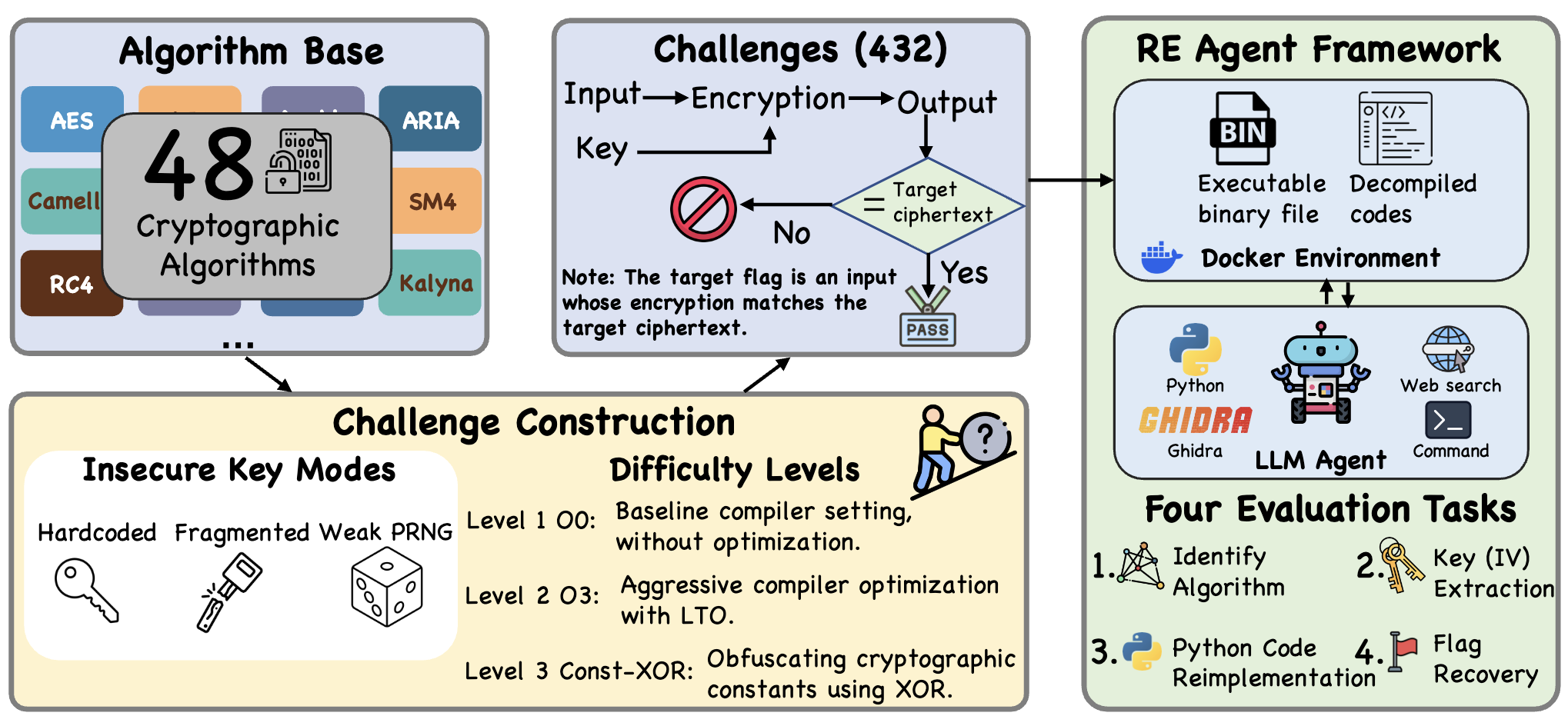
CREBench evaluates reverse-engineering performance on cryptographic binaries over four levels:
L1: algorithm identificationL2: key (IV) extractionL3: wrapper-level code reimplementationL4: flag recovery
Current main benchmark corpus is CREBench with:
48algorithms3key modes:hardcode_plain,fragmented_build,weak_prng_seeded3active difficulties:O0,O3,constxor
Supported models include:
gpt-5.4gpt-5.4-minigpt-5.2o4-minigemini-2.5-proclaude-sonnet-4-6doubao-seed-1-8-251228mimo-v2-pro
Installation
Requirements
- Python
3.10+ - Docker
- A working Python environment for this repo
- For
codex: local Codex CLI installed on host
Install dependencies:
pip install -r requirements.txt
If you want Codex token accounting through LiteLLM, install the proxy extras:
pip install 'litellm[proxy]'
Warning: do not use LiteLLM 1.82.7 or 1.82.8 because of the backdoor vulnerability.
Docker Setup
The runtime image expects Ghidra archive in docker/ before build.
- Open Ghidra 11.0.1 release page: https://github.com/NationalSecurityAgency/ghidra/releases/tag/Ghidra_11.0.1_build
- Download
ghidra_11.0.1_PUBLIC_20240130.zip - Place it at
docker/ghidra_11.0.1_PUBLIC_20240130.zip
Example:
wget https://github.com/NationalSecurityAgency/ghidra/releases/download/Ghidra_11.0.1_build/ghidra_11.0.1_PUBLIC_20240130.zip \
  -O docker/ghidra_11.0.1_PUBLIC_20240130.zip
Build image:
sudo docker build -t rev-sandbox:latest -f docker/Dockerfile docker
Configuration
Use a repo-root .env file for API credentials. Runtime scripts load .env automatically.
Example .env:
# OpenAI
OPENAI_API_KEY=""
OPENAI_API_BASE_URL=https://api.openai.com/v1

# Azure OpenAI
AZURE_OPENAI_API_KEY=""
AZURE_OPENAI_ENDPOINT=""
AZURE_OPENAI_API_VERSION=""

# Claude
CLAUDE_API_KEY=""

# Gemini
GOOGLE_APPLICATION_CREDENTIALS=/path/to/service-account.json
GEMINI_PROJECT=""
GEMINI_LOCATION=global

# Doubao
DOUBAO_API_KEY=""
DOUBAO_BASE_URL=""

# MiMo
MIMO_API_KEY=""
MIMO_BASE_URL=""

# Tavily web tools (optional)
TVLY_API_KEY=""

# Codex
CODEX_MODEL=""
Evaluation Workflow
Pass@k Evaluation
scripts/run_passk_eval.py is the recommended runner for official evaluation and benchmarking.
It handles:
- pass@k repeats
- full
CREBenchcorpus sweeps - parallel execution (
--jobs) - resumable suites (
--resume-dir) - suite-level summaries and CSV reports
Run one challenge:
python3 scripts/run_passk_eval.py \
  --model gpt-5.4 \
  --challenge AES-128-CBC \
  --difficulty O0 \
  --key-mode weak_prng_seeded \
  --pass-k 3
Run full matrix (48 * 3 * 3):
python3 scripts/run_passk_eval.py \
  --model gpt-5.4 \
  --all-c-all \
  --all-key-modes \
  --difficulty ALL \
  --pass-k 3 \
  --eval-mode full \
  --jobs 4 \
  --max-rounds 30 \
  --max-tokens 600000
Resume an interrupted suite:
python3 scripts/run_passk_eval.py \
  --model gpt-5.4 \
  --all-c-all \
  --all-key-modes \
  --difficulty ALL \
  --pass-k 3 \
  --jobs 4 \
  --resume-dir outputs/passk/<your-suite-dir>
Single-run Runner
run_reverse.py remains useful for single-run debugging / development.
python3 run_reverse.py \
  --model gpt-5.4 \
  --challenge-path CREBench/AES-128-CBC \
  --key-mode weak_prng_seeded \
  --difficulty O0 \
  --eval-mode full
Provider selection for OpenAI-family models (gpt-*, o4-*) and codex:
- You can force provider with
--provider openaior--provider azure. - If omitted, runner selects
openaiwhenOPENAI_API_KEYis set. - Otherwise it selects
azurewhen Azure credentials are set. - If neither is available, run fails with provider resolution error.
Codex-specific Run Notes
Codex local runner:
python run_reverse.py \
  --model codex \
  --provider openai \
  --challenge-path CREBench/AES-128-CBC \
  --key-mode weak_prng_seeded \
  --difficulty O0
Codex local runner with Azure backend:
python run_reverse.py \
  --model codex \
  --provider azure \
  --challenge-path CREBench/AES-128-CBC \
  --key-mode weak_prng_seeded \
  --difficulty O0
Codex local runner with explicit backend model override:
python run_reverse.py \
  --model codex-gpt-5.4 \
  --provider openai \
  --challenge-path CREBench/AES-128-CBC \
  --key-mode weak_prng_seeded \
  --difficulty O0
Codex + LiteLLM proxy path for request-level token accounting:
export REV_CODEX_USE_LITELLM=1

python run_reverse.py \
  --model codex \
  --provider azure \
  --challenge-path CREBench/AES-128-CBC \
  --key-mode weak_prng_seeded \
  --difficulty constxor \
  --max-tokens 500000 \
  --output-dir outputs/codex-litellm-aes
Notes for Codex + LiteLLM:
--provider openaiand--provider azureare both supported for Codex.- When
--provideris omitted for Codex, the local Codex config is used if present; otherwise the runner auto-configures from available credentials. - Token cutoff is enforced at the request level, not token-by-token.
- A single in-flight backend request can overshoot the remaining budget.
- LiteLLM artifacts are written to the run output directory:
litellm_proxy_config.yamllitellm_proxy_stdout.loglitellm_proxy_stderr.loglitellm_usage.jsonllitellm_trace.jsonl
Output Layout
Single run (run_reverse.py) output:
outputs/<challenge>/<key_mode>/<difficulty>/<provider>/<model>/<eval_mode>/<timestamp>/
Suite run (run_passk_eval.py) output:
outputs/passk/<suite-name>-<timestamp>/
  suite_manifest.json
  summary.json
  report.md
  case_results.csv
  attempt_results.csv
  runs/
    <challenge>/<key_mode>/<difficulty>/attempt-<n>/
Per-run artifacts include:
record.txtscore.jsonrun_metrics.jsonrun_metadata.jsonconversation.json
Project Structure
CREBench/                     # Our repo
  CREBench/                   # Main benchmark corpus (432 challenges with 48 algorithms)
    AES-128-CBC/
    DES/
    RC4/
    SM4-CBC-Official/
    ...
  src/reverse_agent/          # Agent runtime, tools, sandbox, evaluator
  scripts/
    run_passk_eval.py         # Primary pass@k runner
  run_reverse.py              # Single-run entry
Citation
If you find this project useful, please cite:
@article{chen2026crebench,
  title={CREBench: Evaluating Large Language Models in Cryptographic Binary Reverse Engineering},
  author={Chen, Baicheng and Wang, Yu and Zhou, Ziheng and Liu, Xiangru and Li, Juanru and Chen, Yilei and He, Tianxing},
  journal={arXiv preprint arXiv:2604.03750},
  year={2026}
}
Contributors

9 commits

4 commits
Similar repos


Languages
Standard ML
52.0%
C
39.2%
Python
7.6%
README
CREBench: Evaluating Large Language Models in Cryptographic Binary Reverse Engineering
Official code repository for the paper "CREBench: Evaluating Large Language Models in Cryptographic Binary Reverse Engineering" (COLM 2026).
Introduction
CREBench evaluates reverse-engineering performance on cryptographic binaries over four levels:
L1: algorithm identificationL2: key (IV) extractionL3: wrapper-level code reimplementationL4: flag recovery
Current main benchmark corpus is CREBench with:
48algorithms3key modes:hardcode_plain,fragmented_build,weak_prng_seeded3active difficulties:O0,O3,constxor
Supported models include:
gpt-5.4gpt-5.4-minigpt-5.2o4-minigemini-2.5-proclaude-sonnet-4-6doubao-seed-1-8-251228mimo-v2-pro
Installation
Requirements
- Python
3.10+ - Docker
- A working Python environment for this repo
- For
codex: local Codex CLI installed on host
Install dependencies:
pip install -r requirements.txt
If you want Codex token accounting through LiteLLM, install the proxy extras:
pip install 'litellm[proxy]'
Warning: do not use LiteLLM 1.82.7 or 1.82.8 because of the backdoor vulnerability.
Docker Setup
The runtime image expects Ghidra archive in docker/ before build.
- Open Ghidra 11.0.1 release page: https://github.com/NationalSecurityAgency/ghidra/releases/tag/Ghidra_11.0.1_build
- Download
ghidra_11.0.1_PUBLIC_20240130.zip - Place it at
docker/ghidra_11.0.1_PUBLIC_20240130.zip
Example:
wget https://github.com/NationalSecurityAgency/ghidra/releases/download/Ghidra_11.0.1_build/ghidra_11.0.1_PUBLIC_20240130.zip \
  -O docker/ghidra_11.0.1_PUBLIC_20240130.zip
Build image:
sudo docker build -t rev-sandbox:latest -f docker/Dockerfile docker
Configuration
Use a repo-root .env file for API credentials. Runtime scripts load .env automatically.
Example .env:
# OpenAI
OPENAI_API_KEY=""
OPENAI_API_BASE_URL=https://api.openai.com/v1

# Azure OpenAI
AZURE_OPENAI_API_KEY=""
AZURE_OPENAI_ENDPOINT=""
AZURE_OPENAI_API_VERSION=""

# Claude
CLAUDE_API_KEY=""

# Gemini
GOOGLE_APPLICATION_CREDENTIALS=/path/to/service-account.json
GEMINI_PROJECT=""
GEMINI_LOCATION=global

# Doubao
DOUBAO_API_KEY=""
DOUBAO_BASE_URL=""

# MiMo
MIMO_API_KEY=""
MIMO_BASE_URL=""

# Tavily web tools (optional)
TVLY_API_KEY=""

# Codex
CODEX_MODEL=""
Evaluation Workflow
Pass@k Evaluation
scripts/run_passk_eval.py is the recommended runner for official evaluation and benchmarking.
It handles:
- pass@k repeats
- full
CREBenchcorpus sweeps - parallel execution (
--jobs) - resumable suites (
--resume-dir) - suite-level summaries and CSV reports
Run one challenge:
python3 scripts/run_passk_eval.py \
  --model gpt-5.4 \
  --challenge AES-128-CBC \
  --difficulty O0 \
  --key-mode weak_prng_seeded \
  --pass-k 3
Run full matrix (48 * 3 * 3):
python3 scripts/run_passk_eval.py \
  --model gpt-5.4 \
  --all-c-all \
  --all-key-modes \
  --difficulty ALL \
  --pass-k 3 \
  --eval-mode full \
  --jobs 4 \
  --max-rounds 30 \
  --max-tokens 600000
Resume an interrupted suite:
python3 scripts/run_passk_eval.py \
  --model gpt-5.4 \
  --all-c-all \
  --all-key-modes \
  --difficulty ALL \
  --pass-k 3 \
  --jobs 4 \
  --resume-dir outputs/passk/<your-suite-dir>
Single-run Runner
run_reverse.py remains useful for single-run debugging / development.
python3 run_reverse.py \
  --model gpt-5.4 \
  --challenge-path CREBench/AES-128-CBC \
  --key-mode weak_prng_seeded \
  --difficulty O0 \
  --eval-mode full
Provider selection for OpenAI-family models (gpt-*, o4-*) and codex:
- You can force provider with
--provider openaior--provider azure. - If omitted, runner selects
openaiwhenOPENAI_API_KEYis set. - Otherwise it selects
azurewhen Azure credentials are set. - If neither is available, run fails with provider resolution error.
Codex-specific Run Notes
Codex local runner:
python run_reverse.py \
  --model codex \
  --provider openai \
  --challenge-path CREBench/AES-128-CBC \
  --key-mode weak_prng_seeded \
  --difficulty O0
Codex local runner with Azure backend:
python run_reverse.py \
  --model codex \
  --provider azure \
  --challenge-path CREBench/AES-128-CBC \
  --key-mode weak_prng_seeded \
  --difficulty O0
Codex local runner with explicit backend model override:
python run_reverse.py \
  --model codex-gpt-5.4 \
  --provider openai \
  --challenge-path CREBench/AES-128-CBC \
  --key-mode weak_prng_seeded \
  --difficulty O0
Codex + LiteLLM proxy path for request-level token accounting:
export REV_CODEX_USE_LITELLM=1

python run_reverse.py \
  --model codex \
  --provider azure \
  --challenge-path CREBench/AES-128-CBC \
  --key-mode weak_prng_seeded \
  --difficulty constxor \
  --max-tokens 500000 \
  --output-dir outputs/codex-litellm-aes
Notes for Codex + LiteLLM:
--provider openaiand--provider azureare both supported for Codex.- When
--provideris omitted for Codex, the local Codex config is used if present; otherwise the runner auto-configures from available credentials. - Token cutoff is enforced at the request level, not token-by-token.
- A single in-flight backend request can overshoot the remaining budget.
- LiteLLM artifacts are written to the run output directory:
litellm_proxy_config.yamllitellm_proxy_stdout.loglitellm_proxy_stderr.loglitellm_usage.jsonllitellm_trace.jsonl
Output Layout
Single run (run_reverse.py) output:
outputs/<challenge>/<key_mode>/<difficulty>/<provider>/<model>/<eval_mode>/<timestamp>/
Suite run (run_passk_eval.py) output:
outputs/passk/<suite-name>-<timestamp>/
  suite_manifest.json
  summary.json
  report.md
  case_results.csv
  attempt_results.csv
  runs/
    <challenge>/<key_mode>/<difficulty>/attempt-<n>/
Per-run artifacts include:
record.txtscore.jsonrun_metrics.jsonrun_metadata.jsonconversation.json
Project Structure
CREBench/                     # Our repo
  CREBench/                   # Main benchmark corpus (432 challenges with 48 algorithms)
    AES-128-CBC/
    DES/
    RC4/
    SM4-CBC-Official/
    ...
  src/reverse_agent/          # Agent runtime, tools, sandbox, evaluator
  scripts/
    run_passk_eval.py         # Primary pass@k runner
  run_reverse.py              # Single-run entry
Citation
If you find this project useful, please cite:
@article{chen2026crebench,
  title={CREBench: Evaluating Large Language Models in Cryptographic Binary Reverse Engineering},
  author={Chen, Baicheng and Wang, Yu and Zhou, Ziheng and Liu, Xiangru and Li, Juanru and Chen, Yilei and He, Tianxing},
  journal={arXiv preprint arXiv:2604.03750},
  year={2026}
}
Similar repos
Contributors
9 commits
4 commits
Languages
Standard ML
52.0%
C
39.2%
Python
7.6%