
A holistic evaluation library for multi-modal generative models using Weave
See the codeREADME
Hemm: Holistic Evaluation of Multi-modal Generative Models

Hemm is a library for performing comprehensive benchmark of text-to-image diffusion models on image quality and prompt comprehension integrated with Weave, a lightweight toolkit for tracking and evaluating LLM applications, built by Weights & Biases.
Hemm is highly inspired by the following projects:
- Holistic Evaluation of Text-To-Image Models
- T2I-CompBench: A Comprehensive Benchmark for Open-world Compositional Text-to-image Generation
- T2I-CompBench++: An Enhanced and Comprehensive Benchmark for Compositional Text-to-image Generation
- GenEval: An Object-Focused Framework for Evaluating Text-to-Image Alignment
 |
|---|
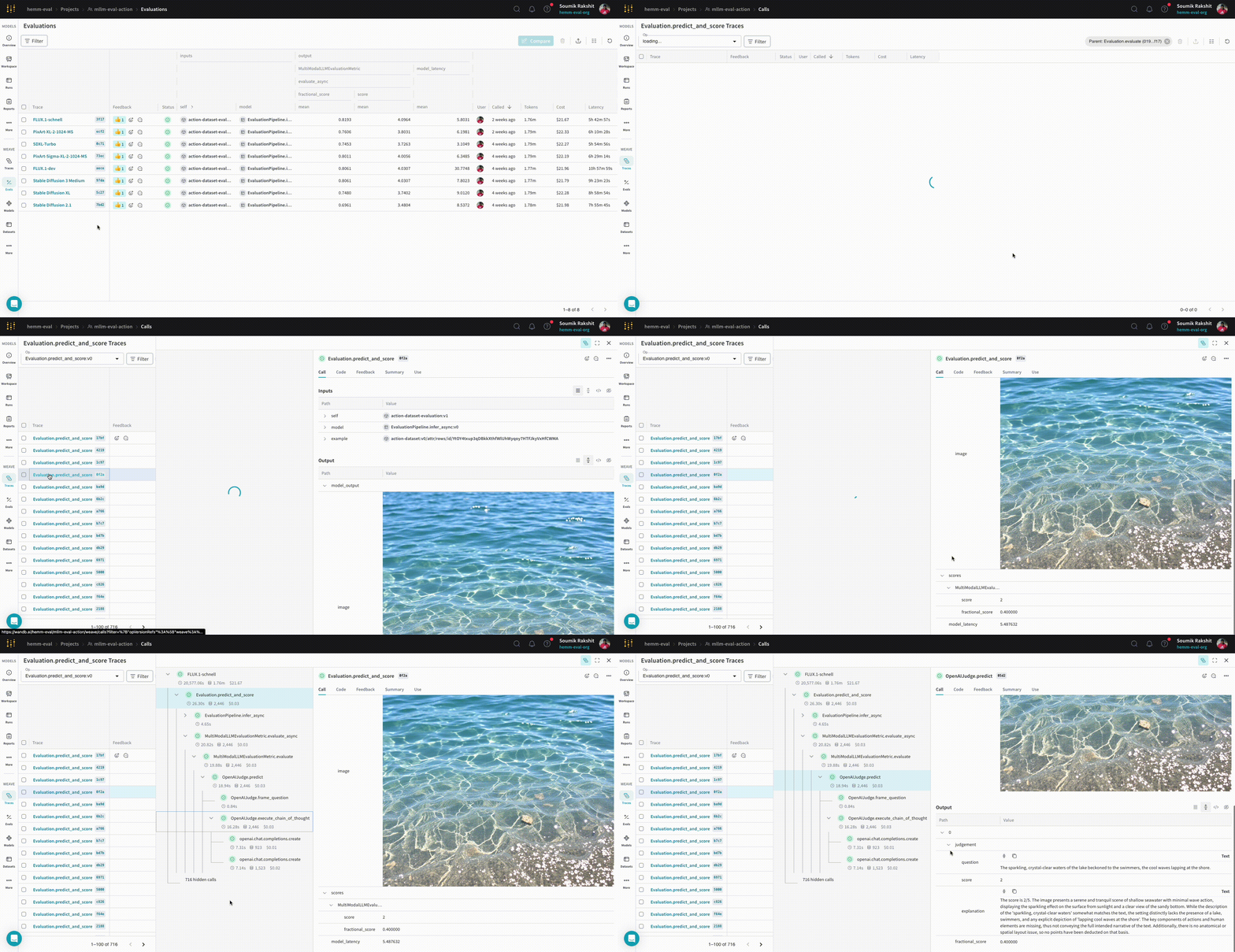
| The evaluation pipeline will take each example, pass it through your application and score the output on multiple custom scoring functions using Weave Evaluation. By doing this, you'll have a view of the performance of your model, and a rich UI to drill into individual ouputs and scores. |
Leaderboards
| Leaderboard | Weave Evals |
|---|---|
| Rendering prompts with Complex Actions | Weave Evals |
Installation
First, we recommend you install the PyTorch by visiting pytorch.org/get-started/locally.
git clone https://github.com/wandb/Hemm
cd Hemm
pip install -e ".[core]"
Quickstart
First, you need to publish your evaluation dataset to Weave. Check out this tutorial that shows you how to publish a dataset on your project.
Once you have a dataset on your Weave project, you can evaluate a text-to-image generation model on the metrics.
import asyncio
import weave
from hemm.metrics.vqa import MultiModalLLMEvaluationMetric
from hemm.metrics.vqa.judges.mmllm_judges import OpenAIJudge
from hemm.models import DiffusersModel

# Initialize Weave
weave.init(project_name="image-quality-leaderboard")

# The `DiffusersModel` is a `weave.Model` that uses a
# `diffusers.DiffusionPipeline` under the hood.
# You can write your own model `weave.Model` if your
# model is not diffusers compatible.
model = DiffusersModel(
    diffusion_model_name_or_path="stabilityai/stable-diffusion-2-1",
    image_height=1024,
    image_width=1024,
)

# Define the metric
metric = MultiModalLLMEvaluationMetric(judge=OpenAIJudge())

# Get the Weave dataset reference
dataset=weave.ref("Dataset:v2").get()

# Evaluate!
evaluation = weave.Evaluation(dataset=dataset, scorers=[metric])
summary = asyncio.run(evaluation.evaluate(model))
Contributors

253 commits

1 commits
Similar repos


Languages
Python
100.0%
A holistic evaluation library for multi-modal generative models using Weave
See the codeREADME
Hemm: Holistic Evaluation of Multi-modal Generative Models
Hemm is a library for performing comprehensive benchmark of text-to-image diffusion models on image quality and prompt comprehension integrated with Weave, a lightweight toolkit for tracking and evaluating LLM applications, built by Weights & Biases.
Hemm is highly inspired by the following projects:
- Holistic Evaluation of Text-To-Image Models
- T2I-CompBench: A Comprehensive Benchmark for Open-world Compositional Text-to-image Generation
- T2I-CompBench++: An Enhanced and Comprehensive Benchmark for Compositional Text-to-image Generation
- GenEval: An Object-Focused Framework for Evaluating Text-to-Image Alignment
|
|---|
| The evaluation pipeline will take each example, pass it through your application and score the output on multiple custom scoring functions using Weave Evaluation. By doing this, you'll have a view of the performance of your model, and a rich UI to drill into individual ouputs and scores. |
Leaderboards
| Leaderboard | Weave Evals |
|---|---|
| Rendering prompts with Complex Actions | Weave Evals |
Installation
First, we recommend you install the PyTorch by visiting pytorch.org/get-started/locally.
git clone https://github.com/wandb/Hemm
cd Hemm
pip install -e ".[core]"
Quickstart
First, you need to publish your evaluation dataset to Weave. Check out this tutorial that shows you how to publish a dataset on your project.
Once you have a dataset on your Weave project, you can evaluate a text-to-image generation model on the metrics.
import asyncio
import weave
from hemm.metrics.vqa import MultiModalLLMEvaluationMetric
from hemm.metrics.vqa.judges.mmllm_judges import OpenAIJudge
from hemm.models import DiffusersModel

# Initialize Weave
weave.init(project_name="image-quality-leaderboard")

# The `DiffusersModel` is a `weave.Model` that uses a
# `diffusers.DiffusionPipeline` under the hood.
# You can write your own model `weave.Model` if your
# model is not diffusers compatible.
model = DiffusersModel(
    diffusion_model_name_or_path="stabilityai/stable-diffusion-2-1",
    image_height=1024,
    image_width=1024,
)

# Define the metric
metric = MultiModalLLMEvaluationMetric(judge=OpenAIJudge())

# Get the Weave dataset reference
dataset=weave.ref("Dataset:v2").get()

# Evaluate!
evaluation = weave.Evaluation(dataset=dataset, scorers=[metric])
summary = asyncio.run(evaluation.evaluate(model))
Similar repos
Contributors
253 commits
1 commits
Languages
Python
100.0%