
Memory for Hermes, Codex, Claude Code, OpenCode, Devin, and any MCP agent. daimon-memory v2: one binary, local or remote server, hybrid keyword+vector recall, bitemporal, multitenant.
Rust
17
151 commits
updated Aug 25, 2026
README
dm-lite
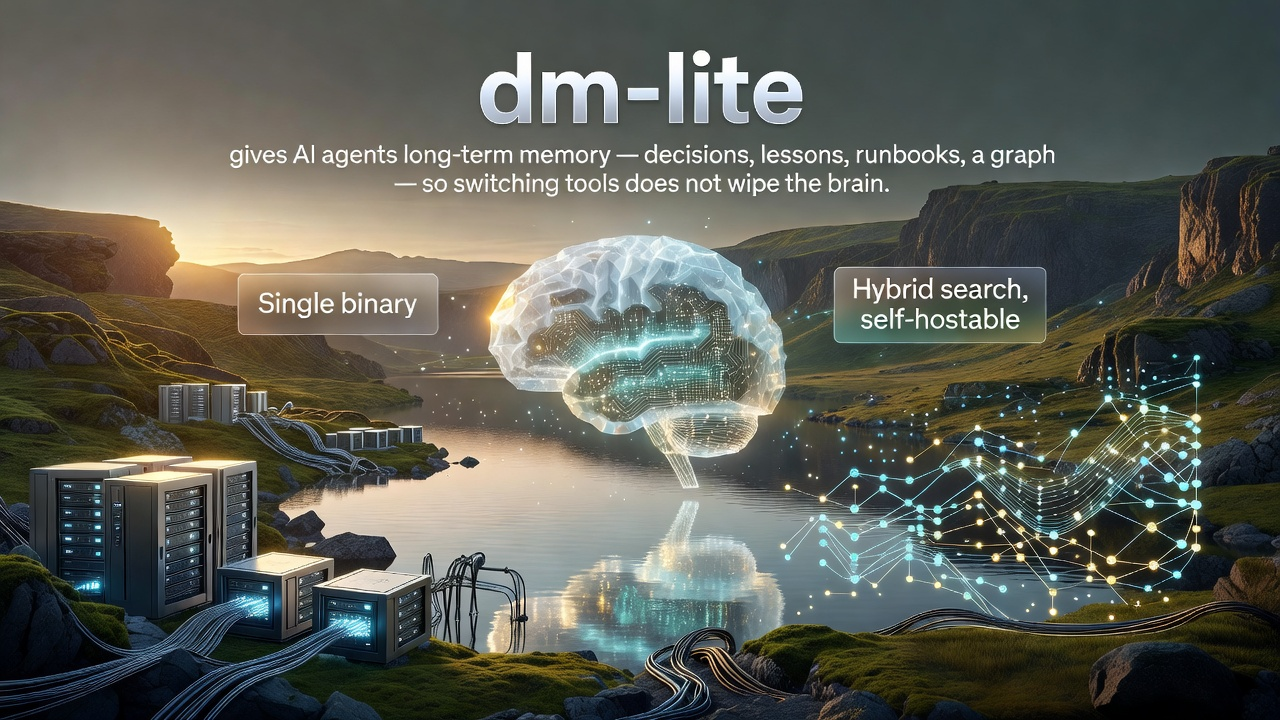
Memory for Hermes, Codex, Claude Code, OpenCode, Devin, Grok CLI, Claude Desktop, and any MCP agent. dm-lite is daimon-memory v2: one small typed memory engine in a single binary. Run dmem serve locally (a managed loopback daemon) or on a host, then point the CLI and agent hooks at it; local versus remote is just the URL. Hybrid recall (keyword and dense vector), bitemporal history, and multitenant storage (one database per tenant).
Features
- One memory across your AI tools: the same recall and capture in Hermes, Codex, Claude Code, Devin, OpenCode, Grok CLI, and Claude Desktop, with the integration built in (one command per tool), not left for you to wire yourself. Switch tools, keep the same brain. Any MCP client can connect too, and receives the persona and protocols, not only the tools.
- Typed, curated memory: decisions, lessons, incidents, runbooks, conventions, reminders, and more, each a first-class kind.
- Hybrid recall: SQLite FTS5 keyword search fused with dense vectors (candle + bge-small by default, via zvec), ranked together.
- A graph over your memory: link records and mint domain entities (org, product, person, and more), so a recall pulls in a hit's neighbours; browse it offline with
dmem ui. - Bitemporal: two time axes, when a fact is true in the world and when you recorded it. Backdate a fact, end its validity, and recall both what was true at a past moment and what you knew at one. Nothing is overwritten.
- Client/server in one binary: run it locally, or host it on a VPS, homelab, or cloud box and point your machines at it. Local or remote is just a URL.
- Multitenant: one database per tenant, token-only IAM (root admin plus per-tenant tokens), built-in TLS (no reverse proxy).
- Per-agent identity on a shared memory: a token can carry an agent label, so each agent is served its own persona (namespace
agents/<agent>/) while house rules, protocols, and the memory itself stay shared across the tenant; writes are attributed with anauthor:<agent>tag. - Self-updating:
dmem upgradepulls the latest release in place.
Quickstart
Grab the archive for your OS from the latest release. Each one holds dmem plus its native vector library; keep them together.
install -m755 dmem ~/.local/bin/dmem
cp libzvec_c_api.* ~/.local/bin/       # the lib must sit next to the binary
dmem setup                             # pick your agents, seed a first memory
Save and recall:
dmem remember "Devin is the Windsurf lineage"
dmem log_decision --title "Bet on zvec" --decision "use zvec as the vector store"
dmem recall "vector store decision"
Wire it into an agent (one command each, or --all):
dmem bootstrap --claude # or --codex / --hermes / --devin / --opencode / --claude-desktop / --all
Out of the box this runs on one machine: the server and your client live together. To run the server on one host and connect clients from elsewhere, see the wiki.
Requirements
Resource use is dominated by the embedding model the server keeps resident, not by the SQLite store. Live data is usually tens of megabytes on disk; process RSS is mostly model weights plus the vector index.
Prebuilt release binaries ship candle with default model BAAI/bge-small-en-v1.5. That is the supported out-of-the-box path. The same binary can load another 384-d Bert checkpoint via env (no recompile). You can also rebuild with a different embedder feature (model2vec, fastembed, or none for the hash placeholder) if you want a smaller footprint and accept the quality trade-off.
Figures below are order-of-magnitude, once warm, for a typical dmem serve on a small Linux VPS. OS, concurrent load, and corpus size move the needle; check dmem doctor and your process monitor on the real host.
| Setup | Typical process RSS | Languages / notes |
|---|---|---|
Prebuilt default: candle + BAAI/bge-small-en-v1.5 | ~0.8-1.2 GiB | English-first. What the release ships. |
candle + intfloat/multilingual-e5-small (env override) | ~1.2-1.5 GiB | Strong pick for English + Malay (BM/MS) and other languages. Set mean pooling and e5 role prefixes (see wiki). |
| candle + other 384-d Bert (env override) | similar to model size | Any HF Bert checkpoint with tokenizer.json + 384-d hidden size. Match pooling/prefixes to the model card. |
Build with model2vec (e.g. potion-base-8M) | a few hundred MB | Much smaller; weaker semantic recall. |
| No real embedder (hash placeholder) | tens of MB | Keyword/FTS only. Not for production semantic recall. |
Client-only against a remote dmem serve | negligible local model RAM | Embeddings run on the server. |
Disk: model cache is separate from the store (default bge weights ~130 MB on disk; multilingual checkpoints are often larger). After switching models, run dmem reindex-embeddings so old and new vectors share one space.
Details, offline cache, and env knobs: wiki Embedding models.
Per-agent identity (shared memory, separate personas)
Several agents can share one tenant's memory while each receives only its own persona. Mint a token per agent (dmem admin add <tenant> --agent izu, or the env form DM_TOKEN_<TENANT>__<AGENT>=secret - double underscore separates tenant from agent). An agent-labelled token cannot read another agent's agents/<other>/... tree through ANY surface (recall, recent, history, graph expansion - not just the persona route), cannot write into it, and cannot forget/invalidate records there; its writes are stamped with an author:<agent> tag. Everything OUTSIDE the agents/ tree is one shared pool by design - the shared brain is the point, so do not put per-agent secrets in shared namespaces, and do not share a tenant with agents or users you don't trust (see Security model). Agent-less tokens keep the full legacy behaviour.
Offline / air-gapped
Hybrid recall uses a small embedding model (prebuilt default: BAAI/bge-small-en-v1.5, about 130 MB on disk), downloaded from HuggingFace on first use. Check readiness before deploying to a sealed network:
dmem doctor          # active embedder, model, cache dir, whether it is already cached, CPU features
dmem doctor --json   # the same, machine-parseable
To run offline, pre-populate the model cache once on a connected machine, then carry it over (or point at a shared path):
# Pre-warm the cache (run once with network), then start dmem offline:
HF_HOME=/srv/hf-cache python -c \
  "from huggingface_hub import snapshot_download; snapshot_download('BAAI/bge-small-en-v1.5')"
HF_HOME=/srv/hf-cache dmem serve --addr 127.0.0.1:8088
dmem honours HF_HOME and HUGGINGFACE_HUB_CACHE (it uses the standard HuggingFace cache), and dmem serve logs the cache dir and model on startup. dmem doctor prints the exact directory it expects and whether the model is present, so you know up front if a first run needs network.
For CI and scripted ops, point any command at a server without editing the config: dmem --endpoint https://memory.example.com recall "x" (overrides DM_ENDPOINT; the token comes from DM_TOKEN or the config).
Security model
The trust boundaries, plainly:
- Tenant = the hard boundary. One tenant, one SQLite database, one vector index. Nothing crosses tenants.
- Scope = the partition inside a tenant (design doc: daimon-docs, dm-lite/scope-primitive.md): per-record audience labels, server-stamped writes, grant-filtered reads. Scoped tokens cannot write global; adapter tokens assert a reader's scopes per request.
- Agent label = persona protection + attribution, not a general ACL. The
agents/tree is isolated per agent; everything else in the tenant is a shared pool. Share a tenant only with mutually-trusted agents/users: anything a member writes can reach every member's context (shared brains share prompt-injection surface too). - Transport:
dmem serverefuses plain HTTP on a non-loopback bind unless you pass--allow-insecure-http. Use--tls-generateor bring your own cert. - Startup is fail-closed: an unopenable IAM database refuses to start (revocation would not be enforced) unless you pass
--allow-env-only;DM_TOKEN_*env secrets under 16 characters are rejected outright. - Tokens: prefer
dmem login <url>with$DM_LOGIN_TOKENor the prompt - a positional token lands in shell history andps. - Files: tenant DBs and
iam.dbare created/re-chmodded 0600 on Unix. On Windows there is no ACL tightening yet - rely on the account boundary. - The local graph viewer (
dmem ui) has no auth by design: keep it on the default loopback bind and reach it over an SSH tunnel. It rejects DNS-name Host headers (rebinding guard); IP-literal and localhost Hosts are allowed.
Docs
Full documentation is in the project wiki: install and first run, wiring each agent, run as a server, run as a client, embedding models and footprint, multitenant admin, persona and governance, migrating from v1, upgrading, and building from source.
License: MIT. See also CONTRIBUTING, CODE_OF_CONDUCT, and SECURITY.
Contributors

151 commits
Similar repos


Languages
Rust
96.0%
HTML
3.5%
Memory for Hermes, Codex, Claude Code, OpenCode, Devin, and any MCP agent. daimon-memory v2: one binary, local or remote server, hybrid keyword+vector recall, bitemporal, multitenant.
Rust
17
151 commits
updated Aug 25, 2026
README
dm-lite
Memory for Hermes, Codex, Claude Code, OpenCode, Devin, Grok CLI, Claude Desktop, and any MCP agent. dm-lite is daimon-memory v2: one small typed memory engine in a single binary. Run dmem serve locally (a managed loopback daemon) or on a host, then point the CLI and agent hooks at it; local versus remote is just the URL. Hybrid recall (keyword and dense vector), bitemporal history, and multitenant storage (one database per tenant).
Features
- One memory across your AI tools: the same recall and capture in Hermes, Codex, Claude Code, Devin, OpenCode, Grok CLI, and Claude Desktop, with the integration built in (one command per tool), not left for you to wire yourself. Switch tools, keep the same brain. Any MCP client can connect too, and receives the persona and protocols, not only the tools.
- Typed, curated memory: decisions, lessons, incidents, runbooks, conventions, reminders, and more, each a first-class kind.
- Hybrid recall: SQLite FTS5 keyword search fused with dense vectors (candle + bge-small by default, via zvec), ranked together.
- A graph over your memory: link records and mint domain entities (org, product, person, and more), so a recall pulls in a hit's neighbours; browse it offline with
dmem ui. - Bitemporal: two time axes, when a fact is true in the world and when you recorded it. Backdate a fact, end its validity, and recall both what was true at a past moment and what you knew at one. Nothing is overwritten.
- Client/server in one binary: run it locally, or host it on a VPS, homelab, or cloud box and point your machines at it. Local or remote is just a URL.
- Multitenant: one database per tenant, token-only IAM (root admin plus per-tenant tokens), built-in TLS (no reverse proxy).
- Per-agent identity on a shared memory: a token can carry an agent label, so each agent is served its own persona (namespace
agents/<agent>/) while house rules, protocols, and the memory itself stay shared across the tenant; writes are attributed with anauthor:<agent>tag. - Self-updating:
dmem upgradepulls the latest release in place.
Quickstart
Grab the archive for your OS from the latest release. Each one holds dmem plus its native vector library; keep them together.
install -m755 dmem ~/.local/bin/dmem
cp libzvec_c_api.* ~/.local/bin/       # the lib must sit next to the binary
dmem setup                             # pick your agents, seed a first memory
Save and recall:
dmem remember "Devin is the Windsurf lineage"
dmem log_decision --title "Bet on zvec" --decision "use zvec as the vector store"
dmem recall "vector store decision"
Wire it into an agent (one command each, or --all):
dmem bootstrap --claude # or --codex / --hermes / --devin / --opencode / --claude-desktop / --all
Out of the box this runs on one machine: the server and your client live together. To run the server on one host and connect clients from elsewhere, see the wiki.
Requirements
Resource use is dominated by the embedding model the server keeps resident, not by the SQLite store. Live data is usually tens of megabytes on disk; process RSS is mostly model weights plus the vector index.
Prebuilt release binaries ship candle with default model BAAI/bge-small-en-v1.5. That is the supported out-of-the-box path. The same binary can load another 384-d Bert checkpoint via env (no recompile). You can also rebuild with a different embedder feature (model2vec, fastembed, or none for the hash placeholder) if you want a smaller footprint and accept the quality trade-off.
Figures below are order-of-magnitude, once warm, for a typical dmem serve on a small Linux VPS. OS, concurrent load, and corpus size move the needle; check dmem doctor and your process monitor on the real host.
| Setup | Typical process RSS | Languages / notes |
|---|---|---|
Prebuilt default: candle + BAAI/bge-small-en-v1.5 | ~0.8-1.2 GiB | English-first. What the release ships. |
candle + intfloat/multilingual-e5-small (env override) | ~1.2-1.5 GiB | Strong pick for English + Malay (BM/MS) and other languages. Set mean pooling and e5 role prefixes (see wiki). |
| candle + other 384-d Bert (env override) | similar to model size | Any HF Bert checkpoint with tokenizer.json + 384-d hidden size. Match pooling/prefixes to the model card. |
Build with model2vec (e.g. potion-base-8M) | a few hundred MB | Much smaller; weaker semantic recall. |
| No real embedder (hash placeholder) | tens of MB | Keyword/FTS only. Not for production semantic recall. |
Client-only against a remote dmem serve | negligible local model RAM | Embeddings run on the server. |
Disk: model cache is separate from the store (default bge weights ~130 MB on disk; multilingual checkpoints are often larger). After switching models, run dmem reindex-embeddings so old and new vectors share one space.
Details, offline cache, and env knobs: wiki Embedding models.
Per-agent identity (shared memory, separate personas)
Several agents can share one tenant's memory while each receives only its own persona. Mint a token per agent (dmem admin add <tenant> --agent izu, or the env form DM_TOKEN_<TENANT>__<AGENT>=secret - double underscore separates tenant from agent). An agent-labelled token cannot read another agent's agents/<other>/... tree through ANY surface (recall, recent, history, graph expansion - not just the persona route), cannot write into it, and cannot forget/invalidate records there; its writes are stamped with an author:<agent> tag. Everything OUTSIDE the agents/ tree is one shared pool by design - the shared brain is the point, so do not put per-agent secrets in shared namespaces, and do not share a tenant with agents or users you don't trust (see Security model). Agent-less tokens keep the full legacy behaviour.
Offline / air-gapped
Hybrid recall uses a small embedding model (prebuilt default: BAAI/bge-small-en-v1.5, about 130 MB on disk), downloaded from HuggingFace on first use. Check readiness before deploying to a sealed network:
dmem doctor          # active embedder, model, cache dir, whether it is already cached, CPU features
dmem doctor --json   # the same, machine-parseable
To run offline, pre-populate the model cache once on a connected machine, then carry it over (or point at a shared path):
# Pre-warm the cache (run once with network), then start dmem offline:
HF_HOME=/srv/hf-cache python -c \
  "from huggingface_hub import snapshot_download; snapshot_download('BAAI/bge-small-en-v1.5')"
HF_HOME=/srv/hf-cache dmem serve --addr 127.0.0.1:8088
dmem honours HF_HOME and HUGGINGFACE_HUB_CACHE (it uses the standard HuggingFace cache), and dmem serve logs the cache dir and model on startup. dmem doctor prints the exact directory it expects and whether the model is present, so you know up front if a first run needs network.
For CI and scripted ops, point any command at a server without editing the config: dmem --endpoint https://memory.example.com recall "x" (overrides DM_ENDPOINT; the token comes from DM_TOKEN or the config).
Security model
The trust boundaries, plainly:
- Tenant = the hard boundary. One tenant, one SQLite database, one vector index. Nothing crosses tenants.
- Scope = the partition inside a tenant (design doc: daimon-docs, dm-lite/scope-primitive.md): per-record audience labels, server-stamped writes, grant-filtered reads. Scoped tokens cannot write global; adapter tokens assert a reader's scopes per request.
- Agent label = persona protection + attribution, not a general ACL. The
agents/tree is isolated per agent; everything else in the tenant is a shared pool. Share a tenant only with mutually-trusted agents/users: anything a member writes can reach every member's context (shared brains share prompt-injection surface too). - Transport:
dmem serverefuses plain HTTP on a non-loopback bind unless you pass--allow-insecure-http. Use--tls-generateor bring your own cert. - Startup is fail-closed: an unopenable IAM database refuses to start (revocation would not be enforced) unless you pass
--allow-env-only;DM_TOKEN_*env secrets under 16 characters are rejected outright. - Tokens: prefer
dmem login <url>with$DM_LOGIN_TOKENor the prompt - a positional token lands in shell history andps. - Files: tenant DBs and
iam.dbare created/re-chmodded 0600 on Unix. On Windows there is no ACL tightening yet - rely on the account boundary. - The local graph viewer (
dmem ui) has no auth by design: keep it on the default loopback bind and reach it over an SSH tunnel. It rejects DNS-name Host headers (rebinding guard); IP-literal and localhost Hosts are allowed.
Docs
Full documentation is in the project wiki: install and first run, wiring each agent, run as a server, run as a client, embedding models and footprint, multitenant admin, persona and governance, migrating from v1, upgrading, and building from source.
License: MIT. See also CONTRIBUTING, CODE_OF_CONDUCT, and SECURITY.
Similar repos
Contributors
151 commits
Languages
Rust
96.0%
HTML
3.5%