
Self-hosted AI coding agent platform for GitLab, built with LangGraph. Reviews merge requests, resolves issues autonomously, and chats with full project context.
See the codeSee what people are saying
README
langgraph-harness
Self-hosted AI coding agent platform for GitLab, built with LangGraph
Reviews merge requests, resolves work items and tasks autonomously, and chats with full project context — remembering what matters so every run builds on the last.
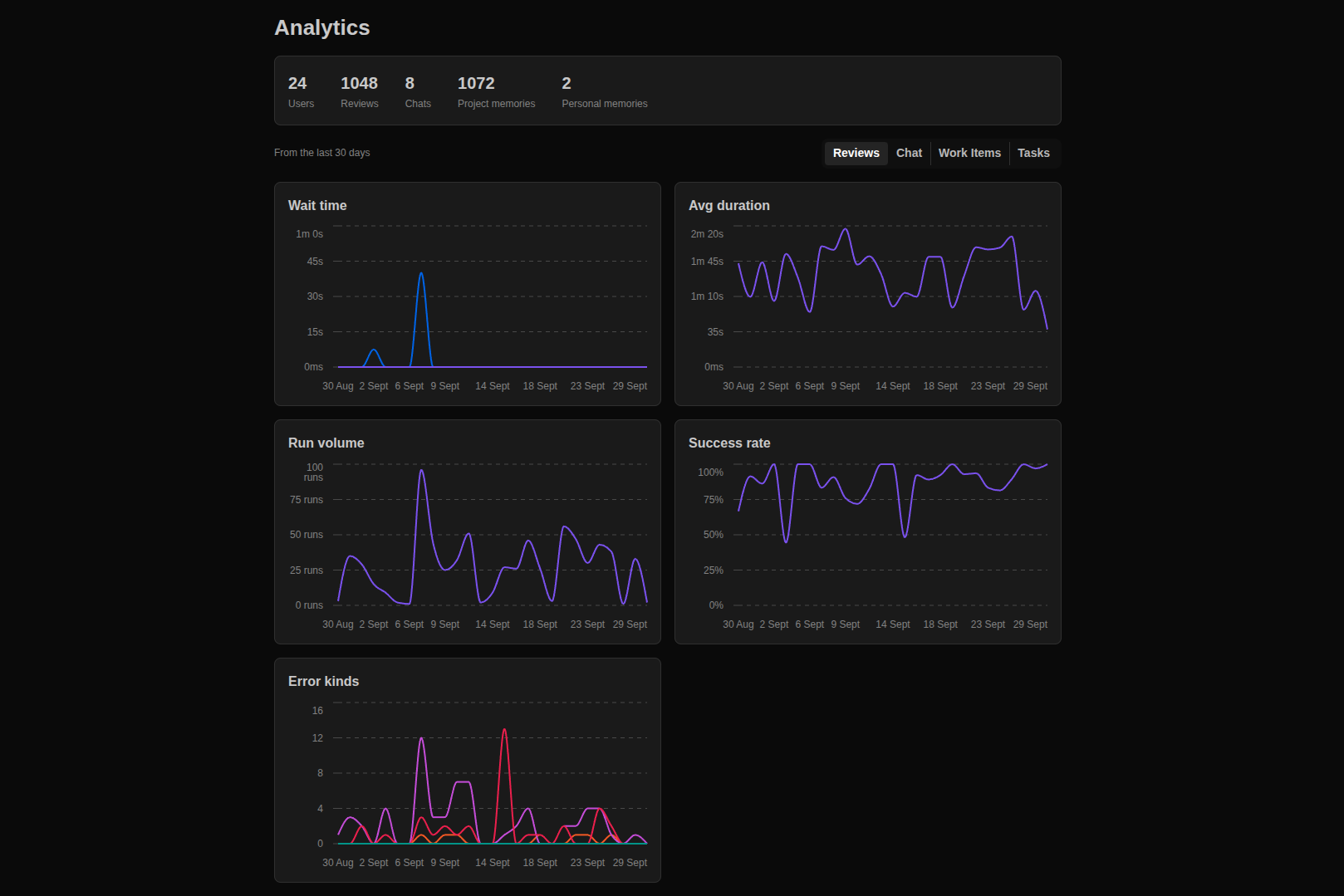
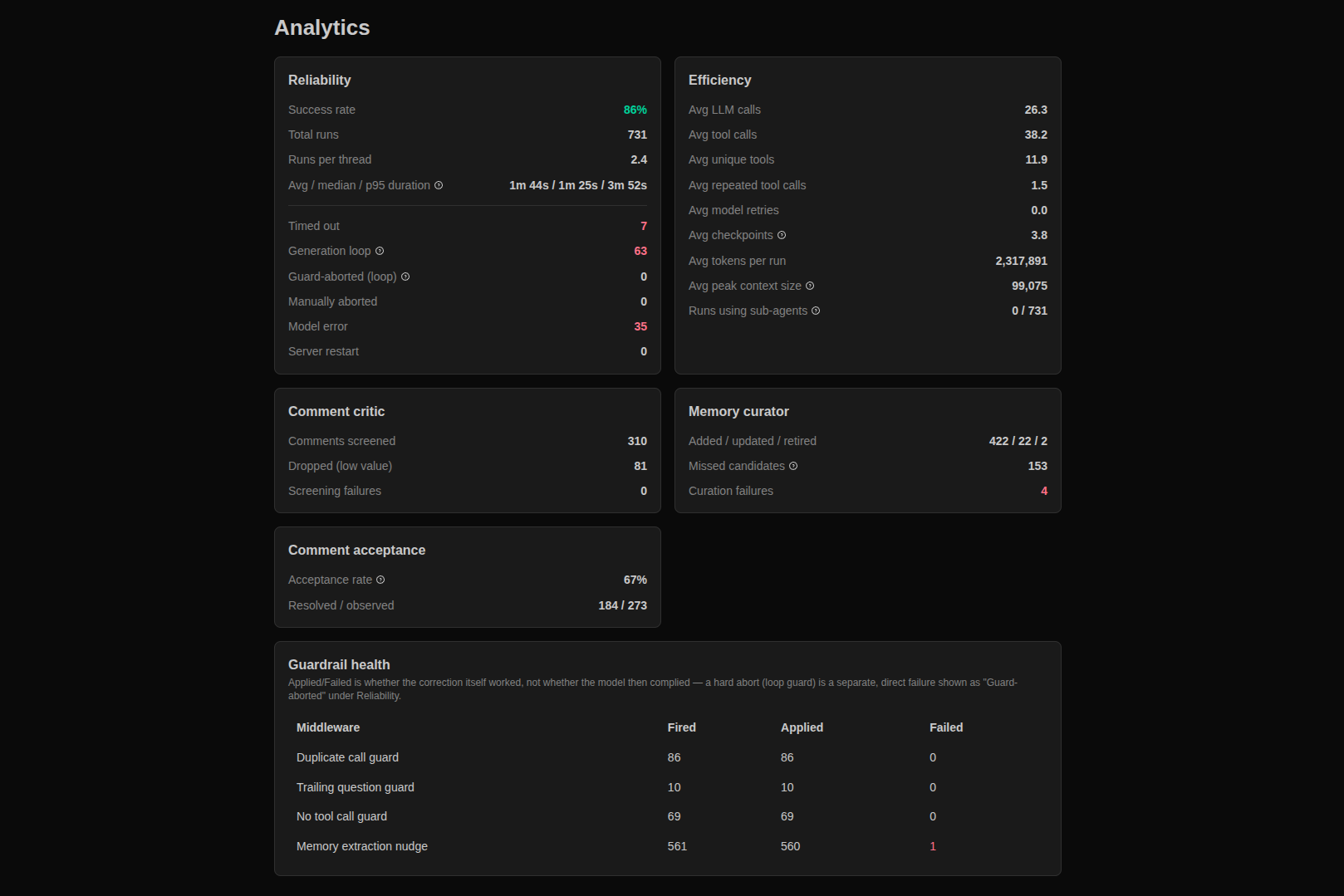
Battle-tested in production since mid-2026 — 133 releases, 1k+ reviews, 67% comment acceptance rate (Sept 29 2026, see snapshot). Development history → every failure and fix, documented.



Docs · Getting Started · Features · Screenshots · Screencasts
https://github.com/user-attachments/assets/5cb90928-054c-498e-bcfb-81d21a49f7f1
Not affiliated with LangChain. See DISCLAIMER.md.
What it does
Four harnesses, one shared foundation:
- 🔍 MR Review — fires on webhook events, reads the diff, drafts comments, publishes them. No polling, no manual trigger.
- 🛠️ Work Item Resolve — assign a GitLab issue or task and get an agent that runs inside its own Kata Containers VM (a dedicated guest kernel per sandbox, not just syscall interception), opens a draft MR, and keeps responding to follow-up comments on the same branch.
- 📋 Task Resolve — the same sandboxed loop, started from a free-text instruction instead of a GitLab issue — on demand or on a recurring schedule.
- 💬 Chat — an interactive, GitLab-aware assistant with real tool access: GitLab data, a headless browser, its own review/chat history; sensitive tool calls pause for explicit human approval before running.
Shared foundation: every drafted comment is screened before it posts; a run that misbehaves (repeats a call, loops, ends on a question, skips a check) gets caught and corrected mid-run — backed by persistent checkpoints, so a run resumes instead of restarting from scratch.
Full breakdown: Features · Architecture
Screenshots
More in the screenshots gallery.
Roadmap
- Automatic MR reviews, issue-to-draft-MR, on-demand tasks, and a GitLab-aware chat
- Isolated sandbox for code-changing runs, with human approval before Chat takes sensitive actions
- Project memory that carries across reviews, and crashed runs that resume instead of restarting
- Recurring scheduled tasks
- GitHub support: assign an issue to the bot, get a draft PR (#35)
- Project memory that keeps itself up to date, with visibility into what it learned (#2)
- A self-hosted memory engine that links related facts and retrieves them by relevance (#1)
- Web search, so agents can look things up instead of only fetching a known page (#24)
Everything else is tracked in open issues.
Stack
- Frontend — React admin UI (Dashboard, Threads, Chat, Workflows) for monitoring runs and chatting directly with the agent
- Backend — Elysia API server running a LangGraph agent with persistent checkpoints
- Agent — Multi-provider LLM (OpenRouter, Gemini, Groq, Ollama, or sglang) with GitLab MCP tools and skill-based workflows
- Queue — BullMQ; debounced re-reviews, capped concurrency, live queue state in the UI
- Memory — context engineering for GitLab: durable, project-scoped facts learned across reviews; personal memory in Chat
Quick Start
Prerequisites: Node.js 22+, Docker, a GitLab PAT (api scope), a GitLab OAuth app, and an OpenRouter/Gemini/Groq key or a local Ollama/sglang instance.
npm install
cp backend/.env.example backend/.env
# fill in GITLAB_PAT, GITLAB_OAUTH_CLIENT_ID/SECRET, SESSION_SECRET, SECRETS_ENCRYPTION_KEY,
# ADMIN_GITLAB_USERNAMES, and one of OPENROUTER_API_KEY / GEMINI_API_KEY / GROQ_API_KEY / OLLAMA_BASE_URL / SGLANG_BASE_URL
npm run dev
Frontend at http://localhost:5173, API at http://localhost:3698.
Full walkthrough — GitLab OAuth app setup, webhook config, per-repo .harness.yml: Getting Started.
Deployment & CI/CD
Self-hosted via Docker Compose; production deploys are automated through GitLab CI on push. See Deployment for server setup, and sglang Deployment if self-hosting the LLM backend.
The Story
Curious how this got built? The Story So Far.
"LangGraph" is a trademark of LangChain, Inc., used here under nominative fair use to describe the framework this project is built on. This project is independent and not affiliated with LangChain, Inc. — see DISCLAIMER.md. Licensed under the MIT License.
Similar repos


Self-hosted AI coding agent platform for GitLab, built with LangGraph. Reviews merge requests, resolves issues autonomously, and chats with full project context.
See the codeSee what people are saying
README
langgraph-harness
Self-hosted AI coding agent platform for GitLab, built with LangGraph
Reviews merge requests, resolves work items and tasks autonomously, and chats with full project context — remembering what matters so every run builds on the last.
Battle-tested in production since mid-2026 — 133 releases, 1k+ reviews, 67% comment acceptance rate (Sept 29 2026, see snapshot). Development history → every failure and fix, documented.
Docs · Getting Started · Features · Screenshots · Screencasts
https://github.com/user-attachments/assets/5cb90928-054c-498e-bcfb-81d21a49f7f1
Not affiliated with LangChain. See DISCLAIMER.md.
What it does
Four harnesses, one shared foundation:
- 🔍 MR Review — fires on webhook events, reads the diff, drafts comments, publishes them. No polling, no manual trigger.
- 🛠️ Work Item Resolve — assign a GitLab issue or task and get an agent that runs inside its own Kata Containers VM (a dedicated guest kernel per sandbox, not just syscall interception), opens a draft MR, and keeps responding to follow-up comments on the same branch.
- 📋 Task Resolve — the same sandboxed loop, started from a free-text instruction instead of a GitLab issue — on demand or on a recurring schedule.
- 💬 Chat — an interactive, GitLab-aware assistant with real tool access: GitLab data, a headless browser, its own review/chat history; sensitive tool calls pause for explicit human approval before running.
Shared foundation: every drafted comment is screened before it posts; a run that misbehaves (repeats a call, loops, ends on a question, skips a check) gets caught and corrected mid-run — backed by persistent checkpoints, so a run resumes instead of restarting from scratch.
Full breakdown: Features · Architecture
Screenshots
More in the screenshots gallery.
Roadmap
- Automatic MR reviews, issue-to-draft-MR, on-demand tasks, and a GitLab-aware chat
- Isolated sandbox for code-changing runs, with human approval before Chat takes sensitive actions
- Project memory that carries across reviews, and crashed runs that resume instead of restarting
- Recurring scheduled tasks
- GitHub support: assign an issue to the bot, get a draft PR (#35)
- Project memory that keeps itself up to date, with visibility into what it learned (#2)
- A self-hosted memory engine that links related facts and retrieves them by relevance (#1)
- Web search, so agents can look things up instead of only fetching a known page (#24)
Everything else is tracked in open issues.
Stack
- Frontend — React admin UI (Dashboard, Threads, Chat, Workflows) for monitoring runs and chatting directly with the agent
- Backend — Elysia API server running a LangGraph agent with persistent checkpoints
- Agent — Multi-provider LLM (OpenRouter, Gemini, Groq, Ollama, or sglang) with GitLab MCP tools and skill-based workflows
- Queue — BullMQ; debounced re-reviews, capped concurrency, live queue state in the UI
- Memory — context engineering for GitLab: durable, project-scoped facts learned across reviews; personal memory in Chat
Quick Start
Prerequisites: Node.js 22+, Docker, a GitLab PAT (api scope), a GitLab OAuth app, and an OpenRouter/Gemini/Groq key or a local Ollama/sglang instance.
npm install
cp backend/.env.example backend/.env
# fill in GITLAB_PAT, GITLAB_OAUTH_CLIENT_ID/SECRET, SESSION_SECRET, SECRETS_ENCRYPTION_KEY,
# ADMIN_GITLAB_USERNAMES, and one of OPENROUTER_API_KEY / GEMINI_API_KEY / GROQ_API_KEY / OLLAMA_BASE_URL / SGLANG_BASE_URL
npm run dev
Frontend at http://localhost:5173, API at http://localhost:3698.
Full walkthrough — GitLab OAuth app setup, webhook config, per-repo .harness.yml: Getting Started.
Deployment & CI/CD
Self-hosted via Docker Compose; production deploys are automated through GitLab CI on push. See Deployment for server setup, and sglang Deployment if self-hosting the LLM backend.
The Story
Curious how this got built? The Story So Far.
"LangGraph" is a trademark of LangChain, Inc., used here under nominative fair use to describe the framework this project is built on. This project is independent and not affiliated with LangChain, Inc. — see DISCLAIMER.md. Licensed under the MIT License.