
A self-hostable, collaborative travel planner
See the codeSee what people are saying
README
wander
A self-hostable, collaborative travel planner. Spring Boot 4 + Angular 22, one container, one Postgres.
A self-hosted, collaborative travel planner.
Plan trips together, organize itineraries, manage bookings, expenses, and packing lists — while keeping control of your data.

Why Wander?
Wander is an open-source travel planner designed for people who want a collaborative travel-planning experience without giving up control of their data.
- Self-hosted
- Collaborative trip planning
- Real-time synchronization
- Itineraries and activities
- Bookings
- Expenses
- Packing lists
- Sharing and invitation-based access
- Offline reading
- Backup support
- Progressive Web App (PWA)
Try Wander
Visit meridianx.co.in to learn more about Wander and explore the application.
Features
Plan the trip
- Days are derived from the date range, never stored - and moving the dates carries the itinerary with them rather than stranding it
- Places on a day: add, rename, annotate and drag into order - within a day or into another one, with buttons as the equal keyboard path
- A note on each day, what the day cost, and the forecast when there is one
- Place search over Nominatim, proxied and cached, so a place keeps the coordinates of the candidate you actually picked
- A vector map beside the itinerary, so a place abroad is labelled in your language and as it appears on the signs
- Place enrichment from OpenStreetMap, Wikidata, Wikipedia and Commons - description, hours, website and photographs, each with its source and licence
Go together
- Members by email, owner / editor / viewer roles, and handing the trip over
- Invitation links for people with no account here: single-use, expiring, revocable, delivered by whatever you already use to talk to them
- Live sync over a WebSocket - two people on one trip see each other's edits without reloading
- A packing list of shared and per-person items, ticked off live
Money, without a rounding bug
- Integer minor units everywhere, equal or exact splits, balances, and who-owes-whom reduced to the fewest payments - plus recording those payments
- Pay in another currency and it converts once at the rate of that day, then frozen on the expense, so editing it later cannot move anybody's balance
Bookings
- Flights, trains, hotels and tables stored as an instant plus the zone they were booked in - a flight keeps London time for departure and Tokyo time for arrival - and the list is ordered by when things really happen
- Read a booking out of a confirmation: email, PDF, HTML, calendar attachment or Apple Wallet pass, via KDE's KItinerary. It fills in the form and saves nothing until you do
Take it with you
- Sort a day by travel time over an OSRM you point wander at, with locked stops - proposed, never applied behind your back - then open the finished order in Google Maps
- Print it, or save a PDF: a day-by-day document with bookings, references and phone numbers folded onto the days they happen on
- Export GPX, the whole trip or one day, for OsmAnd, Organic Maps or a GPS
- Offline reading - a trip you have opened stays readable with no signal, honestly labelled with how old the copy is
- Installable to a home screen or a dock, in its own window
Run it yourself
- One container: the Angular app ships inside the boot jar, beside one Postgres
- No API keys anywhere. OpenFreeMap, Nominatim, Open-Meteo and Frankfurter all work as shipped, and each is a setting you can point elsewhere
- Session-cookie auth with CSRF and sessions in Postgres, so a restart signs nobody out; self-signup off by default, and password guessing throttled
- An admin surface: see the accounts, take one out of service, promote somebody, and mint a single-use password-reset link - or let people request one themselves once you give it an SMTP relay
- Nightly backups, verified by reading each dump back, with a restore procedure that has actually been run
- Light / dark / follow-the-OS theming, all driven by design tokens
What it looks like
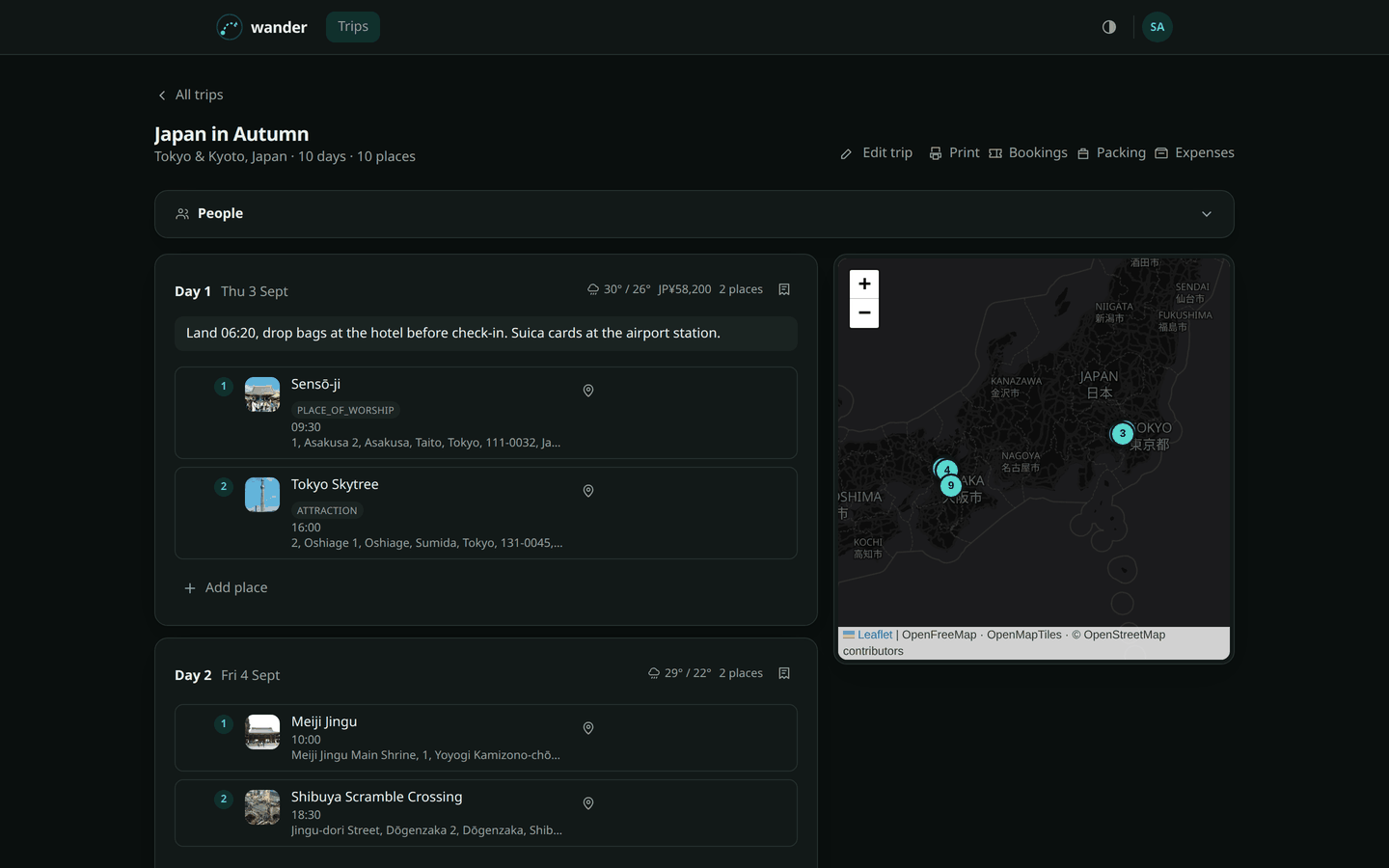
The itinerary: derived days, places in the order you dragged them, what each day cost, the forecast when there is one, and a map beside it drawn from vector tiles so places abroad are labelled in your language and as they appear on the signs.
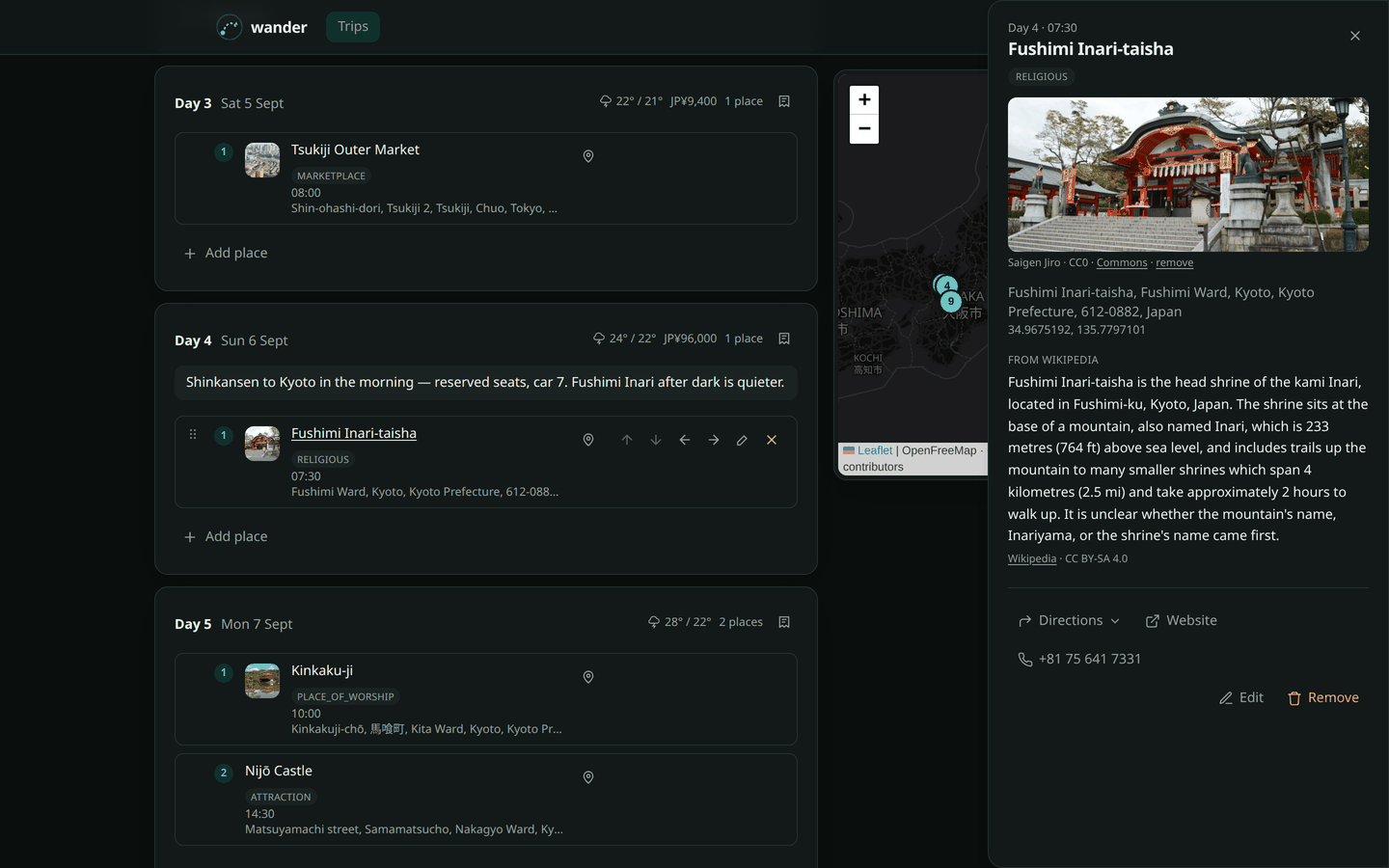
Open a place and wander asks OpenStreetMap, Wikidata, Wikipedia and Commons about it. Every photograph carries its photographer and its licence, because a Commons image is licensed per image - one without its credit is a picture this project has no right to draw.
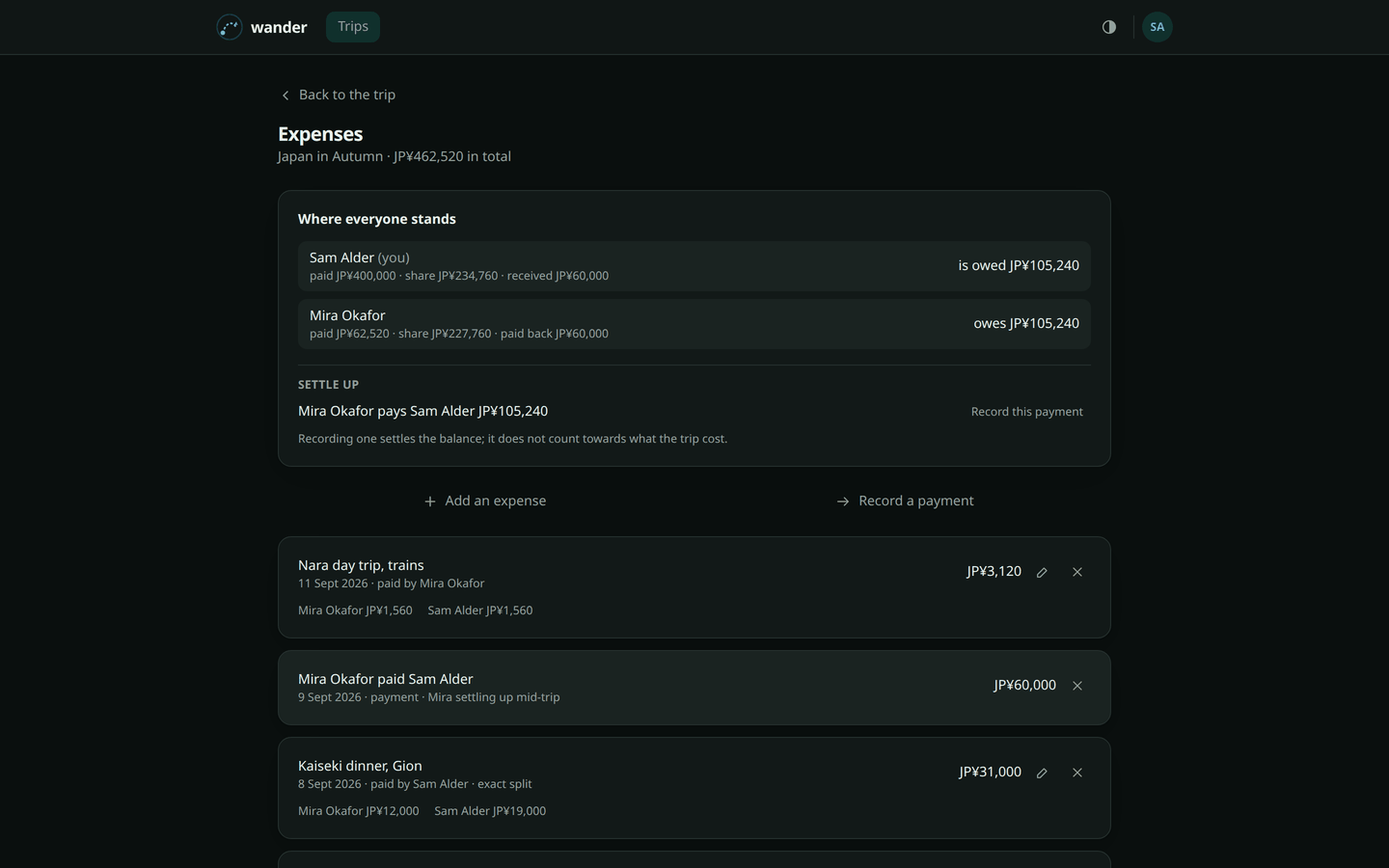
Money, where a rounding bug would be silent and permanent. Integer minor units everywhere, all the arithmetic server-side, and four figures kept apart so a balance never reads as a lie: what you paid, what your share was, and what has been paid back.
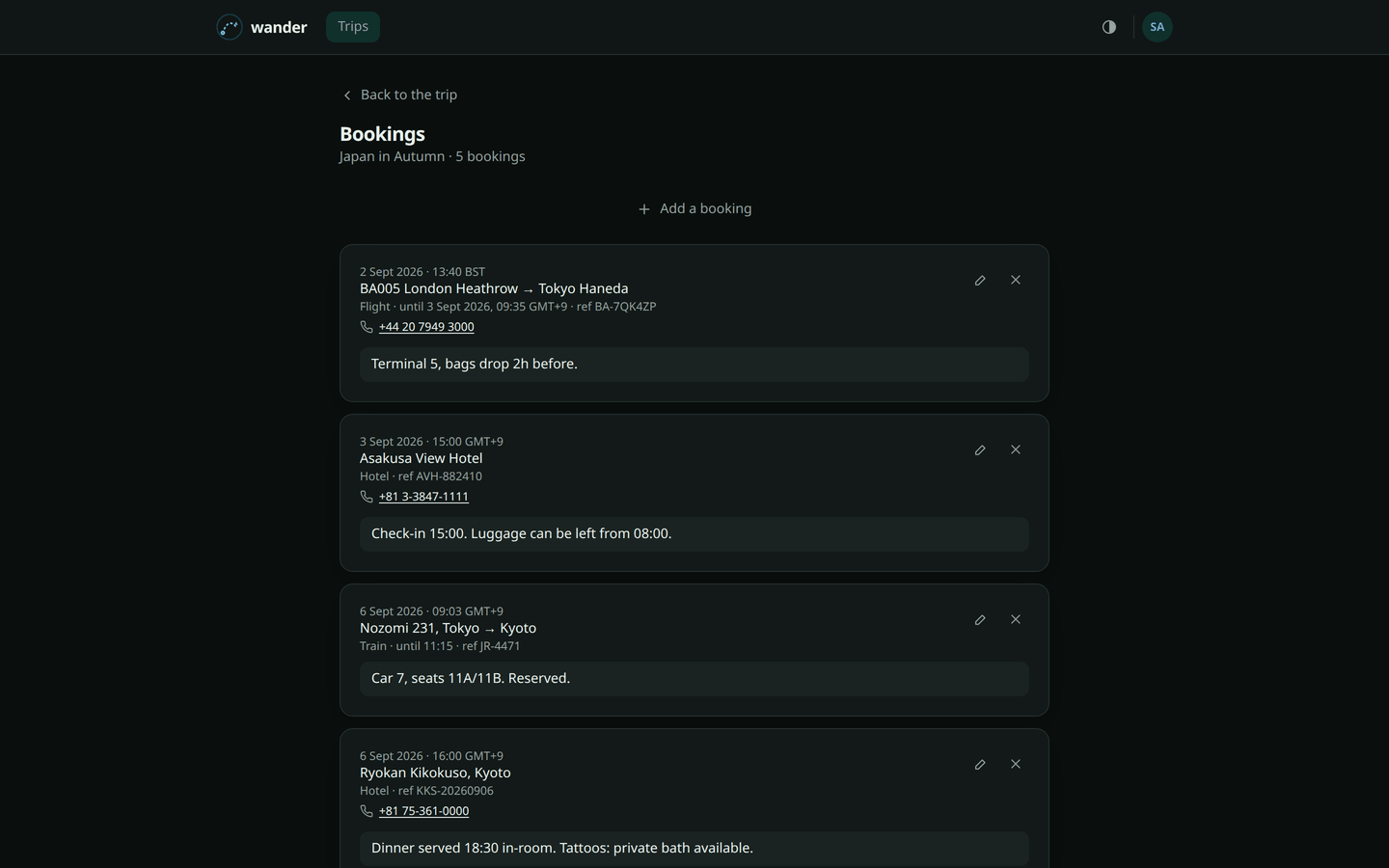
Bookings are stored as an instant plus the zone they were booked in, so a flight keeps London time for its departure and Tokyo time for its arrival - and the list is ordered by when things really happen.
More: the trip list · packing · the printable itinerary
Try it without installing anything
Turn on the demo and wander seeds a worked example trip - an itinerary with photographs and a map, two people splitting expenses unevenly, a packing list, and a flight that lands in another timezone - plus a read-only account to look at it with. The sign-in page then offers it, credentials and all.
WANDER_DEMO_ENABLED=true docker compose up -d
The published account is a viewer on that trip, which the server enforces the same way it would for anybody else - the READ ONLY badge you will meet is the real thing, not a demo mode. It re-seeds on every boot, so restarting the container resets the demo and re-dates the trip; it needs that, because a forecast only exists about sixteen days out.
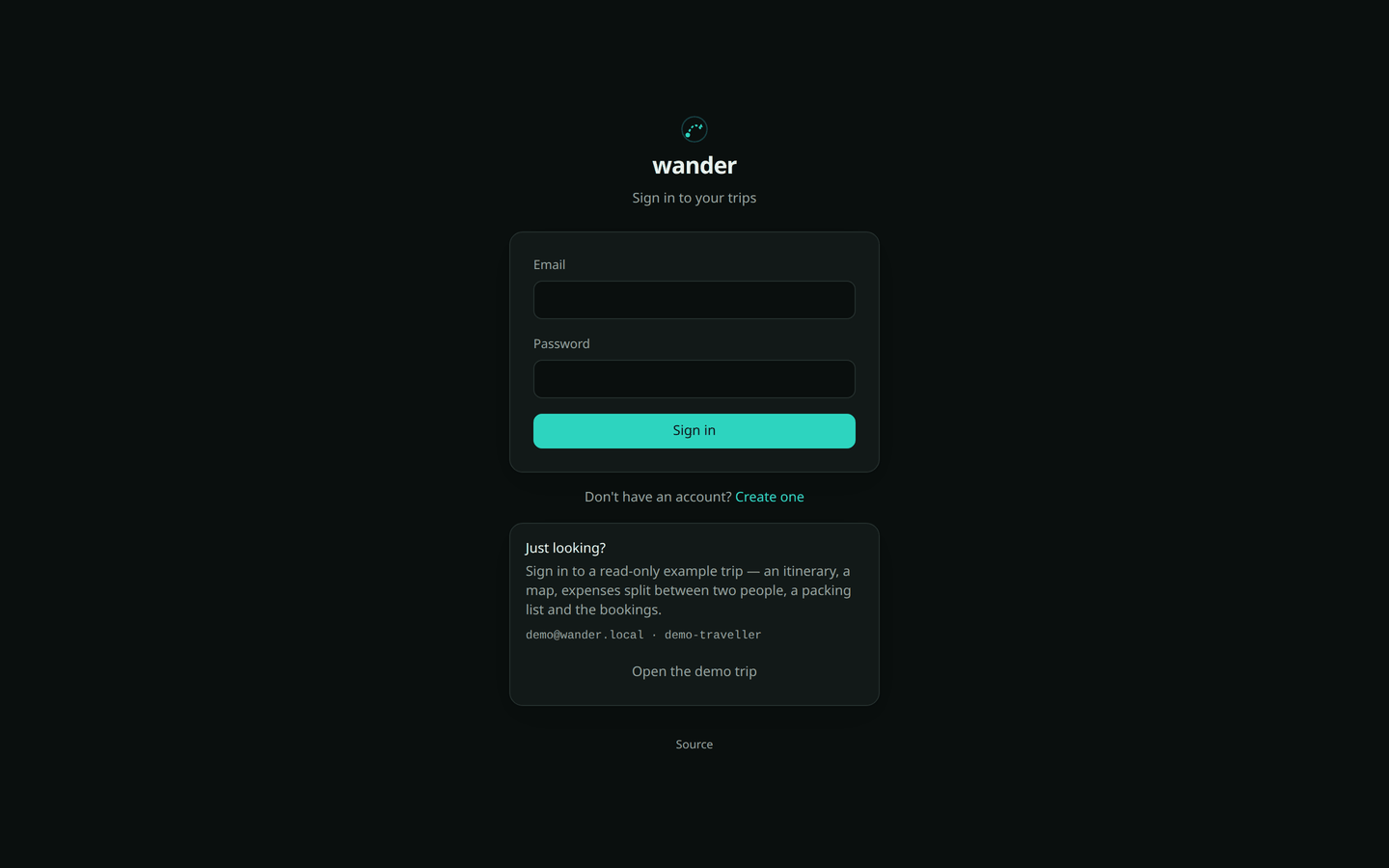
Off by default: it writes rows, so it is for a demo box rather than your real
instance. See WANDER_DEMO_* in .env.example.
Run it
cp .env.example .env          # then set POSTGRES_PASSWORD
docker compose up -d
docker compose logs wander    # the generated admin password is printed once
Open http://localhost:8080.
Sign-ups are off by default. The first admin comes from that log line; anybody
else joins by opening an invitation link, which admits its holder even with
self-signup switched off. Set WANDER_REGISTRATION_ENABLED=true in .env for a
private box you would rather have an open sign-up form on - and note the browser
suite creates its accounts by registering, so an instance you run npm run e2e
against needs it on.
Before you put it on the internet
Five things, and none of them is a code change:
-
POSTGRES_PASSWORDis notchange-me. -
WANDER_SITE_ADDRESSis your hostname andWANDER_COOKIE_SECURE=true. They move together; see the note in.env.examplefor what happens if only one of them does. -
Decide how a forgotten password gets recovered. Somebody signed in can change their own (Account, from the avatar in the header). Somebody who has forgotten it has two possible routes, and which ones exist is your choice.
By default there is one: you. From Accounts in the same menu, an admin mints a single-use link and delivers it however they already talk to that person, exactly as an invitation link works. Nobody edits
users.password_hashby hand, and an instance can have more than one administrator, so losing one account's password is not losing the instance. The limit is that recovery goes through a human - which pairs with sign-ups being off by default, and keeps two facts in step: the people with accounts are people you can reach.Set
WANDER_MAIL_ENABLED=truewith an SMTP relay and there is a second: a "Forgot password?" link that mails the same kind of link to the address on the account. This is what makes self-signup survivable at any size, since an instance strangers can join is one where recovery cannot go through you. The endpoint answers identically for an address it knows and one it does not- it will never confirm who has an account here - so the page can only say
"if that address has an account, a link is on its way". See
.env.examplefor which relay to pick; there is no provider in the code, only SMTP.
- it will never confirm who has an account here - so the page can only say
"if that address has an account, a link is on its way". See
-
The backups are on the same disk as the database. They survive a bad migration, a wrong
DELETEand a corrupted table; they do not survive losing the machine. Copy them off it - see below. -
Booking import parses files your members upload. A confirmation is fed to KItinerary, and behind it poppler for PDFs and ZXing for barcodes - libraries with a long history of parser bugs, doing exactly the thing they are bad at. It runs as a short-lived subprocess with a timeout, as the non-root application user, and the upload is never written to persistent storage, so a malformed file kills a child process rather than the instance. That is a deliberate trade rather than a non-issue: only a signed-in member who can already edit that trip can reach it.
WANDER_IMPORT_ENABLED=falseturns it off entirely if you would rather nothing here parsed an upload - the feature simply stops being offered.
/api/auth/login throttles guesses on its own: failed sign-ins are counted per
account and per client address and refused with a 429 past ten and forty of them
in a quarter of an hour, and any success clears both counts. It is not a lockout,
deliberately - see point 3 for why one would be unrecoverable.
If you turn sign-ups on
WANDER_REGISTRATION_ENABLED=true opens the form to anyone who finds the
hostname, so four things carry the weight once it is on. All four are on by
default; the settings are in .env.example.
- Creating accounts is metered per address, twenty in a quarter of an hour, counted whether the sign-up succeeds or not. The endpoint is anonymous and spends a bcrypt round on every call, so an unmetered one is both a way to burn the machine's CPU and a way to fill its user table.
- The upstreams are metered per person. Place search, place enrichment and the forecast all run on somebody else's donated capacity, and that - rather than anything about accounts - is the real reason self-signup is off by default. Authentication alone stops nothing here once anybody can register.
- Passwords are checked against a list of the ones that get guessed. Ten
characters was the whole policy before, and
password12is ten characters. - The proxy overwrites
X-Forwarded-For. The Caddyfile in this repository does it; if you put something else in front, it has to as well. Without it the per-address counters above are set by whoever is calling, and a header is a cheap thing to rotate.
wander also sends a Content-Security-Policy, assembled from your configured map
hosts so that pointing at your own tile server does not blank the map. See
WANDER_CSP_REPORT_ONLY in .env.example for how to diagnose one that does.
Deploy it from the registry
A server needs no source checkout and no JDK. CI publishes the image for linux/amd64 and linux/arm64 - so an Ampere or Graviton free-tier box pulls the same tag as an x86 one - and the image carries its own deployment bundle:
mkdir -p /opt/wander && cd /opt/wander
docker run --rm ghcr.io/vahdamv0/wander:latest bundle | tar x

cp .env.example .env && $EDITOR .env    # WANDER_IMAGE, POSTGRES_PASSWORD, the site address
docker compose pull
docker compose up -d --no-build
The bundle is compose.yaml, the Caddyfile, the backup script, .env.example
and a DEPLOY.md - the same files this repository tests, copied into the image
at build time rather than kept as a second copy in a deployment repository. That
is the point: a compose file maintained separately from the image drifts, and the
symptom of drift is a stack that starts and is quietly wrong.
Cutting a release
main publishes :latest and :<short-sha> on every commit, and those images
call themselves dev - they are builds, not releases. A release is a tag:
git tag v0.2.0 && git push origin v0.2.0
That runs the same pipeline, publishes :v0.2.0 alongside :latest, and is the
only thing that gives the image a version. The account menu then reads
wander v0.2.0 · a1b2c3d - the tag and the commit it was built from - so
somebody reporting a problem can say what they are running without being asked to
SSH anywhere.
Updating later is ./update.sh from that directory: pull, restart, prune. Pin a
version by pointing WANDER_IMAGE at the commit tag CI pushes alongside
latest, and note that a rollback of the image does not roll back a migration
Flyway has already applied.
Use a deploy token with read_registry, not a personal access token - this
credential lives on an internet-facing machine, and a deploy token can be revoked
without disturbing your own access.
Develop
Needs JDK 21 and Node ≥ 22.22.3 (Angular 22's CLI refuses older). The Gradle build downloads its own pinned Node, so only the Angular CLI itself cares about your local version.
# 1. Postgres on :5432 with the credentials application.yml defaults to.
#    (Not `docker compose up -d db` - that one publishes no host port on
#    purpose, so the production stack keeps its database off the network.)
docker run -d --name wander-dev-db -p 5432:5432 \
  -e POSTGRES_DB=wander -e POSTGRES_USER=wander -e POSTGRES_PASSWORD=wander \
  postgres:17-alpine

# 2. API on :8080  (Flyway migrates on boot; an admin is seeded on first run)
./gradlew :api:bootRun

# 3. Angular dev server on :4200, proxying /api to :8080
cd web && npm install && npm start
Stop and reset the dev database with
docker rm -f wander-dev-db (its data is not on a volume, so this wipes it).
Useful commands:
./gradlew build                          # everything: frontend, jar, tests
cd web && npm run e2e                    # Playwright, against a running instance
./gradlew build -Pfrontend.skip=true     # backend only, no npm work
./gradlew :api:test                      # tests + exports api/build/openapi.json
cd web && npm run api:gen                # regenerate the typed client from that spec
./gradlew :web:apiGen                    # the same, using Gradle's pinned Node
cd web && npm run icons                  # redraw the app icons from public/icon.svg
Tests need a Docker daemon: they run against a real Postgres via Testcontainers, never H2, because the migrations use Postgres-specific SQL.
Thinking of contributing? CONTRIBUTING.md is the short
version - what to install, what CI gates on, and the one rule people trip over
(the API client under web/src/app/api/ is generated and committed; never edit
it by hand). CLAUDE.md is the long version, and it is where the
reasons live: why days have no rows, why money is integer minor units, why a
popup was the wrong home for enrichment. It is the fastest way into this
codebase.
Backups, and restoring one
docker compose up -d starts a backup sidecar alongside the database. It writes
a compressed pg_dump into ./backups once a day, keeps the newest thirty, and
reads each dump back with pg_restore --list before publishing it - a dump
nobody has ever read is a file, not a backup. It writes under a temporary name
and renames, so a copy job never picks up a half-written file, and retention only
runs after a successful dump, so a run of failures cannot rotate away the good
copies that came before.
Restoring, which is the half worth rehearsing before you need it:
# Into a scratch database first - always. Restoring over a live one is how a
# bad backup becomes a lost database.
docker compose exec db psql -U wander -d postgres -c "CREATE DATABASE restore_check OWNER wander;"
docker compose exec backup pg_restore --no-owner --dbname=restore_check /backups/wander-<stamp>.dump

# Then check it is really a wander database, not just rows in tables:
docker compose run --rm --no-deps \
  -e WANDER_DB_URL=jdbc:postgresql://db:5432/restore_check wander
If that starts and Flyway reports "Successfully validated N migrations", the dump
is sound: Hibernate runs ddl-auto: validate, so a schema that does not match the
code fails at boot rather than quietly later. To promote it, stop the app, rename
the databases, and start again.
These dumps do not protect you from losing the machine. They sit on the same host as the database they came from, so anything that takes the host - a failed disk, a provider reclaiming the instance, a compromise - takes the database and every backup of it in one go. Thirty dumps on one box is one copy in disguise.
The other half is one line, run from the other machine:
rsync -az user@your-host:/path/to/wander/backups/ ~/wander-backups/
Two deliberate details. No --delete: that would make your copy mirror the
server, so a backups/ emptied by a disk fault or an attacker would replicate as
an empty local directory and destroy the safeguard exactly when it was needed.
Copies accumulate here instead, and pruning is a decision you make while looking
at them. And it pulls rather than the server pushing: a machine that has been
taken over cannot reach into a destination it holds no credentials for, whereas a
server that pushes can be made to delete what it previously sent.
Monitoring, and where visitors are
Off unless you ask for it, and asking is a compose profile:
echo 'COMPOSE_PROFILES=monitoring' >> .env    # once
./monitoring/geoip-update.sh                  # once, before the first start
docker compose up -d
The profile lives in .env rather than on the command line because update.sh
ends with a bare docker compose up -d, which selects none: passed as a flag,
every update would leave Alloy running on the image it started with — still
filling the dashboards, quietly a release behind, with nothing failing.
That adds one container. Grafana Cloud hosts the Grafana, the Prometheus and
the Loki, so none of those run here — but Cloud cannot reach into the machine,
and publishing Caddy's metrics port or its access log so a hosted service could
pull from them would be a far worse trade than a fifth container. So
Grafana Alloy collects locally and pushes
out. Five values in .env point it at your stack.
Two dashboards, and the split is not arbitrary:
| Source | Dashboard | |
|---|---|---|
| Traffic, latency, status codes | Caddy's Prometheus metrics | 22870 from grafana.com |
| Which country | Caddy's access log, with the country looked up | monitoring/wander-countries.json |
The second exists because the first cannot answer it. Caddy's Prometheus metrics
carry the labels server, handler, code and method and nothing
geographic — a counter per country is not something Caddy exports, and it is not
something a dashboard can derive. The country has to come out of the access log,
where the address is, which means a log pipeline rather than a metrics one.
Decisions in it worth knowing
- The lookup happens here, not in the cloud. Loki does not enrich on ingest,
so the database sits on this machine either way.
monitoring/geoip-update.shfetches DB-IP's free country database — CC BY 4.0, no account, onecurl, which matters because this file goes stale silently. Addresses get reassigned between countries; a database nobody refreshed does not fail, it gets quietly wronger. Refresh it monthly from cron. The licence asks for attribution, which the dashboard carries. - The address is redacted before the line is pushed, and the country is not.
The country is a label, set by a lookup that has already happened on this
machine; what goes is the ability to pick one visitor out and follow them
around the site. That is a different thing from knowing where people are, and
it is not a thing this application needs. Same bargain as hashing the
invitation token because the nightly dumps leave the machine, and deleting an
uploaded confirmation in a
finallybecause it holds a booking reference. One commented-out stage inmonitoring/config.alloyreverses it, which is a reasonable thing to want if you are looking at abuse rather than geography. - Caddy's own metrics endpoint is not counted as traffic. Caddy counts
requests to every server it runs, including the one serving
/metrics, and dashboard 22870 groups byjobandinstancewithout ever filtering onserver. Left alone, a scrape every 30 seconds arrives as 2,880 requests a day — on a personal instance, most of the graph. So the Caddyfile names that listenermetrics_onlyand Alloy drops it. Naming rather than droppingsrv0is the point: Caddy numbers unnamed servers by sorting their listen addresses as strings, so:2020issrv0by a coincidence of lexical ordering that would reverse silently, and reversing it means discarding the real traffic and keeping the synthetic. - Metrics are served on their own port, not from the admin API. Caddy already
exposes
/metricson its admin API, but that API can also rewrite the running configuration — reaching it from another container would mean putting a remote-control socket on the compose network to read some counters.:2020is a plain site block with one handler on it, and compose publishes nothing. - Two access loggers, not one reformatted.
docker compose logs proxyis how anybody looks at this stack by hand, and a wall of JSON there would make the console log useless in order to get a machine-readable one.log_skipapplies to the request rather than to a logger, so the invitation tokens kept out of one are kept out of both — which matters more for the JSON one, because that file leaves the machine. - The countries are approximate, and that is inherent. A VPN, a corporate egress or a mobile carrier's national gateway each answer with somewhere the person is not, and no database fixes it. This is "roughly where my visitors are", not a fact about anybody.
- Your access log leaves the machine. Redacted of addresses, but the paths, status codes and timings land on Grafana Labs' servers with a retention you do not set. That is a different trade from self-hosting Loki, and it is the one being made here.
How it fits together
Angular component → repo (web/src/app/repo) → generated client → /api → controller → service → JPA
                                  ▲                                        │
                                  └──── ng-openapi-gen ◄── openapi.json ◄──┘
The Java code is the contract. springdoc renders the OpenAPI document,
OpenApiSpecExportTest writes it to api/build/openapi.json, and
ng-openapi-gen turns it into web/src/app/api. No DTO is written twice - edit
the Java record and the TypeScript type follows.
The generated client is committed, so a fresh clone and the Docker build need no database to produce a spec first. CI regenerates it and fails the pipeline on any drift, so it cannot quietly diverge.
Components never call HTTP directly; they go through a repo. That seam is what
let offline reading land without touching a single component - OfflineCache
sits inside the repos, and a page only has to ask how old the copy it is showing
is. A write queue could land the same way; it deliberately has not.
Decisions worth knowing
Session cookies, not JWT. Angular is served same-origin from the same jar, so
an httpOnly cookie cannot be read by XSS and there is no refresh-token dance.
Angular's HttpClient handles the XSRF-TOKEN cookie with no code.
Money is integers. Amounts are stored and sent as minor units - 1234 is
12.34 - in one currency per trip, fixed when the trip is created. No floating
point touches money in either language, an uneven split spreads its remainder to
the penny rather than losing it, and the balances arrive computed from the server
so there is only ever one implementation of the arithmetic.
Sessions live in Postgres, not in the heap. Spring Session JDBC, with its two tables owned by Flyway like everything else. Because the session is the credential here, an in-memory store would mean every restart signs out every user - on a self-hosted instance that is a deploy logging out the household, and live sync coming back from it asking people to log in again instead of reconnecting. It also means a second instance behind a load balancer needs no sticky sessions.
Multi-tenant from the first migration. trip_members was there before it
carried anything but an OWNER row. Access to a trip is decided by membership and
nothing else - there is no owner column to fall out of step with it.
A closed instance, but not a sealed one. Self-signup is off by default, because the default has to be the safe answer for the deployment that faces the internet - an open form there hands this machine's Nominatim, Wikimedia and Open-Meteo budget, donated capacity all of it, to whoever finds the hostname. Off would be useless if it also broke invitation links, though: accepting one requires an account, and nothing here mails an invitation to make one another way. So a live invitation token is accepted by the sign-up form as authorisation in its own right. It is checked there and spent later, by the join - the failure worth having is an account with no trip, not an invitation burned on the way to a sign-up that then failed on a taken email address. A wrong token and no token get the same 403, so the form cannot be used to find out which invitations exist.
The login endpoint counts wrong answers. Bcrypt alone is not an answer to guessing: it makes every attempt expensive for the server, so a word list becomes an outage rather than a breach. Failures are counted per account and per client address - the second catches a spray across many accounts that no single account's counter would ever see - and a success clears both, so an ordinary fumbled password leaves nothing behind. The gate closes in front of the password check, not behind it, because the point is to stop spending the hash. It is a window, not a lockout: recovering an account here goes through an administrator, so a lockout that outlived its window would be a way for a stranger to make somebody else's afternoon a support request.
A non-member gets 404, not 403. A 403 confirms the trip exists, which lets anyone count trips by walking ids. A member with too weak a role does get 403 - they already know it exists.
One token layer, three theme states. Every colour comes from a CSS variable
in web/src/styles.css; no component holds a raw colour. The theme follows the OS
by default and an explicit light/dark choice overrides it in both directions -
which is why each dark palette is declared twice, once per condition.
Days are derived, never stored. A stored day list is a second copy of the
date range, and moving a trip's dates would then mean keeping two things in step.
A place therefore carries a plain day_date rather than a foreign key, and
GET /api/trips/{id}/itinerary rebuilds the range on every read - empty days
included, so the client never reconstructs it.
Place search is proxied, never called from the browser. Nominatim's usage
policy wants one identifiable caller honouring one request a second, which is
impossible to arrange across N browsers; a shared cache only works server-side
anyway, and a self-hoster can point WANDER_GEOCODING_URL at their own instance
without any client learning a new address. GeocodingService holds the toggle,
the LRU cache, and the rate gate; GeocoderClient is the interface the tests
replace, so the suite never touches the network or spends a public service's
budget. Search off (WANDER_GEOCODING_ENABLED=false) is a supported
configuration - the itinerary still works, places are typed by hand and simply
have no coordinates.
The client asks the instance what it may do. GET /api/config carries the
tile URL, its attribution, and whether search works. None of it is compiled into
the client, because all of it is the operator's decision - an instance pointed at
its own tile server, or one with no outbound network at all, is a supported
configuration rather than a broken one.
Tiles are the one request wander does not proxy, since the browser has to fetch a tile per screenful and routing those through the jar would make it a tile cache. That is the reason the map source is configurable: an operator who does not want their users' browsers talking to a third party points it elsewhere. The attribution travels with the URL, because the terms attach to the service, not to the code.
The basemap is vector, and that is what makes it readable abroad. A raster
tile is a picture with the local name already painted into it - 東京都, never
Tokyo, whatever the browser asks for. Vector tiles carry name, name:latin and
name:xx as data, so the client chooses, and wander draws both lines: the
reader's language over the local name, because on a trip the useful map is the
one you can read and match against the sign in front of you. It also means the
map follows the theme with a dark style rather than a filter over a light one.
The default is OpenFreeMap, which needs no API key and
no account; WANDER_MAP_STYLE_URL points somewhere else, and setting it blank
falls back to raster tiles from WANDER_MAP_TILE_URL, which an instance with its
own tile server loses nothing by - except the language.
Results come back in the browser's language. The caller's Accept-Language
is forwarded to the geocoder and keyed into the cache with the query, because a
geocoder given no preference answers in the place's own language and one shared
cache entry would hand the first caller's language to everyone else.
A picked location is saved, not re-derived. The client sends the coordinates of the candidate the user chose. Re-geocoding the name server-side would be tidier in principle and wrong in practice: searching again can rank a different result first, so the place would quietly move.
Dragging did not replace the buttons. A drag has no keyboard or screen-reader equivalent, so the arrow controls stayed as the accessible path; they fade in on hover or focus rather than sitting on every row, and on a device with no hover they simply stay visible. Both paths make the same one call.
The one irreversible action asks first. Deleting a place takes the notes
written on it, has no undo, and live sync puts it on everybody else's screen
within the second. It can be reached two ways - the row's × and the detail
panel - and both now confirm inline, naming what goes with it. The × in
particular is a small icon directly after "move to next day", permanently visible
on a device with no hover, which is a mis-tap away from destroying something.
It is the only confirmation in wander so far. Most of what else can be deleted
can simply be entered again; leaving a trip is the one that cannot, since getting
back in needs the owner, and it is the obvious next candidate.
The map is a view, not a surface for content. Everything known about a place lives in a panel; the pin carries a label and nothing more. That is a lesson rather than a preference - the enrichment was built into a Leaflet popup first, and a popup computes its size and its auto-pan once, on open, so anything that arrives afterwards does not fit. The label is a tooltip for the same family of reason: Leaflet positions a popup to fit the map container and cannot see the panel drawn over it, so a popup opened by the click that opens the panel was drawn underneath it every time.
Directions offer both, and choose neither. The coordinates are OSM's and the tiles are OSM's by default, but getting somewhere is the moment a person wants the routing app they actually use. So the panel offers Google Maps and OpenStreetMap as plain links out, in that order, and sends nothing to either beyond the coordinates in the URL the user chose to open.
A day can be sorted by route, and the sort proposes rather than applies.
Point WANDER_ROUTING_URL at an OSRM - off by default, because unlike the
geocoder and the forecast there is no routing service anybody is entitled to
lean on, and OSRM over a Geofabrik extract is a docker run. FOSSGIS do run
public instances at routing.openstreetmap.de, and their terms permit this
shape of use: one request a second - so raise WANDER_ROUTING_MIN_INTERVAL_MS
to 1000, its default of 200 being written for an engine in the next rack - a
User-Agent that names the application, which wander sends, and the
OpenStreetMap credit with a link to fixthemap. .env.example carries the four
lines to copy. It stays a documented option rather than the default for three
reasons: access is revocable without notice, pointing every instance at one
donated server is the aggregate those terms exist to prevent, and each profile
lives behind its own path prefix there while wander has a single base URL - so
all three profiles answer from whichever graph you name, and asking for driving
would quietly return walking times. wander asks it for one matrix of travel
times between the day's stops, runs nearest-neighbour then 2-opt over it, and
shows the result as a proposal with what it saves: 30 minutes of walking
down to 16. Nothing is written until somebody says so, which is the same
bargain booking import makes, and applying it goes through the ordinary reorder
- so there is one thing on the server that decides what order a day is in, whether the order came from a drag or an optimiser. A stop can be locked to its position (the hotel to start from, the table booked for eight) and the rest are fitted around it; a place with no coordinates is locked implicitly, because moving a stop the engine was never told about is rearranging a plan around a guess. Nothing is inferred from a place's category: an anchor is something you say, not something the geocoder decides. Then the finished order opens in Google Maps.
Two writes are optimistic, and for the same reason. Every other write
re-reads and lets the server's answer win. But a drag has already moved the row
under the user's finger and a tick has already moved the checkbox, so waiting for
the round trip would snap either back and then repeat it. PlaceRepo.move
reorders its local copy first (renumbering exactly as the server does) and
restores the previous order if it fails; PackingRepo.setPacked carries the
ticker's name along with the boolean, or a shared item says "packed" without
saying by whom.
The server owns ordering. Ranks are dense and zero-based, and any move or delete renumbers the affected day from scratch inside one transaction. Moving a place is one operation - "put it at rank N of day D" - which is what the up/down buttons and a drag both send. The client re-reads after a write rather than guessing at the new ranks.
A backup nobody has restored is not a backup. The sidecar reads every dump
back with pg_restore --list before publishing it, and the documented restore was
carried out rather than written down from memory: dumped, restored into a scratch
database, compared row-for-row by checksum against the original, and then booted -
the application started against the restored copy and Flyway validated all 14
migrations. Retention only runs after a dump succeeds, so a bad week cannot rotate
the good copies away. This is the one part of the system whose failure is
unrecoverable, and it is the one part where "it looked fine" is worth the least.
An invitation link is a credential, and is treated like one. Only a SHA-256 digest is stored, so the token is readable exactly once and a leaked backup is inert; accepting takes a row lock, so a forwarded link cannot admit two people at once; an unknown token is a 404 whatever is wrong with it, so guessing tells you nothing. It needs no mail server, which is why it was never really blocked - the owner sends the link themselves.
Printing needs no PDF library. window.print() is already a PDF exporter in
every browser: it honours the reader's paper size, works offline from the cache,
and needs no endpoint - the printable page is assembled from the two repos the app
already has. What it did need was a stylesheet, and the two things that would ruin
a printout (the app shell coming along, the toolbar printing itself) are invisible
on screen, so the browser test asserts them under emulateMedia({ media: 'print' })
rather than trusting them.
Installing it needed a manifest, not a framework. The service worker had been there since offline reading landed; what was missing was the file that gives a browser a name, an icon and a window to install with. The icons come from one drawing composited three ways by Playwright's Chromium - the same engine that will draw them - rather than by a native image library added to render four pictures that change never. Installing is also what made an update prompt necessary: ngsw serves a new build on the next load, and a standalone window has no reload button and stays open for the length of a holiday. It asks rather than reloading, since a reload throws away whatever is in a form.
Gates stay on. EndpointAuthRatchetTest fires an anonymous request at every
endpoint this project declares and fails if one answers; opening an endpoint
requires an explicit @PublicEndpoint that shows up in review. Hibernate runs
with ddl-auto: validate, so a drifted entity fails at boot instead of altering
tables under a running instance. Don't lower a gate to land a change.
Stack
| API | Java 21, Spring Boot 4.1, Spring Security 7, JPA/Hibernate, Flyway |
| DB | Postgres 17 |
| Web | Angular 22 (standalone, signals, zoneless), Tailwind 4, TypeScript |
| Contract | springdoc-openapi → ng-openapi-gen |
| Tests | JUnit 5, Testcontainers (real Postgres, never H2), Playwright |
| Build | Gradle 9.7 (Kotlin DSL), one Docker image |
Roadmap
- Milestone 0 - walking skeleton. ✅ Accounts, trips, contract loop, one container.
- Days and places. ✅ Days from the date range, places with ordering within and across days, place search over Nominatim, a Leaflet map, drag ordering, and a note on each day.
- Sharing. ✅ The member list, roles beyond
OWNER, transferring a trip, live sync, and invitation links - add somebody by email, or send a link to somebody with no account at all, make them an editor or a viewer, hand the trip over, and watch each other's edits appear without reloading. - Money and stuff. Expenses are done ✅ - one currency per trip, amounts in integer minor units, equal or exact splits, a "who owes whom" summary reduced to the fewest payments, and recording those payments so balances actually clear, a packing list grouped by who is bringing what, and bookings kept on a real clock - each time in the zone it happens in. An expense may be paid in any currency: it is converted once on the way in, at the rate of the day, and that rate is stored on the row - so the balances stay arithmetic in one currency and a later edit cannot silently re-price a holiday. The day card is finished alongside it: the day's own note, what the day cost (grouped from the expenses, payments excluded), and the forecast from Open-Meteo when there is one - no API key, CC BY 4.0, and nothing at all for a day past the ~16-day horizon rather than a placeholder.
- Offline. Reads are done ✅ - a service worker for the app shell and IndexedDB inside the repos, so a trip you have opened is readable with no signal, honestly labelled as a saved copy. Writes are refused rather than queued: a replay queue forces conflict resolution that live sync deliberately never needed, and that stays a decision rather than a gap. Installing it is done too ✅ - a manifest, an icon and a standalone window, plus the piece that only matters once there is no reload button: a prompt when a new build is waiting.
- Routes. ✅ Sorting a day by how long it takes to get between its stops, over an OSRM you point wander at, on foot, driving or cycling - proposed rather than applied, with locked stops staying where they are, and the finished order handed to Google Maps.
Licence
GNU Affero General Public License v3.0 or later. The full text is in
LICENSE; SPDX-License-Identifier: AGPL-3.0-or-later.
Copyright © 2026 Vivek Madhav and wander contributors.
The AGPL was chosen over a permissive licence for the reason the AGPL exists: wander is software people run as a service for other people, and under MIT/Apache-2.0 a host could take it, improve it, and offer it back to its users with the improvements closed. Section 13 is what closes that gap - modify wander and run it for others over a network, and those users are entitled to the source of what they are actually using. Self-hosting is the whole point of this project, so the licence that protects the people doing the hosting is the right one.
Two consequences worth being clear about, since they are the parts people get wrong:
-
Using wander is unrestricted. Run it, host it for your household, plan trips on it. The obligations attach to distributing a modified version or offering a modified version to others over a network - not to use.
-
Section 13 wants a source offer in the running app, and wander ships one. There is a Source link on the sign-in page and in the account menu. It is on the sign-in page as well as behind it on purpose: section 13 owes source to everybody interacting with the instance over a network, and on a public one most of those people never sign in.
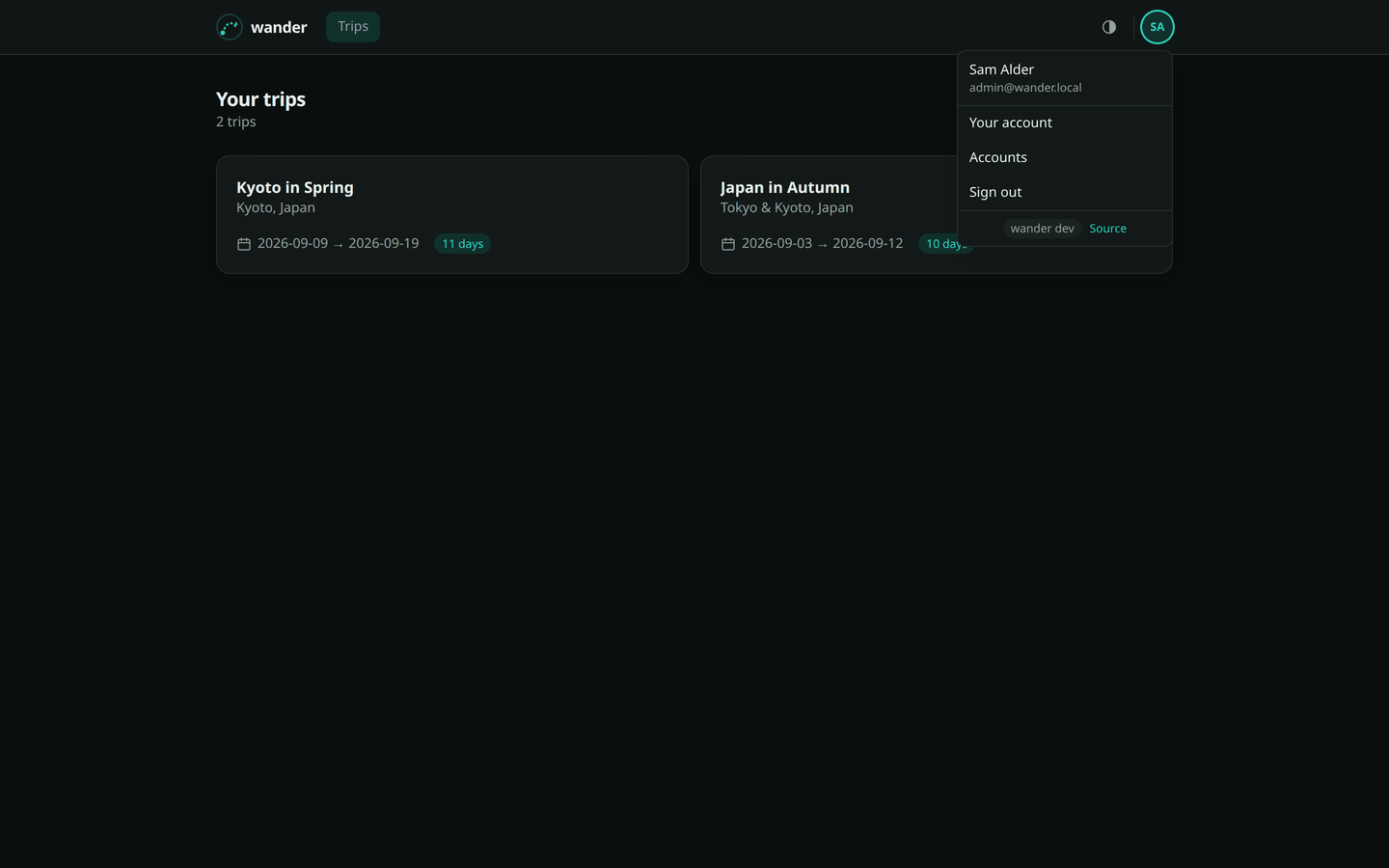
It is a setting,
WANDER_SOURCE_URL, not a compiled-in constant - if you modify wander, point it at your fork. Leaving it aimed at upstream is worse than removing it, because it looks like compliance while naming code your instance is not running. Blanking it hides the link, which is meant for a private box nobody else is offered; on a public instance that is most likely a violation rather than a preference.
Third-party notices
wander redistributes other people's code - Angular, Leaflet, MapLibre and rxjs in the browser bundle, Spring and its dependencies in the jar, and the whole KItinerary, Qt, poppler and ZXing stack in the image. MIT, BSD, ISC and Apache-2.0 all require the copyright notice to travel with a binary distribution, and a container image is a binary distribution, so the image carries them:
docker run --rm --entrypoint sh ghcr.io/vahdamv0/wander:latest -c 'cat /app/THIRD-PARTY.txt'
Three parts, because there are three things being redistributed and they are generated in two different places. Parts 1 and 2 are the jar's dependency trees
- the browser bundle and the server's jars - written by
./gradlew thirdPartyNoticestobuild/THIRD-PARTY.txt. Part 3 is the operating-system packages, appended when the image is built, bydeploy/os-notices.shreading apk's own database. It has to happen there: the package set belongs to the runtime stage rather than the source tree, and it genuinely differs by architecture - 233 packages on amd64, and a slightly shorter list on arm64.
All of it is generated, never committed, for the same reason the API client is: a hand-maintained list goes stale the first time somebody adds a dependency without thinking about licences, which is the normal case and exactly when it most needs to be right.
Part 3 is also where the copyleft components are, and it says so rather than burying them: the image contains GPL, LGPL and MPL packages, and the notice carries the offer of source for them - Alpine's aports plus each project's upstream, since these are Alpine's own unmodified binary packages. None of that reaches wander's own licensing. They are separate programs sharing a filesystem, not code linked into the application, which talks to KItinerary by running it and reading its output - so a GPL-2.0-only utility can sit beside an AGPL-3.0 application here without either licence touching the other. If you rebuild this image with your own changes to those packages, that offer of source becomes yours to make.
Worth knowing that this section was never empty: the base image has always
carried a GPL-3 coreutils and gnupg. Booking import took it from 73 packages
to 233, which is what prompted writing it down.
Similar repos


Languages
Java
55.8%
TypeScript
31.9%
HTML
9.6%
A self-hostable, collaborative travel planner
See the codeSee what people are saying
README
wander
A self-hostable, collaborative travel planner. Spring Boot 4 + Angular 22, one container, one Postgres.
A self-hosted, collaborative travel planner.
Plan trips together, organize itineraries, manage bookings, expenses, and packing lists — while keeping control of your data.
Why Wander?
Wander is an open-source travel planner designed for people who want a collaborative travel-planning experience without giving up control of their data.
- Self-hosted
- Collaborative trip planning
- Real-time synchronization
- Itineraries and activities
- Bookings
- Expenses
- Packing lists
- Sharing and invitation-based access
- Offline reading
- Backup support
- Progressive Web App (PWA)
Try Wander
Visit meridianx.co.in to learn more about Wander and explore the application.
Features
Plan the trip
- Days are derived from the date range, never stored - and moving the dates carries the itinerary with them rather than stranding it
- Places on a day: add, rename, annotate and drag into order - within a day or into another one, with buttons as the equal keyboard path
- A note on each day, what the day cost, and the forecast when there is one
- Place search over Nominatim, proxied and cached, so a place keeps the coordinates of the candidate you actually picked
- A vector map beside the itinerary, so a place abroad is labelled in your language and as it appears on the signs
- Place enrichment from OpenStreetMap, Wikidata, Wikipedia and Commons - description, hours, website and photographs, each with its source and licence
Go together
- Members by email, owner / editor / viewer roles, and handing the trip over
- Invitation links for people with no account here: single-use, expiring, revocable, delivered by whatever you already use to talk to them
- Live sync over a WebSocket - two people on one trip see each other's edits without reloading
- A packing list of shared and per-person items, ticked off live
Money, without a rounding bug
- Integer minor units everywhere, equal or exact splits, balances, and who-owes-whom reduced to the fewest payments - plus recording those payments
- Pay in another currency and it converts once at the rate of that day, then frozen on the expense, so editing it later cannot move anybody's balance
Bookings
- Flights, trains, hotels and tables stored as an instant plus the zone they were booked in - a flight keeps London time for departure and Tokyo time for arrival - and the list is ordered by when things really happen
- Read a booking out of a confirmation: email, PDF, HTML, calendar attachment or Apple Wallet pass, via KDE's KItinerary. It fills in the form and saves nothing until you do
Take it with you
- Sort a day by travel time over an OSRM you point wander at, with locked stops - proposed, never applied behind your back - then open the finished order in Google Maps
- Print it, or save a PDF: a day-by-day document with bookings, references and phone numbers folded onto the days they happen on
- Export GPX, the whole trip or one day, for OsmAnd, Organic Maps or a GPS
- Offline reading - a trip you have opened stays readable with no signal, honestly labelled with how old the copy is
- Installable to a home screen or a dock, in its own window
Run it yourself
- One container: the Angular app ships inside the boot jar, beside one Postgres
- No API keys anywhere. OpenFreeMap, Nominatim, Open-Meteo and Frankfurter all work as shipped, and each is a setting you can point elsewhere
- Session-cookie auth with CSRF and sessions in Postgres, so a restart signs nobody out; self-signup off by default, and password guessing throttled
- An admin surface: see the accounts, take one out of service, promote somebody, and mint a single-use password-reset link - or let people request one themselves once you give it an SMTP relay
- Nightly backups, verified by reading each dump back, with a restore procedure that has actually been run
- Light / dark / follow-the-OS theming, all driven by design tokens
What it looks like
The itinerary: derived days, places in the order you dragged them, what each day cost, the forecast when there is one, and a map beside it drawn from vector tiles so places abroad are labelled in your language and as they appear on the signs.
Open a place and wander asks OpenStreetMap, Wikidata, Wikipedia and Commons about it. Every photograph carries its photographer and its licence, because a Commons image is licensed per image - one without its credit is a picture this project has no right to draw.
Money, where a rounding bug would be silent and permanent. Integer minor units everywhere, all the arithmetic server-side, and four figures kept apart so a balance never reads as a lie: what you paid, what your share was, and what has been paid back.
Bookings are stored as an instant plus the zone they were booked in, so a flight keeps London time for its departure and Tokyo time for its arrival - and the list is ordered by when things really happen.
More: the trip list · packing · the printable itinerary
Try it without installing anything
Turn on the demo and wander seeds a worked example trip - an itinerary with photographs and a map, two people splitting expenses unevenly, a packing list, and a flight that lands in another timezone - plus a read-only account to look at it with. The sign-in page then offers it, credentials and all.
WANDER_DEMO_ENABLED=true docker compose up -d
The published account is a viewer on that trip, which the server enforces the same way it would for anybody else - the READ ONLY badge you will meet is the real thing, not a demo mode. It re-seeds on every boot, so restarting the container resets the demo and re-dates the trip; it needs that, because a forecast only exists about sixteen days out.
Off by default: it writes rows, so it is for a demo box rather than your real
instance. See WANDER_DEMO_* in .env.example.
Run it
cp .env.example .env          # then set POSTGRES_PASSWORD
docker compose up -d
docker compose logs wander    # the generated admin password is printed once
Open http://localhost:8080.
Sign-ups are off by default. The first admin comes from that log line; anybody
else joins by opening an invitation link, which admits its holder even with
self-signup switched off. Set WANDER_REGISTRATION_ENABLED=true in .env for a
private box you would rather have an open sign-up form on - and note the browser
suite creates its accounts by registering, so an instance you run npm run e2e
against needs it on.
Before you put it on the internet
Five things, and none of them is a code change:
-
POSTGRES_PASSWORDis notchange-me. -
WANDER_SITE_ADDRESSis your hostname andWANDER_COOKIE_SECURE=true. They move together; see the note in.env.examplefor what happens if only one of them does. -
Decide how a forgotten password gets recovered. Somebody signed in can change their own (Account, from the avatar in the header). Somebody who has forgotten it has two possible routes, and which ones exist is your choice.
By default there is one: you. From Accounts in the same menu, an admin mints a single-use link and delivers it however they already talk to that person, exactly as an invitation link works. Nobody edits
users.password_hashby hand, and an instance can have more than one administrator, so losing one account's password is not losing the instance. The limit is that recovery goes through a human - which pairs with sign-ups being off by default, and keeps two facts in step: the people with accounts are people you can reach.Set
WANDER_MAIL_ENABLED=truewith an SMTP relay and there is a second: a "Forgot password?" link that mails the same kind of link to the address on the account. This is what makes self-signup survivable at any size, since an instance strangers can join is one where recovery cannot go through you. The endpoint answers identically for an address it knows and one it does not- it will never confirm who has an account here - so the page can only say
"if that address has an account, a link is on its way". See
.env.examplefor which relay to pick; there is no provider in the code, only SMTP.
- it will never confirm who has an account here - so the page can only say
"if that address has an account, a link is on its way". See
-
The backups are on the same disk as the database. They survive a bad migration, a wrong
DELETEand a corrupted table; they do not survive losing the machine. Copy them off it - see below. -
Booking import parses files your members upload. A confirmation is fed to KItinerary, and behind it poppler for PDFs and ZXing for barcodes - libraries with a long history of parser bugs, doing exactly the thing they are bad at. It runs as a short-lived subprocess with a timeout, as the non-root application user, and the upload is never written to persistent storage, so a malformed file kills a child process rather than the instance. That is a deliberate trade rather than a non-issue: only a signed-in member who can already edit that trip can reach it.
WANDER_IMPORT_ENABLED=falseturns it off entirely if you would rather nothing here parsed an upload - the feature simply stops being offered.
/api/auth/login throttles guesses on its own: failed sign-ins are counted per
account and per client address and refused with a 429 past ten and forty of them
in a quarter of an hour, and any success clears both counts. It is not a lockout,
deliberately - see point 3 for why one would be unrecoverable.
If you turn sign-ups on
WANDER_REGISTRATION_ENABLED=true opens the form to anyone who finds the
hostname, so four things carry the weight once it is on. All four are on by
default; the settings are in .env.example.
- Creating accounts is metered per address, twenty in a quarter of an hour, counted whether the sign-up succeeds or not. The endpoint is anonymous and spends a bcrypt round on every call, so an unmetered one is both a way to burn the machine's CPU and a way to fill its user table.
- The upstreams are metered per person. Place search, place enrichment and the forecast all run on somebody else's donated capacity, and that - rather than anything about accounts - is the real reason self-signup is off by default. Authentication alone stops nothing here once anybody can register.
- Passwords are checked against a list of the ones that get guessed. Ten
characters was the whole policy before, and
password12is ten characters. - The proxy overwrites
X-Forwarded-For. The Caddyfile in this repository does it; if you put something else in front, it has to as well. Without it the per-address counters above are set by whoever is calling, and a header is a cheap thing to rotate.
wander also sends a Content-Security-Policy, assembled from your configured map
hosts so that pointing at your own tile server does not blank the map. See
WANDER_CSP_REPORT_ONLY in .env.example for how to diagnose one that does.
Deploy it from the registry
A server needs no source checkout and no JDK. CI publishes the image for linux/amd64 and linux/arm64 - so an Ampere or Graviton free-tier box pulls the same tag as an x86 one - and the image carries its own deployment bundle:
mkdir -p /opt/wander && cd /opt/wander
docker run --rm ghcr.io/vahdamv0/wander:latest bundle | tar x

cp .env.example .env && $EDITOR .env    # WANDER_IMAGE, POSTGRES_PASSWORD, the site address
docker compose pull
docker compose up -d --no-build
The bundle is compose.yaml, the Caddyfile, the backup script, .env.example
and a DEPLOY.md - the same files this repository tests, copied into the image
at build time rather than kept as a second copy in a deployment repository. That
is the point: a compose file maintained separately from the image drifts, and the
symptom of drift is a stack that starts and is quietly wrong.
Cutting a release
main publishes :latest and :<short-sha> on every commit, and those images
call themselves dev - they are builds, not releases. A release is a tag:
git tag v0.2.0 && git push origin v0.2.0
That runs the same pipeline, publishes :v0.2.0 alongside :latest, and is the
only thing that gives the image a version. The account menu then reads
wander v0.2.0 · a1b2c3d - the tag and the commit it was built from - so
somebody reporting a problem can say what they are running without being asked to
SSH anywhere.
Updating later is ./update.sh from that directory: pull, restart, prune. Pin a
version by pointing WANDER_IMAGE at the commit tag CI pushes alongside
latest, and note that a rollback of the image does not roll back a migration
Flyway has already applied.
Use a deploy token with read_registry, not a personal access token - this
credential lives on an internet-facing machine, and a deploy token can be revoked
without disturbing your own access.
Develop
Needs JDK 21 and Node ≥ 22.22.3 (Angular 22's CLI refuses older). The Gradle build downloads its own pinned Node, so only the Angular CLI itself cares about your local version.
# 1. Postgres on :5432 with the credentials application.yml defaults to.
#    (Not `docker compose up -d db` - that one publishes no host port on
#    purpose, so the production stack keeps its database off the network.)
docker run -d --name wander-dev-db -p 5432:5432 \
  -e POSTGRES_DB=wander -e POSTGRES_USER=wander -e POSTGRES_PASSWORD=wander \
  postgres:17-alpine

# 2. API on :8080  (Flyway migrates on boot; an admin is seeded on first run)
./gradlew :api:bootRun

# 3. Angular dev server on :4200, proxying /api to :8080
cd web && npm install && npm start
Stop and reset the dev database with
docker rm -f wander-dev-db (its data is not on a volume, so this wipes it).
Useful commands:
./gradlew build                          # everything: frontend, jar, tests
cd web && npm run e2e                    # Playwright, against a running instance
./gradlew build -Pfrontend.skip=true     # backend only, no npm work
./gradlew :api:test                      # tests + exports api/build/openapi.json
cd web && npm run api:gen                # regenerate the typed client from that spec
./gradlew :web:apiGen                    # the same, using Gradle's pinned Node
cd web && npm run icons                  # redraw the app icons from public/icon.svg
Tests need a Docker daemon: they run against a real Postgres via Testcontainers, never H2, because the migrations use Postgres-specific SQL.
Thinking of contributing? CONTRIBUTING.md is the short
version - what to install, what CI gates on, and the one rule people trip over
(the API client under web/src/app/api/ is generated and committed; never edit
it by hand). CLAUDE.md is the long version, and it is where the
reasons live: why days have no rows, why money is integer minor units, why a
popup was the wrong home for enrichment. It is the fastest way into this
codebase.
Backups, and restoring one
docker compose up -d starts a backup sidecar alongside the database. It writes
a compressed pg_dump into ./backups once a day, keeps the newest thirty, and
reads each dump back with pg_restore --list before publishing it - a dump
nobody has ever read is a file, not a backup. It writes under a temporary name
and renames, so a copy job never picks up a half-written file, and retention only
runs after a successful dump, so a run of failures cannot rotate away the good
copies that came before.
Restoring, which is the half worth rehearsing before you need it:
# Into a scratch database first - always. Restoring over a live one is how a
# bad backup becomes a lost database.
docker compose exec db psql -U wander -d postgres -c "CREATE DATABASE restore_check OWNER wander;"
docker compose exec backup pg_restore --no-owner --dbname=restore_check /backups/wander-<stamp>.dump

# Then check it is really a wander database, not just rows in tables:
docker compose run --rm --no-deps \
  -e WANDER_DB_URL=jdbc:postgresql://db:5432/restore_check wander
If that starts and Flyway reports "Successfully validated N migrations", the dump
is sound: Hibernate runs ddl-auto: validate, so a schema that does not match the
code fails at boot rather than quietly later. To promote it, stop the app, rename
the databases, and start again.
These dumps do not protect you from losing the machine. They sit on the same host as the database they came from, so anything that takes the host - a failed disk, a provider reclaiming the instance, a compromise - takes the database and every backup of it in one go. Thirty dumps on one box is one copy in disguise.
The other half is one line, run from the other machine:
rsync -az user@your-host:/path/to/wander/backups/ ~/wander-backups/
Two deliberate details. No --delete: that would make your copy mirror the
server, so a backups/ emptied by a disk fault or an attacker would replicate as
an empty local directory and destroy the safeguard exactly when it was needed.
Copies accumulate here instead, and pruning is a decision you make while looking
at them. And it pulls rather than the server pushing: a machine that has been
taken over cannot reach into a destination it holds no credentials for, whereas a
server that pushes can be made to delete what it previously sent.
Monitoring, and where visitors are
Off unless you ask for it, and asking is a compose profile:
echo 'COMPOSE_PROFILES=monitoring' >> .env    # once
./monitoring/geoip-update.sh                  # once, before the first start
docker compose up -d
The profile lives in .env rather than on the command line because update.sh
ends with a bare docker compose up -d, which selects none: passed as a flag,
every update would leave Alloy running on the image it started with — still
filling the dashboards, quietly a release behind, with nothing failing.
That adds one container. Grafana Cloud hosts the Grafana, the Prometheus and
the Loki, so none of those run here — but Cloud cannot reach into the machine,
and publishing Caddy's metrics port or its access log so a hosted service could
pull from them would be a far worse trade than a fifth container. So
Grafana Alloy collects locally and pushes
out. Five values in .env point it at your stack.
Two dashboards, and the split is not arbitrary:
| Source | Dashboard | |
|---|---|---|
| Traffic, latency, status codes | Caddy's Prometheus metrics | 22870 from grafana.com |
| Which country | Caddy's access log, with the country looked up | monitoring/wander-countries.json |
The second exists because the first cannot answer it. Caddy's Prometheus metrics
carry the labels server, handler, code and method and nothing
geographic — a counter per country is not something Caddy exports, and it is not
something a dashboard can derive. The country has to come out of the access log,
where the address is, which means a log pipeline rather than a metrics one.
Decisions in it worth knowing
- The lookup happens here, not in the cloud. Loki does not enrich on ingest,
so the database sits on this machine either way.
monitoring/geoip-update.shfetches DB-IP's free country database — CC BY 4.0, no account, onecurl, which matters because this file goes stale silently. Addresses get reassigned between countries; a database nobody refreshed does not fail, it gets quietly wronger. Refresh it monthly from cron. The licence asks for attribution, which the dashboard carries. - The address is redacted before the line is pushed, and the country is not.
The country is a label, set by a lookup that has already happened on this
machine; what goes is the ability to pick one visitor out and follow them
around the site. That is a different thing from knowing where people are, and
it is not a thing this application needs. Same bargain as hashing the
invitation token because the nightly dumps leave the machine, and deleting an
uploaded confirmation in a
finallybecause it holds a booking reference. One commented-out stage inmonitoring/config.alloyreverses it, which is a reasonable thing to want if you are looking at abuse rather than geography. - Caddy's own metrics endpoint is not counted as traffic. Caddy counts
requests to every server it runs, including the one serving
/metrics, and dashboard 22870 groups byjobandinstancewithout ever filtering onserver. Left alone, a scrape every 30 seconds arrives as 2,880 requests a day — on a personal instance, most of the graph. So the Caddyfile names that listenermetrics_onlyand Alloy drops it. Naming rather than droppingsrv0is the point: Caddy numbers unnamed servers by sorting their listen addresses as strings, so:2020issrv0by a coincidence of lexical ordering that would reverse silently, and reversing it means discarding the real traffic and keeping the synthetic. - Metrics are served on their own port, not from the admin API. Caddy already
exposes
/metricson its admin API, but that API can also rewrite the running configuration — reaching it from another container would mean putting a remote-control socket on the compose network to read some counters.:2020is a plain site block with one handler on it, and compose publishes nothing. - Two access loggers, not one reformatted.
docker compose logs proxyis how anybody looks at this stack by hand, and a wall of JSON there would make the console log useless in order to get a machine-readable one.log_skipapplies to the request rather than to a logger, so the invitation tokens kept out of one are kept out of both — which matters more for the JSON one, because that file leaves the machine. - The countries are approximate, and that is inherent. A VPN, a corporate egress or a mobile carrier's national gateway each answer with somewhere the person is not, and no database fixes it. This is "roughly where my visitors are", not a fact about anybody.
- Your access log leaves the machine. Redacted of addresses, but the paths, status codes and timings land on Grafana Labs' servers with a retention you do not set. That is a different trade from self-hosting Loki, and it is the one being made here.
How it fits together
Angular component → repo (web/src/app/repo) → generated client → /api → controller → service → JPA
                                  ▲                                        │
                                  └──── ng-openapi-gen ◄── openapi.json ◄──┘
The Java code is the contract. springdoc renders the OpenAPI document,
OpenApiSpecExportTest writes it to api/build/openapi.json, and
ng-openapi-gen turns it into web/src/app/api. No DTO is written twice - edit
the Java record and the TypeScript type follows.
The generated client is committed, so a fresh clone and the Docker build need no database to produce a spec first. CI regenerates it and fails the pipeline on any drift, so it cannot quietly diverge.
Components never call HTTP directly; they go through a repo. That seam is what
let offline reading land without touching a single component - OfflineCache
sits inside the repos, and a page only has to ask how old the copy it is showing
is. A write queue could land the same way; it deliberately has not.
Decisions worth knowing
Session cookies, not JWT. Angular is served same-origin from the same jar, so
an httpOnly cookie cannot be read by XSS and there is no refresh-token dance.
Angular's HttpClient handles the XSRF-TOKEN cookie with no code.
Money is integers. Amounts are stored and sent as minor units - 1234 is
12.34 - in one currency per trip, fixed when the trip is created. No floating
point touches money in either language, an uneven split spreads its remainder to
the penny rather than losing it, and the balances arrive computed from the server
so there is only ever one implementation of the arithmetic.
Sessions live in Postgres, not in the heap. Spring Session JDBC, with its two tables owned by Flyway like everything else. Because the session is the credential here, an in-memory store would mean every restart signs out every user - on a self-hosted instance that is a deploy logging out the household, and live sync coming back from it asking people to log in again instead of reconnecting. It also means a second instance behind a load balancer needs no sticky sessions.
Multi-tenant from the first migration. trip_members was there before it
carried anything but an OWNER row. Access to a trip is decided by membership and
nothing else - there is no owner column to fall out of step with it.
A closed instance, but not a sealed one. Self-signup is off by default, because the default has to be the safe answer for the deployment that faces the internet - an open form there hands this machine's Nominatim, Wikimedia and Open-Meteo budget, donated capacity all of it, to whoever finds the hostname. Off would be useless if it also broke invitation links, though: accepting one requires an account, and nothing here mails an invitation to make one another way. So a live invitation token is accepted by the sign-up form as authorisation in its own right. It is checked there and spent later, by the join - the failure worth having is an account with no trip, not an invitation burned on the way to a sign-up that then failed on a taken email address. A wrong token and no token get the same 403, so the form cannot be used to find out which invitations exist.
The login endpoint counts wrong answers. Bcrypt alone is not an answer to guessing: it makes every attempt expensive for the server, so a word list becomes an outage rather than a breach. Failures are counted per account and per client address - the second catches a spray across many accounts that no single account's counter would ever see - and a success clears both, so an ordinary fumbled password leaves nothing behind. The gate closes in front of the password check, not behind it, because the point is to stop spending the hash. It is a window, not a lockout: recovering an account here goes through an administrator, so a lockout that outlived its window would be a way for a stranger to make somebody else's afternoon a support request.
A non-member gets 404, not 403. A 403 confirms the trip exists, which lets anyone count trips by walking ids. A member with too weak a role does get 403 - they already know it exists.
One token layer, three theme states. Every colour comes from a CSS variable
in web/src/styles.css; no component holds a raw colour. The theme follows the OS
by default and an explicit light/dark choice overrides it in both directions -
which is why each dark palette is declared twice, once per condition.
Days are derived, never stored. A stored day list is a second copy of the
date range, and moving a trip's dates would then mean keeping two things in step.
A place therefore carries a plain day_date rather than a foreign key, and
GET /api/trips/{id}/itinerary rebuilds the range on every read - empty days
included, so the client never reconstructs it.
Place search is proxied, never called from the browser. Nominatim's usage
policy wants one identifiable caller honouring one request a second, which is
impossible to arrange across N browsers; a shared cache only works server-side
anyway, and a self-hoster can point WANDER_GEOCODING_URL at their own instance
without any client learning a new address. GeocodingService holds the toggle,
the LRU cache, and the rate gate; GeocoderClient is the interface the tests
replace, so the suite never touches the network or spends a public service's
budget. Search off (WANDER_GEOCODING_ENABLED=false) is a supported
configuration - the itinerary still works, places are typed by hand and simply
have no coordinates.
The client asks the instance what it may do. GET /api/config carries the
tile URL, its attribution, and whether search works. None of it is compiled into
the client, because all of it is the operator's decision - an instance pointed at
its own tile server, or one with no outbound network at all, is a supported
configuration rather than a broken one.
Tiles are the one request wander does not proxy, since the browser has to fetch a tile per screenful and routing those through the jar would make it a tile cache. That is the reason the map source is configurable: an operator who does not want their users' browsers talking to a third party points it elsewhere. The attribution travels with the URL, because the terms attach to the service, not to the code.
The basemap is vector, and that is what makes it readable abroad. A raster
tile is a picture with the local name already painted into it - 東京都, never
Tokyo, whatever the browser asks for. Vector tiles carry name, name:latin and
name:xx as data, so the client chooses, and wander draws both lines: the
reader's language over the local name, because on a trip the useful map is the
one you can read and match against the sign in front of you. It also means the
map follows the theme with a dark style rather than a filter over a light one.
The default is OpenFreeMap, which needs no API key and
no account; WANDER_MAP_STYLE_URL points somewhere else, and setting it blank
falls back to raster tiles from WANDER_MAP_TILE_URL, which an instance with its
own tile server loses nothing by - except the language.
Results come back in the browser's language. The caller's Accept-Language
is forwarded to the geocoder and keyed into the cache with the query, because a
geocoder given no preference answers in the place's own language and one shared
cache entry would hand the first caller's language to everyone else.
A picked location is saved, not re-derived. The client sends the coordinates of the candidate the user chose. Re-geocoding the name server-side would be tidier in principle and wrong in practice: searching again can rank a different result first, so the place would quietly move.
Dragging did not replace the buttons. A drag has no keyboard or screen-reader equivalent, so the arrow controls stayed as the accessible path; they fade in on hover or focus rather than sitting on every row, and on a device with no hover they simply stay visible. Both paths make the same one call.
The one irreversible action asks first. Deleting a place takes the notes
written on it, has no undo, and live sync puts it on everybody else's screen
within the second. It can be reached two ways - the row's × and the detail
panel - and both now confirm inline, naming what goes with it. The × in
particular is a small icon directly after "move to next day", permanently visible
on a device with no hover, which is a mis-tap away from destroying something.
It is the only confirmation in wander so far. Most of what else can be deleted
can simply be entered again; leaving a trip is the one that cannot, since getting
back in needs the owner, and it is the obvious next candidate.
The map is a view, not a surface for content. Everything known about a place lives in a panel; the pin carries a label and nothing more. That is a lesson rather than a preference - the enrichment was built into a Leaflet popup first, and a popup computes its size and its auto-pan once, on open, so anything that arrives afterwards does not fit. The label is a tooltip for the same family of reason: Leaflet positions a popup to fit the map container and cannot see the panel drawn over it, so a popup opened by the click that opens the panel was drawn underneath it every time.
Directions offer both, and choose neither. The coordinates are OSM's and the tiles are OSM's by default, but getting somewhere is the moment a person wants the routing app they actually use. So the panel offers Google Maps and OpenStreetMap as plain links out, in that order, and sends nothing to either beyond the coordinates in the URL the user chose to open.
A day can be sorted by route, and the sort proposes rather than applies.
Point WANDER_ROUTING_URL at an OSRM - off by default, because unlike the
geocoder and the forecast there is no routing service anybody is entitled to
lean on, and OSRM over a Geofabrik extract is a docker run. FOSSGIS do run
public instances at routing.openstreetmap.de, and their terms permit this
shape of use: one request a second - so raise WANDER_ROUTING_MIN_INTERVAL_MS
to 1000, its default of 200 being written for an engine in the next rack - a
User-Agent that names the application, which wander sends, and the
OpenStreetMap credit with a link to fixthemap. .env.example carries the four
lines to copy. It stays a documented option rather than the default for three
reasons: access is revocable without notice, pointing every instance at one
donated server is the aggregate those terms exist to prevent, and each profile
lives behind its own path prefix there while wander has a single base URL - so
all three profiles answer from whichever graph you name, and asking for driving
would quietly return walking times. wander asks it for one matrix of travel
times between the day's stops, runs nearest-neighbour then 2-opt over it, and
shows the result as a proposal with what it saves: 30 minutes of walking
down to 16. Nothing is written until somebody says so, which is the same
bargain booking import makes, and applying it goes through the ordinary reorder
- so there is one thing on the server that decides what order a day is in, whether the order came from a drag or an optimiser. A stop can be locked to its position (the hotel to start from, the table booked for eight) and the rest are fitted around it; a place with no coordinates is locked implicitly, because moving a stop the engine was never told about is rearranging a plan around a guess. Nothing is inferred from a place's category: an anchor is something you say, not something the geocoder decides. Then the finished order opens in Google Maps.
Two writes are optimistic, and for the same reason. Every other write
re-reads and lets the server's answer win. But a drag has already moved the row
under the user's finger and a tick has already moved the checkbox, so waiting for
the round trip would snap either back and then repeat it. PlaceRepo.move
reorders its local copy first (renumbering exactly as the server does) and
restores the previous order if it fails; PackingRepo.setPacked carries the
ticker's name along with the boolean, or a shared item says "packed" without
saying by whom.
The server owns ordering. Ranks are dense and zero-based, and any move or delete renumbers the affected day from scratch inside one transaction. Moving a place is one operation - "put it at rank N of day D" - which is what the up/down buttons and a drag both send. The client re-reads after a write rather than guessing at the new ranks.
A backup nobody has restored is not a backup. The sidecar reads every dump
back with pg_restore --list before publishing it, and the documented restore was
carried out rather than written down from memory: dumped, restored into a scratch
database, compared row-for-row by checksum against the original, and then booted -
the application started against the restored copy and Flyway validated all 14
migrations. Retention only runs after a dump succeeds, so a bad week cannot rotate
the good copies away. This is the one part of the system whose failure is
unrecoverable, and it is the one part where "it looked fine" is worth the least.
An invitation link is a credential, and is treated like one. Only a SHA-256 digest is stored, so the token is readable exactly once and a leaked backup is inert; accepting takes a row lock, so a forwarded link cannot admit two people at once; an unknown token is a 404 whatever is wrong with it, so guessing tells you nothing. It needs no mail server, which is why it was never really blocked - the owner sends the link themselves.
Printing needs no PDF library. window.print() is already a PDF exporter in
every browser: it honours the reader's paper size, works offline from the cache,
and needs no endpoint - the printable page is assembled from the two repos the app
already has. What it did need was a stylesheet, and the two things that would ruin
a printout (the app shell coming along, the toolbar printing itself) are invisible
on screen, so the browser test asserts them under emulateMedia({ media: 'print' })
rather than trusting them.
Installing it needed a manifest, not a framework. The service worker had been there since offline reading landed; what was missing was the file that gives a browser a name, an icon and a window to install with. The icons come from one drawing composited three ways by Playwright's Chromium - the same engine that will draw them - rather than by a native image library added to render four pictures that change never. Installing is also what made an update prompt necessary: ngsw serves a new build on the next load, and a standalone window has no reload button and stays open for the length of a holiday. It asks rather than reloading, since a reload throws away whatever is in a form.
Gates stay on. EndpointAuthRatchetTest fires an anonymous request at every
endpoint this project declares and fails if one answers; opening an endpoint
requires an explicit @PublicEndpoint that shows up in review. Hibernate runs
with ddl-auto: validate, so a drifted entity fails at boot instead of altering
tables under a running instance. Don't lower a gate to land a change.
Stack
| API | Java 21, Spring Boot 4.1, Spring Security 7, JPA/Hibernate, Flyway |
| DB | Postgres 17 |
| Web | Angular 22 (standalone, signals, zoneless), Tailwind 4, TypeScript |
| Contract | springdoc-openapi → ng-openapi-gen |
| Tests | JUnit 5, Testcontainers (real Postgres, never H2), Playwright |
| Build | Gradle 9.7 (Kotlin DSL), one Docker image |
Roadmap
- Milestone 0 - walking skeleton. ✅ Accounts, trips, contract loop, one container.
- Days and places. ✅ Days from the date range, places with ordering within and across days, place search over Nominatim, a Leaflet map, drag ordering, and a note on each day.
- Sharing. ✅ The member list, roles beyond
OWNER, transferring a trip, live sync, and invitation links - add somebody by email, or send a link to somebody with no account at all, make them an editor or a viewer, hand the trip over, and watch each other's edits appear without reloading. - Money and stuff. Expenses are done ✅ - one currency per trip, amounts in integer minor units, equal or exact splits, a "who owes whom" summary reduced to the fewest payments, and recording those payments so balances actually clear, a packing list grouped by who is bringing what, and bookings kept on a real clock - each time in the zone it happens in. An expense may be paid in any currency: it is converted once on the way in, at the rate of the day, and that rate is stored on the row - so the balances stay arithmetic in one currency and a later edit cannot silently re-price a holiday. The day card is finished alongside it: the day's own note, what the day cost (grouped from the expenses, payments excluded), and the forecast from Open-Meteo when there is one - no API key, CC BY 4.0, and nothing at all for a day past the ~16-day horizon rather than a placeholder.
- Offline. Reads are done ✅ - a service worker for the app shell and IndexedDB inside the repos, so a trip you have opened is readable with no signal, honestly labelled as a saved copy. Writes are refused rather than queued: a replay queue forces conflict resolution that live sync deliberately never needed, and that stays a decision rather than a gap. Installing it is done too ✅ - a manifest, an icon and a standalone window, plus the piece that only matters once there is no reload button: a prompt when a new build is waiting.
- Routes. ✅ Sorting a day by how long it takes to get between its stops, over an OSRM you point wander at, on foot, driving or cycling - proposed rather than applied, with locked stops staying where they are, and the finished order handed to Google Maps.
Licence
GNU Affero General Public License v3.0 or later. The full text is in
LICENSE; SPDX-License-Identifier: AGPL-3.0-or-later.
Copyright © 2026 Vivek Madhav and wander contributors.
The AGPL was chosen over a permissive licence for the reason the AGPL exists: wander is software people run as a service for other people, and under MIT/Apache-2.0 a host could take it, improve it, and offer it back to its users with the improvements closed. Section 13 is what closes that gap - modify wander and run it for others over a network, and those users are entitled to the source of what they are actually using. Self-hosting is the whole point of this project, so the licence that protects the people doing the hosting is the right one.
Two consequences worth being clear about, since they are the parts people get wrong:
-
Using wander is unrestricted. Run it, host it for your household, plan trips on it. The obligations attach to distributing a modified version or offering a modified version to others over a network - not to use.
-
Section 13 wants a source offer in the running app, and wander ships one. There is a Source link on the sign-in page and in the account menu. It is on the sign-in page as well as behind it on purpose: section 13 owes source to everybody interacting with the instance over a network, and on a public one most of those people never sign in.
It is a setting,
WANDER_SOURCE_URL, not a compiled-in constant - if you modify wander, point it at your fork. Leaving it aimed at upstream is worse than removing it, because it looks like compliance while naming code your instance is not running. Blanking it hides the link, which is meant for a private box nobody else is offered; on a public instance that is most likely a violation rather than a preference.
Third-party notices
wander redistributes other people's code - Angular, Leaflet, MapLibre and rxjs in the browser bundle, Spring and its dependencies in the jar, and the whole KItinerary, Qt, poppler and ZXing stack in the image. MIT, BSD, ISC and Apache-2.0 all require the copyright notice to travel with a binary distribution, and a container image is a binary distribution, so the image carries them:
docker run --rm --entrypoint sh ghcr.io/vahdamv0/wander:latest -c 'cat /app/THIRD-PARTY.txt'
Three parts, because there are three things being redistributed and they are generated in two different places. Parts 1 and 2 are the jar's dependency trees
- the browser bundle and the server's jars - written by
./gradlew thirdPartyNoticestobuild/THIRD-PARTY.txt. Part 3 is the operating-system packages, appended when the image is built, bydeploy/os-notices.shreading apk's own database. It has to happen there: the package set belongs to the runtime stage rather than the source tree, and it genuinely differs by architecture - 233 packages on amd64, and a slightly shorter list on arm64.
All of it is generated, never committed, for the same reason the API client is: a hand-maintained list goes stale the first time somebody adds a dependency without thinking about licences, which is the normal case and exactly when it most needs to be right.
Part 3 is also where the copyleft components are, and it says so rather than burying them: the image contains GPL, LGPL and MPL packages, and the notice carries the offer of source for them - Alpine's aports plus each project's upstream, since these are Alpine's own unmodified binary packages. None of that reaches wander's own licensing. They are separate programs sharing a filesystem, not code linked into the application, which talks to KItinerary by running it and reading its output - so a GPL-2.0-only utility can sit beside an AGPL-3.0 application here without either licence touching the other. If you rebuild this image with your own changes to those packages, that offer of source becomes yours to make.
Worth knowing that this section was never empty: the base image has always
carried a GPL-3 coreutils and gnupg. Booking import took it from 73 packages
to 233, which is what prompted writing it down.
Similar repos
Languages
Java
55.8%
TypeScript
31.9%
HTML
9.6%