
README
GSH (Gleam Shell)


GSH is an interactive REPL for the Gleam Programming Language written in Gleam and Erlang.
Installation
Add gsh to your project as a development dependency:
gleam add gsh --dev
Usage
gsh can either be used as a standalone REPL or a live-app bootloader.
Standalone
gleam run -m gsh
Call functions from GSH
Erlang/OTP 28 [erts-16.1.2] [source] [64-bit] [smp:16:16] [ds:16:16:10] [async-threads:1] [jit:ns]

Interactive Gleam (GSH 1.1.6) - press Ctrl+C to exit (type :h ENTER for help)
gsh(1)> import your_app/config
ok
gsh(2)> config.load()
Runtime Error: "error:undef"
gsh(3)> :cc
  Compiling your_app
   Compiled in 0.25s

Ok (Imports hot-reloaded)
gsh(4)> config.load()
Config("0.1.0", "0.0.0.0", 8000) : Config
gsh(5)>
App loader
gleam run -m gsh -- my_app worker_pool bg_module_1
Built-in Commands
GSH includes several built-in commands to manage your session:
:h- Show the help menu:v- Show the current GSH version:b- List all currently active variable bindings:hs- Show the history of executed commands:cc- Recompile the host Gleam project without leaving the shell:c- Clear the terminal screen (or Ctrl + L)pid()- Create a pid from a string (e.g. pid("<0.34.0>")):h <module/function>- Retrieve module/function documentation:q- Exit the shell
Target limitations
Note: GSH is heavily tied to the Erlang VM (BEAM) for state persistence and dynamic evaluation. It does not support the JavaScript target.
Why a REPL?
After using Elixir's iex, OCaml's utop or even Rust's evcxr. I really wanted to build a tool for Gleam that gets me closer to the BEAM. GSH, expanded as Gleam SHell is a materialization of that dream.
REPL use cases
- Function & module debugging with mock data.
- Interaction with actors & the supervision tree.
- Quick scratch-pad for validating logic & trivial constructs.
- Working with the Gleam ecosystem and libraries.
Demo
-
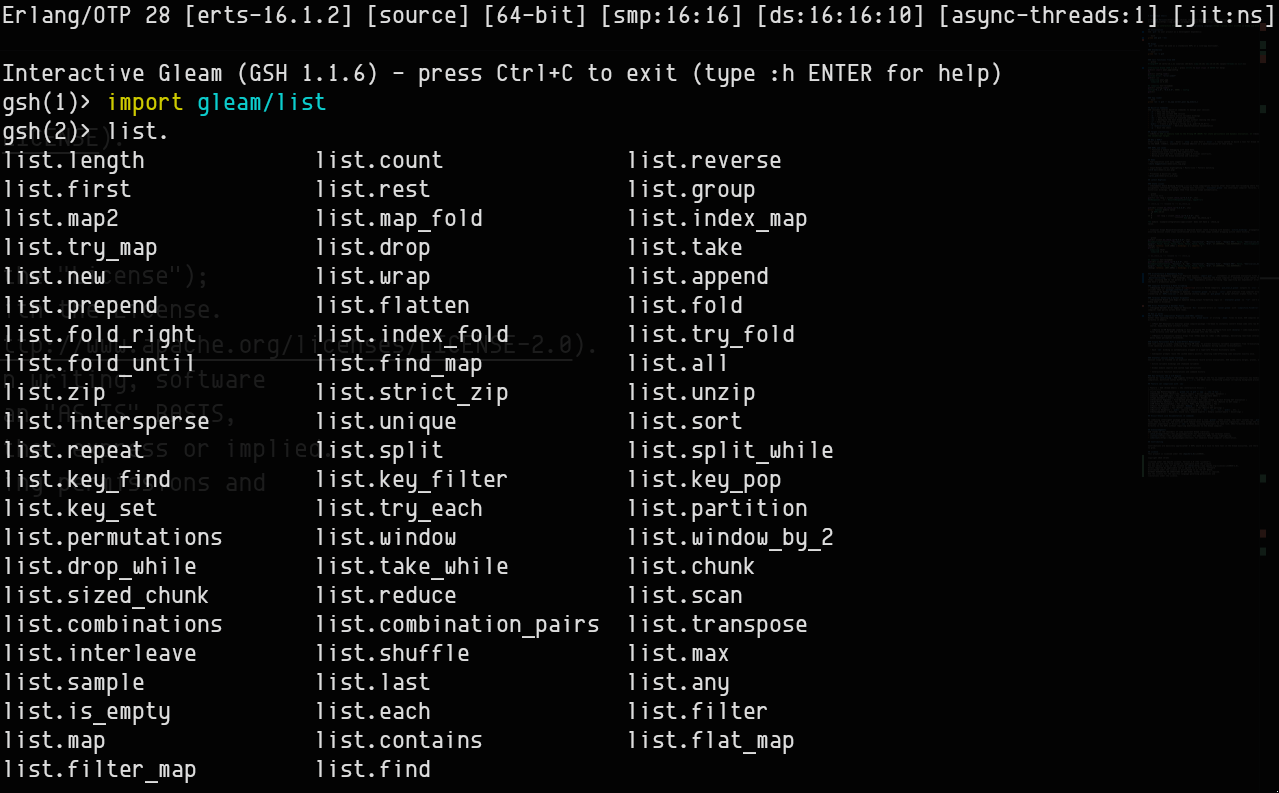
Tab-completion with auto suggestions
-
Suggestions work for your project modules as well

-
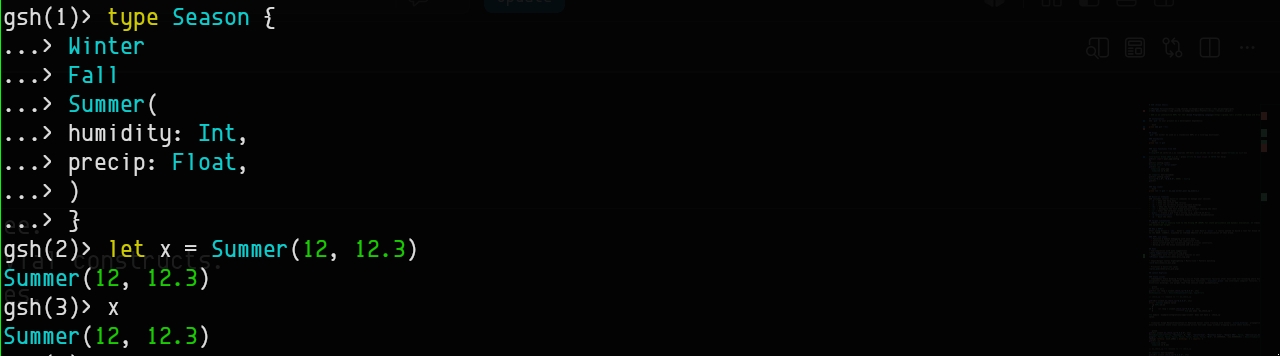
Input/Output syntax highlighting + Multi-line support
-
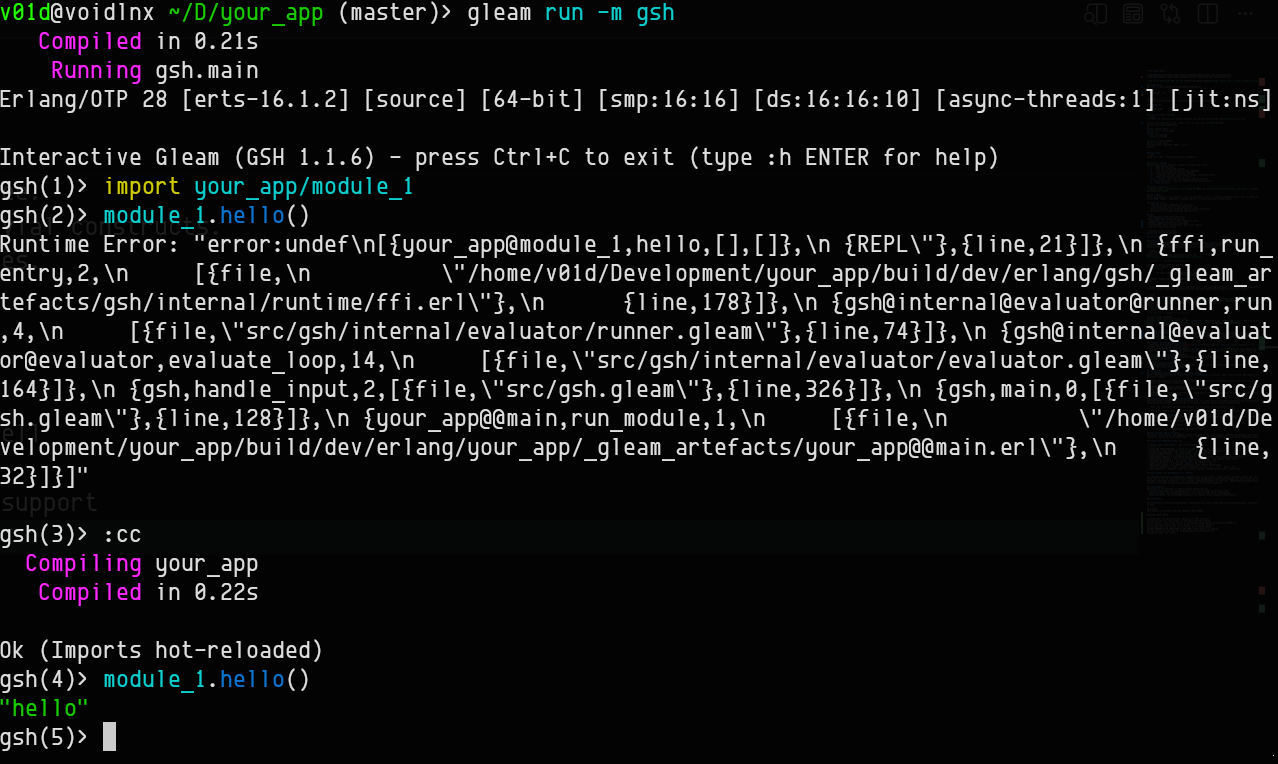
Compile your project before calling functions. Recompile after edits!
-
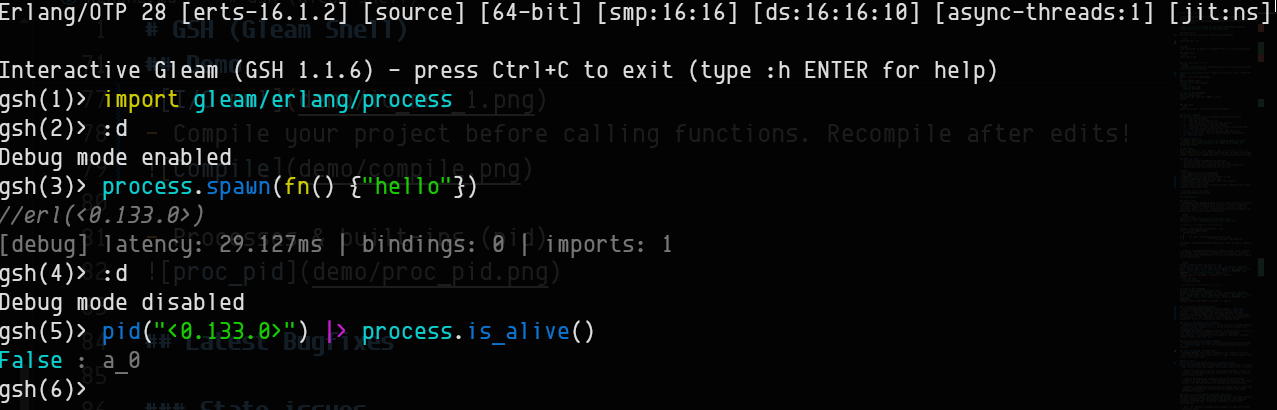
Processes & built-ins (pid)
Feature highlights
- Tab-autocompletion & suggestions:
Press <TAB> during imports or function calls to get completion & suggestions.
- Stateless session history:
Use the <up and down arrows> to navigate through previously entered commands. History isn't saved after the session ends.
- Word-wise navigation:
Ctrl+<left or right arrows> allow word-wise navigation.
- Dynamic function redefinition:
Swap out function logic on the fly without restarting the shell. While the Gleam compiler strictly forbids duplicate function names within a module, GSH acts as a dynamic REPL layer—automatically pruning your historical state to allow Elixir-style rapid prototyping.
- Observer GUI support:
Provided you have Erlang with wxwidgets support, :obs will open the Observer GUI.
How it works
In-RAM Fast Compilation Pipeline (Sub-50ms Latency)
Rather than spawning heavy OS subprocesses with gleam build or writing .beam files to disk, GSH compiles and executes code directly in memory:
-
Fast AST Emission: Executes gleam compile-package --no-beam to instantly convert Gleam code into raw Erlang (.erl) source, bypassing disk artifact writes.
-
Native In-VM Bytecode Loading: Uses an Erlang FFI bridge (compile:file with [binary] + code:load_binary) to compile .erl files directly into RAM and hot-load the bytecode into the running VM.
-
Result: Evaluation latency drops from ~375ms down to ~18ms (~20x speedup), delivering real-time interactive feedback below human perception thresholds.
Single Persistent Node & Side-Effect Memoization
GSH runs inside a single, long-lived Erlang VM node. To prevent historic variable assignments from re-executing side effects (like spawning processes, printing logs, or hitting a database) during session re-evaluations:
-
Each
letbinding is automatically wrapped in a type-safe Process Dictionary cache. -
Subsequent prompts reuse the cached memory pointer, ensuring side-effecting code executes exactly once.
Stateful Lexical Scope Tracking
Session scope is tracked in an explicit ShellState record across evaluations. GSH dynamically merges, prunes, and re-injects:
-
Active variable bindings and shadowed variables
-
Global module imports and custom type definitions
-
Interactive function declarations and command history
Raw Terminal TUI & I/O Engine
Powered by etch_erlang, GSH toggles terminal raw mode on the fly to support character-by-character key handling, live TAB completion, multiline syntax buffering (...>), and ANSI color formatting without corrupting background process stdout.
Feature set comparison with iex
| Feature | GSH (Gleam Shell) | IEx (Interactive Elixir) |
|---|---|---|
| Live App Bootstrapping | gleam run -m gsh -- app | iex -S mix |
| Syntax | Gleam (Rust-like, strict types) | Elixir (Ruby-like, dynamic) |
| Syntax Highlighting | Yes (ANSI-based) | Yes (Configurable ANSI) |
| Type System | Static (recompiles on the fly) | Dynamic |
| Evaluation Engine | File-backed generation + Hot code reload | Direct Erlang AST evaluation |
| Side-Effect Safety | Yes (Process Dictionary memoization) | Yes (Native to AST loop) |
| VM State Persistence | Yes (Actors, PIDs, ETS stay alive) | Yes |
| Fault Tolerance | Yes (Catches Badarg / VM crashes) | Yes |
| Multiline Input | Yes (Buffer completion) | Yes (Native AST parsing) |
| Built-in Helpers | pid() (easily extensible) | h(), i(), v(), pid(), etc. |
| Autocomplete | Keywords, bound vars, module exports | Deeply context-aware + docstrings |
Elixir-Style Live Documentation (h command)
By combining intelligent package path resolution with a live glexer token stream, the shell locates raw .gleam source files, lexes them on the fly, and extracts both module-level documentation and function signatures. This brings the legendary, tactile developer experience of Elixir's iex to Gleam, allowing developers to read rich, ANSI-formatted markdown documentation directly in the REPL without requiring modifications to the Gleam compiler.
Acknowledgments
GSH stands on the shoulders of some excellent Gleam libraries:
- etch_erlang for non-blocking raw terminal events.
- contour for beautiful ANSI syntax highlighting.
- shellout for seamless Gleam compiler orchestration.
Contributing
Contributions are massively appreciated! A REPL would be a nice to have tool in the Gleam ecosystem, and there is plenty of room to grow.
License
This project is licensed under the Apache-2.0.
Copyright 2026 v4rm4n
Licensed under the Apache License, Version 2.0 (the "License"); you may not use this file except in compliance with the License. You may obtain a copy of the License at here. Unless required by applicable law or agreed to in writing, software distributed under the License is distributed on an "AS IS" BASIS, WITHOUT WARRANTIES OR CONDITIONS OF ANY KIND, either express or implied. See the License for the specific language governing permissions and limitations under the License.


See what people are saying
Similar repos


Languages
Gleam
95.0%
Erlang
5.0%
README
GSH (Gleam Shell)
GSH is an interactive REPL for the Gleam Programming Language written in Gleam and Erlang.
Installation
Add gsh to your project as a development dependency:
gleam add gsh --dev
Usage
gsh can either be used as a standalone REPL or a live-app bootloader.
Standalone
gleam run -m gsh
Call functions from GSH
Erlang/OTP 28 [erts-16.1.2] [source] [64-bit] [smp:16:16] [ds:16:16:10] [async-threads:1] [jit:ns]

Interactive Gleam (GSH 1.1.6) - press Ctrl+C to exit (type :h ENTER for help)
gsh(1)> import your_app/config
ok
gsh(2)> config.load()
Runtime Error: "error:undef"
gsh(3)> :cc
  Compiling your_app
   Compiled in 0.25s

Ok (Imports hot-reloaded)
gsh(4)> config.load()
Config("0.1.0", "0.0.0.0", 8000) : Config
gsh(5)>
App loader
gleam run -m gsh -- my_app worker_pool bg_module_1
Built-in Commands
GSH includes several built-in commands to manage your session:
:h- Show the help menu:v- Show the current GSH version:b- List all currently active variable bindings:hs- Show the history of executed commands:cc- Recompile the host Gleam project without leaving the shell:c- Clear the terminal screen (or Ctrl + L)pid()- Create a pid from a string (e.g. pid("<0.34.0>")):h <module/function>- Retrieve module/function documentation:q- Exit the shell
Target limitations
Note: GSH is heavily tied to the Erlang VM (BEAM) for state persistence and dynamic evaluation. It does not support the JavaScript target.
Why a REPL?
After using Elixir's iex, OCaml's utop or even Rust's evcxr. I really wanted to build a tool for Gleam that gets me closer to the BEAM. GSH, expanded as Gleam SHell is a materialization of that dream.
REPL use cases
- Function & module debugging with mock data.
- Interaction with actors & the supervision tree.
- Quick scratch-pad for validating logic & trivial constructs.
- Working with the Gleam ecosystem and libraries.
Demo
-
Tab-completion with auto suggestions
-
Suggestions work for your project modules as well
-
Input/Output syntax highlighting + Multi-line support
-
Compile your project before calling functions. Recompile after edits!
-
Processes & built-ins (pid)
Feature highlights
- Tab-autocompletion & suggestions:
Press <TAB> during imports or function calls to get completion & suggestions.
- Stateless session history:
Use the <up and down arrows> to navigate through previously entered commands. History isn't saved after the session ends.
- Word-wise navigation:
Ctrl+<left or right arrows> allow word-wise navigation.
- Dynamic function redefinition:
Swap out function logic on the fly without restarting the shell. While the Gleam compiler strictly forbids duplicate function names within a module, GSH acts as a dynamic REPL layer—automatically pruning your historical state to allow Elixir-style rapid prototyping.
- Observer GUI support:
Provided you have Erlang with wxwidgets support, :obs will open the Observer GUI.
How it works
In-RAM Fast Compilation Pipeline (Sub-50ms Latency)
Rather than spawning heavy OS subprocesses with gleam build or writing .beam files to disk, GSH compiles and executes code directly in memory:
-
Fast AST Emission: Executes gleam compile-package --no-beam to instantly convert Gleam code into raw Erlang (.erl) source, bypassing disk artifact writes.
-
Native In-VM Bytecode Loading: Uses an Erlang FFI bridge (compile:file with [binary] + code:load_binary) to compile .erl files directly into RAM and hot-load the bytecode into the running VM.
-
Result: Evaluation latency drops from ~375ms down to ~18ms (~20x speedup), delivering real-time interactive feedback below human perception thresholds.
Single Persistent Node & Side-Effect Memoization
GSH runs inside a single, long-lived Erlang VM node. To prevent historic variable assignments from re-executing side effects (like spawning processes, printing logs, or hitting a database) during session re-evaluations:
-
Each
letbinding is automatically wrapped in a type-safe Process Dictionary cache. -
Subsequent prompts reuse the cached memory pointer, ensuring side-effecting code executes exactly once.
Stateful Lexical Scope Tracking
Session scope is tracked in an explicit ShellState record across evaluations. GSH dynamically merges, prunes, and re-injects:
-
Active variable bindings and shadowed variables
-
Global module imports and custom type definitions
-
Interactive function declarations and command history
Raw Terminal TUI & I/O Engine
Powered by etch_erlang, GSH toggles terminal raw mode on the fly to support character-by-character key handling, live TAB completion, multiline syntax buffering (...>), and ANSI color formatting without corrupting background process stdout.
Feature set comparison with iex
| Feature | GSH (Gleam Shell) | IEx (Interactive Elixir) |
|---|---|---|
| Live App Bootstrapping | gleam run -m gsh -- app | iex -S mix |
| Syntax | Gleam (Rust-like, strict types) | Elixir (Ruby-like, dynamic) |
| Syntax Highlighting | Yes (ANSI-based) | Yes (Configurable ANSI) |
| Type System | Static (recompiles on the fly) | Dynamic |
| Evaluation Engine | File-backed generation + Hot code reload | Direct Erlang AST evaluation |
| Side-Effect Safety | Yes (Process Dictionary memoization) | Yes (Native to AST loop) |
| VM State Persistence | Yes (Actors, PIDs, ETS stay alive) | Yes |
| Fault Tolerance | Yes (Catches Badarg / VM crashes) | Yes |
| Multiline Input | Yes (Buffer completion) | Yes (Native AST parsing) |
| Built-in Helpers | pid() (easily extensible) | h(), i(), v(), pid(), etc. |
| Autocomplete | Keywords, bound vars, module exports | Deeply context-aware + docstrings |
Elixir-Style Live Documentation (h command)
By combining intelligent package path resolution with a live glexer token stream, the shell locates raw .gleam source files, lexes them on the fly, and extracts both module-level documentation and function signatures. This brings the legendary, tactile developer experience of Elixir's iex to Gleam, allowing developers to read rich, ANSI-formatted markdown documentation directly in the REPL without requiring modifications to the Gleam compiler.
Acknowledgments
GSH stands on the shoulders of some excellent Gleam libraries:
- etch_erlang for non-blocking raw terminal events.
- contour for beautiful ANSI syntax highlighting.
- shellout for seamless Gleam compiler orchestration.
Contributing
Contributions are massively appreciated! A REPL would be a nice to have tool in the Gleam ecosystem, and there is plenty of room to grow.
License
This project is licensed under the Apache-2.0.
Copyright 2026 v4rm4n
Licensed under the Apache License, Version 2.0 (the "License"); you may not use this file except in compliance with the License. You may obtain a copy of the License at here. Unless required by applicable law or agreed to in writing, software distributed under the License is distributed on an "AS IS" BASIS, WITHOUT WARRANTIES OR CONDITIONS OF ANY KIND, either express or implied. See the License for the specific language governing permissions and limitations under the License.
See what people are saying
Similar repos
Languages
Gleam
95.0%
Erlang
5.0%