
The guidelines for building UI components with a perfect user experience, developer experience and agentic experience.
See the codeSee what people are saying
README

Open Components
Open Components is the standard for perfect UI components: guidelines for building UI components with a perfect user experience, developer experience and agentic experience, whether humans or AI agents write them.
Open Components is part of UXFront, written and maintained by @alexgrozav.
Homepage
·
Documentation
·
llms.txt
·
Issue Tracker



Table of contents
- The standard
- Reading the standard
- For agents
- Bugs and feature requests
- Contributing
- Creator
- Copyright and license
The standard
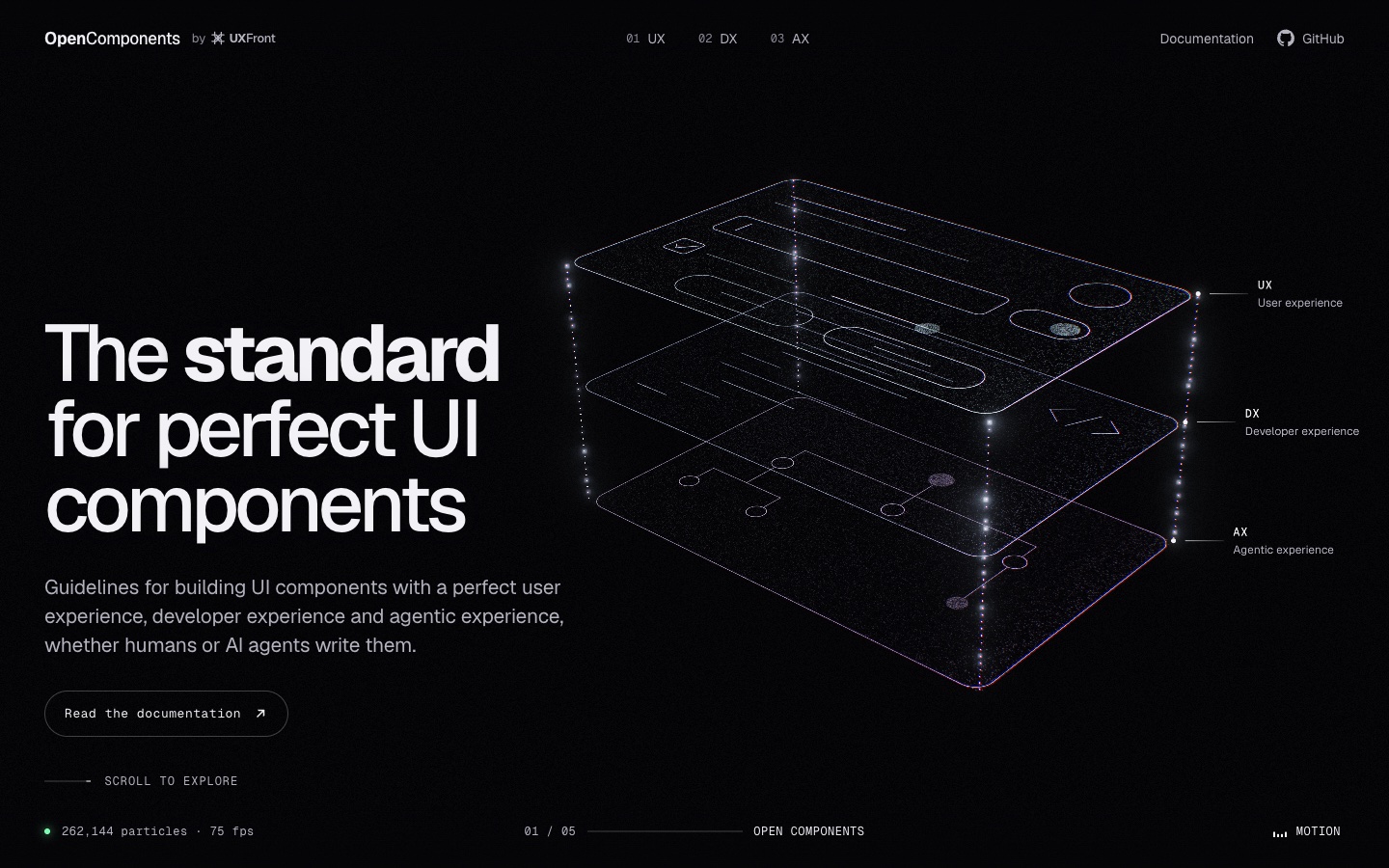
The standard has three layers, one for each audience a component serves. A component meets the standard when it meets all three.
- User experience (UX): components behave the way people expect them to, with any input, on any device and for every ability. Accessible, predictable, every state, adaptive.
- Developer experience (DX): one clear API, learned once and used everywhere. Knowing one component means knowing them all. Consistent, type-safe, composable, controllable.
- Agentic experience (AX): components that AI agents can read, reason about and build with, so their output meets the same bar as yours. Semantic, described, deterministic, verifiable.
Learn the guidelines once, then hold every component to the same high standards, whether you or your agents write it.
Reading the standard
Start with the Introduction, which walks through the three
layers and what each one asks of a component. The guidelines live as markdown in
content/docs/, so you can also read them right here on GitHub.
For agents
Every page of the documentation is also published as markdown, so agents can read the standard and check their work against it:
https://opencomponents.dev/raw/<path>.mdholds one page, as in/raw/docs/getting-started/introduction.mdfor the introduction.https://opencomponents.dev/raw/<path>.yamlholds a page's contract, with every rule from its checklist, as in/raw/docs/components/button.yaml. It's every requirement in a fraction of the page's length./llms.txtlists every page and every contract./llms-full.txtholds them all in one file. Point your agent at it to give it the whole standard in one request.
Bugs and feature requests
Found a bug on the site, a gap in the guidelines or an idea for a new one? Please first search for existing and closed issues. If your problem or idea is not addressed yet, please open a new issue.
Contributing
Please read through our contributing guide. There you can find how to run the site locally, edit the guidelines and deploy. Everyone taking part in the project agrees to follow our Code of Conduct.
Thanks goes to these wonderful people!
Creator
Alex Grozav
If you use Open Components in your daily work and feel that it has made your life easier, please consider sponsoring me on GitHub Sponsors. 💖
Copyright and license
Copyright © 2026 UXFront. The site code is released under the
MIT License. The guidelines in content/ are released under the
Creative Commons Attribution 4.0 License: you can share and adapt them,
commercially too, as long as you credit Open Components.
Similar repos


Languages
Vue
56.8%
TypeScript
37.0%
CSS
4.1%
JavaScript
2.1%
The guidelines for building UI components with a perfect user experience, developer experience and agentic experience.
See the codeSee what people are saying
README
Open Components
Open Components is the standard for perfect UI components: guidelines for building UI components with a perfect user experience, developer experience and agentic experience, whether humans or AI agents write them.
Open Components is part of UXFront, written and maintained by @alexgrozav.
Homepage
·
Documentation
·
llms.txt
·
Issue Tracker
Table of contents
- The standard
- Reading the standard
- For agents
- Bugs and feature requests
- Contributing
- Creator
- Copyright and license
The standard
The standard has three layers, one for each audience a component serves. A component meets the standard when it meets all three.
- User experience (UX): components behave the way people expect them to, with any input, on any device and for every ability. Accessible, predictable, every state, adaptive.
- Developer experience (DX): one clear API, learned once and used everywhere. Knowing one component means knowing them all. Consistent, type-safe, composable, controllable.
- Agentic experience (AX): components that AI agents can read, reason about and build with, so their output meets the same bar as yours. Semantic, described, deterministic, verifiable.
Learn the guidelines once, then hold every component to the same high standards, whether you or your agents write it.
Reading the standard
Start with the Introduction, which walks through the three
layers and what each one asks of a component. The guidelines live as markdown in
content/docs/, so you can also read them right here on GitHub.
For agents
Every page of the documentation is also published as markdown, so agents can read the standard and check their work against it:
https://opencomponents.dev/raw/<path>.mdholds one page, as in/raw/docs/getting-started/introduction.mdfor the introduction.https://opencomponents.dev/raw/<path>.yamlholds a page's contract, with every rule from its checklist, as in/raw/docs/components/button.yaml. It's every requirement in a fraction of the page's length./llms.txtlists every page and every contract./llms-full.txtholds them all in one file. Point your agent at it to give it the whole standard in one request.
Bugs and feature requests
Found a bug on the site, a gap in the guidelines or an idea for a new one? Please first search for existing and closed issues. If your problem or idea is not addressed yet, please open a new issue.
Contributing
Please read through our contributing guide. There you can find how to run the site locally, edit the guidelines and deploy. Everyone taking part in the project agrees to follow our Code of Conduct.
Thanks goes to these wonderful people!
Creator
Alex Grozav
If you use Open Components in your daily work and feel that it has made your life easier, please consider sponsoring me on GitHub Sponsors. 💖
Copyright and license
Copyright © 2026 UXFront. The site code is released under the
MIT License. The guidelines in content/ are released under the
Creative Commons Attribution 4.0 License: you can share and adapt them,
commercially too, as long as you credit Open Components.
Similar repos
Languages
Vue
56.8%
TypeScript
37.0%
CSS
4.1%
JavaScript
2.1%