
Surgical derivative of Orca. Same product surface. Residual orchestration and safety contracts closed.
0
stars
10,997
commits
TypeScript
primary language
Sep 14, 2026
updated
README

Odin
Surgical derivative of Orca. Same product surface. Residual orchestration and safety contracts closed.
Odin is Orca (upstream stablyai/orca at 539d4d1f32, v1.4.197, MIT © Lovecast Inc.) with a small set of patches at the exact sites where Orca still synthesised a verdict from an absence of evidence, or acted on the operator's machine without a recorded grant. Nothing else changed: terminals, worktrees, SSH, mobile, the 36 supported agent CLIs and the UI are Orca's. Every patch is proven the same way: its test fails at the upstream commit and passes here.
odin/proof/run-proofs.sh        # reruns every proof test at the upstream commit (must fail) and on Odin (must pass)
odin/proof/real-sessions.mjs    # drives real claude / codex / grok workers through Orca's own orchestration on a headless host
git log --first-parent odin     # one commit per residual, message = residual (file:line) → contract → proof files
Orca residual failure → Odin stricter contract
| # | Orca residual failure (upstream citation) | Odin contract | Proof |
|---|---|---|---|
| A | Retired-incarnation tombstone minted a clean exit: code: session.exitCode ?? 0 (src/main/daemon/terminal-host.ts:132) although src/shared/terminal-exit-cause.ts:36-45 forbids exactly that; the consumer (terminal-host-process-inspection.ts:43-63) published verdict:'exited' regardless of the code, and the renderer fired a completion notification on it. Relay twin: src/relay/pty-handler.ts:2412 hard-coded code: 0 even for record-torn-down. | The exiting session is captured, not re-looked-up; an absent status is UNVERIFIED_PROCESS_EXIT_CODE; the inspector publishes exited only when isProvenProcessExit(code), else unverifiable. The relay applies the same gate (closed by construction: its test pins the extracted mapping, because the record-torn-down race has no deterministic relay harness). | terminal-host-process-inspection.test.ts |
| B | Worker liveness read an empty or non-enumerating host answer as death (src/main/runtime/orchestration/worker-terminal-process-liveness.ts:8-31); the local provider lists only in-process PTYs and a restarted relay omits every prior id, so worker-release settled retained resources whose process was alive (#3191). | Only a host that enumerated this PTY under a different incarnation may report its death. Empty or unmatched listings are unverifiable. | worker-terminal-process-liveness.test.ts |
| C | tui-idle waits settled on silence: tier-3 "sustained title idle" returned the same true as positive evidence (src/main/runtime/tui-idle-evidence.ts:127-138; the module's own header calls it "ABSENCE, a last resort"; #6011, roadmap #15190). A silent worker was declared ready and an automation run declared completed. | Three-valued verdict observed-idle / silence / not-idle; the wire result carries evidence and satisfied is never true on silence; worker start and the automation observer treat silence as not-ready / not-completed; the CLI prints the evidence. Exit waits never settle on a disconnected PTY without a proven exit code. Two deliberate exceptions remain and are named in the module header: an explicit idle marker or ready prompt the agent itself paints is positive evidence, and agents whose only rest signal is their name (grok, copilot, aider, mimo, agy, opencode) settle after the quiescence window rather than never. | terminal-wait-name-only-idle.test.ts |
| S | Renderer adjudicated agent status by comparing two machines' wall clocks with no ownership requirement (src/renderer/src/runtime/web-session-tabs-sync/agent-status-patch.ts:118); a host blocked row lost to a stale client row with a later clock. The main-process copies were already closed upstream (docs/reference/agent-status-store.md, PR 1a/1b). | A host row is replaced only by a proven, fresh, client-owned row that the host does not pierce; cross-machine updatedAt no longer decides. The renderer is still a second writer for remote-runtime and structured panes, and a stateStartedAt comparison still guards provider-session retention; both are written down in odin/OPEN.md. | web-session-tabs-sync-host-authority.test.ts |
| D | The runtime WebSocket listener widened to 0.0.0.0 on every start once any device had ever paired (src/main/runtime/runtime-rpc/runtime-rpc-lifecycle.ts:146-158); nothing ever narrowed it back (#9963). | Loopback unless a persisted networkExposureConsent record is true, read at every bind; pairing refuses to widen without it; flipping it off rebinds the live listener to loopback. orca serve and orcad --bind remain explicit opt-ins. | runtime-rpc-websocket-bind-host.test.ts |
| E | Hooks were written into 14 other tools' user-global configs on boot; agentStatusHooksEnabled defaulted to true and the check was !== false, so an unset or unreadable setting installed (src/shared/default-global-settings.ts:211, managed-agent-hook-controls.ts:40-52; #9963). | Default false; the gate is === true; an absent, null or unreadable setting installs nothing. | managed-agent-hook-controls.test.ts |
| F | New installs were opted in to telemetry without ever seeing the banner (loaded-cohort-migrations.ts:52-57 wrote optedIn: true; the first-launch surface only renders for pre-existing installs). | Fresh installs are opted out. | persistence-cohort-and-identity-migration.test.ts |
| G | ~/.codex/auth.json was copied into an Orca-owned runtime home from the service constructor, on every launch and account switch, with no setting or prompt (runtime-home-service-auth-sync.ts:9-84, runtime-home-service-sync.ts:95). | codexCredentialMirrorConsent (default false) gates the copy primitive itself, so the constructor, account-switch and system-default-changed paths cannot copy without it; unreadable settings deny; any apply with consent false clears the runtime copy and snapshot. Logout bookkeeping stays ungated. | runtime-home-system-default-mirror-readback.test.ts |
| H | Permission bypass was the shipped default for 26 agents: DEFAULT_TUI_AGENT_ARGS = YOLO_TUI_AGENT_ARGS (src/shared/tui-agent-launch-defaults.ts:10), spread into default settings and force-migrated into profiles that never chose it (terminal-settings-migrations.ts:149-179; #9963). | Shipped defaults carry no bypass flag; the migration hydrates keys with empty values; bypass exists only as the payload of the user's own per-agent setting or permission-mode switch. | constants.test.ts, terminal-settings-migrations.test.ts |
| I | The worker launch receipt's effective was a structural copy of requested (worker-launch-preferences.ts:23-33); model and effort were validated against a table compiled into the binary, never against the installed CLI (#10846, open). | For Claude, effective comes from the installed CLI's own list_models answer (source: 'probe') for both model and effort. For Codex, effective's model also comes from the installed CLI's own codex debug models answer (source: 'probe'); effort stays validated against the static catalog only (effortSource: 'catalog') because that CLI's reported reasoning levels never include minimal, which the catalog offers as every model's floor — checking effort against the probe would reject a catalog-valid selection. Grok has no live probe at this receipt: GROK_SESSION_OPTION_CATALOG has no supportsWorkerLaunchPreferences, so a grok --model/--effort worker-start is rejected before any receipt is built; its model-list probe is wired and tested at the discovery layer only (grok-model-list-probe.ts), ready for the day grok's catalog opts in. A refusal carries the CLI's reason; a probe that cannot run yields effective: null, source: 'unverified' with the reason; a federated worker whose host never answered gets effective: null, never a copy; a remote or command-overridden placement skips the local probe and is unverified. Membership in the CLI's model list proves advertised support, not what the launched session applied. | worker-launch-preferences.test.ts |
| K | In-process sub-agents were flattened into fake dispatches: the sidebar fabricated orchestration: { taskId: 'subagent:<id>', dispatchId: 'subagent:<id>' } for rows that have no Task or Dispatch anywhere (worktree-subagent-child-rows.ts:55-60; #8251). | Sub-agent rows carry their own subagent: { id, parentPaneKey } identity and never masquerade as a dispatch. | worktree-subagent-child-rows.test.ts |
| M | Dispatches created by orchestration dispatch --inject had no worker row and were invisible to crash recovery (worker-terminal-recovery.ts:13-27 inner-joins worker_dispatches), so after a restart they stayed live with a valid capability forever. | Every active dispatch is reconciled on every host start (wired into the one recovery method orca serve, orcad and the desktop share): left alone when its terminal is live or the host cannot be asked, failed with termination_reason: 'unknown' and its capability revoked only when the owner says the terminal is gone. | orchestration-unsupervised-dispatch-recovery.test.ts |
| N | dispatch_contexts.dispatched_at was stamped at row creation (a dead duplicate of created_at), the observed exit code was dropped before failDispatch (orca-runtime-subscribe-to-terminal-resize.ts:87-90), and nothing exposed per-attempt wallclock. | dispatched_at is written on the pending→dispatched edge, exit_code is a column (schema v42), and worker-show --json reports dispatchedAt, completedAt, wallclockMs, exitCode, terminationReason. | worker-dispatch-accounting.test.ts |
Verified, not re-implemented (see odin/VERIFIED.md): nesting-depth enforcement (#16668), durable mutation receipts, capability fencing and journal recovery (#16904, fixes #15180), and the headless recovery sweep that already runs on orca serve and orcad. Odin pins these with tests so they cannot regress silently.
Left open, with the exact plan and cost written down in odin/OPEN.md: the renderer is still a second writer of agent status for remote-runtime panes whose bytes never transit the host.
Real sessions on this build
odin/proof/real-sessions.mjs drives real agent CLIs through Orca's own orchestration worker-start on a headless serve host with an isolated profile. Recorded runs (macOS, this checkout; files under odin/proofs/):
| Phase | Claude | Codex | Grok | Artifact |
|---|---|---|---|---|
Safe default: a fresh profile launches every worker with no bypass flag in its argv (ps captured live, full command lines) | no bypass; completes because this operator's own Claude config auto-approves | no bypass; stays dispatched, never settles | no bypass; the worker fails to start | real-sessions.2026-09-14T14-29-05-741Z.json |
Settle: with the operator's per-agent grant recorded in the profile, the worker reports worker_done and the dispatch row settles completed with dispatchedAt, completedAt, wallclockMs | 8.7 s | 4.6 s | not run: the operator's Grok account is at its free usage limit | real-sessions.2026-09-14T15-08-32-250Z.json |
| Concurrent: two workers started in parallel both settle | 8.6 s | 5.3 s | — | same file |
Crash: the host is SIGKILLed after worker-start has returned (the send is delivered, the receipt completed, the task unsettled) and restarted on the same profile; replaying the same --retry-request returns the identical dispatch (one row, no second worker); the worker is still dispatched, never falsely exited or completed. The other honest answer, operation_unknown for a receipt still pending at the crash, is pinned by upstream's own unit tests (odin/VERIFIED.md), not by this driver | pass | pass | pass | real-sessions.2026-09-14T14-49-45-377Z.json |
Two things these runs show that a unit test cannot. First, the H1 contract acting on a real profile: a run whose grants were written without agentBypassDefaultsReviewed had them cleared on load because they equal Orca's former automatic values verbatim, and the Codex worker parked on its approval prompt instead of settling (real-sessions.2026-09-14T15-05-30-764Z.json, kept as evidence). Second, the operator's own agent configuration is outside Odin's contract: the Claude worker completes even in the safe-default phase because this operator's Claude config auto-approves; the argv still carries no flag from Odin.
Linux: the same 13 proofs reproduce at upstream and close on Odin inside a node:24 Linux container, and the twelve process-ownership test files that read a real ps and /proc (PTY process groups, foreground-process batches and fingerprints, process-table snapshots, daemon session reaping, tombstone inspection, worker liveness) pass there: 151 tests (odin/proofs/linux-proofs.txt). Not covered: Windows hosts, a third agent settling (Grok quota), and Orca's mobile app paired against an Odin host.
Independent review
Two independent reviewers were given the same brief (odin/REVIEW_BRIEF.md): review this repository against odin/DIRECTION.md and odin/AGENTS.md, do not rubber-stamp. Two rounds ran. Round one: Codex (codex exec, read-only) returned NOT FINISHED with concrete file:line findings; a Claude review covered the consent and durability sections before its session was rate-limited. Round two, on the fixed tree: Codex again returned NOT FINISHED (its remaining findings are the credential write primitive, the handle-stale classification, the veto ordering, and the contract-level items listed under Deviations); Claude returned FINISHED WITH MATERIAL DEVIATIONS and independently reran all 13 proofs (13/13 reproduce and close), finding one contradiction between two checked-in tests and one unlisted renderer writer. Every material finding from both rounds became a odin(fix-…) commit with its own failing-first proof:
- injected-dispatch recovery had no production caller (wired into the shared recovery method, runtime-level proof);
- the wallclock reader mis-parsed SQLite timestamps outside UTC (34,201,000 ms for a one-second interval in Adelaide; both ends normalised);
- two credential-copy paths bypassed the consent gate (gate moved into the copy primitive);
- two hook checks were still fail-open (
=== trueeverywhere); - exit waits settled on a disconnected PTY and mapped the unverified exit code to
exited; tui-idle results accepted missing evidence; the boolean adapter said satisfied on silence (all removed); - worker observation minted
exitedfrom absence and read every inspection failure as "missing" (now only the owner's not-found answer counts); - widen/narrow of the network listener could race (serialised, consent re-read after a widen);
- profiles that inherited Orca's automatic bypass values kept them (one-shot review migration clears values equal to the YOLO table; a user who chose the same value re-enables it once);
- launch receipts still copied
requestedintoeffectivein two paths (nownullwhen unknown); - sub-agent rows defaulted to done when nothing was observed (now unverifiable);
- the proof runner accepted any nonzero exit as a reproduction (now requires the named assertion at the upstream commit);
- round two: the credential copy could still be reached through retained-pane synchronisation and revocation left the credential in the provenance file (gate moved into
writeRuntimeAuth, provenance deleted on revocation);terminal_handle_stalewas read as owner-proven absence although it describes the client handle graph (only the PTY host'sterminal_goneor a resolved null counts now; the injected-sweep error is returned, not dropped); a retained idle title or ready prompt outranked a fresh first-party working status (the veto is consulted first); two tests written by the original H commit contradicted the H1 review migration (reconciled to the chosen contract);odin/OPEN.mdomitted the command-code title writer (now enumerated).
Findings the reviews raised that are deliberately not changed, with the reason: the liveness projection keeps unattached, missing and identity_changed as wire values beside live / unverifiable / exited because existing tests pin them as distinct client-facing states; orca serve and orcad --bind bind wide by explicit operator command; positive on-screen evidence (an explicit idle marker or ready prompt the agent paints) remains tier-1 evidence.
Test status on this build
Orca's full unit suite was run on the merged tree (8,751 files, 81,585 tests) and then every failing file was rerun both here and at the upstream commit. Twenty files failed only on Odin; all of them were tests pinned to behaviour Odin deliberately changed (bypass flags in launch and resume commands, sub-agent row state, liveness verdicts) and were updated to the new contract with a reason on each, no production code changed. Eight files fail identically at upstream and are environment-bound (real signed-in Claude CLI, real bash/PTY quirks, network, a release-checkout download, a missing optional package, a stale upstream keepalive test). The classification with evidence is odin/proofs/full-suite-triage.md. Typecheck is clean on node, cli and web.
Deviations at v0.1.0
Stated plainly, because two independent reviews returned NOT FINISHED against odin/DIRECTION.md's definition of done and these are the items that remain open by decision rather than by oversight:
- Status is not yet single-writer end to end. The main-process store is; the renderer still writes rows for remote-runtime and structured panes whose bytes never transit the host, and it still merges client identity fields into host rows. Closing it needs host-side OSC ingest plus a wire capability gate (
odin/OPEN.md). Odin removed the cross-machine wall-clock adjudication and nothing more. - Settlement keeps two positive-evidence exceptions. An explicit idle marker or ready prompt the agent itself paints counts as observation (a fresh first-party working status now vetoes it), and agents whose only rest signal is their name (grok, copilot, aider, mimo, agy, opencode) settle after the quiescence window. Removing the second would make
tui-idleunusable for those agents (#6011); it is a named trade-off, not the pure "silence is unverifiable" rule. - The wait result is
satisfiedplusevidence, not the literalaccepted | refused | unverifiabletype. The three outcomes are representable and every silence path maps to not-satisfied, but the wire shape is Orca's, kept for compatibility. - Worker observation keeps
unattached,missingandidentity_changedbesidelive / unverifiable / exitedbecause clients depend on them as distinct states. - The launch receipt verifies advertised support, not applied options.
source: 'probe'means the installed CLI listed the model (Claude: and the effort too). For Codex, effort is validated against the static catalog, not the probe (effortSource: 'catalog') — the CLI'sdebug modelsreports per-model reasoning levels but never listsminimal, which the catalog treats as universal, so trusting the probe there would reject a valid selection. Grok has no live probe at this receipt at all: its catalog does not opt into worker launch preferences, so a grok--model/--effortworker-start is rejected before any receipt exists; its model-list probe is wired only at the discovery layer, unreachable from here until that catalog gate opens. Nothing reads back what the launched session actually applied, for any agent. - Sub-agent rows carry their own identity but are still renderer-derived and their synthesized entry state falls back to
donewhere the status type has nounverifiablemember. - Proof coverage is macOS plus a Linux container. Windows process ownership, SSH-hosted worktrees, mixed-version clients, mobile pairing against an Odin host, and a third agent settling (this operator's Grok quota) are not established by the recorded runs.
- Retained telemetry opt-ins from Orca's automatic enrollment are preserved for pre-existing profiles; only fresh installs are opted out.
Everything above is either in odin/OPEN.md with a plan, or accepted for v0.1.0 as Orca's existing behaviour.
How to read the proofs
Each residual is one commit on the odin branch. The commit body names the upstream site, the contract, the judgement calls, and two files under odin/proofs/: <id>.before.txt is the new test failing on the unpatched code, <id>.after.txt is the same test and its neighbours passing after the patch. odin/proof/run-proofs.sh repeats that check mechanically against the pinned upstream commit. odin/proofs/real-sessions.*.json are the recorded runs of real agents through the orchestration surface.
Credits and licence
Orca is by Stably AI and Lovecast Inc., MIT. Odin keeps Orca's licence, copyright notice and history; the Odin commits are additive on top of upstream 539d4d1f32. Odin's own briefs are under odin/ (DIRECTION.md, AGENTS.md).
Orca (upstream README, unchanged below)
 Orca
Orca





中文 · 日本語 · 한국어 · Español · Français · Português
The AI Orchestrator for 100x builders.
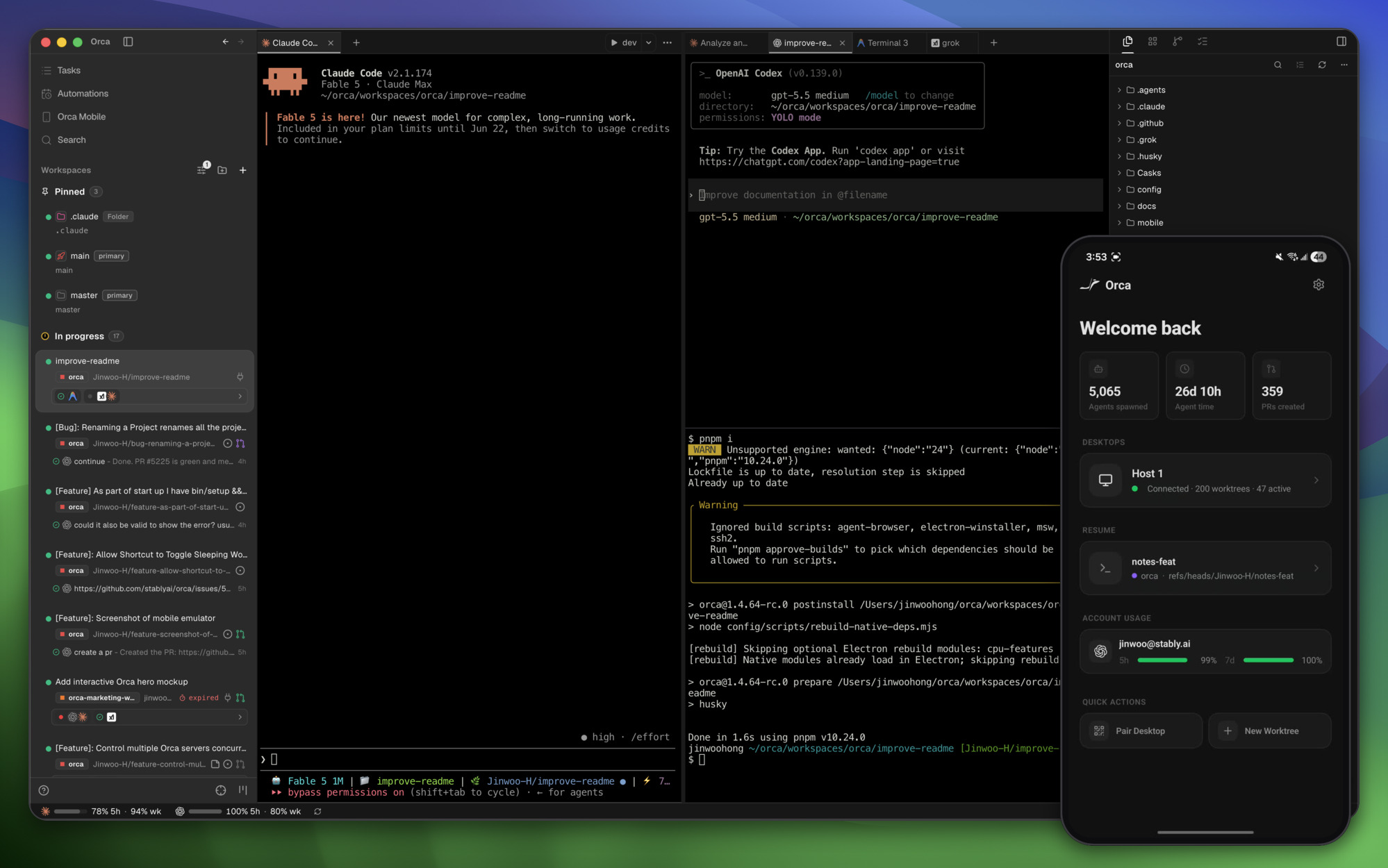
Run Codex, ClaudeCode, OpenCode or Pi side-by-side — each in its own worktree, tracked in one place.
Download Orca
Features
Mobile CompanionMonitor and steer your agents from your phone — get notified when an agent finishes and send follow-ups from anywhere. |
 |
Parallel WorktreesFan one prompt across five agents, each in its own isolated git worktree — compare the results and merge the winner. |
 |
Terminal SplitsGhostty-class terminals with WebGL rendering, infinite splits, and scrollback that survives restarts. |
 |
Design ModeClick any UI element in a real Chromium window to send its HTML, CSS, and a cropped screenshot straight into your agent's prompt. |
 |
GitHub & Linear, NativeBrowse PRs, issues, and project boards in-app — open a worktree from any task and review without a context switch. |
 |
SSH WorktreesRun agents on a beefy remote box with full file editing, git, and terminals — auto-reconnect and port forwarding included. |
 |
Annotate AI DiffsDrop comments on any diff line and ship them back to the agent — review, edit, and commit without leaving Orca. |
 |
Drag Files to AgentsVS Code's editor with autosave everywhere — drag files or images straight into an agent prompt. |
 |
Orca CLIAgents drive Orca too — script every workflow with |
 |
Also in the box:
- Quick open — Search across worktrees, files, agents, commands, and repo context without leaving your flow.
- Account switcher & usage tracking — See Claude and Codex usage and rate-limit resets, and hot-swap accounts without re-logging in.
- Rich repo previews — Preview Markdown, images, PDFs, and repo docs in the workspace.
- Computer Use — Let agents operate desktop apps and visible UI when a workflow needs real interaction.
- Notifications and unread state — Know when an agent finishes or needs attention, then mark threads unread to come back later.
- And many, many more — we ship daily, so this list is perpetually behind. The changelog is the real feature list.
Supported Agents
Works with any CLI agent — if it runs in a terminal, it runs in Orca.
 Claude Code
Codex
Grok
Cursor
GitHub Copilot
OpenCode
MiMo Code
Amp
 OpenClaude
Antigravity
 Pi
Pi
 oh-my-pi
Hermes Agent
Devin
Goose
Auggie
Autohand Code
Charm
Cline
Codebuff
Command Code
Continue
 Droid
Droid
 Kilocode
Kimi
Kiro
Mistral Vibe
Qwen Code
Rovo Dev
+ any CLI agent
Install
Desktop — macOS, Windows, Linux
- Download from onOrca.dev
- Or grab a build directly: macOS Apple Silicon · macOS Intel · Windows (.exe) · Linux AppImage · All builds
- Running
orca serveon a headless Linux server? See the headless Linux server guide.
Or via a package manager:
# macOS (Homebrew)
brew install --cask stablyai/orca/orca

# Arch Linux (AUR) — or stably-orca-git to build from source
yay -S stably-orca-bin
Mobile Companion — iOS, Android
Pair with your desktop app to monitor and steer your agents from your phone.
- iOS: Download on the App Store or join TestFlight
- Android: Download APK 0.0.48 · Install guide
Community & Support
-
Discord: Join the community on Discord.
-
Twitter / X: Follow @orca_build for updates and announcements.
-
WeChat: Scan to join the Orca community WeChat group 8. Group 8 may be full; if so, scan the Group 9 QR code instead.
-
Feedback & Ideas: We ship fast. Missing something? Request a new feature.
-
Privacy: See the privacy & telemetry docs for what anonymous usage data Orca collects and how to opt out.
-
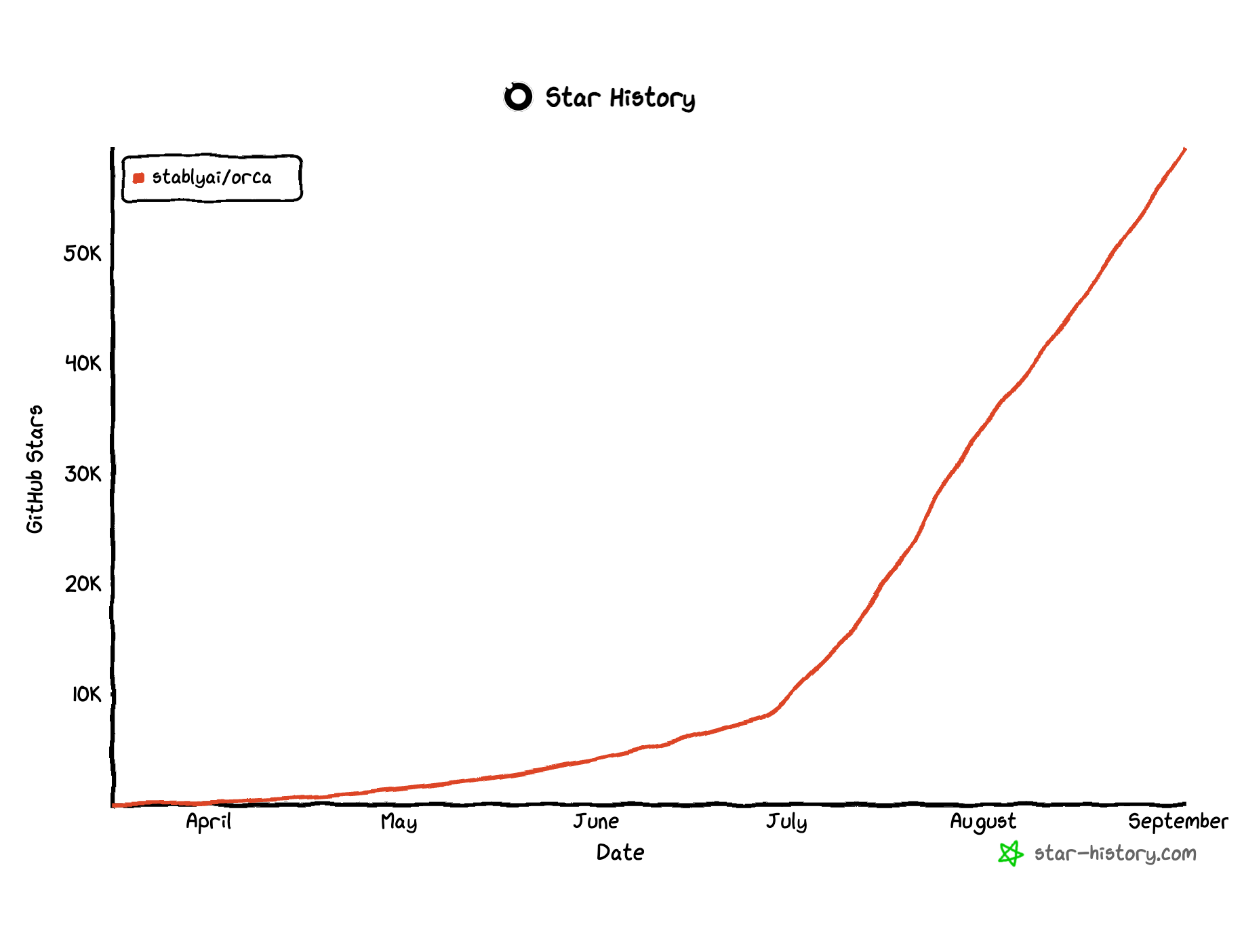
Show Support: Star this repo to follow along with our daily ships.
Developing
Want to contribute or run locally? See our CONTRIBUTING.md guide.
The relay that pairs the mobile app with a desktop host is also in this repository under
cloud/, with a separate pnpm workspace and setup guide.
Signed Builds
Windows code signing sponored/provided by SignPath.io, certificate by SignPath Foundation.
License
Orca is free and open source under the MIT License.
Contributors
(top 30 of 367)


See what people are saying
Similar repos





Languages
TypeScript
95.7%
JavaScript
3.5%
Surgical derivative of Orca. Same product surface. Residual orchestration and safety contracts closed.
0
stars
10,997
commits
TypeScript
primary language
Sep 14, 2026
updated
README
Odin
Surgical derivative of Orca. Same product surface. Residual orchestration and safety contracts closed.
Odin is Orca (upstream stablyai/orca at 539d4d1f32, v1.4.197, MIT © Lovecast Inc.) with a small set of patches at the exact sites where Orca still synthesised a verdict from an absence of evidence, or acted on the operator's machine without a recorded grant. Nothing else changed: terminals, worktrees, SSH, mobile, the 36 supported agent CLIs and the UI are Orca's. Every patch is proven the same way: its test fails at the upstream commit and passes here.
odin/proof/run-proofs.sh        # reruns every proof test at the upstream commit (must fail) and on Odin (must pass)
odin/proof/real-sessions.mjs    # drives real claude / codex / grok workers through Orca's own orchestration on a headless host
git log --first-parent odin     # one commit per residual, message = residual (file:line) → contract → proof files
Orca residual failure → Odin stricter contract
| # | Orca residual failure (upstream citation) | Odin contract | Proof |
|---|---|---|---|
| A | Retired-incarnation tombstone minted a clean exit: code: session.exitCode ?? 0 (src/main/daemon/terminal-host.ts:132) although src/shared/terminal-exit-cause.ts:36-45 forbids exactly that; the consumer (terminal-host-process-inspection.ts:43-63) published verdict:'exited' regardless of the code, and the renderer fired a completion notification on it. Relay twin: src/relay/pty-handler.ts:2412 hard-coded code: 0 even for record-torn-down. | The exiting session is captured, not re-looked-up; an absent status is UNVERIFIED_PROCESS_EXIT_CODE; the inspector publishes exited only when isProvenProcessExit(code), else unverifiable. The relay applies the same gate (closed by construction: its test pins the extracted mapping, because the record-torn-down race has no deterministic relay harness). | terminal-host-process-inspection.test.ts |
| B | Worker liveness read an empty or non-enumerating host answer as death (src/main/runtime/orchestration/worker-terminal-process-liveness.ts:8-31); the local provider lists only in-process PTYs and a restarted relay omits every prior id, so worker-release settled retained resources whose process was alive (#3191). | Only a host that enumerated this PTY under a different incarnation may report its death. Empty or unmatched listings are unverifiable. | worker-terminal-process-liveness.test.ts |
| C | tui-idle waits settled on silence: tier-3 "sustained title idle" returned the same true as positive evidence (src/main/runtime/tui-idle-evidence.ts:127-138; the module's own header calls it "ABSENCE, a last resort"; #6011, roadmap #15190). A silent worker was declared ready and an automation run declared completed. | Three-valued verdict observed-idle / silence / not-idle; the wire result carries evidence and satisfied is never true on silence; worker start and the automation observer treat silence as not-ready / not-completed; the CLI prints the evidence. Exit waits never settle on a disconnected PTY without a proven exit code. Two deliberate exceptions remain and are named in the module header: an explicit idle marker or ready prompt the agent itself paints is positive evidence, and agents whose only rest signal is their name (grok, copilot, aider, mimo, agy, opencode) settle after the quiescence window rather than never. | terminal-wait-name-only-idle.test.ts |
| S | Renderer adjudicated agent status by comparing two machines' wall clocks with no ownership requirement (src/renderer/src/runtime/web-session-tabs-sync/agent-status-patch.ts:118); a host blocked row lost to a stale client row with a later clock. The main-process copies were already closed upstream (docs/reference/agent-status-store.md, PR 1a/1b). | A host row is replaced only by a proven, fresh, client-owned row that the host does not pierce; cross-machine updatedAt no longer decides. The renderer is still a second writer for remote-runtime and structured panes, and a stateStartedAt comparison still guards provider-session retention; both are written down in odin/OPEN.md. | web-session-tabs-sync-host-authority.test.ts |
| D | The runtime WebSocket listener widened to 0.0.0.0 on every start once any device had ever paired (src/main/runtime/runtime-rpc/runtime-rpc-lifecycle.ts:146-158); nothing ever narrowed it back (#9963). | Loopback unless a persisted networkExposureConsent record is true, read at every bind; pairing refuses to widen without it; flipping it off rebinds the live listener to loopback. orca serve and orcad --bind remain explicit opt-ins. | runtime-rpc-websocket-bind-host.test.ts |
| E | Hooks were written into 14 other tools' user-global configs on boot; agentStatusHooksEnabled defaulted to true and the check was !== false, so an unset or unreadable setting installed (src/shared/default-global-settings.ts:211, managed-agent-hook-controls.ts:40-52; #9963). | Default false; the gate is === true; an absent, null or unreadable setting installs nothing. | managed-agent-hook-controls.test.ts |
| F | New installs were opted in to telemetry without ever seeing the banner (loaded-cohort-migrations.ts:52-57 wrote optedIn: true; the first-launch surface only renders for pre-existing installs). | Fresh installs are opted out. | persistence-cohort-and-identity-migration.test.ts |
| G | ~/.codex/auth.json was copied into an Orca-owned runtime home from the service constructor, on every launch and account switch, with no setting or prompt (runtime-home-service-auth-sync.ts:9-84, runtime-home-service-sync.ts:95). | codexCredentialMirrorConsent (default false) gates the copy primitive itself, so the constructor, account-switch and system-default-changed paths cannot copy without it; unreadable settings deny; any apply with consent false clears the runtime copy and snapshot. Logout bookkeeping stays ungated. | runtime-home-system-default-mirror-readback.test.ts |
| H | Permission bypass was the shipped default for 26 agents: DEFAULT_TUI_AGENT_ARGS = YOLO_TUI_AGENT_ARGS (src/shared/tui-agent-launch-defaults.ts:10), spread into default settings and force-migrated into profiles that never chose it (terminal-settings-migrations.ts:149-179; #9963). | Shipped defaults carry no bypass flag; the migration hydrates keys with empty values; bypass exists only as the payload of the user's own per-agent setting or permission-mode switch. | constants.test.ts, terminal-settings-migrations.test.ts |
| I | The worker launch receipt's effective was a structural copy of requested (worker-launch-preferences.ts:23-33); model and effort were validated against a table compiled into the binary, never against the installed CLI (#10846, open). | For Claude, effective comes from the installed CLI's own list_models answer (source: 'probe') for both model and effort. For Codex, effective's model also comes from the installed CLI's own codex debug models answer (source: 'probe'); effort stays validated against the static catalog only (effortSource: 'catalog') because that CLI's reported reasoning levels never include minimal, which the catalog offers as every model's floor — checking effort against the probe would reject a catalog-valid selection. Grok has no live probe at this receipt: GROK_SESSION_OPTION_CATALOG has no supportsWorkerLaunchPreferences, so a grok --model/--effort worker-start is rejected before any receipt is built; its model-list probe is wired and tested at the discovery layer only (grok-model-list-probe.ts), ready for the day grok's catalog opts in. A refusal carries the CLI's reason; a probe that cannot run yields effective: null, source: 'unverified' with the reason; a federated worker whose host never answered gets effective: null, never a copy; a remote or command-overridden placement skips the local probe and is unverified. Membership in the CLI's model list proves advertised support, not what the launched session applied. | worker-launch-preferences.test.ts |
| K | In-process sub-agents were flattened into fake dispatches: the sidebar fabricated orchestration: { taskId: 'subagent:<id>', dispatchId: 'subagent:<id>' } for rows that have no Task or Dispatch anywhere (worktree-subagent-child-rows.ts:55-60; #8251). | Sub-agent rows carry their own subagent: { id, parentPaneKey } identity and never masquerade as a dispatch. | worktree-subagent-child-rows.test.ts |
| M | Dispatches created by orchestration dispatch --inject had no worker row and were invisible to crash recovery (worker-terminal-recovery.ts:13-27 inner-joins worker_dispatches), so after a restart they stayed live with a valid capability forever. | Every active dispatch is reconciled on every host start (wired into the one recovery method orca serve, orcad and the desktop share): left alone when its terminal is live or the host cannot be asked, failed with termination_reason: 'unknown' and its capability revoked only when the owner says the terminal is gone. | orchestration-unsupervised-dispatch-recovery.test.ts |
| N | dispatch_contexts.dispatched_at was stamped at row creation (a dead duplicate of created_at), the observed exit code was dropped before failDispatch (orca-runtime-subscribe-to-terminal-resize.ts:87-90), and nothing exposed per-attempt wallclock. | dispatched_at is written on the pending→dispatched edge, exit_code is a column (schema v42), and worker-show --json reports dispatchedAt, completedAt, wallclockMs, exitCode, terminationReason. | worker-dispatch-accounting.test.ts |
Verified, not re-implemented (see odin/VERIFIED.md): nesting-depth enforcement (#16668), durable mutation receipts, capability fencing and journal recovery (#16904, fixes #15180), and the headless recovery sweep that already runs on orca serve and orcad. Odin pins these with tests so they cannot regress silently.
Left open, with the exact plan and cost written down in odin/OPEN.md: the renderer is still a second writer of agent status for remote-runtime panes whose bytes never transit the host.
Real sessions on this build
odin/proof/real-sessions.mjs drives real agent CLIs through Orca's own orchestration worker-start on a headless serve host with an isolated profile. Recorded runs (macOS, this checkout; files under odin/proofs/):
| Phase | Claude | Codex | Grok | Artifact |
|---|---|---|---|---|
Safe default: a fresh profile launches every worker with no bypass flag in its argv (ps captured live, full command lines) | no bypass; completes because this operator's own Claude config auto-approves | no bypass; stays dispatched, never settles | no bypass; the worker fails to start | real-sessions.2026-09-14T14-29-05-741Z.json |
Settle: with the operator's per-agent grant recorded in the profile, the worker reports worker_done and the dispatch row settles completed with dispatchedAt, completedAt, wallclockMs | 8.7 s | 4.6 s | not run: the operator's Grok account is at its free usage limit | real-sessions.2026-09-14T15-08-32-250Z.json |
| Concurrent: two workers started in parallel both settle | 8.6 s | 5.3 s | — | same file |
Crash: the host is SIGKILLed after worker-start has returned (the send is delivered, the receipt completed, the task unsettled) and restarted on the same profile; replaying the same --retry-request returns the identical dispatch (one row, no second worker); the worker is still dispatched, never falsely exited or completed. The other honest answer, operation_unknown for a receipt still pending at the crash, is pinned by upstream's own unit tests (odin/VERIFIED.md), not by this driver | pass | pass | pass | real-sessions.2026-09-14T14-49-45-377Z.json |
Two things these runs show that a unit test cannot. First, the H1 contract acting on a real profile: a run whose grants were written without agentBypassDefaultsReviewed had them cleared on load because they equal Orca's former automatic values verbatim, and the Codex worker parked on its approval prompt instead of settling (real-sessions.2026-09-14T15-05-30-764Z.json, kept as evidence). Second, the operator's own agent configuration is outside Odin's contract: the Claude worker completes even in the safe-default phase because this operator's Claude config auto-approves; the argv still carries no flag from Odin.
Linux: the same 13 proofs reproduce at upstream and close on Odin inside a node:24 Linux container, and the twelve process-ownership test files that read a real ps and /proc (PTY process groups, foreground-process batches and fingerprints, process-table snapshots, daemon session reaping, tombstone inspection, worker liveness) pass there: 151 tests (odin/proofs/linux-proofs.txt). Not covered: Windows hosts, a third agent settling (Grok quota), and Orca's mobile app paired against an Odin host.
Independent review
Two independent reviewers were given the same brief (odin/REVIEW_BRIEF.md): review this repository against odin/DIRECTION.md and odin/AGENTS.md, do not rubber-stamp. Two rounds ran. Round one: Codex (codex exec, read-only) returned NOT FINISHED with concrete file:line findings; a Claude review covered the consent and durability sections before its session was rate-limited. Round two, on the fixed tree: Codex again returned NOT FINISHED (its remaining findings are the credential write primitive, the handle-stale classification, the veto ordering, and the contract-level items listed under Deviations); Claude returned FINISHED WITH MATERIAL DEVIATIONS and independently reran all 13 proofs (13/13 reproduce and close), finding one contradiction between two checked-in tests and one unlisted renderer writer. Every material finding from both rounds became a odin(fix-…) commit with its own failing-first proof:
- injected-dispatch recovery had no production caller (wired into the shared recovery method, runtime-level proof);
- the wallclock reader mis-parsed SQLite timestamps outside UTC (34,201,000 ms for a one-second interval in Adelaide; both ends normalised);
- two credential-copy paths bypassed the consent gate (gate moved into the copy primitive);
- two hook checks were still fail-open (
=== trueeverywhere); - exit waits settled on a disconnected PTY and mapped the unverified exit code to
exited; tui-idle results accepted missing evidence; the boolean adapter said satisfied on silence (all removed); - worker observation minted
exitedfrom absence and read every inspection failure as "missing" (now only the owner's not-found answer counts); - widen/narrow of the network listener could race (serialised, consent re-read after a widen);
- profiles that inherited Orca's automatic bypass values kept them (one-shot review migration clears values equal to the YOLO table; a user who chose the same value re-enables it once);
- launch receipts still copied
requestedintoeffectivein two paths (nownullwhen unknown); - sub-agent rows defaulted to done when nothing was observed (now unverifiable);
- the proof runner accepted any nonzero exit as a reproduction (now requires the named assertion at the upstream commit);
- round two: the credential copy could still be reached through retained-pane synchronisation and revocation left the credential in the provenance file (gate moved into
writeRuntimeAuth, provenance deleted on revocation);terminal_handle_stalewas read as owner-proven absence although it describes the client handle graph (only the PTY host'sterminal_goneor a resolved null counts now; the injected-sweep error is returned, not dropped); a retained idle title or ready prompt outranked a fresh first-party working status (the veto is consulted first); two tests written by the original H commit contradicted the H1 review migration (reconciled to the chosen contract);odin/OPEN.mdomitted the command-code title writer (now enumerated).
Findings the reviews raised that are deliberately not changed, with the reason: the liveness projection keeps unattached, missing and identity_changed as wire values beside live / unverifiable / exited because existing tests pin them as distinct client-facing states; orca serve and orcad --bind bind wide by explicit operator command; positive on-screen evidence (an explicit idle marker or ready prompt the agent paints) remains tier-1 evidence.
Test status on this build
Orca's full unit suite was run on the merged tree (8,751 files, 81,585 tests) and then every failing file was rerun both here and at the upstream commit. Twenty files failed only on Odin; all of them were tests pinned to behaviour Odin deliberately changed (bypass flags in launch and resume commands, sub-agent row state, liveness verdicts) and were updated to the new contract with a reason on each, no production code changed. Eight files fail identically at upstream and are environment-bound (real signed-in Claude CLI, real bash/PTY quirks, network, a release-checkout download, a missing optional package, a stale upstream keepalive test). The classification with evidence is odin/proofs/full-suite-triage.md. Typecheck is clean on node, cli and web.
Deviations at v0.1.0
Stated plainly, because two independent reviews returned NOT FINISHED against odin/DIRECTION.md's definition of done and these are the items that remain open by decision rather than by oversight:
- Status is not yet single-writer end to end. The main-process store is; the renderer still writes rows for remote-runtime and structured panes whose bytes never transit the host, and it still merges client identity fields into host rows. Closing it needs host-side OSC ingest plus a wire capability gate (
odin/OPEN.md). Odin removed the cross-machine wall-clock adjudication and nothing more. - Settlement keeps two positive-evidence exceptions. An explicit idle marker or ready prompt the agent itself paints counts as observation (a fresh first-party working status now vetoes it), and agents whose only rest signal is their name (grok, copilot, aider, mimo, agy, opencode) settle after the quiescence window. Removing the second would make
tui-idleunusable for those agents (#6011); it is a named trade-off, not the pure "silence is unverifiable" rule. - The wait result is
satisfiedplusevidence, not the literalaccepted | refused | unverifiabletype. The three outcomes are representable and every silence path maps to not-satisfied, but the wire shape is Orca's, kept for compatibility. - Worker observation keeps
unattached,missingandidentity_changedbesidelive / unverifiable / exitedbecause clients depend on them as distinct states. - The launch receipt verifies advertised support, not applied options.
source: 'probe'means the installed CLI listed the model (Claude: and the effort too). For Codex, effort is validated against the static catalog, not the probe (effortSource: 'catalog') — the CLI'sdebug modelsreports per-model reasoning levels but never listsminimal, which the catalog treats as universal, so trusting the probe there would reject a valid selection. Grok has no live probe at this receipt at all: its catalog does not opt into worker launch preferences, so a grok--model/--effortworker-start is rejected before any receipt exists; its model-list probe is wired only at the discovery layer, unreachable from here until that catalog gate opens. Nothing reads back what the launched session actually applied, for any agent. - Sub-agent rows carry their own identity but are still renderer-derived and their synthesized entry state falls back to
donewhere the status type has nounverifiablemember. - Proof coverage is macOS plus a Linux container. Windows process ownership, SSH-hosted worktrees, mixed-version clients, mobile pairing against an Odin host, and a third agent settling (this operator's Grok quota) are not established by the recorded runs.
- Retained telemetry opt-ins from Orca's automatic enrollment are preserved for pre-existing profiles; only fresh installs are opted out.
Everything above is either in odin/OPEN.md with a plan, or accepted for v0.1.0 as Orca's existing behaviour.
How to read the proofs
Each residual is one commit on the odin branch. The commit body names the upstream site, the contract, the judgement calls, and two files under odin/proofs/: <id>.before.txt is the new test failing on the unpatched code, <id>.after.txt is the same test and its neighbours passing after the patch. odin/proof/run-proofs.sh repeats that check mechanically against the pinned upstream commit. odin/proofs/real-sessions.*.json are the recorded runs of real agents through the orchestration surface.
Credits and licence
Orca is by Stably AI and Lovecast Inc., MIT. Odin keeps Orca's licence, copyright notice and history; the Odin commits are additive on top of upstream 539d4d1f32. Odin's own briefs are under odin/ (DIRECTION.md, AGENTS.md).
Orca (upstream README, unchanged below)
Orca
中文 · 日本語 · 한국어 · Español · Français · Português
The AI Orchestrator for 100x builders.
Run Codex, ClaudeCode, OpenCode or Pi side-by-side — each in its own worktree, tracked in one place.
Download Orca
Features
Mobile CompanionMonitor and steer your agents from your phone — get notified when an agent finishes and send follow-ups from anywhere. |
|
Parallel WorktreesFan one prompt across five agents, each in its own isolated git worktree — compare the results and merge the winner. |
|
Terminal SplitsGhostty-class terminals with WebGL rendering, infinite splits, and scrollback that survives restarts. |
|
Design ModeClick any UI element in a real Chromium window to send its HTML, CSS, and a cropped screenshot straight into your agent's prompt. |
|
GitHub & Linear, NativeBrowse PRs, issues, and project boards in-app — open a worktree from any task and review without a context switch. |
|
SSH WorktreesRun agents on a beefy remote box with full file editing, git, and terminals — auto-reconnect and port forwarding included. |
|
Annotate AI DiffsDrop comments on any diff line and ship them back to the agent — review, edit, and commit without leaving Orca. |
|
Drag Files to AgentsVS Code's editor with autosave everywhere — drag files or images straight into an agent prompt. |
|
Orca CLIAgents drive Orca too — script every workflow with |
|
Also in the box:
- Quick open — Search across worktrees, files, agents, commands, and repo context without leaving your flow.
- Account switcher & usage tracking — See Claude and Codex usage and rate-limit resets, and hot-swap accounts without re-logging in.
- Rich repo previews — Preview Markdown, images, PDFs, and repo docs in the workspace.
- Computer Use — Let agents operate desktop apps and visible UI when a workflow needs real interaction.
- Notifications and unread state — Know when an agent finishes or needs attention, then mark threads unread to come back later.
- And many, many more — we ship daily, so this list is perpetually behind. The changelog is the real feature list.
Supported Agents
Works with any CLI agent — if it runs in a terminal, it runs in Orca.
Claude Code
Codex
Grok
Cursor
GitHub Copilot
OpenCode
MiMo Code
Amp
OpenClaude
Antigravity
Pi
oh-my-pi
Hermes Agent
Devin
Goose
Auggie
Autohand Code
Charm
Cline
Codebuff
Command Code
Continue
Droid
Kilocode
Kimi
Kiro
Mistral Vibe
Qwen Code
Rovo Dev
+ any CLI agent
Install
Desktop — macOS, Windows, Linux
- Download from onOrca.dev
- Or grab a build directly: macOS Apple Silicon · macOS Intel · Windows (.exe) · Linux AppImage · All builds
- Running
orca serveon a headless Linux server? See the headless Linux server guide.
Or via a package manager:
# macOS (Homebrew)
brew install --cask stablyai/orca/orca

# Arch Linux (AUR) — or stably-orca-git to build from source
yay -S stably-orca-bin
Mobile Companion — iOS, Android
Pair with your desktop app to monitor and steer your agents from your phone.
- iOS: Download on the App Store or join TestFlight
- Android: Download APK 0.0.48 · Install guide
Community & Support
-
Discord: Join the community on Discord.
-
Twitter / X: Follow @orca_build for updates and announcements.
-
WeChat: Scan to join the Orca community WeChat group 8. Group 8 may be full; if so, scan the Group 9 QR code instead.
-
Feedback & Ideas: We ship fast. Missing something? Request a new feature.
-
Privacy: See the privacy & telemetry docs for what anonymous usage data Orca collects and how to opt out.
-
Show Support: Star this repo to follow along with our daily ships.
Developing
Want to contribute or run locally? See our CONTRIBUTING.md guide.
The relay that pairs the mobile app with a desktop host is also in this repository under
cloud/, with a separate pnpm workspace and setup guide.
Signed Builds
Windows code signing sponored/provided by SignPath.io, certificate by SignPath Foundation.
License
Orca is free and open source under the MIT License.
See what people are saying
Similar repos
Contributors
(top 30 of 367)
Languages
TypeScript
95.7%
JavaScript
3.5%