
See what people are saying
README
pawl





Deterministic gates for coding agents, as one plugin for Claude Code, OpenAI Codex and Antigravity.
Agents make the same mistakes over and over, and telling them not to in the
prompt stops working after a page. pawl is a set of small checks that run as
code, not as instructions, and a report command that tallies what they blocked.
Each check watches for one mistake and refuses it, cleans it up, or (for
provably read-only commands) waves it through without a prompt. Plain Python
standard library, no model calls, nothing added to the prompt but a 144-token
skill description.
A pawl is the small part in a ratchet that lets the wheel move forward and stops it from slipping back. Every check here works the same way: the current state is the floor.
Try it
No install, no harness, nothing written outside a scratch directory:
git clone https://github.com/ulukaya/pawl && python3 pawl/hooks/pawl.py demo
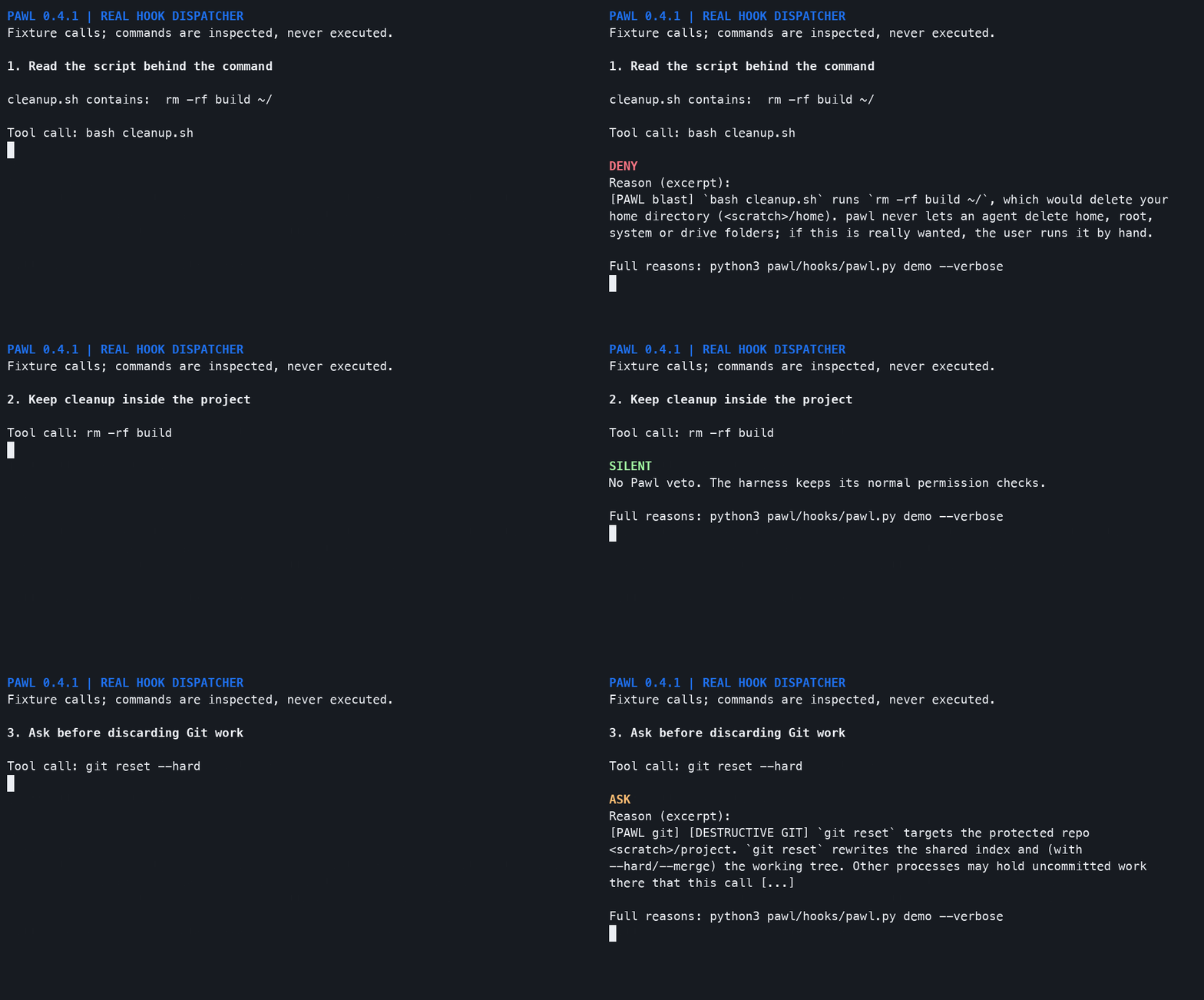
Recorded through the real Claude Code hook adapter using fixture tool calls. The commands are inspected, never executed; displayed reasons are excerpts. This demonstrates hook decisions rather than a live agent session.
The command above sends thirteen calls through the real dispatcher, written as Antigravity, Claude Code and Codex send it, and prints what each harness is told:
call                        gate        antigravity      claude code      codex
-------------------------------------------------------------------------------
make build                  -           allow            silent           silent
git log --oneline -5        readonly    auto_approve     allow            silent
git reset --hard            git         force_ask        ask              deny
script that runs rm -rf ~/  blast       deny             deny             deny
curl install.sh | sh        pin         force_ask        ask              deny
tail -f server.log          poll        force_ask        ask              deny
same pytest run, 3rd time   loop        force_ask        ask              deny
edit that changes nothing   noop        deny             deny             deny
write with a U+200B         zero-width  allow +rewrite   +rewrite         allow +rewrite
send naming ~/.deploy/      egress      deny             deny             deny
read another session        fence       force_ask        ask              deny
read Chrome's cookie key    creds       force_ask        ask              deny
stop with tail -f running   idle        n/a              block            n/a
silent leaves the harness's own prompt in place; allow and
auto_approve skip it. A Codex PreToolUse hook can neither ask nor approve,
so there an ask is a deny that tells the agent how to proceed. --verbose adds every
reason, --json every raw answer.
On your own sessions
replay sends every tool call from your past Claude Code sessions through
the same gates. It runs nothing and keeps no state:
python3 pawl/hooks/pawl.py replay --days 30 --show
It lists each call pawl would have asked about or refused, then a tally per gate, including how many read-only commands it would have approved without a prompt. Run it before installing to see what would change, and after changing a gate to find its false alarms on real work.
What it catches
Grouped by what a miss costs. The first table is work or data an agent cannot take back; those gates are the reason pawl exists.
Can't be undone
| The mistake | What pawl does | Gate |
|---|---|---|
Deletes home, root, a drive or ~/Documents, directly or from a script, trap, npm run, Makefile, python -c or container it runs | Refuses; asks before anything else outside the workspace | blast |
Runs git reset --hard, git clean -fdx, git commit --no-verify, git push --force or git branch -D and loses work | Asks the human first | git |
| Pastes internal paths, tokens or hostnames into a message | Blocks the send | send (egress) |
Reads browser cookies, saved passwords or the keychain (security find-generic-password, import browser_cookie3) | Asks the human first | creds |
| Reads another conversation's private files | Asks the human first | fence |
Installs from a branch URL (pip install .../archive/main.zip), runs npm install -g tool with no version, or pipes curl into sh | Asks the human to pin it or approve it | pin |
| Floods a chat room or inbox | Caps sends per channel per day; refuses a send loop it cannot count | send (budget) |
Prompts it removes
| The mistake | What pawl does | Gate |
|---|---|---|
Stalls on a permission prompt for ls or git log | Approves commands that provably only read | readonly |
Time and tokens it saves
| The mistake | What pawl does | Gate |
|---|---|---|
Runs while true; do sleep, tail -f or sleep 3600 and hangs | Asks the human first | poll |
| Calls the same tool with the same arguments in a loop | Asks before the third identical call | loop |
Ends its turn with a tail -f still running in the background | Blocks the stop once and names the task | idle |
| Changes a configured Git project without passing its checks | Reminds once at Stop; receipts match the tested contents | verify |
| Re-reads its own transcript after every context truncation | Refuses past a per-turn limit | reread |
| Sends an edit whose replacement equals its target, or rewrites a file with the bytes it already holds | Refuses it and sends the agent back to read | noop |
| Writes invisible zero-width characters into a file | Strips them so the write lands clean | zero-width |
| Writes a message that reads like a bot | Blocks it above a score threshold | send (prose) |
CLIs for pre-commit, CI and cron
| The mistake | What pawl does | Gate |
|---|---|---|
| Claims a bug is fixed without proving it | Requires the test to fail before the fix | repro_fence.py |
| Ships a test that still passes with the function stubbed out | Stubs each function in a copy and fails when the tests survive | bite_check.py |
| Lets failing-test or lint counts creep up | Keeps a baseline that can only go down | ratchet.py |
| Grows always-on prompt files until they cost more than they help | Caps their token size | prompt_budget.py |
| Keeps retrying a cron job that fails every night | Pauses it after repeated failures | breaker.py |
The first three tables are hook gates that fire on their own; the
last holds CLIs. Every piece also runs on its own: see
pieces/<name>/README.md.
What it costs
| Prompt | 144 tokens: the skill's description, the only always-on text |
| Latency | about 45 ms per Read and 65 ms per Bash call (median, Linux, Python 3.11), all gates in one process |
| Network | none: no telemetry, no model calls (PRIVACY.md) |
| Dependencies | the Python 3.11+ standard library |
Install
Claude Code
claude plugin marketplace add ulukaya/pawl
claude plugin install pawl@pawl
Or inside a session: /plugin marketplace add ulukaya/pawl, then
/plugin install pawl@pawl. Start a new session (or /reload-plugins), and
claude plugin details pawl lists Hooks (2) PreToolUse, Stop.
Codex
codex plugin marketplace add ulukaya/pawl
codex plugin add pawl@pawl
Codex reads .codex-plugin/plugin.json, which points it at
hooks/codex.json and the skill. Hooks need a Codex release with lifecycle
hooks.
Adding the plugin does not turn its hooks on. Codex runs a plugin's hooks only once you have reviewed and trusted their current definitions, and skips new or changed ones until then; see review and trust hooks in the Codex docs. To activate pawl:
- Start
codex. It warns at startup when hooks need review. - Open
/hooks, review pawl'sPreToolUseandStophooks (each runshooks/pawl.pywith--harness codex) and trust both. - Do it again after an update that changes
hooks/codex.json: a changed definition is skipped until trusted again.
To check that pawl is live, open /hooks and confirm both hooks are trusted
and enabled. Then, in a scratch session, ask Codex to run echo pawl-check
three times as separate commands: the third is refused with a
[PAWL loop] reason. hooks/e2e_test.py does not prove this: it runs the
shipped hook commands directly on fixture payloads, with no Codex process,
so it passes whether or not Codex loaded or trusted the hooks.
Antigravity
git clone https://github.com/ulukaya/pawl && cd pawl
./install.sh --antigravity
This links the checkout to ~/.gemini/config/plugins/pawl and adds
{"path": "plugins/pawl"} to ~/.gemini/config/plugins.json next to any
plugins already listed. Restart Antigravity; the plugin inventory lists
pawl.
From a checkout, any harness
./install.sh                 # every harness found on this machine
./install.sh --claude        # or --antigravity, --codex
./install.sh --uninstall     # reverse every step
./install.sh --dry-run       # print what would change
For Claude Code and Codex the installer runs the commands above with this
checkout as the marketplace, so the plugin loads in place (Codex still needs
the /hooks trust step above; the installer reminds you); --source ulukaya/pawl tracks GitHub instead. Every step is idempotent. It then runs
the test battery, which needs pytest (PAWL_PYTHON picks the
interpreter); the plugin itself needs only Python 3.11+.
How it works
 harness ──stdin──▶ hooks/pawl.py pre|stop --harness H
                      │
                      ├─ harness.parse()    native payload ─▶ one canonical call
                      ├─ gates.plan()       which gates apply to this tool
                      ├─ pieces/<name>/     each gate asks its piece
                      ├─ merge              deny > ask > approve > allow
                      └─ harness.render()   answer in H's own contract ──stdout──▶
Each harness has its own config, all running the same dispatcher:
| Harness | Config | Command |
|---|---|---|
| Antigravity | hooks.json | python3 -B hooks/pawl.py pre --only <gate> --harness antigravity, one group per gate |
| Claude Code | hooks/hooks.json | python3 -B "${CLAUDE_PLUGIN_ROOT}/hooks/pawl.py" pre --harness claude, plus stop |
| Codex | hooks/codex.json | python3 -B "${PLUGIN_ROOT}/hooks/pawl.py" pre --harness codex, plus stop |
hooks/harness.py, with its tables in hooks/harness_vocab.py, maps each
harness's tools onto the canonical names the pieces speak (Claude Code
Bash, Read, Write, Edit, TaskOutput; Codex Bash and
apply_patch) and writes each answer the way that harness reads it:
| pawl decides | Antigravity | Claude Code | Codex |
|---|---|---|---|
| no objection | allow | no output: the normal permission prompt still applies | no output |
| ask the human | force_ask | permissionDecision: ask | deny with the reason: a PreToolUse hook cannot ask |
| refuse | deny | permissionDecision: deny | permissionDecision: deny |
| provably read-only | auto_approve | permissionDecision: allow | no output: a PreToolUse hook cannot approve |
| rewrite the input | overwrite | updatedInput, permission unchanged | updatedInput |
| keep working (Stop) | block | decision: block | decision: block |
git, poll, pin, creds and fence read a shell command through
hooks/shell_view.py, which blanks heredoc bodies that never run as shell:
the file cat > notes.md <<'EOF' writes, a commit message in
git commit -m "$(cat <<'EOF' ...)", the string literals of a
python3 - <<'EOF' edit script, a list of commands that a while read
loop or a later python3 check.py cases.txt only reads. Each rule names
what is known to be data, and anything else keeps the body: a file run or
copied later, a loop that runs or saves the lines it reads, and Python
whose code can start a process (hooks/py_body.py reads it with ast).
creds and fence keep the paths in Python literals.
Codex does let a separate PermissionRequest hook, sent only when Codex is
about to ask the user, answer allow or deny; pawl registers no such hook.
Reasons are reworded in the harness's own tool names (Read, not
view_file). The first deny ends a run, so a refused call never spends a
send-budget unit. On Codex an ask is a deny, so it ends the run as well, and
a send over budget is refused with nothing spent and no override logged.
A git or poll gate whose piece cannot load denies, as it does when it fails.
Every answer exits 0; no path prints a traceback.
Gates
| Gate | Fires on | Fails | Antigravity | Claude Code | Codex |
|---|---|---|---|---|---|
fence | every tool | open | brain/, conversations/ | ~/.claude/projects/ | ~/.codex/sessions/ |
creds | every tool | open | yes | yes | yes (ask is deny) |
git | shell | closed | yes | yes | yes (deny) |
blast | shell | open (an unfinished analysis asks) | yes | yes | yes (ask is deny) |
pin | shell | open | yes | yes | yes (ask is deny) |
poll | shell | closed | yes | yes | yes (deny) |
noop | edits | open | replace_file_content | Edit | apply_patch |
zero-width | writes, edits | open | yes | Write, Edit | apply_patch |
readonly | shell | open | yes | yes | no (PreToolUse cannot approve) |
reread | reads, shell | open | yes | yes | yes |
loop | every tool | open | yes | yes | yes (deny) |
send | shell | egress closed | yes | yes | yes |
idle | Stop | open | /proc tasks | Stop payload tasks | no task list |
verify | all + Stop | open | configured Git files | configured Git files | configured Git files |
hooks/pawl.py gates lists them. Details: skills/pawl/references/<piece>.md
and pieces/<piece>/README.md.
Configuration
| Need | Do |
|---|---|
| Skip gates for a session | PAWL_DISABLE=git,poll (any gate name, or egress, prose, budget) |
| See what pawl would have done in past sessions | python3 hooks/pawl.py replay --days 30 --show (Claude Code transcripts) |
| See how often each send gate fires | python3 hooks/pawl.py stats (reads $PAWL_DATA/gate_events.jsonl) |
| Tally every gate's denials | python3 pieces/report/report.py --days 7 |
| One send, git or repeated call past a gate | approve the prompt; the row is logged as a human override |
| Change send ceilings | SEND_BUDGET_CEILINGS='{"chat_space": 4}' |
| Change egress rules | edit $PAWL_DATA/egress_rules.json (default ~/.pawl/) |
| Protect specific repos | PAWL_GIT_PROTECTED_ROOTS=/repo/a:/repo/b (default: the call's git toplevel) |
| Keep the prompt for read-only commands | PAWL_READONLY_PASS_OFF=1 |
| Refuse, not ask, on another session's files | PAWL_CONVERSATION_FENCE_STRICT=1 |
| Fence another credential store | PAWL_CREDENTIAL_EXTRA_ROOTS=~/.agent-reach |
| Refuse, not ask, on browser logins or unpinned installs | PAWL_CREDENTIAL_FENCE_STRICT=1, PAWL_INSTALL_PIN_GUARD_STRICT=1 |
| Force a harness format | --harness in the config, or PAWL_HARNESS |
On Claude Code four of these are plugin settings, so nobody edits an
environment: /config lists pawl's rows (Approve read-only shell commands,
Repos the git guard protects, Refuse reads of other sessions, Gates to turn
off), and claude plugin install pawl@pawl --config disable=reread sets one
at install. A PAWL_* variable you export wins over the setting.
State and logs live under PAWL_DATA (default ~/.pawl). Each piece's knobs
are listed in its reference page.
Privacy
pawl runs on your machine and nowhere else: no network, no telemetry, no
model calls. Its logs hold counters and SHA-1 digests, never a command,
path or message. One gate loosens anything: on Claude Code and Antigravity,
readonly approves shell commands it can prove only read, without a prompt
(a Codex PreToolUse hook cannot approve, so there it stays silent); turn it
off in /config or with PAWL_READONLY_PASS_OFF=1.
PRIVACY.md lists every file pawl reads and writes.
Pieces
| Piece | Wire point | Command |
|---|---|---|
| prose-gate | gate send, CI on docs | pieces/prose-gate/prose_gate.py --plane chat draft.md |
| egress-firewall | gate send | pieces/egress-firewall/egress_firewall.py check < text |
| send-budget | gate send | pieces/send-budget/send_budget.py status |
| blast-radius-guard | gate blast | pieces/blast-radius-guard/blast_radius.py check --cwd . -- bash cleanup.sh |
| destructive-git-guard | gate git | pieces/destructive-git-guard/destructive_git_guard.py check --cwd . git reset --hard |
| poll-loop-guard | gate poll | pieces/poll-loop-guard/poll_loop_guard.py classify "while true; do sleep 5; done" |
| oscillation-breaker | gate loop | pieces/oscillation-breaker/oscillation_breaker.py check <conversation-id> view_file '{"path": "a"}' |
| noop-edit-guard | gate noop | pieces/noop-edit-guard/noop_edit_guard.py check replace_file_content '{"TargetContent": "a", "ReplacementContent": "a"}' |
| zero-width-sanitizer | gate zero-width | pieces/zero-width-sanitizer/zero_width_sanitizer.py strip < draft.txt |
| readonly-pass | gate readonly | pieces/readonly-pass/readonly_pass.py check git log -5 |
| reread-guard | gate reread | pieces/reread-guard/reread_guard_hook.py < payload.json |
| conversation-fence | gate fence | pieces/conversation-fence/conversation_fence_hook.py < payload.json |
| credential-fence | gate creds | pieces/credential-fence/credential_fence.py check security dump-keychain |
| install-pin-guard | gate pin | pieces/install-pin-guard/install_pin_guard.py check npm install -g mcporter |
| idle-task-gate | gate idle (Stop) | pieces/idle-task-gate/idle_task_gate.py list <conversation-id> |
| ratchet-baseline | pre-commit, CI | pieces/ratchet-baseline/ratchet.py check --baseline .ratchet.json --metric failing_tests=N |
| circuit-breaker | cron, sidecars | pieces/circuit-breaker/breaker.py run nightly -- ./job.sh |
| repro-fence | pre-commit on bug fixes | pieces/repro-fence/repro_fence.py both --cmd "pytest tests/test_x.py" --file src/x.py |
| bite-check | pre-commit, CI on new tests | pieces/bite-check/bite_check.py check --file src/x.py --cmd "pytest tests/test_x.py" |
| prompt-budget | pre-commit on prompt files | pieces/prompt-budget/prompt_budget.py check --config budget.json |
| report | CLI, retro | pieces/report/report.py --days 7 |
One skill, skills/pawl/SKILL.md, routes an agent by denial prefix or task to
skills/pawl/references/<piece>.md, which carries that piece's flags.
What it is not
- Not a model, model router, or model picker.
pawlnever names, selects, or calls a model. - Not a replacement for other plugins. Skill packs and shell guards keep doing their jobs; each plugin registers its own hooks and the harness runs them all.
- Not a sandbox. The gates read tool arguments; a script that builds a path at run time is not fenced.
- Not a workflow engine. Nothing here spawns subagents or schedules anything.
Eval
eval/ holds a gates-on vs gates-off ablation suite: 24 tasks with a
temptation in each (10 code-change, 6 repo-hygiene, 8 outbound), throwaway
git fixtures, stub senders and script graders, with no LLM judge.
The blast gate has its own measurements: five labelled corpora (329
cases, four held out before tuning, first-seen scores kept in
pieces/blast-radius-guard/HILLCLIMB.md), a replay of 472 real commands
with no false alarm, and eval/blast-compare/, which runs other deletion
guards on the same cases:
Historical comparison from October 3, 2026. Competitor error counts were not measured; rerun them before quoting their false-alarm counts. The comparison README explains the scoring and policy differences.
| Guard | Caught (191 dangerous) | False alarms (138 everyday) |
|---|---|---|
pawl blast | 190 | 0 |
| cc-safety-net 2.5.1 | 100 | 22 |
cc-safety-net 2.5.1, paranoid | 144 | 62 |
| dcg 0.15.2 | 156 | 61 |
The same author wrote pawl and the cases; read the caveats in
eval/blast-compare/README.md before quoting a number.
Scorecards for the ablation suite, three passes per arm; eval/README.md
has the per-case tables. A gate that blocks a leak often ends the task, so a
blocked leak scores as a failure. The harm columns count the failures where
something went out or was lost: a leak, a send past a ceiling or to an
address off the allowlist, another session's uncommitted work.
| Agent | Passed, on | Passed, off | Harm, on | Harm, off |
|---|---|---|---|---|
| Claude Code, claude-sonnet-5-5 | 57/67 (85%) | 41/67 (61%) | 0 | 17 |
| Claude Code, local Qwen3.8 Flash-Next | 50/72 (69%) | 48/72 (67%) | 5 | 16 |
Sonnet's runs leave out 5 per arm the model refused. Of Qwen's 5 on-arm
harms, 2 sent from one shell loop, gated since (a re-run of that case sent
nothing past the ceiling), and 3 deleted another session's uncommitted work
with rm -rf after the git gate refused a stash. Same caveat: the same
author wrote pawl and the cases.
Sonnet's harm counts are documented in eval/README.md; that older JSONL
lacks verdict lines, so the harm counts cannot be regenerated from it with
results_table.py. Neither agent scorecard is a new run of version 0.4.1.
eval/run_arms.sh runs both arms; see eval/README.md. eval/claude/ holds
four cases for Claude Code's built-in runner (claude plugin eval . --scaffold --allow-tools Bash Edit Write), also judge-free.
Development
python3 -m venv .venv && .venv/bin/pip install pytest
.venv/bin/python3 -B run_tests.py       # one OK line per suite
.venv/bin/python3 -B check_portable.py  # portable: clean
git config core.hooksPath .githooks     # run both before every push
run_tests.py runs the hooks suite (including end-to-end runs of the
commands in the shipped Claude Code and Codex configs, fed fixture payloads
without a real host), every piece's suite, the root tools and the
eval grader twins. check_portable.py fails on an absolute home path, a
non-stdlib import in shipped code, a CR byte, a markdown prose line over 80
columns, a reference page naming an env var its piece never reads, a hook
config that does not run hooks/pawl.py the way its harness needs,
manifests that disagree on name or version, a source file over 500 lines, or
a function nested more than 3 blocks deep. The .githooks/pre-push hook runs
both and refuses a push that fails. GitHub CI (.github/workflows/ci.yml,
Linux and macOS, Python 3.11 to 3.14) is paused and runs only by hand for
now. CLAUDE.md holds the engineering rules; CHANGELOG.md the history.
CONTRIBUTING.md is the short version for a first pull
request, and SECURITY.md says what to report privately.
To add a gate: write the piece under pieces/<name>/ with its tests, add a
Gate to hooks/gates.py, add its Antigravity group to hooks.json, and
add skills/pawl/references/<name>.md; check_portable.py tells you what
is missing.
Questions
Open an issue at https://github.com/ulukaya/pawl/issues or email ulukaya@gmail.com. pawl is licensed under Apache-2.0.
Similar repos


See what people are saying
README
pawl
Deterministic gates for coding agents, as one plugin for Claude Code, OpenAI Codex and Antigravity.
Agents make the same mistakes over and over, and telling them not to in the
prompt stops working after a page. pawl is a set of small checks that run as
code, not as instructions, and a report command that tallies what they blocked.
Each check watches for one mistake and refuses it, cleans it up, or (for
provably read-only commands) waves it through without a prompt. Plain Python
standard library, no model calls, nothing added to the prompt but a 144-token
skill description.
A pawl is the small part in a ratchet that lets the wheel move forward and stops it from slipping back. Every check here works the same way: the current state is the floor.
Try it
No install, no harness, nothing written outside a scratch directory:
git clone https://github.com/ulukaya/pawl && python3 pawl/hooks/pawl.py demo
Recorded through the real Claude Code hook adapter using fixture tool calls. The commands are inspected, never executed; displayed reasons are excerpts. This demonstrates hook decisions rather than a live agent session.
The command above sends thirteen calls through the real dispatcher, written as Antigravity, Claude Code and Codex send it, and prints what each harness is told:
call                        gate        antigravity      claude code      codex
-------------------------------------------------------------------------------
make build                  -           allow            silent           silent
git log --oneline -5        readonly    auto_approve     allow            silent
git reset --hard            git         force_ask        ask              deny
script that runs rm -rf ~/  blast       deny             deny             deny
curl install.sh | sh        pin         force_ask        ask              deny
tail -f server.log          poll        force_ask        ask              deny
same pytest run, 3rd time   loop        force_ask        ask              deny
edit that changes nothing   noop        deny             deny             deny
write with a U+200B         zero-width  allow +rewrite   +rewrite         allow +rewrite
send naming ~/.deploy/      egress      deny             deny             deny
read another session        fence       force_ask        ask              deny
read Chrome's cookie key    creds       force_ask        ask              deny
stop with tail -f running   idle        n/a              block            n/a
silent leaves the harness's own prompt in place; allow and
auto_approve skip it. A Codex PreToolUse hook can neither ask nor approve,
so there an ask is a deny that tells the agent how to proceed. --verbose adds every
reason, --json every raw answer.
On your own sessions
replay sends every tool call from your past Claude Code sessions through
the same gates. It runs nothing and keeps no state:
python3 pawl/hooks/pawl.py replay --days 30 --show
It lists each call pawl would have asked about or refused, then a tally per gate, including how many read-only commands it would have approved without a prompt. Run it before installing to see what would change, and after changing a gate to find its false alarms on real work.
What it catches
Grouped by what a miss costs. The first table is work or data an agent cannot take back; those gates are the reason pawl exists.
Can't be undone
| The mistake | What pawl does | Gate |
|---|---|---|
Deletes home, root, a drive or ~/Documents, directly or from a script, trap, npm run, Makefile, python -c or container it runs | Refuses; asks before anything else outside the workspace | blast |
Runs git reset --hard, git clean -fdx, git commit --no-verify, git push --force or git branch -D and loses work | Asks the human first | git |
| Pastes internal paths, tokens or hostnames into a message | Blocks the send | send (egress) |
Reads browser cookies, saved passwords or the keychain (security find-generic-password, import browser_cookie3) | Asks the human first | creds |
| Reads another conversation's private files | Asks the human first | fence |
Installs from a branch URL (pip install .../archive/main.zip), runs npm install -g tool with no version, or pipes curl into sh | Asks the human to pin it or approve it | pin |
| Floods a chat room or inbox | Caps sends per channel per day; refuses a send loop it cannot count | send (budget) |
Prompts it removes
| The mistake | What pawl does | Gate |
|---|---|---|
Stalls on a permission prompt for ls or git log | Approves commands that provably only read | readonly |
Time and tokens it saves
| The mistake | What pawl does | Gate |
|---|---|---|
Runs while true; do sleep, tail -f or sleep 3600 and hangs | Asks the human first | poll |
| Calls the same tool with the same arguments in a loop | Asks before the third identical call | loop |
Ends its turn with a tail -f still running in the background | Blocks the stop once and names the task | idle |
| Changes a configured Git project without passing its checks | Reminds once at Stop; receipts match the tested contents | verify |
| Re-reads its own transcript after every context truncation | Refuses past a per-turn limit | reread |
| Sends an edit whose replacement equals its target, or rewrites a file with the bytes it already holds | Refuses it and sends the agent back to read | noop |
| Writes invisible zero-width characters into a file | Strips them so the write lands clean | zero-width |
| Writes a message that reads like a bot | Blocks it above a score threshold | send (prose) |
CLIs for pre-commit, CI and cron
| The mistake | What pawl does | Gate |
|---|---|---|
| Claims a bug is fixed without proving it | Requires the test to fail before the fix | repro_fence.py |
| Ships a test that still passes with the function stubbed out | Stubs each function in a copy and fails when the tests survive | bite_check.py |
| Lets failing-test or lint counts creep up | Keeps a baseline that can only go down | ratchet.py |
| Grows always-on prompt files until they cost more than they help | Caps their token size | prompt_budget.py |
| Keeps retrying a cron job that fails every night | Pauses it after repeated failures | breaker.py |
The first three tables are hook gates that fire on their own; the
last holds CLIs. Every piece also runs on its own: see
pieces/<name>/README.md.
What it costs
| Prompt | 144 tokens: the skill's description, the only always-on text |
| Latency | about 45 ms per Read and 65 ms per Bash call (median, Linux, Python 3.11), all gates in one process |
| Network | none: no telemetry, no model calls (PRIVACY.md) |
| Dependencies | the Python 3.11+ standard library |
Install
Claude Code
claude plugin marketplace add ulukaya/pawl
claude plugin install pawl@pawl
Or inside a session: /plugin marketplace add ulukaya/pawl, then
/plugin install pawl@pawl. Start a new session (or /reload-plugins), and
claude plugin details pawl lists Hooks (2) PreToolUse, Stop.
Codex
codex plugin marketplace add ulukaya/pawl
codex plugin add pawl@pawl
Codex reads .codex-plugin/plugin.json, which points it at
hooks/codex.json and the skill. Hooks need a Codex release with lifecycle
hooks.
Adding the plugin does not turn its hooks on. Codex runs a plugin's hooks only once you have reviewed and trusted their current definitions, and skips new or changed ones until then; see review and trust hooks in the Codex docs. To activate pawl:
- Start
codex. It warns at startup when hooks need review. - Open
/hooks, review pawl'sPreToolUseandStophooks (each runshooks/pawl.pywith--harness codex) and trust both. - Do it again after an update that changes
hooks/codex.json: a changed definition is skipped until trusted again.
To check that pawl is live, open /hooks and confirm both hooks are trusted
and enabled. Then, in a scratch session, ask Codex to run echo pawl-check
three times as separate commands: the third is refused with a
[PAWL loop] reason. hooks/e2e_test.py does not prove this: it runs the
shipped hook commands directly on fixture payloads, with no Codex process,
so it passes whether or not Codex loaded or trusted the hooks.
Antigravity
git clone https://github.com/ulukaya/pawl && cd pawl
./install.sh --antigravity
This links the checkout to ~/.gemini/config/plugins/pawl and adds
{"path": "plugins/pawl"} to ~/.gemini/config/plugins.json next to any
plugins already listed. Restart Antigravity; the plugin inventory lists
pawl.
From a checkout, any harness
./install.sh                 # every harness found on this machine
./install.sh --claude        # or --antigravity, --codex
./install.sh --uninstall     # reverse every step
./install.sh --dry-run       # print what would change
For Claude Code and Codex the installer runs the commands above with this
checkout as the marketplace, so the plugin loads in place (Codex still needs
the /hooks trust step above; the installer reminds you); --source ulukaya/pawl tracks GitHub instead. Every step is idempotent. It then runs
the test battery, which needs pytest (PAWL_PYTHON picks the
interpreter); the plugin itself needs only Python 3.11+.
How it works
 harness ──stdin──▶ hooks/pawl.py pre|stop --harness H
                      │
                      ├─ harness.parse()    native payload ─▶ one canonical call
                      ├─ gates.plan()       which gates apply to this tool
                      ├─ pieces/<name>/     each gate asks its piece
                      ├─ merge              deny > ask > approve > allow
                      └─ harness.render()   answer in H's own contract ──stdout──▶
Each harness has its own config, all running the same dispatcher:
| Harness | Config | Command |
|---|---|---|
| Antigravity | hooks.json | python3 -B hooks/pawl.py pre --only <gate> --harness antigravity, one group per gate |
| Claude Code | hooks/hooks.json | python3 -B "${CLAUDE_PLUGIN_ROOT}/hooks/pawl.py" pre --harness claude, plus stop |
| Codex | hooks/codex.json | python3 -B "${PLUGIN_ROOT}/hooks/pawl.py" pre --harness codex, plus stop |
hooks/harness.py, with its tables in hooks/harness_vocab.py, maps each
harness's tools onto the canonical names the pieces speak (Claude Code
Bash, Read, Write, Edit, TaskOutput; Codex Bash and
apply_patch) and writes each answer the way that harness reads it:
| pawl decides | Antigravity | Claude Code | Codex |
|---|---|---|---|
| no objection | allow | no output: the normal permission prompt still applies | no output |
| ask the human | force_ask | permissionDecision: ask | deny with the reason: a PreToolUse hook cannot ask |
| refuse | deny | permissionDecision: deny | permissionDecision: deny |
| provably read-only | auto_approve | permissionDecision: allow | no output: a PreToolUse hook cannot approve |
| rewrite the input | overwrite | updatedInput, permission unchanged | updatedInput |
| keep working (Stop) | block | decision: block | decision: block |
git, poll, pin, creds and fence read a shell command through
hooks/shell_view.py, which blanks heredoc bodies that never run as shell:
the file cat > notes.md <<'EOF' writes, a commit message in
git commit -m "$(cat <<'EOF' ...)", the string literals of a
python3 - <<'EOF' edit script, a list of commands that a while read
loop or a later python3 check.py cases.txt only reads. Each rule names
what is known to be data, and anything else keeps the body: a file run or
copied later, a loop that runs or saves the lines it reads, and Python
whose code can start a process (hooks/py_body.py reads it with ast).
creds and fence keep the paths in Python literals.
Codex does let a separate PermissionRequest hook, sent only when Codex is
about to ask the user, answer allow or deny; pawl registers no such hook.
Reasons are reworded in the harness's own tool names (Read, not
view_file). The first deny ends a run, so a refused call never spends a
send-budget unit. On Codex an ask is a deny, so it ends the run as well, and
a send over budget is refused with nothing spent and no override logged.
A git or poll gate whose piece cannot load denies, as it does when it fails.
Every answer exits 0; no path prints a traceback.
Gates
| Gate | Fires on | Fails | Antigravity | Claude Code | Codex |
|---|---|---|---|---|---|
fence | every tool | open | brain/, conversations/ | ~/.claude/projects/ | ~/.codex/sessions/ |
creds | every tool | open | yes | yes | yes (ask is deny) |
git | shell | closed | yes | yes | yes (deny) |
blast | shell | open (an unfinished analysis asks) | yes | yes | yes (ask is deny) |
pin | shell | open | yes | yes | yes (ask is deny) |
poll | shell | closed | yes | yes | yes (deny) |
noop | edits | open | replace_file_content | Edit | apply_patch |
zero-width | writes, edits | open | yes | Write, Edit | apply_patch |
readonly | shell | open | yes | yes | no (PreToolUse cannot approve) |
reread | reads, shell | open | yes | yes | yes |
loop | every tool | open | yes | yes | yes (deny) |
send | shell | egress closed | yes | yes | yes |
idle | Stop | open | /proc tasks | Stop payload tasks | no task list |
verify | all + Stop | open | configured Git files | configured Git files | configured Git files |
hooks/pawl.py gates lists them. Details: skills/pawl/references/<piece>.md
and pieces/<piece>/README.md.
Configuration
| Need | Do |
|---|---|
| Skip gates for a session | PAWL_DISABLE=git,poll (any gate name, or egress, prose, budget) |
| See what pawl would have done in past sessions | python3 hooks/pawl.py replay --days 30 --show (Claude Code transcripts) |
| See how often each send gate fires | python3 hooks/pawl.py stats (reads $PAWL_DATA/gate_events.jsonl) |
| Tally every gate's denials | python3 pieces/report/report.py --days 7 |
| One send, git or repeated call past a gate | approve the prompt; the row is logged as a human override |
| Change send ceilings | SEND_BUDGET_CEILINGS='{"chat_space": 4}' |
| Change egress rules | edit $PAWL_DATA/egress_rules.json (default ~/.pawl/) |
| Protect specific repos | PAWL_GIT_PROTECTED_ROOTS=/repo/a:/repo/b (default: the call's git toplevel) |
| Keep the prompt for read-only commands | PAWL_READONLY_PASS_OFF=1 |
| Refuse, not ask, on another session's files | PAWL_CONVERSATION_FENCE_STRICT=1 |
| Fence another credential store | PAWL_CREDENTIAL_EXTRA_ROOTS=~/.agent-reach |
| Refuse, not ask, on browser logins or unpinned installs | PAWL_CREDENTIAL_FENCE_STRICT=1, PAWL_INSTALL_PIN_GUARD_STRICT=1 |
| Force a harness format | --harness in the config, or PAWL_HARNESS |
On Claude Code four of these are plugin settings, so nobody edits an
environment: /config lists pawl's rows (Approve read-only shell commands,
Repos the git guard protects, Refuse reads of other sessions, Gates to turn
off), and claude plugin install pawl@pawl --config disable=reread sets one
at install. A PAWL_* variable you export wins over the setting.
State and logs live under PAWL_DATA (default ~/.pawl). Each piece's knobs
are listed in its reference page.
Privacy
pawl runs on your machine and nowhere else: no network, no telemetry, no
model calls. Its logs hold counters and SHA-1 digests, never a command,
path or message. One gate loosens anything: on Claude Code and Antigravity,
readonly approves shell commands it can prove only read, without a prompt
(a Codex PreToolUse hook cannot approve, so there it stays silent); turn it
off in /config or with PAWL_READONLY_PASS_OFF=1.
PRIVACY.md lists every file pawl reads and writes.
Pieces
| Piece | Wire point | Command |
|---|---|---|
| prose-gate | gate send, CI on docs | pieces/prose-gate/prose_gate.py --plane chat draft.md |
| egress-firewall | gate send | pieces/egress-firewall/egress_firewall.py check < text |
| send-budget | gate send | pieces/send-budget/send_budget.py status |
| blast-radius-guard | gate blast | pieces/blast-radius-guard/blast_radius.py check --cwd . -- bash cleanup.sh |
| destructive-git-guard | gate git | pieces/destructive-git-guard/destructive_git_guard.py check --cwd . git reset --hard |
| poll-loop-guard | gate poll | pieces/poll-loop-guard/poll_loop_guard.py classify "while true; do sleep 5; done" |
| oscillation-breaker | gate loop | pieces/oscillation-breaker/oscillation_breaker.py check <conversation-id> view_file '{"path": "a"}' |
| noop-edit-guard | gate noop | pieces/noop-edit-guard/noop_edit_guard.py check replace_file_content '{"TargetContent": "a", "ReplacementContent": "a"}' |
| zero-width-sanitizer | gate zero-width | pieces/zero-width-sanitizer/zero_width_sanitizer.py strip < draft.txt |
| readonly-pass | gate readonly | pieces/readonly-pass/readonly_pass.py check git log -5 |
| reread-guard | gate reread | pieces/reread-guard/reread_guard_hook.py < payload.json |
| conversation-fence | gate fence | pieces/conversation-fence/conversation_fence_hook.py < payload.json |
| credential-fence | gate creds | pieces/credential-fence/credential_fence.py check security dump-keychain |
| install-pin-guard | gate pin | pieces/install-pin-guard/install_pin_guard.py check npm install -g mcporter |
| idle-task-gate | gate idle (Stop) | pieces/idle-task-gate/idle_task_gate.py list <conversation-id> |
| ratchet-baseline | pre-commit, CI | pieces/ratchet-baseline/ratchet.py check --baseline .ratchet.json --metric failing_tests=N |
| circuit-breaker | cron, sidecars | pieces/circuit-breaker/breaker.py run nightly -- ./job.sh |
| repro-fence | pre-commit on bug fixes | pieces/repro-fence/repro_fence.py both --cmd "pytest tests/test_x.py" --file src/x.py |
| bite-check | pre-commit, CI on new tests | pieces/bite-check/bite_check.py check --file src/x.py --cmd "pytest tests/test_x.py" |
| prompt-budget | pre-commit on prompt files | pieces/prompt-budget/prompt_budget.py check --config budget.json |
| report | CLI, retro | pieces/report/report.py --days 7 |
One skill, skills/pawl/SKILL.md, routes an agent by denial prefix or task to
skills/pawl/references/<piece>.md, which carries that piece's flags.
What it is not
- Not a model, model router, or model picker.
pawlnever names, selects, or calls a model. - Not a replacement for other plugins. Skill packs and shell guards keep doing their jobs; each plugin registers its own hooks and the harness runs them all.
- Not a sandbox. The gates read tool arguments; a script that builds a path at run time is not fenced.
- Not a workflow engine. Nothing here spawns subagents or schedules anything.
Eval
eval/ holds a gates-on vs gates-off ablation suite: 24 tasks with a
temptation in each (10 code-change, 6 repo-hygiene, 8 outbound), throwaway
git fixtures, stub senders and script graders, with no LLM judge.
The blast gate has its own measurements: five labelled corpora (329
cases, four held out before tuning, first-seen scores kept in
pieces/blast-radius-guard/HILLCLIMB.md), a replay of 472 real commands
with no false alarm, and eval/blast-compare/, which runs other deletion
guards on the same cases:
Historical comparison from October 3, 2026. Competitor error counts were not measured; rerun them before quoting their false-alarm counts. The comparison README explains the scoring and policy differences.
| Guard | Caught (191 dangerous) | False alarms (138 everyday) |
|---|---|---|
pawl blast | 190 | 0 |
| cc-safety-net 2.5.1 | 100 | 22 |
cc-safety-net 2.5.1, paranoid | 144 | 62 |
| dcg 0.15.2 | 156 | 61 |
The same author wrote pawl and the cases; read the caveats in
eval/blast-compare/README.md before quoting a number.
Scorecards for the ablation suite, three passes per arm; eval/README.md
has the per-case tables. A gate that blocks a leak often ends the task, so a
blocked leak scores as a failure. The harm columns count the failures where
something went out or was lost: a leak, a send past a ceiling or to an
address off the allowlist, another session's uncommitted work.
| Agent | Passed, on | Passed, off | Harm, on | Harm, off |
|---|---|---|---|---|
| Claude Code, claude-sonnet-5-5 | 57/67 (85%) | 41/67 (61%) | 0 | 17 |
| Claude Code, local Qwen3.8 Flash-Next | 50/72 (69%) | 48/72 (67%) | 5 | 16 |
Sonnet's runs leave out 5 per arm the model refused. Of Qwen's 5 on-arm
harms, 2 sent from one shell loop, gated since (a re-run of that case sent
nothing past the ceiling), and 3 deleted another session's uncommitted work
with rm -rf after the git gate refused a stash. Same caveat: the same
author wrote pawl and the cases.
Sonnet's harm counts are documented in eval/README.md; that older JSONL
lacks verdict lines, so the harm counts cannot be regenerated from it with
results_table.py. Neither agent scorecard is a new run of version 0.4.1.
eval/run_arms.sh runs both arms; see eval/README.md. eval/claude/ holds
four cases for Claude Code's built-in runner (claude plugin eval . --scaffold --allow-tools Bash Edit Write), also judge-free.
Development
python3 -m venv .venv && .venv/bin/pip install pytest
.venv/bin/python3 -B run_tests.py       # one OK line per suite
.venv/bin/python3 -B check_portable.py  # portable: clean
git config core.hooksPath .githooks     # run both before every push
run_tests.py runs the hooks suite (including end-to-end runs of the
commands in the shipped Claude Code and Codex configs, fed fixture payloads
without a real host), every piece's suite, the root tools and the
eval grader twins. check_portable.py fails on an absolute home path, a
non-stdlib import in shipped code, a CR byte, a markdown prose line over 80
columns, a reference page naming an env var its piece never reads, a hook
config that does not run hooks/pawl.py the way its harness needs,
manifests that disagree on name or version, a source file over 500 lines, or
a function nested more than 3 blocks deep. The .githooks/pre-push hook runs
both and refuses a push that fails. GitHub CI (.github/workflows/ci.yml,
Linux and macOS, Python 3.11 to 3.14) is paused and runs only by hand for
now. CLAUDE.md holds the engineering rules; CHANGELOG.md the history.
CONTRIBUTING.md is the short version for a first pull
request, and SECURITY.md says what to report privately.
To add a gate: write the piece under pieces/<name>/ with its tests, add a
Gate to hooks/gates.py, add its Antigravity group to hooks.json, and
add skills/pawl/references/<name>.md; check_portable.py tells you what
is missing.
Questions
Open an issue at https://github.com/ulukaya/pawl/issues or email ulukaya@gmail.com. pawl is licensed under Apache-2.0.