[CVPRW 2025] McByte - tracking in sports without training (No Train Yet Gain)
Python
146
22 commits
updated Sep 7, 2026
No Train Yet Gain: Towards Generic Multi-Object Tracking in Sports and Beyond
Tomasz Stanczyk (first author, code creator), Seongro Yoon, Francois Bremond


Designed and developed at Inria, in the STARS team.


🌟🌟🌟 Exciting news! 🌟🌟🌟
McByte is now also included in the Roboflow Trackers! Be sure to check it out here as well!
📣📣📣 Update news 📣📣📣
🛠️ McByte++ is there! Faster, improved and long-term tracking version of this McByte. 📈
Have a look at McByte++ repository here.
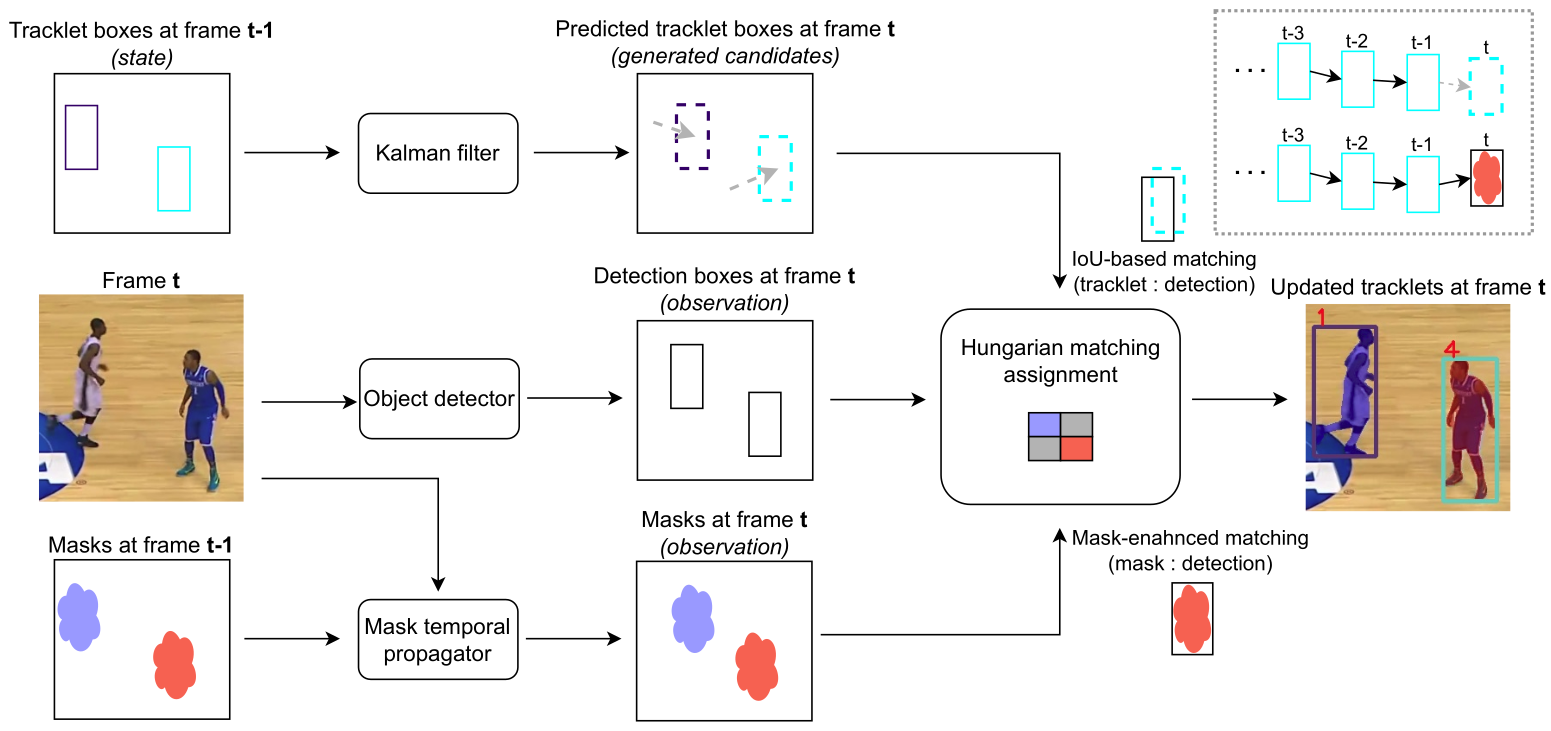
Multi-object tracking (MOT) is essential for sports analytics, enabling performance evaluation and tactical insights. However, tracking in sports is challenging due to fast movements, occlusions, and camera shifts. Traditional tracking-by-detection methods require extensive tuning, while segmentation-based approaches struggle with track processing. We propose McByte, a tracking-by-detection framework that integrates temporally propagated segmentation mask as an association cue to improve robustness without per-video tuning. Unlike many existing methods, McByte does not require training, relying solely on pre-trained models and object detectors commonly used in the community. Evaluated on SportsMOT, DanceTrack, SoccerNet-tracking 2022 and MOT17, McByte demonstrates strong performance across sports and general pedestrian tracking. Our results highlight the benefits of mask propagation for a more adaptable and generalizable MOT approach.
Please follow the complete guideline in INSTALLATION.md.
python tools/demo_track.py --path path/to/your/input
Input is a frame folder or a video file.
Output will be located in: McByte/YOLOX_outputs/yolox_x_mix_det/track_vis/date_time_stamp. Folder with processed frames and a log file (see the section below) will be created. Text output file (tracking records per frame in MOT format) will be created outside the folder.
More arguments:
Additional note: The YOLOX object detector model pretrained on SportsMOT as provided by the dataset authors (used as default setting above) behaves very well on the considered sport settings - soccer, basketball, volleyball 🔥
For a complete list of arguments, run:
python tools/demo_track.py --help
During the run, a logging file will be created and located in: McByte/YOLOX_outputs/yolox_x_mix_det/track_vis/date_time_stamp/logging_info.txt.
This file contains information per frame with all the tracklets, detections, their confidence scores, tracklet states, associations and cost matrix per step, before and after the mask update. Together with the detection per frame output and traklets-before-Kalman-filter output (--vis_type=full, default, see above), it is a powerful tool to go deep into the details, verify fine-grained behaviour of the tracker and associations per frame, and to further adjust the algorithm to your needs if needed (e.g. if you want to change yourself some hyper-parameters, etc.). This functionality as a whole was very useful in developing McByte and thus we hope it will serve the interested users as well.
In case you face issues with memory (e.g. GPU limitations), you can reduce the mask internal representation size of the mask temporal propagator component.
In order to do that, go to the file: McByte/Cutie/cutie/config/eval_config.yaml. Find the parameter max_internal_size (line 23). By default it is set as -1 which means that the mask internal representation (used to compute the final propagation mask) will have the same dimensions as your input frames/video. You can decrease the size, by updating the -1 with some fraction of the lower size of your input. E.g. If your input has dimensions of 1920x1080, you can try with 540 (50% of 1080), which will reduce the total size by the factor of 4 (2x smaller weight, 2x smaller width). Consider also less natural numbers, e.g. sqrt(2) ~ 1.41, thus in this case, setting the number as 1080/1.41 ~ 766 (total size reduced by the factor of 2).
Note that as the internal representation of mask becomes smaller, the mask accuracy might decrease. Although mask is used as an association cue in McByte, and small inaccuracies are handled withing the tracker design, significant size changes might lead to overall decreased performace, particularly with small objects and crowds.
A large part of the McByte code was borrwed from ByteTrack, YOLOX and Cutie. SAM model was smoothly incorporated and some additional parts were borrowed from BoT-SORT. Many thanks to all the authors for their amazing work!
If you find this work useful, consider leaving us a star ⭐ and please cite it in your research paper as follows:
@InProceedings{Stanczyk_2025_CVPR,
    author    = {Stanczyk, Tomasz and Yoon, Seongro and Bremond, Francois},
    title     = {No Train Yet Gain: Towards Generic Multi-Object Tracking in Sports and Beyond},
    booktitle = {Proceedings of the Computer Vision and Pattern Recognition Conference (CVPR) Workshops},
    month     = {June},
    year      = {2025},
    pages     = {6039-6048}
}
7,138 followers · starred Jul 2025
89 followers · starred Aug 2026
[CVPRW 2025] McByte - tracking in sports without training (No Train Yet Gain)
Python
146
22 commits
updated Sep 7, 2026
No Train Yet Gain: Towards Generic Multi-Object Tracking in Sports and Beyond
Tomasz Stanczyk (first author, code creator), Seongro Yoon, Francois Bremond
Designed and developed at Inria, in the STARS team.
🌟🌟🌟 Exciting news! 🌟🌟🌟
McByte is now also included in the Roboflow Trackers! Be sure to check it out here as well!
📣📣📣 Update news 📣📣📣
🛠️ McByte++ is there! Faster, improved and long-term tracking version of this McByte. 📈
Have a look at McByte++ repository here.
Multi-object tracking (MOT) is essential for sports analytics, enabling performance evaluation and tactical insights. However, tracking in sports is challenging due to fast movements, occlusions, and camera shifts. Traditional tracking-by-detection methods require extensive tuning, while segmentation-based approaches struggle with track processing. We propose McByte, a tracking-by-detection framework that integrates temporally propagated segmentation mask as an association cue to improve robustness without per-video tuning. Unlike many existing methods, McByte does not require training, relying solely on pre-trained models and object detectors commonly used in the community. Evaluated on SportsMOT, DanceTrack, SoccerNet-tracking 2022 and MOT17, McByte demonstrates strong performance across sports and general pedestrian tracking. Our results highlight the benefits of mask propagation for a more adaptable and generalizable MOT approach.
Please follow the complete guideline in INSTALLATION.md.
python tools/demo_track.py --path path/to/your/input
Input is a frame folder or a video file.
Output will be located in: McByte/YOLOX_outputs/yolox_x_mix_det/track_vis/date_time_stamp. Folder with processed frames and a log file (see the section below) will be created. Text output file (tracking records per frame in MOT format) will be created outside the folder.
More arguments:
Additional note: The YOLOX object detector model pretrained on SportsMOT as provided by the dataset authors (used as default setting above) behaves very well on the considered sport settings - soccer, basketball, volleyball 🔥
For a complete list of arguments, run:
python tools/demo_track.py --help
During the run, a logging file will be created and located in: McByte/YOLOX_outputs/yolox_x_mix_det/track_vis/date_time_stamp/logging_info.txt.
This file contains information per frame with all the tracklets, detections, their confidence scores, tracklet states, associations and cost matrix per step, before and after the mask update. Together with the detection per frame output and traklets-before-Kalman-filter output (--vis_type=full, default, see above), it is a powerful tool to go deep into the details, verify fine-grained behaviour of the tracker and associations per frame, and to further adjust the algorithm to your needs if needed (e.g. if you want to change yourself some hyper-parameters, etc.). This functionality as a whole was very useful in developing McByte and thus we hope it will serve the interested users as well.
In case you face issues with memory (e.g. GPU limitations), you can reduce the mask internal representation size of the mask temporal propagator component.
In order to do that, go to the file: McByte/Cutie/cutie/config/eval_config.yaml. Find the parameter max_internal_size (line 23). By default it is set as -1 which means that the mask internal representation (used to compute the final propagation mask) will have the same dimensions as your input frames/video. You can decrease the size, by updating the -1 with some fraction of the lower size of your input. E.g. If your input has dimensions of 1920x1080, you can try with 540 (50% of 1080), which will reduce the total size by the factor of 4 (2x smaller weight, 2x smaller width). Consider also less natural numbers, e.g. sqrt(2) ~ 1.41, thus in this case, setting the number as 1080/1.41 ~ 766 (total size reduced by the factor of 2).
Note that as the internal representation of mask becomes smaller, the mask accuracy might decrease. Although mask is used as an association cue in McByte, and small inaccuracies are handled withing the tracker design, significant size changes might lead to overall decreased performace, particularly with small objects and crowds.
A large part of the McByte code was borrwed from ByteTrack, YOLOX and Cutie. SAM model was smoothly incorporated and some additional parts were borrowed from BoT-SORT. Many thanks to all the authors for their amazing work!
If you find this work useful, consider leaving us a star ⭐ and please cite it in your research paper as follows:
@InProceedings{Stanczyk_2025_CVPR,
    author    = {Stanczyk, Tomasz and Yoon, Seongro and Bremond, Francois},
    title     = {No Train Yet Gain: Towards Generic Multi-Object Tracking in Sports and Beyond},
    booktitle = {Proceedings of the Computer Vision and Pattern Recognition Conference (CVPR) Workshops},
    month     = {June},
    year      = {2025},
    pages     = {6039-6048}
}
7,138 followers · starred Jul 2025
89 followers · starred Aug 2026



