The Semantic Agent Governance Platform
See the code




Playground | Self-Host | Docs | YouTube | Discord | Website
Open Source · Open Standards · Total Transparency
TrustGraph is an open-source, ontology-native semantic intelligence platform that turns source data into governed, traceable knowledge for natural-language analytics and AI agents. It combines semantic modeling and retrieval, structured-data querying, knowledge lifecycle operations, reusable Knowledge Cores, provenance, and modular agent services in a containerized, API-first architecture.
AI applications need shared, unambiguous semantics. Vector search over isolated text chunks can leave agents without the structure or provenance to produce consistent outcomes. TrustGraph provides that foundation: typed facts, defined relationships, and agent actions traceable to source knowledge in interoperable, W3C standards compliant formats.
To understand why AI struggles in complex use cases, consider Abbott and Costello’s classic "Who's on First?" routine.
Abbott explains the baseball lineup: Who is on first base, What is on second base, and I Don't Know is on third base. Costello is driven mad because he assumes Abbott is asking questions rather than stating the names of the players: Who, What, and I Don't Know.
Two agents cannot communicate if they do not share the same context understanding.
If you feed this scenario into a standard RAG pipeline using vector embeddings or keyword search, it breaks completely.
If a user asks: "Who is playing on first base?"
Cosine similarity operates on fuzzy, statistical probability. It cannot distinguish between the linguistic usage of a word as a pronoun and its usage as a proper noun within a specific, localized context.
An ontology defines the concepts, unique definitions, and relationships that matter in a domain. In the “Who’s on First?” example, it distinguishes a player’s name from their position, so “Who” can be the name of the player at first base without being mistaken for a question. It gives knowledge extraction and retrieval a shared understanding instead of leaving a LLM to infer entity types, definitions, and relationships from each text chunk.
TrustGraph puts that shared understanding to work. Bring an OWL ontology, build your own, or start with a domain standard. For each chunk of source text, TrustGraph retrieves the relevant part of the ontology to guide extraction, turning raw data into more consistent, ontology-enhanced knowledge. Native natural-language retrieval then makes that knowledge available to agents, with its provenance intact.
A semantic intelligence layer built using standards like RDF and OWL, establishes explicit, unambiguous semantics. It doesn't rely on "guessing" based on word proximity; it relies on defined relationships.
Here is the "Who's on First" routine modeled in RDF with an OWL ontology. By structuring data this way, the LLM knows exactly what "Who" means in this context:
@prefix : <http://trustgraph.ai/baseball#> .
@prefix rdf: <http://www.w3.org/1999/02/22-rdf-syntax-ns#> .
@prefix rdfs: <http://www.w3.org/2000/01/rdf-schema#> .
@prefix owl: <http://www.w3.org/2002/07/owl#> .

# Ontology Classes
:Player a owl:Class ;
    rdfs:subClassOf owl:Thing .

:BaseballPosition a owl:Class .

# Object Properties
:playsPosition a owl:ObjectProperty ;
    rdfs:domain :Player ;
    rdfs:range :BaseballPosition .

# Data (The Context)
:Who a :Player ;
    rdfs:label "Who" .

:What a :Player ;
    rdfs:label "What" .

:IDontKnow a :Player ;
    rdfs:label "I Don't Know" .

:FirstBase a :BaseballPosition ;
    rdfs:label "First Base" .

:SecondBase a :BaseballPosition ;
    rdfs:label "Second Base" .

:ThirdBase a :BaseballPosition ;
    rdfs:label "Third Base" .

# The Explicit Relationships
:Who :playsPosition :FirstBase .
:What :playsPosition :SecondBase .
:IDontKnow :playsPosition :ThirdBase .
When an agent queries the TrustGraph semantic intelligence layer, it uses SPARQL or GraphRAG to traverse these explicit paths. The agent knows that :Who is a :Player whose :playsPosition is :FirstBase. Hallucination is eliminated because context is structured, not inferred via probability.
| Dimension | TrustGraph | Conventional Graph Databases (e.g., Neo4j) |
|---|---|---|
| Primary purpose | Semantic Intelligence Layer purpose-built for AI: make knowledge unambiguous, traceable, and retrieval-ready for LLMs and agents | General-purpose property graph database for transactional workloads and graph analytics |
| Data model | RDF 1.2 named graphs (quads) with reification — statements are first-class, addressable resources enabling n-ary relationships | Labeled property graph — nodes and edges with key-value properties; no native statement reification |
| Semantic rigor | OWL ontology enforcement: typed entities and properties with formally defined meaning | Schema-optional; semantics live in application code or conventions, not the data model |
| Provenance | Built-in, standards-based (W3C PROV-O); extraction lineage, query traces, and agent behavior stored as queryable graph triples | Not native; provenance must be hand-modeled as ordinary nodes/edges with no standard vocabulary |
| Natural language retrieval | Automated NL-to-graph retrieval with semantic filtering and reranking | Requires manual Cypher queries or add-on vector search with no semantic grounding |
| Agent integration | Native Agent Runtime with full behavioral tracing linked to source intelligence, plus API Gateway for bring-your-own-framework | None; agents access the graph as an external data source with no behavioral traceability |
| Knowledge lifecycle management | Workspaces, Collections, Flows, and Knowledge Cores for isolation, access control, and versioning of semantic intelligence | Database-level separation only; versioning and lifecycle management are application concerns |
| Unstructured data ingest | Integrated pipeline converts PDF, DOCX, XLSX, PPTX, HTML, Markdown, CSV, and images into ontology-typed knowledge | Not included; requires external ETL and custom extraction pipelines |
| LLM stack | Full inference stack: all major provider APIs or self-hosted open-weight models on Nvidia, AMD, or Intel | None; LLM integration is entirely external |
| Interoperability | Open standards throughout (RDF 1.2, OWL, PROV-O); exports to Turtle portable to any RDF-compliant system | Proprietary property graph model; Cypher is not a W3C standard; migration requires data transformation |
| Query paradigm | SPARQL + semantic graph patterns with automated natural language access | Cypher / GQL pattern matching requiring graph expertise |
How many times have you cloned a repo and opened the .env.example to see the dozens of API keys for 3rd party dependencies needed to make the services work? There are only 3 things in TrustGraph that might need an API key:
Everything else is included.
No need to clone the repo unless you are building from source. TrustGraph deploys as a set of Docker containers. Configure it on the command line in one step:
npx @trustgraph/config
The config process will generate an app config that can be run locally with Docker, Podman, or Minikube. The process will output:
deploy.zip with either a docker-compose.yaml file for a Docker/Podman or resources.yaml for KubernetesINSTALLATION.md
For a browser based configuration, try the Configuration Terminal.
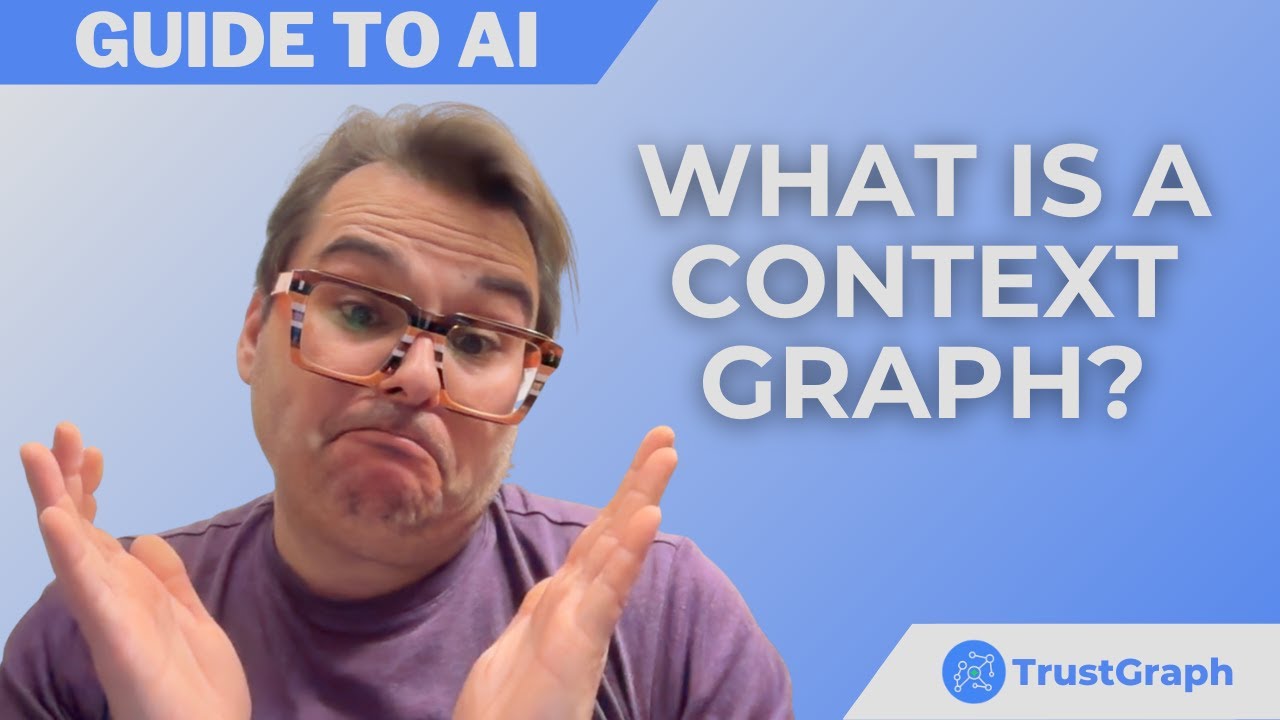
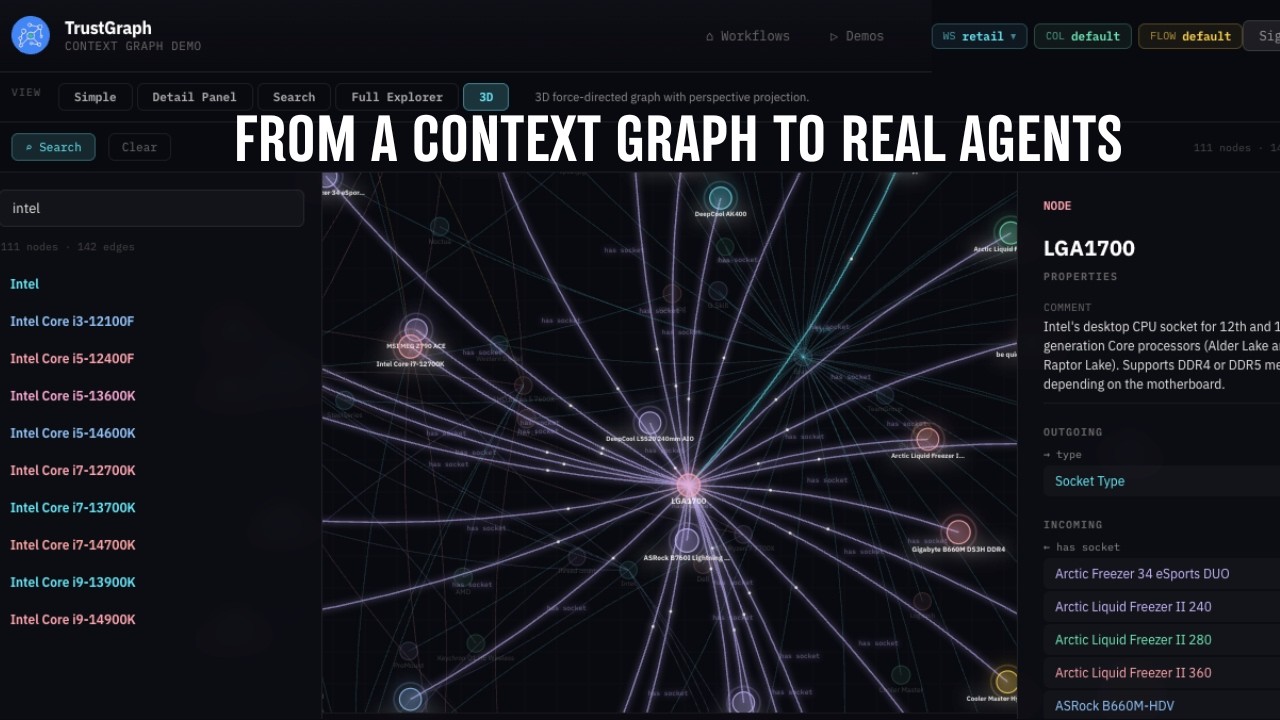
The UI provides tools for all major features of TrustGraph. The UI deploys on port 8888 by default.
There are 3 libraries for quick UI integration of TrustGraph services.
TrustGraph is licensed under Apache 2.0.
Copyright 2024-2026 TrustGraph
Licensed under the Apache License, Version 2.0 (the "License"); you may not use this file except in compliance with the License. You may obtain a copy of the License at
http://www.apache.org/licenses/LICENSE-2.0
Unless required by applicable law or agreed to in writing, software distributed under the License is distributed on an "AS IS" BASIS, WITHOUT WARRANTIES OR CONDITIONS OF ANY KIND, either express or implied. See the License for the specific language governing permissions and limitations under the License.
282 followers · starred Oct 2025
325 followers · starred Mar 2026
145 followers · starred Aug 2026
351 followers · starred Sep 2024
The Semantic Agent Governance Platform
See the code
Playground | Self-Host | Docs | YouTube | Discord | Website
Open Source · Open Standards · Total Transparency
TrustGraph is an open-source, ontology-native semantic intelligence platform that turns source data into governed, traceable knowledge for natural-language analytics and AI agents. It combines semantic modeling and retrieval, structured-data querying, knowledge lifecycle operations, reusable Knowledge Cores, provenance, and modular agent services in a containerized, API-first architecture.
AI applications need shared, unambiguous semantics. Vector search over isolated text chunks can leave agents without the structure or provenance to produce consistent outcomes. TrustGraph provides that foundation: typed facts, defined relationships, and agent actions traceable to source knowledge in interoperable, W3C standards compliant formats.
To understand why AI struggles in complex use cases, consider Abbott and Costello’s classic "Who's on First?" routine.
Abbott explains the baseball lineup: Who is on first base, What is on second base, and I Don't Know is on third base. Costello is driven mad because he assumes Abbott is asking questions rather than stating the names of the players: Who, What, and I Don't Know.
Two agents cannot communicate if they do not share the same context understanding.
If you feed this scenario into a standard RAG pipeline using vector embeddings or keyword search, it breaks completely.
If a user asks: "Who is playing on first base?"
Cosine similarity operates on fuzzy, statistical probability. It cannot distinguish between the linguistic usage of a word as a pronoun and its usage as a proper noun within a specific, localized context.
An ontology defines the concepts, unique definitions, and relationships that matter in a domain. In the “Who’s on First?” example, it distinguishes a player’s name from their position, so “Who” can be the name of the player at first base without being mistaken for a question. It gives knowledge extraction and retrieval a shared understanding instead of leaving a LLM to infer entity types, definitions, and relationships from each text chunk.
TrustGraph puts that shared understanding to work. Bring an OWL ontology, build your own, or start with a domain standard. For each chunk of source text, TrustGraph retrieves the relevant part of the ontology to guide extraction, turning raw data into more consistent, ontology-enhanced knowledge. Native natural-language retrieval then makes that knowledge available to agents, with its provenance intact.
A semantic intelligence layer built using standards like RDF and OWL, establishes explicit, unambiguous semantics. It doesn't rely on "guessing" based on word proximity; it relies on defined relationships.
Here is the "Who's on First" routine modeled in RDF with an OWL ontology. By structuring data this way, the LLM knows exactly what "Who" means in this context:
@prefix : <http://trustgraph.ai/baseball#> .
@prefix rdf: <http://www.w3.org/1999/02/22-rdf-syntax-ns#> .
@prefix rdfs: <http://www.w3.org/2000/01/rdf-schema#> .
@prefix owl: <http://www.w3.org/2002/07/owl#> .

# Ontology Classes
:Player a owl:Class ;
    rdfs:subClassOf owl:Thing .

:BaseballPosition a owl:Class .

# Object Properties
:playsPosition a owl:ObjectProperty ;
    rdfs:domain :Player ;
    rdfs:range :BaseballPosition .

# Data (The Context)
:Who a :Player ;
    rdfs:label "Who" .

:What a :Player ;
    rdfs:label "What" .

:IDontKnow a :Player ;
    rdfs:label "I Don't Know" .

:FirstBase a :BaseballPosition ;
    rdfs:label "First Base" .

:SecondBase a :BaseballPosition ;
    rdfs:label "Second Base" .

:ThirdBase a :BaseballPosition ;
    rdfs:label "Third Base" .

# The Explicit Relationships
:Who :playsPosition :FirstBase .
:What :playsPosition :SecondBase .
:IDontKnow :playsPosition :ThirdBase .
When an agent queries the TrustGraph semantic intelligence layer, it uses SPARQL or GraphRAG to traverse these explicit paths. The agent knows that :Who is a :Player whose :playsPosition is :FirstBase. Hallucination is eliminated because context is structured, not inferred via probability.
| Dimension | TrustGraph | Conventional Graph Databases (e.g., Neo4j) |
|---|---|---|
| Primary purpose | Semantic Intelligence Layer purpose-built for AI: make knowledge unambiguous, traceable, and retrieval-ready for LLMs and agents | General-purpose property graph database for transactional workloads and graph analytics |
| Data model | RDF 1.2 named graphs (quads) with reification — statements are first-class, addressable resources enabling n-ary relationships | Labeled property graph — nodes and edges with key-value properties; no native statement reification |
| Semantic rigor | OWL ontology enforcement: typed entities and properties with formally defined meaning | Schema-optional; semantics live in application code or conventions, not the data model |
| Provenance | Built-in, standards-based (W3C PROV-O); extraction lineage, query traces, and agent behavior stored as queryable graph triples | Not native; provenance must be hand-modeled as ordinary nodes/edges with no standard vocabulary |
| Natural language retrieval | Automated NL-to-graph retrieval with semantic filtering and reranking | Requires manual Cypher queries or add-on vector search with no semantic grounding |
| Agent integration | Native Agent Runtime with full behavioral tracing linked to source intelligence, plus API Gateway for bring-your-own-framework | None; agents access the graph as an external data source with no behavioral traceability |
| Knowledge lifecycle management | Workspaces, Collections, Flows, and Knowledge Cores for isolation, access control, and versioning of semantic intelligence | Database-level separation only; versioning and lifecycle management are application concerns |
| Unstructured data ingest | Integrated pipeline converts PDF, DOCX, XLSX, PPTX, HTML, Markdown, CSV, and images into ontology-typed knowledge | Not included; requires external ETL and custom extraction pipelines |
| LLM stack | Full inference stack: all major provider APIs or self-hosted open-weight models on Nvidia, AMD, or Intel | None; LLM integration is entirely external |
| Interoperability | Open standards throughout (RDF 1.2, OWL, PROV-O); exports to Turtle portable to any RDF-compliant system | Proprietary property graph model; Cypher is not a W3C standard; migration requires data transformation |
| Query paradigm | SPARQL + semantic graph patterns with automated natural language access | Cypher / GQL pattern matching requiring graph expertise |
How many times have you cloned a repo and opened the .env.example to see the dozens of API keys for 3rd party dependencies needed to make the services work? There are only 3 things in TrustGraph that might need an API key:
Everything else is included.
No need to clone the repo unless you are building from source. TrustGraph deploys as a set of Docker containers. Configure it on the command line in one step:
npx @trustgraph/config
The config process will generate an app config that can be run locally with Docker, Podman, or Minikube. The process will output:
deploy.zip with either a docker-compose.yaml file for a Docker/Podman or resources.yaml for KubernetesINSTALLATION.md
For a browser based configuration, try the Configuration Terminal.
The UI provides tools for all major features of TrustGraph. The UI deploys on port 8888 by default.
There are 3 libraries for quick UI integration of TrustGraph services.
TrustGraph is licensed under Apache 2.0.
Copyright 2024-2026 TrustGraph
Licensed under the Apache License, Version 2.0 (the "License"); you may not use this file except in compliance with the License. You may obtain a copy of the License at
http://www.apache.org/licenses/LICENSE-2.0
Unless required by applicable law or agreed to in writing, software distributed under the License is distributed on an "AS IS" BASIS, WITHOUT WARRANTIES OR CONDITIONS OF ANY KIND, either express or implied. See the License for the specific language governing permissions and limitations under the License.
282 followers · starred Oct 2025
325 followers · starred Mar 2026
145 followers · starred Aug 2026
351 followers · starred Sep 2024



