Free Python interview flashcards for Anki. 100 cards for software engineer interviews.
See the code


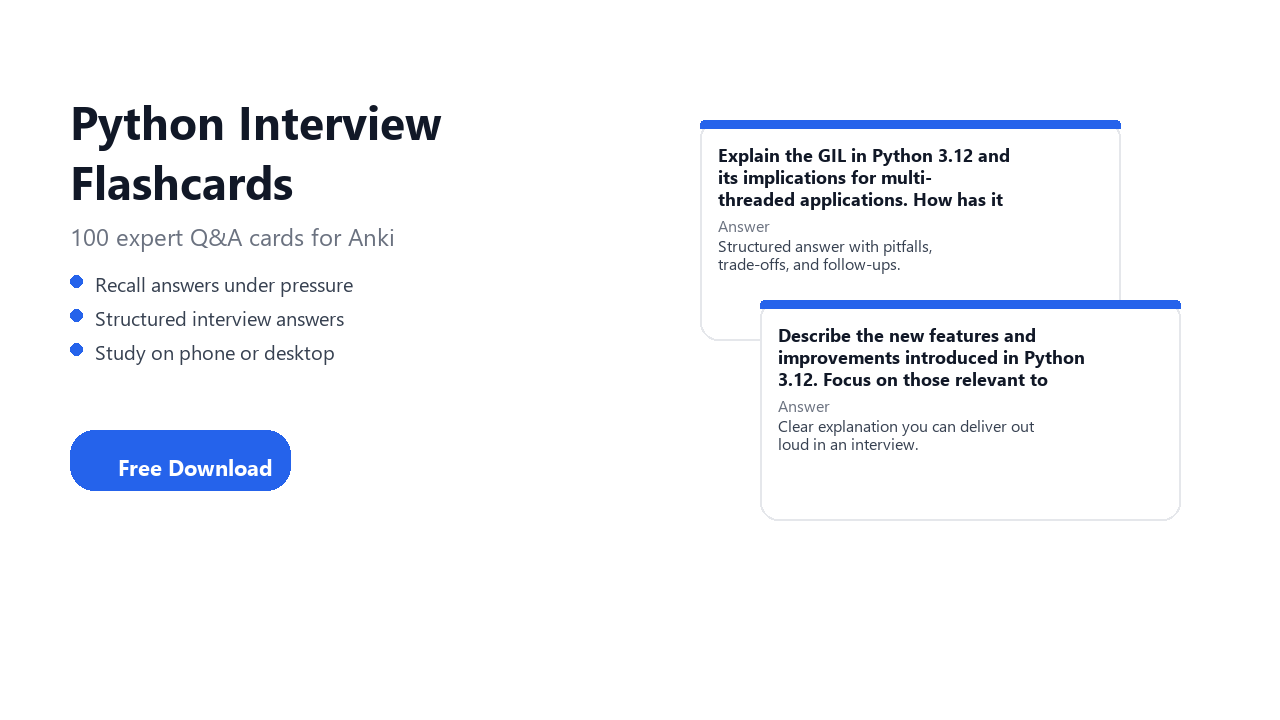
Walk into your Python interview prepared. 100 curated questions with clear, structured answers you can recall under pressure. Study on your phone, tablet, or computer.
Download Python_Interview_2026.apkg · free for personal study · no GitHub account required
Python_Interview_2026.apkg from the latest release.| Latest release | v2026.1 |
| Direct .apkg | Python_Interview_2026.apkg |
| File size | ~1 MB (varies by deck) |
| Cost | Free for personal study |
| Account | No GitHub account required |
A flashcard is a simple question on one side and the answer on the other. You try to recall the answer from memory before you flip the card. That act of retrieval is called active recall, and it is one of the most effective ways to move knowledge from short-term reading into long-term memory.
Anki is a flashcard app built around spaced repetition. Instead of cramming everything in one sitting, Anki schedules each card based on how well you know it:
You spend more time on weak spots and less on what you already know.
The result: steady progress with less total study time than passive re-reading.
Tech interviews are not only coding puzzles. You also need to explain how things work, compare trade-offs, and handle follow-up questions without freezing. Flashcards train exactly that skill.
They match how interviews actually feel
They fill gaps LeetCode does not cover
They turn passive reading into active recall
They help you study in small sessions
They build confidence for follow-ups
This deck is built for that: one interview question per card, structured answers on the back.
AI can summarize docs, generate examples, and answer questions on demand. That is useful, but interviews still test what you can produce from your own head in real time.
Flashcards complement AI rather than replace them:
| AI alone | Flashcards + Anki |
|---|---|
| Easy to read an explanation and feel you understand it | Forces recall without hints |
| Answers fade if you do not revisit the topic | Spaced repetition brings weak cards back automatically |
| Risk of shallow "I saw this in ChatGPT" familiarity | Builds durable memory for whiteboard and verbal rounds |
| Great for exploring new topics | Great for locking in what you must explain clearly |
Use AI to explore and clarify. Use Anki to remember, retrieve, and perform when it counts. Candidates who combine both tend to interview more confidently than those who only consume generated answers.
Install the official Anki app for the device you want to study on, then import the .apkg on that same device.
| Platform | App | Get it |
|---|---|---|
| Windows | Anki | Download Anki |
| macOS | Anki | Download Anki |
| Linux | Anki | Download Anki |
| iPhone / iPad | AnkiMobile | App Store |
| Android | AnkiDroid | Google Play |
Desktop Anki 2.1.49+ or newer. AnkiMobile and AnkiDroid are kept up to date via their app stores.
Download Python_Interview_2026.apkg, then follow the steps for your platform. More detail: Anki importing guide.
Python_Interview_2026.apkg.Python_Interview_2026.apkg in Safari (or another browser).Python_Interview_2026.apkg.If you use Anki on more than one device, you can use AnkiWeb sync after importing. This is optional, not required for phone-only study.
| Cards | 100 interview questions with detailed answers |
| Audience | software engineer |
| Topics | Python 3.12+, typing, asyncio, data structures, OOP, and production Python |
| Deck file | Python_Interview_2026.apkg |
asyncio for building high-performance network services in Python 3.12? Discuss common patterns and potential pitfalls.mypy and pyright. When would you choose one over the other for static type checking in a Python project?Protocol in Python typing. Provide a practical example where it significantly improves code clarity or flexibility.pip-tools, Poetry, and Rye.dataclasses, NamedTuple, and custom classes for defining data structures. When would you choose each?@contextlib.contextmanager). Explain the differences.Full topic index (categories only; deck text is in the .apkg).
Each card follows a consistent structure:
Yes, for personal, non-commercial study. See License.
No. Redistribution is not permitted. Each person should download their own copy from this repository.
No. Any AI-related use, extraction, derivatives, or commercial use requires a separate written license (minimum USD $5000). Contact Summon The JSON.
Yes. Install AnkiMobile or AnkiDroid, download the .apkg on your phone, and import it there. You do not need a computer.
No. Flashcards reinforce concepts and talking points. Pair them with coding practice and mock interviews.
Releases are tagged by year (e.g. v2026.1). Watch this repo for new editions.
Summon The JSON offers physical and printable programming flashcards.
Part of the Summon The JSON interview flashcard series:
tomaszs interview-flashcards-free for related reposIf this deck helped you, star the repo so others can find it.
Tom Smykowski is a software engineer with 20+ years in programming and mentoring. He is an awarded tech editor, in the top 2% on Stack Overflow, and has reached millions of readers through technical writing.
Tom builds interview flashcards to help developers explain technical topics clearly under pressure, not just recognize buzzwords. This deck is part of that work.
Summon The JSON is a learning brand for developers. It combines practical study tools with programming education: physical flashcards, printable decks, and free Anki decks like this one.
The goal is simple: structured prep that fits real interview rooms. Questions you can practice daily, answers you can deliver out loud, and topics aligned with what hiring teams actually ask about python.
Anki® is a registered trademark of Ankitects Pty Ltd. Summon The JSON and this repository are independent projects. We are not affiliated with, endorsed by, or sponsored by Ankitects Pty Ltd, AnkiWeb, AnkiMobile, AnkiDroid, or the official Anki application.
This deck is compatible with Anki. It is published by Tom Smykowski under Summon The JSON, not by the Anki project.
Personal use only. Copyright (c) 2026 Tom Smykowski.
This deck is licensed under the STJ-PSL-1.0 (STJ-PSL-1.0). You may use it only for personal, non-commercial study. You may not redistribute, copy, create derivatives, use it commercially, or use it in any way related to AI without a separate written license.
Commercial, derivative, organizational, or AI-related licenses start at USD $5000 and require approval. Inquiries: https://summonthejson.com/contact.
Free Python interview flashcards for Anki. 100 cards for software engineer interviews.
See the code
Walk into your Python interview prepared. 100 curated questions with clear, structured answers you can recall under pressure. Study on your phone, tablet, or computer.
Download Python_Interview_2026.apkg · free for personal study · no GitHub account required
Python_Interview_2026.apkg from the latest release.| Latest release | v2026.1 |
| Direct .apkg | Python_Interview_2026.apkg |
| File size | ~1 MB (varies by deck) |
| Cost | Free for personal study |
| Account | No GitHub account required |
A flashcard is a simple question on one side and the answer on the other. You try to recall the answer from memory before you flip the card. That act of retrieval is called active recall, and it is one of the most effective ways to move knowledge from short-term reading into long-term memory.
Anki is a flashcard app built around spaced repetition. Instead of cramming everything in one sitting, Anki schedules each card based on how well you know it:
You spend more time on weak spots and less on what you already know.
The result: steady progress with less total study time than passive re-reading.
Tech interviews are not only coding puzzles. You also need to explain how things work, compare trade-offs, and handle follow-up questions without freezing. Flashcards train exactly that skill.
They match how interviews actually feel
They fill gaps LeetCode does not cover
They turn passive reading into active recall
They help you study in small sessions
They build confidence for follow-ups
This deck is built for that: one interview question per card, structured answers on the back.
AI can summarize docs, generate examples, and answer questions on demand. That is useful, but interviews still test what you can produce from your own head in real time.
Flashcards complement AI rather than replace them:
| AI alone | Flashcards + Anki |
|---|---|
| Easy to read an explanation and feel you understand it | Forces recall without hints |
| Answers fade if you do not revisit the topic | Spaced repetition brings weak cards back automatically |
| Risk of shallow "I saw this in ChatGPT" familiarity | Builds durable memory for whiteboard and verbal rounds |
| Great for exploring new topics | Great for locking in what you must explain clearly |
Use AI to explore and clarify. Use Anki to remember, retrieve, and perform when it counts. Candidates who combine both tend to interview more confidently than those who only consume generated answers.
Install the official Anki app for the device you want to study on, then import the .apkg on that same device.
| Platform | App | Get it |
|---|---|---|
| Windows | Anki | Download Anki |
| macOS | Anki | Download Anki |
| Linux | Anki | Download Anki |
| iPhone / iPad | AnkiMobile | App Store |
| Android | AnkiDroid | Google Play |
Desktop Anki 2.1.49+ or newer. AnkiMobile and AnkiDroid are kept up to date via their app stores.
Download Python_Interview_2026.apkg, then follow the steps for your platform. More detail: Anki importing guide.
Python_Interview_2026.apkg.Python_Interview_2026.apkg in Safari (or another browser).Python_Interview_2026.apkg.If you use Anki on more than one device, you can use AnkiWeb sync after importing. This is optional, not required for phone-only study.
| Cards | 100 interview questions with detailed answers |
| Audience | software engineer |
| Topics | Python 3.12+, typing, asyncio, data structures, OOP, and production Python |
| Deck file | Python_Interview_2026.apkg |
asyncio for building high-performance network services in Python 3.12? Discuss common patterns and potential pitfalls.mypy and pyright. When would you choose one over the other for static type checking in a Python project?Protocol in Python typing. Provide a practical example where it significantly improves code clarity or flexibility.pip-tools, Poetry, and Rye.dataclasses, NamedTuple, and custom classes for defining data structures. When would you choose each?@contextlib.contextmanager). Explain the differences.Full topic index (categories only; deck text is in the .apkg).
Each card follows a consistent structure:
Yes, for personal, non-commercial study. See License.
No. Redistribution is not permitted. Each person should download their own copy from this repository.
No. Any AI-related use, extraction, derivatives, or commercial use requires a separate written license (minimum USD $5000). Contact Summon The JSON.
Yes. Install AnkiMobile or AnkiDroid, download the .apkg on your phone, and import it there. You do not need a computer.
No. Flashcards reinforce concepts and talking points. Pair them with coding practice and mock interviews.
Releases are tagged by year (e.g. v2026.1). Watch this repo for new editions.
Summon The JSON offers physical and printable programming flashcards.
Part of the Summon The JSON interview flashcard series:
tomaszs interview-flashcards-free for related reposIf this deck helped you, star the repo so others can find it.
Tom Smykowski is a software engineer with 20+ years in programming and mentoring. He is an awarded tech editor, in the top 2% on Stack Overflow, and has reached millions of readers through technical writing.
Tom builds interview flashcards to help developers explain technical topics clearly under pressure, not just recognize buzzwords. This deck is part of that work.
Summon The JSON is a learning brand for developers. It combines practical study tools with programming education: physical flashcards, printable decks, and free Anki decks like this one.
The goal is simple: structured prep that fits real interview rooms. Questions you can practice daily, answers you can deliver out loud, and topics aligned with what hiring teams actually ask about python.
Anki® is a registered trademark of Ankitects Pty Ltd. Summon The JSON and this repository are independent projects. We are not affiliated with, endorsed by, or sponsored by Ankitects Pty Ltd, AnkiWeb, AnkiMobile, AnkiDroid, or the official Anki application.
This deck is compatible with Anki. It is published by Tom Smykowski under Summon The JSON, not by the Anki project.
Personal use only. Copyright (c) 2026 Tom Smykowski.
This deck is licensed under the STJ-PSL-1.0 (STJ-PSL-1.0). You may use it only for personal, non-commercial study. You may not redistribute, copy, create derivatives, use it commercially, or use it in any way related to AI without a separate written license.
Commercial, derivative, organizational, or AI-related licenses start at USD $5000 and require approval. Inquiries: https://summonthejson.com/contact.





