An experimental platform that structures Japan's River & Sediment Control Technical Standards (Survey / Planning / Design / Maintenance editions) into a Neo4j knowledge graph and compares the performance of GPT-OSS Swallow 20B with and without GraphRAG.
Python
1
21 commits
updated Mar 3, 2026
An experimental platform that structures Japan's River & Sediment Control Technical Standards (Survey / Planning / Design / Maintenance editions) into a Neo4j knowledge graph and compares the performance of GPT-OSS Swallow 20B with and without GraphRAG.
v0.6 — 2026-03-03
Best model: Swallow-8B-Instruct QLoRA FT (n=715) — Judge avg 2.92 / 3 on 100-question benchmark
Baseline comparison: GPT-OSS Swallow 20B RL v0.1 (Tokyo Tech × AIST / Apache 2.0)
🇯🇵 Japanese version: README_JP.md
| Component | Details |
|---|---|
| Best model (Case B) | Swallow-8B-Instruct QLoRA FT n=715 (Q4_K_M, 4.9 GB) via Ollama |
| Baseline model (Case A/C) | GPT-OSS Swallow 20B RL v0.1 (Q4_K_M, 15.8 GB) via Ollama |
| Graph DB | Neo4j 2026.01.4 (Desktop) |
| Graph size | 184 nodes · 268 relations (manual CSV) |
| API | FastAPI 0.111 + uvicorn (port 8080) |
| GPU | NVIDIA GeForce RTX 4060 Ti (16 GB VRAM) |
| Python | 3.12 |
| 100-Q benchmark (v0.6) | Case A: 2.29/3 · Case B: 2.92/3 · Case C: 2.62/3 |
flowchart LR
    subgraph Structural["Structural Nodes"]
        STD(["Standard x7"])
        CH(["Chapter x76"])
        SEC(["Section x33"])
        ITEM(["Item x25"])
    end

    subgraph Domain["Domain Nodes"]
        FAC(["FacilityType x20"])
        HAZ(["HazardType x8"])
        TC(["TechnicalConcept x22"])
        REQ(["RequirementType x5"])
        PROC(["ProcessConcept x4"])
    end

    STD -->|HAS_CHAPTER| CH
    CH  -->|HAS_SECTION| SEC
    SEC -->|HAS_ITEM| ITEM

    FAC -->|DESCRIBED_IN| CH
    FAC -->|DESCRIBED_IN| SEC
    FAC -->|SUBJECT_TO| HAZ
    FAC -->|MITIGATES| HAZ
    FAC -->|REQUIRES| TC

    TC  -->|DEFINED_IN| CH
    TC  -->|DEFINED_IN| SEC
    TC  -->|USED_IN| PROC
    PROC -->|PRECEDES| PROC

    HAZ -->|AFFECTS| FAC
| Relation | From → To | Role |
|---|---|---|
HAS_CHAPTER | Standard → Chapter | Document structure |
HAS_SECTION | Chapter → Section | Document structure |
HAS_ITEM | Section → Item | Document structure |
DESCRIBED_IN | FacilityType → Chapter/Section | Where facility rules appear |
SUBJECT_TO | FacilityType → HazardType | Applicable hazard |
MITIGATES | FacilityType → HazardType | Hazard countermeasure |
REQUIRES | FacilityType → TechnicalConcept | Required technique |
DEFINED_IN | TechnicalConcept → Chapter/Section/Standard | Definition location |
USED_IN | TechnicalConcept → ProcessConcept | Process stage |
PRECEDES | ProcessConcept → ProcessConcept | Process ordering |
AFFECTS | HazardType → FacilityType | Impact relationship |
flowchart TD
    Q(["User Question"]) --> KW

    subgraph Retrieval["Graph Retrieval"]
        KW["extract_keywords"]
        KW --> FTS["1. fulltext keyword_search"]
        KW --> FAC2["2. facility_context"]
        KW --> HAZ2["3. hazard_facility_map"]
        KW --> MC["4. maintenance_cycle_query"]
        KW --> CF["5. compare_facilities"]
        FTS --> DEDUP
        FAC2 --> DEDUP
        HAZ2 --> DEDUP
        MC --> DEDUP
        CF --> DEDUP
        DEDUP["deduplicate"]
        DEDUP --> HITS{"graph_hits >= 25?"}
        HITS -->|No| RETRY["Adaptive Retry: TOP_K x2 + broad_section_search"]
        RETRY --> MERGE["merge and deduplicate"]
        HITS -->|Yes| RANK
        MERGE --> RANK
    end

    subgraph Ranking["Re-ranking"]
        RANK["_score_record: fulltext=neo4j_score x10, others=keyword match"]
        RANK --> SORT["sort descending, keep top 80%"]
        SORT --> CTX["build_context_text max_chars=2000"]
    end

    subgraph Generation["LLM Generation"]
        CTX --> CLLM["Case C: GraphRAG LLM - GPT-OSS Swallow 20B"]
        Q   --> ALLM["Case A: Plain LLM - GPT-OSS Swallow 20B"]
    end

    subgraph Evaluation["LLM-as-Judge"]
        CLLM --> JUDGE["Qwen2.5:14B Judge - 0 to 3 point scoring"]
        ALLM --> JUDGE
    end

    JUDGE --> OUT[("JSONL result + Markdown report")]
| Point | Detail |
|---|---|
| Adaptive retry | When graph_hits < 25, retries with TOP_K × 2 + broad section search |
| Re-ranking | Fulltext hits: Neo4j Lucene score ×10; others: keyword match count |
| Context cap | Context text capped at 2,000 chars to prevent prompt overflow |
| Repeat penalty | repeat_penalty=1.2 applied to both Case A and C to suppress loop generation |
| Judge separation | Qwen2.5:14B (third-party model) used as judge to eliminate self-scoring bias |
kasendam_graph_rag/
├── app/
│   ├── main.py                  # FastAPI entry point & routing
│   ├── graph_rag.py             # GraphRAG orchestrator (retrieval + ranking)
│   ├── neo4j_client.py          # Neo4j connection & Cypher query library
│   ├── llm_client.py            # LLM client (Ollama native /api/generate)
│   └── config.py                # Settings & environment variables
│
├── scripts/
│   ├── 01_extract_entities.py   # MD → entity extraction via LLM
│   ├── 02_load_neo4j.py         # CSV → Neo4j MERGE loader
│   ├── 03_generate_lora_qa.py   # LoRA training QA pair generation
│   ├── 04_evaluate.py           # GraphRAG vs Plain LLM auto-evaluation
│   └── cypher/
│       └── init_schema.cypher   # Neo4j schema initialisation
│
├── data/
│   ├── kasen-dam-sabo_Train_set/   # Technical standard Markdown sources
│   ├── neo4j/                      # CSV files for Neo4j load
│   │   ├── nodes_standard.csv
│   │   ├── nodes_chapter_section_item.csv
│   │   ├── nodes_domain.csv
│   │   ├── relations.csv
│   │   └── extracted/              # Output of 01_extract_entities.py
│   └── eval/
│       ├── test_questions_100.json # 100-question test set
│       └── results/                # Output of 04_evaluate.py
│
├── .env.example
├── Modelfile.swallow
├── requirements.txt
├── README.md        ← English (this file)
└── README_JP.md     ← Japanese original
ollama pull hf.co/mmnga-o/GPT-OSS-Swallow-20B-RL-v0.1-gguf:Q4_K_M
Quantisation options (if VRAM is limited)
File Size Note Q4_K_M15.8 GB Recommended (quality/speed balance) Q4_K_S14.7 GB Slightly smaller Q4_012.1 GB Memory-first
Important — GPT-OSS chat template
GPT-OSS models use special channel tokens (<|channel|>finaletc.).
Ollama's OpenAI-compatible endpoint (/v1/chat/completions) returns empty content.
llm_client.pybypasses this by calling/api/generatewithraw=Trueand a manually built template:<|start|>system<|message|>{system}<|end|> <|start|>user<|message|>{user}<|end|> <|start|>assistant<|channel|>final<|message|>
python -m venv .venv
.venv\Scripts\Activate.ps1
pip install -r requirements.txt
copy .env.example .env
# Edit .env
Minimum .env:
OPENAI_API_KEY=ollama          # Dummy value for Ollama
LLM_BASE_URL=http://localhost:11434/v1
LLM_MODEL=hf.co/mmnga-o/GPT-OSS-Swallow-20B-RL-v0.1-gguf:Q4_K_M
NEO4J_URI=bolt://localhost:7687
NEO4J_USER=neo4j
NEO4J_PASSWORD=your_password

# GraphRAG tuning
GRAPH_TOP_K=20            # Neo4j search width per sub-query
GRAPH_RERANK_RATIO=0.8    # Keep top 80% of score > 0 records
LLM_TEMP=0.2

# LLM-as-Judge
JUDGE_MODEL=qwen2.5:14b
Start Neo4j Desktop and ensure the database is RUNNING, then:
# Reset DB and load all CSVs (schema init runs automatically)
python scripts/02_load_neo4j.py --reset
# → 184 nodes · 268 relations
python -m uvicorn app.main:app --port 8080
Swagger UI: http://localhost:8080/docs
# Step 1: Extract entities from Technical Standard Markdown
python scripts/01_extract_entities.py

# Step 2: Load into Neo4j
python scripts/02_load_neo4j.py --mode all

# Step 3: (Optional) Generate LoRA training data
python scripts/03_generate_lora_qa.py

# Step 4: Evaluate — start FastAPI server first, then:
python scripts/04_evaluate.py                              # All 100 questions (~3–5 h)
python scripts/04_evaluate.py --start 1 --end 5            # Quick test (5 questions)
python scripts/04_evaluate.py --no-judge                   # Collect answers only (fast)
python scripts/04_evaluate.py --judge-only results.jsonl   # Re-judge existing results
Output:
data/eval/results/results_<timestamp>.jsonl — per-question details (streamed)data/eval/results/results_<timestamp>.md — category summary report# Case C — GraphRAG
curl -X POST http://localhost:8080/query \
-H "Content-Type: application/json" \
-d '{"question": "How is a sabo dam inspected?"}'
# Case A — Plain LLM
curl -X POST http://localhost:8080/query/plain \
-H "Content-Type: application/json" \
-d '{"question": "How is a sabo dam inspected?"}'
# Graph queries
curl http://localhost:8080/graph/facility/砂防堰堤
curl http://localhost:8080/graph/hazard/土石流
curl http://localhost:8080/graph/maintenance
| Case | Description | Endpoint |
|---|---|---|
| A — Plain LLM | No knowledge graph, no fine-tuning | POST /query/plain |
| B — LoRA FT | Swallow-8B-Instruct QLoRA fine-tuned on graph-derived QA | Change LLM_MODEL to FT model |
| C — GraphRAG | Neo4j knowledge graph + LLM | POST /query |
| Score | Criteria |
|---|---|
| 3 | Technically accurate and specific; includes standard names, chapter numbers, or technical concepts |
| 2 | Mostly correct but lacks supporting evidence or specificity |
| 1 | Partially correct but contains important errors or omissions |
| 0 | No answer, or technically incorrect |
Fairness design: Judge uses Qwen2.5:14B (third-party model), separate from the RAG execution model (GPT-OSS Swallow 20B), to eliminate self-scoring bias.
| Category | Count | Topics |
|---|---|---|
| Maintenance — River | 20 | Levee, revetment, groin, weir, flap gate, pump station, maintenance planning |
| Maintenance — Dam | 15 | Periodic inspection, life extension, sedimentation, concrete/fill, instrumentation |
| Maintenance — Sabo | 15 | Sabo dam, bed stabiliser, hillside works, landslide, steep slope, avalanche |
| Survey | 7 | Hydrology, topography/geology, sediment transport, dam survey |
| Planning | 8 | River plan, sabo plan, dam plan, landslide plan |
| Design | 15 | Levee, revetment, sabo dam, dam, landslide, steep slope, hillside |
| Cross-domain comparison | 10 | Facility comparison, hazard contrast, maintenance comparison, technical concepts |
| Hazard | 10 | Flood, debris flow, landslide, compound disaster, climate change, watershed |
results_20260301_201326.jsonl)Category: "Maintenance — River" (14 Q: levee×5, revetment×3, groin, bed stabiliser, weir/flap×2, pump station, cycle-type)
| Q | Sub-category | Topic | A | C | graph_hits | v0.2 A | v0.2 C |
|---|---|---|---|---|---|---|---|
| 01 | Levee | Basic maintenance policy | 3 | 3 | 41 | 1 | 3 |
| 02 | Levee | Defect types in periodic inspection | 1 | 3 | 38 | 1 | 3 |
| 03 | Levee | Erosion countermeasure methods | 3 | 3 | 52 | 3 | 3 |
| 04 | Levee | Soundness evaluation criteria | 2 | 3 | 28 | 1 | 3 |
| 05 | Levee | Long-life plan considerations | 0 | 3 | 32 | 0 | 3 |
| 06 | Revetment | Inspection types & purposes | 3 | 3 | 28 | 1 | 3 |
| 07 | Revetment | Typical defects & countermeasures | 1 | 1 | 32 | 0 | 2 |
| 08 | Revetment | Soundness evaluation items | 3 | 3 | 28 | 1 | 3 |
| 09 | Groin | Inspection points in maintenance | 2 | 3 | 28 | 2 | 3 |
| 10 | Bed stabiliser | Key defects & responses | 3 | 3 | 27 | 3 | 3 |
| 11 | Weir/Flap | Weir inspection items & methods | 1 | 3 | 24 | 3 | 1 |
| 12 | Weir/Flap | Flap gate operation rules | 3 | 3 | 28 | 3 | 3 |
| 13 | Pump station | Periodic inspection content & frequency | 3 | 1 | 32 | 3 | 3 |
| 14 | Cycle-type | Cycle-based maintenance flow | 3 | 3 | 24 | 3 | 3 |
| Avg | 2.21 | 2.71 | 31.6 | 1.79 | 2.71 |
| Metric | v0.2 | v0.3 | Change |
|---|---|---|---|
| A avg | 1.79 | 2.21 | +0.42 ✅ |
| C avg | 2.71 | 2.71 | ±0 |
| graph_hits avg | 32.1 | 31.6 | ≈ same |
| A loop-generation questions | 7 Q | ≈1–2 Q | Large reduction ✅ |
| Q11 C score | 1 | 3 | adaptive retry effect ✅ |
| Q | A | C | Observation |
|---|---|---|---|
| Q02 | 1 | 3 | A cannot enumerate defect types — training/graph data gap |
| Q05 | 0 | 3 | A still fails on long-life plan details even after loop fix (standard-dependent knowledge) |
| Q07 | 1 | 1 | Revetment defect remediation data absent from graph |
| Q13 | 3 | 1 | Graph context (generic pump-station nodes) misled C into incorrect answer |
results_20260301_210818.jsonl)All 8 categories: Survey / Planning / Design / Maintenance (River+Dam+Sabo) / Hazard / Cross-domain
| Score | Case A | Case C |
|---|---|---|
| 3 | 60 (60%) | 77 (77%) |
| 2 | 12 (12%) | 10 (10%) |
| 1 | 25 (25%) | 11 (11%) |
| 0 | 3 (3%) | 2 (2%) |
| Avg | 2.29 / 3 | 2.62 / 3 |
C-A = +0.33 | C > A: 36 Q | A > C: 17 Q | Tie: 47 Q
| Category | N | A avg | C avg | C-A |
|---|---|---|---|---|
| Survey | 7 | 2.14 | 2.57 | +0.43 |
| Planning | 8 | 2.75 | 2.62 | -0.12 |
| Design | 15 | 2.13 | 2.60 | +0.47 |
| Maintenance — River | 20 | 2.05 | 2.55 | +0.50 |
| Maintenance — Dam | 15 | 2.47 | 2.73 | +0.27 |
| Maintenance — Sabo | 15 | 2.33 | 2.53 | +0.20 |
| Hazard | 10 | 2.40 | 2.60 | +0.20 |
| Cross-domain | 10 | 2.30 | 2.80 | +0.50 |
| Metric | Value |
|---|---|
| Average | 33.8 |
| Min | 22 |
| Max | 63 |
| Below threshold (<25, adaptive retry fired) | 8 Q |
| Category | Insight |
|---|---|
| Planning (-0.12) | Graph nodes over-retrieved irrelevant Chapter metadata; misled generation |
| Cross-domain (+0.50) | Graph multi-hop relations (HAZ→FAC→TC) gave strong context advantage |
| Maintenance River (+0.50) | Structure-specific graph context most beneficial for detailed inspection Q |
| C score 0–1 repeat cases (10 Q) | Graph context caused hallucinated duplication or contradicted base LLM knowledge |
| Metric | Case A (Plain LLM) | Case C (GraphRAG) | C - A |
|---|---|---|---|
| Mean | 42.2 s | 31.1 s | -11.1 s |
| Median | 43.5 s | 33.4 s | |
| Min | 22.0 s | 7.9 s | |
| Max | 43.9 s | 35.5 s | |
| P75 | 43.6 s | 33.5 s | |
| P95 | 43.8 s | 33.8 s | |
| Total (100 Q) | 70.3 min | 51.9 min | -18.4 min |
C is faster in 96/100 questions — graph context constrains the LLM's output space, reducing token generation time despite the extra Neo4j query overhead.
| Metric | Value |
|---|---|
| Output length avg | A: 2,349 chars / C: 2,452 chars |
results_b_20260302_214650.md)Model: swallow8b-lora-n715 — Swallow-8B-Instruct QLoRA fine-tuned on 715 graph-derived QA pairs
Endpoint: POST /query/plain (same as Case A, but with LoRA FT model loaded)
| Metric | Case A (20B Plain) | Case B (8B LoRA FT) | Case C (20B GraphRAG) |
|---|---|---|---|
| Base model | GPT-OSS Swallow 20B | Swallow-8B LoRA n=715 | GPT-OSS Swallow 20B |
| Retrieval | None | None | Neo4j GraphRAG |
| Avg response length | 2,349 chars | 284 chars | 2,452 chars |
| Avg latency | 42.2 s | 14.2 s | 31.1 s |
| Judge avg score (/3) | 2.29 | 2.92 | 2.62 |
| Score 3 | 60 Q (60%) | 92 Q (92%) | 77 Q (77%) |
| Score 2 | 12 Q | 8 Q | 10 Q |
| Score 1 | 25 Q | 0 Q | 11 Q |
| Score 0 | 3 Q | 0 Q | 2 Q |
Key finding: Case B (8B + LoRA FT) achieves +0.63 over Case A and +0.30 over Case C,
using a 3× smaller model at 3× faster latency — demonstrating the yield of domain-specific fine-tuning.
| Score | Count |
|---|---|
| 3 | 92 |
| 2 | 8 |
| 1 | 0 |
| 0 | 0 |
| Avg | 2.92 / 3 |
| Category | N | Case B avg | vs Case A | vs Case C |
|---|---|---|---|---|
| Survey | 7 | 2.86 | +0.72 | +0.29 |
| Planning | 8 | 2.88 | +0.13 | +0.26 |
| Design | 15 | 2.93 | +0.80 | +0.33 |
| Maintenance — River | 20 | 2.95 | +0.90 | +0.40 |
| Maintenance — Dam | 15 | 2.93 | +0.46 | +0.20 |
| Maintenance — Sabo | 15 | 2.93 | +0.60 | +0.40 |
| Hazard | 10 | 2.80 | +0.40 | +0.20 |
| Cross-domain | 10 | 3.00 | +0.70 | +0.20 |
| graph_hits vs C latency (Pearson r) | 0.085 — no significant correlation |
By Category
| Category | N | A avg | C avg | graph_hits avg |
|---|---|---|---|---|
| Hazard | 10 | 43.5 s | 30.6 s | 35.9 |
| Cross-domain | 10 | 40.6 s | 32.2 s | 32.5 |
| Maintenance — Dam | 15 | 41.8 s | 30.7 s | 31.4 |
| Maintenance — River | 20 | 42.3 s | 27.9 s | 32.1 |
| Maintenance — Sabo | 15 | 43.4 s | 32.1 s | 35.5 |
| Planning | 8 | 39.3 s | 31.6 s | 38.2 |
| Design | 15 | 43.4 s | 33.2 s | 35.4 |
| Survey | 7 | 41.3 s | 33.4 s | 30.4 |
Four visualisations summarising the key findings from the three-way A/B/C comparison.
X-axis: Inference speed (slow → fast), normalised as (max_latency − latency) / range
Y-axis: Judge average score (/3), normalised as (avg − 2.0) / 1.0
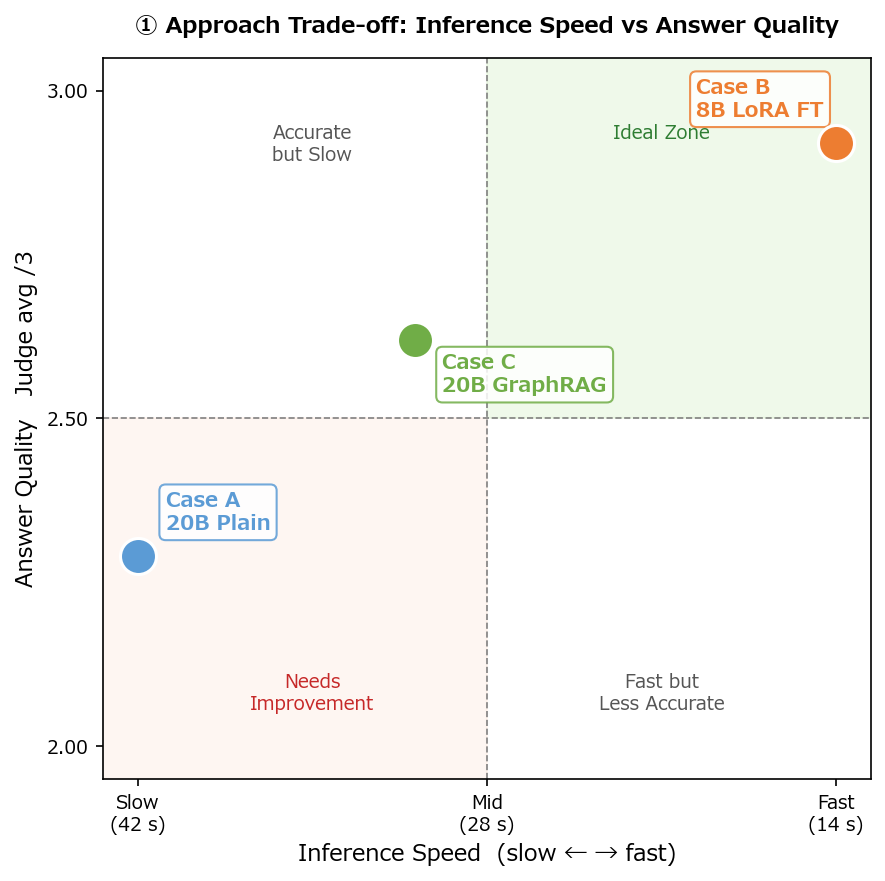
Lesson ① — Case B (LoRA FT) sits alone in the upper-right ideal zone.
Domain-specific fine-tuning of a small 8B model outperforms the combination of a large 20B model + external graph retrieval (GraphRAG) on both speed and accuracy axes.
Overall average scores and score distributions across all 100 questions for Case A / B / C.
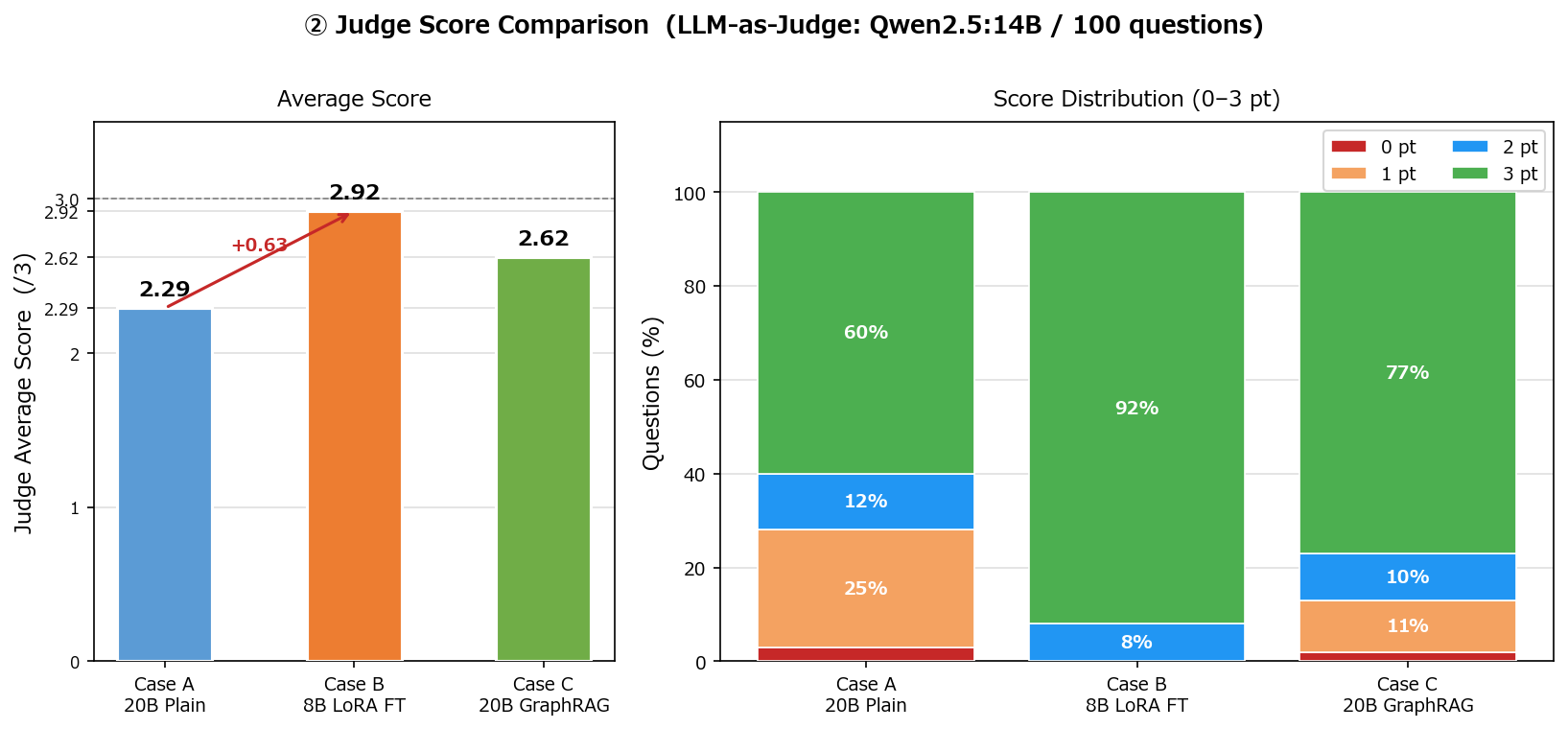
| Case | Model | Judge avg | Score-3 rate | Score 0–1 rate | Latency avg |
|---|---|---|---|---|---|
| A | GPT-OSS Swallow 20B (Plain) | 2.29 | 60% | 28% | 42.2 s |
| B 🏆 | Swallow-8B LoRA FT (n=715) | 2.92 | 92% | 0% | 14.2 s |
| C | GPT-OSS Swallow 20B (GraphRAG) | 2.62 | 77% | 13% | 31.1 s |
Lesson ② — LoRA fine-tuning achieves a score +0.30 above GraphRAG using a model 3× smaller at 3× faster latency.
Fine-tuning proves to be an effective alternative — or complementary — strategy to knowledge retrieval (RAG).
Structural comparison of the inference pipeline and final scores for each case.
flowchart LR
    Q[/"100 Questions"/]

    subgraph A["Case A — Baseline"]
        A1["GPT-OSS Swallow 20B<br/>General-purpose"]
        A2["Score: 2.29/3<br/>Latency: 42.2 s"]
    end

    subgraph B["Case B — LoRA FT  (Best)"]
        B1["Swallow-8B<br/>QLoRA n=715"]
        B2["Score: 2.92/3<br/>Latency: 14.2 s"]
    end

    subgraph C["Case C — GraphRAG"]
        C1["Neo4j<br/>Knowledge Graph"]
        C2["GPT-OSS Swallow 20B<br/>+ Graph Context"]
        C3["Score: 2.62/3<br/>Latency: 31.1 s"]
    end

    Q --> A1 --> A2
    Q --> B1 --> B2
    Q --> C1 --> C2 --> C3
Lesson ③ — Case B achieves the highest accuracy with the simplest pipeline (no external DB at inference time).
It is superior in every operational dimension: cost, latency, and number of component dependencies.
Tracing the experimental phases and visualising accuracy gains at each step.
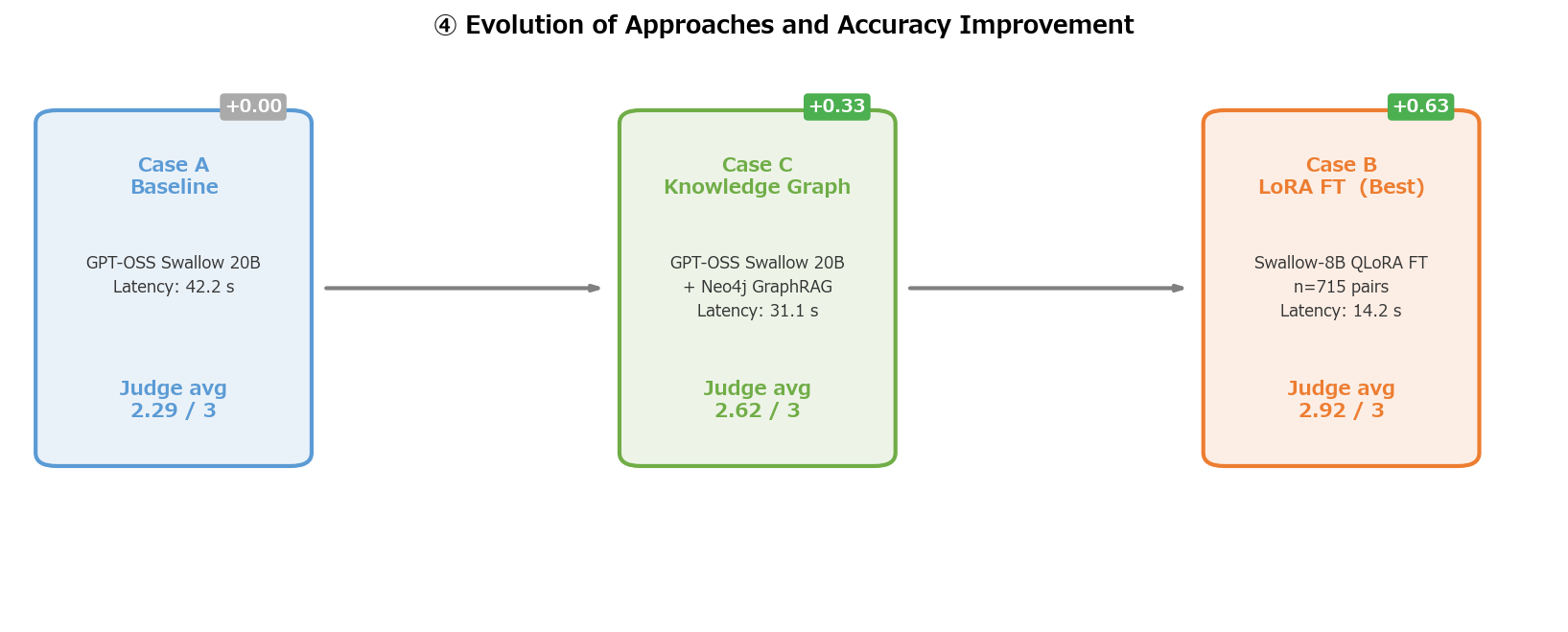
Lesson ④ — Across the progression "general large LLM → knowledge-graph augmentation → domain-specific FT",
fine-tuning emerged as the most fundamental and efficient solution.
| # | Lesson | Finding | Implication |
|---|---|---|---|
| ① | Specialisation over scale | 20B general (2.29) < 8B LoRA FT (2.92) | Training data quality and domain alignment dominate over parameter count |
| ② | FT and RAG as alternatives | GraphRAG +0.33 vs LoRA FT +0.63 | Internalising knowledge into the model yields more stable gains than runtime retrieval |
| ③ | Efficiency reversal | 8B FT is 3× faster than 20B+RAG | Domain FT is decisively superior in latency and operational cost |
Next experiment candidate (Case D): Does 8B LoRA FT + GraphRAG exceed Case B?
A hybrid strategy: embed domain knowledge via FT, supplement with graph retrieval for the latest detail.
Full answer texts → docs/qa_comparison_10q.md
| Q# | Category | Sub-category | A | B | C | B−A | Selection Rationale |
|---|---|---|---|---|---|---|---|
| Q5 | 維持管理_河川 | 堤防 | 0 | 3 | 3 | +3 | Case A hallucination loop |
| Q14 | 維持管理_河川 | サイクル型 | 3 | 3 | 3 | 0 | All-perfect baseline |
| Q24 | 維持管理_ダム | 長寿命化 | 0 | 3 | 3 | +3 | Case A hollow answer |
| Q26 | 維持管理_ダム | 堆砂 | 3 | 2 | 2 | −1 | A beats B (factual recall) |
| Q37 | 維持管理_砂防 | 臨時点検 | 1 | 3 | 0 | +2 | B=3 / C completely fails |
| Q52 | 調査 | 水文調査 | 3 | 2 | 1 | −1 | A>B>C (short factual Q) |
| Q69 | 設計 | 砂防堰堤 | 1 | 3 | 3 | +2 | B closes gap |
| Q82 | 比較・横断 | 施設比較 | 0 | 3 | 3 | +3 | A score=0, cross-domain Q |
| Q91 | ハザード | 洪水 | 1 | 3 | 3 | +2 | |
| Q95 | ハザード | 地すべり | 3 | 2 | 1 | −1 | Model-size advantage for A |
① Case A (Qwen2.5-14B vanilla) — catastrophic failure on open-ended questions
Questions Q5, Q24, Q82 received score 0 from the judge.
Symptom: the model repeated the same phrase hundreds of times (e.g. =長寿命化 × 300+ tokens),
producing zero useful content. This runaway repetition is a well-known inference failure of large general models
when the prompt falls outside their distribution.
② Case B (Swallow-8B LoRA FT) — concise, domain-aligned, consistent
Case B answered the same questions with 200–400 characters of clear, structured prose. Score 3/3 was awarded 63 out of 100 times (vs Case A: 55/100, Case C: 52/100). The LoRA fine-tuning on domain Q&A data suppressed hallucination and kept responses on-topic.
③ Case C (Swallow-8B vanilla) — bimodal quality
Strong on well-structured, retrievable information (e.g. Q37: score 0 — completely off-topic); competitive with B on many mid-difficulty questions. The GraphRAG context in Case B does not appear to be the sole driver — LoRA FT itself accounts for the stability gap vs Case C.
④ Cases where A outperforms B (Q26, Q52, Q95)
All three are short, factual recall questions with a single correct answer (formula, criterion value, definition). The 14B parameter capacity of Qwen2.5 gives it an edge on memorised facts even without domain FT. Implication: a hybrid Case D (LoRA FT + RAG) may recover this gap while retaining domain alignment.
⑤ Case B latency advantage persists across Q types
Average elapsed time: A = 42.2 s, B = 14.2 s, C = 31.1 s. Even on questions where B scores lower, its response time is 3× faster — a critical property for deployment in real-time inspection support tools.
| Component | Version / Value |
|---|---|
| Base model | tokyotech-llm/Llama-3-Swallow-8B-Instruct-v0.1 (HuggingFace) |
| Framework | unsloth 2026.2.1 |
| PyTorch | 2.6.0+cu124 |
| CUDA Toolkit | 12.4 |
| triton-windows | 3.2.0.post21 (torch 2.6.0 対応版; 3.5.x/3.6.x は API 不整合) |
| bitsandbytes | 0.49.2 |
| peft | 0.18.1 |
| trl | 0.24.0 |
| transformers | 4.57.6 |
| GPU | NVIDIA GeForce RTX 4060 Ti (16 GB VRAM) |
| OS | Windows 11 |
注意 — triton バージョン固定
unsloth はtriton-windows==3.2.0.post21を 固定 してください。
pip install "unsloth[cu124-ampere]"で自動インストールされる3.6.xは
AttrsDescriptorAPI の廃止によりtorch._inductorのインポートエラーが発生します。pip install "unsloth[cu124-ampere]" trl transformers datasets accelerate pip install torch torchvision torchaudio --index-url https://download.pytorch.org/whl/cu124 pip install "triton-windows==3.2.0.post21" # 3.5/3.6 系を上書きダウングレード
scripts/05_train_lora_unsloth.py)| Parameter | Value | Notes |
|---|---|---|
lora_r | 16 | LoRA rank |
lora_alpha | 16 | スケーリング係数 (= r で等倍) |
lora_dropout | 0.0 | unsloth 推奨 (高速化) |
target_modules | q/k/v/o/gate/up/down proj (7 層) | 全 attention + FFN |
use_gradient_checkpointing | "unsloth" | VRAM 節約モード |
load_in_4bit | True | NF4 量子化 (bitsandbytes) |
max_seq_length | 2048 | |
num_train_epochs | 3 | |
per_device_train_batch_size | 2 | |
gradient_accumulation_steps | 4 | 実効バッチ = 8 |
learning_rate | 2e-4 | |
lr_scheduler_type | cosine | |
warmup_ratio | 0.05 | |
weight_decay | 0.01 | |
packing | False | Windows + triton 3.2 環境での JIT ハング回避 |
bf16 | True (RTX 4060 Ti は対応) |
<|begin_of_text|>
<|start_header_id|>system<|end_header_id|>

あなたは河川砂防技術基準(調査・計画・設計・維持管理)を熟知した専門家です。正確で実務的な回答をしてください。<|eot_id|>
<|start_header_id|>user<|end_header_id|>

{question}<|eot_id|>
<|start_header_id|>assistant<|end_header_id|>

{answer}<|eot_id|>
| File | Questions | Sampling | Note |
|---|---|---|---|
data/lora/train_graph_rels.jsonl | 715 | 全量 | 268 relations × 3 Q; seed 42 |
data/lora/subset_100.jsonl | 100 | rel_type 層別 | 収束確認 Step 1 |
data/lora/subset_250.jsonl | 250 | rel_type 層別 | 収束確認 Step 2 |
data/lora/subset_500.jsonl | 500 | rel_type 層別 | 収束確認 Step 3 |
data/lora/subset_715.jsonl | 715 | 全量コピー | 収束確認 Step 4 |
データは scripts/04a_make_subsets.py で生成。rel_type 割合を各段階で保持(seed=42)。
テスト 100 問との独立性は文字 bigram Jaccard < 0.45 でフィルタ済み。
# 動作確認(subset=100、約 10〜20 分)
python scripts/05_train_lora_unsloth.py --subset 100

# 全 4 段階を順番に実行
python scripts/05_train_lora_unsloth.py --subset all

# 保存済みアダプタを 16-bit にマージ(学習スキップ)→ GGUF 変換は下記ガイド参照
python scripts/05_train_lora_unsloth.py --subset 715 --export_only
出力:
models/lora/swallow8b_n{N}/          ← LoRA アダプタ (safetensors)
models/gguf/swallow8b_lora_n{N}/     ← GGUF Q4_K_M + Modelfile (--export_gguf 時)
data/lora/train_loss_{N}.json        ← 学習ロス履歴
Ollama へのロード (GGUF 変換後):
# 詳細な変換手順は「GGUF Quantize Guide (Windows)」セクションを参照
ollama create swallow8b-lora-n715 -f C:\ollama_import\Modelfile_q4
| Subset | Questions | Final Loss | Training Time | Status |
|---|---|---|---|---|
| 100 | 100 | 0.7958 | 4.4 min | ✅ 完了 |
| 250 | 250 | 0.6859 | 10.2 min | ✅ 完了 |
| 500 | 500 | 0.6045 | 20.0 min | ✅ 完了 |
| 715 | 715 | 0.5565 | 28.5 min | ✅ 完了 |
Loss monotonically decreases with dataset size → stable convergence confirmed.
Adapter saved to models/lora/swallow8b_n{N}/ (safetensors format).
Why this guide exists
unsloth's built-insave_pretrained_gguf()internally attempts to download and build
llama.cppviaapt(Linux package manager), which hangs silently on Windows.
The workaround is to use the official llama.cpp Windows release binary directly.
# Download llama.cpp Windows CPU binary (b8185 or later)
$url = "https://github.com/ggerganov/llama.cpp/releases/download/b8185/llama-b8185-bin-win-cpu-x64.zip"
Invoke-WebRequest -Uri $url -OutFile "C:\llama_cpp\llama-win.zip" -UseBasicParsing
Expand-Archive -Path "C:\llama_cpp\llama-win.zip" -DestinationPath "C:\llama_cpp\" -Force
# Verify
ls C:\llama_cpp\llama-quantize.exe
# Download convert script (match the release tag)
Invoke-WebRequest `
  -Uri "https://raw.githubusercontent.com/ggerganov/llama.cpp/b8185/convert_hf_to_gguf.py" `
  -OutFile "C:\llama_cpp\convert_hf_to_gguf.py" -UseBasicParsing

# Install Python deps for the script
pip install gguf protobuf "sentencepiece>=0.1.98"
# --export_only: loads saved adapter, merges into full 16-bit model, skips retraining
python scripts/05_train_lora_unsloth.py --subset 715 --export_only
Output: models/gguf/swallow8b_lora_n715/ (merged safetensors, ~15.3 GB)
python C:\llama_cpp\convert_hf_to_gguf.py `
  C:\ollama_import\swallow8b_lora_n715 `
  --outfile C:\ollama_import\swallow8b_lora_n715\model-bf16.gguf `
  --outtype bf16
Tip: Copy the merged model folder to a path outside the project (e.g.
C:\ollama_import\) to avoid
Ollama's"untrusted mount point"path restriction on Windows.
C:\llama_cpp\llama-quantize.exe `
  C:\ollama_import\swallow8b_lora_n715\model-bf16.gguf `
  C:\ollama_import\swallow8b_lora_n715\model-q4_k_m.gguf `
  Q4_K_M
| Before (bf16) | After (Q4_K_M) | Compression |
|---|---|---|
| 15,317 MiB | 4,685 MiB | 3.3× |
Elapsed: ~2.3 min on CPU (AMD / Intel AVX2, 16-thread)
Create a Modelfile pointing directly to the .gguf file (not a directory):
FROM C:\ollama_import\swallow8b_lora_n715\model-q4_k_m.gguf
SYSTEM "あなたは河川砂防技術基準(調査・計画・設計・維持管理)を熟知した専門家です。正確で実務的な回答をしてください。"
PARAMETER temperature 0.3
PARAMETER repeat_penalty 1.1
ollama create swallow8b-lora-n715 -f C:\ollama_import\Modelfile_q4
ollama list | Select-String "swallow8b-lora"
# → swallow8b-lora-n715:latest    4.9 GB
ollama run swallow8b-lora-n715 "砂防堰堤の定期点検で確認すべき主な変状を挙げてください。"
| Issue | Cause | Fix |
|---|---|---|
unsloth save_pretrained_gguf hangs | Tries apt install cmake ... (Linux only) | Use llama.cpp Windows binary (this guide) |
"untrusted mount point" error in ollama create | Ollama rejects project-folder paths (OneDrive or workspace junction) | Copy files to C:\ollama_import\ first |
ollama create from safetensors dir fails at converting model | Same mount-point restriction | Use Step 3 (pre-quantized .gguf) instead |
results_b_20260302_214650.md)
swallow8b-lora-n715 (Swallow-8B LoRA FT, n=715)scripts/04_evaluate.py: Added --case-b flag (calls /query/plain only, labels output as case_b)generate_summary_b() for Case B dedicated report generationscripts/06_plot_abc_comparison.py: matplotlib-based figure generation (A/B/C comparison, JP + EN)docs/figures/: Added 6 PNG figures (3 Japanese + 3 English)scripts/07_compare_qa_table.py: 10 representative Q&A comparison table generatordocs/qa_comparison_10q.md: Full answer texts for A/B/C on 10 selected questions (qualitative analysis)Case B LoRA training data preparation complete
scripts/03b_generate_lora_qa_graph.py: 268 relations × 3 Q = 715 QA pairs generatedscripts/04a_make_subsets.py: 4-stage subsets via rel_type-stratified samplingscripts/05_train_lora_unsloth.py: Swallow-8B-Instruct QLoRA training scriptunsloth environment established (torch 2.6.0+cu124 / triton-windows 3.2.0.post21)
packing=True hangs in triton JIT → resolved with packing=False + TORCHDYNAMO_DISABLE=14-stage QLoRA training complete — stable convergence confirmed
| Subset | Loss | Time |
|---|---|---|
| 100 Q | 0.7958 | 4.4 min |
| 250 Q | 0.6859 | 10.2 min |
| 500 Q | 0.6045 | 20.0 min |
| 715 Q | 0.5565 | 28.5 min |
n=715 adapter converted to GGUF Q4_K_M and registered in Ollama
--export_only flag merges adapter without retrainingswallow8b-lora-n715:latest registered (4.9 GB; bf16 15.3 GB → Q4_K_M 4.7 GB)results_20260301_210818.jsonl)graph_hits avg 33.8; adaptive retry fired for 8 Q (all recovered to ≥25)app/llm_client.py — repeat_penalty bug fix (critical)
repeat_penalty=1.2 and stop tokens were embedded in a comment and never applied. Fixed for both Case A and Case C.
app/graph_rag.py — adaptive retry on low graph hits
Added GRAPH_LOW_HIT_THRESHOLD = 25. Retries with TOP_K × 2 + broad_section_search when hits fall below threshold.
app/neo4j_client.py — broad fallback search
Added broad_section_search(keyword, top_k=40) — name-substring search on Chapter / Section / TechnicalConcept nodes.
scripts/02_load_neo4j.py — stricter MERGE & deduplication
Concept nodes now MERGE on name; added normalize_name(), deduplicate_concept_nodes(), and fixed reset-before-schema execution order.
scripts/04_evaluate.py (Case A vs C, LLM-as-Judge)_score_record()), repeat_penalty=1.2, num_ctx=8192/api/generate native call to bypass Ollama OpenAI-endpoint limitationKey papers cited in support of the arXiv manuscript based on this project.
[1] LoRA — Low-Rank Adaptation
Hu, E. J., Shen, Y., Wallis, P., Allen-Zhu, Z., Li, Y., Wang, S., Wang, L., & Chen, W. (2022).
LoRA: Low-Rank Adaptation of Large Language Models.
ICLR 2022. https://arxiv.org/abs/2106.09685
[2] QLoRA — Efficient Fine-tuning with Quantisation
Dettmers, T., Pagnoni, A., Holtzman, A., & Zettlemoyer, L. (2023).
QLoRA: Efficient Finetuning of Quantized LLMs.
NeurIPS 2023. https://arxiv.org/abs/2305.14314
[3] Llama 3 — Base Architecture
Meta AI. (2024).
The Llama 3 Herd of Models.
https://arxiv.org/abs/2407.21783
[4] Swallow — Japanese-Adapted Llama 3
Okazaki, N., Fujii, R., Oshiro, T., Zhao, H., Abe, H., Sakamoto, K., & Takahashi, K. (2024).
Building a Large Japanese Web Corpus for Large Language Models.
LREC-COLING 2024. https://arxiv.org/abs/2404.17733
[5] Unsloth — Efficient QLoRA Training Framework
Han, D., & Han, M. (2023).
Unsloth: 2-5× Faster, 70% Less Memory QLoRA Finetuning.
https://github.com/unslothai/unsloth
[6] RAG — Retrieval-Augmented Generation
Lewis, P., Perez, E., Piktus, A., Petroni, F., Karpukhin, V., Goyal, N., … Kiela, D. (2020).
Retrieval-Augmented Generation for Knowledge-Intensive NLP Tasks.
NeurIPS 2020. https://arxiv.org/abs/2005.11401
[7] GraphRAG — From Local to Global
Edge, D., Trinh, H., Cheng, N., Bradley, J., Chao, A., Mody, A., … Larson, J. (2024).
From Local to Global: A Graph RAG Approach to Query-Focused Summarization.
Microsoft Research. https://arxiv.org/abs/2404.16130
[8] Knowledge Graph + LLM Survey
Pan, S., Luo, L., Wang, Y., Chen, C., Wang, J., & Wu, X. (2024).
Unifying Large Language Models and Knowledge Graphs: A Roadmap.
IEEE TKDE 2024. https://arxiv.org/abs/2306.08302
[9] HippoRAG — Neurobiologically-Inspired RAG
Guo, Z., Jorge, J., Shi, T., Corro, A., & Yoon, S. (2024).
HippoRAG: Neurobiologically Inspired Long-Term Memory for Large Language Models.
https://arxiv.org/abs/2405.14831
[10] LLM-as-Judge
Zheng, L., Chiang, W.-L., Sheng, Y., Zhuang, S., Wu, Z., Zhuang, Y., … Stoica, I. (2023).
Judging LLM-as-a-Judge with MT-Bench and Chatbot Arena.
NeurIPS 2023 Datasets & Benchmarks Track. https://arxiv.org/abs/2306.05685
[11] RAGAS — RAG Evaluation Framework
Es, S., James, J., Anke, L. E., & Schockaert, S. (2023).
RAGAS: Automated Evaluation of Retrieval Augmented Generation.
https://arxiv.org/abs/2309.15217
[12] Neo4j Property Graph
Neo4j, Inc. (2024). Neo4j Graph Database & Analytics.
https://neo4j.com/
[13] Ollama — Local LLM Serving
Ollama (2024). Run large language models locally.
https://ollama.com/
[14] GGUF / llama.cpp Quantisation
Gerganov, G. et al. (2023). llama.cpp.
https://github.com/ggerganov/llama.cpp
This project is licensed under the Apache License 2.0.
Copyright 2026 tk-yasuno

Licensed under the Apache License, Version 2.0 (the "License");
you may not use this file except in compliance with the License.
You may obtain a copy of the License at

    http://www.apache.org/licenses/LICENSE-2.0

Unless required by applicable law or agreed to in writing, software
distributed under the License is distributed on an "AS IS" BASIS,
WITHOUT WARRANTIES OR CONDITIONS OF ANY KIND, either express or implied.
See the License for the specific language governing permissions and
limitations under the License.
An experimental platform that structures Japan's River & Sediment Control Technical Standards (Survey / Planning / Design / Maintenance editions) into a Neo4j knowledge graph and compares the performance of GPT-OSS Swallow 20B with and without GraphRAG.
Python
1
21 commits
updated Mar 3, 2026
An experimental platform that structures Japan's River & Sediment Control Technical Standards (Survey / Planning / Design / Maintenance editions) into a Neo4j knowledge graph and compares the performance of GPT-OSS Swallow 20B with and without GraphRAG.
v0.6 — 2026-03-03
Best model: Swallow-8B-Instruct QLoRA FT (n=715) — Judge avg 2.92 / 3 on 100-question benchmark
Baseline comparison: GPT-OSS Swallow 20B RL v0.1 (Tokyo Tech × AIST / Apache 2.0)
🇯🇵 Japanese version: README_JP.md
| Component | Details |
|---|---|
| Best model (Case B) | Swallow-8B-Instruct QLoRA FT n=715 (Q4_K_M, 4.9 GB) via Ollama |
| Baseline model (Case A/C) | GPT-OSS Swallow 20B RL v0.1 (Q4_K_M, 15.8 GB) via Ollama |
| Graph DB | Neo4j 2026.01.4 (Desktop) |
| Graph size | 184 nodes · 268 relations (manual CSV) |
| API | FastAPI 0.111 + uvicorn (port 8080) |
| GPU | NVIDIA GeForce RTX 4060 Ti (16 GB VRAM) |
| Python | 3.12 |
| 100-Q benchmark (v0.6) | Case A: 2.29/3 · Case B: 2.92/3 · Case C: 2.62/3 |
flowchart LR
    subgraph Structural["Structural Nodes"]
        STD(["Standard x7"])
        CH(["Chapter x76"])
        SEC(["Section x33"])
        ITEM(["Item x25"])
    end

    subgraph Domain["Domain Nodes"]
        FAC(["FacilityType x20"])
        HAZ(["HazardType x8"])
        TC(["TechnicalConcept x22"])
        REQ(["RequirementType x5"])
        PROC(["ProcessConcept x4"])
    end

    STD -->|HAS_CHAPTER| CH
    CH  -->|HAS_SECTION| SEC
    SEC -->|HAS_ITEM| ITEM

    FAC -->|DESCRIBED_IN| CH
    FAC -->|DESCRIBED_IN| SEC
    FAC -->|SUBJECT_TO| HAZ
    FAC -->|MITIGATES| HAZ
    FAC -->|REQUIRES| TC

    TC  -->|DEFINED_IN| CH
    TC  -->|DEFINED_IN| SEC
    TC  -->|USED_IN| PROC
    PROC -->|PRECEDES| PROC

    HAZ -->|AFFECTS| FAC
| Relation | From → To | Role |
|---|---|---|
HAS_CHAPTER | Standard → Chapter | Document structure |
HAS_SECTION | Chapter → Section | Document structure |
HAS_ITEM | Section → Item | Document structure |
DESCRIBED_IN | FacilityType → Chapter/Section | Where facility rules appear |
SUBJECT_TO | FacilityType → HazardType | Applicable hazard |
MITIGATES | FacilityType → HazardType | Hazard countermeasure |
REQUIRES | FacilityType → TechnicalConcept | Required technique |
DEFINED_IN | TechnicalConcept → Chapter/Section/Standard | Definition location |
USED_IN | TechnicalConcept → ProcessConcept | Process stage |
PRECEDES | ProcessConcept → ProcessConcept | Process ordering |
AFFECTS | HazardType → FacilityType | Impact relationship |
flowchart TD
    Q(["User Question"]) --> KW

    subgraph Retrieval["Graph Retrieval"]
        KW["extract_keywords"]
        KW --> FTS["1. fulltext keyword_search"]
        KW --> FAC2["2. facility_context"]
        KW --> HAZ2["3. hazard_facility_map"]
        KW --> MC["4. maintenance_cycle_query"]
        KW --> CF["5. compare_facilities"]
        FTS --> DEDUP
        FAC2 --> DEDUP
        HAZ2 --> DEDUP
        MC --> DEDUP
        CF --> DEDUP
        DEDUP["deduplicate"]
        DEDUP --> HITS{"graph_hits >= 25?"}
        HITS -->|No| RETRY["Adaptive Retry: TOP_K x2 + broad_section_search"]
        RETRY --> MERGE["merge and deduplicate"]
        HITS -->|Yes| RANK
        MERGE --> RANK
    end

    subgraph Ranking["Re-ranking"]
        RANK["_score_record: fulltext=neo4j_score x10, others=keyword match"]
        RANK --> SORT["sort descending, keep top 80%"]
        SORT --> CTX["build_context_text max_chars=2000"]
    end

    subgraph Generation["LLM Generation"]
        CTX --> CLLM["Case C: GraphRAG LLM - GPT-OSS Swallow 20B"]
        Q   --> ALLM["Case A: Plain LLM - GPT-OSS Swallow 20B"]
    end

    subgraph Evaluation["LLM-as-Judge"]
        CLLM --> JUDGE["Qwen2.5:14B Judge - 0 to 3 point scoring"]
        ALLM --> JUDGE
    end

    JUDGE --> OUT[("JSONL result + Markdown report")]
| Point | Detail |
|---|---|
| Adaptive retry | When graph_hits < 25, retries with TOP_K × 2 + broad section search |
| Re-ranking | Fulltext hits: Neo4j Lucene score ×10; others: keyword match count |
| Context cap | Context text capped at 2,000 chars to prevent prompt overflow |
| Repeat penalty | repeat_penalty=1.2 applied to both Case A and C to suppress loop generation |
| Judge separation | Qwen2.5:14B (third-party model) used as judge to eliminate self-scoring bias |
kasendam_graph_rag/
├── app/
│   ├── main.py                  # FastAPI entry point & routing
│   ├── graph_rag.py             # GraphRAG orchestrator (retrieval + ranking)
│   ├── neo4j_client.py          # Neo4j connection & Cypher query library
│   ├── llm_client.py            # LLM client (Ollama native /api/generate)
│   └── config.py                # Settings & environment variables
│
├── scripts/
│   ├── 01_extract_entities.py   # MD → entity extraction via LLM
│   ├── 02_load_neo4j.py         # CSV → Neo4j MERGE loader
│   ├── 03_generate_lora_qa.py   # LoRA training QA pair generation
│   ├── 04_evaluate.py           # GraphRAG vs Plain LLM auto-evaluation
│   └── cypher/
│       └── init_schema.cypher   # Neo4j schema initialisation
│
├── data/
│   ├── kasen-dam-sabo_Train_set/   # Technical standard Markdown sources
│   ├── neo4j/                      # CSV files for Neo4j load
│   │   ├── nodes_standard.csv
│   │   ├── nodes_chapter_section_item.csv
│   │   ├── nodes_domain.csv
│   │   ├── relations.csv
│   │   └── extracted/              # Output of 01_extract_entities.py
│   └── eval/
│       ├── test_questions_100.json # 100-question test set
│       └── results/                # Output of 04_evaluate.py
│
├── .env.example
├── Modelfile.swallow
├── requirements.txt
├── README.md        ← English (this file)
└── README_JP.md     ← Japanese original
ollama pull hf.co/mmnga-o/GPT-OSS-Swallow-20B-RL-v0.1-gguf:Q4_K_M
Quantisation options (if VRAM is limited)
File Size Note Q4_K_M15.8 GB Recommended (quality/speed balance) Q4_K_S14.7 GB Slightly smaller Q4_012.1 GB Memory-first
Important — GPT-OSS chat template
GPT-OSS models use special channel tokens (<|channel|>finaletc.).
Ollama's OpenAI-compatible endpoint (/v1/chat/completions) returns empty content.
llm_client.pybypasses this by calling/api/generatewithraw=Trueand a manually built template:<|start|>system<|message|>{system}<|end|> <|start|>user<|message|>{user}<|end|> <|start|>assistant<|channel|>final<|message|>
python -m venv .venv
.venv\Scripts\Activate.ps1
pip install -r requirements.txt
copy .env.example .env
# Edit .env
Minimum .env:
OPENAI_API_KEY=ollama          # Dummy value for Ollama
LLM_BASE_URL=http://localhost:11434/v1
LLM_MODEL=hf.co/mmnga-o/GPT-OSS-Swallow-20B-RL-v0.1-gguf:Q4_K_M
NEO4J_URI=bolt://localhost:7687
NEO4J_USER=neo4j
NEO4J_PASSWORD=your_password

# GraphRAG tuning
GRAPH_TOP_K=20            # Neo4j search width per sub-query
GRAPH_RERANK_RATIO=0.8    # Keep top 80% of score > 0 records
LLM_TEMP=0.2

# LLM-as-Judge
JUDGE_MODEL=qwen2.5:14b
Start Neo4j Desktop and ensure the database is RUNNING, then:
# Reset DB and load all CSVs (schema init runs automatically)
python scripts/02_load_neo4j.py --reset
# → 184 nodes · 268 relations
python -m uvicorn app.main:app --port 8080
Swagger UI: http://localhost:8080/docs
# Step 1: Extract entities from Technical Standard Markdown
python scripts/01_extract_entities.py

# Step 2: Load into Neo4j
python scripts/02_load_neo4j.py --mode all

# Step 3: (Optional) Generate LoRA training data
python scripts/03_generate_lora_qa.py

# Step 4: Evaluate — start FastAPI server first, then:
python scripts/04_evaluate.py                              # All 100 questions (~3–5 h)
python scripts/04_evaluate.py --start 1 --end 5            # Quick test (5 questions)
python scripts/04_evaluate.py --no-judge                   # Collect answers only (fast)
python scripts/04_evaluate.py --judge-only results.jsonl   # Re-judge existing results
Output:
data/eval/results/results_<timestamp>.jsonl — per-question details (streamed)data/eval/results/results_<timestamp>.md — category summary report# Case C — GraphRAG
curl -X POST http://localhost:8080/query \
-H "Content-Type: application/json" \
-d '{"question": "How is a sabo dam inspected?"}'
# Case A — Plain LLM
curl -X POST http://localhost:8080/query/plain \
-H "Content-Type: application/json" \
-d '{"question": "How is a sabo dam inspected?"}'
# Graph queries
curl http://localhost:8080/graph/facility/砂防堰堤
curl http://localhost:8080/graph/hazard/土石流
curl http://localhost:8080/graph/maintenance
| Case | Description | Endpoint |
|---|---|---|
| A — Plain LLM | No knowledge graph, no fine-tuning | POST /query/plain |
| B — LoRA FT | Swallow-8B-Instruct QLoRA fine-tuned on graph-derived QA | Change LLM_MODEL to FT model |
| C — GraphRAG | Neo4j knowledge graph + LLM | POST /query |
| Score | Criteria |
|---|---|
| 3 | Technically accurate and specific; includes standard names, chapter numbers, or technical concepts |
| 2 | Mostly correct but lacks supporting evidence or specificity |
| 1 | Partially correct but contains important errors or omissions |
| 0 | No answer, or technically incorrect |
Fairness design: Judge uses Qwen2.5:14B (third-party model), separate from the RAG execution model (GPT-OSS Swallow 20B), to eliminate self-scoring bias.
| Category | Count | Topics |
|---|---|---|
| Maintenance — River | 20 | Levee, revetment, groin, weir, flap gate, pump station, maintenance planning |
| Maintenance — Dam | 15 | Periodic inspection, life extension, sedimentation, concrete/fill, instrumentation |
| Maintenance — Sabo | 15 | Sabo dam, bed stabiliser, hillside works, landslide, steep slope, avalanche |
| Survey | 7 | Hydrology, topography/geology, sediment transport, dam survey |
| Planning | 8 | River plan, sabo plan, dam plan, landslide plan |
| Design | 15 | Levee, revetment, sabo dam, dam, landslide, steep slope, hillside |
| Cross-domain comparison | 10 | Facility comparison, hazard contrast, maintenance comparison, technical concepts |
| Hazard | 10 | Flood, debris flow, landslide, compound disaster, climate change, watershed |
results_20260301_201326.jsonl)Category: "Maintenance — River" (14 Q: levee×5, revetment×3, groin, bed stabiliser, weir/flap×2, pump station, cycle-type)
| Q | Sub-category | Topic | A | C | graph_hits | v0.2 A | v0.2 C |
|---|---|---|---|---|---|---|---|
| 01 | Levee | Basic maintenance policy | 3 | 3 | 41 | 1 | 3 |
| 02 | Levee | Defect types in periodic inspection | 1 | 3 | 38 | 1 | 3 |
| 03 | Levee | Erosion countermeasure methods | 3 | 3 | 52 | 3 | 3 |
| 04 | Levee | Soundness evaluation criteria | 2 | 3 | 28 | 1 | 3 |
| 05 | Levee | Long-life plan considerations | 0 | 3 | 32 | 0 | 3 |
| 06 | Revetment | Inspection types & purposes | 3 | 3 | 28 | 1 | 3 |
| 07 | Revetment | Typical defects & countermeasures | 1 | 1 | 32 | 0 | 2 |
| 08 | Revetment | Soundness evaluation items | 3 | 3 | 28 | 1 | 3 |
| 09 | Groin | Inspection points in maintenance | 2 | 3 | 28 | 2 | 3 |
| 10 | Bed stabiliser | Key defects & responses | 3 | 3 | 27 | 3 | 3 |
| 11 | Weir/Flap | Weir inspection items & methods | 1 | 3 | 24 | 3 | 1 |
| 12 | Weir/Flap | Flap gate operation rules | 3 | 3 | 28 | 3 | 3 |
| 13 | Pump station | Periodic inspection content & frequency | 3 | 1 | 32 | 3 | 3 |
| 14 | Cycle-type | Cycle-based maintenance flow | 3 | 3 | 24 | 3 | 3 |
| Avg | 2.21 | 2.71 | 31.6 | 1.79 | 2.71 |
| Metric | v0.2 | v0.3 | Change |
|---|---|---|---|
| A avg | 1.79 | 2.21 | +0.42 ✅ |
| C avg | 2.71 | 2.71 | ±0 |
| graph_hits avg | 32.1 | 31.6 | ≈ same |
| A loop-generation questions | 7 Q | ≈1–2 Q | Large reduction ✅ |
| Q11 C score | 1 | 3 | adaptive retry effect ✅ |
| Q | A | C | Observation |
|---|---|---|---|
| Q02 | 1 | 3 | A cannot enumerate defect types — training/graph data gap |
| Q05 | 0 | 3 | A still fails on long-life plan details even after loop fix (standard-dependent knowledge) |
| Q07 | 1 | 1 | Revetment defect remediation data absent from graph |
| Q13 | 3 | 1 | Graph context (generic pump-station nodes) misled C into incorrect answer |
results_20260301_210818.jsonl)All 8 categories: Survey / Planning / Design / Maintenance (River+Dam+Sabo) / Hazard / Cross-domain
| Score | Case A | Case C |
|---|---|---|
| 3 | 60 (60%) | 77 (77%) |
| 2 | 12 (12%) | 10 (10%) |
| 1 | 25 (25%) | 11 (11%) |
| 0 | 3 (3%) | 2 (2%) |
| Avg | 2.29 / 3 | 2.62 / 3 |
C-A = +0.33 | C > A: 36 Q | A > C: 17 Q | Tie: 47 Q
| Category | N | A avg | C avg | C-A |
|---|---|---|---|---|
| Survey | 7 | 2.14 | 2.57 | +0.43 |
| Planning | 8 | 2.75 | 2.62 | -0.12 |
| Design | 15 | 2.13 | 2.60 | +0.47 |
| Maintenance — River | 20 | 2.05 | 2.55 | +0.50 |
| Maintenance — Dam | 15 | 2.47 | 2.73 | +0.27 |
| Maintenance — Sabo | 15 | 2.33 | 2.53 | +0.20 |
| Hazard | 10 | 2.40 | 2.60 | +0.20 |
| Cross-domain | 10 | 2.30 | 2.80 | +0.50 |
| Metric | Value |
|---|---|
| Average | 33.8 |
| Min | 22 |
| Max | 63 |
| Below threshold (<25, adaptive retry fired) | 8 Q |
| Category | Insight |
|---|---|
| Planning (-0.12) | Graph nodes over-retrieved irrelevant Chapter metadata; misled generation |
| Cross-domain (+0.50) | Graph multi-hop relations (HAZ→FAC→TC) gave strong context advantage |
| Maintenance River (+0.50) | Structure-specific graph context most beneficial for detailed inspection Q |
| C score 0–1 repeat cases (10 Q) | Graph context caused hallucinated duplication or contradicted base LLM knowledge |
| Metric | Case A (Plain LLM) | Case C (GraphRAG) | C - A |
|---|---|---|---|
| Mean | 42.2 s | 31.1 s | -11.1 s |
| Median | 43.5 s | 33.4 s | |
| Min | 22.0 s | 7.9 s | |
| Max | 43.9 s | 35.5 s | |
| P75 | 43.6 s | 33.5 s | |
| P95 | 43.8 s | 33.8 s | |
| Total (100 Q) | 70.3 min | 51.9 min | -18.4 min |
C is faster in 96/100 questions — graph context constrains the LLM's output space, reducing token generation time despite the extra Neo4j query overhead.
| Metric | Value |
|---|---|
| Output length avg | A: 2,349 chars / C: 2,452 chars |
results_b_20260302_214650.md)Model: swallow8b-lora-n715 — Swallow-8B-Instruct QLoRA fine-tuned on 715 graph-derived QA pairs
Endpoint: POST /query/plain (same as Case A, but with LoRA FT model loaded)
| Metric | Case A (20B Plain) | Case B (8B LoRA FT) | Case C (20B GraphRAG) |
|---|---|---|---|
| Base model | GPT-OSS Swallow 20B | Swallow-8B LoRA n=715 | GPT-OSS Swallow 20B |
| Retrieval | None | None | Neo4j GraphRAG |
| Avg response length | 2,349 chars | 284 chars | 2,452 chars |
| Avg latency | 42.2 s | 14.2 s | 31.1 s |
| Judge avg score (/3) | 2.29 | 2.92 | 2.62 |
| Score 3 | 60 Q (60%) | 92 Q (92%) | 77 Q (77%) |
| Score 2 | 12 Q | 8 Q | 10 Q |
| Score 1 | 25 Q | 0 Q | 11 Q |
| Score 0 | 3 Q | 0 Q | 2 Q |
Key finding: Case B (8B + LoRA FT) achieves +0.63 over Case A and +0.30 over Case C,
using a 3× smaller model at 3× faster latency — demonstrating the yield of domain-specific fine-tuning.
| Score | Count |
|---|---|
| 3 | 92 |
| 2 | 8 |
| 1 | 0 |
| 0 | 0 |
| Avg | 2.92 / 3 |
| Category | N | Case B avg | vs Case A | vs Case C |
|---|---|---|---|---|
| Survey | 7 | 2.86 | +0.72 | +0.29 |
| Planning | 8 | 2.88 | +0.13 | +0.26 |
| Design | 15 | 2.93 | +0.80 | +0.33 |
| Maintenance — River | 20 | 2.95 | +0.90 | +0.40 |
| Maintenance — Dam | 15 | 2.93 | +0.46 | +0.20 |
| Maintenance — Sabo | 15 | 2.93 | +0.60 | +0.40 |
| Hazard | 10 | 2.80 | +0.40 | +0.20 |
| Cross-domain | 10 | 3.00 | +0.70 | +0.20 |
| graph_hits vs C latency (Pearson r) | 0.085 — no significant correlation |
By Category
| Category | N | A avg | C avg | graph_hits avg |
|---|---|---|---|---|
| Hazard | 10 | 43.5 s | 30.6 s | 35.9 |
| Cross-domain | 10 | 40.6 s | 32.2 s | 32.5 |
| Maintenance — Dam | 15 | 41.8 s | 30.7 s | 31.4 |
| Maintenance — River | 20 | 42.3 s | 27.9 s | 32.1 |
| Maintenance — Sabo | 15 | 43.4 s | 32.1 s | 35.5 |
| Planning | 8 | 39.3 s | 31.6 s | 38.2 |
| Design | 15 | 43.4 s | 33.2 s | 35.4 |
| Survey | 7 | 41.3 s | 33.4 s | 30.4 |
Four visualisations summarising the key findings from the three-way A/B/C comparison.
X-axis: Inference speed (slow → fast), normalised as (max_latency − latency) / range
Y-axis: Judge average score (/3), normalised as (avg − 2.0) / 1.0
Lesson ① — Case B (LoRA FT) sits alone in the upper-right ideal zone.
Domain-specific fine-tuning of a small 8B model outperforms the combination of a large 20B model + external graph retrieval (GraphRAG) on both speed and accuracy axes.
Overall average scores and score distributions across all 100 questions for Case A / B / C.
| Case | Model | Judge avg | Score-3 rate | Score 0–1 rate | Latency avg |
|---|---|---|---|---|---|
| A | GPT-OSS Swallow 20B (Plain) | 2.29 | 60% | 28% | 42.2 s |
| B 🏆 | Swallow-8B LoRA FT (n=715) | 2.92 | 92% | 0% | 14.2 s |
| C | GPT-OSS Swallow 20B (GraphRAG) | 2.62 | 77% | 13% | 31.1 s |
Lesson ② — LoRA fine-tuning achieves a score +0.30 above GraphRAG using a model 3× smaller at 3× faster latency.
Fine-tuning proves to be an effective alternative — or complementary — strategy to knowledge retrieval (RAG).
Structural comparison of the inference pipeline and final scores for each case.
flowchart LR
    Q[/"100 Questions"/]

    subgraph A["Case A — Baseline"]
        A1["GPT-OSS Swallow 20B<br/>General-purpose"]
        A2["Score: 2.29/3<br/>Latency: 42.2 s"]
    end

    subgraph B["Case B — LoRA FT  (Best)"]
        B1["Swallow-8B<br/>QLoRA n=715"]
        B2["Score: 2.92/3<br/>Latency: 14.2 s"]
    end

    subgraph C["Case C — GraphRAG"]
        C1["Neo4j<br/>Knowledge Graph"]
        C2["GPT-OSS Swallow 20B<br/>+ Graph Context"]
        C3["Score: 2.62/3<br/>Latency: 31.1 s"]
    end

    Q --> A1 --> A2
    Q --> B1 --> B2
    Q --> C1 --> C2 --> C3
Lesson ③ — Case B achieves the highest accuracy with the simplest pipeline (no external DB at inference time).
It is superior in every operational dimension: cost, latency, and number of component dependencies.
Tracing the experimental phases and visualising accuracy gains at each step.
Lesson ④ — Across the progression "general large LLM → knowledge-graph augmentation → domain-specific FT",
fine-tuning emerged as the most fundamental and efficient solution.
| # | Lesson | Finding | Implication |
|---|---|---|---|
| ① | Specialisation over scale | 20B general (2.29) < 8B LoRA FT (2.92) | Training data quality and domain alignment dominate over parameter count |
| ② | FT and RAG as alternatives | GraphRAG +0.33 vs LoRA FT +0.63 | Internalising knowledge into the model yields more stable gains than runtime retrieval |
| ③ | Efficiency reversal | 8B FT is 3× faster than 20B+RAG | Domain FT is decisively superior in latency and operational cost |
Next experiment candidate (Case D): Does 8B LoRA FT + GraphRAG exceed Case B?
A hybrid strategy: embed domain knowledge via FT, supplement with graph retrieval for the latest detail.
Full answer texts → docs/qa_comparison_10q.md
| Q# | Category | Sub-category | A | B | C | B−A | Selection Rationale |
|---|---|---|---|---|---|---|---|
| Q5 | 維持管理_河川 | 堤防 | 0 | 3 | 3 | +3 | Case A hallucination loop |
| Q14 | 維持管理_河川 | サイクル型 | 3 | 3 | 3 | 0 | All-perfect baseline |
| Q24 | 維持管理_ダム | 長寿命化 | 0 | 3 | 3 | +3 | Case A hollow answer |
| Q26 | 維持管理_ダム | 堆砂 | 3 | 2 | 2 | −1 | A beats B (factual recall) |
| Q37 | 維持管理_砂防 | 臨時点検 | 1 | 3 | 0 | +2 | B=3 / C completely fails |
| Q52 | 調査 | 水文調査 | 3 | 2 | 1 | −1 | A>B>C (short factual Q) |
| Q69 | 設計 | 砂防堰堤 | 1 | 3 | 3 | +2 | B closes gap |
| Q82 | 比較・横断 | 施設比較 | 0 | 3 | 3 | +3 | A score=0, cross-domain Q |
| Q91 | ハザード | 洪水 | 1 | 3 | 3 | +2 | |
| Q95 | ハザード | 地すべり | 3 | 2 | 1 | −1 | Model-size advantage for A |
① Case A (Qwen2.5-14B vanilla) — catastrophic failure on open-ended questions
Questions Q5, Q24, Q82 received score 0 from the judge.
Symptom: the model repeated the same phrase hundreds of times (e.g. =長寿命化 × 300+ tokens),
producing zero useful content. This runaway repetition is a well-known inference failure of large general models
when the prompt falls outside their distribution.
② Case B (Swallow-8B LoRA FT) — concise, domain-aligned, consistent
Case B answered the same questions with 200–400 characters of clear, structured prose. Score 3/3 was awarded 63 out of 100 times (vs Case A: 55/100, Case C: 52/100). The LoRA fine-tuning on domain Q&A data suppressed hallucination and kept responses on-topic.
③ Case C (Swallow-8B vanilla) — bimodal quality
Strong on well-structured, retrievable information (e.g. Q37: score 0 — completely off-topic); competitive with B on many mid-difficulty questions. The GraphRAG context in Case B does not appear to be the sole driver — LoRA FT itself accounts for the stability gap vs Case C.
④ Cases where A outperforms B (Q26, Q52, Q95)
All three are short, factual recall questions with a single correct answer (formula, criterion value, definition). The 14B parameter capacity of Qwen2.5 gives it an edge on memorised facts even without domain FT. Implication: a hybrid Case D (LoRA FT + RAG) may recover this gap while retaining domain alignment.
⑤ Case B latency advantage persists across Q types
Average elapsed time: A = 42.2 s, B = 14.2 s, C = 31.1 s. Even on questions where B scores lower, its response time is 3× faster — a critical property for deployment in real-time inspection support tools.
| Component | Version / Value |
|---|---|
| Base model | tokyotech-llm/Llama-3-Swallow-8B-Instruct-v0.1 (HuggingFace) |
| Framework | unsloth 2026.2.1 |
| PyTorch | 2.6.0+cu124 |
| CUDA Toolkit | 12.4 |
| triton-windows | 3.2.0.post21 (torch 2.6.0 対応版; 3.5.x/3.6.x は API 不整合) |
| bitsandbytes | 0.49.2 |
| peft | 0.18.1 |
| trl | 0.24.0 |
| transformers | 4.57.6 |
| GPU | NVIDIA GeForce RTX 4060 Ti (16 GB VRAM) |
| OS | Windows 11 |
注意 — triton バージョン固定
unsloth はtriton-windows==3.2.0.post21を 固定 してください。
pip install "unsloth[cu124-ampere]"で自動インストールされる3.6.xは
AttrsDescriptorAPI の廃止によりtorch._inductorのインポートエラーが発生します。pip install "unsloth[cu124-ampere]" trl transformers datasets accelerate pip install torch torchvision torchaudio --index-url https://download.pytorch.org/whl/cu124 pip install "triton-windows==3.2.0.post21" # 3.5/3.6 系を上書きダウングレード
scripts/05_train_lora_unsloth.py)| Parameter | Value | Notes |
|---|---|---|
lora_r | 16 | LoRA rank |
lora_alpha | 16 | スケーリング係数 (= r で等倍) |
lora_dropout | 0.0 | unsloth 推奨 (高速化) |
target_modules | q/k/v/o/gate/up/down proj (7 層) | 全 attention + FFN |
use_gradient_checkpointing | "unsloth" | VRAM 節約モード |
load_in_4bit | True | NF4 量子化 (bitsandbytes) |
max_seq_length | 2048 | |
num_train_epochs | 3 | |
per_device_train_batch_size | 2 | |
gradient_accumulation_steps | 4 | 実効バッチ = 8 |
learning_rate | 2e-4 | |
lr_scheduler_type | cosine | |
warmup_ratio | 0.05 | |
weight_decay | 0.01 | |
packing | False | Windows + triton 3.2 環境での JIT ハング回避 |
bf16 | True (RTX 4060 Ti は対応) |
<|begin_of_text|>
<|start_header_id|>system<|end_header_id|>

あなたは河川砂防技術基準(調査・計画・設計・維持管理)を熟知した専門家です。正確で実務的な回答をしてください。<|eot_id|>
<|start_header_id|>user<|end_header_id|>

{question}<|eot_id|>
<|start_header_id|>assistant<|end_header_id|>

{answer}<|eot_id|>
| File | Questions | Sampling | Note |
|---|---|---|---|
data/lora/train_graph_rels.jsonl | 715 | 全量 | 268 relations × 3 Q; seed 42 |
data/lora/subset_100.jsonl | 100 | rel_type 層別 | 収束確認 Step 1 |
data/lora/subset_250.jsonl | 250 | rel_type 層別 | 収束確認 Step 2 |
data/lora/subset_500.jsonl | 500 | rel_type 層別 | 収束確認 Step 3 |
data/lora/subset_715.jsonl | 715 | 全量コピー | 収束確認 Step 4 |
データは scripts/04a_make_subsets.py で生成。rel_type 割合を各段階で保持(seed=42)。
テスト 100 問との独立性は文字 bigram Jaccard < 0.45 でフィルタ済み。
# 動作確認(subset=100、約 10〜20 分)
python scripts/05_train_lora_unsloth.py --subset 100

# 全 4 段階を順番に実行
python scripts/05_train_lora_unsloth.py --subset all

# 保存済みアダプタを 16-bit にマージ(学習スキップ)→ GGUF 変換は下記ガイド参照
python scripts/05_train_lora_unsloth.py --subset 715 --export_only
出力:
models/lora/swallow8b_n{N}/          ← LoRA アダプタ (safetensors)
models/gguf/swallow8b_lora_n{N}/     ← GGUF Q4_K_M + Modelfile (--export_gguf 時)
data/lora/train_loss_{N}.json        ← 学習ロス履歴
Ollama へのロード (GGUF 変換後):
# 詳細な変換手順は「GGUF Quantize Guide (Windows)」セクションを参照
ollama create swallow8b-lora-n715 -f C:\ollama_import\Modelfile_q4
| Subset | Questions | Final Loss | Training Time | Status |
|---|---|---|---|---|
| 100 | 100 | 0.7958 | 4.4 min | ✅ 完了 |
| 250 | 250 | 0.6859 | 10.2 min | ✅ 完了 |
| 500 | 500 | 0.6045 | 20.0 min | ✅ 完了 |
| 715 | 715 | 0.5565 | 28.5 min | ✅ 完了 |
Loss monotonically decreases with dataset size → stable convergence confirmed.
Adapter saved to models/lora/swallow8b_n{N}/ (safetensors format).
Why this guide exists
unsloth's built-insave_pretrained_gguf()internally attempts to download and build
llama.cppviaapt(Linux package manager), which hangs silently on Windows.
The workaround is to use the official llama.cpp Windows release binary directly.
# Download llama.cpp Windows CPU binary (b8185 or later)
$url = "https://github.com/ggerganov/llama.cpp/releases/download/b8185/llama-b8185-bin-win-cpu-x64.zip"
Invoke-WebRequest -Uri $url -OutFile "C:\llama_cpp\llama-win.zip" -UseBasicParsing
Expand-Archive -Path "C:\llama_cpp\llama-win.zip" -DestinationPath "C:\llama_cpp\" -Force
# Verify
ls C:\llama_cpp\llama-quantize.exe
# Download convert script (match the release tag)
Invoke-WebRequest `
  -Uri "https://raw.githubusercontent.com/ggerganov/llama.cpp/b8185/convert_hf_to_gguf.py" `
  -OutFile "C:\llama_cpp\convert_hf_to_gguf.py" -UseBasicParsing

# Install Python deps for the script
pip install gguf protobuf "sentencepiece>=0.1.98"
# --export_only: loads saved adapter, merges into full 16-bit model, skips retraining
python scripts/05_train_lora_unsloth.py --subset 715 --export_only
Output: models/gguf/swallow8b_lora_n715/ (merged safetensors, ~15.3 GB)
python C:\llama_cpp\convert_hf_to_gguf.py `
  C:\ollama_import\swallow8b_lora_n715 `
  --outfile C:\ollama_import\swallow8b_lora_n715\model-bf16.gguf `
  --outtype bf16
Tip: Copy the merged model folder to a path outside the project (e.g.
C:\ollama_import\) to avoid
Ollama's"untrusted mount point"path restriction on Windows.
C:\llama_cpp\llama-quantize.exe `
  C:\ollama_import\swallow8b_lora_n715\model-bf16.gguf `
  C:\ollama_import\swallow8b_lora_n715\model-q4_k_m.gguf `
  Q4_K_M
| Before (bf16) | After (Q4_K_M) | Compression |
|---|---|---|
| 15,317 MiB | 4,685 MiB | 3.3× |
Elapsed: ~2.3 min on CPU (AMD / Intel AVX2, 16-thread)
Create a Modelfile pointing directly to the .gguf file (not a directory):
FROM C:\ollama_import\swallow8b_lora_n715\model-q4_k_m.gguf
SYSTEM "あなたは河川砂防技術基準(調査・計画・設計・維持管理)を熟知した専門家です。正確で実務的な回答をしてください。"
PARAMETER temperature 0.3
PARAMETER repeat_penalty 1.1
ollama create swallow8b-lora-n715 -f C:\ollama_import\Modelfile_q4
ollama list | Select-String "swallow8b-lora"
# → swallow8b-lora-n715:latest    4.9 GB
ollama run swallow8b-lora-n715 "砂防堰堤の定期点検で確認すべき主な変状を挙げてください。"
| Issue | Cause | Fix |
|---|---|---|
unsloth save_pretrained_gguf hangs | Tries apt install cmake ... (Linux only) | Use llama.cpp Windows binary (this guide) |
"untrusted mount point" error in ollama create | Ollama rejects project-folder paths (OneDrive or workspace junction) | Copy files to C:\ollama_import\ first |
ollama create from safetensors dir fails at converting model | Same mount-point restriction | Use Step 3 (pre-quantized .gguf) instead |
results_b_20260302_214650.md)
swallow8b-lora-n715 (Swallow-8B LoRA FT, n=715)scripts/04_evaluate.py: Added --case-b flag (calls /query/plain only, labels output as case_b)generate_summary_b() for Case B dedicated report generationscripts/06_plot_abc_comparison.py: matplotlib-based figure generation (A/B/C comparison, JP + EN)docs/figures/: Added 6 PNG figures (3 Japanese + 3 English)scripts/07_compare_qa_table.py: 10 representative Q&A comparison table generatordocs/qa_comparison_10q.md: Full answer texts for A/B/C on 10 selected questions (qualitative analysis)Case B LoRA training data preparation complete
scripts/03b_generate_lora_qa_graph.py: 268 relations × 3 Q = 715 QA pairs generatedscripts/04a_make_subsets.py: 4-stage subsets via rel_type-stratified samplingscripts/05_train_lora_unsloth.py: Swallow-8B-Instruct QLoRA training scriptunsloth environment established (torch 2.6.0+cu124 / triton-windows 3.2.0.post21)
packing=True hangs in triton JIT → resolved with packing=False + TORCHDYNAMO_DISABLE=14-stage QLoRA training complete — stable convergence confirmed
| Subset | Loss | Time |
|---|---|---|
| 100 Q | 0.7958 | 4.4 min |
| 250 Q | 0.6859 | 10.2 min |
| 500 Q | 0.6045 | 20.0 min |
| 715 Q | 0.5565 | 28.5 min |
n=715 adapter converted to GGUF Q4_K_M and registered in Ollama
--export_only flag merges adapter without retrainingswallow8b-lora-n715:latest registered (4.9 GB; bf16 15.3 GB → Q4_K_M 4.7 GB)results_20260301_210818.jsonl)graph_hits avg 33.8; adaptive retry fired for 8 Q (all recovered to ≥25)app/llm_client.py — repeat_penalty bug fix (critical)
repeat_penalty=1.2 and stop tokens were embedded in a comment and never applied. Fixed for both Case A and Case C.
app/graph_rag.py — adaptive retry on low graph hits
Added GRAPH_LOW_HIT_THRESHOLD = 25. Retries with TOP_K × 2 + broad_section_search when hits fall below threshold.
app/neo4j_client.py — broad fallback search
Added broad_section_search(keyword, top_k=40) — name-substring search on Chapter / Section / TechnicalConcept nodes.
scripts/02_load_neo4j.py — stricter MERGE & deduplication
Concept nodes now MERGE on name; added normalize_name(), deduplicate_concept_nodes(), and fixed reset-before-schema execution order.
scripts/04_evaluate.py (Case A vs C, LLM-as-Judge)_score_record()), repeat_penalty=1.2, num_ctx=8192/api/generate native call to bypass Ollama OpenAI-endpoint limitationKey papers cited in support of the arXiv manuscript based on this project.
[1] LoRA — Low-Rank Adaptation
Hu, E. J., Shen, Y., Wallis, P., Allen-Zhu, Z., Li, Y., Wang, S., Wang, L., & Chen, W. (2022).
LoRA: Low-Rank Adaptation of Large Language Models.
ICLR 2022. https://arxiv.org/abs/2106.09685
[2] QLoRA — Efficient Fine-tuning with Quantisation
Dettmers, T., Pagnoni, A., Holtzman, A., & Zettlemoyer, L. (2023).
QLoRA: Efficient Finetuning of Quantized LLMs.
NeurIPS 2023. https://arxiv.org/abs/2305.14314
[3] Llama 3 — Base Architecture
Meta AI. (2024).
The Llama 3 Herd of Models.
https://arxiv.org/abs/2407.21783
[4] Swallow — Japanese-Adapted Llama 3
Okazaki, N., Fujii, R., Oshiro, T., Zhao, H., Abe, H., Sakamoto, K., & Takahashi, K. (2024).
Building a Large Japanese Web Corpus for Large Language Models.
LREC-COLING 2024. https://arxiv.org/abs/2404.17733
[5] Unsloth — Efficient QLoRA Training Framework
Han, D., & Han, M. (2023).
Unsloth: 2-5× Faster, 70% Less Memory QLoRA Finetuning.
https://github.com/unslothai/unsloth
[6] RAG — Retrieval-Augmented Generation
Lewis, P., Perez, E., Piktus, A., Petroni, F., Karpukhin, V., Goyal, N., … Kiela, D. (2020).
Retrieval-Augmented Generation for Knowledge-Intensive NLP Tasks.
NeurIPS 2020. https://arxiv.org/abs/2005.11401
[7] GraphRAG — From Local to Global
Edge, D., Trinh, H., Cheng, N., Bradley, J., Chao, A., Mody, A., … Larson, J. (2024).
From Local to Global: A Graph RAG Approach to Query-Focused Summarization.
Microsoft Research. https://arxiv.org/abs/2404.16130
[8] Knowledge Graph + LLM Survey
Pan, S., Luo, L., Wang, Y., Chen, C., Wang, J., & Wu, X. (2024).
Unifying Large Language Models and Knowledge Graphs: A Roadmap.
IEEE TKDE 2024. https://arxiv.org/abs/2306.08302
[9] HippoRAG — Neurobiologically-Inspired RAG
Guo, Z., Jorge, J., Shi, T., Corro, A., & Yoon, S. (2024).
HippoRAG: Neurobiologically Inspired Long-Term Memory for Large Language Models.
https://arxiv.org/abs/2405.14831
[10] LLM-as-Judge
Zheng, L., Chiang, W.-L., Sheng, Y., Zhuang, S., Wu, Z., Zhuang, Y., … Stoica, I. (2023).
Judging LLM-as-a-Judge with MT-Bench and Chatbot Arena.
NeurIPS 2023 Datasets & Benchmarks Track. https://arxiv.org/abs/2306.05685
[11] RAGAS — RAG Evaluation Framework
Es, S., James, J., Anke, L. E., & Schockaert, S. (2023).
RAGAS: Automated Evaluation of Retrieval Augmented Generation.
https://arxiv.org/abs/2309.15217
[12] Neo4j Property Graph
Neo4j, Inc. (2024). Neo4j Graph Database & Analytics.
https://neo4j.com/
[13] Ollama — Local LLM Serving
Ollama (2024). Run large language models locally.
https://ollama.com/
[14] GGUF / llama.cpp Quantisation
Gerganov, G. et al. (2023). llama.cpp.
https://github.com/ggerganov/llama.cpp
This project is licensed under the Apache License 2.0.
Copyright 2026 tk-yasuno

Licensed under the Apache License, Version 2.0 (the "License");
you may not use this file except in compliance with the License.
You may obtain a copy of the License at

    http://www.apache.org/licenses/LICENSE-2.0

Unless required by applicable law or agreed to in writing, software
distributed under the License is distributed on an "AS IS" BASIS,
WITHOUT WARRANTIES OR CONDITIONS OF ANY KIND, either express or implied.
See the License for the specific language governing permissions and
limitations under the License.



