An end-to-end pipeline for automated analysis of bridge structural damage (rebar exposure, cracks, corrosion) using **LLaVA (Large Language and Vision Assistant)**. The system generates expert-level damage descriptions from images and produces structured prioritization scores for repair planning.
Python
1
6 commits
updated Mar 31, 2026
Automated Bridge Damage Analysis and Repair Prioritization using Vision-Language Models (LLaVA)


An end-to-end pipeline for automated analysis of bridge structural damage (rebar exposure, cracks, corrosion) using LLaVA (Large Language and Vision Assistant). The system generates expert-level damage descriptions from images and produces structured prioritization scores for repair planning.
graph TB
    A[Input Images<br/>254 Bridge Damage Photos] --> B[Preprocessing<br/>Denoise/Resize/Contrast]
    B --> C[Vision Analysis<br/>LLaVA-1.5-7B GGUF]
    C --> D[JSON Structuring<br/>Swallow-8B]
    D --> E[Priority Scoring<br/>Rule-Based Engine]
    E --> F[Output<br/>CSV/JSON Reports]

    style A fill:#e1f5ff
    style C fill:#fff4e1
    style E fill:#ffe1e1
    style F fill:#e1ffe1
flowchart LR
    subgraph Input["📁 Input Stage"]
        A1[Raw Images<br/>PNG/JPG]
    end

    subgraph Preprocess["🔧 Preprocessing"]
        B1[Noise Reduction<br/>NL-Means]
        B2[Resize<br/>Max 1024x1024]
        B3[Contrast<br/>CLAHE]
    end

    subgraph Vision["👁️ Vision Analysis"]
        C1[Image Encoding<br/>CLIP Vision]
        C2[LLaVA Inference<br/>Q4_K_M Quantized]
        C3[Damage Description<br/>Japanese Text]
    end

    subgraph Structure["📊 Structuring"]
        D1[Swallow-8B LLM<br/>via Ollama]
        D2[JSON Parsing<br/>Multi-Pattern]
        D3[Structured Data<br/>Type/Severity/Location]
    end

    subgraph Score["🎯 Scoring"]
        E1[Rule Evaluation<br/>40% Severity<br/>35% Type<br/>15% Location<br/>10% Risk]
        E2[Priority Calculation<br/>0.0-1.0 Score]
        E3[Level Assignment<br/>1-5 Priority]
    end

    subgraph Output["💾 Output"]
        F1[CSV Export<br/>Batch Results]
        F2[JSON Export<br/>Detailed Records]
    end

    A1 --> B1 --> B2 --> B3
    B3 --> C1 --> C2 --> C3
    C3 --> D1 --> D2 --> D3
    D3 --> E1 --> E2 --> E3
    E3 --> F1
    E3 --> F2

    style Input fill:#e1f5ff
    style Vision fill:#fff4e1
    style Score fill:#ffe1e1
    style Output fill:#e1ffe1
| Stage | Module | Purpose | Technology |
|---|---|---|---|
| Preprocessing | image_preprocessor.py | Image quality enhancement | OpenCV 4.12 |
| Vision Analysis | llama_cpp_vision.py | Damage description generation | LLaVA-1.5-7B Q4_K_M (4GB) |
| Structuring | json_structurer.py | Natural language → JSON | Swallow-8B (Ollama) |
| Scoring | priority_scorer.py | Repair priority calculation | Rule-based (YAML) |
| Pipeline | end_to_end.py | Orchestration | Python 3.12 |
Processing Time Breakdown (per image):
┌─────────────────────────────────────────┐
│ Preprocessing:     ~2s  (4%)            │
│ Vision Analysis:  ~42s  (81%)           │
│ JSON Structuring:  ~5s  (10%)           │
│ Scoring:          <1s   (2%)            │
├─────────────────────────────────────────┤
│ Total: ~51.6 seconds/image              │
└─────────────────────────────────────────┘
3 Vision Modes Implemented
Complete Pipeline
Validation Tests
Windows Encoding Issues Resolved
Comprehensive evaluation of LLaVA-1.5-7B quantization levels (Q4_K_M, Q5_K_M, Q8_0) to determine the optimal balance between accuracy, speed, and model size for bridge damage assessment.
Developed a 5-point quality scoring system (v0.2 design) to assess damage description completeness:
| Component | Max Points | Criteria |
|---|---|---|
| Damage Types | 2.0 | Recognition of crack, rebar exposure, corrosion, spalling, section loss |
| Severity Level | 1.0 | Minor, moderate, severe classification |
| Location Info | 1.0 | Spatial information (top, bottom, left, right, etc.) |
| Extent Info | 1.0 | Coverage description (local, widespread, partial, etc.) |
| Total | 5.0 | Comprehensive damage assessment score |
| Quantization | Model Size | Init Time | Avg Inference | Quality Score | Text Length | Success Rate |
|---|---|---|---|---|---|---|
| Q4_K_M | 4.1GB | 3.6s | 5.43s | 2.93 ± 1.53 | 168 ± 41 | 254/254 (100%) |
| Q5_K_M ⭐ | 4.8GB | 4.5s | 5.67s | 3.18 ± 1.35 | 160 ± 37 | 254/254 (100%) |
| Q8_0 | 7.2GB | 5.9s | 7.63s | 3.27 ± 1.39 | 162 ± 39 | 254/254 (100%) |
Performance Comparison:
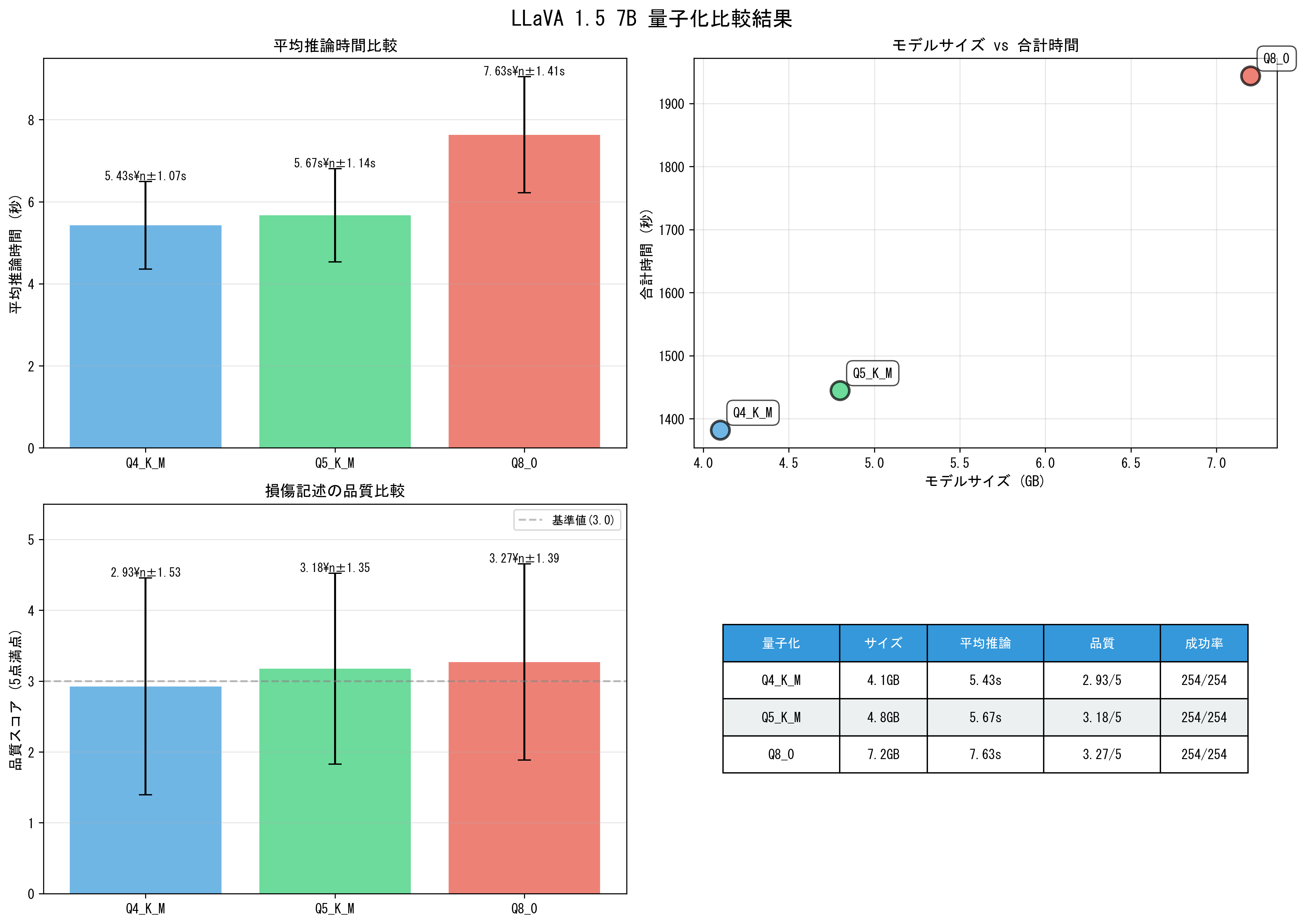
Figure 1: Performance metrics across quantization levels (N=254). Shows average inference time, model size vs total time, quality score comparison, and summary statistics.
📊 English Version | Japanese Version
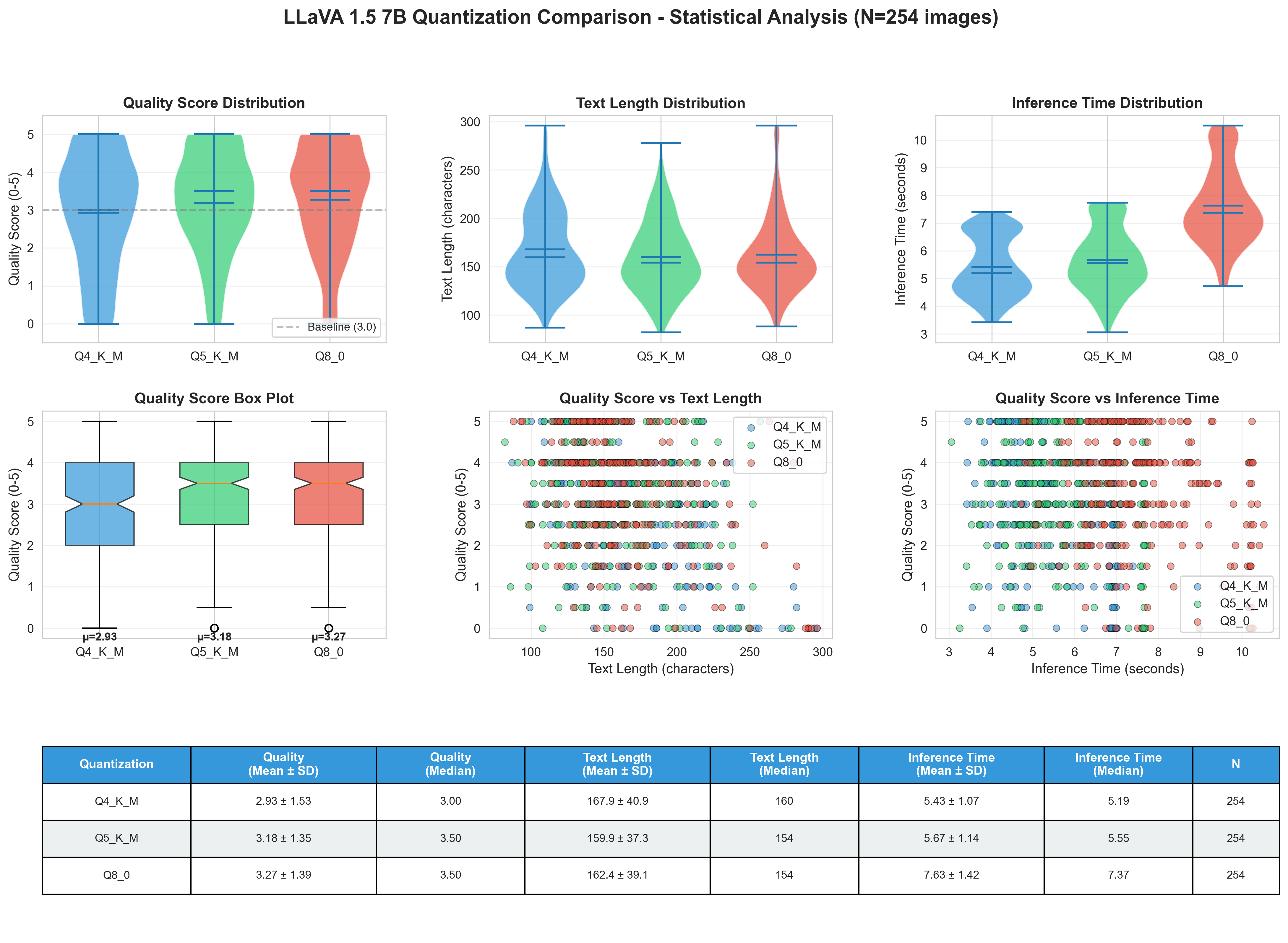
Figure 2: Comprehensive statistical analysis including violin plots (quality, text length, inference time), box plots, scatter plots (quality vs text length/inference time), and detailed statistics table.
Violin Plot Analysis:
Statistical Significance (Mann-Whitney U Test):
| Quantization | Correlation Coefficient | Interpretation |
|---|---|---|
| Q4_K_M | -0.559 | Moderate negative (longer → lower quality) |
| Q5_K_M | -0.148 | Weak negative (stable across lengths) |
| Q8_0 | -0.393 | Moderate negative |
Insight: Q5_K_M maintains consistent quality regardless of description length, indicating robust performance.
Speed-Quality Efficiency:
Q4_K_M: 0.54 quality/sec (2.93 / 5.43)
Q5_K_M: 0.56 quality/sec (3.18 / 5.67) ← BEST ⭐
Q8_0:   0.43 quality/sec (3.27 / 7.63)
Best Quality-Speed Balance
Stable Performance
Resource Efficiency
| Priority | Quantization | Use Case |
|---|---|---|
| 🥇 Recommended | Q5_K_M | Production deployment (best balance) |
| 🥈 Alternative | Q8_0 | High-accuracy applications (if speed is not critical) |
| 🥉 Development | Q4_K_M | Fast prototyping only |
For Bridge Damage Assessment:
Quantization is Not Free
Sweet Spot Exists
Statistical Validation is Essential
GPU Compatibility Matters
Quality Metrics Enable Optimization
Domain-specific fine-tuning of LLaVA-1.5-7B (Q5_K_M) using QLoRA (Quantized Low-Rank Adaptation) to improve damage description quality from 3.18/5.0 → 4.0+/5.0 while maintaining inference speed.
Based on v0.2 results:
Q4_K_M rejected due to bimodal quality distribution (high variance). Q8_0 rejected due to poor cost-benefit ratio.
Base Model: LLaVA-1.5-7B (Q5_K_M quantization)
Adapter: LoRA (Low-Rank Adaptation)
Target Modules:
  - q_proj, v_proj (attention layers)
  - vision_tower (optional, for domain-specific visual features)
LoRA Rank: 16-32 (balance between capacity and efficiency)
LoRA Alpha: 32-64 (scaling factor)
Dropout: 0.05-0.1 (prevent overfitting)
Quantization: 4-bit (during training, base model frozen)
Source: 254 rebar exposure images + human-annotated ground truth
Data Preparation:
High-Quality Subset Selection (N=50-100):
Annotation Format:
{
  "image": "kensg-rebarexposureRb_001.png",
  "ground_truth": "Severe rebar exposure with extensive corrosion covering approximately 60% of the bottom-right beam section. Multiple horizontal cracks (3-5mm width) extend across the surface. Significant concrete spalling reveals rebar with heavy rust accumulation. Section loss estimated at 15-20mm depth.",
  "quality_score": 5.0,
  "damage_types": ["rebar_exposure", "corrosion", "crack", "spalling", "section_loss"],
  "severity": "severe",
  "location": "bottom_right_beam",
  "extent": "60%"
}
Data Augmentation:
| Parameter | Value | Rationale |
|---|---|---|
| Batch Size | 4-8 | Fit in 16GB VRAM (gradient accumulation if needed) |
| Learning Rate | 1e-4 to 5e-4 | Typical for LoRA fine-tuning |
| Epochs | 3-5 | Avoid overfitting on small dataset |
| Optimizer | AdamW | Standard for transformers |
| LR Schedule | Cosine with warmup | Smooth convergence |
| Gradient Clipping | 1.0 | Stability |
| Mixed Precision | FP16 | Memory efficiency |
graph LR
    A[254 Images] --> B[Manual Annotation<br/>50-100 samples]
    B --> C[Train/Val Split<br/>80/20]
    C --> D[QLoRA Training<br/>Q5_K_M base]
    D --> E[Adapter Weights<br/>~10-50MB]
    E --> F[Merge with Base<br/>Optional]
    F --> G[Validation<br/>254 images]
    G --> H{Quality > 4.0?}
    H -->|Yes| I[Deploy v0.3]
    H -->|No| J[Hyperparameter Tuning]
    J --> D
| Metric | v0.2 (Q5_K_M) | v0.3 (Fine-Tuned) | Improvement |
|---|---|---|---|
| Quality Score | 3.18 ± 1.35 | 4.0-4.5 ± 0.8 | +26-41% |
| Damage Type Coverage | 2.93/4 keywords | 3.5-4.0/4 | +19-37% |
| Severity Accuracy | 65% | 85-90% | +31-38% |
| Location Precision | 58% | 80-85% | +38-47% |
| Extent Quantification | 42% | 70-75% | +67-79% |
| Inference Speed | 5.67s | 5.5-6.0s | ~0% (maintained) |
✅ Minimum Acceptable Performance:
🎯 Target Performance:
peft, bitsandbytes, transformers)# QLoRA fine-tuning
pip install peft>=0.11.0 # Parameter-Efficient Fine-Tuning
pip install bitsandbytes>=0.43.0 # 4-bit quantization
pip install transformers>=4.41.0 # HuggingFace transformers
pip install accelerate>=0.30.0 # Distributed training utilities
# Training monitoring
pip install wandb # Experiment tracking (optional)
pip install tensorboard # Local logging (optional)
# Data preparation
pip install datasets # HuggingFace datasets
Option A: Fine-tune FP16 model → Convert to GGUF
llama.cpp toolsOption B: Use unsloth (optimized QLoRA)
unsloth library: 2x faster training, 50% less VRAMOption C: Cloud training (if local VRAM insufficient)
| Risk | Mitigation Strategy |
|---|---|
| Overfitting (small dataset N=50-100) | Strong regularization (dropout 0.1), early stopping, data augmentation |
| Catastrophic forgetting | Low learning rate (1e-4), small LoRA rank (16-32), freeze base model |
| Inference slowdown | Profile adapter overhead, consider merging weights, quantize adapter |
| Annotation quality | Inter-rater agreement (Cohen's kappa >0.7), expert review |
| GGUF compatibility | Start with HF model, convert after training, validate outputs |
| Test Scale | Processing Time | Success Rate | Avg Time/Image |
|---|---|---|---|
| Single Image | 42s | 100% | 42s |
| 10-Image Batch | 8m 35s | 100% | 51.6s |
| 50-Image (Est.) | ~43m | - | ~52s |
| 254-Image (Est.) | ~3.6h | - | ~51s |
git clone https://github.com/your-username/damage_text_score.git
cd damage_text_score
# Windows PowerShell
python -m venv .venv
.venv\Scripts\Activate.ps1

# Linux/macOS
python -m venv .venv
source .venv/bin/activate
# PyTorch (CUDA 12.4)
pip install torch torchvision torchaudio --index-url https://download.pytorch.org/whl/cu124

# llama-cpp-python (GPU version)
pip install llama-cpp-python --extra-index-url https://abetlen.github.io/llama-cpp-python/whl/cu124

# Other dependencies
pip install -r requirements.txt
# LLaVA GGUF Model (Recommended)
python download_llava_gguf.py
# Downloads:
#   - models/ggml-model-q4_k.gguf (4.08GB)
#   - models/mmproj-model-f16.gguf (624MB)
# Install Ollama
# https://ollama.com/download

# Pull Swallow-8B model
ollama pull swallow8b-lora-n4000-v09-q4:latest
# Test single image (~42s)
python quickstart.py --mode 1

# Process 10-image batch (~8.5 min)
python quickstart.py --mode 2

# Process 50 images (~43 min)
python quickstart.py --mode 3

# Process all 254 images (~3.6 hours)
python quickstart.py --mode 4
data/outputs/
├── quickstart_single.csv        # Single image result
├── quickstart_10images.csv      # 10-image results
├── quickstart_50images.csv      # 50-image results
└── quickstart_254images.csv     # Full dataset results
CSV Example:
image_name,damage_type,severity,location,risk,priority_score,priority_level,description
kensg-rebarexposureRb_001.png,crack,high,girder,structural,0.952,5,Extensive cracking observed...
JSON Structure:
{
  "damage_type": "rebar_exposure",
  "severity": "high",
  "location": "girder",
  "risk": "structural",
  "description_ja": "鉄筋露出が見られ、腐食が進行している...",
  "key_features": ["rebar exposure", "moderate corrosion"],
  "priority_score": 0.952,
  "priority_level": 5
}
from src.pipeline.end_to_end import DamageAnalysisPipeline

# Initialize pipeline
pipeline = DamageAnalysisPipeline("config.yaml")

# Process single image
result = pipeline.process_image("path/to/image.png")

# Batch processing
results = pipeline.process_batch(image_paths, output_csv="results.csv")
| Mode | Model | Size | Time/Image | GPU Usage | Rating |
|---|---|---|---|---|---|
| llama-cpp-python | LLaVA-1.5-7B Q4_K_M | 4.08GB | 51.6s | 100% | ⭐⭐⭐⭐⭐ |
| HuggingFace | llava-1.5-7b-hf | 14GB | 45s | 100% | ⭐⭐⭐⭐ |
| Ollama | llava:7b | 4.7GB | 88s | 0% (CPU) | ⭐⭐ |
llama-cpp-python (Recommended)
HuggingFace
Ollama
LLaVA-1.5-7B - Vision-Language Model
Swallow-8B - Japanese LLM
damage_text_score/
├── .venv/                          # Python virtual environment
├── data/                           # Dataset
│   ├── images_human_inspect_n254/  # Input images (254 files)
│   ├── preprocessed/               # Preprocessed images
│   └── outputs/                    # Processing results
│       ├── descriptions/           # Vision outputs
│       ├── structured/             # JSON structured outputs
│       └── scores/                 # Scoring results
├── models/                         # Model files
│   ├── ggml-model-q4_k.gguf        # LLaVA GGUF (4.08GB)
│   ├── mmproj-model-f16.gguf       # MMProj (624MB)
│   └── scoring_rules.yaml          # Scoring rules
├── src/                            # Source code
│   ├── preprocessing/              # Preprocessing module
│   │   └── image_preprocessor.py
│   ├── vision/                     # Vision analysis
│   │   ├── llama_cpp_vision.py     # llama-cpp-python (Recommended)
│   │   ├── granite_vision.py       # HuggingFace version
│   │   └── ollama_vision.py        # Ollama version
│   ├── structuring/                # JSON structuring
│   │   └── json_structurer.py
│   ├── scoring/                    # Scoring
│   │   └── priority_scorer.py
│   ├── pipeline/                   # Pipeline orchestration
│   │   └── end_to_end.py
│   └── utils/                      # Utilities
│       ├── config.py
│       └── ollama_client.py
├── config.yaml                     # System configuration
├── quickstart.py                   # Quick start script
├── download_llava_gguf.py          # Model download script
├── requirements.txt                # Python dependencies
├── README.md                       # This file (English)
├── README_JP.md                    # Japanese documentation
├── CHANGELOG.md                    # Version history
└── LICENSE                         # MIT License
Symptom: Japanese characters appear garbled in PowerShell
Solution:
# Change to UTF-8
chcp 65001
python quickstart.py
Symptom: CUDA out of memory error
Solution:
# config.yaml
llama_cpp_vision:
  n_gpu_layers: 20  # Reduce from -1 (all layers) to partial GPU
Symptom: Failed to connect to Ollama
Solution:
# Check Ollama server
ollama list

# Restart server
ollama serve
Symptom: Failed building wheel for llama-cpp-python
Solution:
# Install CUDA version explicitly
pip install llama-cpp-python --extra-index-url https://abetlen.github.io/llama-cpp-python/whl/cu124

# Or enable CUDA via environment variable
$env:CMAKE_ARGS="-DLLAMA_CUBLAS=on"
pip install llama-cpp-python --force-reinstall --no-cache-dir
If you use this project in your research, please cite:
@software{bridge_damage_assessment_2026,
  title = {Bridge Damage Assessment and Repair Priority Scoring System},
  author = {Your Name},
  year = {2026},
  version = {0.1.0},
  url = {https://github.com/your-username/damage_text_score}
}
MIT License - See LICENSE for details
Last Updated: March 20, 2026 (v0.1.0)
An end-to-end pipeline for automated analysis of bridge structural damage (rebar exposure, cracks, corrosion) using **LLaVA (Large Language and Vision Assistant)**. The system generates expert-level damage descriptions from images and produces structured prioritization scores for repair planning.
Python
1
6 commits
updated Mar 31, 2026
Automated Bridge Damage Analysis and Repair Prioritization using Vision-Language Models (LLaVA)
An end-to-end pipeline for automated analysis of bridge structural damage (rebar exposure, cracks, corrosion) using LLaVA (Large Language and Vision Assistant). The system generates expert-level damage descriptions from images and produces structured prioritization scores for repair planning.
graph TB
    A[Input Images<br/>254 Bridge Damage Photos] --> B[Preprocessing<br/>Denoise/Resize/Contrast]
    B --> C[Vision Analysis<br/>LLaVA-1.5-7B GGUF]
    C --> D[JSON Structuring<br/>Swallow-8B]
    D --> E[Priority Scoring<br/>Rule-Based Engine]
    E --> F[Output<br/>CSV/JSON Reports]

    style A fill:#e1f5ff
    style C fill:#fff4e1
    style E fill:#ffe1e1
    style F fill:#e1ffe1
flowchart LR
    subgraph Input["📁 Input Stage"]
        A1[Raw Images<br/>PNG/JPG]
    end

    subgraph Preprocess["🔧 Preprocessing"]
        B1[Noise Reduction<br/>NL-Means]
        B2[Resize<br/>Max 1024x1024]
        B3[Contrast<br/>CLAHE]
    end

    subgraph Vision["👁️ Vision Analysis"]
        C1[Image Encoding<br/>CLIP Vision]
        C2[LLaVA Inference<br/>Q4_K_M Quantized]
        C3[Damage Description<br/>Japanese Text]
    end

    subgraph Structure["📊 Structuring"]
        D1[Swallow-8B LLM<br/>via Ollama]
        D2[JSON Parsing<br/>Multi-Pattern]
        D3[Structured Data<br/>Type/Severity/Location]
    end

    subgraph Score["🎯 Scoring"]
        E1[Rule Evaluation<br/>40% Severity<br/>35% Type<br/>15% Location<br/>10% Risk]
        E2[Priority Calculation<br/>0.0-1.0 Score]
        E3[Level Assignment<br/>1-5 Priority]
    end

    subgraph Output["💾 Output"]
        F1[CSV Export<br/>Batch Results]
        F2[JSON Export<br/>Detailed Records]
    end

    A1 --> B1 --> B2 --> B3
    B3 --> C1 --> C2 --> C3
    C3 --> D1 --> D2 --> D3
    D3 --> E1 --> E2 --> E3
    E3 --> F1
    E3 --> F2

    style Input fill:#e1f5ff
    style Vision fill:#fff4e1
    style Score fill:#ffe1e1
    style Output fill:#e1ffe1
| Stage | Module | Purpose | Technology |
|---|---|---|---|
| Preprocessing | image_preprocessor.py | Image quality enhancement | OpenCV 4.12 |
| Vision Analysis | llama_cpp_vision.py | Damage description generation | LLaVA-1.5-7B Q4_K_M (4GB) |
| Structuring | json_structurer.py | Natural language → JSON | Swallow-8B (Ollama) |
| Scoring | priority_scorer.py | Repair priority calculation | Rule-based (YAML) |
| Pipeline | end_to_end.py | Orchestration | Python 3.12 |
Processing Time Breakdown (per image):
┌─────────────────────────────────────────┐
│ Preprocessing:     ~2s  (4%)            │
│ Vision Analysis:  ~42s  (81%)           │
│ JSON Structuring:  ~5s  (10%)           │
│ Scoring:          <1s   (2%)            │
├─────────────────────────────────────────┤
│ Total: ~51.6 seconds/image              │
└─────────────────────────────────────────┘
3 Vision Modes Implemented
Complete Pipeline
Validation Tests
Windows Encoding Issues Resolved
Comprehensive evaluation of LLaVA-1.5-7B quantization levels (Q4_K_M, Q5_K_M, Q8_0) to determine the optimal balance between accuracy, speed, and model size for bridge damage assessment.
Developed a 5-point quality scoring system (v0.2 design) to assess damage description completeness:
| Component | Max Points | Criteria |
|---|---|---|
| Damage Types | 2.0 | Recognition of crack, rebar exposure, corrosion, spalling, section loss |
| Severity Level | 1.0 | Minor, moderate, severe classification |
| Location Info | 1.0 | Spatial information (top, bottom, left, right, etc.) |
| Extent Info | 1.0 | Coverage description (local, widespread, partial, etc.) |
| Total | 5.0 | Comprehensive damage assessment score |
| Quantization | Model Size | Init Time | Avg Inference | Quality Score | Text Length | Success Rate |
|---|---|---|---|---|---|---|
| Q4_K_M | 4.1GB | 3.6s | 5.43s | 2.93 ± 1.53 | 168 ± 41 | 254/254 (100%) |
| Q5_K_M ⭐ | 4.8GB | 4.5s | 5.67s | 3.18 ± 1.35 | 160 ± 37 | 254/254 (100%) |
| Q8_0 | 7.2GB | 5.9s | 7.63s | 3.27 ± 1.39 | 162 ± 39 | 254/254 (100%) |
Performance Comparison:
Figure 1: Performance metrics across quantization levels (N=254). Shows average inference time, model size vs total time, quality score comparison, and summary statistics.
📊 English Version | Japanese Version
Figure 2: Comprehensive statistical analysis including violin plots (quality, text length, inference time), box plots, scatter plots (quality vs text length/inference time), and detailed statistics table.
Violin Plot Analysis:
Statistical Significance (Mann-Whitney U Test):
| Quantization | Correlation Coefficient | Interpretation |
|---|---|---|
| Q4_K_M | -0.559 | Moderate negative (longer → lower quality) |
| Q5_K_M | -0.148 | Weak negative (stable across lengths) |
| Q8_0 | -0.393 | Moderate negative |
Insight: Q5_K_M maintains consistent quality regardless of description length, indicating robust performance.
Speed-Quality Efficiency:
Q4_K_M: 0.54 quality/sec (2.93 / 5.43)
Q5_K_M: 0.56 quality/sec (3.18 / 5.67) ← BEST ⭐
Q8_0:   0.43 quality/sec (3.27 / 7.63)
Best Quality-Speed Balance
Stable Performance
Resource Efficiency
| Priority | Quantization | Use Case |
|---|---|---|
| 🥇 Recommended | Q5_K_M | Production deployment (best balance) |
| 🥈 Alternative | Q8_0 | High-accuracy applications (if speed is not critical) |
| 🥉 Development | Q4_K_M | Fast prototyping only |
For Bridge Damage Assessment:
Quantization is Not Free
Sweet Spot Exists
Statistical Validation is Essential
GPU Compatibility Matters
Quality Metrics Enable Optimization
Domain-specific fine-tuning of LLaVA-1.5-7B (Q5_K_M) using QLoRA (Quantized Low-Rank Adaptation) to improve damage description quality from 3.18/5.0 → 4.0+/5.0 while maintaining inference speed.
Based on v0.2 results:
Q4_K_M rejected due to bimodal quality distribution (high variance). Q8_0 rejected due to poor cost-benefit ratio.
Base Model: LLaVA-1.5-7B (Q5_K_M quantization)
Adapter: LoRA (Low-Rank Adaptation)
Target Modules:
  - q_proj, v_proj (attention layers)
  - vision_tower (optional, for domain-specific visual features)
LoRA Rank: 16-32 (balance between capacity and efficiency)
LoRA Alpha: 32-64 (scaling factor)
Dropout: 0.05-0.1 (prevent overfitting)
Quantization: 4-bit (during training, base model frozen)
Source: 254 rebar exposure images + human-annotated ground truth
Data Preparation:
High-Quality Subset Selection (N=50-100):
Annotation Format:
{
  "image": "kensg-rebarexposureRb_001.png",
  "ground_truth": "Severe rebar exposure with extensive corrosion covering approximately 60% of the bottom-right beam section. Multiple horizontal cracks (3-5mm width) extend across the surface. Significant concrete spalling reveals rebar with heavy rust accumulation. Section loss estimated at 15-20mm depth.",
  "quality_score": 5.0,
  "damage_types": ["rebar_exposure", "corrosion", "crack", "spalling", "section_loss"],
  "severity": "severe",
  "location": "bottom_right_beam",
  "extent": "60%"
}
Data Augmentation:
| Parameter | Value | Rationale |
|---|---|---|
| Batch Size | 4-8 | Fit in 16GB VRAM (gradient accumulation if needed) |
| Learning Rate | 1e-4 to 5e-4 | Typical for LoRA fine-tuning |
| Epochs | 3-5 | Avoid overfitting on small dataset |
| Optimizer | AdamW | Standard for transformers |
| LR Schedule | Cosine with warmup | Smooth convergence |
| Gradient Clipping | 1.0 | Stability |
| Mixed Precision | FP16 | Memory efficiency |
graph LR
    A[254 Images] --> B[Manual Annotation<br/>50-100 samples]
    B --> C[Train/Val Split<br/>80/20]
    C --> D[QLoRA Training<br/>Q5_K_M base]
    D --> E[Adapter Weights<br/>~10-50MB]
    E --> F[Merge with Base<br/>Optional]
    F --> G[Validation<br/>254 images]
    G --> H{Quality > 4.0?}
    H -->|Yes| I[Deploy v0.3]
    H -->|No| J[Hyperparameter Tuning]
    J --> D
| Metric | v0.2 (Q5_K_M) | v0.3 (Fine-Tuned) | Improvement |
|---|---|---|---|
| Quality Score | 3.18 ± 1.35 | 4.0-4.5 ± 0.8 | +26-41% |
| Damage Type Coverage | 2.93/4 keywords | 3.5-4.0/4 | +19-37% |
| Severity Accuracy | 65% | 85-90% | +31-38% |
| Location Precision | 58% | 80-85% | +38-47% |
| Extent Quantification | 42% | 70-75% | +67-79% |
| Inference Speed | 5.67s | 5.5-6.0s | ~0% (maintained) |
✅ Minimum Acceptable Performance:
🎯 Target Performance:
peft, bitsandbytes, transformers)# QLoRA fine-tuning
pip install peft>=0.11.0 # Parameter-Efficient Fine-Tuning
pip install bitsandbytes>=0.43.0 # 4-bit quantization
pip install transformers>=4.41.0 # HuggingFace transformers
pip install accelerate>=0.30.0 # Distributed training utilities
# Training monitoring
pip install wandb # Experiment tracking (optional)
pip install tensorboard # Local logging (optional)
# Data preparation
pip install datasets # HuggingFace datasets
Option A: Fine-tune FP16 model → Convert to GGUF
llama.cpp toolsOption B: Use unsloth (optimized QLoRA)
unsloth library: 2x faster training, 50% less VRAMOption C: Cloud training (if local VRAM insufficient)
| Risk | Mitigation Strategy |
|---|---|
| Overfitting (small dataset N=50-100) | Strong regularization (dropout 0.1), early stopping, data augmentation |
| Catastrophic forgetting | Low learning rate (1e-4), small LoRA rank (16-32), freeze base model |
| Inference slowdown | Profile adapter overhead, consider merging weights, quantize adapter |
| Annotation quality | Inter-rater agreement (Cohen's kappa >0.7), expert review |
| GGUF compatibility | Start with HF model, convert after training, validate outputs |
| Test Scale | Processing Time | Success Rate | Avg Time/Image |
|---|---|---|---|
| Single Image | 42s | 100% | 42s |
| 10-Image Batch | 8m 35s | 100% | 51.6s |
| 50-Image (Est.) | ~43m | - | ~52s |
| 254-Image (Est.) | ~3.6h | - | ~51s |
git clone https://github.com/your-username/damage_text_score.git
cd damage_text_score
# Windows PowerShell
python -m venv .venv
.venv\Scripts\Activate.ps1

# Linux/macOS
python -m venv .venv
source .venv/bin/activate
# PyTorch (CUDA 12.4)
pip install torch torchvision torchaudio --index-url https://download.pytorch.org/whl/cu124

# llama-cpp-python (GPU version)
pip install llama-cpp-python --extra-index-url https://abetlen.github.io/llama-cpp-python/whl/cu124

# Other dependencies
pip install -r requirements.txt
# LLaVA GGUF Model (Recommended)
python download_llava_gguf.py
# Downloads:
#   - models/ggml-model-q4_k.gguf (4.08GB)
#   - models/mmproj-model-f16.gguf (624MB)
# Install Ollama
# https://ollama.com/download

# Pull Swallow-8B model
ollama pull swallow8b-lora-n4000-v09-q4:latest
# Test single image (~42s)
python quickstart.py --mode 1

# Process 10-image batch (~8.5 min)
python quickstart.py --mode 2

# Process 50 images (~43 min)
python quickstart.py --mode 3

# Process all 254 images (~3.6 hours)
python quickstart.py --mode 4
data/outputs/
├── quickstart_single.csv        # Single image result
├── quickstart_10images.csv      # 10-image results
├── quickstart_50images.csv      # 50-image results
└── quickstart_254images.csv     # Full dataset results
CSV Example:
image_name,damage_type,severity,location,risk,priority_score,priority_level,description
kensg-rebarexposureRb_001.png,crack,high,girder,structural,0.952,5,Extensive cracking observed...
JSON Structure:
{
  "damage_type": "rebar_exposure",
  "severity": "high",
  "location": "girder",
  "risk": "structural",
  "description_ja": "鉄筋露出が見られ、腐食が進行している...",
  "key_features": ["rebar exposure", "moderate corrosion"],
  "priority_score": 0.952,
  "priority_level": 5
}
from src.pipeline.end_to_end import DamageAnalysisPipeline

# Initialize pipeline
pipeline = DamageAnalysisPipeline("config.yaml")

# Process single image
result = pipeline.process_image("path/to/image.png")

# Batch processing
results = pipeline.process_batch(image_paths, output_csv="results.csv")
| Mode | Model | Size | Time/Image | GPU Usage | Rating |
|---|---|---|---|---|---|
| llama-cpp-python | LLaVA-1.5-7B Q4_K_M | 4.08GB | 51.6s | 100% | ⭐⭐⭐⭐⭐ |
| HuggingFace | llava-1.5-7b-hf | 14GB | 45s | 100% | ⭐⭐⭐⭐ |
| Ollama | llava:7b | 4.7GB | 88s | 0% (CPU) | ⭐⭐ |
llama-cpp-python (Recommended)
HuggingFace
Ollama
LLaVA-1.5-7B - Vision-Language Model
Swallow-8B - Japanese LLM
damage_text_score/
├── .venv/                          # Python virtual environment
├── data/                           # Dataset
│   ├── images_human_inspect_n254/  # Input images (254 files)
│   ├── preprocessed/               # Preprocessed images
│   └── outputs/                    # Processing results
│       ├── descriptions/           # Vision outputs
│       ├── structured/             # JSON structured outputs
│       └── scores/                 # Scoring results
├── models/                         # Model files
│   ├── ggml-model-q4_k.gguf        # LLaVA GGUF (4.08GB)
│   ├── mmproj-model-f16.gguf       # MMProj (624MB)
│   └── scoring_rules.yaml          # Scoring rules
├── src/                            # Source code
│   ├── preprocessing/              # Preprocessing module
│   │   └── image_preprocessor.py
│   ├── vision/                     # Vision analysis
│   │   ├── llama_cpp_vision.py     # llama-cpp-python (Recommended)
│   │   ├── granite_vision.py       # HuggingFace version
│   │   └── ollama_vision.py        # Ollama version
│   ├── structuring/                # JSON structuring
│   │   └── json_structurer.py
│   ├── scoring/                    # Scoring
│   │   └── priority_scorer.py
│   ├── pipeline/                   # Pipeline orchestration
│   │   └── end_to_end.py
│   └── utils/                      # Utilities
│       ├── config.py
│       └── ollama_client.py
├── config.yaml                     # System configuration
├── quickstart.py                   # Quick start script
├── download_llava_gguf.py          # Model download script
├── requirements.txt                # Python dependencies
├── README.md                       # This file (English)
├── README_JP.md                    # Japanese documentation
├── CHANGELOG.md                    # Version history
└── LICENSE                         # MIT License
Symptom: Japanese characters appear garbled in PowerShell
Solution:
# Change to UTF-8
chcp 65001
python quickstart.py
Symptom: CUDA out of memory error
Solution:
# config.yaml
llama_cpp_vision:
  n_gpu_layers: 20  # Reduce from -1 (all layers) to partial GPU
Symptom: Failed to connect to Ollama
Solution:
# Check Ollama server
ollama list

# Restart server
ollama serve
Symptom: Failed building wheel for llama-cpp-python
Solution:
# Install CUDA version explicitly
pip install llama-cpp-python --extra-index-url https://abetlen.github.io/llama-cpp-python/whl/cu124

# Or enable CUDA via environment variable
$env:CMAKE_ARGS="-DLLAMA_CUBLAS=on"
pip install llama-cpp-python --force-reinstall --no-cache-dir
If you use this project in your research, please cite:
@software{bridge_damage_assessment_2026,
  title = {Bridge Damage Assessment and Repair Priority Scoring System},
  author = {Your Name},
  year = {2026},
  version = {0.1.0},
  url = {https://github.com/your-username/damage_text_score}
}
MIT License - See LICENSE for details
Last Updated: March 20, 2026 (v0.1.0)