
README
TileLang LSP (tlsp)
A Language Server Protocol (LSP) implementation for TileLang, providing inlay hints for buffer shapes/dtypes/scopes and inferred layouts, hover details, and precise diagnostics.
Features
- Inlay hints at end of line, five kinds:
alloc—X = T.alloc_*(...)lines: shape/dtype/scope, plus the inferredLayout/Fragmentonce LayoutInference has runparam— kernel signature parameters:⟨(M, K) float16 @global⟩op—T.copy/T.gemm/ ... lines: short summary of the layouts involvedloop—T.Pipelined/T.Parallellines:⟨pipelined, stages=3⟩, parallel loop layoutkernel—with T.Kernel(...)line: grid dims and thread count
- Hover on a hint line shows the full layout/fragment text.
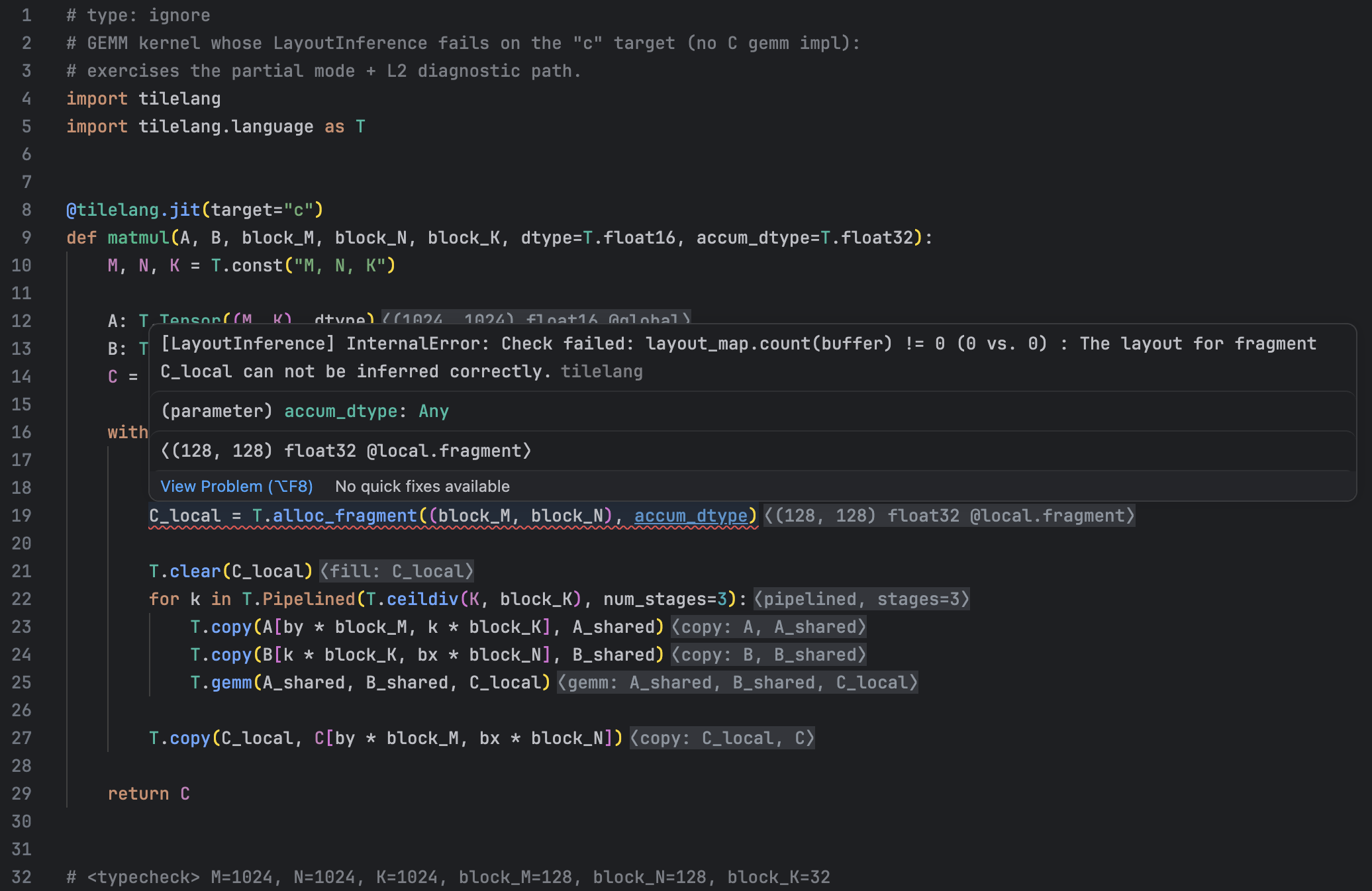
- Diagnostics at three precision levels (see below).
- Works while your kernel does not compile: a four-level degradation chain still produces as many hints as possible (see "How it works").
Results are cached in memory (LRU) and on disk under ~/.cache/tilelang_lsp/
(override with TLSP_CACHE_DIR), keyed by file content hash + target + tilelang version.
Installation
- Python 3.8+ with tilelang importable (for full analysis; without it tlsp still serves static hints).
- Install the server package:
pip install -e . - Install the VS Code extension (see below).
Usage
VS Code
cd tilelang_lsp_extension
npm install
vsce package   # produces tilelang-type-decorator-*.vsix
Install the .vsix in VS Code. The extension launches python -m tlsp with the
configured interpreter. To develop/debug the extension: npm run compile, then open
src/extension.ts and press F5.
Settings (all under tilelang.*, changes restart the server automatically):
| Setting | Default | Meaning |
|---|---|---|
tilelang.pythonPath | "python" | Python interpreter for the server (must be able to import tlsp; tilelang optional but recommended) |
tilelang.enableInlayHints | true | Master switch for the server |
tilelang.serverArgs | [] | Extra CLI args appended to python -m tlsp (e.g. ["--target", "c"] to change the default analysis target) |
tilelang.serverEnv | {"TILELANG_ENABLE_DATA_RACE_CHECK": "1"} | Extra environment variables for the server process (the analyzer subprocess inherits them). Default enables data-race diagnostics; remove that entry to opt out. Custom entries replace the whole default object — keep the race-check key if you still want those diagnostics. PYTHONPATH is managed by the extension |
Neovim
vim.lsp.config['tlsp'] = {
  cmd = { 'python', '-m', 'tlsp' },  -- add '--target', 'c' on CUDA-free machines
  filetypes = { 'python' },
  root_markers = { 'pyproject.toml', '.git' },
}
vim.lsp.config['tlsp'].capabilities = vim.lsp.protocol.make_client_capabilities()
vim.lsp.enable('tlsp')
Outside VS Code, set TILELANG_ENABLE_DATA_RACE_CHECK=1 in the server process
environment to enable data-race diagnostics (the VS Code extension enables it by
default via tilelang.serverEnv).
The <typecheck> directive
tlsp needs concrete kernel arguments to elaborate TIR. It resolves them in this order:
- A comment directive nearest to the kernel definition:
Values are parsed with# <typecheck> M=1024, N=1024, K=1024, block_M=128, kernel=matmulast.literal_eval; dtype strings like"float16"work.kernel=selects which kernel to analyze (default: first@tilelang.jitfound). - Kwargs harvested from
<name>.compile(...)/ direct kernel calls in the file. - Function signature defaults.
The analysis target comes from the code:
# <typecheck> target=c wins over target= at a <kernel>.compile(...) call
site, which wins over a literal @tilelang.jit(target=...) decorator, which in
turn wins over the server default (--target, cuda if unset).
Missing required parameters produce a diagnostic asking for a <typecheck> directive.
Symbolic variables declared via T.const("M, N") may stay unbound.
CLI debugging
python -m tlsp.analyzer --once path/to/kernel.py --target c
prints the full analysis result (schema v2) as a single JSON line.
How it works
On every open/save, the analyzer runs a four-level degradation chain and reports its mode:
| Mode | Condition | What you get |
|---|---|---|
full | get_tir OK + frontend passes up to LayoutInference OK | All hints, alloc hints include inferred layouts |
partial | get_tir OK, some pass failed | Hints collected from the last good IR state + an L2 diagnostic at the exact line (parsed from the --> file:line:col marker in the pass error) |
tracer | IR spans unavailable (old tilelang, or TILELANG_ENABLE_IR_SPAN=0) | Hints from a monkeypatch call tracer over T.* entries; layouts joined by buffer name when passes succeed |
static | get_tir failed (import error, NameError, half-written code) | Pure-AST hints (shape/dtype/scope) + shape-mismatch warnings + an L1 diagnostic from traceback remapping |
If the analyzer subprocess itself crashes or tilelang is missing entirely, the server falls back to static mode with a file-level (L3) diagnostic explaining why.
While you type (before saving), hints come from the same static analysis running in-process — so they stay responsive and correct for unparsable intermediate states.
Development
python -m unittest discover tests -v # unit tests (no tilelang needed)
Integration tests need a python that can import tilelang — a plain
pip install tilelang>=0.1.13 environment is enough (they skip cleanly without
one):
TLSP_TEST_PYTHON=/path/to/venv/bin/python python -m unittest tests.test_integration -v
# using a source checkout instead? also point at it:
# TLSP_TEST_TILELANG=/path/to/tilelang/repo
Demo
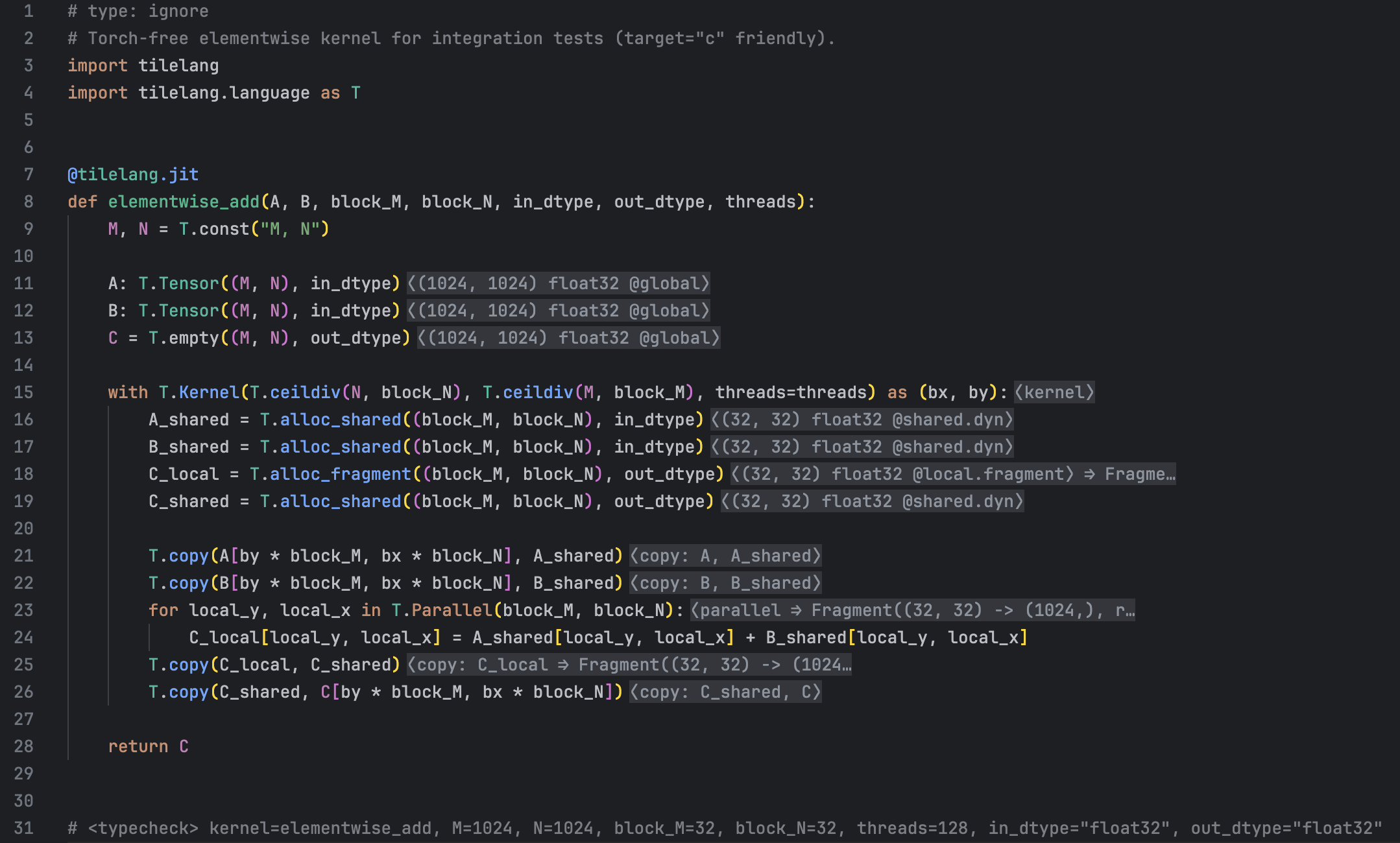
Diagnostics
Significant stargazers

1,475 followers · starred Aug 2026

145 followers · starred Aug 2026

56 followers · starred Aug 2026
Similar repos


Languages
Python
94.8%
TypeScript
4.8%
README
TileLang LSP (tlsp)
A Language Server Protocol (LSP) implementation for TileLang, providing inlay hints for buffer shapes/dtypes/scopes and inferred layouts, hover details, and precise diagnostics.
Features
- Inlay hints at end of line, five kinds:
alloc—X = T.alloc_*(...)lines: shape/dtype/scope, plus the inferredLayout/Fragmentonce LayoutInference has runparam— kernel signature parameters:⟨(M, K) float16 @global⟩op—T.copy/T.gemm/ ... lines: short summary of the layouts involvedloop—T.Pipelined/T.Parallellines:⟨pipelined, stages=3⟩, parallel loop layoutkernel—with T.Kernel(...)line: grid dims and thread count
- Hover on a hint line shows the full layout/fragment text.
- Diagnostics at three precision levels (see below).
- Works while your kernel does not compile: a four-level degradation chain still produces as many hints as possible (see "How it works").
Results are cached in memory (LRU) and on disk under ~/.cache/tilelang_lsp/
(override with TLSP_CACHE_DIR), keyed by file content hash + target + tilelang version.
Installation
- Python 3.8+ with tilelang importable (for full analysis; without it tlsp still serves static hints).
- Install the server package:
pip install -e . - Install the VS Code extension (see below).
Usage
VS Code
cd tilelang_lsp_extension
npm install
vsce package   # produces tilelang-type-decorator-*.vsix
Install the .vsix in VS Code. The extension launches python -m tlsp with the
configured interpreter. To develop/debug the extension: npm run compile, then open
src/extension.ts and press F5.
Settings (all under tilelang.*, changes restart the server automatically):
| Setting | Default | Meaning |
|---|---|---|
tilelang.pythonPath | "python" | Python interpreter for the server (must be able to import tlsp; tilelang optional but recommended) |
tilelang.enableInlayHints | true | Master switch for the server |
tilelang.serverArgs | [] | Extra CLI args appended to python -m tlsp (e.g. ["--target", "c"] to change the default analysis target) |
tilelang.serverEnv | {"TILELANG_ENABLE_DATA_RACE_CHECK": "1"} | Extra environment variables for the server process (the analyzer subprocess inherits them). Default enables data-race diagnostics; remove that entry to opt out. Custom entries replace the whole default object — keep the race-check key if you still want those diagnostics. PYTHONPATH is managed by the extension |
Neovim
vim.lsp.config['tlsp'] = {
  cmd = { 'python', '-m', 'tlsp' },  -- add '--target', 'c' on CUDA-free machines
  filetypes = { 'python' },
  root_markers = { 'pyproject.toml', '.git' },
}
vim.lsp.config['tlsp'].capabilities = vim.lsp.protocol.make_client_capabilities()
vim.lsp.enable('tlsp')
Outside VS Code, set TILELANG_ENABLE_DATA_RACE_CHECK=1 in the server process
environment to enable data-race diagnostics (the VS Code extension enables it by
default via tilelang.serverEnv).
The <typecheck> directive
tlsp needs concrete kernel arguments to elaborate TIR. It resolves them in this order:
- A comment directive nearest to the kernel definition:
Values are parsed with# <typecheck> M=1024, N=1024, K=1024, block_M=128, kernel=matmulast.literal_eval; dtype strings like"float16"work.kernel=selects which kernel to analyze (default: first@tilelang.jitfound). - Kwargs harvested from
<name>.compile(...)/ direct kernel calls in the file. - Function signature defaults.
The analysis target comes from the code:
# <typecheck> target=c wins over target= at a <kernel>.compile(...) call
site, which wins over a literal @tilelang.jit(target=...) decorator, which in
turn wins over the server default (--target, cuda if unset).
Missing required parameters produce a diagnostic asking for a <typecheck> directive.
Symbolic variables declared via T.const("M, N") may stay unbound.
CLI debugging
python -m tlsp.analyzer --once path/to/kernel.py --target c
prints the full analysis result (schema v2) as a single JSON line.
How it works
On every open/save, the analyzer runs a four-level degradation chain and reports its mode:
| Mode | Condition | What you get |
|---|---|---|
full | get_tir OK + frontend passes up to LayoutInference OK | All hints, alloc hints include inferred layouts |
partial | get_tir OK, some pass failed | Hints collected from the last good IR state + an L2 diagnostic at the exact line (parsed from the --> file:line:col marker in the pass error) |
tracer | IR spans unavailable (old tilelang, or TILELANG_ENABLE_IR_SPAN=0) | Hints from a monkeypatch call tracer over T.* entries; layouts joined by buffer name when passes succeed |
static | get_tir failed (import error, NameError, half-written code) | Pure-AST hints (shape/dtype/scope) + shape-mismatch warnings + an L1 diagnostic from traceback remapping |
If the analyzer subprocess itself crashes or tilelang is missing entirely, the server falls back to static mode with a file-level (L3) diagnostic explaining why.
While you type (before saving), hints come from the same static analysis running in-process — so they stay responsive and correct for unparsable intermediate states.
Development
python -m unittest discover tests -v # unit tests (no tilelang needed)
Integration tests need a python that can import tilelang — a plain
pip install tilelang>=0.1.13 environment is enough (they skip cleanly without
one):
TLSP_TEST_PYTHON=/path/to/venv/bin/python python -m unittest tests.test_integration -v
# using a source checkout instead? also point at it:
# TLSP_TEST_TILELANG=/path/to/tilelang/repo
Demo
Diagnostics
Similar repos
Significant stargazers
1,475 followers · starred Aug 2026
145 followers · starred Aug 2026
56 followers · starred Aug 2026
Languages
Python
94.8%
TypeScript
4.8%