
a curated list of the role of small models in the LLM era
Python
113
51 commits
updated Sep 23, 2024
README
The Role of Small Models




This work is ongoing, and we welcome any comments or suggestions.
Please feel free to reach out if you find we have overlooked any relevant papers.
What is the Role of Small Models in the LLM Era: A Survey
Lihu Chen1 Gaël Varoquaux2
1 Imperial College London, UK 2 Soda, Inria Saclay, France
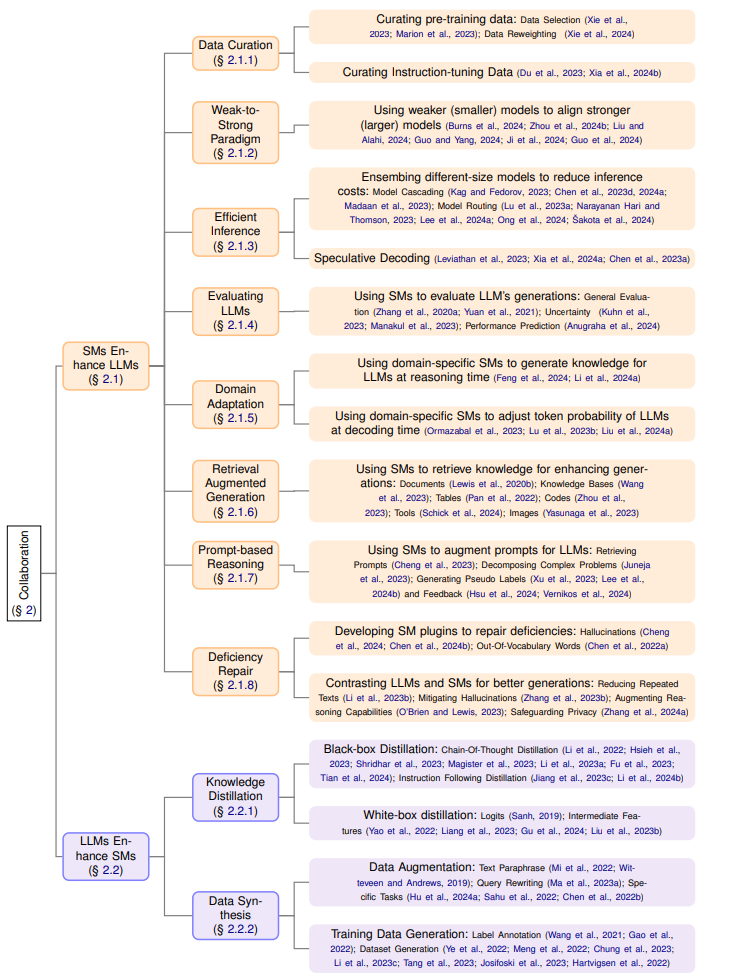
Content List
- Collaboration
- Competition
Collaboration
SMs Enhance LLMs
Data Curation
Curating pre-training data
| Title | Topic | Venue | Code |
|---|---|---|---|
| Data selection for language models via importance resampling | Data Selection |

|
 |
| When Less is More: Investigating Data Pruning for Pretraining LLMs at Scale | Data Selection |

| |
| CCNet: Extracting High Quality Monolingual Datasets from Web Crawl Data | Data Selection |

|
|
| QuRating: Selecting High-Quality Data for Training Language Models | Data Selection |

|
|
| DoReMi: Optimizing Data Mixtures Speeds Up Language Model Pretraining | Data Reweighting |
|
|
Curating Instruction-tuning Data
| Title | Topic | Venue | Code |
|---|---|---|---|
| MoDS: Model-oriented Data Selection for Instruction Tuning | Data Selection |
|
|
| LESS: Selecting Influential Data for Targeted Instruction Tuning | Data Selection |
|
|
| What Makes Good Data for Alignment? A Comprehensive Study of Automatic Data Selection in Instruction Tuning | Data Selection |

|
|
Weak-to-Strong Paradigm
Using weaker (smaller) models to align stronger (larger) models
| Title | Topic | Venue | Code |
|---|---|---|---|
| Weak-to-Strong Generalization: Eliciting Strong Capabilities With Weak Supervision | Weak-to-Strong |
|
|
| Weak-to-Strong Search: Align Large Language Models via Searching over Small Language Models | Weak-to-Strong |

|
|
| Co-Supervised Learning: Improving Weak-to-Strong Generalization with Hierarchical Mixture of Experts | Weak-to-Strong |
|
|
| Improving Weak-to-Strong Generalization with Reliability-Aware Alignment | Weak-to-Strong |
|
|
| Aligner: Efficient Alignment by Learning to Correct | Weak-to-Strong |
|
|
| Vision Superalignment: Weak-to-Strong Generalization for Vision Foundation Models | Weak-to-Strong |
|
|
| Theoretical Analysis of Weak-to-Strong Generalization | Weak-to-Strong |
|
Efficient Inference
Ensembling different-size models to reduce inference costs
| Title | Topic | Venue | Code |
|---|---|---|---|
| Efficient Edge Inference by Selective Query | Model Cascading |

|
|
| FrugalGPT: How to Use Large Language Models While Reducing Cost and Improving Performance | Model Cascading |
| |
| Data Shunt: Collaboration of Small and Large Models for Lower Costs and Better Performance | Model Cascading |

|
|
| AutoMix: Automatically Mixing Language Models | Model Cascading |
|
|
| FrugalML: How to use ML Prediction APIs more accurately and cheaply | Model Cascading |

|
|
| Model Cascading: Towards Jointly Improving Efficiency and Accuracy of NLP Systems | Model Cascading |

| |
| Routing to the Expert: Efficient Reward-guided Ensemble of Large Language Models | Model Routing |

| |
| Tryage: Real-time, intelligent Routing of User Prompts to Large Language Models | Model Routing |
| |
| OrchestraLLM: Efficient Orchestration of Language Models for Dialogue State Tracking | Model Routing |
| |
| RouteLLM: Learning to Route LLMs with Preference Data | Model Routing |
|
|
| Fly-Swat or Cannon? Cost-Effective Language Model Choice via Meta-Modeling | Model Routing |

|
|
| Hybrid LLM: Cost-Efficient and Quality-Aware Query Routing | Model Routing |
|
|
| LLM-BLENDER: Ensembling Large Language Models with Pairwise Ranking and Generative Fusion | Model Routing |

|
|
| RouterBench: A Benchmark for Multi-LLM Routing System | Model Routing |
|
|
| Large Language Model Routing with Benchmark Datasets | Model Routing |
|
Speculative Decoding
| Title | Topic | Venue | Code |
|---|---|---|---|
| Fast Inference from Transformers via Speculative Decoding | Speculative Decoding |

|
|
| Unlocking Efficiency in Large Language Model Inference: A Comprehensive Survey of Speculative Decoding | Speculative Decoding |

|
|
| Accelerating Large Language Model Decoding with Speculative Sampling | Speculative Decoding |
|
|
Evaluating LLMs
Using SMs to evaluate LLM's generations
| Title | Topic | Venue | Code |
|---|---|---|---|
| BERTScore: Evaluating Text Generation with BERT | General Evaluation |

|
|
| BARTScore: Evaluating Generated Text as Text Generation | General Evaluation |

|
|
| Semantic Uncertainty: Linguistic Invariances for Uncertainty Estimation in Natural Language Generation | Uncertainty |
|
|
| Selfcheckgpt: Zero-resource black-box hallucination detection for generative large language models | Uncertainty |

|
|
| ProxyLM: Predicting Language Model Performance on Multilingual Tasks via Proxy Models | Performance Prediction |
|
|
Domain Adaptation
Using domain-specific SMs to adjust token probability of LLMs at decoding time
| Title | Topic | Venue | Code |
|---|---|---|---|
| CombLM: Adapting Black-Box Language Models through Small Fine-Tuned Models | White-box Domain Adaptation |
| |
| Inference-Time Policy Adapters (IPA): Tailoring Extreme-Scale LMs without Fine-tuning | White-box Domain Adaptation |
|
|
| Tuning Language Models by Proxy | White-box Domain Adaptation |

|
|
Using domain-specific SMs to generate knowledge for LLMs at reasoning time
| Title | Topic | Venue | Code |
|---|---|---|---|
| Knowledge Card: Filling LLMs' Knowledge Gaps with Plug-in Specialized Language Models | Black-box Domain Adaptation |
|
|
| BLADE: Enhancing Black-box Large Language Models with Small Domain-Specific Models | Black-box Domain Adaptation |
|
Retrieval Augmented Generation
Using SMs to retrieve knowledge for enhancing generations:
| Title | Topic | Venue | Code |
|---|---|---|---|
| Retrieval-Augmented Generation for Knowledge-Intensive NLP Tasks | Documents |
| |
| KnowledGPT: Enhancing Large Language Models with Retrieval and Storage Access on Knowledge Bases | Knowledge Bases |
| |
| End-to-End Table Question Answering via Retrieval-Augmented Generation | Tables |

| |
| DocPrompting: Generating Code by Retrieving the Docs | Codes |
|
|
| Toolformer: Language Models Can Teach Themselves to Use Tools | Tools |
|
|
| Retrieval-Augmented Multimodal Language Modeling | Images |
|
Prompt-based Reasoning
Using SMs to augment prompts for LLMs
| Title | Topic | Venue | Code |
|---|---|---|---|
| UPRISE: Universal Prompt Retrieval for Improving Zero-Shot Evaluation | Retrieving Prompts |
|
|
| Small Language Models Fine-tuned to Coordinate Larger Language Models improve Complex Reasoning | Decomposing Complex Problems |
|
|
| Small Models are Valuable Plug-ins for Large Language Models | Generating Pseudo Labels |
|
|
| Can Small Language Models Help Large Language Models Reason Better?: LM-Guided Chain-of-Thought | Generating Pseudo Labels |

| |
| CaLM: Contrasting Large and Small Language Models to Verify Grounded Generation | Generating Feedback |
| |
| Small Language Models Improve Giants by Rewriting Their Outputs | Generating Feedback |

|
|
Deficiency Repair
Developing SM plugins to repair deficiencies:
| Title | Topic | Venue | Code |
|---|---|---|---|
| Small Agent Can Also Rock! Empowering Small Language Models as Hallucination Detector | Hallucinations |
|
|
| Reconfidencing LLMs from the Grouping Loss Perspective | Hallucinations |
| |
| Imputing Out-of-Vocabulary Embeddings with LOVE Makes LanguageModels Robust with Little Cost | Out-Of-Vocabulary Words |

|
|
Contrasting LLMs and SMs for better generations:
| Title | Topic | Venue | Code |
|---|---|---|---|
| Contrastive Decoding: Open-ended Text Generation as Optimization | Reducing Repeated Texts |
|
|
| Alleviating Hallucinations of Large Language Models through Induced Hallucinations | Mitigating Hallucinations |
| |
| Contrastive Decoding Improves Reasoning in Large Language Models | Augmenting Reasoning Capabilities |
| |
| CoGenesis: A Framework Collaborating Large and Small Language Models for Secure Context-Aware Instruction Following | Safeguarding Privacy |
|
LLMs Enhance SMs
Knowledge Distillation
Black-box Distillation:
| Title | Topic | Venue | Code |
|---|---|---|---|
| Explanations from Large Language Models Make Small Reasoners Better | Chain-Of-Thought Distillation |
| |
| Distilling Step-by-Step! Outperforming Larger Language Models with Less Training Data and Smaller Model Sizes | Chain-Of-Thought Distillation |
|
|
| Distilling Reasoning Capabilities into Smaller Language Models | Chain-Of-Thought Distillation |
|
|
| Teaching Small Language Models to Reason | Chain-Of-Thought Distillation |
| |
| Symbolic Chain-of-Thought Distillation: Small Models Can Also "Think" Step-by-Step | Chain-Of-Thought Distillation |
|
|
| Specializing Smaller Language Models towards Multi-Step Reasoning | Chain-Of-Thought Distillation |
| |
| TinyLLM: Learning a Small Student from Multiple Large Language Models | Chain-Of-Thought Distillation |
| |
| Lion: Adversarial Distillation of Proprietary Large Language Models | Instruction Following Distillation |
|
|
| Selective Reflection-Tuning: Student-Selected Data Recycling for LLM Instruction-Tuning | Instruction Following Distillation |
|
|
White-box Distillation:
| Title | Topic | Venue | Code |
|---|---|---|---|
| DistilBERT, a distilled version of BERT: smaller, faster, cheaper and lighter | Logits |

| |
| ZeroQuant: Efficient and Affordable Post-Training Quantization for Large-Scale Transformers | Intermediate Features |

|
|
| Less is More: Task-aware Layer-wise Distillation for Language Model Compression | Intermediate Features |
|
|
| MiniLLM: Knowledge Distillation of Large Language Models | Intermediate Features |
|
|
| LLM-QAT: Data-Free Quantization Aware Training for Large Language Models | Intermediate Features |
|
Data Synthesis
Data Augmentation:
| Title | Topic | Venue | Code |
|---|---|---|---|
| Improving data augmentation for low resource speech-to-text translation with diverse paraphrasing | Text Paraphrase |

| |
| Paraphrasing with Large Language Models | Text Paraphrase |

| |
| Query Rewriting for Retrieval-Augmented Large Language Models | Query Rewriting |
|
|
| LLMvsSmall Model? Large Language Model Based Text Augmentation Enhanced Personality Detection Model | Specific Tasks |

| |
| Data Augmentation for Intent Classification with Off-the-shelf Large Language Models | Specific Tasks |
|
|
| Weakly Supervised Data Augmentation Through Prompting for Dialogue Understanding | Specific Tasks |

|
Training Data Generation:
| Title | Topic | Venue | Code |
|---|---|---|---|
| Want To Reduce Labeling Cost? GPT-3 Can Help | Label Annotation |

| |
| Self-Guided Noise-Free Data Generation for Efficient Zero-Shot Learning | Label Annotation |
| |
| ZeroGen: Efficient Zero-shot Learning via Dataset Generation | Dataset Generation |
|
|
| Generating Training Data with Language Models: Towards Zero-Shot Language Understanding | Dataset Generation |
|
|
| Increasing Diversity While Maintaining Accuracy: Text Data Generation with Large Language Models and Human Interventions | Dataset Generation |
| |
| Synthetic Data Generation with Large Language Models for Text Classification: Potential and Limitations | Dataset Generation |
| |
| Does Synthetic Data Generation of LLMs Help Clinical Text Mining? | Dataset Generation |
| |
| Exploiting Asymmetry for Synthetic Training Data Generation: SynthIE and the Case of Information Extraction | Dataset Generation |
|
|
| ToxiGen: A Large-Scale Machine-Generated Dataset for Adversarial and Implicit Hate Speech Detection | Dataset Generation |
|
|
Competition
Citation
@misc{chen2024rolesmallmodelsllm,
      title={What is the Role of Small Models in the LLM Era: A Survey},
      author={Lihu Chen and Gaël Varoquaux},
      year={2024},
      eprint={2409.06857},
      archivePrefix={arXiv},
      primaryClass={cs.CL},
      url={https://arxiv.org/abs/2409.06857},
}
Similar repos


Languages
Python
100.0%
a curated list of the role of small models in the LLM era
Python
113
51 commits
updated Sep 23, 2024
README
The Role of Small Models
This work is ongoing, and we welcome any comments or suggestions.
Please feel free to reach out if you find we have overlooked any relevant papers.
What is the Role of Small Models in the LLM Era: A Survey
Lihu Chen1 Gaël Varoquaux2
1 Imperial College London, UK 2 Soda, Inria Saclay, France
Content List
- Collaboration
- Competition
Collaboration
SMs Enhance LLMs
Data Curation
Curating pre-training data
| Title | Topic | Venue | Code |
|---|---|---|---|
| Data selection for language models via importance resampling | Data Selection |
|
|
| When Less is More: Investigating Data Pruning for Pretraining LLMs at Scale | Data Selection |
| |
| CCNet: Extracting High Quality Monolingual Datasets from Web Crawl Data | Data Selection |
|
|
| QuRating: Selecting High-Quality Data for Training Language Models | Data Selection |
|
|
| DoReMi: Optimizing Data Mixtures Speeds Up Language Model Pretraining | Data Reweighting |
|
|
Curating Instruction-tuning Data
| Title | Topic | Venue | Code |
|---|---|---|---|
| MoDS: Model-oriented Data Selection for Instruction Tuning | Data Selection |
|
|
| LESS: Selecting Influential Data for Targeted Instruction Tuning | Data Selection |
|
|
| What Makes Good Data for Alignment? A Comprehensive Study of Automatic Data Selection in Instruction Tuning | Data Selection |
|
|
Weak-to-Strong Paradigm
Using weaker (smaller) models to align stronger (larger) models
| Title | Topic | Venue | Code |
|---|---|---|---|
| Weak-to-Strong Generalization: Eliciting Strong Capabilities With Weak Supervision | Weak-to-Strong |
|
|
| Weak-to-Strong Search: Align Large Language Models via Searching over Small Language Models | Weak-to-Strong |
|
|
| Co-Supervised Learning: Improving Weak-to-Strong Generalization with Hierarchical Mixture of Experts | Weak-to-Strong |
|
|
| Improving Weak-to-Strong Generalization with Reliability-Aware Alignment | Weak-to-Strong |
|
|
| Aligner: Efficient Alignment by Learning to Correct | Weak-to-Strong |
|
|
| Vision Superalignment: Weak-to-Strong Generalization for Vision Foundation Models | Weak-to-Strong |
|
|
| Theoretical Analysis of Weak-to-Strong Generalization | Weak-to-Strong |
|
Efficient Inference
Ensembling different-size models to reduce inference costs
| Title | Topic | Venue | Code |
|---|---|---|---|
| Efficient Edge Inference by Selective Query | Model Cascading |
|
|
| FrugalGPT: How to Use Large Language Models While Reducing Cost and Improving Performance | Model Cascading |
| |
| Data Shunt: Collaboration of Small and Large Models for Lower Costs and Better Performance | Model Cascading |
|
|
| AutoMix: Automatically Mixing Language Models | Model Cascading |
|
|
| FrugalML: How to use ML Prediction APIs more accurately and cheaply | Model Cascading |
|
|
| Model Cascading: Towards Jointly Improving Efficiency and Accuracy of NLP Systems | Model Cascading |
| |
| Routing to the Expert: Efficient Reward-guided Ensemble of Large Language Models | Model Routing |
| |
| Tryage: Real-time, intelligent Routing of User Prompts to Large Language Models | Model Routing |
| |
| OrchestraLLM: Efficient Orchestration of Language Models for Dialogue State Tracking | Model Routing |
| |
| RouteLLM: Learning to Route LLMs with Preference Data | Model Routing |
|
|
| Fly-Swat or Cannon? Cost-Effective Language Model Choice via Meta-Modeling | Model Routing |
|
|
| Hybrid LLM: Cost-Efficient and Quality-Aware Query Routing | Model Routing |
|
|
| LLM-BLENDER: Ensembling Large Language Models with Pairwise Ranking and Generative Fusion | Model Routing |
|
|
| RouterBench: A Benchmark for Multi-LLM Routing System | Model Routing |
|
|
| Large Language Model Routing with Benchmark Datasets | Model Routing |
|
Speculative Decoding
| Title | Topic | Venue | Code |
|---|---|---|---|
| Fast Inference from Transformers via Speculative Decoding | Speculative Decoding |
|
|
| Unlocking Efficiency in Large Language Model Inference: A Comprehensive Survey of Speculative Decoding | Speculative Decoding |
|
|
| Accelerating Large Language Model Decoding with Speculative Sampling | Speculative Decoding |
|
|
Evaluating LLMs
Using SMs to evaluate LLM's generations
| Title | Topic | Venue | Code |
|---|---|---|---|
| BERTScore: Evaluating Text Generation with BERT | General Evaluation |
|
|
| BARTScore: Evaluating Generated Text as Text Generation | General Evaluation |
|
|
| Semantic Uncertainty: Linguistic Invariances for Uncertainty Estimation in Natural Language Generation | Uncertainty |
|
|
| Selfcheckgpt: Zero-resource black-box hallucination detection for generative large language models | Uncertainty |
|
|
| ProxyLM: Predicting Language Model Performance on Multilingual Tasks via Proxy Models | Performance Prediction |
|
|
Domain Adaptation
Using domain-specific SMs to adjust token probability of LLMs at decoding time
| Title | Topic | Venue | Code |
|---|---|---|---|
| CombLM: Adapting Black-Box Language Models through Small Fine-Tuned Models | White-box Domain Adaptation |
| |
| Inference-Time Policy Adapters (IPA): Tailoring Extreme-Scale LMs without Fine-tuning | White-box Domain Adaptation |
|
|
| Tuning Language Models by Proxy | White-box Domain Adaptation |
|
|
Using domain-specific SMs to generate knowledge for LLMs at reasoning time
| Title | Topic | Venue | Code |
|---|---|---|---|
| Knowledge Card: Filling LLMs' Knowledge Gaps with Plug-in Specialized Language Models | Black-box Domain Adaptation |
|
|
| BLADE: Enhancing Black-box Large Language Models with Small Domain-Specific Models | Black-box Domain Adaptation |
|
Retrieval Augmented Generation
Using SMs to retrieve knowledge for enhancing generations:
| Title | Topic | Venue | Code |
|---|---|---|---|
| Retrieval-Augmented Generation for Knowledge-Intensive NLP Tasks | Documents |
| |
| KnowledGPT: Enhancing Large Language Models with Retrieval and Storage Access on Knowledge Bases | Knowledge Bases |
| |
| End-to-End Table Question Answering via Retrieval-Augmented Generation | Tables |
| |
| DocPrompting: Generating Code by Retrieving the Docs | Codes |
|
|
| Toolformer: Language Models Can Teach Themselves to Use Tools | Tools |
|
|
| Retrieval-Augmented Multimodal Language Modeling | Images |
|
Prompt-based Reasoning
Using SMs to augment prompts for LLMs
| Title | Topic | Venue | Code |
|---|---|---|---|
| UPRISE: Universal Prompt Retrieval for Improving Zero-Shot Evaluation | Retrieving Prompts |
|
|
| Small Language Models Fine-tuned to Coordinate Larger Language Models improve Complex Reasoning | Decomposing Complex Problems |
|
|
| Small Models are Valuable Plug-ins for Large Language Models | Generating Pseudo Labels |
|
|
| Can Small Language Models Help Large Language Models Reason Better?: LM-Guided Chain-of-Thought | Generating Pseudo Labels |
| |
| CaLM: Contrasting Large and Small Language Models to Verify Grounded Generation | Generating Feedback |
| |
| Small Language Models Improve Giants by Rewriting Their Outputs | Generating Feedback |
|
|
Deficiency Repair
Developing SM plugins to repair deficiencies:
| Title | Topic | Venue | Code |
|---|---|---|---|
| Small Agent Can Also Rock! Empowering Small Language Models as Hallucination Detector | Hallucinations |
|
|
| Reconfidencing LLMs from the Grouping Loss Perspective | Hallucinations |
| |
| Imputing Out-of-Vocabulary Embeddings with LOVE Makes LanguageModels Robust with Little Cost | Out-Of-Vocabulary Words |
|
|
Contrasting LLMs and SMs for better generations:
| Title | Topic | Venue | Code |
|---|---|---|---|
| Contrastive Decoding: Open-ended Text Generation as Optimization | Reducing Repeated Texts |
|
|
| Alleviating Hallucinations of Large Language Models through Induced Hallucinations | Mitigating Hallucinations |
| |
| Contrastive Decoding Improves Reasoning in Large Language Models | Augmenting Reasoning Capabilities |
| |
| CoGenesis: A Framework Collaborating Large and Small Language Models for Secure Context-Aware Instruction Following | Safeguarding Privacy |
|
LLMs Enhance SMs
Knowledge Distillation
Black-box Distillation:
| Title | Topic | Venue | Code |
|---|---|---|---|
| Explanations from Large Language Models Make Small Reasoners Better | Chain-Of-Thought Distillation |
| |
| Distilling Step-by-Step! Outperforming Larger Language Models with Less Training Data and Smaller Model Sizes | Chain-Of-Thought Distillation |
|
|
| Distilling Reasoning Capabilities into Smaller Language Models | Chain-Of-Thought Distillation |
|
|
| Teaching Small Language Models to Reason | Chain-Of-Thought Distillation |
| |
| Symbolic Chain-of-Thought Distillation: Small Models Can Also "Think" Step-by-Step | Chain-Of-Thought Distillation |
|
|
| Specializing Smaller Language Models towards Multi-Step Reasoning | Chain-Of-Thought Distillation |
| |
| TinyLLM: Learning a Small Student from Multiple Large Language Models | Chain-Of-Thought Distillation |
| |
| Lion: Adversarial Distillation of Proprietary Large Language Models | Instruction Following Distillation |
|
|
| Selective Reflection-Tuning: Student-Selected Data Recycling for LLM Instruction-Tuning | Instruction Following Distillation |
|
|
White-box Distillation:
| Title | Topic | Venue | Code |
|---|---|---|---|
| DistilBERT, a distilled version of BERT: smaller, faster, cheaper and lighter | Logits |
| |
| ZeroQuant: Efficient and Affordable Post-Training Quantization for Large-Scale Transformers | Intermediate Features |
|
|
| Less is More: Task-aware Layer-wise Distillation for Language Model Compression | Intermediate Features |
|
|
| MiniLLM: Knowledge Distillation of Large Language Models | Intermediate Features |
|
|
| LLM-QAT: Data-Free Quantization Aware Training for Large Language Models | Intermediate Features |
|
Data Synthesis
Data Augmentation:
| Title | Topic | Venue | Code |
|---|---|---|---|
| Improving data augmentation for low resource speech-to-text translation with diverse paraphrasing | Text Paraphrase |
| |
| Paraphrasing with Large Language Models | Text Paraphrase |
| |
| Query Rewriting for Retrieval-Augmented Large Language Models | Query Rewriting |
|
|
| LLMvsSmall Model? Large Language Model Based Text Augmentation Enhanced Personality Detection Model | Specific Tasks |
| |
| Data Augmentation for Intent Classification with Off-the-shelf Large Language Models | Specific Tasks |
|
|
| Weakly Supervised Data Augmentation Through Prompting for Dialogue Understanding | Specific Tasks |
|
Training Data Generation:
| Title | Topic | Venue | Code |
|---|---|---|---|
| Want To Reduce Labeling Cost? GPT-3 Can Help | Label Annotation |
| |
| Self-Guided Noise-Free Data Generation for Efficient Zero-Shot Learning | Label Annotation |
| |
| ZeroGen: Efficient Zero-shot Learning via Dataset Generation | Dataset Generation |
|
|
| Generating Training Data with Language Models: Towards Zero-Shot Language Understanding | Dataset Generation |
|
|
| Increasing Diversity While Maintaining Accuracy: Text Data Generation with Large Language Models and Human Interventions | Dataset Generation |
| |
| Synthetic Data Generation with Large Language Models for Text Classification: Potential and Limitations | Dataset Generation |
| |
| Does Synthetic Data Generation of LLMs Help Clinical Text Mining? | Dataset Generation |
| |
| Exploiting Asymmetry for Synthetic Training Data Generation: SynthIE and the Case of Information Extraction | Dataset Generation |
|
|
| ToxiGen: A Large-Scale Machine-Generated Dataset for Adversarial and Implicit Hate Speech Detection | Dataset Generation |
|
|
Competition
Citation
@misc{chen2024rolesmallmodelsllm,
      title={What is the Role of Small Models in the LLM Era: A Survey},
      author={Lihu Chen and Gaël Varoquaux},
      year={2024},
      eprint={2409.06857},
      archivePrefix={arXiv},
      primaryClass={cs.CL},
      url={https://arxiv.org/abs/2409.06857},
}
Similar repos
Languages
Python
100.0%