Codes accompanying the paper "Toward Guidance-Free AR Visual Generation via Condition Contrastive Alignment"
See the codeICLR 2025 Oral Presentation
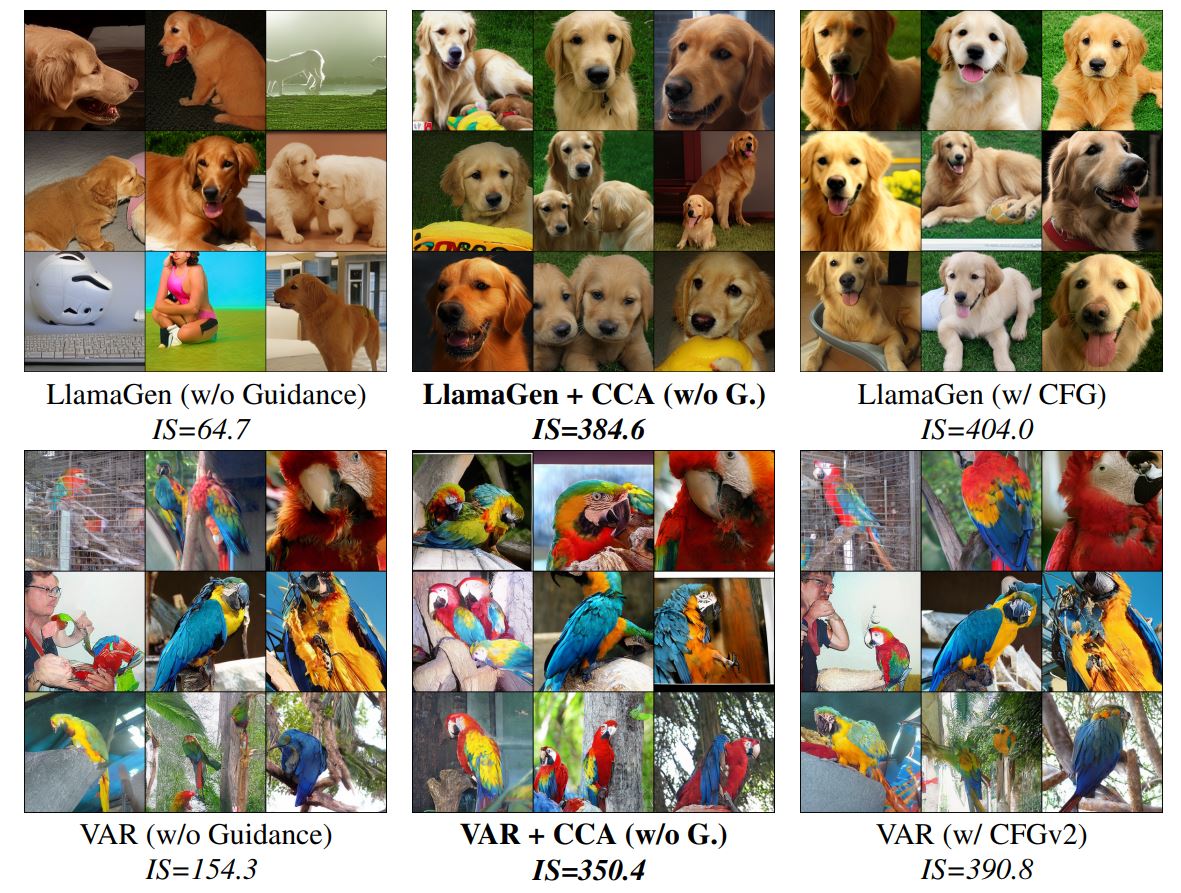
This repo contains model weights and training/sampling PyTorch codes used in
Toward Guidance-Free AR Visual Generation via Condition Contrastive Alignment
Huayu Chen, Hang Su, Peize Sun, Jun Zhu
Tsinghua, HKU
(TL;DR) We propose CCA as a finetuning technique for AR visual models so that they can generate high-quality images without CFG, cutting sampling costs by half. CCA and CFG has the same theoretical foundations and thus similar features, though CCA is inspired from LLM alignment instead of guided sampling.
Features of CCA:
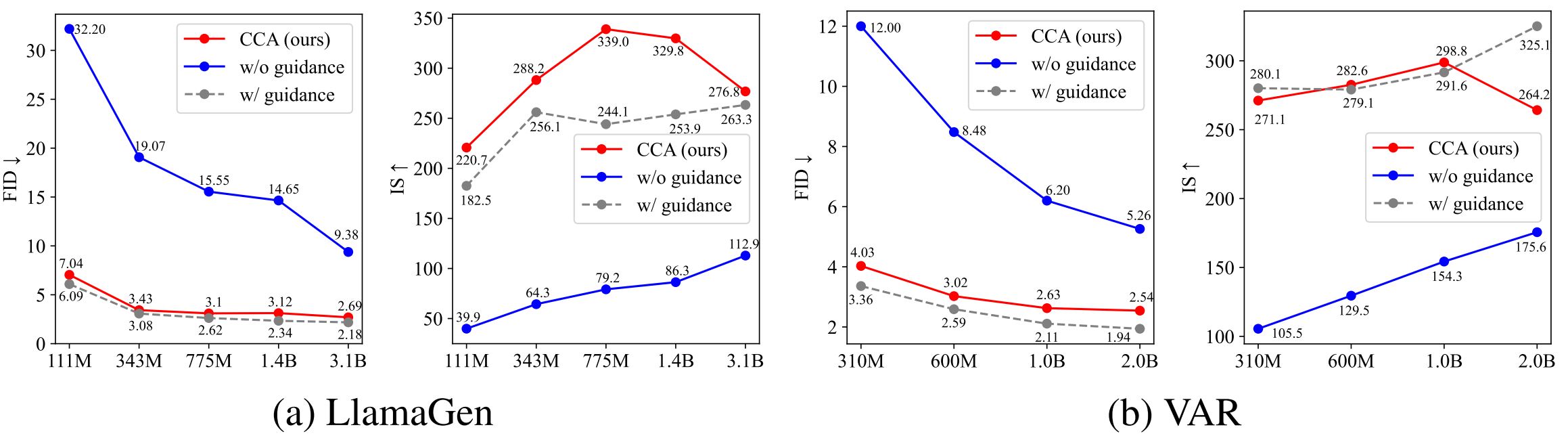
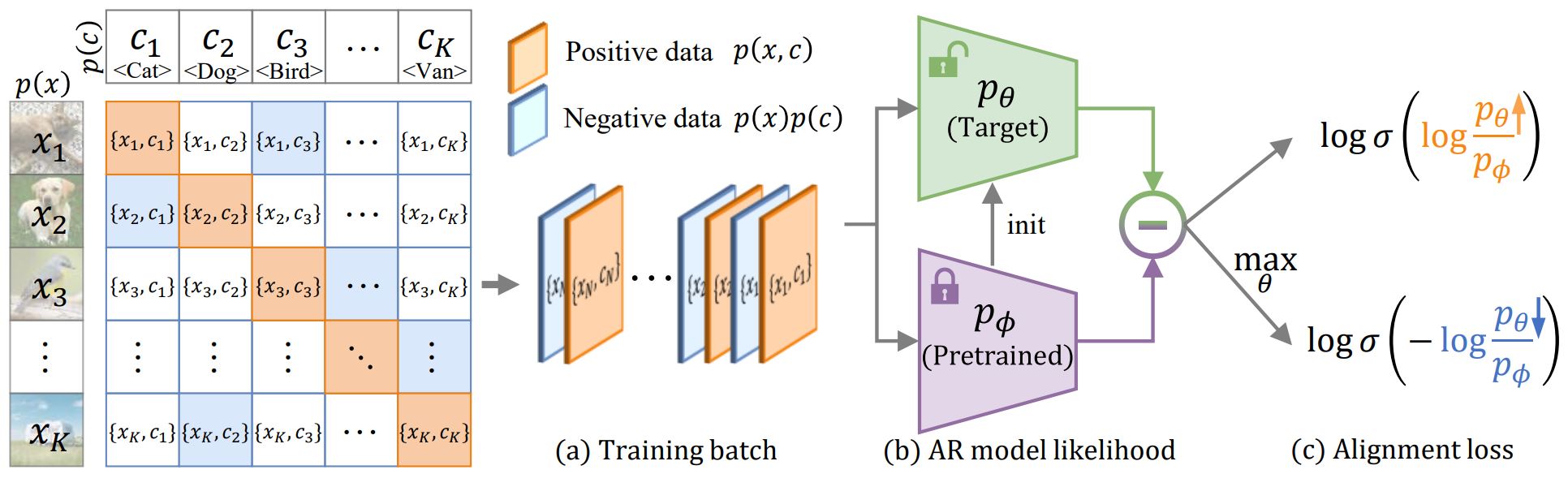
CCA only finetunes conditional AR visual models. Weights for pretrained VAR and LlamaGen models, as well as tokenizers, are publicly accessible in their respective repos.
If you are only interested in evaluating our CCA-finetuned models, please checkout the released ckpts below.
| Base model | reso. | #params | FID (w/o CFG) | HF weights🤗 |
|---|---|---|---|---|
| VAR-d16+CCA | 256 | 310M | 4.03 | var_d16.pth |
| VAR-d20+CCA | 256 | 600M | 3.02 | var_d20.pth |
| VAR-d24+CCA | 256 | 1.0B | 2.63 | var_d24.pth |
| VAR-d30+CCA | 256 | 2.0B | 2.54 | var_d30.pth |
| All |
| model | reso. | #params | FID (w/o CFG) | HF weights🤗 |
|---|---|---|---|---|
| LlamaGen-B+CCA | 384 | 111M | 7.04 | c2i_B_384.pt |
| LlamaGen-L+CCA | 384 | 343M | 3.43 | c2i_L_384.pt |
| LlamaGen-XL+CCA | 384 | 775M | 3.10 | c2i_XL_384.pt |
| LlamaGen-XXL+CCA | 384 | 1.4B | 3.12 | c2i_XXL_384.pt |
| LlamaGen-3B+CCA | 384 | 3.0B | 2.69 | c2i_3B_384.pt |
| All |
Before proceed, please download the ImageNet dataset and pretrained VAR or LlamaGen models as well their respective tokenizers.
To train VAR-{d16, d20, d24, d30, d36-s} on ImageNet 256x256, you can run the following command:
# d16, 256x256
torchrun --nproc_per_node=8 --nnodes=1 --node_rank=0 --master_addr="127.0.0.1" VAR_finetune.py \
  --depth=16 --bs=256 --ep=1 --tblr=2e-5 --fp16=1 --alng=1e-3 --wpe=0.1 \
  --loss_type="CCA" --beta=0.02 --lambda_=50.0 --ac=4 --exp_name="default" --dpr_ratio=0.0 --uncond_ratio=0.1 \
  --ref_ckpt="/path/to/var/var_d16.pth" --data_path="/path/to/imagenet"

# d20, 256x256
torchrun --nproc_per_node=8 --nnodes=1 --node_rank=0 --master_addr="127.0.0.1" VAR_finetune.py \
  --depth=20 --bs=256 --ep=1 --tblr=2e-5 --fp16=1 --alng=1e-3 --wpe=0.1 \
  --loss_type="CCA" --beta=0.02 --lambda_=50.0 --ac=8 --exp_name="default" --uncond_ratio=0.1 \
  --ref_ckpt="/path/to/var/var_d20.pth" --data_path="/path/to/imagenet"

# d24, 256x256
torchrun --nproc_per_node=8 --nnodes=1 --node_rank=0 --master_addr="127.0.0.1" VAR_finetune.py \
  --depth=24 --bs=256 --ep=1 --tblr=2e-5 --fp16=1 --alng=1e-4 --wpe=0.01 \
  --loss_type="CCA" --beta=0.02 --lambda_=100.0 --ac=8 --exp_name="default" --uncond_ratio=0.1 \
  --ref_ckpt="/path/to/var/var_d24.pth" --data_path="/path/to/imagenet"

# d30, 256x256
torchrun --nproc_per_node=8 --nnodes=1 --node_rank=0 --master_addr="127.0.0.1" VAR_finetune.py \
  --depth=30 --bs=256 --ep=1 --tblr=2e-5 --fp16=1 --alng=1e-5 --wpe=0.01 --twde=0.08 \
  --loss_type="CCA" --beta=0.02 --lambda_=1000.0 --ac=16 --exp_name="default" --uncond_ratio=0.1 \
  --ref_ckpt="/path/to/var/var_d30.pth" --data_path="/path/to/imagenet"
A folder named local_output will be created in the base dir (or VAR dir) to save the checkpoints and logs.
LlamaGen trains models on latent data instead of raw image data. Before starting training, you should first generate image latents from imagenet dataset and store them in a local directory. Refer to ./LlamaGen/GETTING_STARTED.md for details.
Then run the following command
# LlamaGen B/L/XL, 384x384
torchrun --nproc_per_node=8 --nnodes=1 --node_rank=0 --master_addr="127.0.0.1" LlamaGen_finetune.py \
    --global-batch-size 256 --gradient-accumulation-step 16 --epochs=1 --ckpt-every=5000 \
    --lr=1e-5 --loss_type="CCA" --expid "default" \
    --lambda_=1000.0/300.0/1000.0 --beta=0.02 --uncond_ratio=0.1 --keep_dropout \
    --ref_ckpt="/path/to/LlamaGen/c2i_B_384.pt/c2i_L_384.pt/c2i_XL_384.pt" \
    --code-path="/path/to/imagenet384_train_code_c2i_flip_ten_crop/" \
    --image-size=384 --gpt-model="GPT-B/GPT-L/GPT-XL"

# LlamaGen XXL/3B, 384x384
torchrun --nproc_per_node=8 --nnodes=1 --node_rank=0 --master_addr="127.0.0.1" LlamaGen_finetune_fsdp.py \
    --global-batch-size 256 --gradient-accumulation-step 16 --epochs=1 --ckpt-every=5000 \
    --lr=1e-5 --loss_type="CCA" --expid "default" \
    --lambda_=1000.0/500.0 --beta=0.02 --uncond_ratio=0.1 --keep_dropout \
    --ref_ckpt="/path/to/LlamaGen/c2i_XXL_384.pt/c2i_3B_384.pt" \
    --code-path="/path/to/imagenet384_train_code_c2i_flip_ten_crop/" \
    --image-size=384 --gpt-model="GPT-XXL/GPT-3B"
Before evaluation, you should first generate 50K image samples and store them in an npz file.
python VAR_sample.py --cfg=0.0 --ckpt_path="/path/to/var/var_d20.pth" --vae_ckpt="./vae_ch160v4096z32.pth" --depth 20
torchrun --nnodes=1 --nproc_per_node=8 --node_rank=0 --master_port=12445 LLamaGen_sample_ddp.py --vq-ckpt="path/to/LlamaGen/vq_ds16_c2i.pt" --ckpt_path="/path/to/LlamaGen/c2i_XL_384.pt" --gpt-model="GPT-XL" --image-size=384 --image-size-eval=256 --per-proc-batch-size=48 --cfg-scale=1.0 --num-fid-samples=50000
Note that for LlamaGen guidance scale $s=1$ means guidance-free, while for VAR it is $s=0$ due to a minor difference in their paper's definition.
We use the standard OPENAI evaluation metric to calculate FID and IS. Please refer to ./LlamaGen/evaluations/c2i for evaluation code.
If you find our project helpful, please cite
@article{chen2024toward,
  title={Toward Guidance-Free AR Visual Generation via Condition Contrastive Alignment},
  author={Chen, Huayu and Su, Hang and Sun, Peize and Zhu, Jun},
  journal={arXiv preprint arXiv:2410.09347},
  year={2024}
}
597 followers · starred Oct 2024
Codes accompanying the paper "Toward Guidance-Free AR Visual Generation via Condition Contrastive Alignment"
See the codeICLR 2025 Oral Presentation
This repo contains model weights and training/sampling PyTorch codes used in
Toward Guidance-Free AR Visual Generation via Condition Contrastive Alignment
Huayu Chen, Hang Su, Peize Sun, Jun Zhu
Tsinghua, HKU
(TL;DR) We propose CCA as a finetuning technique for AR visual models so that they can generate high-quality images without CFG, cutting sampling costs by half. CCA and CFG has the same theoretical foundations and thus similar features, though CCA is inspired from LLM alignment instead of guided sampling.
Features of CCA:
CCA only finetunes conditional AR visual models. Weights for pretrained VAR and LlamaGen models, as well as tokenizers, are publicly accessible in their respective repos.
If you are only interested in evaluating our CCA-finetuned models, please checkout the released ckpts below.
| Base model | reso. | #params | FID (w/o CFG) | HF weights🤗 |
|---|---|---|---|---|
| VAR-d16+CCA | 256 | 310M | 4.03 | var_d16.pth |
| VAR-d20+CCA | 256 | 600M | 3.02 | var_d20.pth |
| VAR-d24+CCA | 256 | 1.0B | 2.63 | var_d24.pth |
| VAR-d30+CCA | 256 | 2.0B | 2.54 | var_d30.pth |
| All |
| model | reso. | #params | FID (w/o CFG) | HF weights🤗 |
|---|---|---|---|---|
| LlamaGen-B+CCA | 384 | 111M | 7.04 | c2i_B_384.pt |
| LlamaGen-L+CCA | 384 | 343M | 3.43 | c2i_L_384.pt |
| LlamaGen-XL+CCA | 384 | 775M | 3.10 | c2i_XL_384.pt |
| LlamaGen-XXL+CCA | 384 | 1.4B | 3.12 | c2i_XXL_384.pt |
| LlamaGen-3B+CCA | 384 | 3.0B | 2.69 | c2i_3B_384.pt |
| All |
Before proceed, please download the ImageNet dataset and pretrained VAR or LlamaGen models as well their respective tokenizers.
To train VAR-{d16, d20, d24, d30, d36-s} on ImageNet 256x256, you can run the following command:
# d16, 256x256
torchrun --nproc_per_node=8 --nnodes=1 --node_rank=0 --master_addr="127.0.0.1" VAR_finetune.py \
  --depth=16 --bs=256 --ep=1 --tblr=2e-5 --fp16=1 --alng=1e-3 --wpe=0.1 \
  --loss_type="CCA" --beta=0.02 --lambda_=50.0 --ac=4 --exp_name="default" --dpr_ratio=0.0 --uncond_ratio=0.1 \
  --ref_ckpt="/path/to/var/var_d16.pth" --data_path="/path/to/imagenet"

# d20, 256x256
torchrun --nproc_per_node=8 --nnodes=1 --node_rank=0 --master_addr="127.0.0.1" VAR_finetune.py \
  --depth=20 --bs=256 --ep=1 --tblr=2e-5 --fp16=1 --alng=1e-3 --wpe=0.1 \
  --loss_type="CCA" --beta=0.02 --lambda_=50.0 --ac=8 --exp_name="default" --uncond_ratio=0.1 \
  --ref_ckpt="/path/to/var/var_d20.pth" --data_path="/path/to/imagenet"

# d24, 256x256
torchrun --nproc_per_node=8 --nnodes=1 --node_rank=0 --master_addr="127.0.0.1" VAR_finetune.py \
  --depth=24 --bs=256 --ep=1 --tblr=2e-5 --fp16=1 --alng=1e-4 --wpe=0.01 \
  --loss_type="CCA" --beta=0.02 --lambda_=100.0 --ac=8 --exp_name="default" --uncond_ratio=0.1 \
  --ref_ckpt="/path/to/var/var_d24.pth" --data_path="/path/to/imagenet"

# d30, 256x256
torchrun --nproc_per_node=8 --nnodes=1 --node_rank=0 --master_addr="127.0.0.1" VAR_finetune.py \
  --depth=30 --bs=256 --ep=1 --tblr=2e-5 --fp16=1 --alng=1e-5 --wpe=0.01 --twde=0.08 \
  --loss_type="CCA" --beta=0.02 --lambda_=1000.0 --ac=16 --exp_name="default" --uncond_ratio=0.1 \
  --ref_ckpt="/path/to/var/var_d30.pth" --data_path="/path/to/imagenet"
A folder named local_output will be created in the base dir (or VAR dir) to save the checkpoints and logs.
LlamaGen trains models on latent data instead of raw image data. Before starting training, you should first generate image latents from imagenet dataset and store them in a local directory. Refer to ./LlamaGen/GETTING_STARTED.md for details.
Then run the following command
# LlamaGen B/L/XL, 384x384
torchrun --nproc_per_node=8 --nnodes=1 --node_rank=0 --master_addr="127.0.0.1" LlamaGen_finetune.py \
    --global-batch-size 256 --gradient-accumulation-step 16 --epochs=1 --ckpt-every=5000 \
    --lr=1e-5 --loss_type="CCA" --expid "default" \
    --lambda_=1000.0/300.0/1000.0 --beta=0.02 --uncond_ratio=0.1 --keep_dropout \
    --ref_ckpt="/path/to/LlamaGen/c2i_B_384.pt/c2i_L_384.pt/c2i_XL_384.pt" \
    --code-path="/path/to/imagenet384_train_code_c2i_flip_ten_crop/" \
    --image-size=384 --gpt-model="GPT-B/GPT-L/GPT-XL"

# LlamaGen XXL/3B, 384x384
torchrun --nproc_per_node=8 --nnodes=1 --node_rank=0 --master_addr="127.0.0.1" LlamaGen_finetune_fsdp.py \
    --global-batch-size 256 --gradient-accumulation-step 16 --epochs=1 --ckpt-every=5000 \
    --lr=1e-5 --loss_type="CCA" --expid "default" \
    --lambda_=1000.0/500.0 --beta=0.02 --uncond_ratio=0.1 --keep_dropout \
    --ref_ckpt="/path/to/LlamaGen/c2i_XXL_384.pt/c2i_3B_384.pt" \
    --code-path="/path/to/imagenet384_train_code_c2i_flip_ten_crop/" \
    --image-size=384 --gpt-model="GPT-XXL/GPT-3B"
Before evaluation, you should first generate 50K image samples and store them in an npz file.
python VAR_sample.py --cfg=0.0 --ckpt_path="/path/to/var/var_d20.pth" --vae_ckpt="./vae_ch160v4096z32.pth" --depth 20
torchrun --nnodes=1 --nproc_per_node=8 --node_rank=0 --master_port=12445 LLamaGen_sample_ddp.py --vq-ckpt="path/to/LlamaGen/vq_ds16_c2i.pt" --ckpt_path="/path/to/LlamaGen/c2i_XL_384.pt" --gpt-model="GPT-XL" --image-size=384 --image-size-eval=256 --per-proc-batch-size=48 --cfg-scale=1.0 --num-fid-samples=50000
Note that for LlamaGen guidance scale $s=1$ means guidance-free, while for VAR it is $s=0$ due to a minor difference in their paper's definition.
We use the standard OPENAI evaluation metric to calculate FID and IS. Please refer to ./LlamaGen/evaluations/c2i for evaluation code.
If you find our project helpful, please cite
@article{chen2024toward,
  title={Toward Guidance-Free AR Visual Generation via Condition Contrastive Alignment},
  author={Chen, Huayu and Su, Hang and Sun, Peize and Zhu, Jun},
  journal={arXiv preprint arXiv:2410.09347},
  year={2024}
}
597 followers · starred Oct 2024



