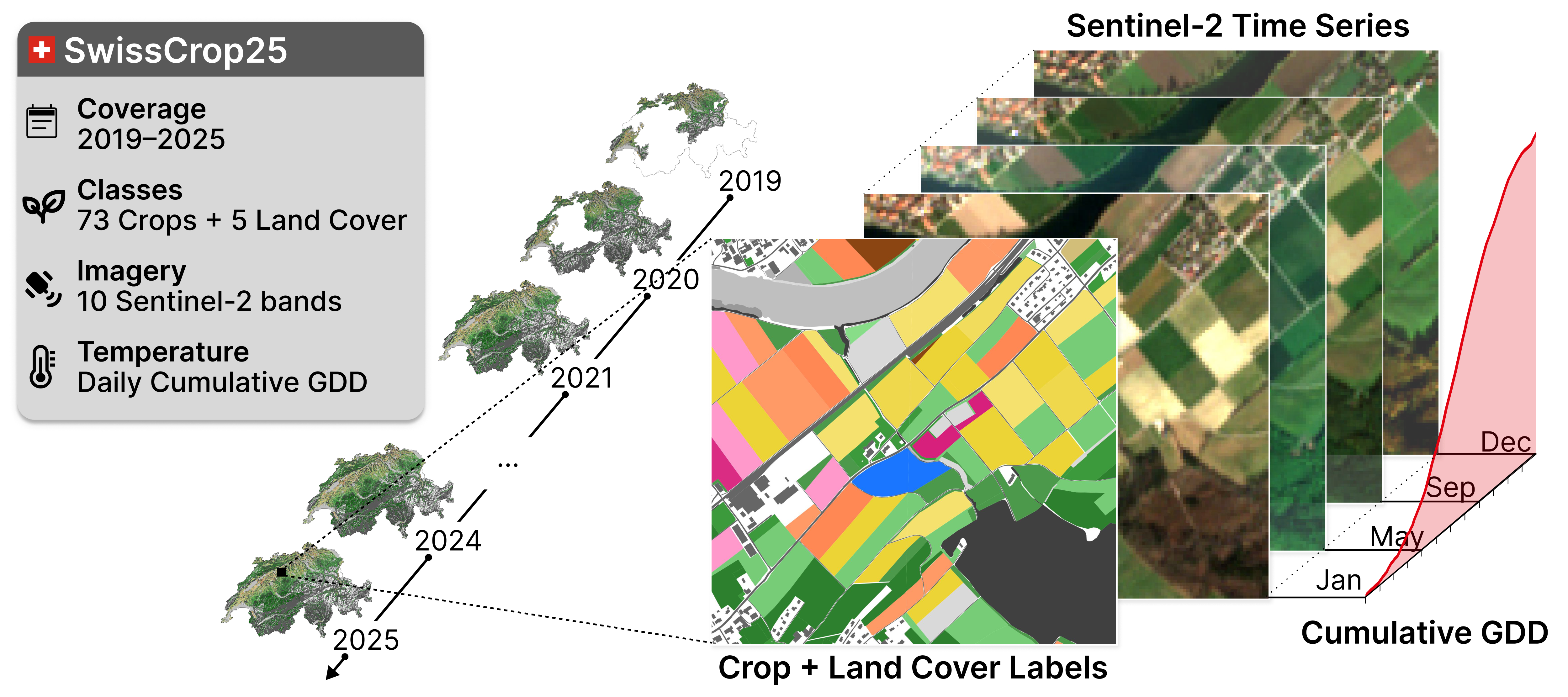
A national benchmark dataset and codebase for operational crop mapping in Switzerland, providing Sentinel-2 time series, daily temperature data, and parcel-level crop type labels across seven growing seasons (2019–2025).
SwissCrop25: A National Multi-Year Benchmark for Operational Crop Mapping
(TerraBytes II Workshop, ECCV 2026) — [Paper] [Dataset] [Team]
src/                    model architectures and dataset loaders
  utae/                 U-TAE and supporting modules (L-TAE, FiLM, FPN, ConvLSTM, ConvGRU)
  tsvit/                TSViT implementation
  galileo/              Galileo segmentation wrapper and model definition
  learning/             loss functions and metrics
train_utae.py           training script for U-TAE
train_tsvit.py          training script for TSViT
train_galileo.py        training script for Galileo
scripts/
  preprocessing/        dataset construction (ground truth, temperature, Kerchunk indices)
  analysis/             baselines, per-class metrics, in-season evaluation
  figures/              figure generation scripts
  tables/               LaTeX table generation scripts
runScripts/             SLURM run scripts for all experiments and splits
storage/                per-experiment evaluation metrics (.pkl)
The dataset is hosted on Hugging Face: EOA-team/SwissCrop25. Download it and pass the root via --dataset_folder:
--dataset_folder /path/to/SwissCrop25
The training scripts expect sentinel2/, labels/, and temperature/ subdirectories, matching the Hugging Face repository layout. For data structure, loading examples, class definitions, and per-year statistics, see the dataset card.
SwissCrop25 defines a five-fold leave-one-year-out (LOYO) protocol. Each split holds out one calendar year as the test set, uses the immediately preceding year for validation, and trains on all remaining years. The two partial years (2019–2020) are included as training data only due to incomplete national coverage.
| Split | Test | Val | Train |
|---|---|---|---|
| S1 | 2021 | 2020 | 2019, 2022–2025 |
| S2 | 2022 | 2021 | 2019–2020, 2023–2025 |
| S3 | 2023 | 2022 | 2019–2021, 2024–2025 |
| S4 | 2024 | 2023 | 2019–2022, 2025 |
| S5 | 2025 | 2024 | 2019–2023 |
Results under the LOYO protocol (mean ± std across five splits, best temporal encoding per model):
| Model | OA (%) | GIoU (%) | mIoU (%) | mF1 (%) |
|---|---|---|---|---|
| U-TAE | 77.7 ± 1.5 | 63.5 ± 2.0 | 35.8 ± 2.3 | 45.7 ± 2.4 |
| TSViT | 77.1 ± 1.2 | 62.7 ± 1.6 | 48.1 ± 2.7 | 60.7 ± 2.5 |
| Galileo-nano (FT) | 72.9 ± 1.3 | 57.4 ± 1.6 | 30.4 ± 2.2 | 41.1 ± 2.5 |
Full per-split and per-class results are reported in the paper.
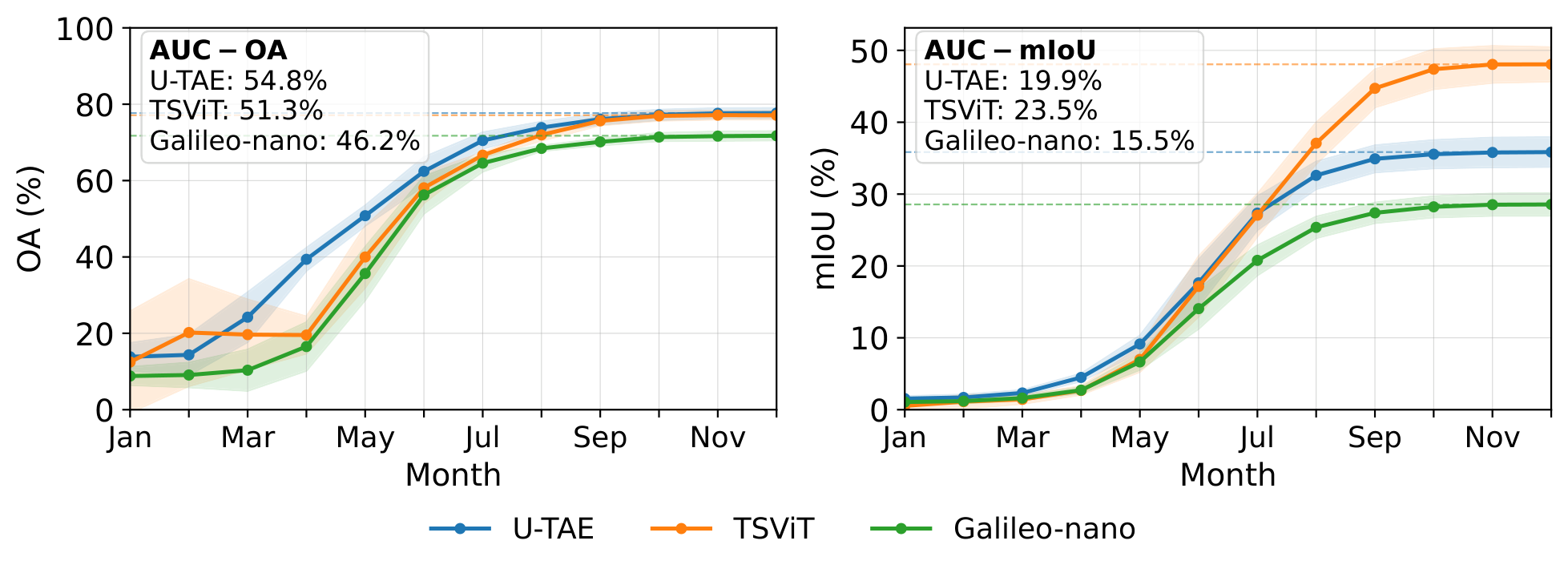
In-season OA (left) and mIoU (right) as a function of month cutoff (mean ±1 std across five LOYO splits). U-TAE leads early-season OA; TSViT gains a late-season advantage in mIoU.
The training scripts support two phenological alignment strategies evaluated in the paper, both applied on top of cloud filtering:
gddsub (--use_temperature_calendar --use_temperature_subsampling): thermal time-based temporal subsampling that selects observations at fixed GDD intervals rather than calendar dates (Turkoglu et al. 2026)gddpe (--use_gdd_pe): thermal positional encoding that replaces day-of-year timestamps with cumulative GDD (Nyborg et al. 2022)The DOY baseline (cloudsub) uses cloud filtering with calendar-based timestamps (neither flag). The training examples below use the best-performing configuration per model: T³S + TPE for U-TAE and TSViT, T³S only for Galileo-nano (whose pretrained positional encoding is fixed).
All three models are trained with distributed data-parallel using torch.distributed.run. Example for a single node with 4 GPUs (LOYO split S1):
U-TAE (GDD substitution + GDD positional encoding):
python -m torch.distributed.run --nproc_per_node=4 train_utae.py \
    --dataset_folder /path/to/SwissCrop25 \
    --epochs 15 --num_workers 12 \
    --bias_initialization --no_normalize_timestamps \
    --use_gdd_pe --use_temperature_calendar --use_temperature_subsampling \
    --satellite sentinel --w_ce 1.0 --use_class_balance_loss \
    --ablation_split S1 --res_dir ./storage/utae_gddsub_gddpe_S1 --seed 7777
TSViT (GDD substitution + GDD positional encoding):
python -m torch.distributed.run --nproc_per_node=4 train_tsvit.py \
    --dataset_folder /path/to/SwissCrop25 \
    --epochs 15 --num_workers 12 \
    --bias_initialization --variable_t \
    --use_gdd_pe --use_temperature_calendar --use_temperature_subsampling \
    --satellite sentinel --w_ce 1.0 --use_class_balance_loss \
    --batch_size 4 --accumulate_steps 4 \
    --ablation_split S1 --res_dir ./storage/tsvit_gddsub_gddpe_S1 --seed 7777
Galileo-nano (fine-tuned, GDD substitution):
python -m torch.distributed.run --nproc_per_node=4 train_galileo.py \
    --dataset_folder /path/to/SwissCrop25 \
    --model nano --epochs 15 --num_workers 12 \
    --bias_initialization --no_normalize_timestamps --variable_t \
    --use_temperature_calendar --use_temperature_subsampling \
    --satellite sentinel --w_ce 1.0 --use_class_balance_loss \
    --batch_size 2 --accumulate_steps 8 \
    --ablation_split S1 --res_dir ./storage/galileo_nano_gddsub_S1 --seed 7777
Complete SLURM run scripts for all experiments and splits are provided in runScripts/.
Built on NVIDIA PyTorch container 24.12. Additional packages:
pip install -r requirements.txt
Built on the b-data R+QGIS devcontainer. Additional Python packages:
pip install -r requirements_preprocess.txt
The ground truth generation script (scripts/preprocessing/generateGT.py) calls R via subprocess. Required R packages: terra, stars, sf, exactextractr, optparse.
Galileo pretrained weights are available on Hugging Face. Download them with:
pip install "huggingface_hub[cli]"
huggingface-cli download nasaharvest/galileo --include "models/**" --local-dir src/galileo/weights
This places the weights at src/galileo/weights/models/{nano,base}/, matching the default --galileo_encoder_path in train_galileo.py.
Evaluation metrics are stored as .pkl files in storage/ after training. To reproduce tables and figures from the paper, use the scripts in scripts/tables/ and scripts/figures/. For example:
python scripts/tables/generate_results_table.py
python scripts/figures/confmat_figure.py
Baselines (majority vote, previous year) can be recomputed with:
python scripts/analysis/compute_baselines.py
@misc{lauber2026swisscrop25nationalmultiyearbenchmark,
  title         = {SwissCrop25: A National Multi-Year Benchmark for Operational Crop Mapping},
  author        = {Thomas Lauber and Mehmet Ozgur Turkoglu and Sélène Ledain and Helge Aasen},
  year          = {2026},
  eprint        = {2608.09497},
  archivePrefix = {arXiv},
  primaryClass  = {cs.CV},
  url           = {https://arxiv.org/abs/2608.09497}
}
Code released under the MIT License. Data released under CC BY 4.0 — license and full attribution details on the dataset card.
This repository builds on U-TAE (MIT), TSViT/DeepSatModels (Apache 2.0), and Galileo (MIT).
A national benchmark dataset and codebase for operational crop mapping in Switzerland, providing Sentinel-2 time series, daily temperature data, and parcel-level crop type labels across seven growing seasons (2019–2025).
SwissCrop25: A National Multi-Year Benchmark for Operational Crop Mapping
(TerraBytes II Workshop, ECCV 2026) — [Paper] [Dataset] [Team]
src/                    model architectures and dataset loaders
  utae/                 U-TAE and supporting modules (L-TAE, FiLM, FPN, ConvLSTM, ConvGRU)
  tsvit/                TSViT implementation
  galileo/              Galileo segmentation wrapper and model definition
  learning/             loss functions and metrics
train_utae.py           training script for U-TAE
train_tsvit.py          training script for TSViT
train_galileo.py        training script for Galileo
scripts/
  preprocessing/        dataset construction (ground truth, temperature, Kerchunk indices)
  analysis/             baselines, per-class metrics, in-season evaluation
  figures/              figure generation scripts
  tables/               LaTeX table generation scripts
runScripts/             SLURM run scripts for all experiments and splits
storage/                per-experiment evaluation metrics (.pkl)
The dataset is hosted on Hugging Face: EOA-team/SwissCrop25. Download it and pass the root via --dataset_folder:
--dataset_folder /path/to/SwissCrop25
The training scripts expect sentinel2/, labels/, and temperature/ subdirectories, matching the Hugging Face repository layout. For data structure, loading examples, class definitions, and per-year statistics, see the dataset card.
SwissCrop25 defines a five-fold leave-one-year-out (LOYO) protocol. Each split holds out one calendar year as the test set, uses the immediately preceding year for validation, and trains on all remaining years. The two partial years (2019–2020) are included as training data only due to incomplete national coverage.
| Split | Test | Val | Train |
|---|---|---|---|
| S1 | 2021 | 2020 | 2019, 2022–2025 |
| S2 | 2022 | 2021 | 2019–2020, 2023–2025 |
| S3 | 2023 | 2022 | 2019–2021, 2024–2025 |
| S4 | 2024 | 2023 | 2019–2022, 2025 |
| S5 | 2025 | 2024 | 2019–2023 |
Results under the LOYO protocol (mean ± std across five splits, best temporal encoding per model):
| Model | OA (%) | GIoU (%) | mIoU (%) | mF1 (%) |
|---|---|---|---|---|
| U-TAE | 77.7 ± 1.5 | 63.5 ± 2.0 | 35.8 ± 2.3 | 45.7 ± 2.4 |
| TSViT | 77.1 ± 1.2 | 62.7 ± 1.6 | 48.1 ± 2.7 | 60.7 ± 2.5 |
| Galileo-nano (FT) | 72.9 ± 1.3 | 57.4 ± 1.6 | 30.4 ± 2.2 | 41.1 ± 2.5 |
Full per-split and per-class results are reported in the paper.
In-season OA (left) and mIoU (right) as a function of month cutoff (mean ±1 std across five LOYO splits). U-TAE leads early-season OA; TSViT gains a late-season advantage in mIoU.
The training scripts support two phenological alignment strategies evaluated in the paper, both applied on top of cloud filtering:
gddsub (--use_temperature_calendar --use_temperature_subsampling): thermal time-based temporal subsampling that selects observations at fixed GDD intervals rather than calendar dates (Turkoglu et al. 2026)gddpe (--use_gdd_pe): thermal positional encoding that replaces day-of-year timestamps with cumulative GDD (Nyborg et al. 2022)The DOY baseline (cloudsub) uses cloud filtering with calendar-based timestamps (neither flag). The training examples below use the best-performing configuration per model: T³S + TPE for U-TAE and TSViT, T³S only for Galileo-nano (whose pretrained positional encoding is fixed).
All three models are trained with distributed data-parallel using torch.distributed.run. Example for a single node with 4 GPUs (LOYO split S1):
U-TAE (GDD substitution + GDD positional encoding):
python -m torch.distributed.run --nproc_per_node=4 train_utae.py \
    --dataset_folder /path/to/SwissCrop25 \
    --epochs 15 --num_workers 12 \
    --bias_initialization --no_normalize_timestamps \
    --use_gdd_pe --use_temperature_calendar --use_temperature_subsampling \
    --satellite sentinel --w_ce 1.0 --use_class_balance_loss \
    --ablation_split S1 --res_dir ./storage/utae_gddsub_gddpe_S1 --seed 7777
TSViT (GDD substitution + GDD positional encoding):
python -m torch.distributed.run --nproc_per_node=4 train_tsvit.py \
    --dataset_folder /path/to/SwissCrop25 \
    --epochs 15 --num_workers 12 \
    --bias_initialization --variable_t \
    --use_gdd_pe --use_temperature_calendar --use_temperature_subsampling \
    --satellite sentinel --w_ce 1.0 --use_class_balance_loss \
    --batch_size 4 --accumulate_steps 4 \
    --ablation_split S1 --res_dir ./storage/tsvit_gddsub_gddpe_S1 --seed 7777
Galileo-nano (fine-tuned, GDD substitution):
python -m torch.distributed.run --nproc_per_node=4 train_galileo.py \
    --dataset_folder /path/to/SwissCrop25 \
    --model nano --epochs 15 --num_workers 12 \
    --bias_initialization --no_normalize_timestamps --variable_t \
    --use_temperature_calendar --use_temperature_subsampling \
    --satellite sentinel --w_ce 1.0 --use_class_balance_loss \
    --batch_size 2 --accumulate_steps 8 \
    --ablation_split S1 --res_dir ./storage/galileo_nano_gddsub_S1 --seed 7777
Complete SLURM run scripts for all experiments and splits are provided in runScripts/.
Built on NVIDIA PyTorch container 24.12. Additional packages:
pip install -r requirements.txt
Built on the b-data R+QGIS devcontainer. Additional Python packages:
pip install -r requirements_preprocess.txt
The ground truth generation script (scripts/preprocessing/generateGT.py) calls R via subprocess. Required R packages: terra, stars, sf, exactextractr, optparse.
Galileo pretrained weights are available on Hugging Face. Download them with:
pip install "huggingface_hub[cli]"
huggingface-cli download nasaharvest/galileo --include "models/**" --local-dir src/galileo/weights
This places the weights at src/galileo/weights/models/{nano,base}/, matching the default --galileo_encoder_path in train_galileo.py.
Evaluation metrics are stored as .pkl files in storage/ after training. To reproduce tables and figures from the paper, use the scripts in scripts/tables/ and scripts/figures/. For example:
python scripts/tables/generate_results_table.py
python scripts/figures/confmat_figure.py
Baselines (majority vote, previous year) can be recomputed with:
python scripts/analysis/compute_baselines.py
@misc{lauber2026swisscrop25nationalmultiyearbenchmark,
  title         = {SwissCrop25: A National Multi-Year Benchmark for Operational Crop Mapping},
  author        = {Thomas Lauber and Mehmet Ozgur Turkoglu and Sélène Ledain and Helge Aasen},
  year          = {2026},
  eprint        = {2608.09497},
  archivePrefix = {arXiv},
  primaryClass  = {cs.CV},
  url           = {https://arxiv.org/abs/2608.09497}
}
Code released under the MIT License. Data released under CC BY 4.0 — license and full attribution details on the dataset card.
This repository builds on U-TAE (MIT), TSViT/DeepSatModels (Apache 2.0), and Galileo (MIT).