
Fully offline tiny LLM chatbot on the ESP32-S3 Cardputer ADV - 8M params, Q4 weights baked into the firmware, ~5 tok/s.
C++
93
17 commits
updated Sep 25, 2026
See what people are saying
README
Cardputer AI
A real chatbot that lives on a microchip.
No internet. No cloud. No phone. Just a tiny chip with 512 KB of RAM, and it talks back.
⬇️ Download firmware · ▶️ Watch the promo · 🤗 Get the model · 📰 Press kit
🎬 Watch the promo
https://github.com/user-attachments/assets/4f42d833-51dd-4b7c-823d-9e9852355083
🤯 Why this is a big deal
Chatbots like ChatGPT run on giant data centers full of GPUs.
Cardputer AI runs on a chip that costs a few dollars. The whole thing (the brain, the words it knows, the chat) fits inside a pocket computer the size of a credit card. Unplug the Wi-Fi. It still works.
Tiny AI on microchips has been done before. But those models could only continue a story: you type "Once upon a time" and they keep going. Ask them a question and you get more story.
This one chats. You say something, it answers. It stays on topic. It asks you questions back. It says "I don't know" when it doesn't know.
To our knowledge, this is the first chatbot that holds a coherent English conversation while running entirely on a microcontroller this small. That means 512 KB of RAM, no extra memory chips, and no internet.
In 2023, the TinyStories paper asked: "How small can language models be and still speak coherent English?" Our answer: small enough to fit on a microchip, and still hold a chat.
📊 By the numbers
| Cardputer AI | |
|---|---|
| 🧠 Brain size | 8 million parameters. That's ~50,000× smaller than Llama 3.1 405B |
| 💾 Memory | 512 KB of RAM, less than one photo on your phone |
| 📦 Model file | 5.7 MB, baked right into the firmware |
| ⚡ Speed | ~5 tokens (word pieces) per second |
| 📡 Internet | Not needed. Ever. |
| 🔋 Power | Runs on the Cardputer's battery |
💬 See it talk
https://github.com/user-attachments/assets/c9977f6f-6a45-461b-82ca-8b01988d8508
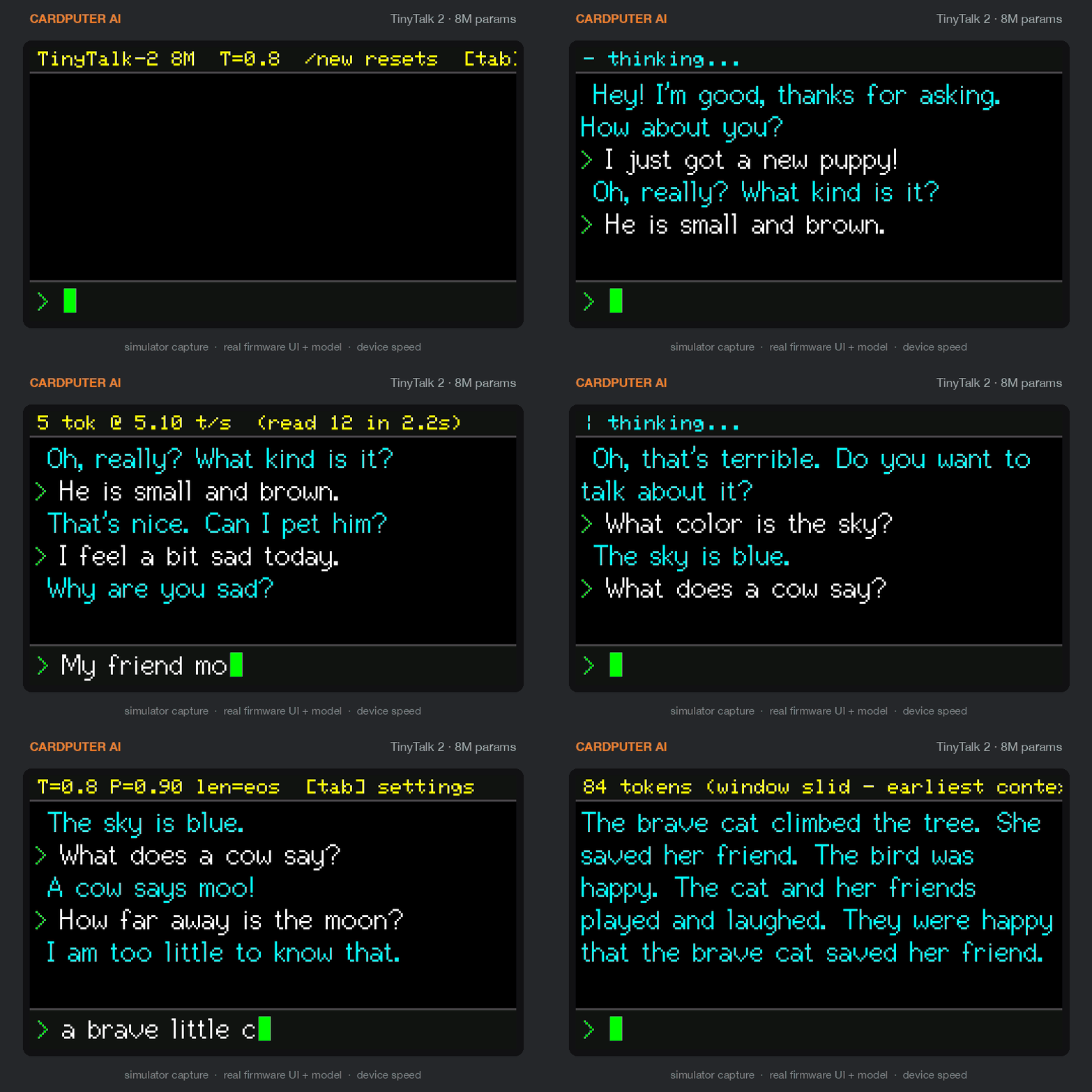
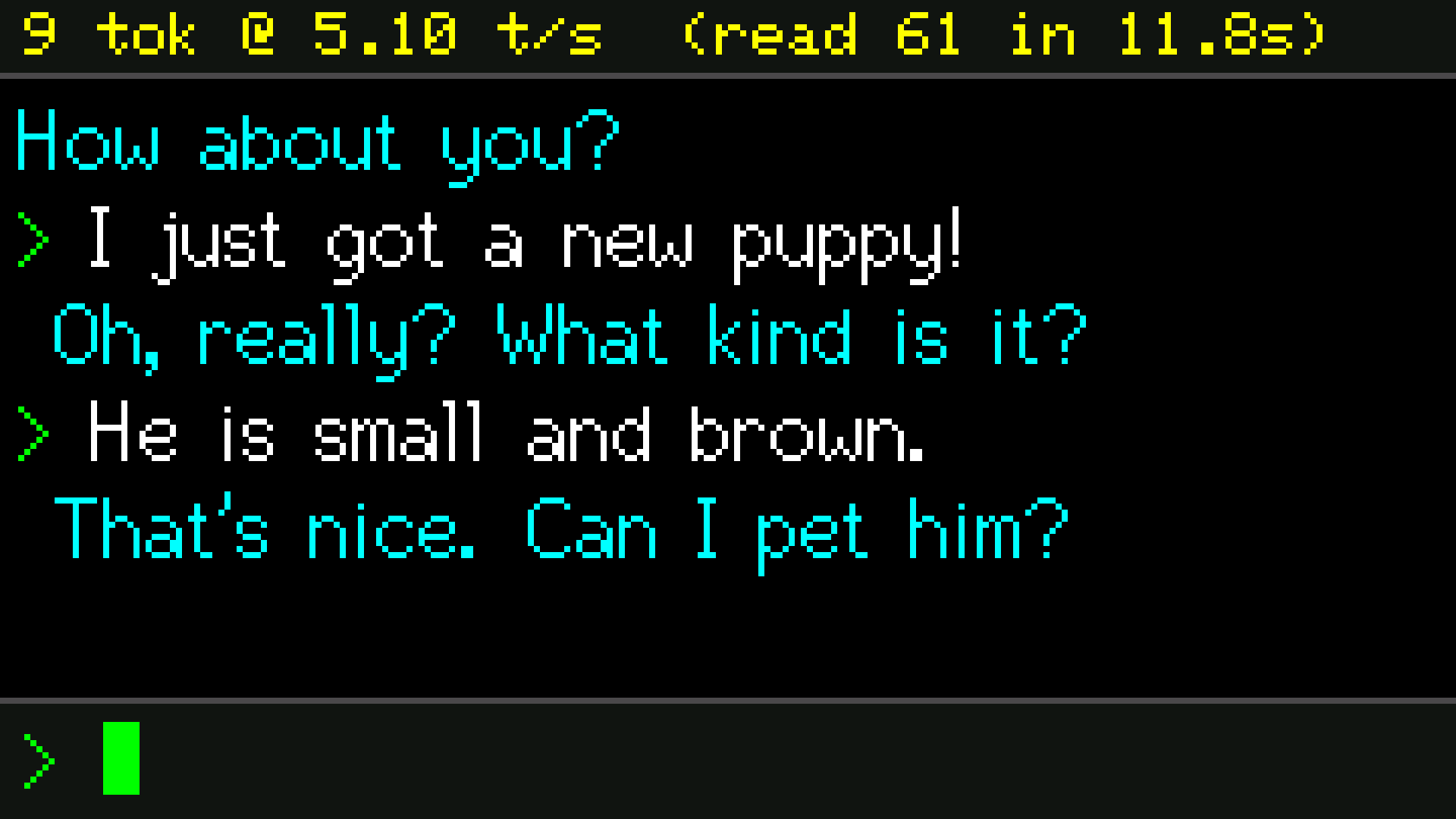
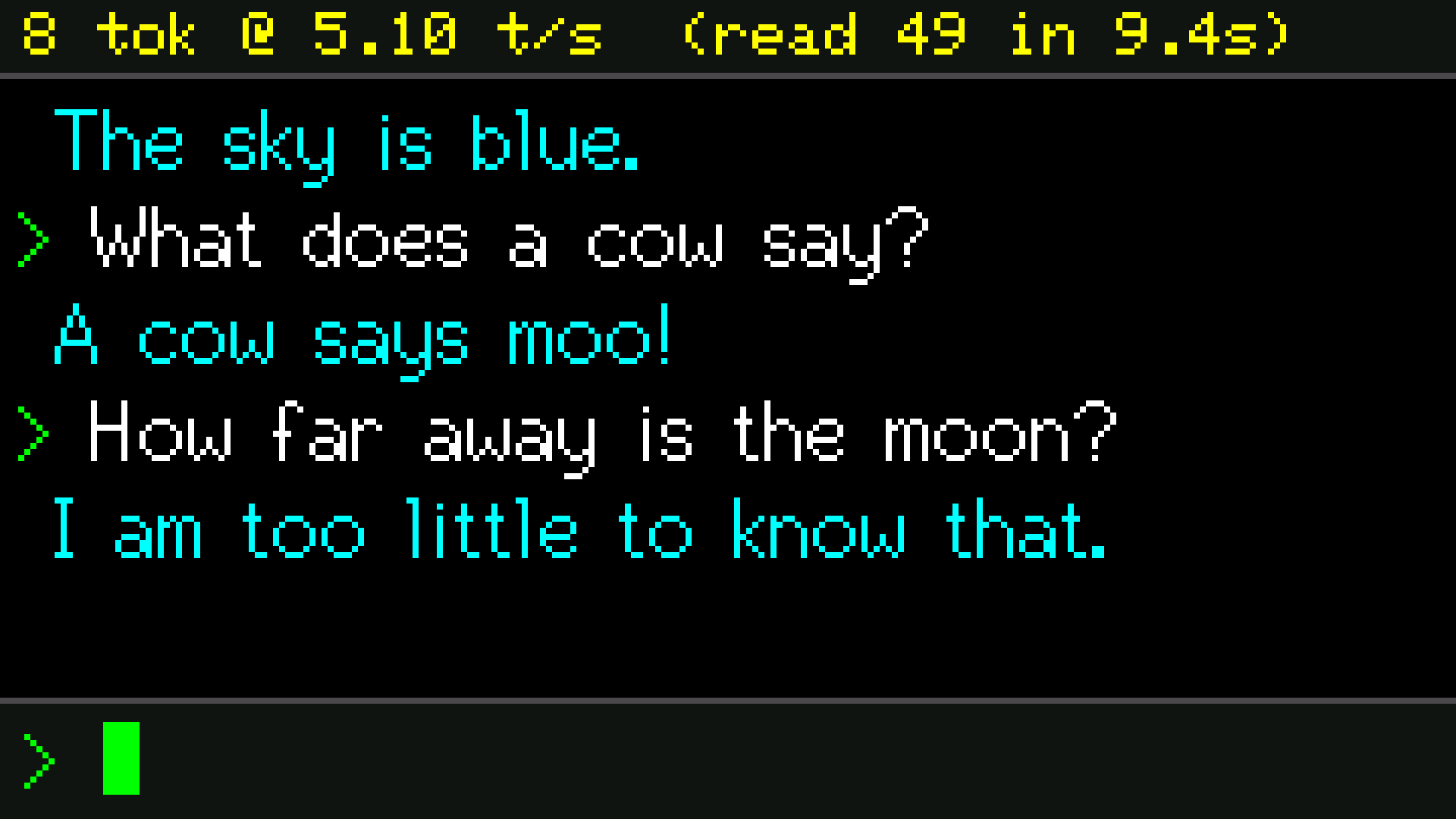
A real conversation, word for word, from the demo video above:
> Hi! How are you?
  Hey! I'm good, thanks for asking. How about you?
> I just got a new puppy!
  Oh, really? What kind is it?
> He is small and brown.
  That's nice. Can I pet him?

> I feel a bit sad today.
  Why are you sad?
> My friend moved away.
  Oh, that's terrible. Do you want to talk about it?

> What color is the sky?
  The sky is blue.
> What does a cow say?
  A cow says moo!
> How far away is the moon?
  I am too little to know that.
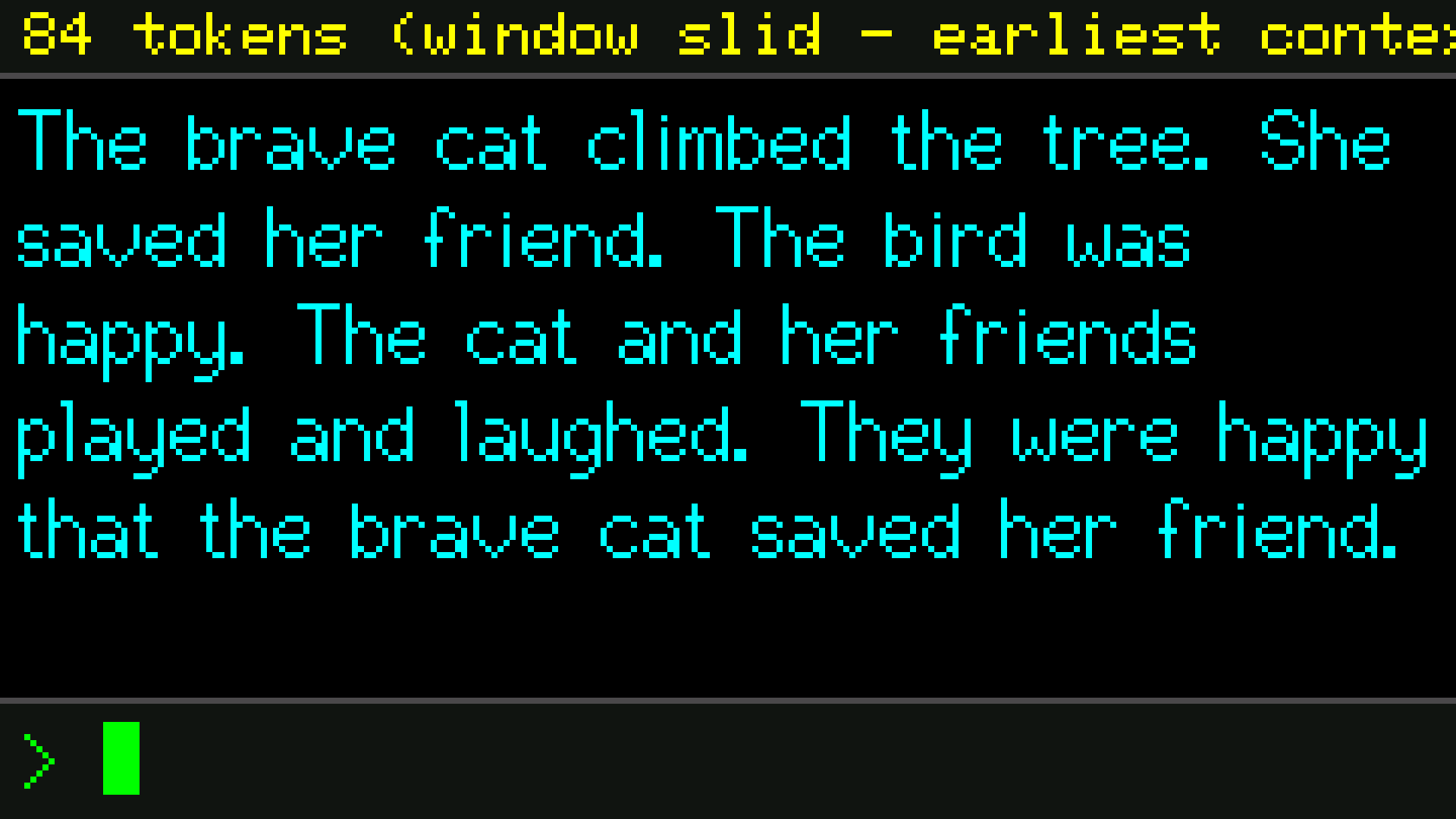
It can tell stories too. Switch to story mode, type "a brave little cat who saves her friend", and you get:
Once upon a time, there was a brave little cat. She lived in a big tree with her friends. One day, she saw a bird in the sky. The bird was scared. The cat wanted to help the bird. The brave cat climbed the tree. She saved her friend. The bird was happy. The cat and her friends played and laughed. They were happy that the brave cat saved her friend.
🧸 What it's good at (and what it's not)
Think of it as a friendly 4-year-old that lives in your pocket.
| 👍 Good at | 👎 Not good at |
|---|---|
| Small talk: "how are you?", pets, feelings | Facts about the real world |
| Simple facts: colors, animal sounds, opposites | Math, homework, coding |
| Saying "I don't know" instead of making things up (mostly) | Remembering more than ~3 messages |
| Short bedtime stories | Long, deep conversations |
It's 8 million parameters. Expect charming nonsense at the edges. That's part of the fun.
🚀 Try it in 3 steps
- Get a Cardputer. An M5Stack Cardputer ADV or the original Cardputer. The same firmware runs on both.
- Flash it. Grab
cardputer_ai_<version>.binfrom Releases and install it with M5Launcher. Or build it yourself:pio run -t upload. - Type and press Enter. That's it. No setup, no account, no SD card.
| Key | What it does |
|---|---|
Enter | send your message |
/new + Enter | start a fresh conversation |
Tab | settings: chat / story mode, creativity (temperature), reply length |
` | stop a reply mid-sentence |
Fn + ; / . | scroll up / down through the chat |
No Cardputer? The model runs on your computer too: ollama run hf.co/TheREZOR/TinyTalk-2-GGUF
🔧 How does it fit?
The short version:
- Start tiny. The base is TinyStories-Instruct-8M, a model trained only on simple kids' stories. Simple words means a small brain can still speak clearly.
- Teach it to chat. We fine-tuned it on thousands of everyday dialogues, so it answers you instead of writing a story.
- Squeeze hard. Weights shrink to 4 bits each. The vocabulary shrinks from 50,000 words to 13,000. The chat memory is 4-bit too.
- Go fast. The model is read straight from flash storage, and hand-written vector (SIMD) code on the ESP32-S3 does the math.
The long version, with every build, training and hacking detail, is in docs/DEVELOPING.md.
📰 Press kit
Writing about Cardputer AI? Use anything here. No need to ask. A credit line and a link to this repo are appreciated.
One-line summary: Cardputer AI is an open-source chatbot that runs entirely on a few-dollar ESP32-S3 microcontroller with 512 KB of RAM. It needs no internet, holds a simple English conversation, and generates about 5 tokens per second.
| Asset | Preview |
|---|---|
| Promo video: 75-second trailer, 1080p MP4 with music · download | |
| Demo video: full demo at real speed, 1080p MP4 (2 min) · download | 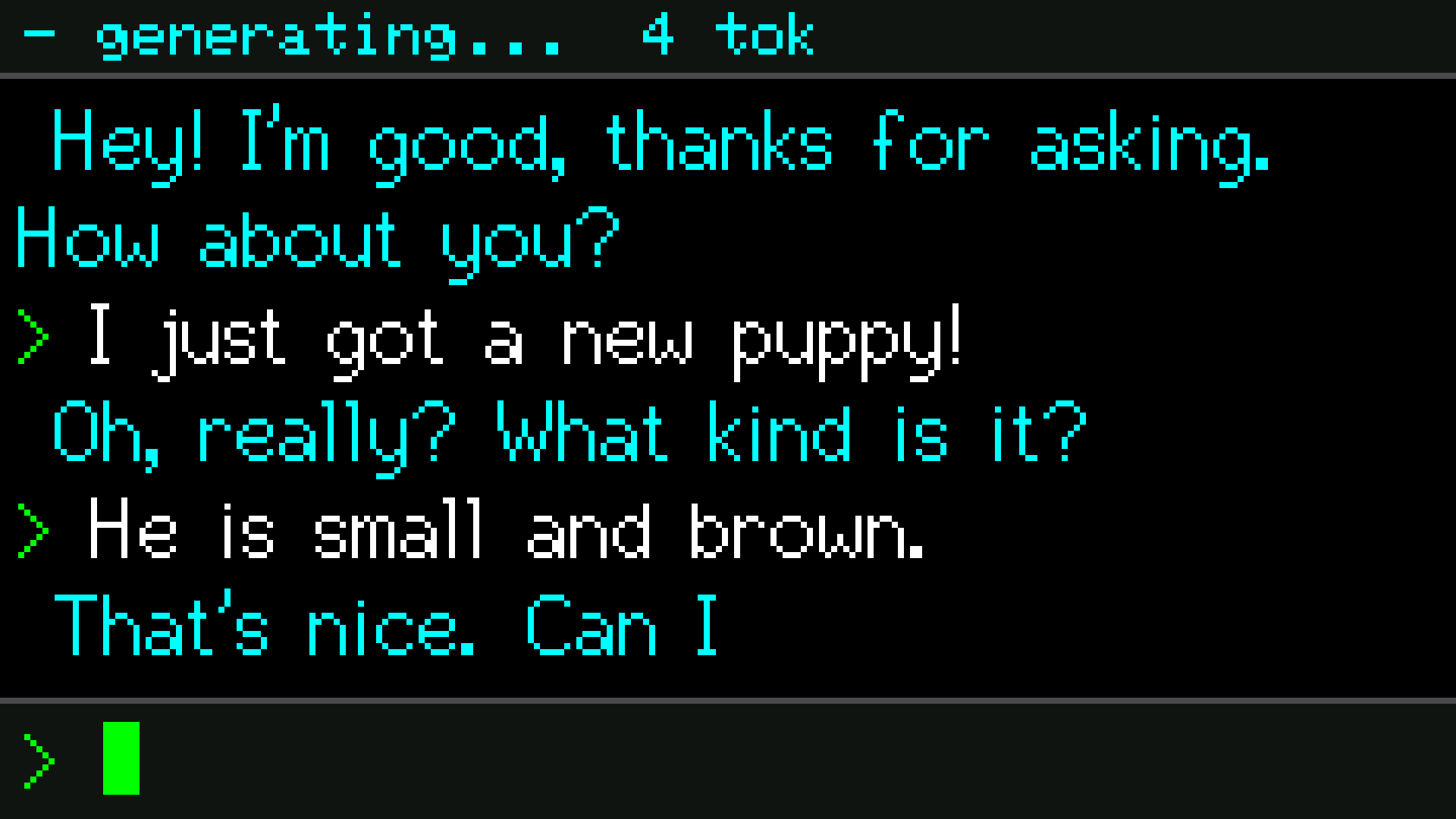 |
| Demo GIF: same demo in a device frame · download | 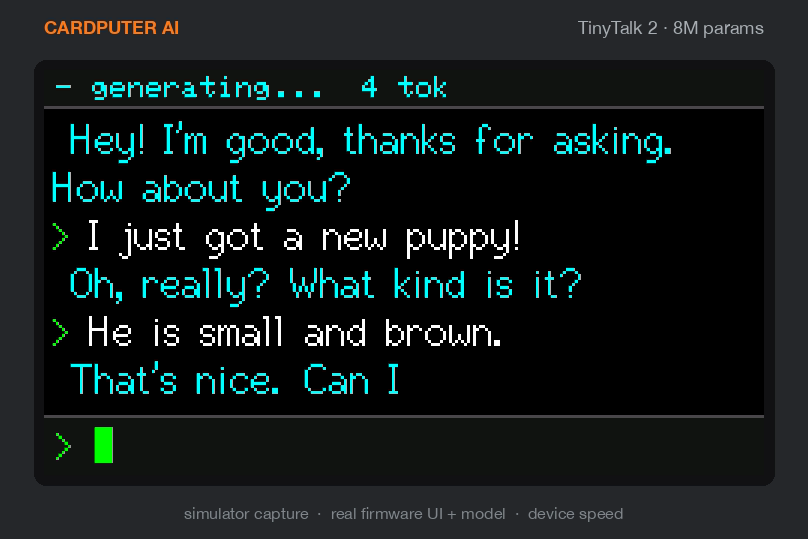 |
| Social banner: 1280×640 · download | 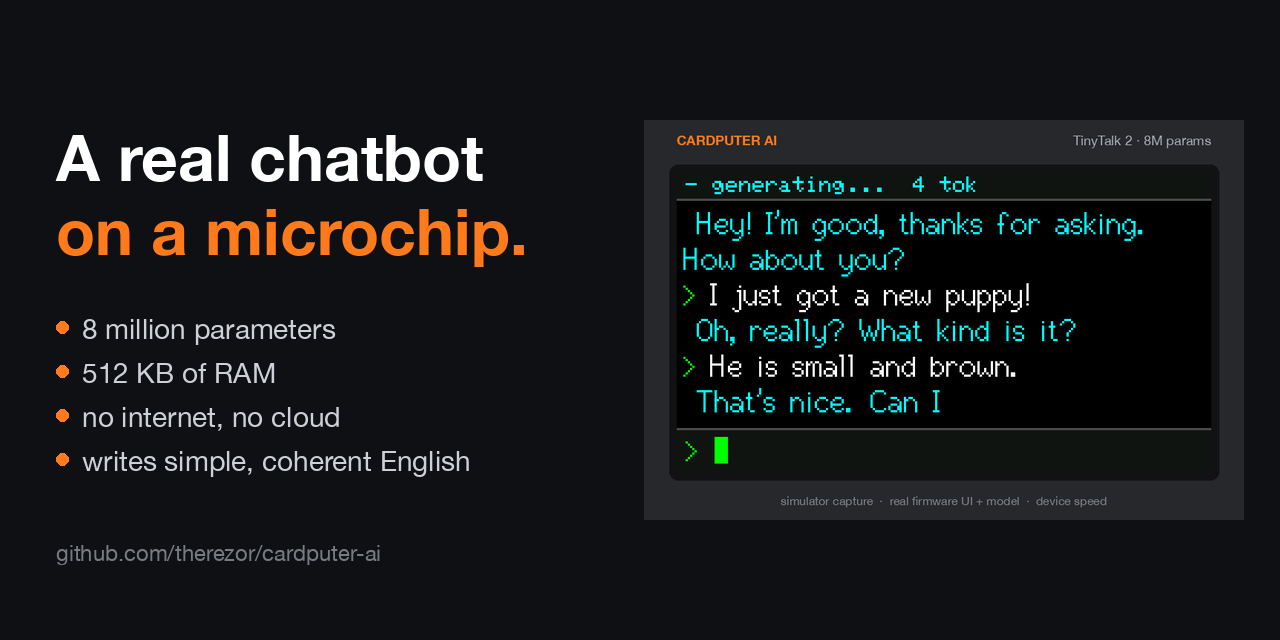 |
| Device frame stills · chat · story | 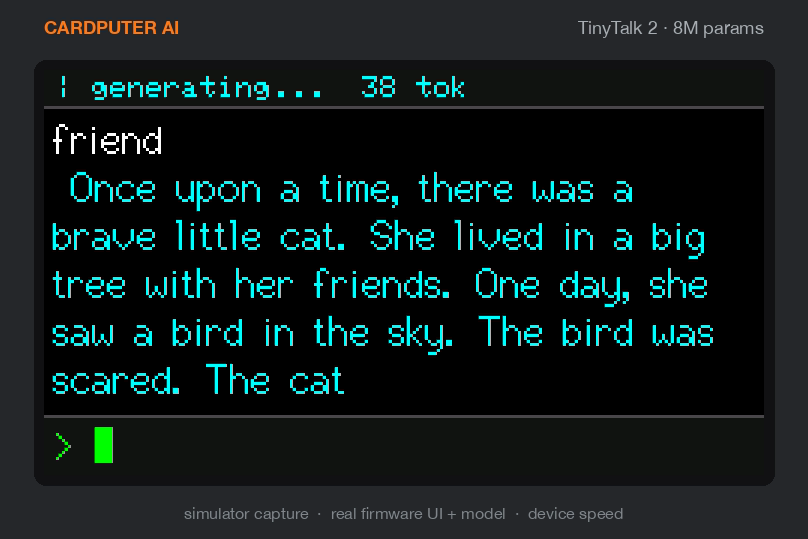 |
| Screenshots: 1920×1080, pixel-exact · small talk · feelings · facts · settings · story | 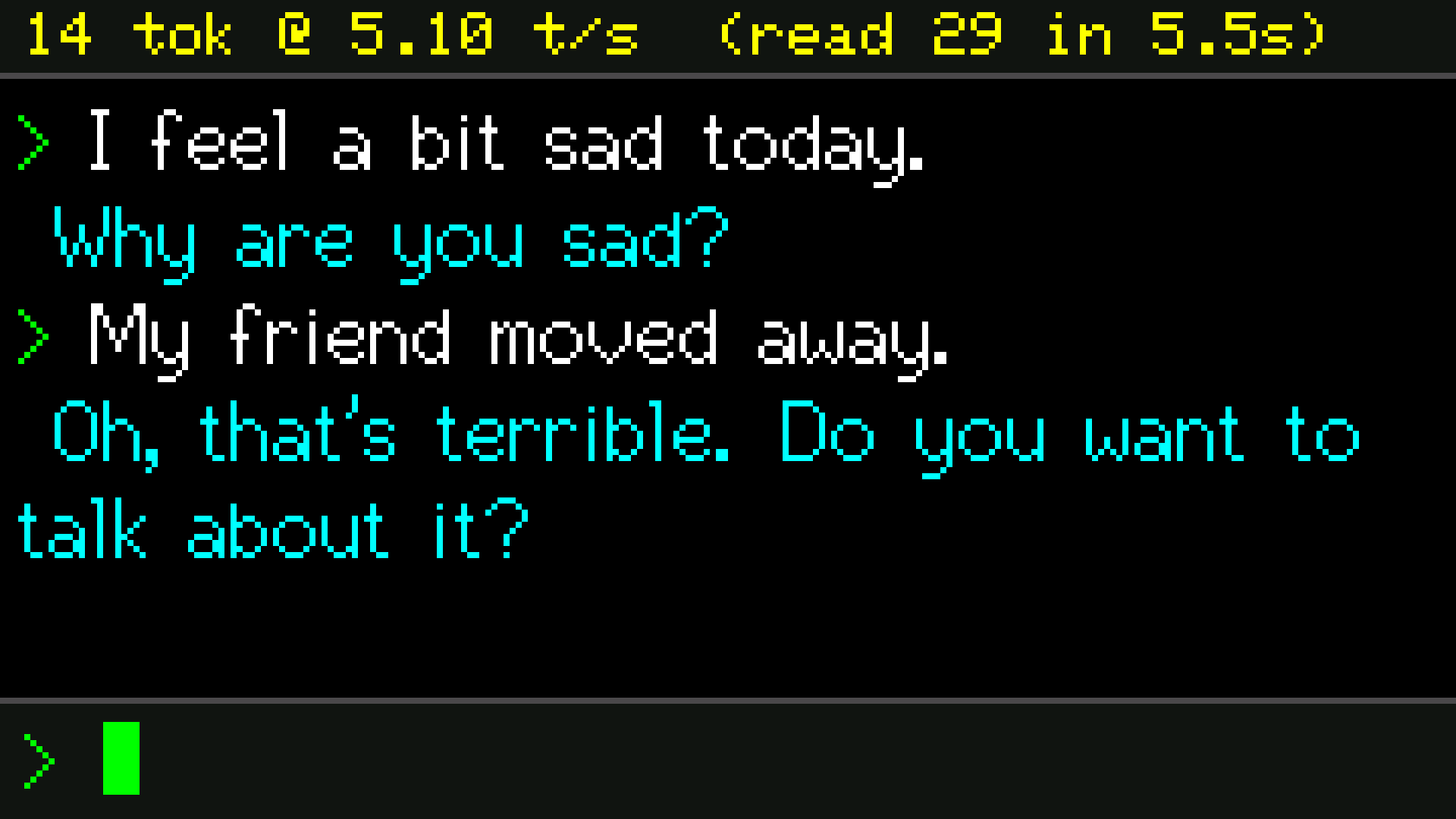 |
| Full transcript of the demo · text |
Key facts:
- Model: TinyTalk 2, 8M parameters, fine-tuned from TinyStories-Instruct-8M for chat. Open weights on Hugging Face.
- Hardware: M5Stack Cardputer / Cardputer ADV. ESP32-S3 chip, 512 KB SRAM, 8 MB flash, no PSRAM.
- Speed: ~5 tokens/second (196 ms per token, measured on device).
- Fully offline. The model is part of the firmware.
- Open source (MIT code). Made by REZOR (@therezor).
How the media was made: the screens come from the firmware's own UI and chat code, run in a pixel-exact simulator with the real embedded model. Every step is timed at the measured on-device speed. The bot's words are unedited model output. We picked the best random seed per scene, just like picking the best take. The device frame is an illustration, not a photo.
📜 Changelog
- v2.2 — honest speed readout + press kit
- The status bar after a reply now shows generation speed and prompt
reading separately:
9 tok @ 5.10 t/s (read 61 in 11.8s). It used to divide the reply's tokens by the whole wait, including re-reading the chat history (one forward per prompt token), which showed e.g. 0.66 t/s. - Landing-page README with a demo video, screenshots and a press kit
(
docs/media); build and training notes moved todocs/DEVELOPING.md. tools/sim: host screen simulator that runs the real firmware UI + model at device speed and regenerates all media;tools/video: Remotion promo.
- The status bar after a reply now shows generation speed and prompt
reading separately:
- v2.1 — sliding context window
- Replies no longer stop at the KV window. When the cache fills mid-reply
the window slides: a quarter-window prefix stays pinned as an attention
sink, the oldest slots after it are evicted, and generation continues. The
physical KV slot and the absolute sequence position are now tracked
separately (
llm_forward_at/llm_kv_slide), since GPT-Neo bakes its learned position into the cached keys and they can't be re-rotated. - Fixes a bug where a prompt of ≥55 tokens (routine in chat mode, which packs history to a 64-token budget) would rewind into prompt replay after a slide and silently re-inject its own tail mid-reply, forever.
- Where the eviction band lands matters: pinning half the window pinned the oldest history and cut straight through the question being answered. The quarter-window pin drops stale history instead, so the live turn survives the first slide — a reply long enough to slide twice still loses it.
- Generation now stops cleanly when the model's 256 position embeddings run out, instead of reusing the last row and degenerating.
- Reply length is decoupled from the KV window: the setting goes up to 256 (was 64) with coarse steps, plus until eos (slides) below 4 — which is now the default, so replies run until the model stops rather than being cut at 44 tokens. The old unsafe mode is gone; sliding replaces it and doesn't corrupt the cache.
tools/host/host_test.cppmirrors the firmware's generation loop (--slide,--sink N,--old-policy,--replay-by-pos) and reports which prompt tokens each slide drops, so the policy is testable on a host.
- Replies no longer stop at the KV window. When the cache fills mid-reply
the window slides: a quarter-window prefix stays pinned as an attention
sink, the oldest slots after it are evicted, and generation continues. The
physical KV slot and the absolute sequence position are now tracked
separately (
- v2.0 — the TinyTalk 2 release
(TinyTalk 1 on HuggingFace)
- 8M model (dim=256): same chat fine-tune recipe on TinyStories-Instruct-8M — noticeably better language quality than 3M (frozen-val loss 1.49 vs 1.80). ~5 tok/s measured on device (196 ms/token), with boot-time serial benchmarks for flash bandwidth and ms/token.
- ESP32-S3 PIE SIMD Q4×Q8 matmul kernel + QIO flash + 64-byte cache lines to keep it fast; CRDP v3 row-planar blob format (16B-aligned).
- int4 KV cache (group-32 bf16 scales) — halves KV memory; the 8M model runs a 72-token window, the 3M keeps 80.
- Stale v2
model_data.cppblobs are rejected at boot instead of producing gibberish; SIMD kernel self-tests against the scalar path.
- v1.2
- Smarter model, same speed: retrained on a ~2x larger corpus — SODA window filtering (85% yield vs 47%) with TinyStories speaker renaming, plus DailyDialog. Frozen-val loss 1.84 → 1.80; kindergarten-fact battery 1/8 → 6/8; "I don't know" on impossible questions 6/8 → 8/8.
- New skills: answers simple kindergarten Q&A (colors, animal sounds, opposites, baby animals); deflects questions it can't know instead of confabulating (trained on SciQ questions + hand-written deflections).
- Top-p (nucleus) sampling, default 0.9, adjustable in settings (1.00 = off). Cheap single-pass implementation, no full-vocab sort.
- Eval tooling:
tools/eval_chat.py(masked val loss) andtools/eval_battery.py(scored prompt battery via the host harness).
- v1.1
- Press the backtick (
`) key to stop a reply while it's being typed out. - Two new reply-length options below the normal range: unlimited (keeps going until the model decides to stop) and unsafe (lets longer replies keep going by reusing memory, clearing the chat when it runs out).
- Press the backtick (
- v1.0 — initial release.
📄 License
Code: MIT (see LICENSE). The embedded model derives from TinyStories-Instruct and the SODA (CC BY 4.0), DailyDialog (CC BY-NC-SA 4.0) and SciQ (CC BY-NC 3.0) datasets. The latter two are non-commercial; see NOTICE.md for full third-party attributions.
Contributors

16 commits

1 commits
Similar repos


Languages
C++
99.6%
Fully offline tiny LLM chatbot on the ESP32-S3 Cardputer ADV - 8M params, Q4 weights baked into the firmware, ~5 tok/s.
C++
93
17 commits
updated Sep 25, 2026
See what people are saying
README
Cardputer AI
A real chatbot that lives on a microchip.
No internet. No cloud. No phone. Just a tiny chip with 512 KB of RAM, and it talks back.
⬇️ Download firmware · ▶️ Watch the promo · 🤗 Get the model · 📰 Press kit
🎬 Watch the promo
https://github.com/user-attachments/assets/4f42d833-51dd-4b7c-823d-9e9852355083
🤯 Why this is a big deal
Chatbots like ChatGPT run on giant data centers full of GPUs.
Cardputer AI runs on a chip that costs a few dollars. The whole thing (the brain, the words it knows, the chat) fits inside a pocket computer the size of a credit card. Unplug the Wi-Fi. It still works.
Tiny AI on microchips has been done before. But those models could only continue a story: you type "Once upon a time" and they keep going. Ask them a question and you get more story.
This one chats. You say something, it answers. It stays on topic. It asks you questions back. It says "I don't know" when it doesn't know.
To our knowledge, this is the first chatbot that holds a coherent English conversation while running entirely on a microcontroller this small. That means 512 KB of RAM, no extra memory chips, and no internet.
In 2023, the TinyStories paper asked: "How small can language models be and still speak coherent English?" Our answer: small enough to fit on a microchip, and still hold a chat.
📊 By the numbers
| Cardputer AI | |
|---|---|
| 🧠 Brain size | 8 million parameters. That's ~50,000× smaller than Llama 3.1 405B |
| 💾 Memory | 512 KB of RAM, less than one photo on your phone |
| 📦 Model file | 5.7 MB, baked right into the firmware |
| ⚡ Speed | ~5 tokens (word pieces) per second |
| 📡 Internet | Not needed. Ever. |
| 🔋 Power | Runs on the Cardputer's battery |
💬 See it talk
https://github.com/user-attachments/assets/c9977f6f-6a45-461b-82ca-8b01988d8508
A real conversation, word for word, from the demo video above:
> Hi! How are you?
  Hey! I'm good, thanks for asking. How about you?
> I just got a new puppy!
  Oh, really? What kind is it?
> He is small and brown.
  That's nice. Can I pet him?

> I feel a bit sad today.
  Why are you sad?
> My friend moved away.
  Oh, that's terrible. Do you want to talk about it?

> What color is the sky?
  The sky is blue.
> What does a cow say?
  A cow says moo!
> How far away is the moon?
  I am too little to know that.
It can tell stories too. Switch to story mode, type "a brave little cat who saves her friend", and you get:
Once upon a time, there was a brave little cat. She lived in a big tree with her friends. One day, she saw a bird in the sky. The bird was scared. The cat wanted to help the bird. The brave cat climbed the tree. She saved her friend. The bird was happy. The cat and her friends played and laughed. They were happy that the brave cat saved her friend.
🧸 What it's good at (and what it's not)
Think of it as a friendly 4-year-old that lives in your pocket.
| 👍 Good at | 👎 Not good at |
|---|---|
| Small talk: "how are you?", pets, feelings | Facts about the real world |
| Simple facts: colors, animal sounds, opposites | Math, homework, coding |
| Saying "I don't know" instead of making things up (mostly) | Remembering more than ~3 messages |
| Short bedtime stories | Long, deep conversations |
It's 8 million parameters. Expect charming nonsense at the edges. That's part of the fun.
🚀 Try it in 3 steps
- Get a Cardputer. An M5Stack Cardputer ADV or the original Cardputer. The same firmware runs on both.
- Flash it. Grab
cardputer_ai_<version>.binfrom Releases and install it with M5Launcher. Or build it yourself:pio run -t upload. - Type and press Enter. That's it. No setup, no account, no SD card.
| Key | What it does |
|---|---|
Enter | send your message |
/new + Enter | start a fresh conversation |
Tab | settings: chat / story mode, creativity (temperature), reply length |
` | stop a reply mid-sentence |
Fn + ; / . | scroll up / down through the chat |
No Cardputer? The model runs on your computer too: ollama run hf.co/TheREZOR/TinyTalk-2-GGUF
🔧 How does it fit?
The short version:
- Start tiny. The base is TinyStories-Instruct-8M, a model trained only on simple kids' stories. Simple words means a small brain can still speak clearly.
- Teach it to chat. We fine-tuned it on thousands of everyday dialogues, so it answers you instead of writing a story.
- Squeeze hard. Weights shrink to 4 bits each. The vocabulary shrinks from 50,000 words to 13,000. The chat memory is 4-bit too.
- Go fast. The model is read straight from flash storage, and hand-written vector (SIMD) code on the ESP32-S3 does the math.
The long version, with every build, training and hacking detail, is in docs/DEVELOPING.md.
📰 Press kit
Writing about Cardputer AI? Use anything here. No need to ask. A credit line and a link to this repo are appreciated.
One-line summary: Cardputer AI is an open-source chatbot that runs entirely on a few-dollar ESP32-S3 microcontroller with 512 KB of RAM. It needs no internet, holds a simple English conversation, and generates about 5 tokens per second.
| Asset | Preview |
|---|---|
| Promo video: 75-second trailer, 1080p MP4 with music · download | |
| Demo video: full demo at real speed, 1080p MP4 (2 min) · download | |
| Demo GIF: same demo in a device frame · download | |
| Social banner: 1280×640 · download | |
| Device frame stills · chat · story | |
| Screenshots: 1920×1080, pixel-exact · small talk · feelings · facts · settings · story | |
| Full transcript of the demo · text |
Key facts:
- Model: TinyTalk 2, 8M parameters, fine-tuned from TinyStories-Instruct-8M for chat. Open weights on Hugging Face.
- Hardware: M5Stack Cardputer / Cardputer ADV. ESP32-S3 chip, 512 KB SRAM, 8 MB flash, no PSRAM.
- Speed: ~5 tokens/second (196 ms per token, measured on device).
- Fully offline. The model is part of the firmware.
- Open source (MIT code). Made by REZOR (@therezor).
How the media was made: the screens come from the firmware's own UI and chat code, run in a pixel-exact simulator with the real embedded model. Every step is timed at the measured on-device speed. The bot's words are unedited model output. We picked the best random seed per scene, just like picking the best take. The device frame is an illustration, not a photo.
📜 Changelog
- v2.2 — honest speed readout + press kit
- The status bar after a reply now shows generation speed and prompt
reading separately:
9 tok @ 5.10 t/s (read 61 in 11.8s). It used to divide the reply's tokens by the whole wait, including re-reading the chat history (one forward per prompt token), which showed e.g. 0.66 t/s. - Landing-page README with a demo video, screenshots and a press kit
(
docs/media); build and training notes moved todocs/DEVELOPING.md. tools/sim: host screen simulator that runs the real firmware UI + model at device speed and regenerates all media;tools/video: Remotion promo.
- The status bar after a reply now shows generation speed and prompt
reading separately:
- v2.1 — sliding context window
- Replies no longer stop at the KV window. When the cache fills mid-reply
the window slides: a quarter-window prefix stays pinned as an attention
sink, the oldest slots after it are evicted, and generation continues. The
physical KV slot and the absolute sequence position are now tracked
separately (
llm_forward_at/llm_kv_slide), since GPT-Neo bakes its learned position into the cached keys and they can't be re-rotated. - Fixes a bug where a prompt of ≥55 tokens (routine in chat mode, which packs history to a 64-token budget) would rewind into prompt replay after a slide and silently re-inject its own tail mid-reply, forever.
- Where the eviction band lands matters: pinning half the window pinned the oldest history and cut straight through the question being answered. The quarter-window pin drops stale history instead, so the live turn survives the first slide — a reply long enough to slide twice still loses it.
- Generation now stops cleanly when the model's 256 position embeddings run out, instead of reusing the last row and degenerating.
- Reply length is decoupled from the KV window: the setting goes up to 256 (was 64) with coarse steps, plus until eos (slides) below 4 — which is now the default, so replies run until the model stops rather than being cut at 44 tokens. The old unsafe mode is gone; sliding replaces it and doesn't corrupt the cache.
tools/host/host_test.cppmirrors the firmware's generation loop (--slide,--sink N,--old-policy,--replay-by-pos) and reports which prompt tokens each slide drops, so the policy is testable on a host.
- Replies no longer stop at the KV window. When the cache fills mid-reply
the window slides: a quarter-window prefix stays pinned as an attention
sink, the oldest slots after it are evicted, and generation continues. The
physical KV slot and the absolute sequence position are now tracked
separately (
- v2.0 — the TinyTalk 2 release
(TinyTalk 1 on HuggingFace)
- 8M model (dim=256): same chat fine-tune recipe on TinyStories-Instruct-8M — noticeably better language quality than 3M (frozen-val loss 1.49 vs 1.80). ~5 tok/s measured on device (196 ms/token), with boot-time serial benchmarks for flash bandwidth and ms/token.
- ESP32-S3 PIE SIMD Q4×Q8 matmul kernel + QIO flash + 64-byte cache lines to keep it fast; CRDP v3 row-planar blob format (16B-aligned).
- int4 KV cache (group-32 bf16 scales) — halves KV memory; the 8M model runs a 72-token window, the 3M keeps 80.
- Stale v2
model_data.cppblobs are rejected at boot instead of producing gibberish; SIMD kernel self-tests against the scalar path.
- v1.2
- Smarter model, same speed: retrained on a ~2x larger corpus — SODA window filtering (85% yield vs 47%) with TinyStories speaker renaming, plus DailyDialog. Frozen-val loss 1.84 → 1.80; kindergarten-fact battery 1/8 → 6/8; "I don't know" on impossible questions 6/8 → 8/8.
- New skills: answers simple kindergarten Q&A (colors, animal sounds, opposites, baby animals); deflects questions it can't know instead of confabulating (trained on SciQ questions + hand-written deflections).
- Top-p (nucleus) sampling, default 0.9, adjustable in settings (1.00 = off). Cheap single-pass implementation, no full-vocab sort.
- Eval tooling:
tools/eval_chat.py(masked val loss) andtools/eval_battery.py(scored prompt battery via the host harness).
- v1.1
- Press the backtick (
`) key to stop a reply while it's being typed out. - Two new reply-length options below the normal range: unlimited (keeps going until the model decides to stop) and unsafe (lets longer replies keep going by reusing memory, clearing the chat when it runs out).
- Press the backtick (
- v1.0 — initial release.
📄 License
Code: MIT (see LICENSE). The embedded model derives from TinyStories-Instruct and the SODA (CC BY 4.0), DailyDialog (CC BY-NC-SA 4.0) and SciQ (CC BY-NC 3.0) datasets. The latter two are non-commercial; see NOTICE.md for full third-party attributions.
Similar repos
Contributors
16 commits
1 commits
Languages
C++
99.6%