Tempo is a blockchain designed specifically for stablecoin payments. Its architecture focuses on high throughput, low cost, and features that financial institutions, payment service providers, and fintech platforms expect from modern payment infrastructure.
Tempo Foundry is a custom fork of Foundry that integrates Tempo's payment-native protocol features directly into the familiar Foundry developer workflow.
This is a temporary required drop-in replacement for upstream Foundry while Tempo-specific features are being integrated into upstream Foundry, after which this fork will be deprecated.
Get started here to use Tempo's features in Foundry.
Tempo's Foundry fork is installed through the standard upstream foundryup using the -n tempo flag, no separate installer is required.
Getting started is very easy:
Install regular foundryup:
curl -L https://foundry.paradigm.xyz | bash
Or if you already have foundryup installed:
foundryup --update
Next, run:
foundryup -n tempo
It will automatically install the latest nightly release of the precompiled binaries: forge and cast.
Done!
For additional details see the installation guide in the Foundry Docs.
If you're experiencing any issues while installing, check out Getting Help and the FAQ.
You can connect to Tempo's public testnet using the following details:
| Property | Value |
|---|---|
| Network Name | Tempo Testnet (Moderato) |
| Currency | USD |
| Chain ID | 42431 |
| HTTP URL | https://rpc.moderato.tempo.xyz |
| WebSocket URL | wss://rpc.moderato.tempo.xyz |
| Block Explorer | https://explore.moderato.tempo.xyz |
Next, grab some stablecoins to test with from Tempo's Faucet.
Alternatively, use cast:
cast rpc tempo_fundAddress <ADDRESS> --rpc-url https://rpc.moderato.tempo.xyz
Key extensions:
In foundryup:
foundryup -n tempo: download the latest nightly release of Tempo's fork of Foundry.foundryup -n tempo -i <TAG>: download a specific nightly release by tag nightly-<hash>.In forge:
forge init -n tempo: adds a Tempo-specific Mail template showcasing a TIP20 transfer with an attached memo.forge install tempoxyz/tempo-std: like forge-std, a collection of helpful contracts and libraries for Tempo-specific testing and utilities.--tempo.fee-token support: pay gas fees in any TIP20 stablecoin.In cast:
cast run: updated to correctly process Tempo's system transactions when replaying a block.cast tip20: alias to cast erc20.--tempo.fee-token support: pay gas fees in any TIP20 stablecoin.Additionally:
TempoEvm extends Revm's Evm to accommodate differences Tempo introduces to optimize for payments.Blazing fast, portable and modular toolkit for Ethereum application development, written in Rust.
Tempo's fork of Foundry consists of:
Need help getting started with Foundry? Read the 📖 Foundry Docs!
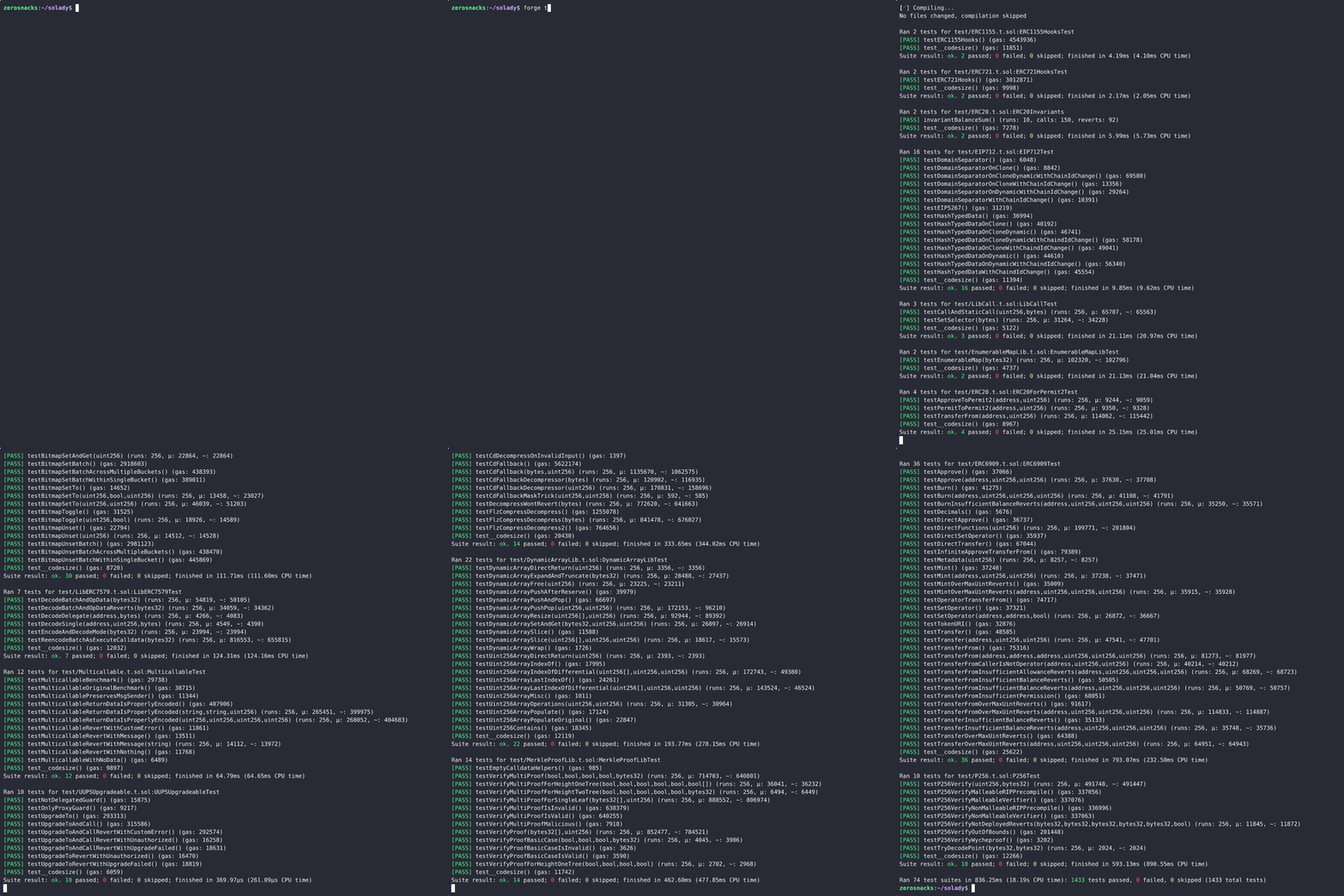
High-Performance Compilation
Advanced Testing
console.sol for flexible debug logging.Powerful Runtime Features
Streamlined CI/CD
Forge is quite fast at both compiling (leveraging solc with [foundry-compilers]) and testing.
See the benchmarks below. Older benchmarks against [DappTools][dapptools] can be found in the [v0.2.0 announcement post][benchmark-post] and in the [Convex Shutdown Simulation][convex] repository.
| Project | Type | [Forge 1.0][foundry-1.0] | [Forge 0.2][foundry-0.2] | DappTools | Speedup |
|---|---|---|---|---|---|
| [vectorized/solady][solady] | Unit / Fuzz | 0.9s | 2.3s | - | 2.6x |
| [morpho-org/morpho-blue][morpho-blue] | Invariant | 0.7s | 1m43s | - | 147.1x |
| [morpho-org/morpho-blue-oracles][morpho-blue] | Integration (Cold) | 6.1s | 6.3s | - | 1.04x |
| [morpho-org/morpho-blue-oracles][morpho-blue] | Integration (Cached) | 0.6s | 0.9s | - | 1.50x |
| [transmissions11/solmate][solmate] | Unit / Fuzz | 2.7s | 2.8s | 6m34s | 1.03x / 140.0x |
| [reflexer-labs/geb][geb] | Unit / Fuzz | 0.2s | 0.4s | 23s | 2.0x / 57.5x |
In the above benchmarks, compilation was always skipped
Takeaway: Forge dramatically outperforms the competition, delivering blazing-fast execution speeds while continuously expanding its robust feature set.


Takeaway: Forge compilation is consistently faster than Hardhat by a factor of 2.1x to 5.2x, depending on the amount of caching involved.
Forge helps you build, test, fuzz, debug and deploy Solidity contracts.
The best way to understand Forge is to simply try it (in less than 30 seconds!).
First, let's initialize a new counter example repository:
forge init counter
Next cd into counter and build:
forge init counter && cd counter
forge build
forge test
Interact with a live network:
cast block-number --rpc-url https://eth.merkle.io
cast balance vitalik.eth --ether --rpc-url https://eth.merkle.io
Replay and trace a transaction
cast run 0x9c32042f5e997e27e67f82583839548eb19dc78c4769ad6218657c17f2a5ed31 --rpc-url https://eth.merkle.io
Optionally, pass --etherscan-api-key <API_KEY> to decode transaction traces using verified source maps, providing more detailed and human-readable information.
Run cast --help to explore the full list of available subcommands and their usage.
More documentation can be found in the cast section of the Foundry Docs.
Foundry is highly configurable, allowing you to tailor it to your needs. Configuration is managed via a file called foundry.toml located in the root of your project or any parent directory. For a full list of configuration options, refer to the config package documentation.
You can find additional setup and configurations guides in the Foundry Docs and in the config crate:
foundry.tomlProfiles and Namespaces
default. Learn more in the Default Profile section.FOUNDRY_PROFILE environment variable.FOUNDRY_ (e.g., FOUNDRY_SRC).Contributions are welcome and highly appreciated. To get started, check out the contributing guidelines.
Join our Telegram to chat about the development of Foundry.
See SECURITY.md.
Having trouble? See if the answer to your question can be found in the Foundry Docs.
If the answer is not there:
496 followers · starred Mar 2026
30 followers · starred Feb 2026
158 followers · starred Dec 2025
43 followers · starred Dec 2025
Tempo is a blockchain designed specifically for stablecoin payments. Its architecture focuses on high throughput, low cost, and features that financial institutions, payment service providers, and fintech platforms expect from modern payment infrastructure.
Tempo Foundry is a custom fork of Foundry that integrates Tempo's payment-native protocol features directly into the familiar Foundry developer workflow.
This is a temporary required drop-in replacement for upstream Foundry while Tempo-specific features are being integrated into upstream Foundry, after which this fork will be deprecated.
Get started here to use Tempo's features in Foundry.
Tempo's Foundry fork is installed through the standard upstream foundryup using the -n tempo flag, no separate installer is required.
Getting started is very easy:
Install regular foundryup:
curl -L https://foundry.paradigm.xyz | bash
Or if you already have foundryup installed:
foundryup --update
Next, run:
foundryup -n tempo
It will automatically install the latest nightly release of the precompiled binaries: forge and cast.
Done!
For additional details see the installation guide in the Foundry Docs.
If you're experiencing any issues while installing, check out Getting Help and the FAQ.
You can connect to Tempo's public testnet using the following details:
| Property | Value |
|---|---|
| Network Name | Tempo Testnet (Moderato) |
| Currency | USD |
| Chain ID | 42431 |
| HTTP URL | https://rpc.moderato.tempo.xyz |
| WebSocket URL | wss://rpc.moderato.tempo.xyz |
| Block Explorer | https://explore.moderato.tempo.xyz |
Next, grab some stablecoins to test with from Tempo's Faucet.
Alternatively, use cast:
cast rpc tempo_fundAddress <ADDRESS> --rpc-url https://rpc.moderato.tempo.xyz
Key extensions:
In foundryup:
foundryup -n tempo: download the latest nightly release of Tempo's fork of Foundry.foundryup -n tempo -i <TAG>: download a specific nightly release by tag nightly-<hash>.In forge:
forge init -n tempo: adds a Tempo-specific Mail template showcasing a TIP20 transfer with an attached memo.forge install tempoxyz/tempo-std: like forge-std, a collection of helpful contracts and libraries for Tempo-specific testing and utilities.--tempo.fee-token support: pay gas fees in any TIP20 stablecoin.In cast:
cast run: updated to correctly process Tempo's system transactions when replaying a block.cast tip20: alias to cast erc20.--tempo.fee-token support: pay gas fees in any TIP20 stablecoin.Additionally:
TempoEvm extends Revm's Evm to accommodate differences Tempo introduces to optimize for payments.Blazing fast, portable and modular toolkit for Ethereum application development, written in Rust.
Tempo's fork of Foundry consists of:
Need help getting started with Foundry? Read the 📖 Foundry Docs!
High-Performance Compilation
Advanced Testing
console.sol for flexible debug logging.Powerful Runtime Features
Streamlined CI/CD
Forge is quite fast at both compiling (leveraging solc with [foundry-compilers]) and testing.
See the benchmarks below. Older benchmarks against [DappTools][dapptools] can be found in the [v0.2.0 announcement post][benchmark-post] and in the [Convex Shutdown Simulation][convex] repository.
| Project | Type | [Forge 1.0][foundry-1.0] | [Forge 0.2][foundry-0.2] | DappTools | Speedup |
|---|---|---|---|---|---|
| [vectorized/solady][solady] | Unit / Fuzz | 0.9s | 2.3s | - | 2.6x |
| [morpho-org/morpho-blue][morpho-blue] | Invariant | 0.7s | 1m43s | - | 147.1x |
| [morpho-org/morpho-blue-oracles][morpho-blue] | Integration (Cold) | 6.1s | 6.3s | - | 1.04x |
| [morpho-org/morpho-blue-oracles][morpho-blue] | Integration (Cached) | 0.6s | 0.9s | - | 1.50x |
| [transmissions11/solmate][solmate] | Unit / Fuzz | 2.7s | 2.8s | 6m34s | 1.03x / 140.0x |
| [reflexer-labs/geb][geb] | Unit / Fuzz | 0.2s | 0.4s | 23s | 2.0x / 57.5x |
In the above benchmarks, compilation was always skipped
Takeaway: Forge dramatically outperforms the competition, delivering blazing-fast execution speeds while continuously expanding its robust feature set.
Takeaway: Forge compilation is consistently faster than Hardhat by a factor of 2.1x to 5.2x, depending on the amount of caching involved.
Forge helps you build, test, fuzz, debug and deploy Solidity contracts.
The best way to understand Forge is to simply try it (in less than 30 seconds!).
First, let's initialize a new counter example repository:
forge init counter
Next cd into counter and build:
forge init counter && cd counter
forge build
forge test
Interact with a live network:
cast block-number --rpc-url https://eth.merkle.io
cast balance vitalik.eth --ether --rpc-url https://eth.merkle.io
Replay and trace a transaction
cast run 0x9c32042f5e997e27e67f82583839548eb19dc78c4769ad6218657c17f2a5ed31 --rpc-url https://eth.merkle.io
Optionally, pass --etherscan-api-key <API_KEY> to decode transaction traces using verified source maps, providing more detailed and human-readable information.
Run cast --help to explore the full list of available subcommands and their usage.
More documentation can be found in the cast section of the Foundry Docs.
Foundry is highly configurable, allowing you to tailor it to your needs. Configuration is managed via a file called foundry.toml located in the root of your project or any parent directory. For a full list of configuration options, refer to the config package documentation.
You can find additional setup and configurations guides in the Foundry Docs and in the config crate:
foundry.tomlProfiles and Namespaces
default. Learn more in the Default Profile section.FOUNDRY_PROFILE environment variable.FOUNDRY_ (e.g., FOUNDRY_SRC).Contributions are welcome and highly appreciated. To get started, check out the contributing guidelines.
Join our Telegram to chat about the development of Foundry.
See SECURITY.md.
Having trouble? See if the answer to your question can be found in the Foundry Docs.
If the answer is not there:
496 followers · starred Mar 2026
30 followers · starred Feb 2026
158 followers · starred Dec 2025
43 followers · starred Dec 2025