Domain-specific BERT representation for Named Entity Recognition of lab protocol
Python
29
8 commits
updated Dec 25, 2020
code for the system that secured 4 runner up at EMNLP 2020 workshop WNUT Shared Task-3
This Repo contains
Relevant Links: arxiv-pdf | poster
For more detail refer shared task website
Please cite with the following BiBTeX code:
@article{Vaidhya_2020,
   title={IITKGP at W-NUT 2020 Shared Task-1: Domain specific BERT representation for Named Entity Recognition of lab protocol},
   url={http://dx.doi.org/10.18653/v1/2020.wnut-1.34},
   DOI={10.18653/v1/2020.wnut-1.34},
   journal={Proceedings of the Sixth Workshop on Noisy User-generated Text (W-NUT 2020)},
   publisher={Association for Computational Linguistics},
   author={Vaidhya, Tejas and Kaushal, Ayush},
   year={2020}
}
Authors: Tejas Vaidhya and Ayush Kaushal
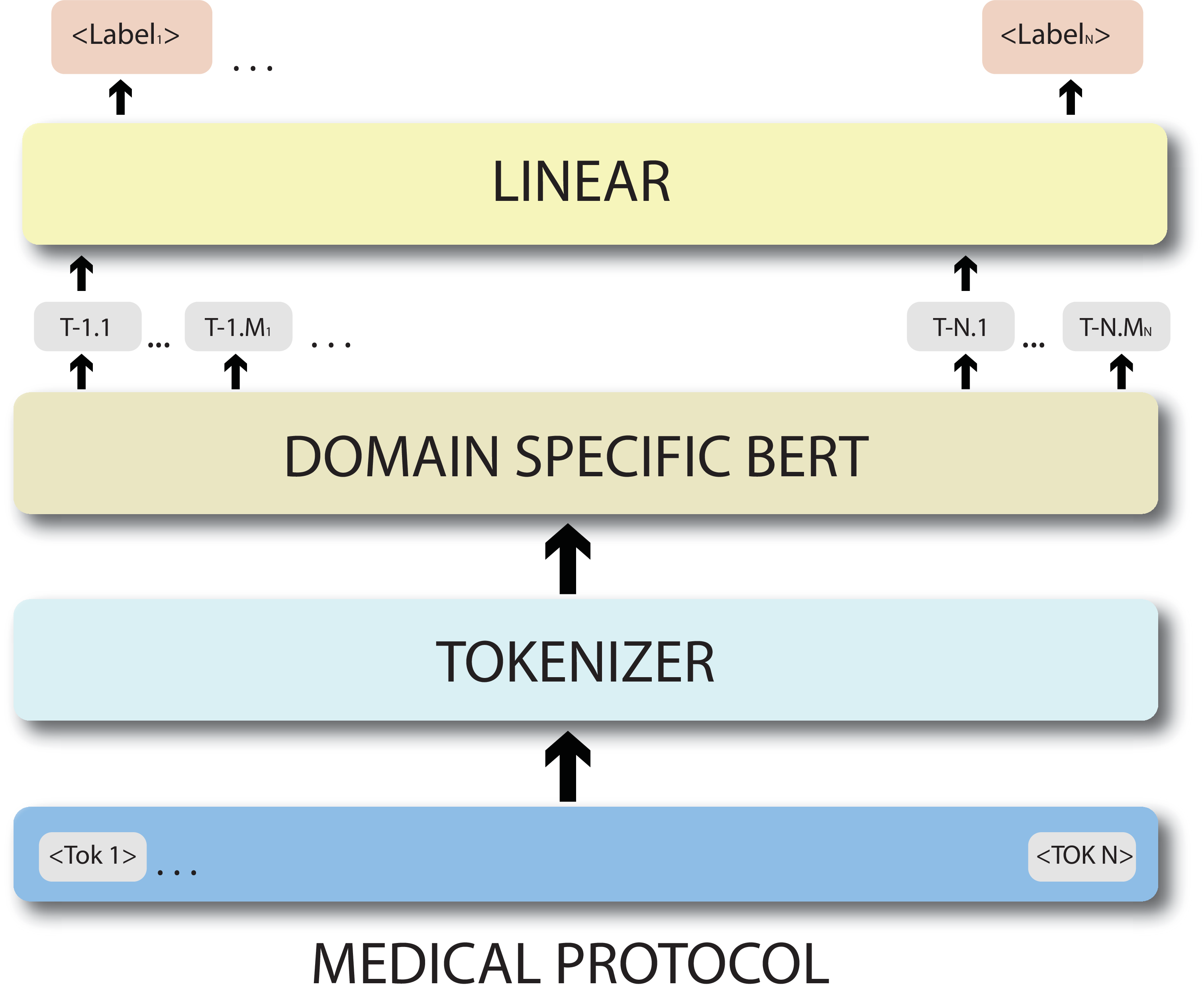
Supervised models trained to predict properties from representations have been achieving high accuracy on a variety of tasks. For instance, the BERT family seems to work exceptionally well on the downstream task from NER tagging to the range of other linguistic tasks. But the vocabulary used in the medical field contains a lot of different tokens used only in the medical industry such as the name of different diseases, devices, organisms, medicines, etc. that makes it difficult for traditional BERT model to create contextualized embedding. In this paper, we are going to illustrate the System for Named Entity Tagging based on Bio-Bert. Experimental results show that our model gives substantial improvements over the baseline and stood the fourth runner up in terms of F1 score, and first runner up in terms of Recall with just 2.21 F1 score behind the best one.
| Dependency | Version | Installation Command |
|---|---|---|
| Python | 3.8 | conda create --name covid_entities python=3.8 and conda activate covid_entities |
| PyTorch, cudatoolkit | 1.5.0, 10.1 | conda install pytorch==1.5.0 cudatoolkit=10.1 -c pytorch |
| Transformers (Huggingface) | 2.9.0 | pip install transformers==2.9.0 |
| Scikit-learn | 0.23.1 | pip install scikit-learn==0.23.1 |
| scipy | 1.5.0 | pip install scipy==1.5.0 |
| NLTK | 3.5 | `pip install nltk==3.5 |
| ` |
Set up the codebase and requirements
-git clone https://github.com/tejasvaidhyadev/W-NUT_2020.git & cd W-NUT_2020.
set-up above to install the dependencies.Setup the dataset : Fllow instruction in ./data/README.md
Recreating the experiment for the final submission:
-run python train.py --dataset=proto (BERT model will be automatically chosen (for now Bio-BERT). It will instantiate a model and train it on the training set following the hyper-parameters specified in experiment/proto/params.json. )
./data/Readme.mdWe release the models weights for our final submission.
./experiment/proto/Model Performance on test set released for final evaluation using organisers script (exact match) On exact matches
| Entity | Precision | Recall | F1 |
|---|---|---|---|
| Action | 87.85 | 85.2 | 86.5 |
| Amount | 72.25 | 93.78 | 81.62 |
| Concentration | 84.27 | 91.21 | 87.6 |
| Device | 65.2 | 58.4 | 61.61 |
| Generic-Measure | 28.74 | 40.34 | 33.57 |
| Location | 62.89 | 71.14 | 66.76 |
| Measure | 66.73 | 51.3 | 58.0 |
| Mention | 66.43 | 64.14 | 65.26 |
| Method | 45.98 | 42.53 | 44.19 |
| Modifier | 73.33 | 46.43 | 56.86 |
| Numerical | 66.15 | 49.62 | 56.7 |
| Reagent | 80.47 | 84.13 | 82.26 |
| Seal | 72.45 | 59.66 | 65.44 |
| Size | 54.93 | 16.39 | 25.24 |
| Speed | 87.01 | 92.08 | 89.47 |
| Temperature | 92.94 | 86.58 | 89.65 |
| Time | 90.27 | 86.13 | 88.15 |
| pH | 95.16 | 89.39 | 92.19 |
**On partial matches **
| Overall | Precision | Recall | F1 |
|---|---|---|---|
| partial matches | 81.76 | 77.43 | 79.54 |
| exact matches | 77 | 72.93 | 74.91 |
MIT
Domain-specific BERT representation for Named Entity Recognition of lab protocol
Python
29
8 commits
updated Dec 25, 2020
code for the system that secured 4 runner up at EMNLP 2020 workshop WNUT Shared Task-3
This Repo contains
Relevant Links: arxiv-pdf | poster
For more detail refer shared task website
Please cite with the following BiBTeX code:
@article{Vaidhya_2020,
   title={IITKGP at W-NUT 2020 Shared Task-1: Domain specific BERT representation for Named Entity Recognition of lab protocol},
   url={http://dx.doi.org/10.18653/v1/2020.wnut-1.34},
   DOI={10.18653/v1/2020.wnut-1.34},
   journal={Proceedings of the Sixth Workshop on Noisy User-generated Text (W-NUT 2020)},
   publisher={Association for Computational Linguistics},
   author={Vaidhya, Tejas and Kaushal, Ayush},
   year={2020}
}
Authors: Tejas Vaidhya and Ayush Kaushal
Supervised models trained to predict properties from representations have been achieving high accuracy on a variety of tasks. For instance, the BERT family seems to work exceptionally well on the downstream task from NER tagging to the range of other linguistic tasks. But the vocabulary used in the medical field contains a lot of different tokens used only in the medical industry such as the name of different diseases, devices, organisms, medicines, etc. that makes it difficult for traditional BERT model to create contextualized embedding. In this paper, we are going to illustrate the System for Named Entity Tagging based on Bio-Bert. Experimental results show that our model gives substantial improvements over the baseline and stood the fourth runner up in terms of F1 score, and first runner up in terms of Recall with just 2.21 F1 score behind the best one.
| Dependency | Version | Installation Command |
|---|---|---|
| Python | 3.8 | conda create --name covid_entities python=3.8 and conda activate covid_entities |
| PyTorch, cudatoolkit | 1.5.0, 10.1 | conda install pytorch==1.5.0 cudatoolkit=10.1 -c pytorch |
| Transformers (Huggingface) | 2.9.0 | pip install transformers==2.9.0 |
| Scikit-learn | 0.23.1 | pip install scikit-learn==0.23.1 |
| scipy | 1.5.0 | pip install scipy==1.5.0 |
| NLTK | 3.5 | `pip install nltk==3.5 |
| ` |
Set up the codebase and requirements
-git clone https://github.com/tejasvaidhyadev/W-NUT_2020.git & cd W-NUT_2020.
set-up above to install the dependencies.Setup the dataset : Fllow instruction in ./data/README.md
Recreating the experiment for the final submission:
-run python train.py --dataset=proto (BERT model will be automatically chosen (for now Bio-BERT). It will instantiate a model and train it on the training set following the hyper-parameters specified in experiment/proto/params.json. )
./data/Readme.mdWe release the models weights for our final submission.
./experiment/proto/Model Performance on test set released for final evaluation using organisers script (exact match) On exact matches
| Entity | Precision | Recall | F1 |
|---|---|---|---|
| Action | 87.85 | 85.2 | 86.5 |
| Amount | 72.25 | 93.78 | 81.62 |
| Concentration | 84.27 | 91.21 | 87.6 |
| Device | 65.2 | 58.4 | 61.61 |
| Generic-Measure | 28.74 | 40.34 | 33.57 |
| Location | 62.89 | 71.14 | 66.76 |
| Measure | 66.73 | 51.3 | 58.0 |
| Mention | 66.43 | 64.14 | 65.26 |
| Method | 45.98 | 42.53 | 44.19 |
| Modifier | 73.33 | 46.43 | 56.86 |
| Numerical | 66.15 | 49.62 | 56.7 |
| Reagent | 80.47 | 84.13 | 82.26 |
| Seal | 72.45 | 59.66 | 65.44 |
| Size | 54.93 | 16.39 | 25.24 |
| Speed | 87.01 | 92.08 | 89.47 |
| Temperature | 92.94 | 86.58 | 89.65 |
| Time | 90.27 | 86.13 | 88.15 |
| pH | 95.16 | 89.39 | 92.19 |
**On partial matches **
| Overall | Precision | Recall | F1 |
|---|---|---|---|
| partial matches | 81.76 | 77.43 | 79.54 |
| exact matches | 77 | 72.93 | 74.91 |
MIT



