
Photo-based reconstruction of classic Commodore 64 keycap lettering, with desktop fonts, webfont, editable outlines, and a specimen.
Python
0
9 commits
updated Oct 5, 2026
See what people are saying
README
C64 Keyboard
A font recreated from photographs of classic Commodore 64 keycaps, with cleaned-up shapes and consistent proportions.
Download TTF · OTF · Webfont · Complete package
Use it
Install the TTF or OTF, then select C64 Keyboard in your application.
To try it out, download and extract the complete package, then open preview.html. Click a special-key or PETSCII button to insert its symbol into the type tester, then copy the text into your application and select C64 Keyboard.
If you have an earlier version installed, replace it with version 1.107 and restart applications that still show the old font.
Included
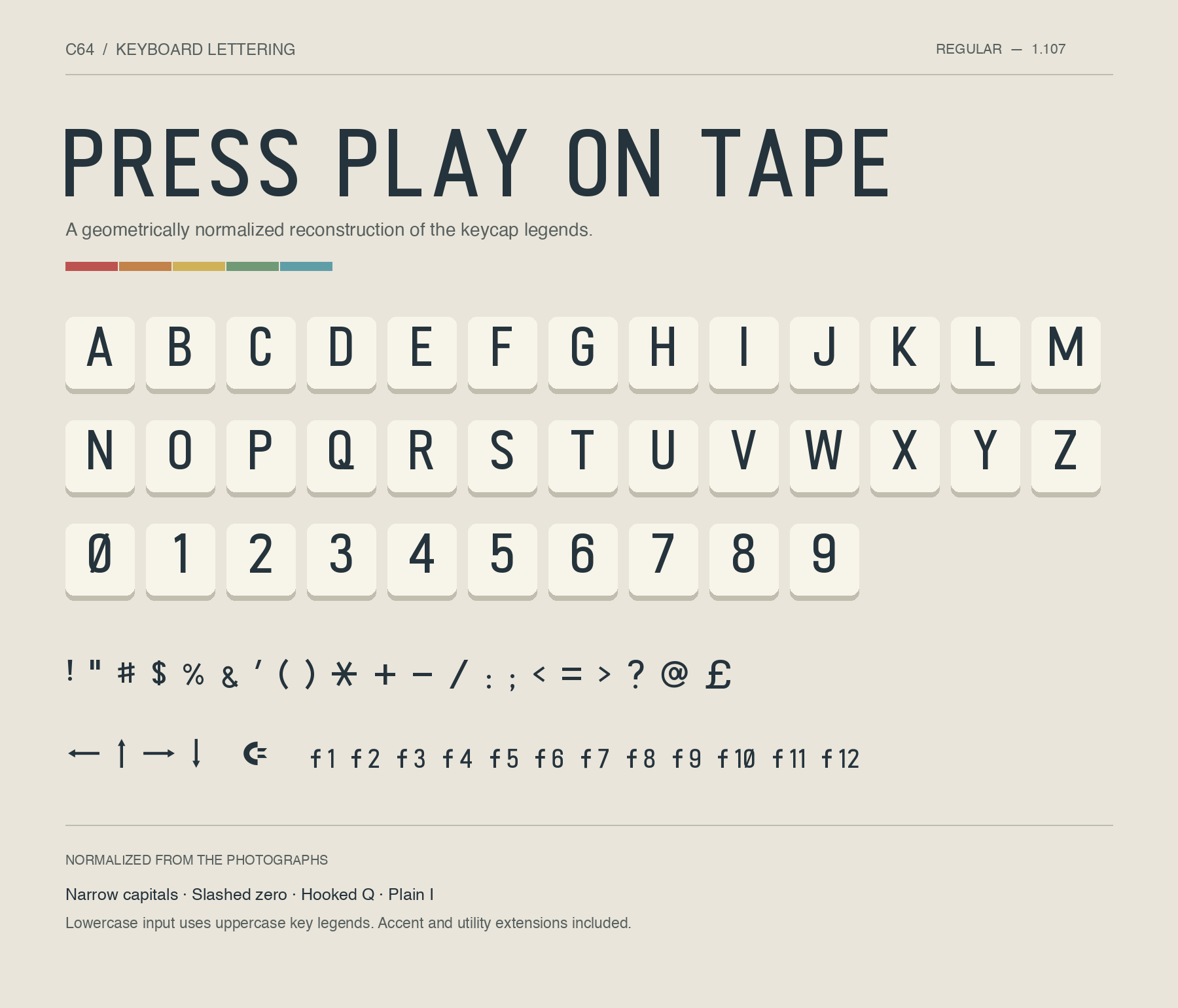
- Uppercase letters, numbers, punctuation, arrows, and £.
- Selected accented letters, including Hungarian characters.
- Function-key labels f1–f12 and classic C64 key legends.
- All 63 PETSCII graphic front legends, arranged by key in the preview.
Lowercase input displays as uppercase. This recreates printed key legends, including smooth geometric reconstructions of the PETSCII graphics, rather than the screen bitmap font.
PETSCII front legends
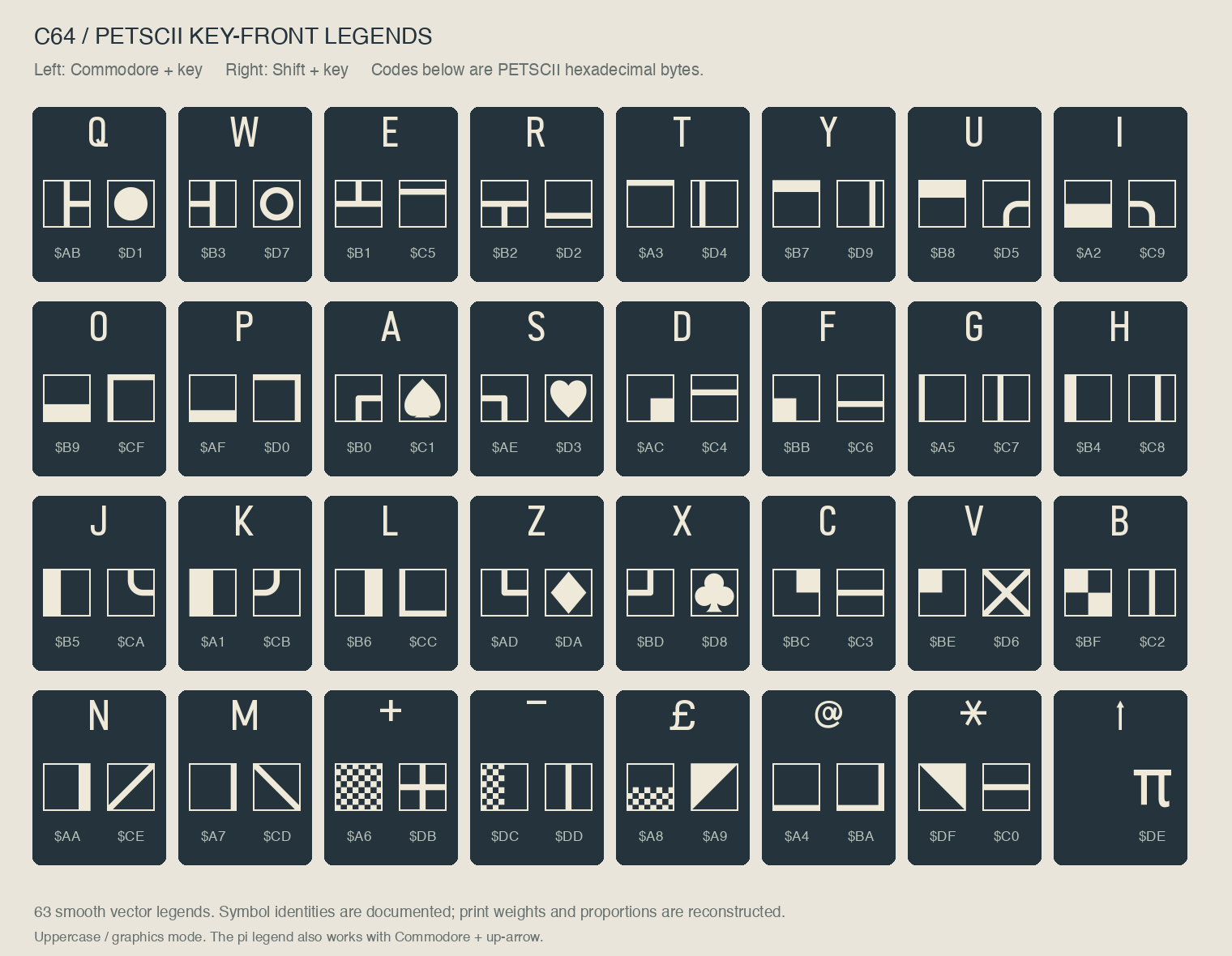
Open preview.html and use the PETSCII buttons to insert the symbols, then copy them from the type tester. Left legends correspond to Commodore + key, right legends to Shift + key in uppercase/graphics mode. Pi on the up-arrow key also works with Commodore.
These are reconstructed outlines: identities and key assignments come from the Ultimate Commodore 64 Reference; frame thickness, curves, and print proportions are inferred from the supplied keyboard photograph. They are not exact photo traces. Pi is unframed as on the key.
The preview handles the special character codes for you. Copied symbols need this font to display correctly. See the PETSCII key map and encoding guide for codes and keyboard combinations.
Editable outlines are in glyphs/, with build tools in scripts/. Original photographs are not included.
Build instructions · Version history
An independent, unofficial reconstruction.
Similar repos





Photo-based reconstruction of classic Commodore 64 keycap lettering, with desktop fonts, webfont, editable outlines, and a specimen.
Python
0
9 commits
updated Oct 5, 2026
See what people are saying
README
C64 Keyboard
A font recreated from photographs of classic Commodore 64 keycaps, with cleaned-up shapes and consistent proportions.
Download TTF · OTF · Webfont · Complete package
Use it
Install the TTF or OTF, then select C64 Keyboard in your application.
To try it out, download and extract the complete package, then open preview.html. Click a special-key or PETSCII button to insert its symbol into the type tester, then copy the text into your application and select C64 Keyboard.
If you have an earlier version installed, replace it with version 1.107 and restart applications that still show the old font.
Included
- Uppercase letters, numbers, punctuation, arrows, and £.
- Selected accented letters, including Hungarian characters.
- Function-key labels f1–f12 and classic C64 key legends.
- All 63 PETSCII graphic front legends, arranged by key in the preview.
Lowercase input displays as uppercase. This recreates printed key legends, including smooth geometric reconstructions of the PETSCII graphics, rather than the screen bitmap font.
PETSCII front legends
Open preview.html and use the PETSCII buttons to insert the symbols, then copy them from the type tester. Left legends correspond to Commodore + key, right legends to Shift + key in uppercase/graphics mode. Pi on the up-arrow key also works with Commodore.
These are reconstructed outlines: identities and key assignments come from the Ultimate Commodore 64 Reference; frame thickness, curves, and print proportions are inferred from the supplied keyboard photograph. They are not exact photo traces. Pi is unframed as on the key.
The preview handles the special character codes for you. Copied symbols need this font to display correctly. See the PETSCII key map and encoding guide for codes and keyboard combinations.
Editable outlines are in glyphs/, with build tools in scripts/. Original photographs are not included.
Build instructions · Version history
An independent, unofficial reconstruction.