Python decompiler for modern Python versions.
See the codePyLingual is a CPython bytecode decompiler supporting all released Python versions since 3.6. For information about the design and implementation of PyLingual, please refer to our research paper.
PyLingual can be run through our web service or run locally.
This codebase is optimized for readability and future extension, so there may initially be some control flow accuracy regression compared to the version hosted on the web service.
uv Python package manager (installation), used for project dependencies and managed Python versions.To verify decompilation correctness and produce model training sets, PyLingual requires the ability to compile Python in the target version.
For current Python versions (3.8-3.15), PyLingual uses uv's managed installations, but for Python 3.6 and 3.7, PyLingual uses pyenv (pyenv-win for Windows).
Install from source, using uv:
git clone https://github.com/syssec-utd/pylingual
uv tool install ./pylingual
The CLI can reuse translation-model predictions across files and runs using Redis, with the same cache used by the dataset evaluator. Entries are keyed by Python version and normalized bytecode. Repeated statements can skip translation-model inference; the first uncached translation still runs the model, and segmentation and model loading are not cached by Redis.
With Docker and Docker Compose installed, start Redis from the cloned repository:
cd pylingual
docker compose up -d redis
The bundled service listens on 127.0.0.1:6379. If Redis is already running there
(for example, for the dataset evaluator), reuse it instead of starting another service.
Enable caching with:
pylingual --redis-host 127.0.0.1 example.pyc
Alternatively, set PYLINGUAL_REDIS_HOST: export PYLINGUAL_REDIS_HOST=127.0.0.1
in a POSIX shell, or $env:PYLINGUAL_REDIS_HOST = '127.0.0.1' in PowerShell.
Without a host, Redis caching remains disabled. Use --redis-port or
PYLINGUAL_REDIS_PORT for a different port; the CLI defaults to 6379.
Command-line settings override their environment variables.
Cache keys do not include the translation model revision. Use a separate Redis instance when switching translation models to avoid reusing predictions from another model.
Usage: pylingual [OPTIONS] [FILES]...

  End to end pipeline to decompile Python bytecode into source code.

Options:
  -o, --out-dir PATH      The directory to export results to.
  -c, --config-file PATH  Config file for model information.
  -v, --version VERSION   Python version of the .pyc, default is auto
                          detection.
  -k, --top-k INT         Maximum number of additional segmentations to
                          consider.
  -r, --redis-host HOST  Redis translation cache host; defaults to
                         $PYLINGUAL_REDIS_HOST. Unset disables caching.
  --redis-port PORT      Redis port; defaults to $PYLINGUAL_REDIS_PORT
                         or 6379.
  -q, --quiet             Suppress console output.
  --trust-lnotab          Use the lnotab for segmentation instead of the
                          segmentation model.
  --init-pyenv            Install pyenv before decompiling.
  -h, --help              Show this message and exit.
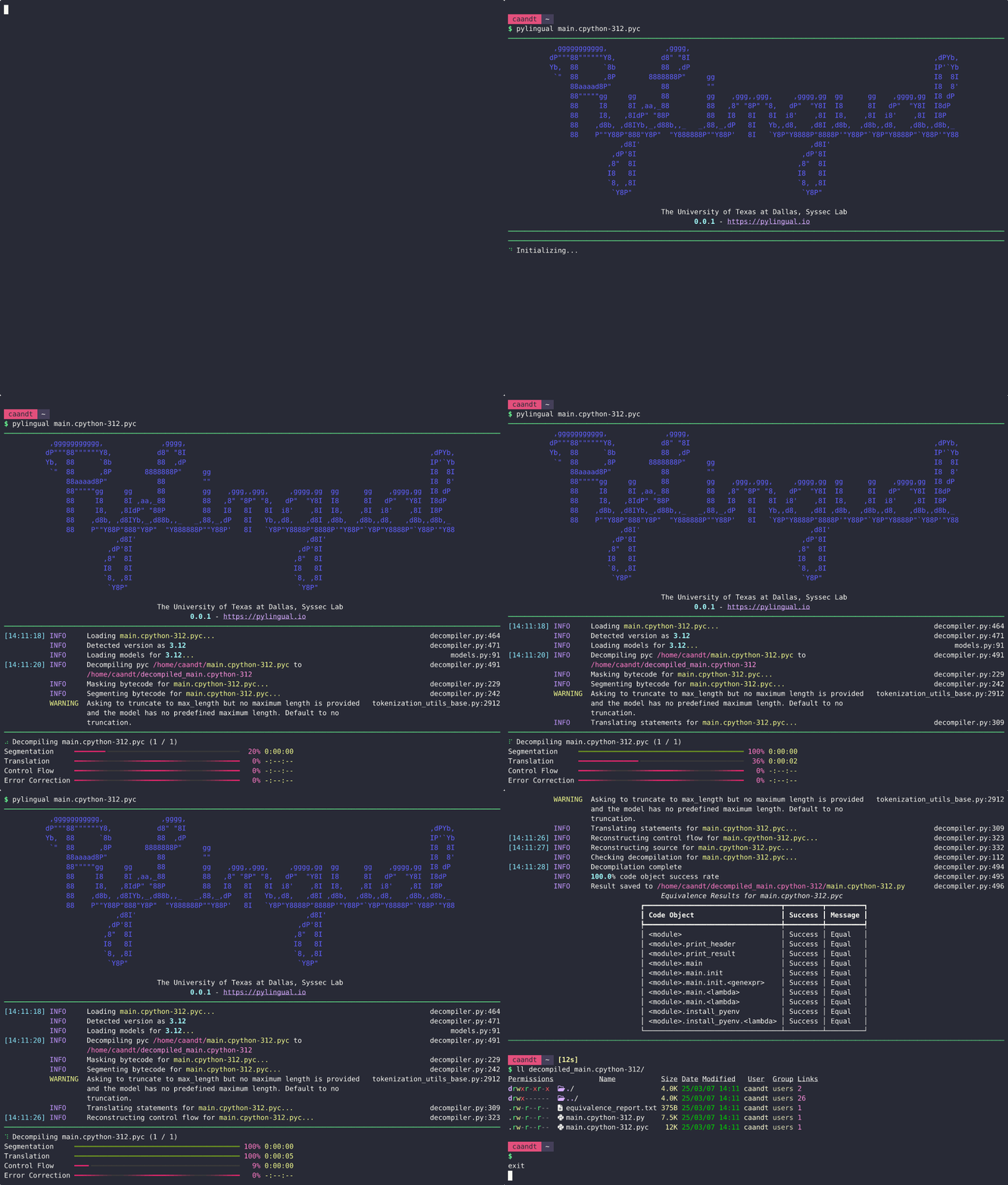
If you have any issues for installing and using PyLingual, please create an issue or send your message via our support email at [email protected].
164 followers · starred Jun 2025
329 followers · starred Nov 2025
715 followers · starred Aug 2025
543 followers · starred Feb 2026
Python decompiler for modern Python versions.
See the codePyLingual is a CPython bytecode decompiler supporting all released Python versions since 3.6. For information about the design and implementation of PyLingual, please refer to our research paper.
PyLingual can be run through our web service or run locally.
This codebase is optimized for readability and future extension, so there may initially be some control flow accuracy regression compared to the version hosted on the web service.
uv Python package manager (installation), used for project dependencies and managed Python versions.To verify decompilation correctness and produce model training sets, PyLingual requires the ability to compile Python in the target version.
For current Python versions (3.8-3.15), PyLingual uses uv's managed installations, but for Python 3.6 and 3.7, PyLingual uses pyenv (pyenv-win for Windows).
Install from source, using uv:
git clone https://github.com/syssec-utd/pylingual
uv tool install ./pylingual
The CLI can reuse translation-model predictions across files and runs using Redis, with the same cache used by the dataset evaluator. Entries are keyed by Python version and normalized bytecode. Repeated statements can skip translation-model inference; the first uncached translation still runs the model, and segmentation and model loading are not cached by Redis.
With Docker and Docker Compose installed, start Redis from the cloned repository:
cd pylingual
docker compose up -d redis
The bundled service listens on 127.0.0.1:6379. If Redis is already running there
(for example, for the dataset evaluator), reuse it instead of starting another service.
Enable caching with:
pylingual --redis-host 127.0.0.1 example.pyc
Alternatively, set PYLINGUAL_REDIS_HOST: export PYLINGUAL_REDIS_HOST=127.0.0.1
in a POSIX shell, or $env:PYLINGUAL_REDIS_HOST = '127.0.0.1' in PowerShell.
Without a host, Redis caching remains disabled. Use --redis-port or
PYLINGUAL_REDIS_PORT for a different port; the CLI defaults to 6379.
Command-line settings override their environment variables.
Cache keys do not include the translation model revision. Use a separate Redis instance when switching translation models to avoid reusing predictions from another model.
Usage: pylingual [OPTIONS] [FILES]...

  End to end pipeline to decompile Python bytecode into source code.

Options:
  -o, --out-dir PATH      The directory to export results to.
  -c, --config-file PATH  Config file for model information.
  -v, --version VERSION   Python version of the .pyc, default is auto
                          detection.
  -k, --top-k INT         Maximum number of additional segmentations to
                          consider.
  -r, --redis-host HOST  Redis translation cache host; defaults to
                         $PYLINGUAL_REDIS_HOST. Unset disables caching.
  --redis-port PORT      Redis port; defaults to $PYLINGUAL_REDIS_PORT
                         or 6379.
  -q, --quiet             Suppress console output.
  --trust-lnotab          Use the lnotab for segmentation instead of the
                          segmentation model.
  --init-pyenv            Install pyenv before decompiling.
  -h, --help              Show this message and exit.
If you have any issues for installing and using PyLingual, please create an issue or send your message via our support email at [email protected].
164 followers · starred Jun 2025
329 followers · starred Nov 2025
715 followers · starred Aug 2025
543 followers · starred Feb 2026



