
LLM switchboard for Claude Code, Codex and AI agents — pool providers, cloud credits, regions and local models behind stable routes.
13
stars
226
commits
Go
primary language
Sep 13, 2026
updated
README
Swobu — LLM Switchboard
Pool the LLM capacity you already have.
Put AWS/Azure credits, provider accounts and quota, free APIs and local GPUs behind stable routes for Claude Code, Codex and other agents. Change the capacity behind a route without reconfiguring every client.
Documentation · Quickstart · Releases · VS Code
curl -fsSL https://swobu.com/install.sh | sh
Windows PowerShell: irm https://swobu.com/install.ps1 | iex
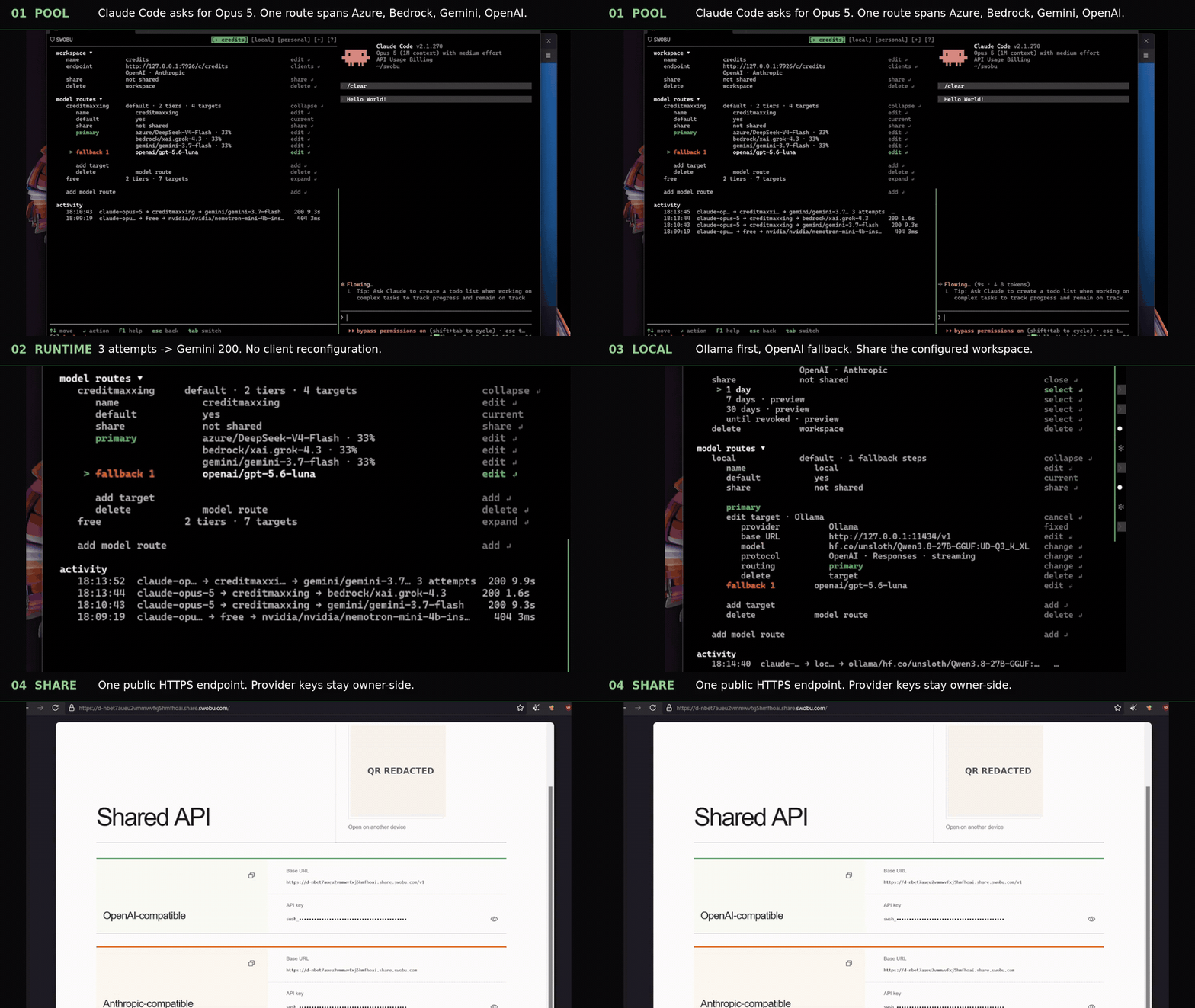
One route. Your capacity underneath.
A Swobu route looks like a model name to the client. You decide what sits behind it.
Claude Code / Codex / OpenCode
              │
              │  model: work
              ▼
            Swobu
              │
              ├─ Azure / westus2 / gpt-5.6-sol
              ├─ Azure / westcentralus / gpt-5.6-sol
              └─ fallback: OpenAI / gpt-5.6-sol
The client keeps asking for work. You can change accounts, regions, providers or models behind that route independently.
Runtime rule: Swobu does not preflight compatibility. It attempts the real request against the configured target. If that attempt fails, it tries the next target in the route. Protocol translation happens per attempt; providers remain different.
What the switchboard is for
| Job | Route pattern |
|---|---|
| Use funded capacity before cash | AWS/Azure/GCP-backed targets before direct paid APIs |
| Aggregate quota | same model across regions or accounts |
| Make cheap capacity useful | free/local targets first, paid fallback behind them |
| Route agents by workload | premium main route, cheap/free worker routes |
| Keep policy out of clients | local-first, region/provider restrictions, funded-first ordering |
| Share configured capacity | one HTTPS endpoint while routing and provider credentials stay owner-side |
Swobu does not inspect your credit balance, remaining TPM, price or latency. The route expresses your policy; Swobu executes it.
One client endpoint, multiple provider protocols
Claude Code ─┐
Codex ───────┤
OpenCode ────┤
Kilo ────────┤
Pi ──────────┼──── Swobu ────┬─ OpenAI Responses / Chat Completions
OpenClaw ────┤                ├─ Anthropic Messages
Hermes ──────┘                ├─ Gemini
                              └─ provider-specific endpoints
Swobu translates supported request semantics for each target attempt. Translation is not equivalence: provider-specific behavior remains observable, and unsupported combinations can fail and advance through the route.
Current docs cover 40 provider integrations, including local inference, frontier APIs, hyperscalers and specialized inference platforms.
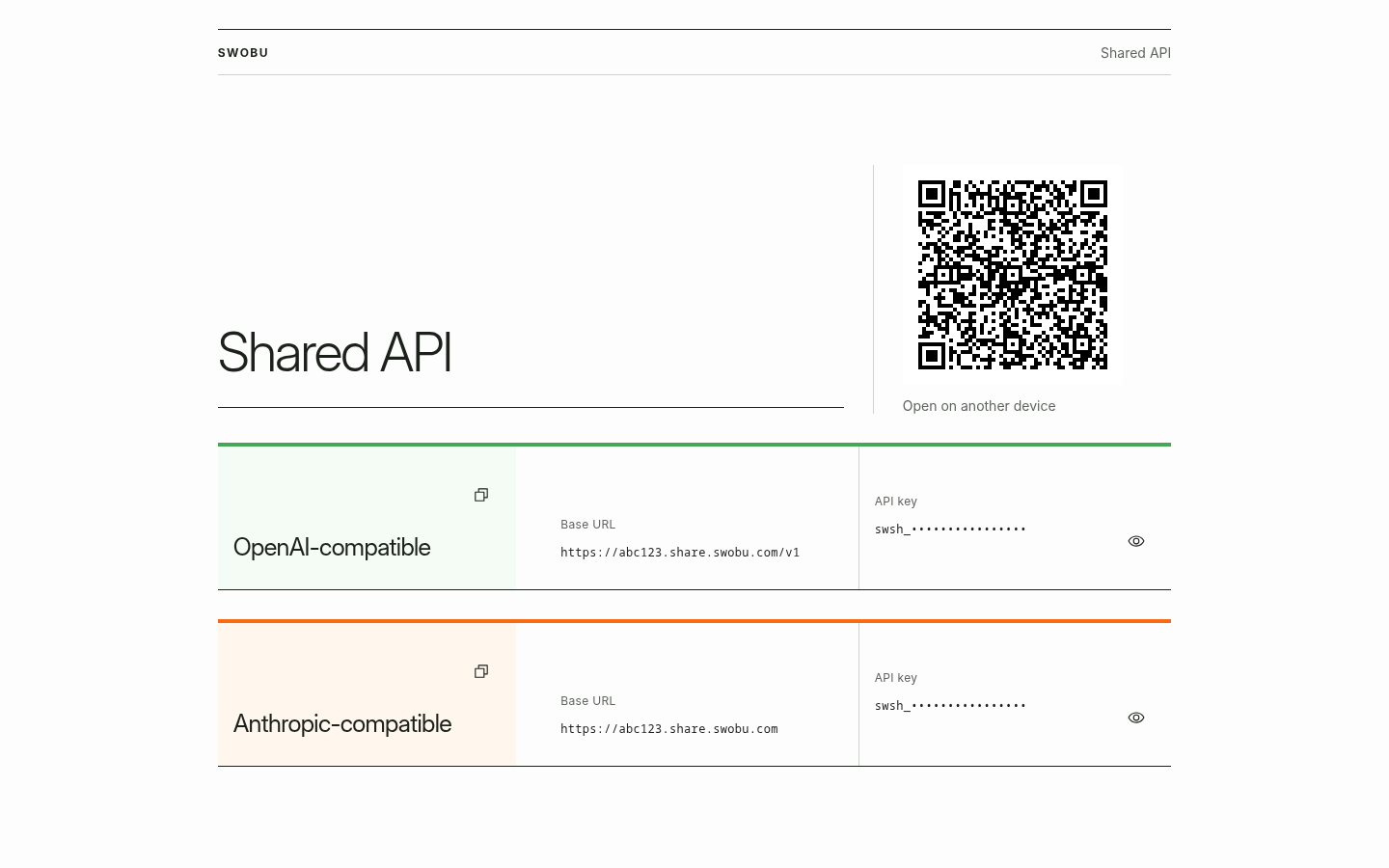
Share the endpoint. Keep provider keys at home.
swobu share dev/coding
A shared route gives the recipient an HTTPS endpoint and Swobu bearer. Routing, fallback and provider credentials remain on the owner side. Change the targets later without changing the recipient's endpoint or route name.
Connect an agent
Cockpit can configure supported clients, or use the CLI:
swobu connect claude
swobu connect codex
swobu connect opencode
swobu connect kilo
swobu connect pi
Provider credentials and routing stay behind Swobu rather than being copied into every client.
Local-first
Swobu runs locally and exposes the endpoint your agents connect to. No Swobu account is required for local use.
Swobu sends privacy-minimized usage and reliability telemetry tied to a random installation ID. It does not send prompts, responses, credentials, endpoints or user-defined names. Disable it with swobu telemetry off or DO_NOT_TRACK.
Build from source
git clone https://github.com/swobuforge/swobu.git
cd swobu
make build
./.out/swobu --version
Swobu publishes versioned binaries for Linux, macOS and Windows with SHA-256 checksums.
License
Swobu is available under the GNU AGPLv3. A commercial license is also available.
Translations: English · 简体中文 · 日本語 · Português (Brasil) · Bahasa Indonesia · 한국어 · Русский · Español · Українська
Contributors

226 commits
See what people are saying
Similar repos


Languages
Go
97.5%
Gosu
1.8%
LLM switchboard for Claude Code, Codex and AI agents — pool providers, cloud credits, regions and local models behind stable routes.
13
stars
226
commits
Go
primary language
Sep 13, 2026
updated
README
Swobu — LLM Switchboard
Pool the LLM capacity you already have.
Put AWS/Azure credits, provider accounts and quota, free APIs and local GPUs behind stable routes for Claude Code, Codex and other agents. Change the capacity behind a route without reconfiguring every client.
Documentation · Quickstart · Releases · VS Code
curl -fsSL https://swobu.com/install.sh | sh
Windows PowerShell: irm https://swobu.com/install.ps1 | iex
One route. Your capacity underneath.
A Swobu route looks like a model name to the client. You decide what sits behind it.
Claude Code / Codex / OpenCode
              │
              │  model: work
              ▼
            Swobu
              │
              ├─ Azure / westus2 / gpt-5.6-sol
              ├─ Azure / westcentralus / gpt-5.6-sol
              └─ fallback: OpenAI / gpt-5.6-sol
The client keeps asking for work. You can change accounts, regions, providers or models behind that route independently.
Runtime rule: Swobu does not preflight compatibility. It attempts the real request against the configured target. If that attempt fails, it tries the next target in the route. Protocol translation happens per attempt; providers remain different.
What the switchboard is for
| Job | Route pattern |
|---|---|
| Use funded capacity before cash | AWS/Azure/GCP-backed targets before direct paid APIs |
| Aggregate quota | same model across regions or accounts |
| Make cheap capacity useful | free/local targets first, paid fallback behind them |
| Route agents by workload | premium main route, cheap/free worker routes |
| Keep policy out of clients | local-first, region/provider restrictions, funded-first ordering |
| Share configured capacity | one HTTPS endpoint while routing and provider credentials stay owner-side |
Swobu does not inspect your credit balance, remaining TPM, price or latency. The route expresses your policy; Swobu executes it.
One client endpoint, multiple provider protocols
Claude Code ─┐
Codex ───────┤
OpenCode ────┤
Kilo ────────┤
Pi ──────────┼──── Swobu ────┬─ OpenAI Responses / Chat Completions
OpenClaw ────┤                ├─ Anthropic Messages
Hermes ──────┘                ├─ Gemini
                              └─ provider-specific endpoints
Swobu translates supported request semantics for each target attempt. Translation is not equivalence: provider-specific behavior remains observable, and unsupported combinations can fail and advance through the route.
Current docs cover 40 provider integrations, including local inference, frontier APIs, hyperscalers and specialized inference platforms.
Share the endpoint. Keep provider keys at home.
swobu share dev/coding
A shared route gives the recipient an HTTPS endpoint and Swobu bearer. Routing, fallback and provider credentials remain on the owner side. Change the targets later without changing the recipient's endpoint or route name.
Connect an agent
Cockpit can configure supported clients, or use the CLI:
swobu connect claude
swobu connect codex
swobu connect opencode
swobu connect kilo
swobu connect pi
Provider credentials and routing stay behind Swobu rather than being copied into every client.
Local-first
Swobu runs locally and exposes the endpoint your agents connect to. No Swobu account is required for local use.
Swobu sends privacy-minimized usage and reliability telemetry tied to a random installation ID. It does not send prompts, responses, credentials, endpoints or user-defined names. Disable it with swobu telemetry off or DO_NOT_TRACK.
Build from source
git clone https://github.com/swobuforge/swobu.git
cd swobu
make build
./.out/swobu --version
Swobu publishes versioned binaries for Linux, macOS and Windows with SHA-256 checksums.
License
Swobu is available under the GNU AGPLv3. A commercial license is also available.
Translations: English · 简体中文 · 日本語 · Português (Brasil) · Bahasa Indonesia · 한국어 · Русский · Español · Українська
See what people are saying
Similar repos
Contributors
226 commits
Languages
Go
97.5%
Gosu
1.8%