
README
sw-os-ml -- MLOS
An operating system, written from scratch in Rust, that treats machine learning state as its primary virtualized resource.
Conventional operating systems virtualize a scarce resource -- physical memory -- behind an abstraction the hardware understands: the page. MLOS virtualizes a different scarce resource -- resident model state -- behind an abstraction the hardware does not yet understand: the ML object. Weights, KV blocks, MoE expert streams, activations, query context, embeddings and adapters are kernel objects with residency, tiering, leases and faults, the way pages are in Unix.
This is not a Linux or BSD derivative. It is a new kernel.
Status: three of eight gates, and the thesis is untested
| Gate | State |
|---|---|
| G1 boots to a shell | done |
| G2 holds an object table | done |
| G3 faults, and the fault carries meaning | done |
| G4 known-next-use beats LRU | not started -- this is the one that matters |
| G5-G8 sharing, degradation, GPU, ML-MMU | not started |
The three that are met are all mechanism. An object table with tiers and a fault handler is, to a fair sceptic, a cache with extra steps -- and the sceptic is right so far.
The one thing that makes MLOS not-a-cache is next_use: the field saying
when an object will be wanted again, which no page-based system can hold.
Nothing writes it. It has existed since the object table was built,
every layout document emits it as never, and until a policy acts on it
this project has demonstrated a problem rather than a solution.
That is deliberate sequencing, not an oversight, and docs/status.md is the ground truth -- if it is not in that file, it does not work.
What has been measured
Real numbers from real runs, not estimates. Reproduce them with the commands under Try it.
| QEMU/HVF (native) | QEMU/TCG | |
|---|---|---|
| One model fault, off virtio-blk | ~42 us | ~91 us |
| Recording one residency event | ~4 ns | ~129 ns |
| Sweep of 32 resident tiles, no I/O | ~4.9 us | ~40 us |
Recording costs about one ten-thousandth of a fault, which is why it is on by default. Method and caveats are in docs/status.md; the first attempt to measure it found nothing, because sweeps that fault are dominated by 32 virtio round trips.
From a running guest, at an 8 KiB arena against a 144 KiB model:
registered 136 objects, 144 KiB across 3 tiers
sweep   acquired 7 of 128 tiles in 364.708 us
        stopped: NoBudget -- no eviction policy yet
Rm      8/144 KiB of the model = 55 per mille
That is a faithful picture of the problem: memory is a fraction of the model, the sweep runs out, and MLOS refuses rather than guessing what to throw away. It is not yet a picture of a solution.
What has not been measured is the claim the project rests on: that an operating system which is told the future beats one that guesses. The next four steps produce that number -- see Where this goes next.
Documents
| Document | What it answers |
|---|---|
| docs/PRD.md | What MLOS is for, and what "done" means |
| docs/architecture.md | Kernel concepts, and the hardware/hypervisor reality we build on |
| docs/design.md | Crates, syscalls, object table, device contracts |
| docs/plan.md | Milestones and the implementation sagas |
| docs/status.md | Ground truth |
| docs/layout-handoff.md | What MLOS emits for the cross-repo visualization, and what it needs back |
| docs/external-asks.md | What MLOS needs from emufpga, sw-mlpl, demo-extensions, sw-tos and demo-memory -- and what it does without each |
| docs/research.txt | Raw source material the architecture was distilled from |
Try it
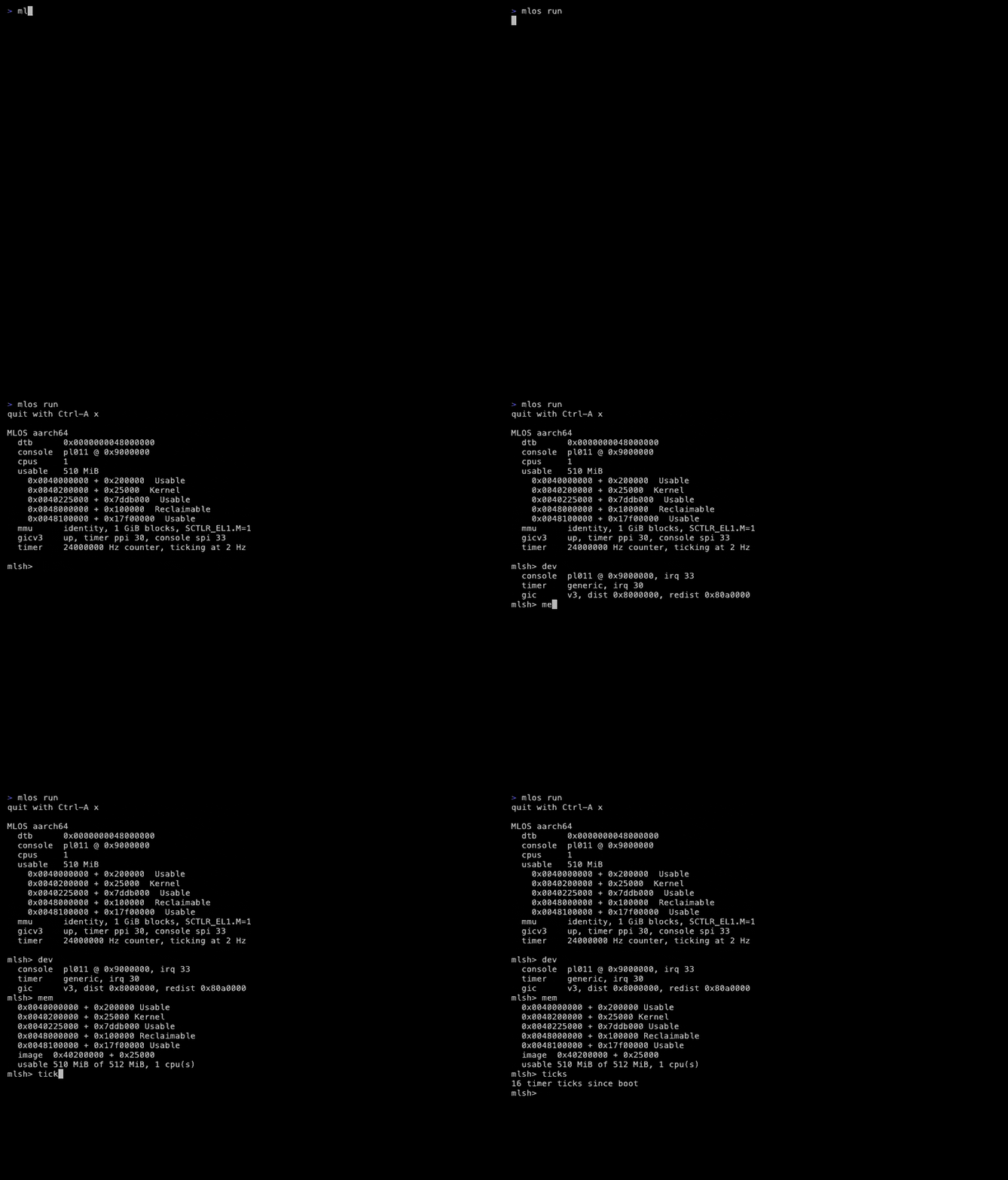
cargo run -p mlos-cli -- doctor
cargo run -p mlos-cli -- run
doctor reports what is installed and what is missing. run builds the
kernel, turns it into a bootable arm64 image and boots it under QEMU with
the console on your terminal -- mlsh is on the other end. Quit with
Ctrl-A x; type help inside for what it can tell you.
Inside, model 8 registers a synthetic transformer against an 8 KiB
arena, get 3 7 acquires one weight tile, sweep walks the whole model
and arena says how much of it fits. Running get on the same tile
twice is the shortest demonstration of what an object table is for: the
second time costs nothing.
(Do not paste a trailing # comment after these: interactive zsh does not
treat # as a comment, so it arrives as an argument. mlos will now say
so rather than passing it to QEMU.)
Looking at it
cargo run -p mlos-cli -- layout
cargo run -p mlos-cli -- runtime
layout describes what the build produced; runtime boots MLOS, sweeps
the model and describes what the running system holds. Both write the
columnar sw-ml-study.system-layout contract that sw-tos
also emits and sw-mlpl renders: where every weight tile sits on disk,
how the kernel image divides RAM, what is resident in the arena, and --
from runtime -- a stream of residency events saying how it got that way.
Conforming samples are committed under examples/viz/ so the sibling
repositories can develop against them without running MLOS. The contract,
the vocabulary and the open questions are in
docs/layout-handoff.md.
How this uses Apple Silicon
As a host, and only as a host. MLOS is an aarch64 kernel, so on an
M-series Mac it runs as a native guest: QEMU with the hvf accelerator
hands the guest's ARM instructions to Hypervisor.framework, which runs
them on the real cores. Nothing translates an instruction set.
The evidence is in the boot banner. Under HVF the guest reads
CNTFRQ_EL0 and gets 24 MHz -- Apple's own counter frequency, passed
through. Under TCG the same read gets 62.5 MHz, which is QEMU's virtual
timer. MLOS reads the register rather than assuming a rate, which is why
the same binary times itself correctly on both.
What MLOS drives is QEMU's virtual hardware, not Apple's: a GICv3 interrupt controller (Apple Silicon has an AIC, which MLOS never sees), a PL011 or virtio console, and virtio-mmio block devices. That is the point -- the kernel is portable to any aarch64 machine QEMU can present, and a second x86-64 target is already built in CI.
The Apple GPU is not used at all. No Metal, no ANE, nothing. Reaching a real GPU across a real PCIe bus is milestone M6, on a Linux/NVIDIA host, because Apple exposes no passthrough path for it. docs/architecture.md s.7 explains why, and what the alternatives cost.
Virtualization.framework (via vfkit) boots the same image and produces
no console output yet: it offers a virtio console and no PL011, and the
virtio-pci transport that would fix it arrives with M6.
Where this goes next
The next milestone is the one that justifies the project: replay one workload against four residency policies under an identical memory budget, and see whether knowing the future wins.
Four host-side steps produce that table -- a replay harness, three baselines, a workload with real reuse in it, and the known-next-use policy. None of them needs an emulator or anything from another repository. Then the saga stops and looks at the answer, because the plan commits to the other outcome: if known-next-use does not separate from LRU on a fair workload, say so and stop before M4.
Development
MLOS boots in a virtual machine, never on bare metal. Apple Silicon is the primary development host; a Linux/NVIDIA host is the second target, where real GPU passthrough becomes possible.
Work is tracked with agentrail sagas.
agentrail next prints the current step.
Copyright (c) Software Wrighter LLC.
Contributors

85 commits
See what people are saying
Similar repos


Languages
Rust
99.2%
README
sw-os-ml -- MLOS
An operating system, written from scratch in Rust, that treats machine learning state as its primary virtualized resource.
Conventional operating systems virtualize a scarce resource -- physical memory -- behind an abstraction the hardware understands: the page. MLOS virtualizes a different scarce resource -- resident model state -- behind an abstraction the hardware does not yet understand: the ML object. Weights, KV blocks, MoE expert streams, activations, query context, embeddings and adapters are kernel objects with residency, tiering, leases and faults, the way pages are in Unix.
This is not a Linux or BSD derivative. It is a new kernel.
Status: three of eight gates, and the thesis is untested
| Gate | State |
|---|---|
| G1 boots to a shell | done |
| G2 holds an object table | done |
| G3 faults, and the fault carries meaning | done |
| G4 known-next-use beats LRU | not started -- this is the one that matters |
| G5-G8 sharing, degradation, GPU, ML-MMU | not started |
The three that are met are all mechanism. An object table with tiers and a fault handler is, to a fair sceptic, a cache with extra steps -- and the sceptic is right so far.
The one thing that makes MLOS not-a-cache is next_use: the field saying
when an object will be wanted again, which no page-based system can hold.
Nothing writes it. It has existed since the object table was built,
every layout document emits it as never, and until a policy acts on it
this project has demonstrated a problem rather than a solution.
That is deliberate sequencing, not an oversight, and docs/status.md is the ground truth -- if it is not in that file, it does not work.
What has been measured
Real numbers from real runs, not estimates. Reproduce them with the commands under Try it.
| QEMU/HVF (native) | QEMU/TCG | |
|---|---|---|
| One model fault, off virtio-blk | ~42 us | ~91 us |
| Recording one residency event | ~4 ns | ~129 ns |
| Sweep of 32 resident tiles, no I/O | ~4.9 us | ~40 us |
Recording costs about one ten-thousandth of a fault, which is why it is on by default. Method and caveats are in docs/status.md; the first attempt to measure it found nothing, because sweeps that fault are dominated by 32 virtio round trips.
From a running guest, at an 8 KiB arena against a 144 KiB model:
registered 136 objects, 144 KiB across 3 tiers
sweep   acquired 7 of 128 tiles in 364.708 us
        stopped: NoBudget -- no eviction policy yet
Rm      8/144 KiB of the model = 55 per mille
That is a faithful picture of the problem: memory is a fraction of the model, the sweep runs out, and MLOS refuses rather than guessing what to throw away. It is not yet a picture of a solution.
What has not been measured is the claim the project rests on: that an operating system which is told the future beats one that guesses. The next four steps produce that number -- see Where this goes next.
Documents
| Document | What it answers |
|---|---|
| docs/PRD.md | What MLOS is for, and what "done" means |
| docs/architecture.md | Kernel concepts, and the hardware/hypervisor reality we build on |
| docs/design.md | Crates, syscalls, object table, device contracts |
| docs/plan.md | Milestones and the implementation sagas |
| docs/status.md | Ground truth |
| docs/layout-handoff.md | What MLOS emits for the cross-repo visualization, and what it needs back |
| docs/external-asks.md | What MLOS needs from emufpga, sw-mlpl, demo-extensions, sw-tos and demo-memory -- and what it does without each |
| docs/research.txt | Raw source material the architecture was distilled from |
Try it
cargo run -p mlos-cli -- doctor
cargo run -p mlos-cli -- run
doctor reports what is installed and what is missing. run builds the
kernel, turns it into a bootable arm64 image and boots it under QEMU with
the console on your terminal -- mlsh is on the other end. Quit with
Ctrl-A x; type help inside for what it can tell you.
Inside, model 8 registers a synthetic transformer against an 8 KiB
arena, get 3 7 acquires one weight tile, sweep walks the whole model
and arena says how much of it fits. Running get on the same tile
twice is the shortest demonstration of what an object table is for: the
second time costs nothing.
(Do not paste a trailing # comment after these: interactive zsh does not
treat # as a comment, so it arrives as an argument. mlos will now say
so rather than passing it to QEMU.)
Looking at it
cargo run -p mlos-cli -- layout
cargo run -p mlos-cli -- runtime
layout describes what the build produced; runtime boots MLOS, sweeps
the model and describes what the running system holds. Both write the
columnar sw-ml-study.system-layout contract that sw-tos
also emits and sw-mlpl renders: where every weight tile sits on disk,
how the kernel image divides RAM, what is resident in the arena, and --
from runtime -- a stream of residency events saying how it got that way.
Conforming samples are committed under examples/viz/ so the sibling
repositories can develop against them without running MLOS. The contract,
the vocabulary and the open questions are in
docs/layout-handoff.md.
How this uses Apple Silicon
As a host, and only as a host. MLOS is an aarch64 kernel, so on an
M-series Mac it runs as a native guest: QEMU with the hvf accelerator
hands the guest's ARM instructions to Hypervisor.framework, which runs
them on the real cores. Nothing translates an instruction set.
The evidence is in the boot banner. Under HVF the guest reads
CNTFRQ_EL0 and gets 24 MHz -- Apple's own counter frequency, passed
through. Under TCG the same read gets 62.5 MHz, which is QEMU's virtual
timer. MLOS reads the register rather than assuming a rate, which is why
the same binary times itself correctly on both.
What MLOS drives is QEMU's virtual hardware, not Apple's: a GICv3 interrupt controller (Apple Silicon has an AIC, which MLOS never sees), a PL011 or virtio console, and virtio-mmio block devices. That is the point -- the kernel is portable to any aarch64 machine QEMU can present, and a second x86-64 target is already built in CI.
The Apple GPU is not used at all. No Metal, no ANE, nothing. Reaching a real GPU across a real PCIe bus is milestone M6, on a Linux/NVIDIA host, because Apple exposes no passthrough path for it. docs/architecture.md s.7 explains why, and what the alternatives cost.
Virtualization.framework (via vfkit) boots the same image and produces
no console output yet: it offers a virtio console and no PL011, and the
virtio-pci transport that would fix it arrives with M6.
Where this goes next
The next milestone is the one that justifies the project: replay one workload against four residency policies under an identical memory budget, and see whether knowing the future wins.
Four host-side steps produce that table -- a replay harness, three baselines, a workload with real reuse in it, and the known-next-use policy. None of them needs an emulator or anything from another repository. Then the saga stops and looks at the answer, because the plan commits to the other outcome: if known-next-use does not separate from LRU on a fair workload, say so and stop before M4.
Development
MLOS boots in a virtual machine, never on bare metal. Apple Silicon is the primary development host; a Linux/NVIDIA host is the second target, where real GPU passthrough becomes possible.
Work is tracked with agentrail sagas.
agentrail next prints the current step.
Copyright (c) Software Wrighter LLC.
See what people are saying
Similar repos
Contributors
85 commits
Languages
Rust
99.2%