[NeurIPS2026] Fast and memory-efficient exact kmeans
Python
739
80 commits
updated Aug 28, 2026
IO-aware batched K-Means clustering implemented with Triton GPU kernels. This repository provides the official K-Means implementation of Sparse VideoGen2.
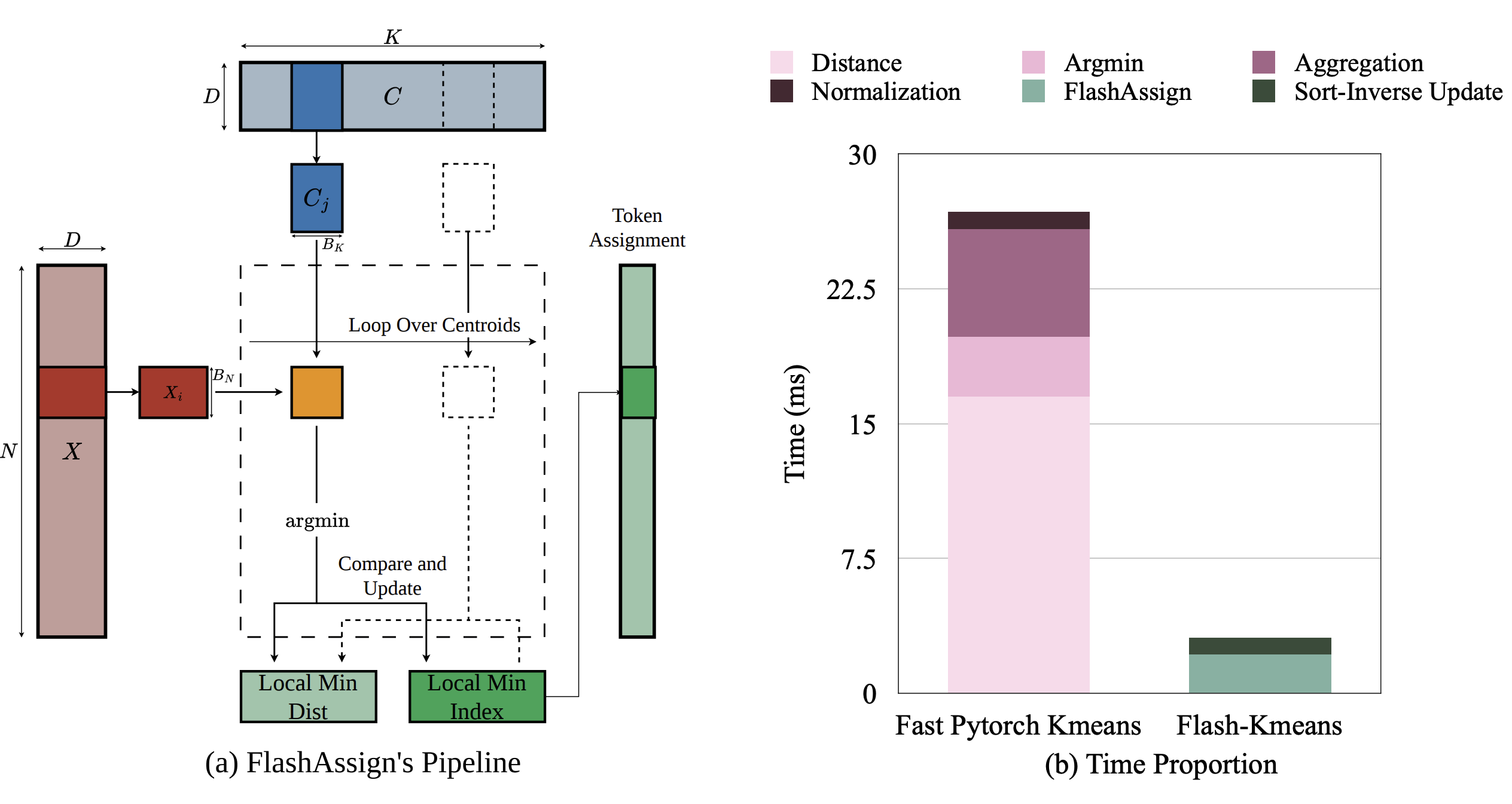
Install flash-kmeans with pip:
pip install flash-kmeans
From source:
git clone https://github.com/svg-project/flash-kmeans.git
cd flash-kmeans
pip install -e .
import torch
from flash_kmeans import batch_kmeans_Euclid

x = torch.randn(32, 75600, 128, device="cuda", dtype=torch.float16)
cluster_ids, centers, _ = batch_kmeans_Euclid(x, n_clusters=1000, tol=1e-4, verbose=True)
We also provide a API interface similar to faiss/sklearn, see API docs for details.
We compare the performance of our Triton implementation with the following baselines:
Tested on NVIDIA H200 GPU with FP16 precision, 128 demensional data, varying number of clusters (k), data points (n) and batch size (b). Our Triton implementation brings significant performance improvements.
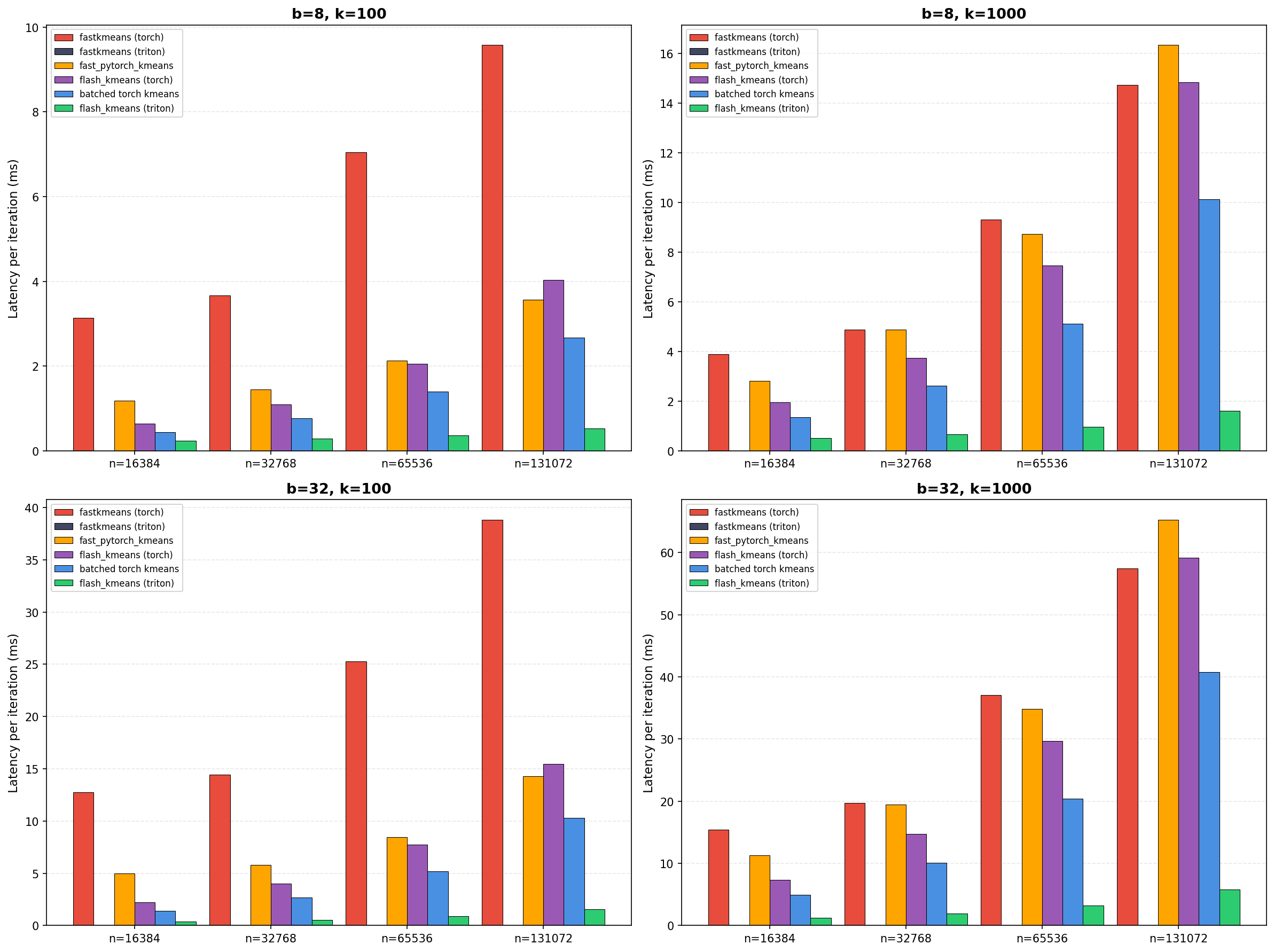
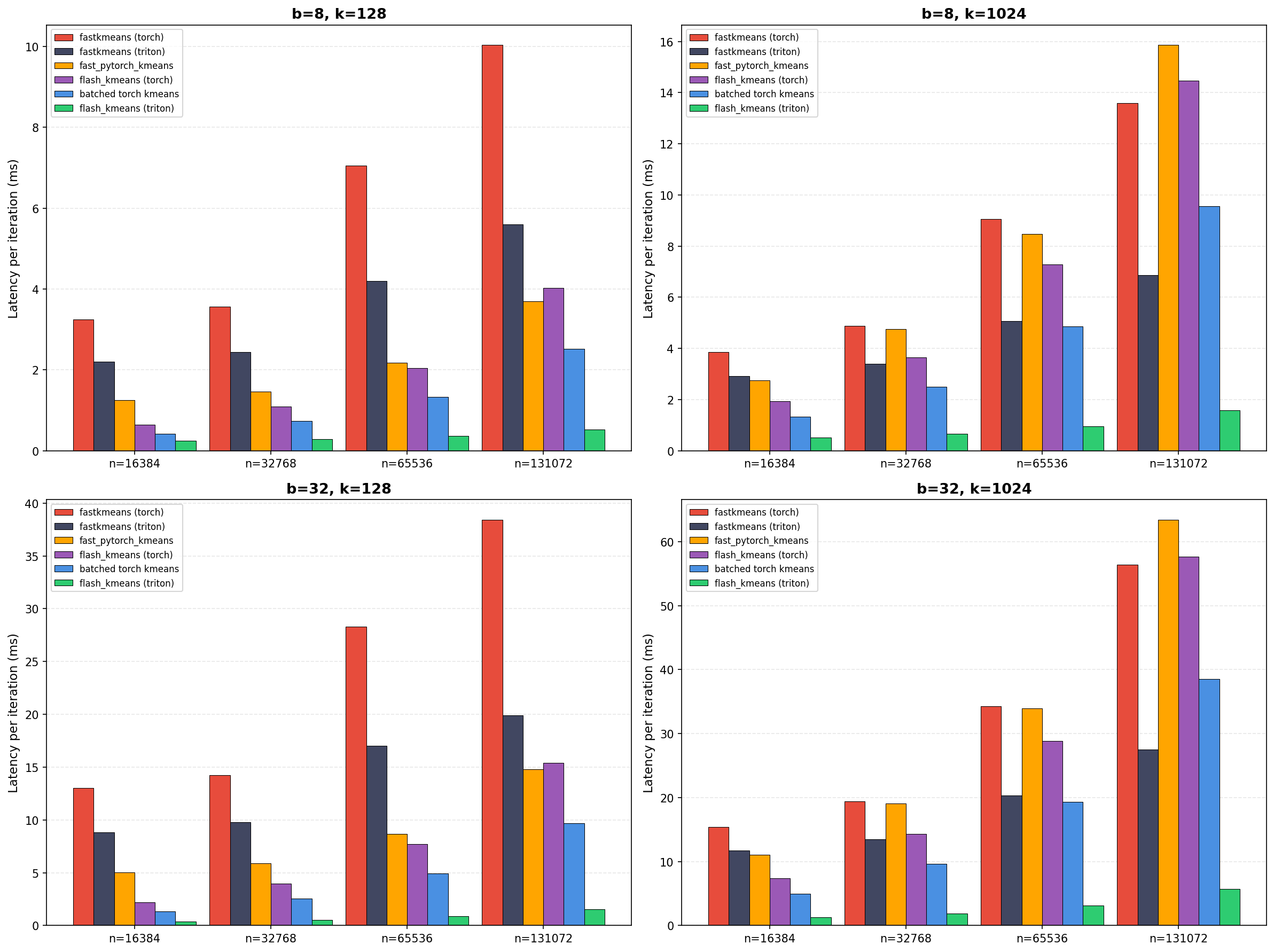
Note: fastkmeans(triton) get error when k=100 or k=1000 in figure 1.
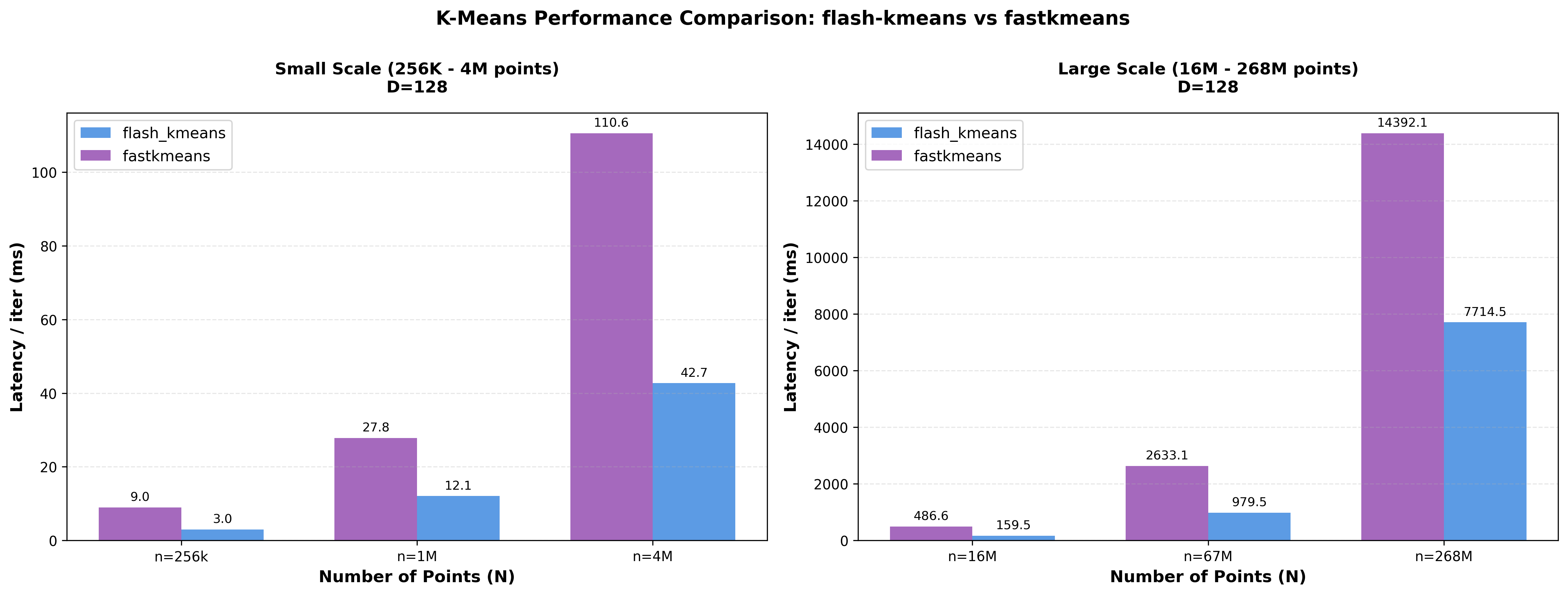
For large input that cannot fit in GPU memory, we compare the performance with fastkmeans(triton) with FP32 precision, 128 demensional data, number if data points scaling from 256K to 268M (N = 2^18, 2^20, 2^22, 2^24, 2^26, 2^28) with cluster counts following K = √N (512, 1024, 2048, 4096, 8192, 16384).
Input tensor is generated randomly in CPU pinned memory. both flash-kmeans and fastkmeans transfer data from CPU to GPU in chunk and compute.
The Triton assign kernel ships in two flavours and dispatches between them automatically based on input shape and dtype:
D ≤ 512): one program loads x_tile (BN, D)
once and streams over centroids in BLOCK_K chunks. Per-arch heuristics
(H200, H100, A100, GB10) pick (BLOCK_N, BLOCK_K, num_warps, num_stages) based
on a hand-tuned table derived from flash-kmeans-tune grid sweeps.D > 512 or whenever the small-D kernel cannot fit
shared memory at minimum tile size): outer K loop, inner D loop tiled by
BLOCK_D. The cross accumulator (BN, BK) is held in registers across the
D loop, so the K-streaming property (no (B, N, K) distance matrix
materialised) is preserved.Unknown GPUs: when the GPU does not match any of the tuned families
(H200/H100/A100/GB10), the wrapper unconditionally dispatches to the
split-D kernel with a conservative fallback config (BLOCK_N=32, BLOCK_K=32, BLOCK_D=32, num_warps=4, num_stages=1). This avoids any reliance on
per-arch tuning data we don't have, and the split-D path's
_fit_config_to_smem_split_d post-process guarantees the launch fits
shared memory regardless of the actual budget. Performance will be
suboptimal on unfamiliar architectures — re-tune via
flash-kmeans-tune
to populate the corresponding _heuristic_euclid_config_<arch>_largeD
function.
The dispatch is automatic — no API changes:
from flash_kmeans import FlashKMeans
km = FlashKMeans(d=2048, k=1024, dtype=torch.float32)  # large-D + fp32 ok
km.train(data)
For large-N workloads (kmeans_largeN), flash-kmeans now supports automatic multi-GPU scaling. When device=None, all available GPUs are used automatically; specifying a single device (e.g. device="cuda:0") falls back to single-GPU mode. No new API parameters are needed.
The multi-GPU pipeline extends the single-GPU double-buffered streaming design with:
from flash_kmeans import FlashKMeans

# Automatically uses all visible GPUs for large-N CPU data
km = FlashKMeans(d=128, k=8192, niter=100)
labels = km.fit_predict(large_cpu_tensor)  # device=None → multi-GPU
If you use this codebase, or otherwise found our work valuable, please cite:
@article{yang2026flash,
  title={Flash-KMeans: Fast and Memory-Efficient Exact K-Means},
  author={Yang, Shuo and Xi, Haocheng and Zhao, Yilong and Li, Muyang and Fan, Xiaoze and Zhang, Jintao and Cai, Han and Lin, Yujun and Li, Xiuyu and Keutzer, Kurt and others},
  journal={arXiv preprint arXiv:2603.09229},
  year={2026}
}

@article{yang2025sparse,
  title={Sparse VideoGen2: Accelerate Video Generation with Sparse Attention via Semantic-Aware Permutation},
  author={Yang, Shuo and Xi, Haocheng and Zhao, Yilong and Li, Muyang and Zhang, Jintao and Cai, Han and Lin, Yujun and Li, Xiuyu and Xu, Chenfeng and Peng, Kelly and others},
  journal={arXiv preprint arXiv:2505.18875},
  year={2025}
}
6,598 followers · starred Jun 2026
4,233 followers · starred Mar 2026
585 followers · starred Mar 2026
487 followers · starred Sep 2025
[NeurIPS2026] Fast and memory-efficient exact kmeans
Python
739
80 commits
updated Aug 28, 2026
IO-aware batched K-Means clustering implemented with Triton GPU kernels. This repository provides the official K-Means implementation of Sparse VideoGen2.
Install flash-kmeans with pip:
pip install flash-kmeans
From source:
git clone https://github.com/svg-project/flash-kmeans.git
cd flash-kmeans
pip install -e .
import torch
from flash_kmeans import batch_kmeans_Euclid

x = torch.randn(32, 75600, 128, device="cuda", dtype=torch.float16)
cluster_ids, centers, _ = batch_kmeans_Euclid(x, n_clusters=1000, tol=1e-4, verbose=True)
We also provide a API interface similar to faiss/sklearn, see API docs for details.
We compare the performance of our Triton implementation with the following baselines:
Tested on NVIDIA H200 GPU with FP16 precision, 128 demensional data, varying number of clusters (k), data points (n) and batch size (b). Our Triton implementation brings significant performance improvements.
Note: fastkmeans(triton) get error when k=100 or k=1000 in figure 1.
For large input that cannot fit in GPU memory, we compare the performance with fastkmeans(triton) with FP32 precision, 128 demensional data, number if data points scaling from 256K to 268M (N = 2^18, 2^20, 2^22, 2^24, 2^26, 2^28) with cluster counts following K = √N (512, 1024, 2048, 4096, 8192, 16384).
Input tensor is generated randomly in CPU pinned memory. both flash-kmeans and fastkmeans transfer data from CPU to GPU in chunk and compute.
The Triton assign kernel ships in two flavours and dispatches between them automatically based on input shape and dtype:
D ≤ 512): one program loads x_tile (BN, D)
once and streams over centroids in BLOCK_K chunks. Per-arch heuristics
(H200, H100, A100, GB10) pick (BLOCK_N, BLOCK_K, num_warps, num_stages) based
on a hand-tuned table derived from flash-kmeans-tune grid sweeps.D > 512 or whenever the small-D kernel cannot fit
shared memory at minimum tile size): outer K loop, inner D loop tiled by
BLOCK_D. The cross accumulator (BN, BK) is held in registers across the
D loop, so the K-streaming property (no (B, N, K) distance matrix
materialised) is preserved.Unknown GPUs: when the GPU does not match any of the tuned families
(H200/H100/A100/GB10), the wrapper unconditionally dispatches to the
split-D kernel with a conservative fallback config (BLOCK_N=32, BLOCK_K=32, BLOCK_D=32, num_warps=4, num_stages=1). This avoids any reliance on
per-arch tuning data we don't have, and the split-D path's
_fit_config_to_smem_split_d post-process guarantees the launch fits
shared memory regardless of the actual budget. Performance will be
suboptimal on unfamiliar architectures — re-tune via
flash-kmeans-tune
to populate the corresponding _heuristic_euclid_config_<arch>_largeD
function.
The dispatch is automatic — no API changes:
from flash_kmeans import FlashKMeans
km = FlashKMeans(d=2048, k=1024, dtype=torch.float32)  # large-D + fp32 ok
km.train(data)
For large-N workloads (kmeans_largeN), flash-kmeans now supports automatic multi-GPU scaling. When device=None, all available GPUs are used automatically; specifying a single device (e.g. device="cuda:0") falls back to single-GPU mode. No new API parameters are needed.
The multi-GPU pipeline extends the single-GPU double-buffered streaming design with:
from flash_kmeans import FlashKMeans

# Automatically uses all visible GPUs for large-N CPU data
km = FlashKMeans(d=128, k=8192, niter=100)
labels = km.fit_predict(large_cpu_tensor)  # device=None → multi-GPU
If you use this codebase, or otherwise found our work valuable, please cite:
@article{yang2026flash,
  title={Flash-KMeans: Fast and Memory-Efficient Exact K-Means},
  author={Yang, Shuo and Xi, Haocheng and Zhao, Yilong and Li, Muyang and Fan, Xiaoze and Zhang, Jintao and Cai, Han and Lin, Yujun and Li, Xiuyu and Keutzer, Kurt and others},
  journal={arXiv preprint arXiv:2603.09229},
  year={2026}
}

@article{yang2025sparse,
  title={Sparse VideoGen2: Accelerate Video Generation with Sparse Attention via Semantic-Aware Permutation},
  author={Yang, Shuo and Xi, Haocheng and Zhao, Yilong and Li, Muyang and Zhang, Jintao and Cai, Han and Lin, Yujun and Li, Xiuyu and Xu, Chenfeng and Peng, Kelly and others},
  journal={arXiv preprint arXiv:2505.18875},
  year={2025}
}
6,598 followers · starred Jun 2026
4,233 followers · starred Mar 2026
585 followers · starred Mar 2026
487 followers · starred Sep 2025



