
See what people are saying
README
Déjà Vu (dejavu-oncall)
"The on-call agent that has seen this outage before."
The Problem
When production breaks at 2 AM, the on-call engineer starts from zero. The fix for this exact failure usually exists in a Slack thread or postmortem from weeks ago that nobody remembers. Generic LLMs give generic advice ("check your logs, restart the service"), missing critical operational parameters and historical failure patterns.
The Solution
Déjà Vu is an incident-response agent powered by Hindsight (Vectorize's agent memory engine). It retains every resolved production incident—including symptoms, root cause, exact resolution steps, what didn't work, and who resolved it—alongside team operational rules. When a new alert fires, Déjà Vu recalls past incidents, grounds its triage in recalled memory, and uses reflection to identify systemic failure loops across the incident ledger.
How Hindsight Memory is Used
Déjà Vu leverages Hindsight via @vectorize-io/hindsight-client across three primary workflows:
graph TD
    User([On-Call Engineer]) -->|Paste Alert / Select Demo| UI[Next.js App Router UI]
    UI -->|POST /api/triage| TriageRoute[app/api/triage/route.ts]

    subgraph Memory Loop
        TriageRoute -->|1. recallSimilar| HindsightRecall[Hindsight Bank]
        HindsightRecall -->|Recalled Context| TriageRoute
        TriageRoute -->|2. Prompt + Context| Groq[Groq OpenAI API]
        Groq -->|Grounded Triage JSON| UI

        UI -->|POST /api/resolve| ResolveRoute[app/api/resolve/route.ts]
        ResolveRoute -->|3. retainIncident| HindsightRetain[Hindsight Bank]

        UI -->|POST /api/patterns| ReflectRoute[app/api/patterns/route.ts]
        ReflectRoute -->|4. reflectPatterns| HindsightReflect[Hindsight Bank]
    end
1. Retain (lib/hindsight.ts & app/api/seed/route.ts)
Each resolved incident is stored as a rich natural-language memory document with ISO timestamps and tags:
// Retain single incident document into Hindsight bank
await client.retain(bankId, formatIncidentDocument(incident), {
  timestamp: new Date(incident.started_at),
  context: "resolved production incident",
  documentId: incident.id,
  tags: [incident.service, incident.severity, "incident"],
  metadata: { incident_id: incident.id, service: incident.service }
});
2. Recall (lib/hindsight.ts & app/api/triage/route.ts)
When a raw alert fires, Hindsight recalls top matching historical incidents before the LLM generates a response:
// Recall past incidents matching the alert query
const response = await client.recall(bankId, query, { maxTokens: 4096 });
const recalledMemories = response.results;
3. Reflect (lib/hindsight.ts & app/api/patterns/route.ts)
Synthesis across all historical memories to detect systemic failure loops:
// Reflect over incident history for failure patterns
const response = await client.reflect(bankId,
  "What recurring failure patterns exist across our incidents, and what systemic fixes would prevent them?"
);
Before vs. After Example (Demo Alert 1)
| Feature | Without Memory (Generic LLM) | With Hindsight (Déjà Vu) |
|---|---|---|
| Verdict | similar — generic guess | similar — 3 exact past matches cited |
| Confidence | 85% | 90% (+5pp) |
| Recall Latency | N/A | 1,644ms (100 memory units searched) |
| Root Cause | "High database load or missing index" | pgbouncer connection pool exhaustion after payments-worker concurrency increase |
| Immediate Actions | "Restart database server" | Lower PAYMENTS_WORKER_CONCURRENCY to 16; set default_pool_size=50 in pgbouncer.ini |
| What NOT To Do | N/A | Do NOT restart payments-worker pods — only relieves connection choke for ~10 minutes |
| End-to-End Time | ~2,000ms | ~6,250ms (recall + LLM synthesis) |
Tech Stack
- Framework: Next.js 15 (App Router) + TypeScript + Tailwind CSS
- Agent Memory:
@vectorize-io/hindsight-client(Hindsight API) - LLM Engine: Groq SDK (
openai/gpt-oss-120bwithqwen/qwen3-32bfallback) - UI & Design: framer-motion, lucide-react, JetBrains Mono & Inter Tight
- Validation: Zod schema validation
Setup & Running Locally
1. Clone & Install
git clone https://github.com/your-username/dejavu-oncall.git
cd dejavu-oncall
npm install
2. Configure Environment Variables
Copy .env.example to .env.local and add your API keys:
GROQ_API_KEY=your_groq_api_key_here
HINDSIGHT_API_KEY=your_hindsight_api_key_here
HINDSIGHT_BASE_URL=https://api.hindsight.vectorize.io
HINDSIGHT_BANK_ID=dejavu-oncall
3. Start Development Server
npm run dev
Open http://localhost:3000 in your browser.
4. Seed Memory Bank
Navigate to http://localhost:3000/memory and click "SEED MEMORY BANK" to populate 18 historical Kirana Cloud incidents and 6 operational preferences into Hindsight.
60-Second Demo Script
- Open
/consoleonhttp://localhost:3000. - Click Demo Scenario 1: "1. Recurring Outage (pgbouncer pool)".
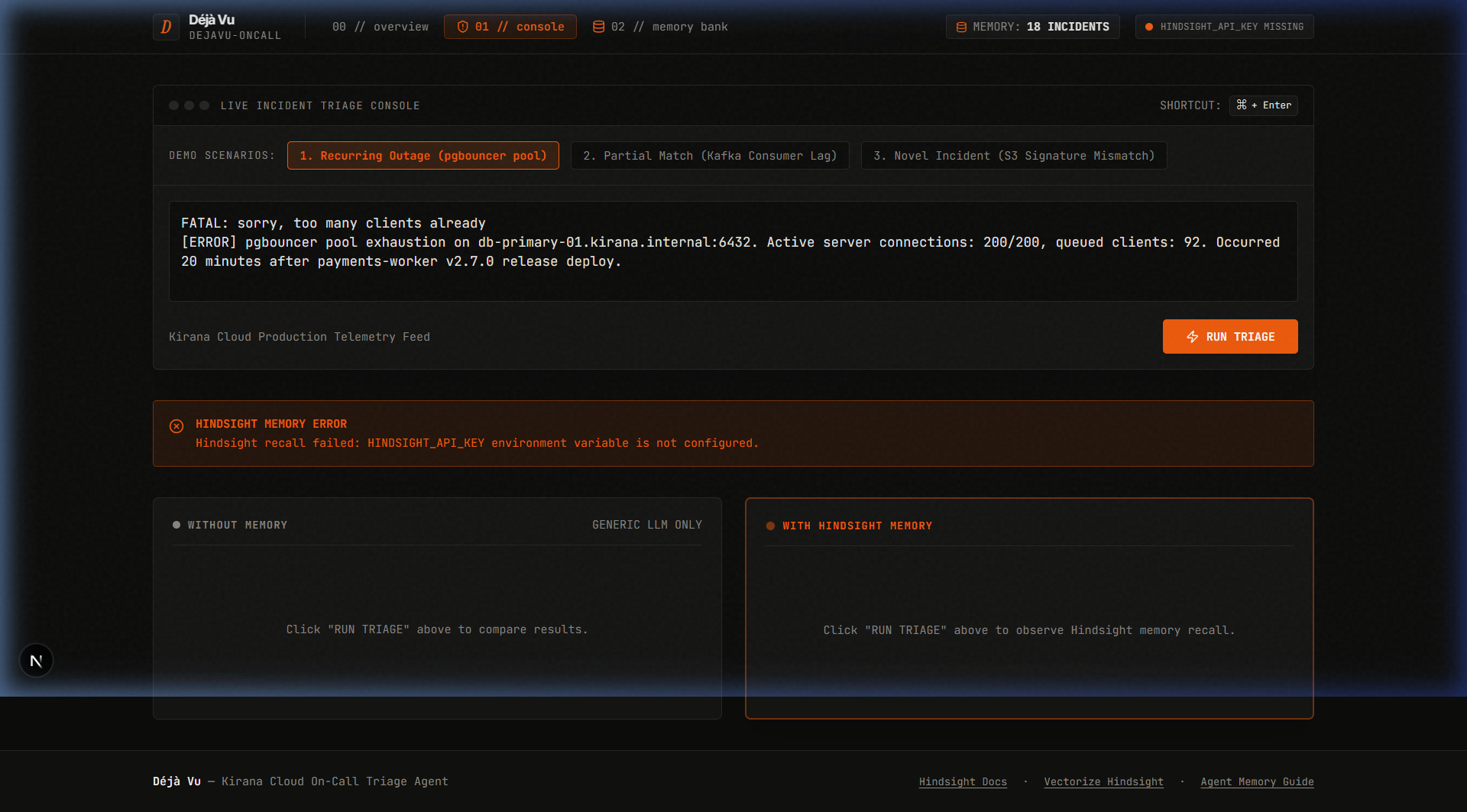
- Click "RUN TRIAGE". Observe the parallel execution:
- Left Pane (Without Memory): Suggests generic pod restarts.
- Right Pane (With Hindsight): Recalls
INC-2104andINC-2148in ~140ms, identifies the exactpgbouncerpool exhaustion, cites prior postmortems, and warns not to restart pods because connections choke again after 10 minutes.
- Click Demo Scenario 3: "3. Novel Incident (S3 Signature Mismatch)".
- Observe the agent honestly flag it as
NOVEL. Fill in the "Resolve & Retain" form and commit it to Hindsight memory bank. - Click "RUN TRIAGE" on the same alert again—watch it immediately recall the newly stored incident as
SEEN BEFORE.
Deploying to Vercel
Deploy with zero configuration:
vercel --prod
Ensure GROQ_API_KEY, HINDSIGHT_API_KEY, HINDSIGHT_BASE_URL, and HINDSIGHT_BANK_ID are configured in Vercel project environment variables.
Resources & Documentation
- Vectorize Hindsight GitHub Repository
- Hindsight API Documentation
- What is Agent Memory? (Vectorize Guide)
License
MIT License. Free for open-source use.
Similar repos


Languages
TypeScript
97.2%
CSS
2.7%
See what people are saying
README
Déjà Vu (dejavu-oncall)
"The on-call agent that has seen this outage before."
The Problem
When production breaks at 2 AM, the on-call engineer starts from zero. The fix for this exact failure usually exists in a Slack thread or postmortem from weeks ago that nobody remembers. Generic LLMs give generic advice ("check your logs, restart the service"), missing critical operational parameters and historical failure patterns.
The Solution
Déjà Vu is an incident-response agent powered by Hindsight (Vectorize's agent memory engine). It retains every resolved production incident—including symptoms, root cause, exact resolution steps, what didn't work, and who resolved it—alongside team operational rules. When a new alert fires, Déjà Vu recalls past incidents, grounds its triage in recalled memory, and uses reflection to identify systemic failure loops across the incident ledger.
How Hindsight Memory is Used
Déjà Vu leverages Hindsight via @vectorize-io/hindsight-client across three primary workflows:
graph TD
    User([On-Call Engineer]) -->|Paste Alert / Select Demo| UI[Next.js App Router UI]
    UI -->|POST /api/triage| TriageRoute[app/api/triage/route.ts]

    subgraph Memory Loop
        TriageRoute -->|1. recallSimilar| HindsightRecall[Hindsight Bank]
        HindsightRecall -->|Recalled Context| TriageRoute
        TriageRoute -->|2. Prompt + Context| Groq[Groq OpenAI API]
        Groq -->|Grounded Triage JSON| UI

        UI -->|POST /api/resolve| ResolveRoute[app/api/resolve/route.ts]
        ResolveRoute -->|3. retainIncident| HindsightRetain[Hindsight Bank]

        UI -->|POST /api/patterns| ReflectRoute[app/api/patterns/route.ts]
        ReflectRoute -->|4. reflectPatterns| HindsightReflect[Hindsight Bank]
    end
1. Retain (lib/hindsight.ts & app/api/seed/route.ts)
Each resolved incident is stored as a rich natural-language memory document with ISO timestamps and tags:
// Retain single incident document into Hindsight bank
await client.retain(bankId, formatIncidentDocument(incident), {
  timestamp: new Date(incident.started_at),
  context: "resolved production incident",
  documentId: incident.id,
  tags: [incident.service, incident.severity, "incident"],
  metadata: { incident_id: incident.id, service: incident.service }
});
2. Recall (lib/hindsight.ts & app/api/triage/route.ts)
When a raw alert fires, Hindsight recalls top matching historical incidents before the LLM generates a response:
// Recall past incidents matching the alert query
const response = await client.recall(bankId, query, { maxTokens: 4096 });
const recalledMemories = response.results;
3. Reflect (lib/hindsight.ts & app/api/patterns/route.ts)
Synthesis across all historical memories to detect systemic failure loops:
// Reflect over incident history for failure patterns
const response = await client.reflect(bankId,
  "What recurring failure patterns exist across our incidents, and what systemic fixes would prevent them?"
);
Before vs. After Example (Demo Alert 1)
| Feature | Without Memory (Generic LLM) | With Hindsight (Déjà Vu) |
|---|---|---|
| Verdict | similar — generic guess | similar — 3 exact past matches cited |
| Confidence | 85% | 90% (+5pp) |
| Recall Latency | N/A | 1,644ms (100 memory units searched) |
| Root Cause | "High database load or missing index" | pgbouncer connection pool exhaustion after payments-worker concurrency increase |
| Immediate Actions | "Restart database server" | Lower PAYMENTS_WORKER_CONCURRENCY to 16; set default_pool_size=50 in pgbouncer.ini |
| What NOT To Do | N/A | Do NOT restart payments-worker pods — only relieves connection choke for ~10 minutes |
| End-to-End Time | ~2,000ms | ~6,250ms (recall + LLM synthesis) |
Tech Stack
- Framework: Next.js 15 (App Router) + TypeScript + Tailwind CSS
- Agent Memory:
@vectorize-io/hindsight-client(Hindsight API) - LLM Engine: Groq SDK (
openai/gpt-oss-120bwithqwen/qwen3-32bfallback) - UI & Design: framer-motion, lucide-react, JetBrains Mono & Inter Tight
- Validation: Zod schema validation
Setup & Running Locally
1. Clone & Install
git clone https://github.com/your-username/dejavu-oncall.git
cd dejavu-oncall
npm install
2. Configure Environment Variables
Copy .env.example to .env.local and add your API keys:
GROQ_API_KEY=your_groq_api_key_here
HINDSIGHT_API_KEY=your_hindsight_api_key_here
HINDSIGHT_BASE_URL=https://api.hindsight.vectorize.io
HINDSIGHT_BANK_ID=dejavu-oncall
3. Start Development Server
npm run dev
Open http://localhost:3000 in your browser.
4. Seed Memory Bank
Navigate to http://localhost:3000/memory and click "SEED MEMORY BANK" to populate 18 historical Kirana Cloud incidents and 6 operational preferences into Hindsight.
60-Second Demo Script
- Open
/consoleonhttp://localhost:3000. - Click Demo Scenario 1: "1. Recurring Outage (pgbouncer pool)".
- Click "RUN TRIAGE". Observe the parallel execution:
- Left Pane (Without Memory): Suggests generic pod restarts.
- Right Pane (With Hindsight): Recalls
INC-2104andINC-2148in ~140ms, identifies the exactpgbouncerpool exhaustion, cites prior postmortems, and warns not to restart pods because connections choke again after 10 minutes.
- Click Demo Scenario 3: "3. Novel Incident (S3 Signature Mismatch)".
- Observe the agent honestly flag it as
NOVEL. Fill in the "Resolve & Retain" form and commit it to Hindsight memory bank. - Click "RUN TRIAGE" on the same alert again—watch it immediately recall the newly stored incident as
SEEN BEFORE.
Deploying to Vercel
Deploy with zero configuration:
vercel --prod
Ensure GROQ_API_KEY, HINDSIGHT_API_KEY, HINDSIGHT_BASE_URL, and HINDSIGHT_BANK_ID are configured in Vercel project environment variables.
Resources & Documentation
- Vectorize Hindsight GitHub Repository
- Hindsight API Documentation
- What is Agent Memory? (Vectorize Guide)
License
MIT License. Free for open-source use.
Similar repos
Languages
TypeScript
97.2%
CSS
2.7%