
An OCI-compliant container registry in a single Rust binary — with pull statistics, tag history, a built-in web UI, and no database to run.
See the codeSee what people are saying (1)
README
summ Container Registry


summ is a simple yet powerful container registry with batteries included. It fully supports the OCI Distribution Spec and adds the practical things a registry should have had all along:
- Simple — a single binary, no additional databases needed
- Powerful — written in Rust, with a bespoke data structure for extremely efficient storage and retrieval of registry metadata, faster than distribution
- Batteries — built-in web UI, image pull statistics, tag history
Live demo
https://demo.registry.summcr.com/r/summcr/summ
Features
A built-in web UI. Browse repositories with their tag and manifest counts, search names by substring, drill into a manifest, and see pull-count grids and tag timelines.
Pull counts, per day and per hour. Every repository, tag and manifest gets a thirty-day contribution grid and a last-24-hours strip, so "what is anyone actually pulling" is a page to open rather than logs to parse.
Tag history. Every tag change is recorded from the first push, so you can ask what a tag has pointed at over time and what names a manifest has had. One endpoint answers both, addressed by tag or by digest, newest first and cursor-paged.
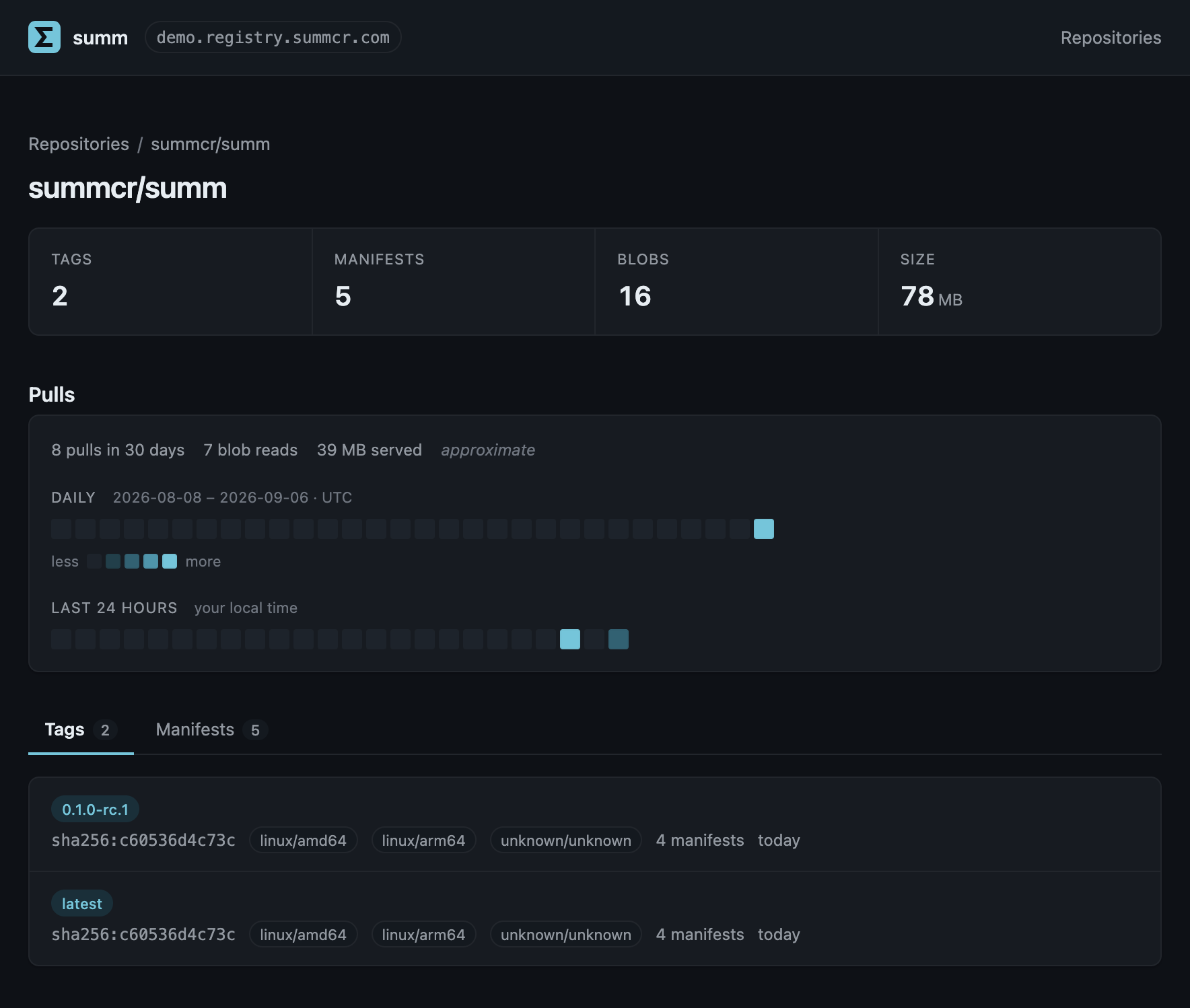
A repository page: tag, manifest, blob and size counts, the thirty-day and last-24-hours pull grids, and the tags with the platforms each one covers.
Simple, practical auth. --auth-mode open|public-pull|private sets who may
push and pull, using API keys, and applies to /v2/, the discovery API and the
UI alike. Details in docs/auth.md.
Space that comes back. A background purge reclaims layers nothing references
any more, uploads nobody finished and repositories left empty, behind a grace
period so it never races a push. Turn on --purge-untagged and it removes
untagged manifests too. POST /api/v1/purge runs a pass on demand, and
?dry-run=true shows what it would take first.
Metadata lookups are the product. Four of the five serial steps in a cold
containerd pull are metadata lookups, and their latencies add up, so summ is
built around a purpose-designed key schema on RocksDB rather than around the
byte path. Nothing is a directory walk, no stored value grows with the size of
the registry, and prefix bloom filters make the hot existence checks about 6×
faster than RocksDB's defaults. Measured: 7.42 GiB layers pushed at ~1.0 GB/s
and pulled back by four concurrent clients at ~1.1 GB/s combined.
Discovery as a first-class API. /api/v1/ serves repositories, tags,
manifests, tag history and pull counts as a flat, cursor-paged API, plus
repository delete and purge. Every list takes a cursor and a limit, and nothing
loads an unbounded set, because the design target is 10M repositories and up to
10M manifests in a single one. The discovery API and /v2/ are documented in
docs/api.md.
Conformant. summ passes the OCI distribution-spec conformance suite with
zero failures at every profile, including the OCI 1.1 referrers API: 1032
checks pass at the suite's dev profile, with nothing skipped.
Use cases
Run your own registry, instead of pulling against someone else's limit.
Docker Hub rate-limits anonymous and free-tier pulls, and so does
ECR Public;
ECR and
GAR meter requests
against per-region quotas and bill every byte that leaves the region.
Meanwhile a scaling cluster and a CI matrix fetch the same few base images
hundreds of times a day. Copy them into summ once — skopeo copy, oras cp,
or a job that runs on merge — and the pulls land on a registry you run, at your
network's speed, with no quota to exhaust.
A throwaway registry for integration tests and CI. One binary and a
directory — summ serve --data-dir "$(mktemp -d)" — no daemon, no compose file,
no service container to wait on. Bind it to loopback and Docker pushes to it
without an insecure-registries entry; delete the directory when the run ends.
Tests assert on what was pushed through the discovery API rather than by
grepping output.
A personal registry that is not a weekend of YAML. A homelab, a NAS, a
laptop, a few side projects that need somewhere to put images. ./summ serve is
the whole deployment — no database, no object store, and the web UI is already
on the same port. Add --auth-mode public-pull when it leaves the laptop.
A home for OCI artifacts that are not images. Helm charts, WASM modules,
SBOMs, signatures, attestations, model weights — push them with oras push or
helm push like any other registry. The referrers API is implemented and passes
conformance, artifactType filtering included, so whatever is attached to an
image is discoverable by the tools that go looking.
An air-gapped, edge or embedded registry. One statically linked file, no runtime dependencies, and a UI compiled into the binary that loads nothing from a CDN — a machine with no route to the internet gets exactly the same registry as one on the public network. Small enough to ship inside a product, an appliance or a cluster bootstrap.
Finding out what your registry is actually for. Which repositories anyone still pulls, when a tag last moved and what it pointed at before, whether a manifest has ever been called anything else — questions most registries cannot answer at all. summ answers them on the page you were already looking at.
Quick start
Run the binary, or run the container. Either way you get a complete registry on
http://127.0.0.1:3110 — nothing else to install, configure or stand up
alongside it.
Prebuilt binary
curl -fsSL https://summcr.com/install.sh | sh
./summ serve
The installer verifies a checksum and leaves a single summ in the current
directory — no PATH edits, no service files, no sudo. Data goes in ./data
beside the binary; --data-dir puts it elsewhere. Platform assets, checksums
and building from source are in docs/setup.md.
Docker
docker run -d --name summ -p 3110:3110 -v summ-data:/var/lib/summ summcr/summ
The image is multi-architecture, so that line is the same on x86_64 and arm64.
summ writes everything to /var/lib/summ, which -v summ-data:/var/lib/summ
keeps on a named volume so it survives the container. Name the
volume — drop the -v and you still get one, but an anonymous volume that
docker run --rm deletes along with the container. A bind mount works too,
after chown 10001:10001 on the host directory.
Check it works
curl http://127.0.0.1:3110/v2/ # {}
Then open http://127.0.0.1:3110 for the web UI, and push an image at it:
docker tag alpine 127.0.0.1:3110/demo/alpine
docker push 127.0.0.1:3110/demo/alpine
Docker treats the whole 127.0.0.0/8 range as insecure by default, so there is
nothing to configure. Other clients make their own rules — oras and crane
have to be told an endpoint is plain HTTP.
More in docs/setup.md, including platform requirements and building from source, DEPLOYMENT.md for running summ as a service behind TLS, and docs/data-dir.md for what summ stores and how to back it up.
Run it unattended
summ serve runs in the foreground. For CI, a script or an AI agent, background
it and wait on the port — and let the kernel pick one if 3110 might be taken:
./summ serve --listen 127.0.0.1:0 --data-dir "$(mktemp -d)" > summ.log 2>&1 &
for _ in $(seq 100); do
  addr=$(awk '/listening on/ {print $3; exit}' summ.log)
  [ -n "$addr" ] && break
  sleep 0.1
done
curl -fsS "http://$addr/v2/"
summ reads the address back from the listener, so the banner reports the port it actually got. That plus a scratch data directory is a throwaway registry with nothing to tear down but the process. AGENTS.md is the rest of the operating manual for an automated caller.
Contributors

91 commits
Similar repos


Languages
Rust
92.9%
JavaScript
2.9%
Shell
2.1%
CSS
1.5%
An OCI-compliant container registry in a single Rust binary — with pull statistics, tag history, a built-in web UI, and no database to run.
See the codeSee what people are saying (1)
README
summ Container Registry
summ is a simple yet powerful container registry with batteries included. It fully supports the OCI Distribution Spec and adds the practical things a registry should have had all along:
- Simple — a single binary, no additional databases needed
- Powerful — written in Rust, with a bespoke data structure for extremely efficient storage and retrieval of registry metadata, faster than distribution
- Batteries — built-in web UI, image pull statistics, tag history
Live demo
https://demo.registry.summcr.com/r/summcr/summ
Features
A built-in web UI. Browse repositories with their tag and manifest counts, search names by substring, drill into a manifest, and see pull-count grids and tag timelines.
Pull counts, per day and per hour. Every repository, tag and manifest gets a thirty-day contribution grid and a last-24-hours strip, so "what is anyone actually pulling" is a page to open rather than logs to parse.
Tag history. Every tag change is recorded from the first push, so you can ask what a tag has pointed at over time and what names a manifest has had. One endpoint answers both, addressed by tag or by digest, newest first and cursor-paged.
A repository page: tag, manifest, blob and size counts, the thirty-day and last-24-hours pull grids, and the tags with the platforms each one covers.
Simple, practical auth. --auth-mode open|public-pull|private sets who may
push and pull, using API keys, and applies to /v2/, the discovery API and the
UI alike. Details in docs/auth.md.
Space that comes back. A background purge reclaims layers nothing references
any more, uploads nobody finished and repositories left empty, behind a grace
period so it never races a push. Turn on --purge-untagged and it removes
untagged manifests too. POST /api/v1/purge runs a pass on demand, and
?dry-run=true shows what it would take first.
Metadata lookups are the product. Four of the five serial steps in a cold
containerd pull are metadata lookups, and their latencies add up, so summ is
built around a purpose-designed key schema on RocksDB rather than around the
byte path. Nothing is a directory walk, no stored value grows with the size of
the registry, and prefix bloom filters make the hot existence checks about 6×
faster than RocksDB's defaults. Measured: 7.42 GiB layers pushed at ~1.0 GB/s
and pulled back by four concurrent clients at ~1.1 GB/s combined.
Discovery as a first-class API. /api/v1/ serves repositories, tags,
manifests, tag history and pull counts as a flat, cursor-paged API, plus
repository delete and purge. Every list takes a cursor and a limit, and nothing
loads an unbounded set, because the design target is 10M repositories and up to
10M manifests in a single one. The discovery API and /v2/ are documented in
docs/api.md.
Conformant. summ passes the OCI distribution-spec conformance suite with
zero failures at every profile, including the OCI 1.1 referrers API: 1032
checks pass at the suite's dev profile, with nothing skipped.
Use cases
Run your own registry, instead of pulling against someone else's limit.
Docker Hub rate-limits anonymous and free-tier pulls, and so does
ECR Public;
ECR and
GAR meter requests
against per-region quotas and bill every byte that leaves the region.
Meanwhile a scaling cluster and a CI matrix fetch the same few base images
hundreds of times a day. Copy them into summ once — skopeo copy, oras cp,
or a job that runs on merge — and the pulls land on a registry you run, at your
network's speed, with no quota to exhaust.
A throwaway registry for integration tests and CI. One binary and a
directory — summ serve --data-dir "$(mktemp -d)" — no daemon, no compose file,
no service container to wait on. Bind it to loopback and Docker pushes to it
without an insecure-registries entry; delete the directory when the run ends.
Tests assert on what was pushed through the discovery API rather than by
grepping output.
A personal registry that is not a weekend of YAML. A homelab, a NAS, a
laptop, a few side projects that need somewhere to put images. ./summ serve is
the whole deployment — no database, no object store, and the web UI is already
on the same port. Add --auth-mode public-pull when it leaves the laptop.
A home for OCI artifacts that are not images. Helm charts, WASM modules,
SBOMs, signatures, attestations, model weights — push them with oras push or
helm push like any other registry. The referrers API is implemented and passes
conformance, artifactType filtering included, so whatever is attached to an
image is discoverable by the tools that go looking.
An air-gapped, edge or embedded registry. One statically linked file, no runtime dependencies, and a UI compiled into the binary that loads nothing from a CDN — a machine with no route to the internet gets exactly the same registry as one on the public network. Small enough to ship inside a product, an appliance or a cluster bootstrap.
Finding out what your registry is actually for. Which repositories anyone still pulls, when a tag last moved and what it pointed at before, whether a manifest has ever been called anything else — questions most registries cannot answer at all. summ answers them on the page you were already looking at.
Quick start
Run the binary, or run the container. Either way you get a complete registry on
http://127.0.0.1:3110 — nothing else to install, configure or stand up
alongside it.
Prebuilt binary
curl -fsSL https://summcr.com/install.sh | sh
./summ serve
The installer verifies a checksum and leaves a single summ in the current
directory — no PATH edits, no service files, no sudo. Data goes in ./data
beside the binary; --data-dir puts it elsewhere. Platform assets, checksums
and building from source are in docs/setup.md.
Docker
docker run -d --name summ -p 3110:3110 -v summ-data:/var/lib/summ summcr/summ
The image is multi-architecture, so that line is the same on x86_64 and arm64.
summ writes everything to /var/lib/summ, which -v summ-data:/var/lib/summ
keeps on a named volume so it survives the container. Name the
volume — drop the -v and you still get one, but an anonymous volume that
docker run --rm deletes along with the container. A bind mount works too,
after chown 10001:10001 on the host directory.
Check it works
curl http://127.0.0.1:3110/v2/ # {}
Then open http://127.0.0.1:3110 for the web UI, and push an image at it:
docker tag alpine 127.0.0.1:3110/demo/alpine
docker push 127.0.0.1:3110/demo/alpine
Docker treats the whole 127.0.0.0/8 range as insecure by default, so there is
nothing to configure. Other clients make their own rules — oras and crane
have to be told an endpoint is plain HTTP.
More in docs/setup.md, including platform requirements and building from source, DEPLOYMENT.md for running summ as a service behind TLS, and docs/data-dir.md for what summ stores and how to back it up.
Run it unattended
summ serve runs in the foreground. For CI, a script or an AI agent, background
it and wait on the port — and let the kernel pick one if 3110 might be taken:
./summ serve --listen 127.0.0.1:0 --data-dir "$(mktemp -d)" > summ.log 2>&1 &
for _ in $(seq 100); do
  addr=$(awk '/listening on/ {print $3; exit}' summ.log)
  [ -n "$addr" ] && break
  sleep 0.1
done
curl -fsS "http://$addr/v2/"
summ reads the address back from the listener, so the banner reports the port it actually got. That plus a scratch data directory is a throwaway registry with nothing to tear down but the process. AGENTS.md is the rest of the operating manual for an automated caller.
Similar repos
Contributors
91 commits
Languages
Rust
92.9%
JavaScript
2.9%
Shell
2.1%
CSS
1.5%