🪄 Markdown To Telegram MarkdownV2 Converter Python| No more worrying about formatting.
Python
384
280 commits
updated Sep 25, 2026


Effortlessly convert raw Markdown to Telegram plain text + MessageEntity pairs.
Say goodbye to MarkdownV2 escaping headaches! This library parses Markdown (including LLM output, GitHub READMEs, etc.)
and produces (text, entities) tuples that can be sent directly via the Telegram Bot API — no parse_mode needed.
[!NOTE] v1.0.0 introduces a new entity-based output:
convert()returns(str, list[MessageEntity]). The 0.x functionsmarkdownify()andstandardize()are still available and return MarkdownV2 strings as before.
| convert() | convert() | telegramify() |
|---|---|---|
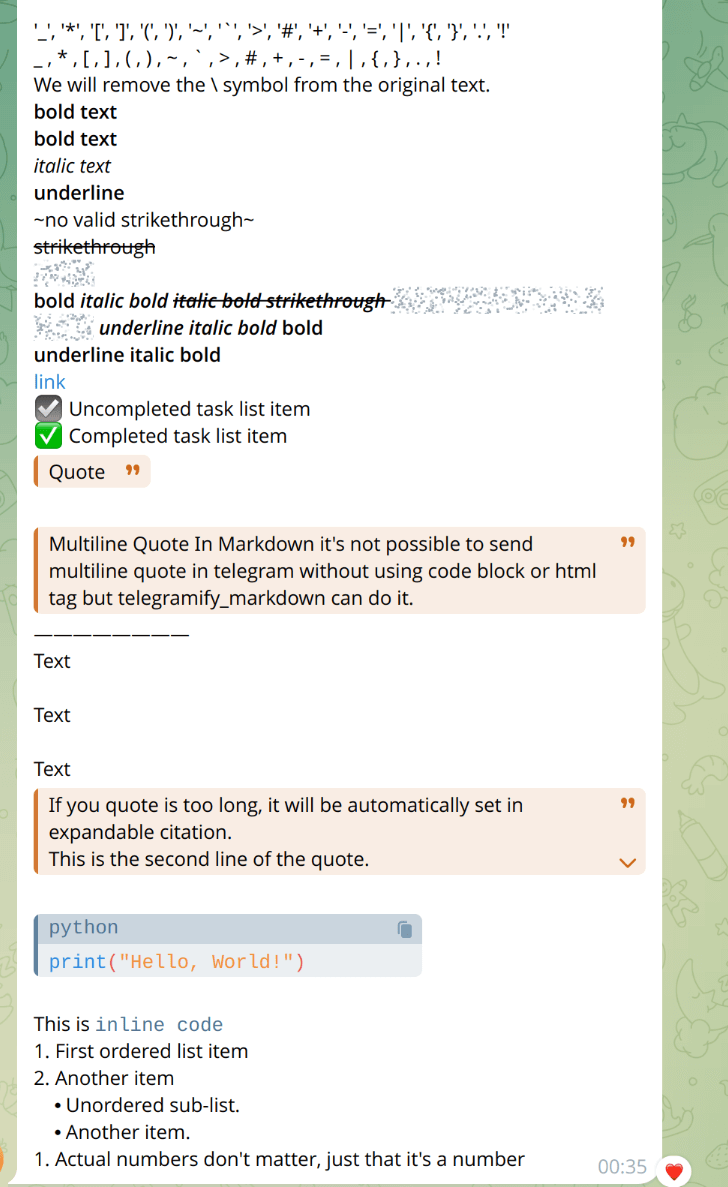 | 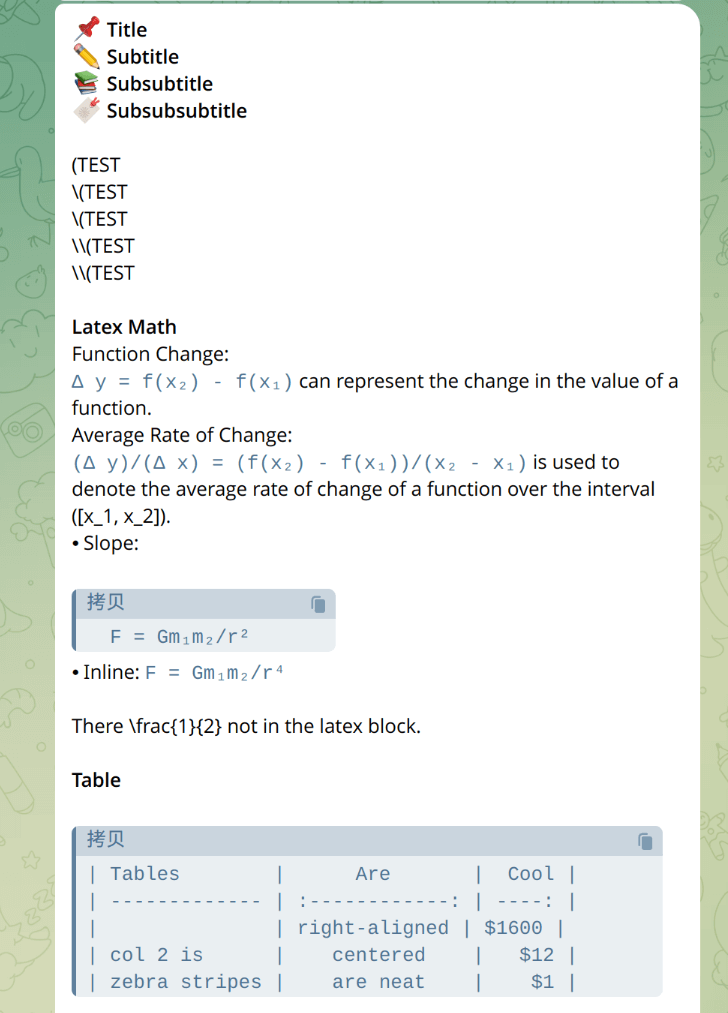 | 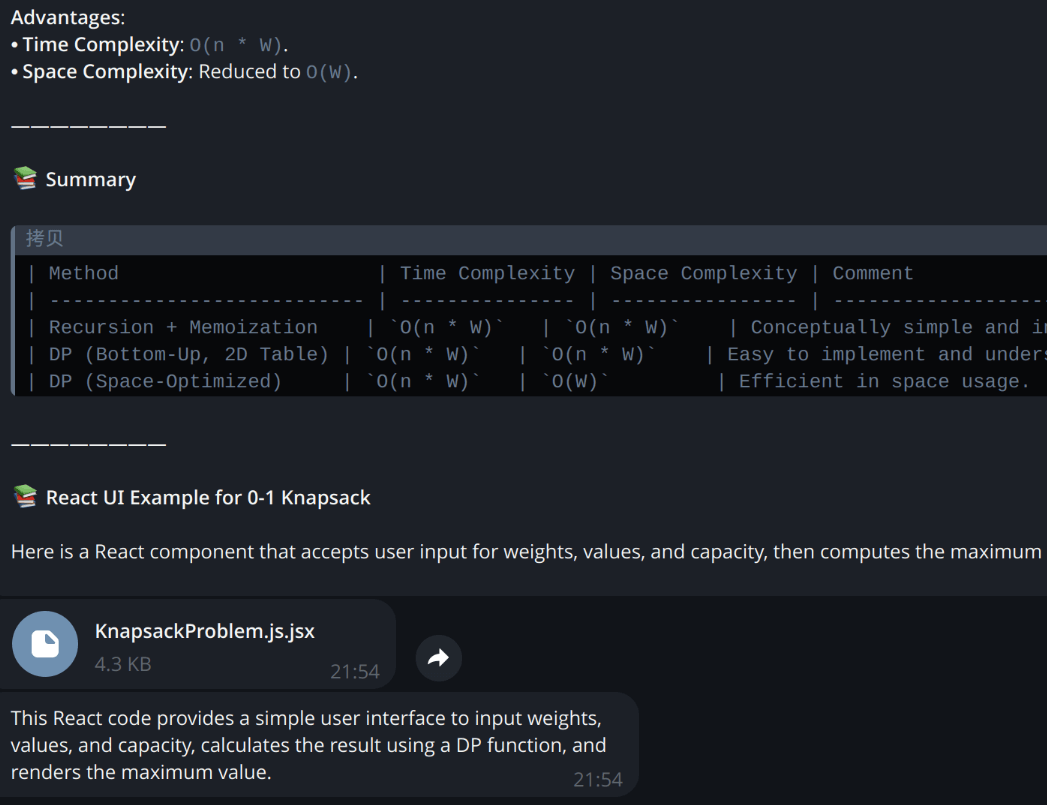 |
Requires Python 3.10+.
# uv (recommended)
uv add telegramify-markdown
uv add "telegramify-markdown[mermaid]"

# pip
pip install telegramify-markdown
pip install "telegramify-markdown[mermaid]"

# PDM
pdm add telegramify-markdown
pdm add "telegramify-markdown[mermaid]"

# Poetry
poetry add telegramify-markdown
poetry add "telegramify-markdown[mermaid]"
convert()telegramify()DraftStream (private) or EditStream (group)convert() output manually → use split_entities()parse_mode="MarkdownV2" (no entities parameter) → use markdownify()split_markdownv2()entities_to_markdownv2()richify()telegramify_rich()convert() — single messagefrom telebot import TeleBot
from telegramify_markdown import convert
bot = TeleBot("YOUR_TOKEN")
md = "**Bold**, _italic_, and `code`."
text, entities = convert(md)
bot.send_message(
chat_id,
text,
entities=[e.to_dict() for e in entities],
)
No parse_mode parameter — Telegram reads the entities directly.
richify() — Bot API 10.1 Rich MessageFor Telegram Bot API 10.1 structured messages, use richify() to produce an
InputRichMessage payload. This is a parallel output backend: it does not
change convert().
import requests
from telegramify_markdown import richify

md = """
# Report

| Metric | Value |
| --- | --- |
| Speed | **42 ms** |

$$E = mc^2$$
"""

rich_message = richify(md)

requests.post(
    f"https://api.telegram.org/bot{token}/sendRichMessage",
    json={
        "chat_id": chat_id,
        "rich_message": rich_message.to_dict(),
    },
    timeout=30,
)
Use richify(markdown, mode="markdown") when you want Telegram to parse the
input as Telegram Rich Markdown directly.
telegramify_rich() — long Rich Messages with automatic splittingFor long Markdown that exceeds Telegram's Rich Message limits (32768 bytes or
500 blocks), telegramify_rich() splits the output into multiple sendable
chunks:
import requests
from telegramify_markdown import telegramify_rich

md = very_long_markdown  # e.g. LLM output

items = telegramify_rich(md)
for item in items:
    requests.post(
        f"https://api.telegram.org/bot{token}/sendRichMessage",
        json={
            "chat_id": chat_id,
            "rich_message": item.to_dict(),
        },
        timeout=30,
    )
Each chunk is a valid, self-contained Rich HTML document. Splitting happens at block boundaries — never in the middle of a tag or nested structure.
For development changes to Rich Message output, run the live contract test before opening a PR:
TELEGRAM_BOT_TOKEN=... TELEGRAM_CHAT_ID=... pdm run test-live-rich
The test sends a real sendRichMessage request and requires Telegram to return
Message.rich_message.
DraftStream / EditStream — streaming LLM output (Bot API 9.3+)For token-by-token LLM output, DraftStream sends intermediate drafts via
sendMessageDraft / sendRichMessageDraft, then finalizes with the complete
message. Works in private chats. For group chats (no draft API), EditStream
sends then edits the message.
import asyncio
from telegramify_markdown.stream import DraftStream

async def stream_response(chat_id, token, llm_tokens):
    async def send_draft(payload):
        # Call sendRichMessageDraft with payload.rich_message.to_dict()
        ...

    async def send_final(payload):
        # Call sendRichMessage with payload.rich_message.to_dict()
        ...

    async with DraftStream(
        send_draft=send_draft,
        send_final=send_final,
        mode="rich",           # "rich" | "entity"
        interval=0.3,          # seconds between draft updates
        thinking_delay=0.5,    # show "Thinking..." before first content
        keepalive_timeout=25.0,  # prevent draft expiry
        config=None,           # entity mode: RenderConfig for symbols (EditStream too)
    ) as stream:
        async for tok in llm_tokens:
            stream.feed(tok)
For group/channel chats (draft API unavailable):
from telegramify_markdown.stream import EditStream

async with EditStream(
    send_message=my_send_fn,   # async (payload) -> message_id
    edit_message=my_edit_fn,   # async (message_id, payload) -> None
    mode="rich",
    interval=1.0,              # >= 1.0s enforced (Telegram edit rate limit)
) as stream:
    async for tok in llm_tokens:
        stream.feed(tok)
telegramify() — long messages, code files, diagramsFor LLM output or long documents, telegramify() splits text, extracts code blocks as files,
and renders Mermaid diagrams as images:
import asyncio
from telebot import TeleBot
from telegramify_markdown import telegramify
from telegramify_markdown.content import ContentType

bot = TeleBot("YOUR_TOKEN")

md = """
# Report

Here is some analysis with **bold** and _italic_ text.

```python
print("hello world")
```

And a diagram:

```mermaid
graph TD
    A-->B
```
"""

async def send():
    results = await telegramify(md, max_message_length=4090)
    for item in results:
        if item.content_type == ContentType.TEXT:
            bot.send_message(
                chat_id,
                item.text,
                entities=[e.to_dict() for e in item.entities],
            )
        elif item.content_type == ContentType.PHOTO:
            bot.send_photo(
                chat_id,
                (item.file_name, item.file_data),
                caption=item.caption_text or None,
                caption_entities=[e.to_dict() for e in item.caption_entities] or None,
            )
        elif item.content_type == ContentType.FILE:
            bot.send_document(
                chat_id,
                (item.file_name, item.file_data),
                caption=item.caption_text or None,
                caption_entities=[e.to_dict() for e in item.caption_entities] or None,
            )

asyncio.run(send())
split_entities() — manual splittingIf you use convert() but need to split long output yourself:
from telegramify_markdown import convert, split_entities

text, entities = convert(long_markdown)

for chunk_text, chunk_entities in split_entities(text, entities, max_utf16_len=4096):
    bot.send_message(
        chat_id,
        chunk_text,
        entities=[e.to_dict() for e in chunk_entities],
    )
split_entities() omits empty and whitespace-only chunks because Telegram rejects them as empty messages.
markdownify() — direct Markdown to MarkdownV2If your middleware only supports parse_mode="MarkdownV2" and cannot pass entities, use markdownify() for a
one-step conversion:
from telegramify_markdown import markdownify

mdv2 = markdownify("**Bold** and `code`")
bot.send_message(chat_id, mdv2, parse_mode="MarkdownV2")
standardize() is an alias for markdownify(), kept for 0.x compatibility.
split_markdownv2() — split MarkdownV2 safelyIf your middleware only supports parse_mode="MarkdownV2", split by the rendered MarkdownV2 length, not only by the plain text length:
from telegramify_markdown import convert, split_markdownv2

text, entities = convert(long_markdown)

for mdv2 in split_markdownv2(text, entities, max_utf16_len=4096):
    bot.send_message(chat_id, mdv2, parse_mode="MarkdownV2")
entities_to_markdownv2() — reverse conversion to MarkdownV2If you already have (text, entities) from convert() and need a MarkdownV2 string:
from telegramify_markdown import convert, entities_to_markdownv2

text, entities = convert("**Bold** and `code`")
mdv2 = entities_to_markdownv2(text, entities)

bot.send_message(chat_id, mdv2, parse_mode="MarkdownV2")
This handles all MarkdownV2 escaping rules correctly (different escaping for normal text, code/pre blocks, and URLs).
Customize heading symbols, link symbols, list markers, expandable citation behavior, and Mermaid rendering:
from telegramify_markdown.config import get_runtime_config

cfg = get_runtime_config()
cfg.markdown_symbol.heading_level_1 = "📌"
cfg.markdown_symbol.link = "🔗"
cfg.markdown_symbol.unordered_list_item = "-"   # default "⦁"; try "•", "*", …
cfg.markdown_symbol.ordered_list_suffix = "."   # renders "1. item"; ")" gives "1) item"
cfg.cite_expandable = True  # Long quotes become expandable_blockquote
cfg.mermaid.width = 1280
cfg.mermaid.scale = 2
cfg.mermaid.theme = "default"
cfg.mermaid.image_type = "webp"

# For clean output without emoji heading prefixes:
# cfg.markdown_symbol.heading_level_1 = ""
# cfg.markdown_symbol.heading_level_2 = ""
# cfg.markdown_symbol.heading_level_3 = ""
# cfg.markdown_symbol.heading_level_4 = ""
List markers are plain text and carry no entity. Task list items keep using
task_completed / task_uncompleted and replace the list marker entirely.
get_runtime_config() returns a process-global config. Setting it once at
startup is the common case. It is shared mutable state, so a bot that varies
symbols per chat must not mutate it inside a handler — concurrent requests would
read each other's values. Use an independent config instead and pass it in:
from telegramify_markdown import RenderConfig, telegramify

cfg = RenderConfig.isolated()          # library defaults, independent
# cfg = get_runtime_config().copy()    # or: start from the current global values
cfg.markdown_symbol.unordered_list_item = "-"

boxes = await telegramify(markdown, config=cfg)
config= is accepted by convert(), convert_with_segments(), markdownify(),
standardize(), and telegramify() (which also applies cfg.mermaid to
rendered diagrams). richify() and telegramify_rich() take no config —
Rich HTML emits structural tags and reads no symbols.
See docs/prd/render-config.md for the full contract.
telegramify() picks up Mermaid settings from the runtime config. The default Mermaid width is 1000.
convert(markdown, *, latex_escape=True) -> tuple[str, list[MessageEntity]]Synchronous. Converts a Markdown string to plain text and a list of MessageEntity objects.
| Parameter | Type | Default | Description |
|---|---|---|---|
markdown | str | required | Raw Markdown text |
latex_escape | bool | True | Convert LaTeX \(...\) and \[...\] to Unicode symbols |
Returns (text, entities) where text is plain text and entities is a list of MessageEntity.
telegramify(content, *, max_message_length=4096, latex_escape=True) -> list[Text | File | Photo]Async. Full pipeline: converts Markdown, splits long messages, extracts code blocks as files, renders Mermaid diagrams as images.
| Parameter | Type | Default | Description |
|---|---|---|---|
content | str | required | Raw Markdown text |
max_message_length | int | 4096 | Max UTF-16 code units per text message |
latex_escape | bool | True | Convert LaTeX to Unicode |
Returns an ordered list of Text, File, or Photo objects.
split_entities(text, entities, max_utf16_len) -> list[tuple[str, list[MessageEntity]]]Split text + entities into chunks within a UTF-16 length limit. Splits at newline boundaries; entities spanning a split point are clipped into both chunks. Empty and whitespace-only chunks are omitted because Telegram rejects them as empty messages.
markdownify(content, *, latex_escape=True) -> strSynchronous. Converts Markdown directly to a Telegram MarkdownV2 string.
Equivalent to entities_to_markdownv2(*convert(content)).
| Parameter | Type | Default | Description |
|---|---|---|---|
content | str | required | Raw Markdown text |
latex_escape | bool | True | Convert LaTeX to Unicode |
standardize(content, *, latex_escape=True) -> strAlias for markdownify(), kept for 0.x compatibility.
richify(markdown, *, mode="html", is_rtl=None, skip_entity_detection=None, latex_escape=False) -> InputRichMessageSynchronous. Converts Markdown to a Telegram Bot API 10.1 InputRichMessage.
| Parameter | Type | Default | Description |
|---|---|---|---|
markdown | str | required | Raw Markdown text |
mode | "html" | "markdown" | "html" | Generate Telegram Rich HTML, or pass input through as Telegram Rich Markdown |
is_rtl | bool | None | None | Optional Bot API is_rtl field |
skip_entity_detection | bool | None | None | Optional Bot API skip_entity_detection field |
latex_escape | bool | False | In HTML mode, keep raw formula source for Telegram math by default |
richify() returns an InputRichMessage object with .to_dict() for Bot API
payloads. In HTML mode it emits Telegram Rich HTML for paragraphs, headings,
inline formatting, links, lists, block quotes, tables, code blocks, images with
HTTP(S) URLs, custom emoji images, and math tags.
telegramify_rich(markdown, *, mode="html", is_rtl=None, skip_entity_detection=None, latex_escape=False) -> list[RichMessage]Synchronous. Converts Markdown to a list of sendable Rich Message chunks, each within Telegram limits (32768 UTF-8 bytes, 500 top-level blocks).
| Parameter | Type | Default | Description |
|---|---|---|---|
markdown | str | required | Raw Markdown text |
mode | "html" | "markdown" | "html" | Rich HTML or Rich Markdown output |
is_rtl | bool | None | None | Optional Bot API is_rtl field |
skip_entity_detection | bool | None | None | Optional Bot API skip_entity_detection field |
latex_escape | bool | False | In HTML mode, keep raw formula source by default |
Returns list[RichMessage] where each item has .to_dict() for the Bot API.
split_rich(rich_message) -> list[InputRichMessage]Split a single InputRichMessage into multiple chunks within Telegram limits.
Useful when you already have a payload (e.g. from richify() on very long input)
and only need splitting.
entities_to_markdownv2(text, entities=None) -> strReverse conversion: takes plain text and entities, returns a MarkdownV2 string with correct escaping.
Useful when you already have (text, entities) from convert() and need a MarkdownV2 string.
| Parameter | Type | Default | Description |
|---|---|---|---|
text | str | required | Plain text content |
entities | list[MessageEntity] | None | None | Entity list (UTF-16 offsets) |
split_markdownv2(text, entities=None, max_utf16_len=4096) -> list[str]Split text + entities into Telegram MarkdownV2 strings within a rendered UTF-16 length limit.
Use this instead of split_entities() when sending with parse_mode="MarkdownV2".
MessageEntity@dataclasses.dataclass(slots=True)
class MessageEntity:
type: str # "bold", "italic", "code", "pre", "text_link", etc.
offset: int # Start position in UTF-16 code units
length: int # Length in UTF-16 code units
url: str | None # For "text_link" entities
language: str | None # For "pre" entities (code block language)
custom_emoji_id: str | None # For "custom_emoji" entities
user: dict | None # For "text_mention" entities
unix_time: int | None # For "date_time" entities
date_time_format: str | None # For "date_time" entities
def to_dict(self) -> dict: ...
InputRichMessage@dataclasses.dataclass(slots=True)
class InputRichMessage:
html: str | None
markdown: str | None
is_rtl: bool | None
skip_entity_detection: bool | None
def to_dict(self) -> dict: ...
| Class | Fields | Description |
|---|---|---|
Text | text, entities, content_trace | A text message segment |
File | file_name, file_data, caption_text, caption_entities, content_trace | An extracted code block |
Photo | file_name, file_data, caption_text, caption_entities, content_trace | A rendered Mermaid diagram |
RichMessage | rich_message, content_trace | A Rich Message chunk (has .to_dict()) |
utf16_len(text) -> intReturns the length of a string in UTF-16 code units (what Telegram uses for offsets).
**Bold**, *Italic*, ~~Strikethrough~~ (a single ~, as in ~5 min, stays literal)||Spoiler||[Links](url) and code and fenced code blocks> (with expandable citation support)pre blocks)- [x] / - [ ]---\(...\) and \[...\] (converted to Unicode)[mermaid] extra)richify()This project provides llms.txt and llms-full.txt for AI assistant context.
Copy the relevant file into your assistant's context (e.g. CLAUDE.md, Cursor Rules) for
accurate code generation.
Critical rules:
[e.to_dict() for e in entities] — never as JSON stringparse_mode when sending with entities — they are mutually exclusiverichify() returns InputRichMessage for sendRichMessage, not text + entitiesutf16_len() to measure.This library is inspired by npm:telegramify-markdown.
LaTeX escape is inspired by latex2unicode and @yym68686.
This project is licensed under the MIT License — see the LICENSE file for details.
626 followers · starred Aug 2026
15,987 followers · starred Jan 2026
595 followers · starred May 2025
992 followers · starred Mar 2025
🪄 Markdown To Telegram MarkdownV2 Converter Python| No more worrying about formatting.
Python
384
280 commits
updated Sep 25, 2026
Effortlessly convert raw Markdown to Telegram plain text + MessageEntity pairs.
Say goodbye to MarkdownV2 escaping headaches! This library parses Markdown (including LLM output, GitHub READMEs, etc.)
and produces (text, entities) tuples that can be sent directly via the Telegram Bot API — no parse_mode needed.
[!NOTE] v1.0.0 introduces a new entity-based output:
convert()returns(str, list[MessageEntity]). The 0.x functionsmarkdownify()andstandardize()are still available and return MarkdownV2 strings as before.
| convert() | convert() | telegramify() |
|---|---|---|
| | |
Requires Python 3.10+.
# uv (recommended)
uv add telegramify-markdown
uv add "telegramify-markdown[mermaid]"

# pip
pip install telegramify-markdown
pip install "telegramify-markdown[mermaid]"

# PDM
pdm add telegramify-markdown
pdm add "telegramify-markdown[mermaid]"

# Poetry
poetry add telegramify-markdown
poetry add "telegramify-markdown[mermaid]"
convert()telegramify()DraftStream (private) or EditStream (group)convert() output manually → use split_entities()parse_mode="MarkdownV2" (no entities parameter) → use markdownify()split_markdownv2()entities_to_markdownv2()richify()telegramify_rich()convert() — single messagefrom telebot import TeleBot
from telegramify_markdown import convert
bot = TeleBot("YOUR_TOKEN")
md = "**Bold**, _italic_, and `code`."
text, entities = convert(md)
bot.send_message(
chat_id,
text,
entities=[e.to_dict() for e in entities],
)
No parse_mode parameter — Telegram reads the entities directly.
richify() — Bot API 10.1 Rich MessageFor Telegram Bot API 10.1 structured messages, use richify() to produce an
InputRichMessage payload. This is a parallel output backend: it does not
change convert().
import requests
from telegramify_markdown import richify

md = """
# Report

| Metric | Value |
| --- | --- |
| Speed | **42 ms** |

$$E = mc^2$$
"""

rich_message = richify(md)

requests.post(
    f"https://api.telegram.org/bot{token}/sendRichMessage",
    json={
        "chat_id": chat_id,
        "rich_message": rich_message.to_dict(),
    },
    timeout=30,
)
Use richify(markdown, mode="markdown") when you want Telegram to parse the
input as Telegram Rich Markdown directly.
telegramify_rich() — long Rich Messages with automatic splittingFor long Markdown that exceeds Telegram's Rich Message limits (32768 bytes or
500 blocks), telegramify_rich() splits the output into multiple sendable
chunks:
import requests
from telegramify_markdown import telegramify_rich

md = very_long_markdown  # e.g. LLM output

items = telegramify_rich(md)
for item in items:
    requests.post(
        f"https://api.telegram.org/bot{token}/sendRichMessage",
        json={
            "chat_id": chat_id,
            "rich_message": item.to_dict(),
        },
        timeout=30,
    )
Each chunk is a valid, self-contained Rich HTML document. Splitting happens at block boundaries — never in the middle of a tag or nested structure.
For development changes to Rich Message output, run the live contract test before opening a PR:
TELEGRAM_BOT_TOKEN=... TELEGRAM_CHAT_ID=... pdm run test-live-rich
The test sends a real sendRichMessage request and requires Telegram to return
Message.rich_message.
DraftStream / EditStream — streaming LLM output (Bot API 9.3+)For token-by-token LLM output, DraftStream sends intermediate drafts via
sendMessageDraft / sendRichMessageDraft, then finalizes with the complete
message. Works in private chats. For group chats (no draft API), EditStream
sends then edits the message.
import asyncio
from telegramify_markdown.stream import DraftStream

async def stream_response(chat_id, token, llm_tokens):
    async def send_draft(payload):
        # Call sendRichMessageDraft with payload.rich_message.to_dict()
        ...

    async def send_final(payload):
        # Call sendRichMessage with payload.rich_message.to_dict()
        ...

    async with DraftStream(
        send_draft=send_draft,
        send_final=send_final,
        mode="rich",           # "rich" | "entity"
        interval=0.3,          # seconds between draft updates
        thinking_delay=0.5,    # show "Thinking..." before first content
        keepalive_timeout=25.0,  # prevent draft expiry
        config=None,           # entity mode: RenderConfig for symbols (EditStream too)
    ) as stream:
        async for tok in llm_tokens:
            stream.feed(tok)
For group/channel chats (draft API unavailable):
from telegramify_markdown.stream import EditStream

async with EditStream(
    send_message=my_send_fn,   # async (payload) -> message_id
    edit_message=my_edit_fn,   # async (message_id, payload) -> None
    mode="rich",
    interval=1.0,              # >= 1.0s enforced (Telegram edit rate limit)
) as stream:
    async for tok in llm_tokens:
        stream.feed(tok)
telegramify() — long messages, code files, diagramsFor LLM output or long documents, telegramify() splits text, extracts code blocks as files,
and renders Mermaid diagrams as images:
import asyncio
from telebot import TeleBot
from telegramify_markdown import telegramify
from telegramify_markdown.content import ContentType

bot = TeleBot("YOUR_TOKEN")

md = """
# Report

Here is some analysis with **bold** and _italic_ text.

```python
print("hello world")
```

And a diagram:

```mermaid
graph TD
    A-->B
```
"""

async def send():
    results = await telegramify(md, max_message_length=4090)
    for item in results:
        if item.content_type == ContentType.TEXT:
            bot.send_message(
                chat_id,
                item.text,
                entities=[e.to_dict() for e in item.entities],
            )
        elif item.content_type == ContentType.PHOTO:
            bot.send_photo(
                chat_id,
                (item.file_name, item.file_data),
                caption=item.caption_text or None,
                caption_entities=[e.to_dict() for e in item.caption_entities] or None,
            )
        elif item.content_type == ContentType.FILE:
            bot.send_document(
                chat_id,
                (item.file_name, item.file_data),
                caption=item.caption_text or None,
                caption_entities=[e.to_dict() for e in item.caption_entities] or None,
            )

asyncio.run(send())
split_entities() — manual splittingIf you use convert() but need to split long output yourself:
from telegramify_markdown import convert, split_entities

text, entities = convert(long_markdown)

for chunk_text, chunk_entities in split_entities(text, entities, max_utf16_len=4096):
    bot.send_message(
        chat_id,
        chunk_text,
        entities=[e.to_dict() for e in chunk_entities],
    )
split_entities() omits empty and whitespace-only chunks because Telegram rejects them as empty messages.
markdownify() — direct Markdown to MarkdownV2If your middleware only supports parse_mode="MarkdownV2" and cannot pass entities, use markdownify() for a
one-step conversion:
from telegramify_markdown import markdownify

mdv2 = markdownify("**Bold** and `code`")
bot.send_message(chat_id, mdv2, parse_mode="MarkdownV2")
standardize() is an alias for markdownify(), kept for 0.x compatibility.
split_markdownv2() — split MarkdownV2 safelyIf your middleware only supports parse_mode="MarkdownV2", split by the rendered MarkdownV2 length, not only by the plain text length:
from telegramify_markdown import convert, split_markdownv2

text, entities = convert(long_markdown)

for mdv2 in split_markdownv2(text, entities, max_utf16_len=4096):
    bot.send_message(chat_id, mdv2, parse_mode="MarkdownV2")
entities_to_markdownv2() — reverse conversion to MarkdownV2If you already have (text, entities) from convert() and need a MarkdownV2 string:
from telegramify_markdown import convert, entities_to_markdownv2

text, entities = convert("**Bold** and `code`")
mdv2 = entities_to_markdownv2(text, entities)

bot.send_message(chat_id, mdv2, parse_mode="MarkdownV2")
This handles all MarkdownV2 escaping rules correctly (different escaping for normal text, code/pre blocks, and URLs).
Customize heading symbols, link symbols, list markers, expandable citation behavior, and Mermaid rendering:
from telegramify_markdown.config import get_runtime_config

cfg = get_runtime_config()
cfg.markdown_symbol.heading_level_1 = "📌"
cfg.markdown_symbol.link = "🔗"
cfg.markdown_symbol.unordered_list_item = "-"   # default "⦁"; try "•", "*", …
cfg.markdown_symbol.ordered_list_suffix = "."   # renders "1. item"; ")" gives "1) item"
cfg.cite_expandable = True  # Long quotes become expandable_blockquote
cfg.mermaid.width = 1280
cfg.mermaid.scale = 2
cfg.mermaid.theme = "default"
cfg.mermaid.image_type = "webp"

# For clean output without emoji heading prefixes:
# cfg.markdown_symbol.heading_level_1 = ""
# cfg.markdown_symbol.heading_level_2 = ""
# cfg.markdown_symbol.heading_level_3 = ""
# cfg.markdown_symbol.heading_level_4 = ""
List markers are plain text and carry no entity. Task list items keep using
task_completed / task_uncompleted and replace the list marker entirely.
get_runtime_config() returns a process-global config. Setting it once at
startup is the common case. It is shared mutable state, so a bot that varies
symbols per chat must not mutate it inside a handler — concurrent requests would
read each other's values. Use an independent config instead and pass it in:
from telegramify_markdown import RenderConfig, telegramify

cfg = RenderConfig.isolated()          # library defaults, independent
# cfg = get_runtime_config().copy()    # or: start from the current global values
cfg.markdown_symbol.unordered_list_item = "-"

boxes = await telegramify(markdown, config=cfg)
config= is accepted by convert(), convert_with_segments(), markdownify(),
standardize(), and telegramify() (which also applies cfg.mermaid to
rendered diagrams). richify() and telegramify_rich() take no config —
Rich HTML emits structural tags and reads no symbols.
See docs/prd/render-config.md for the full contract.
telegramify() picks up Mermaid settings from the runtime config. The default Mermaid width is 1000.
convert(markdown, *, latex_escape=True) -> tuple[str, list[MessageEntity]]Synchronous. Converts a Markdown string to plain text and a list of MessageEntity objects.
| Parameter | Type | Default | Description |
|---|---|---|---|
markdown | str | required | Raw Markdown text |
latex_escape | bool | True | Convert LaTeX \(...\) and \[...\] to Unicode symbols |
Returns (text, entities) where text is plain text and entities is a list of MessageEntity.
telegramify(content, *, max_message_length=4096, latex_escape=True) -> list[Text | File | Photo]Async. Full pipeline: converts Markdown, splits long messages, extracts code blocks as files, renders Mermaid diagrams as images.
| Parameter | Type | Default | Description |
|---|---|---|---|
content | str | required | Raw Markdown text |
max_message_length | int | 4096 | Max UTF-16 code units per text message |
latex_escape | bool | True | Convert LaTeX to Unicode |
Returns an ordered list of Text, File, or Photo objects.
split_entities(text, entities, max_utf16_len) -> list[tuple[str, list[MessageEntity]]]Split text + entities into chunks within a UTF-16 length limit. Splits at newline boundaries; entities spanning a split point are clipped into both chunks. Empty and whitespace-only chunks are omitted because Telegram rejects them as empty messages.
markdownify(content, *, latex_escape=True) -> strSynchronous. Converts Markdown directly to a Telegram MarkdownV2 string.
Equivalent to entities_to_markdownv2(*convert(content)).
| Parameter | Type | Default | Description |
|---|---|---|---|
content | str | required | Raw Markdown text |
latex_escape | bool | True | Convert LaTeX to Unicode |
standardize(content, *, latex_escape=True) -> strAlias for markdownify(), kept for 0.x compatibility.
richify(markdown, *, mode="html", is_rtl=None, skip_entity_detection=None, latex_escape=False) -> InputRichMessageSynchronous. Converts Markdown to a Telegram Bot API 10.1 InputRichMessage.
| Parameter | Type | Default | Description |
|---|---|---|---|
markdown | str | required | Raw Markdown text |
mode | "html" | "markdown" | "html" | Generate Telegram Rich HTML, or pass input through as Telegram Rich Markdown |
is_rtl | bool | None | None | Optional Bot API is_rtl field |
skip_entity_detection | bool | None | None | Optional Bot API skip_entity_detection field |
latex_escape | bool | False | In HTML mode, keep raw formula source for Telegram math by default |
richify() returns an InputRichMessage object with .to_dict() for Bot API
payloads. In HTML mode it emits Telegram Rich HTML for paragraphs, headings,
inline formatting, links, lists, block quotes, tables, code blocks, images with
HTTP(S) URLs, custom emoji images, and math tags.
telegramify_rich(markdown, *, mode="html", is_rtl=None, skip_entity_detection=None, latex_escape=False) -> list[RichMessage]Synchronous. Converts Markdown to a list of sendable Rich Message chunks, each within Telegram limits (32768 UTF-8 bytes, 500 top-level blocks).
| Parameter | Type | Default | Description |
|---|---|---|---|
markdown | str | required | Raw Markdown text |
mode | "html" | "markdown" | "html" | Rich HTML or Rich Markdown output |
is_rtl | bool | None | None | Optional Bot API is_rtl field |
skip_entity_detection | bool | None | None | Optional Bot API skip_entity_detection field |
latex_escape | bool | False | In HTML mode, keep raw formula source by default |
Returns list[RichMessage] where each item has .to_dict() for the Bot API.
split_rich(rich_message) -> list[InputRichMessage]Split a single InputRichMessage into multiple chunks within Telegram limits.
Useful when you already have a payload (e.g. from richify() on very long input)
and only need splitting.
entities_to_markdownv2(text, entities=None) -> strReverse conversion: takes plain text and entities, returns a MarkdownV2 string with correct escaping.
Useful when you already have (text, entities) from convert() and need a MarkdownV2 string.
| Parameter | Type | Default | Description |
|---|---|---|---|
text | str | required | Plain text content |
entities | list[MessageEntity] | None | None | Entity list (UTF-16 offsets) |
split_markdownv2(text, entities=None, max_utf16_len=4096) -> list[str]Split text + entities into Telegram MarkdownV2 strings within a rendered UTF-16 length limit.
Use this instead of split_entities() when sending with parse_mode="MarkdownV2".
MessageEntity@dataclasses.dataclass(slots=True)
class MessageEntity:
type: str # "bold", "italic", "code", "pre", "text_link", etc.
offset: int # Start position in UTF-16 code units
length: int # Length in UTF-16 code units
url: str | None # For "text_link" entities
language: str | None # For "pre" entities (code block language)
custom_emoji_id: str | None # For "custom_emoji" entities
user: dict | None # For "text_mention" entities
unix_time: int | None # For "date_time" entities
date_time_format: str | None # For "date_time" entities
def to_dict(self) -> dict: ...
InputRichMessage@dataclasses.dataclass(slots=True)
class InputRichMessage:
html: str | None
markdown: str | None
is_rtl: bool | None
skip_entity_detection: bool | None
def to_dict(self) -> dict: ...
| Class | Fields | Description |
|---|---|---|
Text | text, entities, content_trace | A text message segment |
File | file_name, file_data, caption_text, caption_entities, content_trace | An extracted code block |
Photo | file_name, file_data, caption_text, caption_entities, content_trace | A rendered Mermaid diagram |
RichMessage | rich_message, content_trace | A Rich Message chunk (has .to_dict()) |
utf16_len(text) -> intReturns the length of a string in UTF-16 code units (what Telegram uses for offsets).
**Bold**, *Italic*, ~~Strikethrough~~ (a single ~, as in ~5 min, stays literal)||Spoiler||[Links](url) and code and fenced code blocks> (with expandable citation support)pre blocks)- [x] / - [ ]---\(...\) and \[...\] (converted to Unicode)[mermaid] extra)richify()This project provides llms.txt and llms-full.txt for AI assistant context.
Copy the relevant file into your assistant's context (e.g. CLAUDE.md, Cursor Rules) for
accurate code generation.
Critical rules:
[e.to_dict() for e in entities] — never as JSON stringparse_mode when sending with entities — they are mutually exclusiverichify() returns InputRichMessage for sendRichMessage, not text + entitiesutf16_len() to measure.This library is inspired by npm:telegramify-markdown.
LaTeX escape is inspired by latex2unicode and @yym68686.
This project is licensed under the MIT License — see the LICENSE file for details.
626 followers · starred Aug 2026
15,987 followers · starred Jan 2026
595 followers · starred May 2025
992 followers · starred Mar 2025