
Strands-based agents and harnesses for agentic benchmarks.
See the codeREADME

Strands Benchmark Harnesses
A repository for Strands-based agents and harnesses for agentic benchmarks. It is a uv workspace: the repository root coordinates one or more member packages. Setup, configuration, and usage live in each agent's README.
Agents
Simple Strands Agent 
A lean autonomous-coding agent achieving state-of-the-art performance across software engineering benchmarks.



For more details, see the technical report.
For a summary of the work, see the post on Amazon-Science.
Overview
Simple Strands Agent (SSA) is a minimal, hackable harness for autonomous software engineering. It pairs frontier LLMs (Claude, GPT, Gemini, and open-weight models via Bedrock/LiteLLM/vLLM) with bash and file-editing tools inside isolated Docker environments to analyze codebases, diagnose bugs, write patches, and verify solutions.
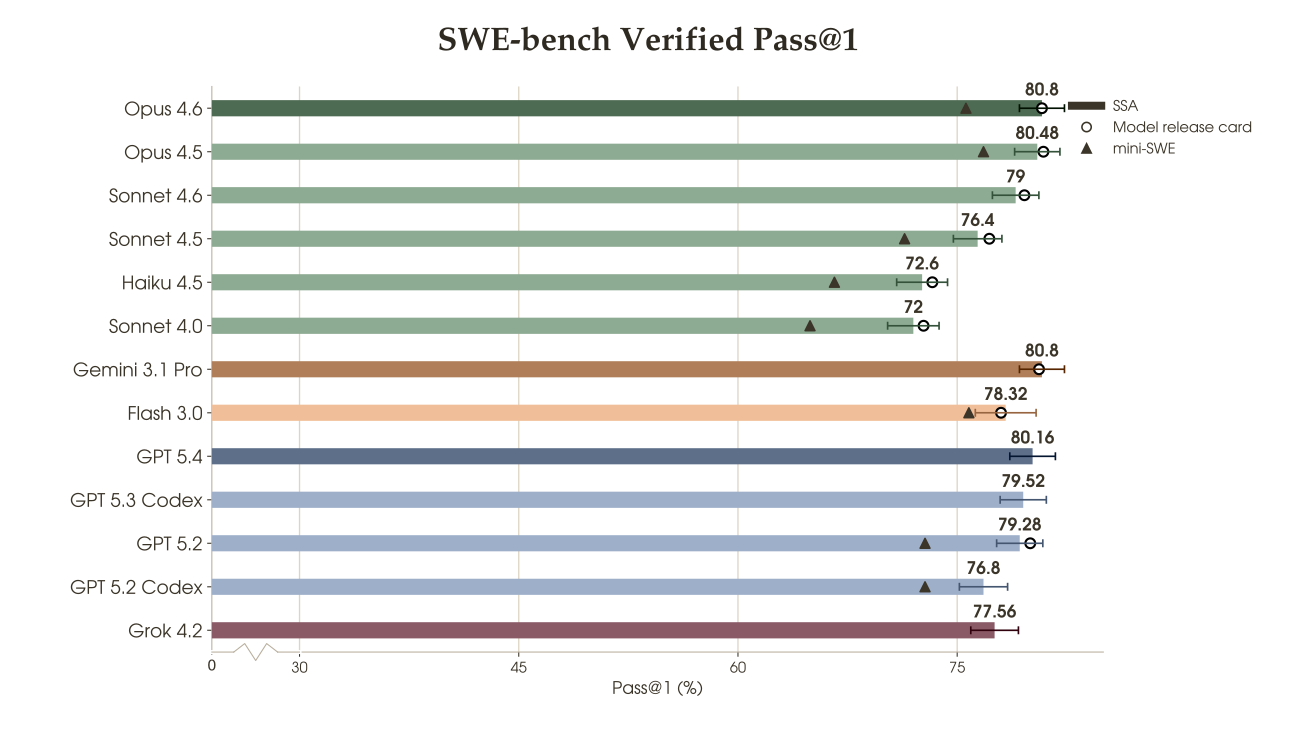
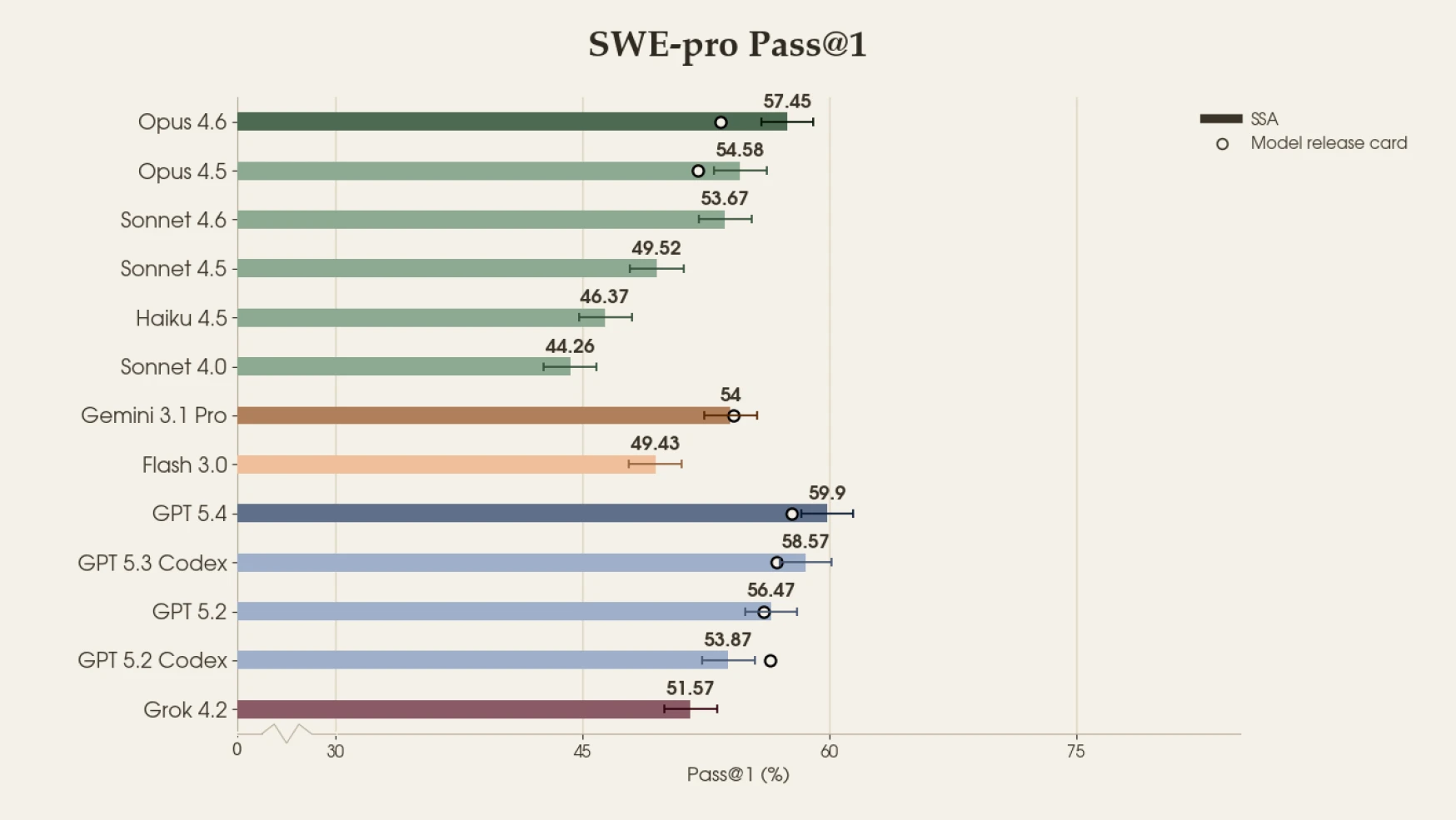
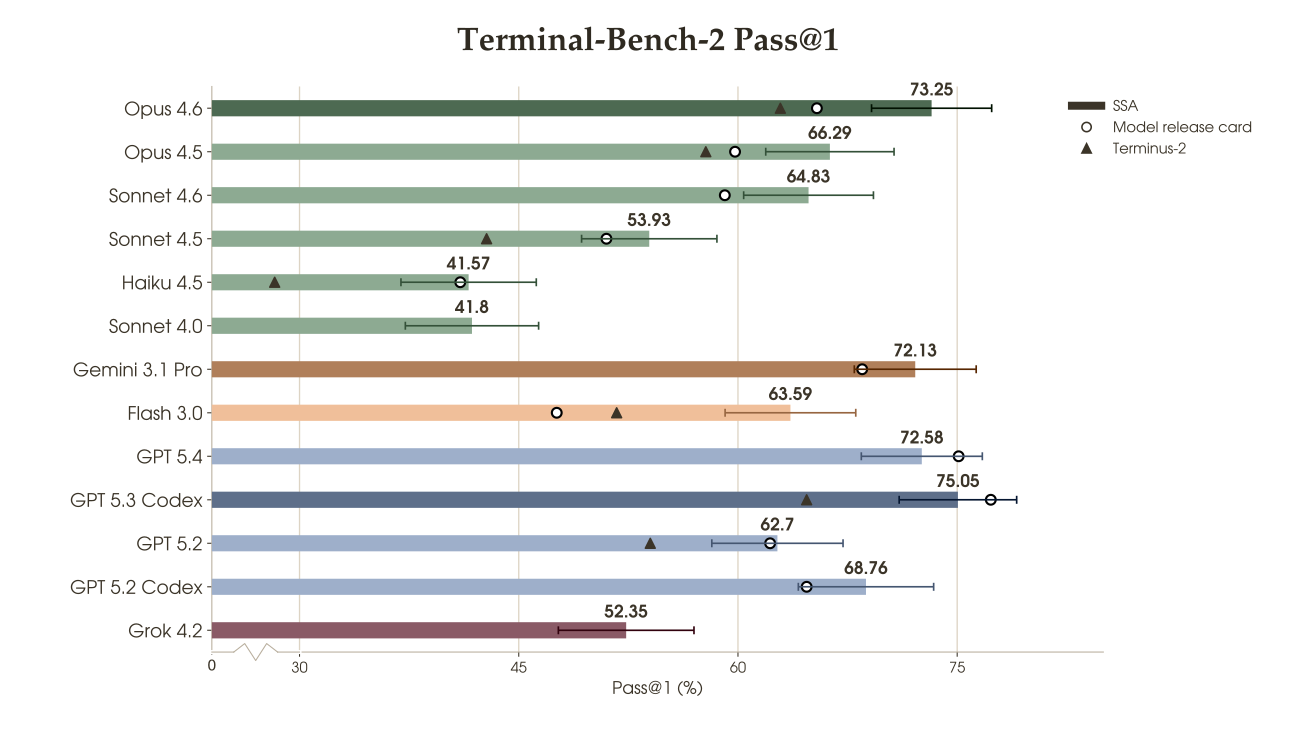
The harness is built for rapid experimentation — swap models, tune prompts, adjust tool behavior, and benchmark all in a single config change. Despite its simplicity, SSA delivers SOTA-level results on widely-used coding benchmarks including SWE-Bench Verified, SWE-Bench Pro, and Terminal Bench 2.
Highlights
- Model-agnostic — first-class adapters for Anthropic, OpenAI, Google, xAI, Bedrock, and any OpenAI-compatible endpoint (vLLM, LiteLLM, Together, Vertex, Z.AI).
- Composable tools —
bash,str_replace_editor,think, andsubmitprimitives with per-tool output clipping and timeout controls. - Isolated environments — Docker-backed sandboxes with streaming exec, automatic image resolution, and ECR support.
- Hydra-powered configs — every knob is overridable from the command line; experiments are reproducible from a single YAML.
- Built-in benchmarking — turnkey scripts for SWE-Bench Verified, SWE-Bench Pro, and Terminal Bench 2, including S3 result upload.
Installation
Requirements
- Python 3.12+
- Docker for containerized task environments
- AWS credentials if using Amazon Bedrock for model access and/or Amazon ECR for docker images
- uv package manager (optional, but recommended)
git clone https://github.com/strands-labs/benchmark-harnesses.git
cd benchmark-harnesses

# Recommended: sync the workspace (creates .venv with this package + its deps)
uv sync
source .venv/bin/activate

# Or install just this package with pip
pip install -e .
Quick Start
Run a single instance
uv run python -m ssa.run \
    --config-name=default.yaml \
    dataset.name=sbv \
    dataset.identifier=django__django-15987 \
    env.env_type=docker \
    env.docker.workdir="/testbed"
We provide simple scripts for running instances from SWE-Bench Verified, SWE-Bench Pro, and Terminal-Bench-2 (and see this for running Terminal-Bench-2 with SSA's harbor plugin).
Configuration
SSA uses Hydra for configuration. All configs live in src/ssa/configs/, and any parameter can be overridden from the command line. Start from src/ssa/configs/default.yaml for the full schema, then mix in a model-specific config as needed.
Architecture
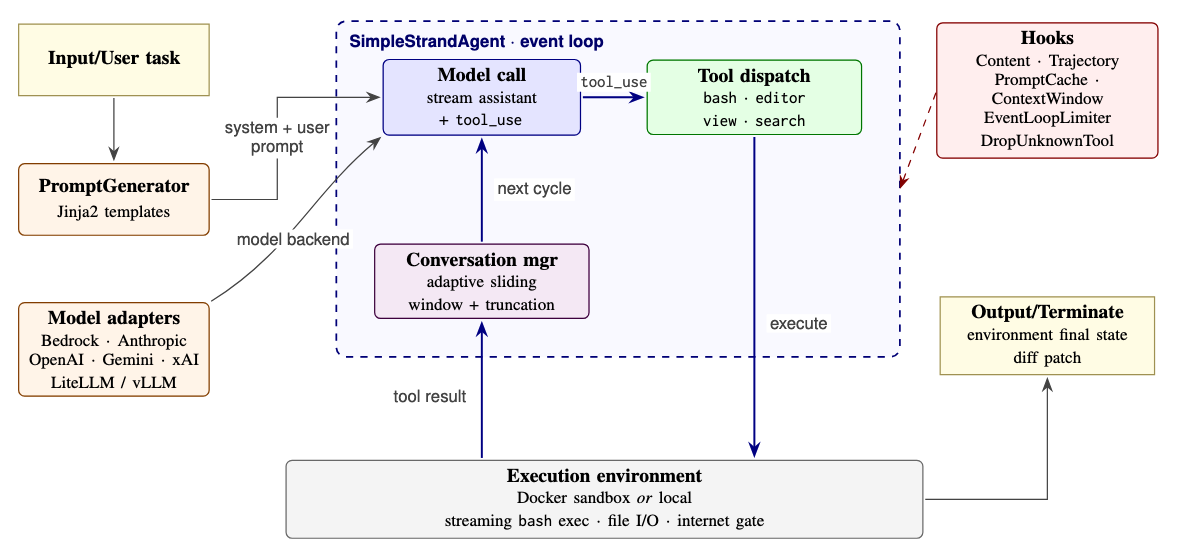
SSA's design and execution loop is summarized in the following figure:
Results
SWE-Bench Verified:
SWE-Bench Pro:
Terminal Bench 2:
Repository Layout
The code is structured as follows:
src/ssa/
├── agent.py / agent_runner.py     # Core agent loop
├── models/                        # Model adapters (Anthropic, OpenAI, Bedrock, ...)
├── tools/                         # bash, str_replace_editor, think, submit
├── environments/                  # Docker-backed sandbox
├── conversation_manager/          # Context management & truncation
├── hooks/ • callbacks/ • metrics/ # Observability and instrumentation
├── prompts/ • configs/            # System prompts and Hydra configs
└── run.py                         # Entry point
scripts/
├── swe_verified/ • swe_pro/ • tb2/
Please consider citing as follows, if you find SSA useful!
@misc{2026simplestrandsagent,
      title={Dissecting model behavior through agent trajectories},
      author={Gaurav Gupta and Vatshank Chaturvedi and Jun Huan and Anoop Deoras},
      year={2026},
      eprint={2606.17454},
      archivePrefix={arXiv},
      url={https://arxiv.org/abs/2606.17454},
}
ARC-AGI-3 Agent
A long-horizon agent that learns unfamiliar interactive environments from its own logs — 99.95% on the public ARC-AGI-3 game set.

Overview
ARC-AGI-3 is a set of interactive games that ship with no instructions: to win one, an agent has to work out what the controls do, what it is looking at, and what counts as progress — by playing. The benchmark exists to measure learning from experience.
This harness pairs the Strands Agents SDK with Amazon Bedrock to play those games from a blank slate. The board is never pasted into the prompt. Instead the runner appends every observation to an append-only logs.txt and hands the agent the path to that file; the agent writes and runs its own code against the log to extract what it needs, forms hypotheses about the mechanics, tests them, and keeps the scripts that prove useful. Context stays small while history grows without bound, and the agent's accumulated scripts become its memory.
It is built on PRO-LONG, which contributes the game loop and the append-only log.
Highlights
- No priors — actions are named
ACTION1..ACTION6with no meaning attached, cell values are unnamed, and no game structure is asserted. One prompt serves all 25 games. - Context via code, not context windows — the agent greps, parses and aggregates a log that reaches tens of megabytes, deciding each turn which slice is worth loading.
- Sandboxed tools — six tools (
read_file,write_file,edit_file,grep,glob_files,bash) execute inside bubblewrap with no network and no cloud credentials; the only channel back to the runner isactions.json. - Log access analysed — the agent's 260 log-reading scripts from the record run are classified into six access patterns, with the design lessons that follow.
Results
Claude Opus 5 (High) on Amazon Bedrock, public game set, competition mode:
| score | 99.95% |
| levels | 183 / 183 |
| environments | 25 / 25 |
| scorecard | 8a10b024-3560-448f-ac31-becc48affe5b |
All 25 games rendered from the run's own logs (animation, 4 MB).
Repository Layout
prolong_agent/
├── agent/          # Strands + Bedrock agent, sandboxed tools, orchestrator, prompts
├── environment/    # ARC-AGI-3 game loop and API wrapper
└── metrics/ • utils/
Setup, flags, cost guidance and a breakdown of what is new versus PRO-LONG are in the agent README.
Note: this agent is a standalone uv project rather than a workspace member, because it pins
strands-agents==1.50.1and the workspace's single lockfile already pins==1.45.0forsimple-strands-agent. It has its ownuv.lock— the one used for the run above — so build it withcd arc-agi-3-agent && uv sync --frozen.
Running agents safely
Agents in this repository are given access to shell tools. In practice, this means the model can run commands in the environment where the agent is started.
This is useful for experiments and benchmarking, but it also means you should treat the agent like you would treat any program with shell access: it may read files, modify files, delete data, install packages, or accidentally expose information from the environment.
For normal use, we recommend running agents in an isolated environment rather than directly on your machine. Our experiments and benchmarks are run inside Docker containers. You should avoid running agents in an environment that contains secrets, credentials, personal files, production data, or anything you would not want the model to access.
A good default setup is:
- run the agent inside Docker or another sandboxed environment
- mount only the files/directories the agent actually needs
- avoid exposing cloud credentials, SSH keys, API keys, or other secrets
- do not run it with unnecessary privileges
- inspect outputs before trusting or reusing them
Agents will usually behave as instructed, but shell access is powerful. Use the same caution you would use when running code from an automated system.
License
Contributors


Similar repos


Languages
Python
99.4%
Strands-based agents and harnesses for agentic benchmarks.
See the codeREADME
Strands Benchmark Harnesses
A repository for Strands-based agents and harnesses for agentic benchmarks. It is a uv workspace: the repository root coordinates one or more member packages. Setup, configuration, and usage live in each agent's README.
Agents
Simple Strands Agent
A lean autonomous-coding agent achieving state-of-the-art performance across software engineering benchmarks.
For more details, see the technical report.
For a summary of the work, see the post on Amazon-Science.
Overview
Simple Strands Agent (SSA) is a minimal, hackable harness for autonomous software engineering. It pairs frontier LLMs (Claude, GPT, Gemini, and open-weight models via Bedrock/LiteLLM/vLLM) with bash and file-editing tools inside isolated Docker environments to analyze codebases, diagnose bugs, write patches, and verify solutions.
The harness is built for rapid experimentation — swap models, tune prompts, adjust tool behavior, and benchmark all in a single config change. Despite its simplicity, SSA delivers SOTA-level results on widely-used coding benchmarks including SWE-Bench Verified, SWE-Bench Pro, and Terminal Bench 2.
Highlights
- Model-agnostic — first-class adapters for Anthropic, OpenAI, Google, xAI, Bedrock, and any OpenAI-compatible endpoint (vLLM, LiteLLM, Together, Vertex, Z.AI).
- Composable tools —
bash,str_replace_editor,think, andsubmitprimitives with per-tool output clipping and timeout controls. - Isolated environments — Docker-backed sandboxes with streaming exec, automatic image resolution, and ECR support.
- Hydra-powered configs — every knob is overridable from the command line; experiments are reproducible from a single YAML.
- Built-in benchmarking — turnkey scripts for SWE-Bench Verified, SWE-Bench Pro, and Terminal Bench 2, including S3 result upload.
Installation
Requirements
- Python 3.12+
- Docker for containerized task environments
- AWS credentials if using Amazon Bedrock for model access and/or Amazon ECR for docker images
- uv package manager (optional, but recommended)
git clone https://github.com/strands-labs/benchmark-harnesses.git
cd benchmark-harnesses

# Recommended: sync the workspace (creates .venv with this package + its deps)
uv sync
source .venv/bin/activate

# Or install just this package with pip
pip install -e .
Quick Start
Run a single instance
uv run python -m ssa.run \
    --config-name=default.yaml \
    dataset.name=sbv \
    dataset.identifier=django__django-15987 \
    env.env_type=docker \
    env.docker.workdir="/testbed"
We provide simple scripts for running instances from SWE-Bench Verified, SWE-Bench Pro, and Terminal-Bench-2 (and see this for running Terminal-Bench-2 with SSA's harbor plugin).
Configuration
SSA uses Hydra for configuration. All configs live in src/ssa/configs/, and any parameter can be overridden from the command line. Start from src/ssa/configs/default.yaml for the full schema, then mix in a model-specific config as needed.
Architecture
SSA's design and execution loop is summarized in the following figure:
Results
SWE-Bench Verified:
SWE-Bench Pro:
Terminal Bench 2:
Repository Layout
The code is structured as follows:
src/ssa/
├── agent.py / agent_runner.py     # Core agent loop
├── models/                        # Model adapters (Anthropic, OpenAI, Bedrock, ...)
├── tools/                         # bash, str_replace_editor, think, submit
├── environments/                  # Docker-backed sandbox
├── conversation_manager/          # Context management & truncation
├── hooks/ • callbacks/ • metrics/ # Observability and instrumentation
├── prompts/ • configs/            # System prompts and Hydra configs
└── run.py                         # Entry point
scripts/
├── swe_verified/ • swe_pro/ • tb2/
Please consider citing as follows, if you find SSA useful!
@misc{2026simplestrandsagent,
      title={Dissecting model behavior through agent trajectories},
      author={Gaurav Gupta and Vatshank Chaturvedi and Jun Huan and Anoop Deoras},
      year={2026},
      eprint={2606.17454},
      archivePrefix={arXiv},
      url={https://arxiv.org/abs/2606.17454},
}
ARC-AGI-3 Agent
A long-horizon agent that learns unfamiliar interactive environments from its own logs — 99.95% on the public ARC-AGI-3 game set.
Overview
ARC-AGI-3 is a set of interactive games that ship with no instructions: to win one, an agent has to work out what the controls do, what it is looking at, and what counts as progress — by playing. The benchmark exists to measure learning from experience.
This harness pairs the Strands Agents SDK with Amazon Bedrock to play those games from a blank slate. The board is never pasted into the prompt. Instead the runner appends every observation to an append-only logs.txt and hands the agent the path to that file; the agent writes and runs its own code against the log to extract what it needs, forms hypotheses about the mechanics, tests them, and keeps the scripts that prove useful. Context stays small while history grows without bound, and the agent's accumulated scripts become its memory.
It is built on PRO-LONG, which contributes the game loop and the append-only log.
Highlights
- No priors — actions are named
ACTION1..ACTION6with no meaning attached, cell values are unnamed, and no game structure is asserted. One prompt serves all 25 games. - Context via code, not context windows — the agent greps, parses and aggregates a log that reaches tens of megabytes, deciding each turn which slice is worth loading.
- Sandboxed tools — six tools (
read_file,write_file,edit_file,grep,glob_files,bash) execute inside bubblewrap with no network and no cloud credentials; the only channel back to the runner isactions.json. - Log access analysed — the agent's 260 log-reading scripts from the record run are classified into six access patterns, with the design lessons that follow.
Results
Claude Opus 5 (High) on Amazon Bedrock, public game set, competition mode:
| score | 99.95% |
| levels | 183 / 183 |
| environments | 25 / 25 |
| scorecard | 8a10b024-3560-448f-ac31-becc48affe5b |
All 25 games rendered from the run's own logs (animation, 4 MB).
Repository Layout
prolong_agent/
├── agent/          # Strands + Bedrock agent, sandboxed tools, orchestrator, prompts
├── environment/    # ARC-AGI-3 game loop and API wrapper
└── metrics/ • utils/
Setup, flags, cost guidance and a breakdown of what is new versus PRO-LONG are in the agent README.
Note: this agent is a standalone uv project rather than a workspace member, because it pins
strands-agents==1.50.1and the workspace's single lockfile already pins==1.45.0forsimple-strands-agent. It has its ownuv.lock— the one used for the run above — so build it withcd arc-agi-3-agent && uv sync --frozen.
Running agents safely
Agents in this repository are given access to shell tools. In practice, this means the model can run commands in the environment where the agent is started.
This is useful for experiments and benchmarking, but it also means you should treat the agent like you would treat any program with shell access: it may read files, modify files, delete data, install packages, or accidentally expose information from the environment.
For normal use, we recommend running agents in an isolated environment rather than directly on your machine. Our experiments and benchmarks are run inside Docker containers. You should avoid running agents in an environment that contains secrets, credentials, personal files, production data, or anything you would not want the model to access.
A good default setup is:
- run the agent inside Docker or another sandboxed environment
- mount only the files/directories the agent actually needs
- avoid exposing cloud credentials, SSH keys, API keys, or other secrets
- do not run it with unnecessary privileges
- inspect outputs before trusting or reusing them
Agents will usually behave as instructed, but shell access is powerful. Use the same caution you would use when running code from an automated system.
License
Similar repos
Contributors
Languages
Python
99.4%