Modular SciFact retrieval and ranking experimentation with PostgreSQL, pgvector, BM25, and neural rerankers.
Python
1
183 commits
updated Oct 7, 2026
An inspectable scientific retrieval-augmented generation system built for one NVIDIA DGX Spark.
It retrieves evidence from 5,183 biomedical abstracts, ranks it with lexical, dense, coreference,
and late-interaction methods, then asks a locally hosted Qwen model for a cited answer or an
explicit insufficient evidence result.
This project is deliberately more than a plausible RAG demo: retrieval and generation decisions are measured, failure cases remain visible, evaluation component revisions are recorded, selected images and checkpoints are pinned, and experimental strategies stay modular rather than accumulating in the production score.
Status: completed DGX-local prototype with an accepted, opt-in public-demo application boundary. CLI, HTTP, MCP, and web interfaces are accepted. The roadmap records completed and stopped experiments. Template/Pi evaluation now belongs to agentic-project-template #59; further scientific research or production-service work requires a new scope decision.
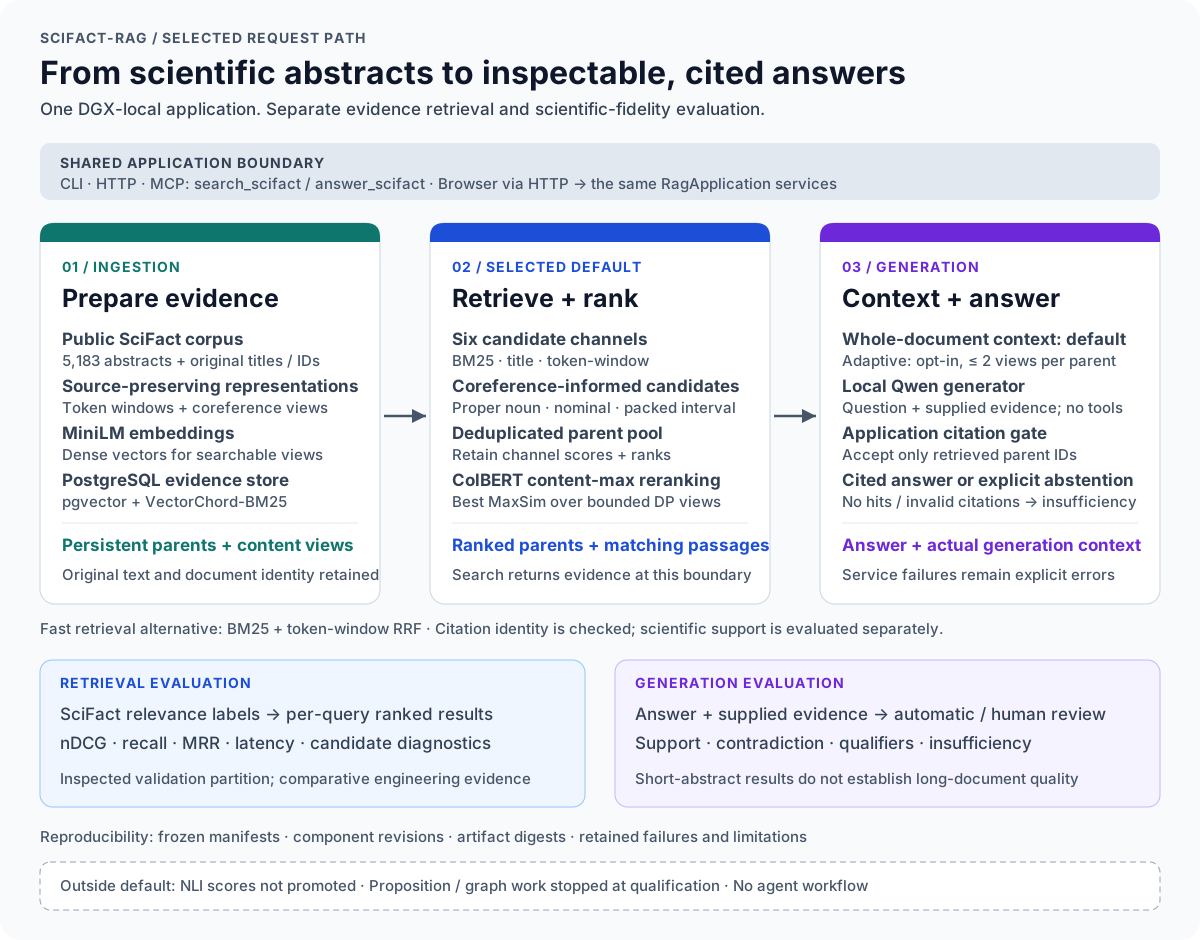
Who and why: researchers and developers need to inspect both the answer and the evidence supplied to the model. The system retains parent-document identity, matching passages, retrieval signals, and generation context so relevance and scientific fidelity can be examined separately.
How: ingest public SciFact abstracts into PostgreSQL, retrieve and deduplicate candidates across six channels, rerank their bounded content views with ColBERT, assemble context, and request a locally generated answer. Search ends at ranked evidence; answering adds generation and a parent-document citation check.
Current boundary: this is a measured single-DGX prototype. Whole-document generation context is the default; adaptive context and the fast BM25 hybrid are explicit alternatives. Citation validation checks document identity, while scientific support, contradiction, and overstatement require separate evaluation. Experimental inference and proposition/graph work are outside the default path.
The selected retrieval architecture builds a broad six-channel candidate pool and ranks each document by its best ColBERT score across bounded, coreference-informed content chunks.
| Retrieval strategy | nDCG@10 | Recall@10 | MRR@10 | Median latency |
|---|---|---|---|---|
| DP content-max ColBERT — selected default | 0.742493 | 0.806250 | 0.728472 | 638.94 ms |
| Whole-document ColBERT | 0.734958 | 0.800000 | 0.722569 | 642.45 ms |
| BM25 + token-window RRF | 0.673519 | 0.787500 | 0.647436 | 78.70 ms |
These are internal comparative results over a fixed 160-query SciFact validation partition that had already been inspected. They support an engineering choice, not an unbiased generalization claim. The selected default improves nDCG by 0.068975 over the BM25 hybrid while accepting an approximately 8.1x median-latency cost and a ColBERT GPU-service dependency. BM25 remains the supported fast/no-ColBERT alternative.
insufficient evidence for empty retrieval,
an explicit model abstention, or missing/invalid citations. Service failures
remain errors. A valid citation does not establish that every claim is supported.Validation is a separate lane. Retrieval comparisons use SciFact relevance labels, per-query rankings, quality metrics, and latency. Generation evaluation examines support, contradiction, insufficiency, qualifiers, and material overstatement against supplied evidence. Frozen manifests, component revisions, and artifact digests keep results attributable. The inspected retrieval partition and short-abstract generation review retain the limitations described above; they do not establish fresh generalization or long-document performance.
See the selected retrieval decision, context-assembly decision, and technical reference for strategy, storage, provenance, and evaluation details. The roadmap records experimental and stopped work separately from the selected request path.
The pipeline is a modular monolith with one explicit composition root. LangGraph is intentionally absent: the current request path is deterministic and does not need a stateful agent workflow. The CLI, loopback HTTP API, loopback MCP service, and small evidence-inspection page share the same application services. The browser calls the existing HTTP contracts rather than implementing a second retrieval or generation path.
Retrieval selects and orders parent documents; generation context independently chooses the text Qwen sees. The branches below are selectable alternatives, not stages that all run for every query. Green marks the selected retrieval default; blue marks the fast fallback.
flowchart TB
    Q["Scientific query"]

    subgraph simple["Baselines and list fusion"]
        direction LR
        L["keyword / bm25<br/>Lexical document ranking"]
        V["Dense MiniLM baselines<br/>token-window; coref-propn / nominal / max<br/>sentence-pack; coref-aware / interval-pack"]
        F["Fuse independently retrieved lists with RRF<br/>title + token-window; BM25 + dense variants<br/>hybrid-rrf: keyword + proper-noun coref"]
        FAST["bm25-token-window-rrf — FAST FALLBACK<br/>BM25 list + MiniLM abstract-window list<br/>reciprocal-rank fusion; no ColBERT"]
    end
    Q --> L
    Q --> V
    Q --> F
    Q --> FAST

    subgraph pooled["Candidate pooling and scoring"]
        direction TB
        P5["Five generators, each top 50<br/>BM25 + title + token-window<br/>+ proper-noun + nominal coref sentences"]
        P6["Six-generator interval pool<br/>same five + coref-interval-pack"]
        P4["Four-generator DP alternative<br/>BM25 + title + nominal coref sentences<br/>+ raw MiniLM-DP chunks: target 112, max 126 tokens"]
        N["Native pooled-score alternatives<br/>Rescore every deduplicated parent in every channel<br/>RRF; optional MS MARCO rank; or robust mean"]
        W["Whole-document reranking alternatives<br/>Raw title + abstract scored by ONE reranker<br/>ColBERT; MS MARCO; RankZephyr on interval pool"]
        C["pooled-coref-interval-content-max-colbert — DEFAULT<br/>Score all stored raw DP content views with ColBERT<br/>Max 510 tokens per view; parent score = highest raw score<br/>No title-score fusion or candidate-score mixing"]
        M["Title + DP-content ablations<br/>Separate title score and max raw DP-content score<br/>Equal mean of raw scores, or separately robust-normalized scores"]
        P5 --> P6
        P5 --> N
        P6 -->|"RRF variant"| N
        P5 --> W
        P6 --> W
        P6 --> C
        P6 --> M
        P4 -->|"Robust-normalized mean"| M
    end
    Q --> P5
    Q --> P4

    R["Ranked parent document IDs<br/>Preserve source text and matching-passage provenance"]
    L --> R
    V --> R
    F --> R
    FAST --> R
    N --> R
    W --> R
    C --> R
    M --> R

    subgraph context["Generation context"]
        direction LR
        WHOLE["whole-document — DEFAULT<br/>Title + complete abstract for each retrieved parent"]
        ADAPT["adaptive — OPT-IN<br/>Keep whole abstract if it is one exact DP view<br/>Otherwise ColBERT-rank stored 510-token views<br/>Select at most two per parent; restore source order<br/>top-dp-chunks is an alias, not a third policy"]
    end
    R --> WHOLE
    R --> ADAPT
    WHOLE --> A["Local Qwen<br/>Cited answer or insufficient evidence<br/>Citations validated against retrieved parent IDs"]
    ADAPT --> A

    classDef selected fill:#e8f5e9,stroke:#2e7d32,color:#163b1c,stroke-width:2px;
    classDef fallback fill:#e3f2fd,stroke:#1565c0,color:#153552,stroke-width:2px;
    class C selected;
    class FAST fallback;
RRF is reciprocal-rank fusion; DP is dynamic programming for chunk boundaries. Coreference rewrites are separate candidate representations; DP views preserve raw source text and use coreference to place boundaries. Pooling deduplicates documents before scoring; the selected content-max path retains the winning chunk as provenance rather than concatenating all chunks into one reranker input.
The native pooled family also includes a sixth sentence-pack or coref-aware-pack channel;
its MS MARCO extra rank and robust-mean variants use the five-generator pool. Whole-document
ColBERT is distinct from the selected DP content-max path. Title/content fusion and robust
normalization are retained ablations, not the selected default. Context selection preserves parent
rank and citations; retrieval token limits are not a guarantee about Qwen's prompt budget.
See the complete strategy reference, composition root, retrieval-default decision, and context-policy decision for exact names and boundaries.
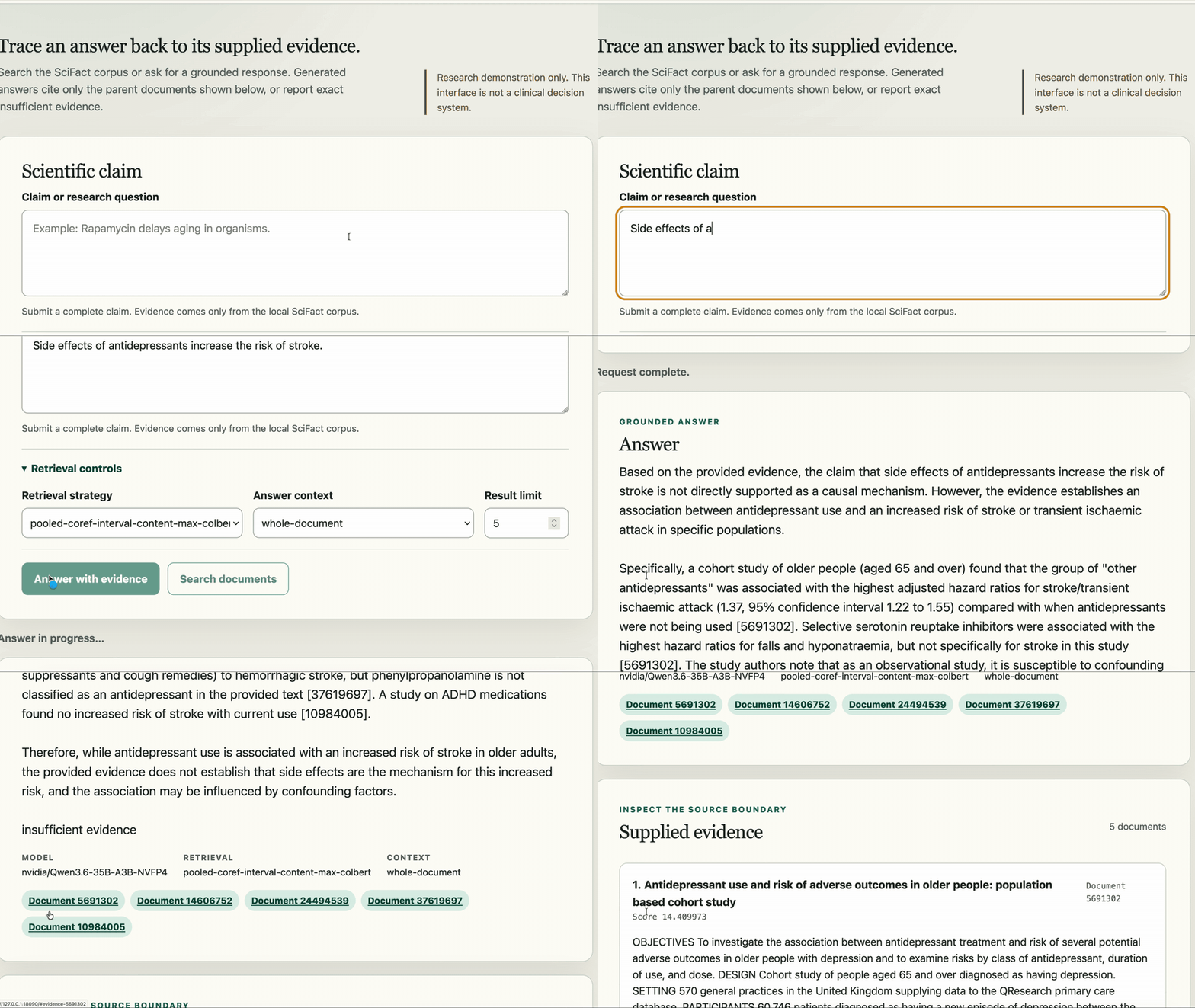
Watch the full recording with captions. It captures the actual loopback application and local model services. The recording is the durable showcase and remains usable when the optional live demo is offline. The page checks the best-effort live path once, enables Open live demo only after a successful readiness response, and otherwise keeps the recording and an honest offline message. The short GIF condenses waiting and scrolling from the disclosed longer edit.
Requirements are Docker Compose, access to an NVIDIA DGX Spark, and the required model assets. The
ColBERT service is required by the selected retrieval default; ask also expects the configured
Qwen OpenAI-compatible endpoint.
docker compose up -d postgres late-interaction
docker compose build app
docker compose run --rm app download
docker compose run --rm app ingest
docker compose run --rm app search \
  "What evidence links immune signaling to disease?"
docker compose run --rm app ask \
  "What evidence links immune signaling to disease?"
Start the local HTTP adapter over the same application layer:
docker compose up -d api
curl http://127.0.0.1:8090/healthz
curl -X POST http://127.0.0.1:8090/v1/search \
  -H 'content-type: application/json' \
  -d '{"schema_version":"search-request/v1","query":"immune signaling","limit":5}'
The default API remains a loopback-only prototype. Issue #27 adds an opt-in, anonymous, best-effort live-demo mode for the same single-worker service; it is not a supported third-party API and has no uptime promise. Complete request, response, error, readiness, capability, and operator details are in the technical reference.
The same API service hosts the evidence inspector:
docker compose up -d --build api
# Open http://127.0.0.1:8090/
It shows the active strategies, answer status, citations, ordered parent-document evidence, document IDs, scores, matching passages, and the complete text supplied to generation. It is a local inspection surface without authentication, TLS, public ingress, or independent retrieval logic.
Start the DGX-local MCP service over the same application layer:
docker compose up -d mcp
It publishes only http://127.0.0.1:8091/mcp and exposes exactly search_scifact and
answer_scifact. Complete tool, result, validation, and client details are in the
technical reference.
Use the fast fallback explicitly when ColBERT is unavailable:
docker compose run --rm app search \
  --strategy bm25-token-window-rrf \
  "What evidence links immune signaling to disease?"
pooled-coref-interval-content-max-colbert.bm25-token-window-rrf.whole-document; adaptive is the scalable opt-in policy.make smoke
The gate checks the harness contract, formatting, linting, static types, unit tests, package build/install, and Docker Compose configuration. Integration and live-model evaluations remain separate because they exercise retained data and GPU services.
Application code is MIT licensed. Dataset, model, container, PostgreSQL extension, and other third-party components retain their own licenses; see the technical reference and LICENSE.
Modular SciFact retrieval and ranking experimentation with PostgreSQL, pgvector, BM25, and neural rerankers.
Python
1
183 commits
updated Oct 7, 2026
An inspectable scientific retrieval-augmented generation system built for one NVIDIA DGX Spark.
It retrieves evidence from 5,183 biomedical abstracts, ranks it with lexical, dense, coreference,
and late-interaction methods, then asks a locally hosted Qwen model for a cited answer or an
explicit insufficient evidence result.
This project is deliberately more than a plausible RAG demo: retrieval and generation decisions are measured, failure cases remain visible, evaluation component revisions are recorded, selected images and checkpoints are pinned, and experimental strategies stay modular rather than accumulating in the production score.
Status: completed DGX-local prototype with an accepted, opt-in public-demo application boundary. CLI, HTTP, MCP, and web interfaces are accepted. The roadmap records completed and stopped experiments. Template/Pi evaluation now belongs to agentic-project-template #59; further scientific research or production-service work requires a new scope decision.
Who and why: researchers and developers need to inspect both the answer and the evidence supplied to the model. The system retains parent-document identity, matching passages, retrieval signals, and generation context so relevance and scientific fidelity can be examined separately.
How: ingest public SciFact abstracts into PostgreSQL, retrieve and deduplicate candidates across six channels, rerank their bounded content views with ColBERT, assemble context, and request a locally generated answer. Search ends at ranked evidence; answering adds generation and a parent-document citation check.
Current boundary: this is a measured single-DGX prototype. Whole-document generation context is the default; adaptive context and the fast BM25 hybrid are explicit alternatives. Citation validation checks document identity, while scientific support, contradiction, and overstatement require separate evaluation. Experimental inference and proposition/graph work are outside the default path.
The selected retrieval architecture builds a broad six-channel candidate pool and ranks each document by its best ColBERT score across bounded, coreference-informed content chunks.
| Retrieval strategy | nDCG@10 | Recall@10 | MRR@10 | Median latency |
|---|---|---|---|---|
| DP content-max ColBERT — selected default | 0.742493 | 0.806250 | 0.728472 | 638.94 ms |
| Whole-document ColBERT | 0.734958 | 0.800000 | 0.722569 | 642.45 ms |
| BM25 + token-window RRF | 0.673519 | 0.787500 | 0.647436 | 78.70 ms |
These are internal comparative results over a fixed 160-query SciFact validation partition that had already been inspected. They support an engineering choice, not an unbiased generalization claim. The selected default improves nDCG by 0.068975 over the BM25 hybrid while accepting an approximately 8.1x median-latency cost and a ColBERT GPU-service dependency. BM25 remains the supported fast/no-ColBERT alternative.
insufficient evidence for empty retrieval,
an explicit model abstention, or missing/invalid citations. Service failures
remain errors. A valid citation does not establish that every claim is supported.Validation is a separate lane. Retrieval comparisons use SciFact relevance labels, per-query rankings, quality metrics, and latency. Generation evaluation examines support, contradiction, insufficiency, qualifiers, and material overstatement against supplied evidence. Frozen manifests, component revisions, and artifact digests keep results attributable. The inspected retrieval partition and short-abstract generation review retain the limitations described above; they do not establish fresh generalization or long-document performance.
See the selected retrieval decision, context-assembly decision, and technical reference for strategy, storage, provenance, and evaluation details. The roadmap records experimental and stopped work separately from the selected request path.
The pipeline is a modular monolith with one explicit composition root. LangGraph is intentionally absent: the current request path is deterministic and does not need a stateful agent workflow. The CLI, loopback HTTP API, loopback MCP service, and small evidence-inspection page share the same application services. The browser calls the existing HTTP contracts rather than implementing a second retrieval or generation path.
Retrieval selects and orders parent documents; generation context independently chooses the text Qwen sees. The branches below are selectable alternatives, not stages that all run for every query. Green marks the selected retrieval default; blue marks the fast fallback.
flowchart TB
    Q["Scientific query"]

    subgraph simple["Baselines and list fusion"]
        direction LR
        L["keyword / bm25<br/>Lexical document ranking"]
        V["Dense MiniLM baselines<br/>token-window; coref-propn / nominal / max<br/>sentence-pack; coref-aware / interval-pack"]
        F["Fuse independently retrieved lists with RRF<br/>title + token-window; BM25 + dense variants<br/>hybrid-rrf: keyword + proper-noun coref"]
        FAST["bm25-token-window-rrf — FAST FALLBACK<br/>BM25 list + MiniLM abstract-window list<br/>reciprocal-rank fusion; no ColBERT"]
    end
    Q --> L
    Q --> V
    Q --> F
    Q --> FAST

    subgraph pooled["Candidate pooling and scoring"]
        direction TB
        P5["Five generators, each top 50<br/>BM25 + title + token-window<br/>+ proper-noun + nominal coref sentences"]
        P6["Six-generator interval pool<br/>same five + coref-interval-pack"]
        P4["Four-generator DP alternative<br/>BM25 + title + nominal coref sentences<br/>+ raw MiniLM-DP chunks: target 112, max 126 tokens"]
        N["Native pooled-score alternatives<br/>Rescore every deduplicated parent in every channel<br/>RRF; optional MS MARCO rank; or robust mean"]
        W["Whole-document reranking alternatives<br/>Raw title + abstract scored by ONE reranker<br/>ColBERT; MS MARCO; RankZephyr on interval pool"]
        C["pooled-coref-interval-content-max-colbert — DEFAULT<br/>Score all stored raw DP content views with ColBERT<br/>Max 510 tokens per view; parent score = highest raw score<br/>No title-score fusion or candidate-score mixing"]
        M["Title + DP-content ablations<br/>Separate title score and max raw DP-content score<br/>Equal mean of raw scores, or separately robust-normalized scores"]
        P5 --> P6
        P5 --> N
        P6 -->|"RRF variant"| N
        P5 --> W
        P6 --> W
        P6 --> C
        P6 --> M
        P4 -->|"Robust-normalized mean"| M
    end
    Q --> P5
    Q --> P4

    R["Ranked parent document IDs<br/>Preserve source text and matching-passage provenance"]
    L --> R
    V --> R
    F --> R
    FAST --> R
    N --> R
    W --> R
    C --> R
    M --> R

    subgraph context["Generation context"]
        direction LR
        WHOLE["whole-document — DEFAULT<br/>Title + complete abstract for each retrieved parent"]
        ADAPT["adaptive — OPT-IN<br/>Keep whole abstract if it is one exact DP view<br/>Otherwise ColBERT-rank stored 510-token views<br/>Select at most two per parent; restore source order<br/>top-dp-chunks is an alias, not a third policy"]
    end
    R --> WHOLE
    R --> ADAPT
    WHOLE --> A["Local Qwen<br/>Cited answer or insufficient evidence<br/>Citations validated against retrieved parent IDs"]
    ADAPT --> A

    classDef selected fill:#e8f5e9,stroke:#2e7d32,color:#163b1c,stroke-width:2px;
    classDef fallback fill:#e3f2fd,stroke:#1565c0,color:#153552,stroke-width:2px;
    class C selected;
    class FAST fallback;
RRF is reciprocal-rank fusion; DP is dynamic programming for chunk boundaries. Coreference rewrites are separate candidate representations; DP views preserve raw source text and use coreference to place boundaries. Pooling deduplicates documents before scoring; the selected content-max path retains the winning chunk as provenance rather than concatenating all chunks into one reranker input.
The native pooled family also includes a sixth sentence-pack or coref-aware-pack channel;
its MS MARCO extra rank and robust-mean variants use the five-generator pool. Whole-document
ColBERT is distinct from the selected DP content-max path. Title/content fusion and robust
normalization are retained ablations, not the selected default. Context selection preserves parent
rank and citations; retrieval token limits are not a guarantee about Qwen's prompt budget.
See the complete strategy reference, composition root, retrieval-default decision, and context-policy decision for exact names and boundaries.
Watch the full recording with captions. It captures the actual loopback application and local model services. The recording is the durable showcase and remains usable when the optional live demo is offline. The page checks the best-effort live path once, enables Open live demo only after a successful readiness response, and otherwise keeps the recording and an honest offline message. The short GIF condenses waiting and scrolling from the disclosed longer edit.
Requirements are Docker Compose, access to an NVIDIA DGX Spark, and the required model assets. The
ColBERT service is required by the selected retrieval default; ask also expects the configured
Qwen OpenAI-compatible endpoint.
docker compose up -d postgres late-interaction
docker compose build app
docker compose run --rm app download
docker compose run --rm app ingest
docker compose run --rm app search \
  "What evidence links immune signaling to disease?"
docker compose run --rm app ask \
  "What evidence links immune signaling to disease?"
Start the local HTTP adapter over the same application layer:
docker compose up -d api
curl http://127.0.0.1:8090/healthz
curl -X POST http://127.0.0.1:8090/v1/search \
  -H 'content-type: application/json' \
  -d '{"schema_version":"search-request/v1","query":"immune signaling","limit":5}'
The default API remains a loopback-only prototype. Issue #27 adds an opt-in, anonymous, best-effort live-demo mode for the same single-worker service; it is not a supported third-party API and has no uptime promise. Complete request, response, error, readiness, capability, and operator details are in the technical reference.
The same API service hosts the evidence inspector:
docker compose up -d --build api
# Open http://127.0.0.1:8090/
It shows the active strategies, answer status, citations, ordered parent-document evidence, document IDs, scores, matching passages, and the complete text supplied to generation. It is a local inspection surface without authentication, TLS, public ingress, or independent retrieval logic.
Start the DGX-local MCP service over the same application layer:
docker compose up -d mcp
It publishes only http://127.0.0.1:8091/mcp and exposes exactly search_scifact and
answer_scifact. Complete tool, result, validation, and client details are in the
technical reference.
Use the fast fallback explicitly when ColBERT is unavailable:
docker compose run --rm app search \
  --strategy bm25-token-window-rrf \
  "What evidence links immune signaling to disease?"
pooled-coref-interval-content-max-colbert.bm25-token-window-rrf.whole-document; adaptive is the scalable opt-in policy.make smoke
The gate checks the harness contract, formatting, linting, static types, unit tests, package build/install, and Docker Compose configuration. Integration and live-model evaluations remain separate because they exercise retained data and GPU services.
Application code is MIT licensed. Dataset, model, container, PostgreSQL extension, and other third-party components retain their own licenses; see the technical reference and LICENSE.



