
Declarative, crash-safe data and schema migration engine with cryptographic verification and WASM plugins.
Rust
3
67 commits
updated Sep 30, 2026
See what people are saying
README

Paganel
Data migration that proves it worked.




Paganel is a data migration engine written in Rust. It moves data and schema between systems with crash recovery, parallel execution, and in-flight transforms, then cryptographically verifies that the destination matches what was written, down to the row. Today that means MySQL, PostgreSQL, and CSV; sources and sinks can also be sandboxed WASM plugins, so anything with data can stand at either end of a pipeline.
A complete migration is one file:
connection "source" {
  driver = "mysql"
  url    = env("MYSQL_URL")
}

connection "dest" {
  driver = "postgres"
  url    = env("POSTGRES_URL")
}

pipeline "customers" {
  from { connection = connection.source table = "customers" }
  to   { connection = connection.dest   table = "customers" mode = "replace" }

  where "active" {
    customers.deleted_at is null
  }

  select {
    id    = customers.id
    name  = customers.name
    email = lower(trim(customers.email))
  }
}
On a 100M-row MySQL->PostgreSQL copy with the databases on separate hosts (over a real network), it sustains ~390K rows/s on a single lane and ~940K rows/s with four parallel lanes (~340K and ~670K with --integrity recording the receipts; see benchmarks).
Why Paganel?
Moving data between databases is simple until the data has to change on the way, the run has to survive a crash, and someone has to prove afterwards that it arrived intact. Paganel is one declarative tool that:
- Reads like config. A single PPL file describes the whole
migration: source, destination, filters, transforms, schema, and dependencies.
The tool parses it instead of passing SQL through, which is why
plancan show the blast radius before anything runs (why a DSL). - Is safe to re-run. Crash-safe checkpoints mean an interrupted migration resumes from the last committed batch. At most one batch is re-written (see State & Resume).
- Checks it worked. The receipt is built while writing, so
verifyruns minutes or weeks later by re-reading the destination and checking it against the receipt. No source connection, and a 32-byte root per table you can keep in a ticket. A mismatch names the row, not just a count. - Migrates schema too. Tables, indexes, foreign keys, ENUMs, and sequences, with FK-aware ordering and dependency-graph discovery.
- Expands the graph, not just a table. Point at a root table and the FK
graph is discovered and migrated with depth and exclude control. A
whereon the root cascades, so only referenced rows come along: orders since January, and only the customers those orders touch. - Extends without forking. Transforms, filters, sources, and sinks can be WASM/JS plugins, sandboxed with fuel, memory and timeout caps and no filesystem or network access by default.
None of these pieces is new on its own; docs/comparison.md lists who else has what. What was missing was all of them in one binary: schema and data, cross-engine, in-flight transforms, a dry-run plan, crash-safe resume, and row-level verification. There is no service to sign up for and no infrastructure to stand up, so it is one tool to get approved, and it runs inside your network.
If dump-and-restore covers your case (pg_dump | psql, mysqldump | mysql),
use that. Paganel is for migrations that need transformation, cross-engine type
mapping, dependency ordering, resumability, or verification.
Features
- Declarative pipelines - PPL with SQL-inspired syntax
- Cryptographic verification - Merkle tree receipts detect any difference between the destination and what was written
- Dry run -
planshows output columns and types, the execution DAG, the exact DDL (--ddl), and duration/memory estimates - Schema migration - CREATE TABLE, indexes, foreign keys, ENUMs, sequences
- Graph expansion - auto-discover and migrate FK-dependent tables
- Crash recovery - sled-backed checkpoints, automatic resume
- WASM plugins - sandboxed transform / filter / source / sink plugins in native Rust or JavaScript
- Transformations - field mapping, computed columns,
whenexpressions, functions - Data quality -
validateblocks with per-rowassert/warnrules - Fault tolerance - circuit breaker, configurable retry, Dead Letter Queue
- DAG execution -
after = [pipeline.x]dependencies, parallel levels - Multi-table pipelines -
tables = [...]fans one block out into a full copy per table - Parallel lanes -
lanes = Nsplits a large single-table copy into N primary-key ranges; graph migrations run their tables concurrently - Pagination strategies - primary key, numeric, timestamp cursor
- Lifecycle hooks -
before/afterSQL blocks per pipeline
Supported Connectors
| Role | Connector |
|---|---|
| Source | MySQL, PostgreSQL, CSV |
| Destination | PostgreSQL (COPY fast-path), MySQL (LOAD DATA fast-path) |
Secure connections (TLS/SSL)
Most managed databases (AWS RDS, GCP Cloud SQL, Azure, Neon, Supabase,
PlanetScale, Aiven, Heroku) require TLS. Both SQL drivers negotiate it from
the connection URL, with no extra config. Each driver uses its ecosystem's native
parameter names; the per-driver tables below show exactly what each mode
encrypts and verifies. To authenticate the server as well as encrypt the link, use a
verifying mode (verify-full / verify_ca), with a CA bundle for private CAs.
PostgreSQL - libpq-style sslmode (plus optional sslrootcert):
sslmode | Transport | Cert chain | Hostname |
|---|---|---|---|
disable | plaintext | – | – |
prefer (default) | TLS, falls back to plaintext | not checked | not checked |
require | TLS | not checked | not checked |
verify-ca | TLS | verified | not checked |
verify-full | TLS | verified | verified |
These follow libpq: require encrypts but does not authenticate the server;
verify-ca / verify-full verify the certificate.
connection "dest" {
  driver = "postgres"
  url    = env("POSTGRES_URL")  // e.g. postgres://user:pass@db.example.com:5432/app?sslmode=verify-full
}
For a private CA (e.g. RDS/Cloud SQL/Supabase), point at the CA bundle so the
chain can be verified: ?sslmode=verify-full&sslrootcert=/path/to/ca.pem.
MySQL - require_ssl plus optional verify_ca / verify_identity, and
ssl_ca for a private CA bundle (implies TLS):
| URL parameters | Transport | Cert chain | Hostname |
|---|---|---|---|
| (none) | plaintext | – | – |
require_ssl=true | TLS | verified | verified |
require_ssl=true&verify_ca=false | TLS | not checked | not checked |
require_ssl=true&verify_identity=false | TLS | verified | not checked |
ssl_ca=/path/to/ca.pem | TLS | verified against CA | verified |
connection "source" {
  driver = "mysql"
  url    = env("MYSQL_URL")  // e.g. mysql://user:pass@db.example.com:3306/app?require_ssl=true
}
For a private CA (e.g. RDS/Cloud SQL), supply the bundle and skip hostname
verification if the certificate's CN doesn't match the host:
?ssl_ca=/path/to/ca.pem&verify_identity=false.
Project Status
Paganel is pre-1.0. The engine runs real migrations today (data + schema, with verification, crash-safe resume, and plugins), but the PPL language and internal APIs still change between commits. Use it for evaluation and non-critical workloads; don't leave it unattended in production yet.
Current limitations:
- Destinations: PostgreSQL (COPY fast-path) and MySQL (LOAD DATA fast-path). CSV is supported as a source only.
- Snapshot/batch migration only - change-data-capture (CDC) is planned but not implemented.
- Single-node: execution and state (sled) are local to one machine; there is no distributed/coordinated mode.
- One run at a time: the state store is a single-process embedded database,
so a second
apply(orverify,receipt,reset) while a migration is running is refused.statusandpausework during a run. - Plugin host functions (outbound HTTP, key-value, metrics) are capability-gated and off by default. Outbound HTTP is guarded (link-local/ cloud-metadata blocked, per-request timeout, response-size cap, optional host allowlist); the key-value store is instance-scoped scratch, not persisted.
- Pre-1.0 versioning: the PPL language and internal APIs still change between releases, so pin the version you tested against.
Install
Prebuilt binary. One file, nothing to install alongside it. Pick your platform from the latest release, or:
v=0.1.1   # or whatever the latest release is

# Linux x86_64 (swap in aarch64-unknown-linux-gnu on arm64)
curl -fsSL "https://github.com/stanstork/paganel/releases/download/v$v/pag-$v-x86_64-unknown-linux-gnu.tar.gz" | tar xz
sudo mv "pag-$v-x86_64-unknown-linux-gnu/pag" /usr/local/bin/

# macOS, Apple silicon (swap in x86_64-apple-darwin on Intel)
curl -fsSL "https://github.com/stanstork/paganel/releases/download/v$v/pag-$v-aarch64-apple-darwin.tar.gz" | tar xz
sudo mv "pag-$v-aarch64-apple-darwin/pag" /usr/local/bin/

pag --version
On Windows, download pag-<version>-x86_64-pc-windows-msvc.zip from the same page.
Every release ships SHA256SUMS, so sha256sum -c SHA256SUMS checks what you
downloaded.
The Linux builds link OpenSSL statically and need only glibc 2.35 or newer (Ubuntu 22.04 and later, Debian 12, RHEL 9, current Fedora and Arch).
From source (requires Rust 1.88 or newer):
git clone https://github.com/stanstork/paganel.git paganel
cd paganel
cargo build --release
# binary at ./target/release/pag
Plugin SDK. Writing a plugin needs no clone at all:
[dependencies]
paganel-plugin-sdk = "0.1"
Quick Start
Spin up throwaway databases (MySQL seeded with the Sakila sample database, plus an empty PostgreSQL) and run an example migration:
# 1. Start source + destination databases (credentials match .env.example)
docker compose up -d

# 2. Point Paganel at them
cp .env.example .env

# 3. Build, preview, then execute an example migration
cargo build --release
./target/release/pag plan  -c examples/configs/schema.ppl -e .env   # dry run, no writes
./target/release/pag apply -c examples/configs/schema.ppl -e .env   # execute

# Tear everything down (and delete the data)
docker compose down -v
Ports already in use? The containers publish on 15432 (PostgreSQL) and 13306 (MySQL) by default (not 5432/3306), so
docker compose up -dworks even if you already run those databases locally. To pick different host ports, setPOSTGRES_PORT/MYSQL_PORT(in.envor your shell) and update the matching port in the URLs in.env.
Usage
# Analyze migration plan (dry run, no changes) - prints a human summary
pag plan -c migration.ppl

# Full machine-readable report (for CI / tooling)
pag plan -c migration.ppl --json

# Preview transformed sample rows in the summary
pag plan -c migration.ppl --sample --sample-size 10

# Print the exact CREATE / ALTER DDL the migration would run
pag plan -c migration.ppl --ddl

# Execute migration
pag apply -c migration.ppl

# Execute with live TUI progress
pag apply -c migration.ppl --tui

# Execute with colored output
pag apply -c migration.ppl --pretty

# Execute and commit a keyed Merkle integrity receipt
pag apply -c migration.ppl --integrity

# Verify destination matches stored receipt
pag verify -c migration.ppl

# Verify and write report to file
pag verify -c migration.ppl --output report.txt

# Print the stored receipts (full table roots) to record outside the state dir
pag receipt -c migration.ppl          # add --json for machine-readable output

# Test database connectivity (--format mysql|postgres if the URL scheme is ambiguous)
pag ping --url mysql://user:pass@localhost:3306/db

# Inspect or control a run
pag status -c migration.ppl   # show run status
pag pause  -c migration.ppl   # request a graceful pause
pag resume -c migration.ppl   # resume a paused run
pag reset  -c migration.ppl   # clear all state for a migration (--force skips the prompt)

# Plugin tooling (compile / inspect / validate / test WASM & JS plugins)
pag plugin --help
One migration at a time. The state store (
~/.paganel/state/) is a single-process embedded database, so while a migration runs, a secondpag apply(orverify,receipt,reset) fails with a clear message instead of opening it.statusandpauseare built for that moment and work anyway: a running migration publishes its run status beside the store forpag statusto read, andpag pauserequests the pause through a sentinel file.
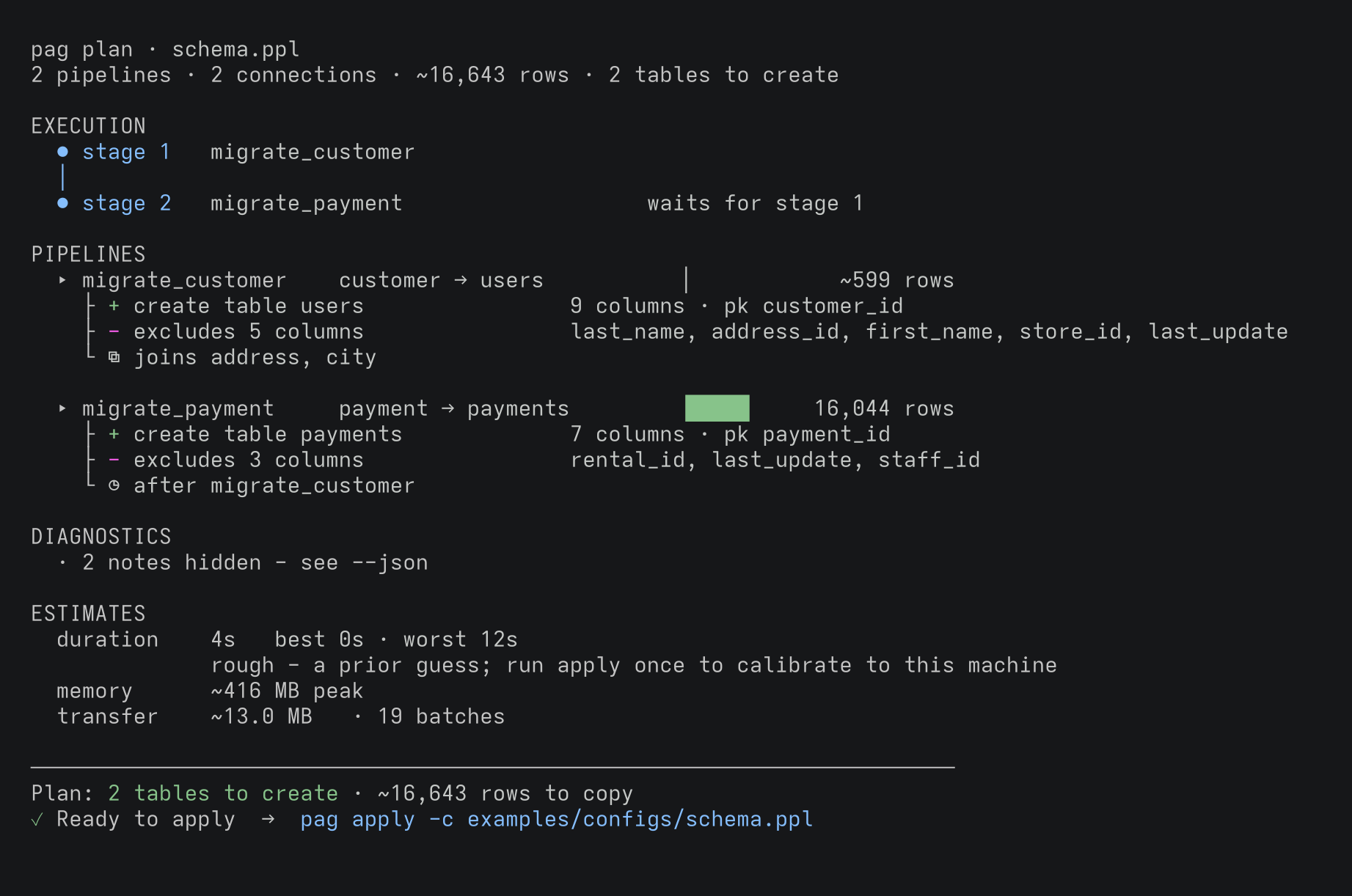
plansummary vs--json. The defaultplanoutput is a compact human summary.--jsonemits the complete report it's built from - every column with its type and indexes, the full row-count objects (value/is_estimated/confidence), all mappings and joins, per-pipeline diagnostics including the routineinfonotes the summary collapses, execution stages, and full resource estimations, plus run metadata (plan_id,config_hash, resolveddefines). Use the summary to read,--jsonto gate CI or feed tooling.stdoutcarries only the report, sopag plan --json > plan.jsonis always valid JSON. See docs/plan.md for the shape, and docs/schema-plan.json for a complete example report.
apply/verifyoutput modes.applyruns in default log mode,--pretty(colored, per-event lines), or--tui(a live dashboard with pause/cancel controls).verifyprints stable✓/✗/?result lines by default and adds headers, progress phases, and a summary under--pretty. See docs/output-modes.md for annotated examples of each, thepag receipttext/JSON shapes, and the TUI keyboard reference.
Global flags:
| Flag | Description |
|---|---|
-e, --env-file <FILE> | Load environment variables from file |
-v / -vv | Increase log verbosity |
-q, --quiet | Suppress non-essential output |
--log-level <LEVEL> | error | warn | info | debug | trace |
--log-file <FILE> | Write logs to file |
--no-color | Disable colored output |
Environment variables:
| Variable | Description |
|---|---|
PAGANEL_CONFIG | Path to config file (overrides auto-discovery) |
PAGANEL_LOG_LEVEL | Default log level |
RUST_LOG | Standard Rust log filter |
Quick Examples
Multi-pipeline DAG with dependencies:
pipeline "dim_products" {
  from { connection = connection.src table = "products" }
  to   { connection = connection.dst table = "dim_products" mode = "replace" }
}

pipeline "fact_orders" {
  after = [pipeline.dim_products]  // runs after dim_products completes

  from { connection = connection.src table = "orders" }
  to   { connection = connection.dst table = "fact_orders" mode = "append" }

  with {
    products from dim_products where products.id == orders.product_id
  }

  select {
    order_id     = orders.id
    product_name = products.name
    total        = orders.total * define.tax_rate
    tier = when {
      orders.total > 10000 then "enterprise"
      orders.total > 1000  then "business"
      else "standard"
    }
  }

  paginate {
    strategy   = "timestamp"
    cursor     = "orders.updated_at"
    tiebreaker = "orders.id"
  }
}
Schema migration with FK graph:
pipeline "migrate_orders_full" {
  from {
    connection = connection.mysql_prod
    table      = "orders"

    with references {
      data  = cascade   // copy schema + referenced rows
      depth = 3
      exclude = ["audit_*"]
    }
  }

  to {
    connection = connection.postgres_warehouse
    mode       = "replace"
    map {
      orders = "fact_orders"
      users  = "dim_users"
    }
  }
}
Multi-table pipeline (one block, many tables):
// `tables` fans out into one full-copy pipeline per table - connections and
// settings declared once. Tables run under the `execution` strategy (parallel
// here). Optional per-table tweaks: `select "T"` projects/renames columns and
// `map` renames the destination table; unnamed tables copy verbatim.
pipeline "warehouse" {
  from {
    connection = connection.src
    tables = ["actor", "category", "customer"]
  }
  to {
    connection = connection.dst
    map { customer = "dim_customer" }
  }
  select "customer" {
    id          = customer.customer_id
    given_name  = customer.first_name
    family_name = customer.last_name
  }
  settings { create_missing_tables = true }
}
Data validation and error handling:
validate {
  assert "positive_total" {
    check   = orders.total >= 0
    message = "Order total cannot be negative"
    action  = skip
  }
  warn "missing_email" {
    check   = users.email is not null
    message = "User email is missing"
  }
}

on_error {
  retry       { max_attempts = 3 backoff = "5s" }
  failed_rows { table = "orders_errors" }
}
WASM plugins (transform + filter):
// Declare plugins once - a .js is compiled to WASM (QuickJS) on first use;
// a prebuilt .wasm (e.g. native Rust) is loaded as-is.
plugin "to_upper"    { path = "plugins/upper.js" }
plugin "is_positive" { path = "plugins/positive.wasm" }

pipeline "customers" {
  from { connection = connection.src table = "customers" }
  to   { connection = connection.dst table = "customers" }

  select {
    id        = customers.id
    loud_name = plugin.to_upper({ name: customers.name })   // transform plugin
  }

  validate {
    assert "positive_balance" {
      check  = plugin.is_positive({ value: customers.balance })   // filter plugin
      action = skip
    }
  }
}
Plugins can also act as a pipeline's source or sink via a
connection { driver = "wasm" plugin = "..." }. See
docs/plugins/ for authoring in
Rust or JavaScript,
capabilities, and resource limits. Runnable examples: examples/plugins/.
Cryptographic verification:
# 1. Migrate with integrity receipts
pag apply -c migration.ppl --integrity

# 2. Later, check the destination against what was written
pag verify -c migration.ppl

# ✓ migrate_customers/customers - match (13,842 rows, root a3f1b2c49d8c7b6a5e2d8a1c04b93f77c0ffee00112233445566778899aabbcc, 312ms)
# ✓ migrate_orders/orders - match (127,491 rows, root 5e2d8a1c04b93f779d8c7b6a1f2e3d4c00112233445566778899aabbccddeeff, 2,841ms)

# Mismatches are pinpointed to the exact row, by primary key:
# ✗ migrate_orders/orders - MISMATCH (0 missing, 1 changed, 0 extra; 127,491 rows expected, 127,491 found; 2,841ms)
#   expected root 5e2d8a1c04b93f779d8c7b6a1f2e3d4c00112233445566778899aabbccddeeff
#   actual   root 9d8c7b6a1f2e3d4ca3f1b2c49d8c7b6affeeddccbbaa99887766554433221100
#   order_id=3412 - changed: expected a3f1b2c49d8c7b6a actual 9d8c7b6a1f2e3d4c

# 3. Keep the receipt: `pag receipt` prints each table's full root (and `--json`
#    for tooling). A root recorded outside `~/.paganel/state/` - a ticket, a build
#    log, a commit - is what makes later tampering with the state directory detectable.
pag receipt -c migration.ppl --json > receipts.json
Every row hash is keyed by its primary key, so verification is independent of batch size, lane count, and read order, and it detects modified, deleted, and inserted rows by key. A receipt covers the whole destination table, so rows that were already there, or that another pipeline wrote, come back as extra. For those cases, pag verify --allow-extra narrows the check to the rows the receipt covers and still fails if any of them went missing or changed.
Integrity costs ~0.3-0.5 µs per row, and the hashes stream to disk rather than memory: about 51 bytes per row, so a 10M-row table with an integer key leaves ~510 MB under ~/.paganel/state/ until that pipeline runs again. See docs/verification.md for the full design and benchmarks for the measured overhead.
State & Resume
Paganel stores pipeline state in ~/.paganel/state/ (sled embedded KV). If a migration is interrupted, re-running the same command resumes from the last checkpoint. The write sequence per batch is: checkpoint (write) -> commit the batch to the destination -> append a commit record to the WAL -> checkpoint (committed). A crash between the destination commit and the WAL append makes resume re-read and re-write that one batch, so recovery is at-least-once at batch granularity for a single batch. With a primary key and on_conflict set the replay is idempotent; with a plain COPY into a keyed table it fails on the duplicate key rather than silently duplicating; without a primary key the batch's rows can be duplicated.
If a pipeline fails, the run is recorded as failed rather than completed, and re-running retries that pipeline while skipping the ones that already finished. Integrity receipts are stored in the same directory under receipt:{pipeline}:{table} keys.
apply also records the throughput it achieves into a separate calibration cache (~/.paganel/calibration) so pag plan can estimate duration from this machine's measured rates rather than a generic default; until then it shows a conservative, clearly-labelled rough estimate. See docs/plan.md.
Documentation
| Document | Description |
|---|---|
| docs/plan.md | Reading pag plan - the summary, flags, sampling, and the magnitude bar |
| docs/ppl-reference.md | Full PPL language reference |
| docs/why-ppl.md | Why a purpose-built DSL (PPL) instead of YAML/JSON/SQL - design rationale and trade-offs |
| docs/architecture.md | Crate map, design decisions, data flow |
| docs/plugins/ | WASM plugins - roles, native Rust & JS (QuickJS) runtimes, authoring, CLI |
| docs/verification.md | Cryptographic verification design and implementation |
| docs/output-modes.md | apply / verify / receipt output - default logs, --pretty, the --tui dashboard, receipt text and JSON |
| docs/comparison.md | How Paganel compares with other migration, CDC, and verification tools |
| docs/benchmarks.md | Reproducible Paganel benchmark (optional pgloader comparison) - methodology, results, ./benchmarks/run.sh |
| examples/configs/ | Runnable PPL examples - schema mapping, DAG dependencies, validation, DLQ, and when.ppl (conditional values & computed-column chains) |
Development
# Run all tests
cargo test

# Integration tests (requires MySQL + PostgreSQL)
docker compose up -d # seeds the exact test databases
cargo test -p engine-tests -- --test-threads=1

# Lint
cargo clippy --all-targets

# Format
cargo fmt
The integration fixtures default to the docker compose ports (15432/13306), so
the two commands above are all you need. If you remap the compose ports, pass the
same values to the tests with POSTGRES_PORT / MYSQL_PORT; they do not read
.env.
The suite is destructive on the destination. Between tests it drops and recreates the
publicschema in the target PostgreSQL database and deletes the state store in~/.paganel/state(checkpoints and receipts included). The port variables are for remapping the compose stack, not for pointing the tests at a database you care about.
Test fixtures and example configs are in examples/configs/.
Roadmap
Rough direction, no dates and no commitments:
Keeping data in sync
- Incremental catch-up after a snapshot, so a cutover only has to freeze the delta
- Change-data-capture: MySQL binlog first, then PostgreSQL logical replication
drift- re-verify a destination on a schedule and fail when it diverges
Making the proof stronger
- Source-side checksums, so a receipt can attest that the destination matches the source for directly mapped columns, not only what was written
- The receipt format published as a spec, with an independent validator that checks a receipt on a machine without Paganel, and signed receipts
- Verification strategies declared per pipeline: full Merkle, row count, or
sampling for tables too large to re-read, and excluding non-deterministic
columns (
now(),ON UPDATE) from row hashing
Day-to-day use
scaffold- generate a starting PPL config from a live database- Rehearsal mode - run the whole migration into a temporary schema, verify it, then drop it
- Shared state with locking, so runs can be concurrent and a team can share one migration's state
- Metrics export (OTLP push, Prometheus pull)
- More connectors and destinations, including an analytical one
- PPL and API stabilization toward 1.0
See the issue tracker for what's actively in progress.
License
Paganel is licensed under the GNU Affero General Public License v3.0 or later
(AGPL-3.0-or-later). See LICENSE for the full text.
The plugin SDK is MIT, deliberately: paganel-plugin-sdk and
paganel-plugin-sdk-macros are what you compile into your own plugin, so
linking them puts no obligation on your code. The engine's copyleft stops at
the plugin boundary.
Copyright (C) 2026 Paganel contributors

This program is free software: you can redistribute it and/or modify it under
the terms of the GNU Affero General Public License as published by the Free
Software Foundation, either version 3 of the License, or (at your option) any
later version. This program is distributed WITHOUT ANY WARRANTY; see the GNU
Affero General Public License for more details.
Similar repos


Languages
Rust
98.1%
Shell
1.3%
Declarative, crash-safe data and schema migration engine with cryptographic verification and WASM plugins.
Rust
3
67 commits
updated Sep 30, 2026
See what people are saying
README
Paganel
Data migration that proves it worked.
Paganel is a data migration engine written in Rust. It moves data and schema between systems with crash recovery, parallel execution, and in-flight transforms, then cryptographically verifies that the destination matches what was written, down to the row. Today that means MySQL, PostgreSQL, and CSV; sources and sinks can also be sandboxed WASM plugins, so anything with data can stand at either end of a pipeline.
A complete migration is one file:
connection "source" {
  driver = "mysql"
  url    = env("MYSQL_URL")
}

connection "dest" {
  driver = "postgres"
  url    = env("POSTGRES_URL")
}

pipeline "customers" {
  from { connection = connection.source table = "customers" }
  to   { connection = connection.dest   table = "customers" mode = "replace" }

  where "active" {
    customers.deleted_at is null
  }

  select {
    id    = customers.id
    name  = customers.name
    email = lower(trim(customers.email))
  }
}
On a 100M-row MySQL->PostgreSQL copy with the databases on separate hosts (over a real network), it sustains ~390K rows/s on a single lane and ~940K rows/s with four parallel lanes (~340K and ~670K with --integrity recording the receipts; see benchmarks).
Why Paganel?
Moving data between databases is simple until the data has to change on the way, the run has to survive a crash, and someone has to prove afterwards that it arrived intact. Paganel is one declarative tool that:
- Reads like config. A single PPL file describes the whole
migration: source, destination, filters, transforms, schema, and dependencies.
The tool parses it instead of passing SQL through, which is why
plancan show the blast radius before anything runs (why a DSL). - Is safe to re-run. Crash-safe checkpoints mean an interrupted migration resumes from the last committed batch. At most one batch is re-written (see State & Resume).
- Checks it worked. The receipt is built while writing, so
verifyruns minutes or weeks later by re-reading the destination and checking it against the receipt. No source connection, and a 32-byte root per table you can keep in a ticket. A mismatch names the row, not just a count. - Migrates schema too. Tables, indexes, foreign keys, ENUMs, and sequences, with FK-aware ordering and dependency-graph discovery.
- Expands the graph, not just a table. Point at a root table and the FK
graph is discovered and migrated with depth and exclude control. A
whereon the root cascades, so only referenced rows come along: orders since January, and only the customers those orders touch. - Extends without forking. Transforms, filters, sources, and sinks can be WASM/JS plugins, sandboxed with fuel, memory and timeout caps and no filesystem or network access by default.
None of these pieces is new on its own; docs/comparison.md lists who else has what. What was missing was all of them in one binary: schema and data, cross-engine, in-flight transforms, a dry-run plan, crash-safe resume, and row-level verification. There is no service to sign up for and no infrastructure to stand up, so it is one tool to get approved, and it runs inside your network.
If dump-and-restore covers your case (pg_dump | psql, mysqldump | mysql),
use that. Paganel is for migrations that need transformation, cross-engine type
mapping, dependency ordering, resumability, or verification.
Features
- Declarative pipelines - PPL with SQL-inspired syntax
- Cryptographic verification - Merkle tree receipts detect any difference between the destination and what was written
- Dry run -
planshows output columns and types, the execution DAG, the exact DDL (--ddl), and duration/memory estimates - Schema migration - CREATE TABLE, indexes, foreign keys, ENUMs, sequences
- Graph expansion - auto-discover and migrate FK-dependent tables
- Crash recovery - sled-backed checkpoints, automatic resume
- WASM plugins - sandboxed transform / filter / source / sink plugins in native Rust or JavaScript
- Transformations - field mapping, computed columns,
whenexpressions, functions - Data quality -
validateblocks with per-rowassert/warnrules - Fault tolerance - circuit breaker, configurable retry, Dead Letter Queue
- DAG execution -
after = [pipeline.x]dependencies, parallel levels - Multi-table pipelines -
tables = [...]fans one block out into a full copy per table - Parallel lanes -
lanes = Nsplits a large single-table copy into N primary-key ranges; graph migrations run their tables concurrently - Pagination strategies - primary key, numeric, timestamp cursor
- Lifecycle hooks -
before/afterSQL blocks per pipeline
Supported Connectors
| Role | Connector |
|---|---|
| Source | MySQL, PostgreSQL, CSV |
| Destination | PostgreSQL (COPY fast-path), MySQL (LOAD DATA fast-path) |
Secure connections (TLS/SSL)
Most managed databases (AWS RDS, GCP Cloud SQL, Azure, Neon, Supabase,
PlanetScale, Aiven, Heroku) require TLS. Both SQL drivers negotiate it from
the connection URL, with no extra config. Each driver uses its ecosystem's native
parameter names; the per-driver tables below show exactly what each mode
encrypts and verifies. To authenticate the server as well as encrypt the link, use a
verifying mode (verify-full / verify_ca), with a CA bundle for private CAs.
PostgreSQL - libpq-style sslmode (plus optional sslrootcert):
sslmode | Transport | Cert chain | Hostname |
|---|---|---|---|
disable | plaintext | – | – |
prefer (default) | TLS, falls back to plaintext | not checked | not checked |
require | TLS | not checked | not checked |
verify-ca | TLS | verified | not checked |
verify-full | TLS | verified | verified |
These follow libpq: require encrypts but does not authenticate the server;
verify-ca / verify-full verify the certificate.
connection "dest" {
  driver = "postgres"
  url    = env("POSTGRES_URL")  // e.g. postgres://user:pass@db.example.com:5432/app?sslmode=verify-full
}
For a private CA (e.g. RDS/Cloud SQL/Supabase), point at the CA bundle so the
chain can be verified: ?sslmode=verify-full&sslrootcert=/path/to/ca.pem.
MySQL - require_ssl plus optional verify_ca / verify_identity, and
ssl_ca for a private CA bundle (implies TLS):
| URL parameters | Transport | Cert chain | Hostname |
|---|---|---|---|
| (none) | plaintext | – | – |
require_ssl=true | TLS | verified | verified |
require_ssl=true&verify_ca=false | TLS | not checked | not checked |
require_ssl=true&verify_identity=false | TLS | verified | not checked |
ssl_ca=/path/to/ca.pem | TLS | verified against CA | verified |
connection "source" {
  driver = "mysql"
  url    = env("MYSQL_URL")  // e.g. mysql://user:pass@db.example.com:3306/app?require_ssl=true
}
For a private CA (e.g. RDS/Cloud SQL), supply the bundle and skip hostname
verification if the certificate's CN doesn't match the host:
?ssl_ca=/path/to/ca.pem&verify_identity=false.
Project Status
Paganel is pre-1.0. The engine runs real migrations today (data + schema, with verification, crash-safe resume, and plugins), but the PPL language and internal APIs still change between commits. Use it for evaluation and non-critical workloads; don't leave it unattended in production yet.
Current limitations:
- Destinations: PostgreSQL (COPY fast-path) and MySQL (LOAD DATA fast-path). CSV is supported as a source only.
- Snapshot/batch migration only - change-data-capture (CDC) is planned but not implemented.
- Single-node: execution and state (sled) are local to one machine; there is no distributed/coordinated mode.
- One run at a time: the state store is a single-process embedded database,
so a second
apply(orverify,receipt,reset) while a migration is running is refused.statusandpausework during a run. - Plugin host functions (outbound HTTP, key-value, metrics) are capability-gated and off by default. Outbound HTTP is guarded (link-local/ cloud-metadata blocked, per-request timeout, response-size cap, optional host allowlist); the key-value store is instance-scoped scratch, not persisted.
- Pre-1.0 versioning: the PPL language and internal APIs still change between releases, so pin the version you tested against.
Install
Prebuilt binary. One file, nothing to install alongside it. Pick your platform from the latest release, or:
v=0.1.1   # or whatever the latest release is

# Linux x86_64 (swap in aarch64-unknown-linux-gnu on arm64)
curl -fsSL "https://github.com/stanstork/paganel/releases/download/v$v/pag-$v-x86_64-unknown-linux-gnu.tar.gz" | tar xz
sudo mv "pag-$v-x86_64-unknown-linux-gnu/pag" /usr/local/bin/

# macOS, Apple silicon (swap in x86_64-apple-darwin on Intel)
curl -fsSL "https://github.com/stanstork/paganel/releases/download/v$v/pag-$v-aarch64-apple-darwin.tar.gz" | tar xz
sudo mv "pag-$v-aarch64-apple-darwin/pag" /usr/local/bin/

pag --version
On Windows, download pag-<version>-x86_64-pc-windows-msvc.zip from the same page.
Every release ships SHA256SUMS, so sha256sum -c SHA256SUMS checks what you
downloaded.
The Linux builds link OpenSSL statically and need only glibc 2.35 or newer (Ubuntu 22.04 and later, Debian 12, RHEL 9, current Fedora and Arch).
From source (requires Rust 1.88 or newer):
git clone https://github.com/stanstork/paganel.git paganel
cd paganel
cargo build --release
# binary at ./target/release/pag
Plugin SDK. Writing a plugin needs no clone at all:
[dependencies]
paganel-plugin-sdk = "0.1"
Quick Start
Spin up throwaway databases (MySQL seeded with the Sakila sample database, plus an empty PostgreSQL) and run an example migration:
# 1. Start source + destination databases (credentials match .env.example)
docker compose up -d

# 2. Point Paganel at them
cp .env.example .env

# 3. Build, preview, then execute an example migration
cargo build --release
./target/release/pag plan  -c examples/configs/schema.ppl -e .env   # dry run, no writes
./target/release/pag apply -c examples/configs/schema.ppl -e .env   # execute

# Tear everything down (and delete the data)
docker compose down -v
Ports already in use? The containers publish on 15432 (PostgreSQL) and 13306 (MySQL) by default (not 5432/3306), so
docker compose up -dworks even if you already run those databases locally. To pick different host ports, setPOSTGRES_PORT/MYSQL_PORT(in.envor your shell) and update the matching port in the URLs in.env.
Usage
# Analyze migration plan (dry run, no changes) - prints a human summary
pag plan -c migration.ppl

# Full machine-readable report (for CI / tooling)
pag plan -c migration.ppl --json

# Preview transformed sample rows in the summary
pag plan -c migration.ppl --sample --sample-size 10

# Print the exact CREATE / ALTER DDL the migration would run
pag plan -c migration.ppl --ddl

# Execute migration
pag apply -c migration.ppl

# Execute with live TUI progress
pag apply -c migration.ppl --tui

# Execute with colored output
pag apply -c migration.ppl --pretty

# Execute and commit a keyed Merkle integrity receipt
pag apply -c migration.ppl --integrity

# Verify destination matches stored receipt
pag verify -c migration.ppl

# Verify and write report to file
pag verify -c migration.ppl --output report.txt

# Print the stored receipts (full table roots) to record outside the state dir
pag receipt -c migration.ppl          # add --json for machine-readable output

# Test database connectivity (--format mysql|postgres if the URL scheme is ambiguous)
pag ping --url mysql://user:pass@localhost:3306/db

# Inspect or control a run
pag status -c migration.ppl   # show run status
pag pause  -c migration.ppl   # request a graceful pause
pag resume -c migration.ppl   # resume a paused run
pag reset  -c migration.ppl   # clear all state for a migration (--force skips the prompt)

# Plugin tooling (compile / inspect / validate / test WASM & JS plugins)
pag plugin --help
One migration at a time. The state store (
~/.paganel/state/) is a single-process embedded database, so while a migration runs, a secondpag apply(orverify,receipt,reset) fails with a clear message instead of opening it.statusandpauseare built for that moment and work anyway: a running migration publishes its run status beside the store forpag statusto read, andpag pauserequests the pause through a sentinel file.
plansummary vs--json. The defaultplanoutput is a compact human summary.--jsonemits the complete report it's built from - every column with its type and indexes, the full row-count objects (value/is_estimated/confidence), all mappings and joins, per-pipeline diagnostics including the routineinfonotes the summary collapses, execution stages, and full resource estimations, plus run metadata (plan_id,config_hash, resolveddefines). Use the summary to read,--jsonto gate CI or feed tooling.stdoutcarries only the report, sopag plan --json > plan.jsonis always valid JSON. See docs/plan.md for the shape, and docs/schema-plan.json for a complete example report.
apply/verifyoutput modes.applyruns in default log mode,--pretty(colored, per-event lines), or--tui(a live dashboard with pause/cancel controls).verifyprints stable✓/✗/?result lines by default and adds headers, progress phases, and a summary under--pretty. See docs/output-modes.md for annotated examples of each, thepag receipttext/JSON shapes, and the TUI keyboard reference.
Global flags:
| Flag | Description |
|---|---|
-e, --env-file <FILE> | Load environment variables from file |
-v / -vv | Increase log verbosity |
-q, --quiet | Suppress non-essential output |
--log-level <LEVEL> | error | warn | info | debug | trace |
--log-file <FILE> | Write logs to file |
--no-color | Disable colored output |
Environment variables:
| Variable | Description |
|---|---|
PAGANEL_CONFIG | Path to config file (overrides auto-discovery) |
PAGANEL_LOG_LEVEL | Default log level |
RUST_LOG | Standard Rust log filter |
Quick Examples
Multi-pipeline DAG with dependencies:
pipeline "dim_products" {
  from { connection = connection.src table = "products" }
  to   { connection = connection.dst table = "dim_products" mode = "replace" }
}

pipeline "fact_orders" {
  after = [pipeline.dim_products]  // runs after dim_products completes

  from { connection = connection.src table = "orders" }
  to   { connection = connection.dst table = "fact_orders" mode = "append" }

  with {
    products from dim_products where products.id == orders.product_id
  }

  select {
    order_id     = orders.id
    product_name = products.name
    total        = orders.total * define.tax_rate
    tier = when {
      orders.total > 10000 then "enterprise"
      orders.total > 1000  then "business"
      else "standard"
    }
  }

  paginate {
    strategy   = "timestamp"
    cursor     = "orders.updated_at"
    tiebreaker = "orders.id"
  }
}
Schema migration with FK graph:
pipeline "migrate_orders_full" {
  from {
    connection = connection.mysql_prod
    table      = "orders"

    with references {
      data  = cascade   // copy schema + referenced rows
      depth = 3
      exclude = ["audit_*"]
    }
  }

  to {
    connection = connection.postgres_warehouse
    mode       = "replace"
    map {
      orders = "fact_orders"
      users  = "dim_users"
    }
  }
}
Multi-table pipeline (one block, many tables):
// `tables` fans out into one full-copy pipeline per table - connections and
// settings declared once. Tables run under the `execution` strategy (parallel
// here). Optional per-table tweaks: `select "T"` projects/renames columns and
// `map` renames the destination table; unnamed tables copy verbatim.
pipeline "warehouse" {
  from {
    connection = connection.src
    tables = ["actor", "category", "customer"]
  }
  to {
    connection = connection.dst
    map { customer = "dim_customer" }
  }
  select "customer" {
    id          = customer.customer_id
    given_name  = customer.first_name
    family_name = customer.last_name
  }
  settings { create_missing_tables = true }
}
Data validation and error handling:
validate {
  assert "positive_total" {
    check   = orders.total >= 0
    message = "Order total cannot be negative"
    action  = skip
  }
  warn "missing_email" {
    check   = users.email is not null
    message = "User email is missing"
  }
}

on_error {
  retry       { max_attempts = 3 backoff = "5s" }
  failed_rows { table = "orders_errors" }
}
WASM plugins (transform + filter):
// Declare plugins once - a .js is compiled to WASM (QuickJS) on first use;
// a prebuilt .wasm (e.g. native Rust) is loaded as-is.
plugin "to_upper"    { path = "plugins/upper.js" }
plugin "is_positive" { path = "plugins/positive.wasm" }

pipeline "customers" {
  from { connection = connection.src table = "customers" }
  to   { connection = connection.dst table = "customers" }

  select {
    id        = customers.id
    loud_name = plugin.to_upper({ name: customers.name })   // transform plugin
  }

  validate {
    assert "positive_balance" {
      check  = plugin.is_positive({ value: customers.balance })   // filter plugin
      action = skip
    }
  }
}
Plugins can also act as a pipeline's source or sink via a
connection { driver = "wasm" plugin = "..." }. See
docs/plugins/ for authoring in
Rust or JavaScript,
capabilities, and resource limits. Runnable examples: examples/plugins/.
Cryptographic verification:
# 1. Migrate with integrity receipts
pag apply -c migration.ppl --integrity

# 2. Later, check the destination against what was written
pag verify -c migration.ppl

# ✓ migrate_customers/customers - match (13,842 rows, root a3f1b2c49d8c7b6a5e2d8a1c04b93f77c0ffee00112233445566778899aabbcc, 312ms)
# ✓ migrate_orders/orders - match (127,491 rows, root 5e2d8a1c04b93f779d8c7b6a1f2e3d4c00112233445566778899aabbccddeeff, 2,841ms)

# Mismatches are pinpointed to the exact row, by primary key:
# ✗ migrate_orders/orders - MISMATCH (0 missing, 1 changed, 0 extra; 127,491 rows expected, 127,491 found; 2,841ms)
#   expected root 5e2d8a1c04b93f779d8c7b6a1f2e3d4c00112233445566778899aabbccddeeff
#   actual   root 9d8c7b6a1f2e3d4ca3f1b2c49d8c7b6affeeddccbbaa99887766554433221100
#   order_id=3412 - changed: expected a3f1b2c49d8c7b6a actual 9d8c7b6a1f2e3d4c

# 3. Keep the receipt: `pag receipt` prints each table's full root (and `--json`
#    for tooling). A root recorded outside `~/.paganel/state/` - a ticket, a build
#    log, a commit - is what makes later tampering with the state directory detectable.
pag receipt -c migration.ppl --json > receipts.json
Every row hash is keyed by its primary key, so verification is independent of batch size, lane count, and read order, and it detects modified, deleted, and inserted rows by key. A receipt covers the whole destination table, so rows that were already there, or that another pipeline wrote, come back as extra. For those cases, pag verify --allow-extra narrows the check to the rows the receipt covers and still fails if any of them went missing or changed.
Integrity costs ~0.3-0.5 µs per row, and the hashes stream to disk rather than memory: about 51 bytes per row, so a 10M-row table with an integer key leaves ~510 MB under ~/.paganel/state/ until that pipeline runs again. See docs/verification.md for the full design and benchmarks for the measured overhead.
State & Resume
Paganel stores pipeline state in ~/.paganel/state/ (sled embedded KV). If a migration is interrupted, re-running the same command resumes from the last checkpoint. The write sequence per batch is: checkpoint (write) -> commit the batch to the destination -> append a commit record to the WAL -> checkpoint (committed). A crash between the destination commit and the WAL append makes resume re-read and re-write that one batch, so recovery is at-least-once at batch granularity for a single batch. With a primary key and on_conflict set the replay is idempotent; with a plain COPY into a keyed table it fails on the duplicate key rather than silently duplicating; without a primary key the batch's rows can be duplicated.
If a pipeline fails, the run is recorded as failed rather than completed, and re-running retries that pipeline while skipping the ones that already finished. Integrity receipts are stored in the same directory under receipt:{pipeline}:{table} keys.
apply also records the throughput it achieves into a separate calibration cache (~/.paganel/calibration) so pag plan can estimate duration from this machine's measured rates rather than a generic default; until then it shows a conservative, clearly-labelled rough estimate. See docs/plan.md.
Documentation
| Document | Description |
|---|---|
| docs/plan.md | Reading pag plan - the summary, flags, sampling, and the magnitude bar |
| docs/ppl-reference.md | Full PPL language reference |
| docs/why-ppl.md | Why a purpose-built DSL (PPL) instead of YAML/JSON/SQL - design rationale and trade-offs |
| docs/architecture.md | Crate map, design decisions, data flow |
| docs/plugins/ | WASM plugins - roles, native Rust & JS (QuickJS) runtimes, authoring, CLI |
| docs/verification.md | Cryptographic verification design and implementation |
| docs/output-modes.md | apply / verify / receipt output - default logs, --pretty, the --tui dashboard, receipt text and JSON |
| docs/comparison.md | How Paganel compares with other migration, CDC, and verification tools |
| docs/benchmarks.md | Reproducible Paganel benchmark (optional pgloader comparison) - methodology, results, ./benchmarks/run.sh |
| examples/configs/ | Runnable PPL examples - schema mapping, DAG dependencies, validation, DLQ, and when.ppl (conditional values & computed-column chains) |
Development
# Run all tests
cargo test

# Integration tests (requires MySQL + PostgreSQL)
docker compose up -d # seeds the exact test databases
cargo test -p engine-tests -- --test-threads=1

# Lint
cargo clippy --all-targets

# Format
cargo fmt
The integration fixtures default to the docker compose ports (15432/13306), so
the two commands above are all you need. If you remap the compose ports, pass the
same values to the tests with POSTGRES_PORT / MYSQL_PORT; they do not read
.env.
The suite is destructive on the destination. Between tests it drops and recreates the
publicschema in the target PostgreSQL database and deletes the state store in~/.paganel/state(checkpoints and receipts included). The port variables are for remapping the compose stack, not for pointing the tests at a database you care about.
Test fixtures and example configs are in examples/configs/.
Roadmap
Rough direction, no dates and no commitments:
Keeping data in sync
- Incremental catch-up after a snapshot, so a cutover only has to freeze the delta
- Change-data-capture: MySQL binlog first, then PostgreSQL logical replication
drift- re-verify a destination on a schedule and fail when it diverges
Making the proof stronger
- Source-side checksums, so a receipt can attest that the destination matches the source for directly mapped columns, not only what was written
- The receipt format published as a spec, with an independent validator that checks a receipt on a machine without Paganel, and signed receipts
- Verification strategies declared per pipeline: full Merkle, row count, or
sampling for tables too large to re-read, and excluding non-deterministic
columns (
now(),ON UPDATE) from row hashing
Day-to-day use
scaffold- generate a starting PPL config from a live database- Rehearsal mode - run the whole migration into a temporary schema, verify it, then drop it
- Shared state with locking, so runs can be concurrent and a team can share one migration's state
- Metrics export (OTLP push, Prometheus pull)
- More connectors and destinations, including an analytical one
- PPL and API stabilization toward 1.0
See the issue tracker for what's actively in progress.
License
Paganel is licensed under the GNU Affero General Public License v3.0 or later
(AGPL-3.0-or-later). See LICENSE for the full text.
The plugin SDK is MIT, deliberately: paganel-plugin-sdk and
paganel-plugin-sdk-macros are what you compile into your own plugin, so
linking them puts no obligation on your code. The engine's copyleft stops at
the plugin boundary.
Copyright (C) 2026 Paganel contributors

This program is free software: you can redistribute it and/or modify it under
the terms of the GNU Affero General Public License as published by the Free
Software Foundation, either version 3 of the License, or (at your option) any
later version. This program is distributed WITHOUT ANY WARRANTY; see the GNU
Affero General Public License for more details.
Similar repos
Languages
Rust
98.1%
Shell
1.3%