
High-performance MCP server for AI coding agents: persistent knowledge graph, blast radius analysis, semantic search. Built in Rust.
Rust
6
729 commits
updated Sep 20, 2026
See what people are saying (1)
README
LAIN-mcp






Structural Code Intelligence & Multi-Agent Coordination for AI Assistants. Give your coding agents an in-memory graph brain instead of making them guess from flat text.
What is LAIN?
LAIN is a persistent, high-performance code intelligence and coordination engine built specifically for AI coding agents (Claude Code, Cursor, Copilot, Codex, Agy, Cline, Windsurf, etc.) over the Model Context Protocol (MCP).
Instead of treating code as unstructured flat text or relying on fuzzy keyword searches, LAIN indexes your codebase into an in-memory, typed structural property graph (using Tree-sitter, language servers, and Git commit history). It then exposes a rich suite of deterministic MCP tools that allow AI agents to navigate, reason about, and modify complex codebases without hallucinations, blind edits, or context-window waste.
See it run
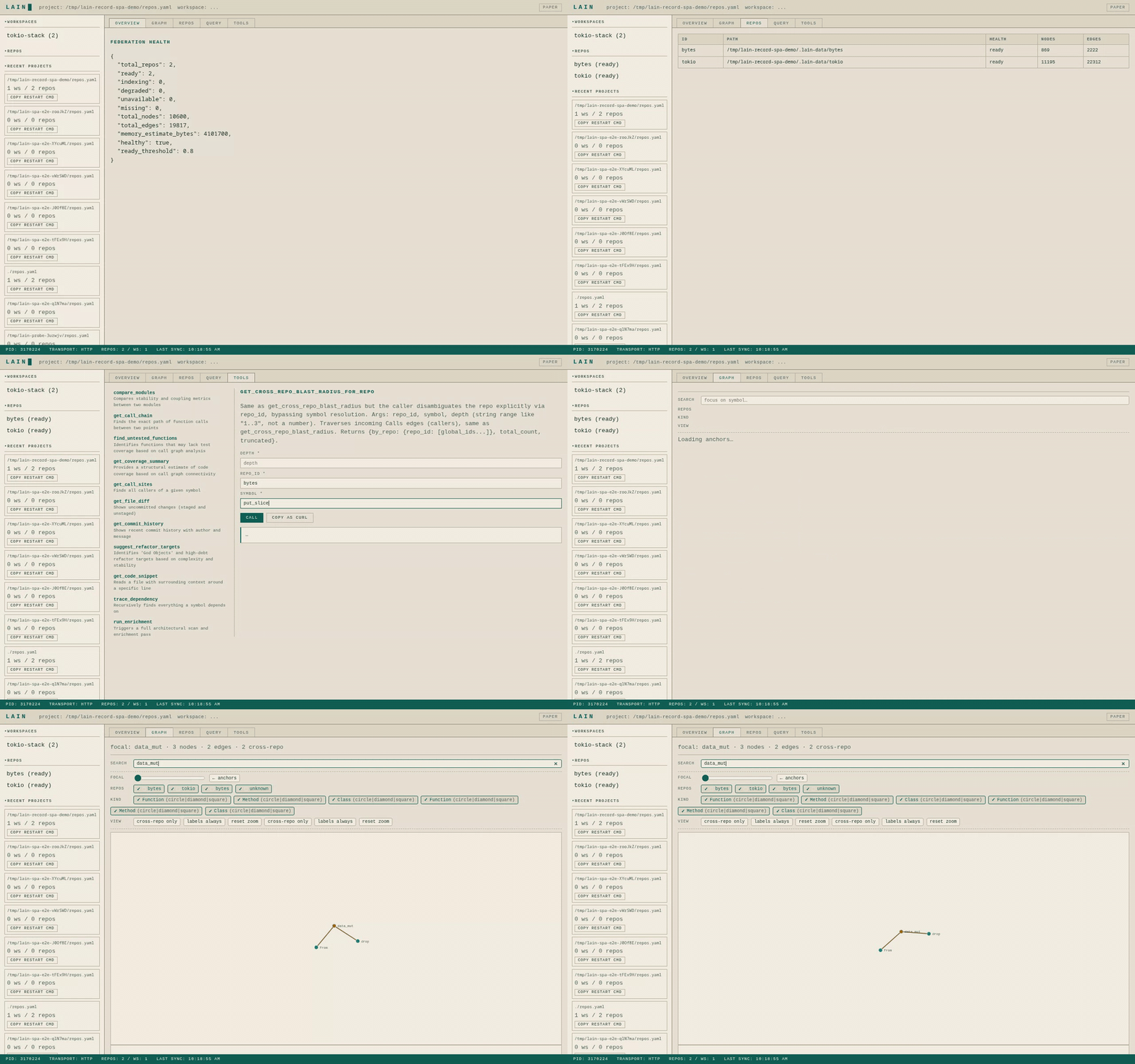
- Instant Answers: Federation overview, repo health, and call graphs answered in milliseconds.
- Hot Reload: Edit
repos.yamlorworkspaces.yaml; the server updates live without dropping a single active MCP session. - Interactive Tool Console: Exercise any MCP tool directly from the web browser; Copy as cURL gives agents and operators instant reproducibility.
[!NOTE] The demo is kept as a single GIF so it plays inline without storing duplicate video encodings in the repository.
How it fits together
flowchart TB
    subgraph Clients["AI Agents & Developers"]
        A["AI Coding Agent<br/>(Claude Code / Cursor / Agy / Codex)"]
        B["Developer / Operator<br/>(Browser Command Center)"]
    end

    subgraph Transports["MCP & Web Transports"]
        S["stdio (single-repo)"]
        H["HTTP :9999 (JSON-RPC & SSE)"]
    end

    subgraph Core["LAIN Core Engine"]
        EX["Unified MCP Tool Dispatcher"]
        G["In-Memory Graph Engine<br/>(Petgraph · UUID v5)"]
        PRES["Presence & Claim Registry<br/>(Advisory Leases & Locks)"]
        FED["Federation Engine<br/>(N Repositories)"]
    end

    subgraph Sources["Code Analysis & Storage"]
        TS["Tree-sitter AST Parser"]
        LSP["Language Servers (rust-analyzer, pylsp...)"]
        GIT["Git Commit History (Co-change radar)"]
        BIN[".lain/graph.bin (Persistent Cache)"]
    end

    A -->|MCP JSON-RPC| S
    A -->|MCP HTTP| H
    B -->|GET /| H
    S --> EX
    H --> EX
    EX --> G
    EX --> PRES
    EX --> FED
    G <--> BIN
    G --> TS
    G --> LSP
    G --> GIT
- Indexing & Parsing: LAIN scans your code using Tree-sitter and language servers (LSPs), extracting functions, classes, imports, and references into a property graph.
- Persistent Graph Store: The graph is serialized into
.lain/graph.binusing deterministically derived UUID v5 identifiers for instant reloads. - Temporal Mining: LAIN analyzes git commit logs to build a co-change coupling radar (identifying modules that evolve together even without explicit imports).
- Advisory Presence: In-memory and on-disk occupancy registries track agent sessions and file claims, preventing overlapping edits in real time.
- Universal MCP Delivery: Exposes standardized tools over stdio or HTTP so any MCP-compatible agent can query the graph directly.
What can AI Agents ask LAIN?
LAIN provides specialized MCP tools categorized by capability:
1. Blast Radius & Dependency Tracing
get_blast_radius— Downstream impact analysis: every function, type, and file affected by changing a symbol.get_call_chain— Shortest path between two functions in the call graph.trace_dependency— All upstream dependencies (callees, imports, types) of a target symbol.get_coupling_radar— Files that frequently change together based on Git commit co-occurrence.
2. Architectural Discovery & Navigation
find_anchors— Identifies the core architectural pillars (most-called, most-stable symbols).list_entry_points— Discoversmain(), HTTP routes, and event handlers.get_context_depth— Measures abstraction distance from public entry points.explore_architecture— High-level hierarchical module and package tree.
3. Multi-Agent Coordination ("Multiplayer Mode")
register_agent/heartbeat— Registers an agent session and keeps advisory leases fresh.claim_files/release_files— Claims or releases files and symbol ranges before editing.detect_overlap— Analyzes overlapping symbol changes between git branches or concurrent sessions.list_active_agents/who_am_i— Discovers other active agents and reports session identity.
4. Search & Deep Graph Queries
semantic_search(requires ONNX model — see Setting Up Semantic Search) — Concept-based code search using local ONNX embeddings with hybrid BM25/stemmed ranking.query_graph— Composable JSON ops pipeline (find,connect,filter,semantic_filter,sort,limit).explain_symbol— Complete structural dossier for a symbol (signature, callers, docstring, location).
5. Multi-Repo Federation
list_repos/get_repo_info— Status, health, and size of all repos registered inrepos.yaml.get_federation_health— Aggregate health counts, total node/edge counts, and a rough memory estimate across the federation.get_cross_repo_blast_radius— Cross-repository impact analysis when modifying a shared symbol.get_cross_repo_blast_radius_for_repo— Same asget_cross_repo_blast_radius, but the caller disambiguates the target repo byrepo_idinstead of by symbol resolution.search_org— Organization-wide symbol and code search across all registered repositories.
6. Code Health & Refactoring
find_dead_code— Detects unreachable functions and unused symbols (excluding traits and tests).suggest_refactor_targets— Identifies brittle code (high-coupling, low-stability candidates).get_agent_strategy— Retrieves operational guidelines and strategic instructions for agents.get_world_state— Summarizes active sessions, file claims, and graph freshness in a single compact call.
TL;DR — Install in 30 Seconds
# Install (interactive — adds `lain` to PATH)
curl -fsSL https://raw.githubusercontent.com/spuentesp/lain/main/install.sh | bash

# Reload your shell, then verify
source ~/.zshrc   # or ~/.bashrc
lain --version
See QUICKSTART.md for Homebrew, manual builds, non-interactive flags, and ONNX model setups.
Connecting Your AI Agent
Claude Code
claude mcp add lain -- lain mcp
Cursor / Windsurf
lain setup --agent cursor
Writes ~/.cursor/mcp.json (the file Cursor reads directly).
Windsurf shares the same config schema, so this command works
for Windsurf too.
VS Code
lain setup --agent vscode
Writes .vscode/mcp.json if it exists (project-scoped) or
mcp.json in your user-config dir otherwise. Details in
docs/COOKBOOK.md.
Codex / Continue
lain setup --agent codex     # uses `codex mcp add` when the CLI is on PATH
lain setup --agent continue  # writes ~/.continue/config.json
Hand-written JSON (any other MCP host)
lain setup --agent generic
Writes .mcp.json at the workspace root. See docs/COOKBOOK.md
for the exact schema.
Multi-Repo Server Mode (HTTP)
Run LAIN as a shared service across multiple repositories:
lain server --config ./repos.yaml --transport http --port 9999
Access the Command Center UI in your browser at http://localhost:9999.
Command Center Dashboard
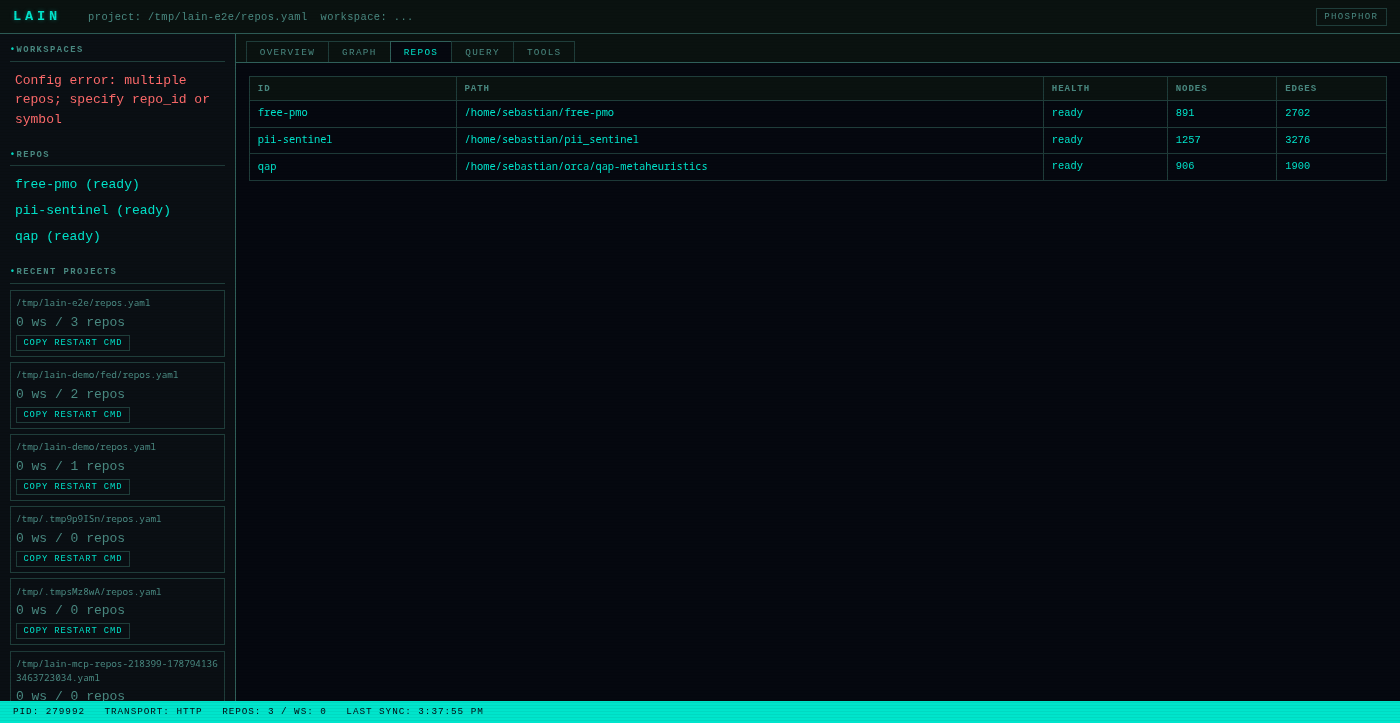
When lain server runs with --transport http, it serves the Command Center dashboard at GET /. It is a self-contained single-page application (SPA) that talks back to the running server over the same MCP JSON-RPC protocol.
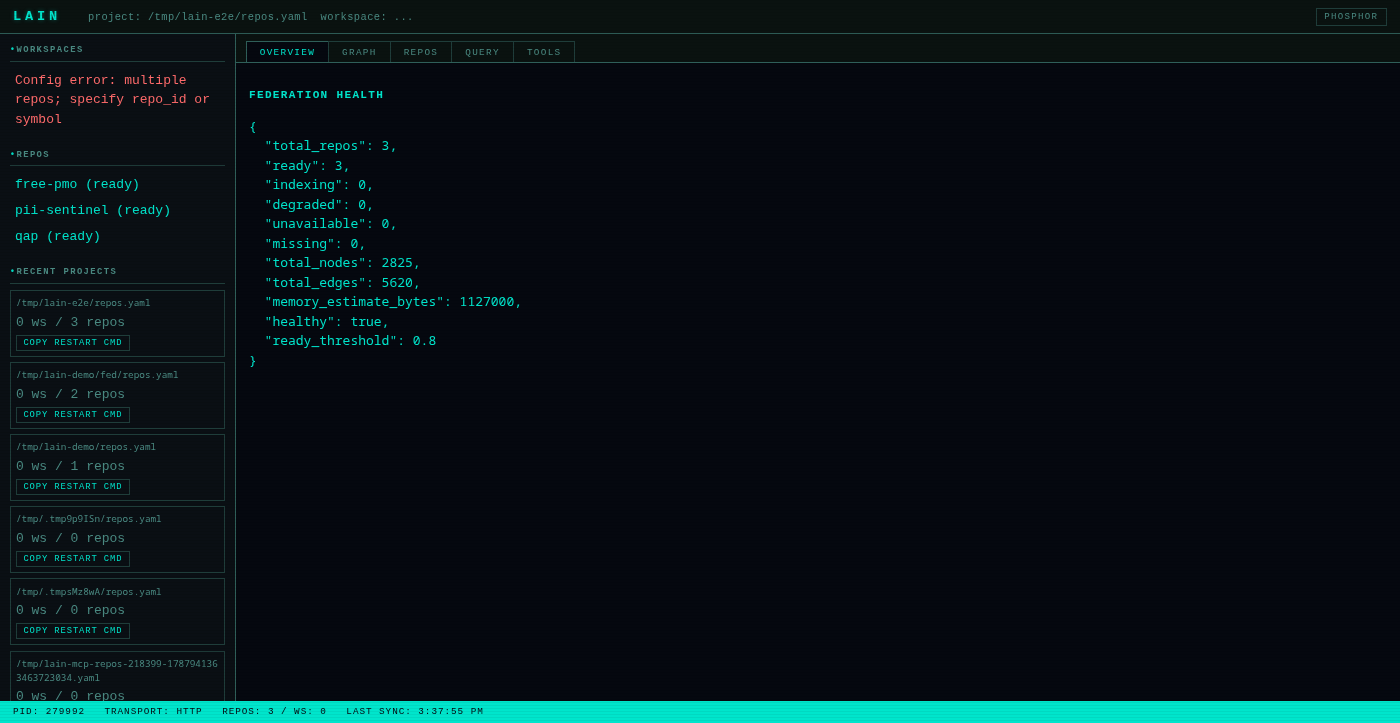
- Overview — Real-time node/edge stats, memory footprint, and federation health.
- Graph — Interactive D3 force-directed visualizer of workspaces and symbol dependencies.
- Repos — Repository table showing health, path, and node/edge statistics.
- Query — Interactive query runner for
query_graphtraversals. - Tools — Form-based MCP tool runner with auto-generated Copy as cURL snippets for quick testing.
The CLI Commands
LAIN exposes the following CLI commands:
| Command | Purpose |
|---|---|
lain server | Start the MCP server (the headline). Reads repos.yaml, serves MCP tools + the Command Center dashboard. Hot-reloads the config when it changes. |
lain mcp | Single-repo MCP server on stdio. Walks up from cwd for .git — the stable "drop in a clone and run" entrypoint. No repos.yaml required. |
lain setup | Guided onboarding: detects the repository and languages, optionally installs the semantic model, configures one MCP client (--agent claude-code shells to claude mcp add; --agent generic writes .mcp.json), and verifies the result with a real MCP round trip. --dry-run and --print-config change nothing. |
lain workspaces | Manage workspaces.yaml. Create, list, show, activate (use), forget named groups of repos. |
lain repos | Manage repos.yaml. Add, list, remove a repo entry. |
lain query | Run a query_graph ops-array against the project's persisted graph. |
lain oneshot | One-shot MCP query: boots a transient lain mcp server, sends a single tools/call, prints the result as a table, and exits. For "just grep the symbols without keeping a server alive". |
lain init | Scaffold a repos.yaml for the current directory. Walks up for .git, then writes a minimal config pointing at the discovered workspace. |
lain ask | Single-user LLM-assisted query (uses semantic_search when an embedding model is loaded; falls back to lexical heuristics via explain_symbol). |
lain hooks | Agent pre-edit hook entry point: claim / release files, overlap-check for commit-time symbol overlap, lock / unlock for the zero-daemon filesystem-fallback layer. |
lain doctor | Read-only repository diagnosis. Reports binary identity, persisted graph freshness, structural and optional semantic capability states, installation paths, and an MCP initialize/tools-list probe. Use --json for the versioned machine-readable report and --workspace PATH outside the target clone. Exit codes are 0 ready, 1 usable but degraded, and 2 unusable. |
lain capabilities | Print the four canonical capability states and repository freshness. Add --json for agent-readable output. |
lain status | Print aggregate repository, index, and MCP readiness. Add --json for the versioned status object. |
lain schema | Emit the canonical tool-surface schema dump (dump [--out PATH] defaults to ./docs/tool-schema.json). Pair with make schema && git diff --exit-code docs/tool-schema.json in CI to fail on schema drift. |
scripts/demo.sh | Capability demonstration and benchmark. Boots a real server against a synthetic repo whose call graph is known by construction, checks lain's answers against that ground truth (not merely that it answered), then benchmarks the same tools against this repo at ~3.5k nodes. --quick skips the build and benchmark phases; --json FILE writes machine-readable results; --force-build overrides --quick / --no-build; --allow-stale skips the binary-freshness check. Exits non-zero if any check fails (or if the binary is older than any source file and --allow-stale was not passed). |
Hot Reload
lain server monitors repos.yaml and workspaces.yaml and automatically updates its federation state when they change—without restarting the process or dropping active agent connections. Both manual file edits and CLI commands (lain repos add ...) communicate over a local Unix socket (~/.local/lain/run/<repos-stem>.sock) to rebuild the index diff atomically.
See docs/hot-reload.md for full operational details.
Documentation Index
| Doc | What's in it |
|---|---|
docs/QUICKSTART.md | Step-by-step 5-minute setup and quickstart |
docs/USER_MANUAL.md | Comprehensive operator and agent manual |
docs/ARCHITECTURE.md | System design, graph layering, and technical rationale |
docs/TECHNICAL.md | Deep dive into internal modules and data structures |
docs/FEDERATION.md | Multi-repo setup, org search, and cross-repo intelligence |
docs/REPOS_YAML.md | Schema and options for repos.yaml |
docs/multiplayer.md | Multi-agent coordination, claims, and advisory locks |
docs/hooks.md | Git and editor pre-edit hook configuration |
docs/query-language.md | Syntax and operations reference for query_graph |
docs/quickstart-tools.md | Complete reference guide for all MCP tools |
docs/command-center.md | Features and usage of the web Command Center |
docs/INDEX.md | Full documentation sitemap |
Requirements & Optional Semantic Search
| Requirement | Details |
|---|---|
| Rust (build only) | 1.75 or newer |
| Git | Required for co-change coupling analysis |
| ONNX Model | Optional — required only for semantic_search |
Setting Up Semantic Search (Optional)
For semantic_search, download an ONNX embedding model (or run install.sh --download-model):
mkdir -p .lain/models

# BAAI/bge-small-en-v1.5 (recommended — 384d, ~120MB)
curl -L https://huggingface.co/BAAI/bge-small-en-v1.5/resolve/main/onnx/model.onnx \
  -o .lain/models/model.onnx
curl -L https://huggingface.co/BAAI/bge-small-en-v1.5/resolve/main/tokenizer.json \
  -o .lain/models/tokenizer.json

export LAIN_EMBEDDING_MODEL=$PWD/.lain/models/model.onnx
For BGE-style asymmetric retrieval (optimized for short natural-language queries), configure the prefix in .lain/tuning.toml:
query_prefix = "Represent this sentence for searching relevant passages: "
Note: If no embedding model is configured, semantic_search is filtered out of tools/list automatically so agents are never presented with an unusable tool. All graph, blast radius, navigation, and coordination tools function without an ONNX model.
MCP Transport Modes
| Mode | Command | Use Case |
|---|---|---|
stdio | lain mcp or lain server --transport stdio | Claude Code, Cursor, MCP clients |
http | lain server --transport http --port 9999 | Command Center dashboard + curl-driven JSON-RPC |
Troubleshooting
- First-time setup issues? See QUICKSTART.md § First aid.
- Run diagnostics:
lain doctorreports repository and MCP readiness without changing files;lain doctor --jsonemits the same result for scripts and agents. - Hand-edit not picked up? The hot-reload watcher is non-recursive and uses atomic rename. Editing the file in place (
vim repos.yaml) triggers a notify event within ~1 s. If you moved the file across directories, save it back into the project directory. - Repo stuck in
indexing/degraded/unavailable?
The Command Center Overview tab displays these metrics live.curl -s -X POST http://localhost:9999/mcp \ -H 'Content-Type: application/json' \ -d '{"jsonrpc":"2.0","method":"tools/call","params":{"name":"get_federation_health","arguments":{}},"id":1}' run_build/run_testsfail with "not found"? Editor-launched MCP servers inherit environments that lack version-manager shims (rustup, nvm, pyenv, volta, asdf). LAIN searches known install locations automatically; to configure custom managers, seetoolchains/README.md.- Answers look stale, or a symbol "doesn't exist" that clearly does? Check
get_health:Build:shows the binary version and git SHA. MCP stdio processes are spawned once by the client and outlive source rebuilds; restart your editor/client to pick up a newly built binary.Status: Degraded ⚠indicates indexing timed out. SetLAIN_REINDEX_TIMEOUT=600(defaults to 300s outer, 60s per-repo) to accommodate large working trees on cold cache.
- Two agents not seeing each other? Verify they share the same workspace. State is persisted under
~/.local/lain/state/, andlist_active_agentsconfirms shared visibility. - Force re-indexing: Call
request_reloadvia MCP or touchrepos.yaml.
Regenerating the Demo Video
The hero demo recording in docs/screenshots/ can be re-recorded after UI changes:
make record-demo
Or run npm run record-demo --prefix tests/js for the Playwright driver (and scripts/record-spa-demo.sh for ffmpeg encoding). For offline fixture testing, run make record-demo-small.
License
MIT — Copyright (c) 2026 spuentesp
Contributors


Similar repos


Languages
Rust
84.5%
Shell
6.6%
JavaScript
4.9%
Python
2.6%
High-performance MCP server for AI coding agents: persistent knowledge graph, blast radius analysis, semantic search. Built in Rust.
Rust
6
729 commits
updated Sep 20, 2026
See what people are saying (1)
README
LAIN-mcp
Structural Code Intelligence & Multi-Agent Coordination for AI Assistants. Give your coding agents an in-memory graph brain instead of making them guess from flat text.
What is LAIN?
LAIN is a persistent, high-performance code intelligence and coordination engine built specifically for AI coding agents (Claude Code, Cursor, Copilot, Codex, Agy, Cline, Windsurf, etc.) over the Model Context Protocol (MCP).
Instead of treating code as unstructured flat text or relying on fuzzy keyword searches, LAIN indexes your codebase into an in-memory, typed structural property graph (using Tree-sitter, language servers, and Git commit history). It then exposes a rich suite of deterministic MCP tools that allow AI agents to navigate, reason about, and modify complex codebases without hallucinations, blind edits, or context-window waste.
See it run
- Instant Answers: Federation overview, repo health, and call graphs answered in milliseconds.
- Hot Reload: Edit
repos.yamlorworkspaces.yaml; the server updates live without dropping a single active MCP session. - Interactive Tool Console: Exercise any MCP tool directly from the web browser; Copy as cURL gives agents and operators instant reproducibility.
[!NOTE] The demo is kept as a single GIF so it plays inline without storing duplicate video encodings in the repository.
How it fits together
flowchart TB
    subgraph Clients["AI Agents & Developers"]
        A["AI Coding Agent<br/>(Claude Code / Cursor / Agy / Codex)"]
        B["Developer / Operator<br/>(Browser Command Center)"]
    end

    subgraph Transports["MCP & Web Transports"]
        S["stdio (single-repo)"]
        H["HTTP :9999 (JSON-RPC & SSE)"]
    end

    subgraph Core["LAIN Core Engine"]
        EX["Unified MCP Tool Dispatcher"]
        G["In-Memory Graph Engine<br/>(Petgraph · UUID v5)"]
        PRES["Presence & Claim Registry<br/>(Advisory Leases & Locks)"]
        FED["Federation Engine<br/>(N Repositories)"]
    end

    subgraph Sources["Code Analysis & Storage"]
        TS["Tree-sitter AST Parser"]
        LSP["Language Servers (rust-analyzer, pylsp...)"]
        GIT["Git Commit History (Co-change radar)"]
        BIN[".lain/graph.bin (Persistent Cache)"]
    end

    A -->|MCP JSON-RPC| S
    A -->|MCP HTTP| H
    B -->|GET /| H
    S --> EX
    H --> EX
    EX --> G
    EX --> PRES
    EX --> FED
    G <--> BIN
    G --> TS
    G --> LSP
    G --> GIT
- Indexing & Parsing: LAIN scans your code using Tree-sitter and language servers (LSPs), extracting functions, classes, imports, and references into a property graph.
- Persistent Graph Store: The graph is serialized into
.lain/graph.binusing deterministically derived UUID v5 identifiers for instant reloads. - Temporal Mining: LAIN analyzes git commit logs to build a co-change coupling radar (identifying modules that evolve together even without explicit imports).
- Advisory Presence: In-memory and on-disk occupancy registries track agent sessions and file claims, preventing overlapping edits in real time.
- Universal MCP Delivery: Exposes standardized tools over stdio or HTTP so any MCP-compatible agent can query the graph directly.
What can AI Agents ask LAIN?
LAIN provides specialized MCP tools categorized by capability:
1. Blast Radius & Dependency Tracing
get_blast_radius— Downstream impact analysis: every function, type, and file affected by changing a symbol.get_call_chain— Shortest path between two functions in the call graph.trace_dependency— All upstream dependencies (callees, imports, types) of a target symbol.get_coupling_radar— Files that frequently change together based on Git commit co-occurrence.
2. Architectural Discovery & Navigation
find_anchors— Identifies the core architectural pillars (most-called, most-stable symbols).list_entry_points— Discoversmain(), HTTP routes, and event handlers.get_context_depth— Measures abstraction distance from public entry points.explore_architecture— High-level hierarchical module and package tree.
3. Multi-Agent Coordination ("Multiplayer Mode")
register_agent/heartbeat— Registers an agent session and keeps advisory leases fresh.claim_files/release_files— Claims or releases files and symbol ranges before editing.detect_overlap— Analyzes overlapping symbol changes between git branches or concurrent sessions.list_active_agents/who_am_i— Discovers other active agents and reports session identity.
4. Search & Deep Graph Queries
semantic_search(requires ONNX model — see Setting Up Semantic Search) — Concept-based code search using local ONNX embeddings with hybrid BM25/stemmed ranking.query_graph— Composable JSON ops pipeline (find,connect,filter,semantic_filter,sort,limit).explain_symbol— Complete structural dossier for a symbol (signature, callers, docstring, location).
5. Multi-Repo Federation
list_repos/get_repo_info— Status, health, and size of all repos registered inrepos.yaml.get_federation_health— Aggregate health counts, total node/edge counts, and a rough memory estimate across the federation.get_cross_repo_blast_radius— Cross-repository impact analysis when modifying a shared symbol.get_cross_repo_blast_radius_for_repo— Same asget_cross_repo_blast_radius, but the caller disambiguates the target repo byrepo_idinstead of by symbol resolution.search_org— Organization-wide symbol and code search across all registered repositories.
6. Code Health & Refactoring
find_dead_code— Detects unreachable functions and unused symbols (excluding traits and tests).suggest_refactor_targets— Identifies brittle code (high-coupling, low-stability candidates).get_agent_strategy— Retrieves operational guidelines and strategic instructions for agents.get_world_state— Summarizes active sessions, file claims, and graph freshness in a single compact call.
TL;DR — Install in 30 Seconds
# Install (interactive — adds `lain` to PATH)
curl -fsSL https://raw.githubusercontent.com/spuentesp/lain/main/install.sh | bash

# Reload your shell, then verify
source ~/.zshrc   # or ~/.bashrc
lain --version
See QUICKSTART.md for Homebrew, manual builds, non-interactive flags, and ONNX model setups.
Connecting Your AI Agent
Claude Code
claude mcp add lain -- lain mcp
Cursor / Windsurf
lain setup --agent cursor
Writes ~/.cursor/mcp.json (the file Cursor reads directly).
Windsurf shares the same config schema, so this command works
for Windsurf too.
VS Code
lain setup --agent vscode
Writes .vscode/mcp.json if it exists (project-scoped) or
mcp.json in your user-config dir otherwise. Details in
docs/COOKBOOK.md.
Codex / Continue
lain setup --agent codex     # uses `codex mcp add` when the CLI is on PATH
lain setup --agent continue  # writes ~/.continue/config.json
Hand-written JSON (any other MCP host)
lain setup --agent generic
Writes .mcp.json at the workspace root. See docs/COOKBOOK.md
for the exact schema.
Multi-Repo Server Mode (HTTP)
Run LAIN as a shared service across multiple repositories:
lain server --config ./repos.yaml --transport http --port 9999
Access the Command Center UI in your browser at http://localhost:9999.
Command Center Dashboard
When lain server runs with --transport http, it serves the Command Center dashboard at GET /. It is a self-contained single-page application (SPA) that talks back to the running server over the same MCP JSON-RPC protocol.
- Overview — Real-time node/edge stats, memory footprint, and federation health.
- Graph — Interactive D3 force-directed visualizer of workspaces and symbol dependencies.
- Repos — Repository table showing health, path, and node/edge statistics.
- Query — Interactive query runner for
query_graphtraversals. - Tools — Form-based MCP tool runner with auto-generated Copy as cURL snippets for quick testing.
The CLI Commands
LAIN exposes the following CLI commands:
| Command | Purpose |
|---|---|
lain server | Start the MCP server (the headline). Reads repos.yaml, serves MCP tools + the Command Center dashboard. Hot-reloads the config when it changes. |
lain mcp | Single-repo MCP server on stdio. Walks up from cwd for .git — the stable "drop in a clone and run" entrypoint. No repos.yaml required. |
lain setup | Guided onboarding: detects the repository and languages, optionally installs the semantic model, configures one MCP client (--agent claude-code shells to claude mcp add; --agent generic writes .mcp.json), and verifies the result with a real MCP round trip. --dry-run and --print-config change nothing. |
lain workspaces | Manage workspaces.yaml. Create, list, show, activate (use), forget named groups of repos. |
lain repos | Manage repos.yaml. Add, list, remove a repo entry. |
lain query | Run a query_graph ops-array against the project's persisted graph. |
lain oneshot | One-shot MCP query: boots a transient lain mcp server, sends a single tools/call, prints the result as a table, and exits. For "just grep the symbols without keeping a server alive". |
lain init | Scaffold a repos.yaml for the current directory. Walks up for .git, then writes a minimal config pointing at the discovered workspace. |
lain ask | Single-user LLM-assisted query (uses semantic_search when an embedding model is loaded; falls back to lexical heuristics via explain_symbol). |
lain hooks | Agent pre-edit hook entry point: claim / release files, overlap-check for commit-time symbol overlap, lock / unlock for the zero-daemon filesystem-fallback layer. |
lain doctor | Read-only repository diagnosis. Reports binary identity, persisted graph freshness, structural and optional semantic capability states, installation paths, and an MCP initialize/tools-list probe. Use --json for the versioned machine-readable report and --workspace PATH outside the target clone. Exit codes are 0 ready, 1 usable but degraded, and 2 unusable. |
lain capabilities | Print the four canonical capability states and repository freshness. Add --json for agent-readable output. |
lain status | Print aggregate repository, index, and MCP readiness. Add --json for the versioned status object. |
lain schema | Emit the canonical tool-surface schema dump (dump [--out PATH] defaults to ./docs/tool-schema.json). Pair with make schema && git diff --exit-code docs/tool-schema.json in CI to fail on schema drift. |
scripts/demo.sh | Capability demonstration and benchmark. Boots a real server against a synthetic repo whose call graph is known by construction, checks lain's answers against that ground truth (not merely that it answered), then benchmarks the same tools against this repo at ~3.5k nodes. --quick skips the build and benchmark phases; --json FILE writes machine-readable results; --force-build overrides --quick / --no-build; --allow-stale skips the binary-freshness check. Exits non-zero if any check fails (or if the binary is older than any source file and --allow-stale was not passed). |
Hot Reload
lain server monitors repos.yaml and workspaces.yaml and automatically updates its federation state when they change—without restarting the process or dropping active agent connections. Both manual file edits and CLI commands (lain repos add ...) communicate over a local Unix socket (~/.local/lain/run/<repos-stem>.sock) to rebuild the index diff atomically.
See docs/hot-reload.md for full operational details.
Documentation Index
| Doc | What's in it |
|---|---|
docs/QUICKSTART.md | Step-by-step 5-minute setup and quickstart |
docs/USER_MANUAL.md | Comprehensive operator and agent manual |
docs/ARCHITECTURE.md | System design, graph layering, and technical rationale |
docs/TECHNICAL.md | Deep dive into internal modules and data structures |
docs/FEDERATION.md | Multi-repo setup, org search, and cross-repo intelligence |
docs/REPOS_YAML.md | Schema and options for repos.yaml |
docs/multiplayer.md | Multi-agent coordination, claims, and advisory locks |
docs/hooks.md | Git and editor pre-edit hook configuration |
docs/query-language.md | Syntax and operations reference for query_graph |
docs/quickstart-tools.md | Complete reference guide for all MCP tools |
docs/command-center.md | Features and usage of the web Command Center |
docs/INDEX.md | Full documentation sitemap |
Requirements & Optional Semantic Search
| Requirement | Details |
|---|---|
| Rust (build only) | 1.75 or newer |
| Git | Required for co-change coupling analysis |
| ONNX Model | Optional — required only for semantic_search |
Setting Up Semantic Search (Optional)
For semantic_search, download an ONNX embedding model (or run install.sh --download-model):
mkdir -p .lain/models

# BAAI/bge-small-en-v1.5 (recommended — 384d, ~120MB)
curl -L https://huggingface.co/BAAI/bge-small-en-v1.5/resolve/main/onnx/model.onnx \
  -o .lain/models/model.onnx
curl -L https://huggingface.co/BAAI/bge-small-en-v1.5/resolve/main/tokenizer.json \
  -o .lain/models/tokenizer.json

export LAIN_EMBEDDING_MODEL=$PWD/.lain/models/model.onnx
For BGE-style asymmetric retrieval (optimized for short natural-language queries), configure the prefix in .lain/tuning.toml:
query_prefix = "Represent this sentence for searching relevant passages: "
Note: If no embedding model is configured, semantic_search is filtered out of tools/list automatically so agents are never presented with an unusable tool. All graph, blast radius, navigation, and coordination tools function without an ONNX model.
MCP Transport Modes
| Mode | Command | Use Case |
|---|---|---|
stdio | lain mcp or lain server --transport stdio | Claude Code, Cursor, MCP clients |
http | lain server --transport http --port 9999 | Command Center dashboard + curl-driven JSON-RPC |
Troubleshooting
- First-time setup issues? See QUICKSTART.md § First aid.
- Run diagnostics:
lain doctorreports repository and MCP readiness without changing files;lain doctor --jsonemits the same result for scripts and agents. - Hand-edit not picked up? The hot-reload watcher is non-recursive and uses atomic rename. Editing the file in place (
vim repos.yaml) triggers a notify event within ~1 s. If you moved the file across directories, save it back into the project directory. - Repo stuck in
indexing/degraded/unavailable?
The Command Center Overview tab displays these metrics live.curl -s -X POST http://localhost:9999/mcp \ -H 'Content-Type: application/json' \ -d '{"jsonrpc":"2.0","method":"tools/call","params":{"name":"get_federation_health","arguments":{}},"id":1}' run_build/run_testsfail with "not found"? Editor-launched MCP servers inherit environments that lack version-manager shims (rustup, nvm, pyenv, volta, asdf). LAIN searches known install locations automatically; to configure custom managers, seetoolchains/README.md.- Answers look stale, or a symbol "doesn't exist" that clearly does? Check
get_health:Build:shows the binary version and git SHA. MCP stdio processes are spawned once by the client and outlive source rebuilds; restart your editor/client to pick up a newly built binary.Status: Degraded ⚠indicates indexing timed out. SetLAIN_REINDEX_TIMEOUT=600(defaults to 300s outer, 60s per-repo) to accommodate large working trees on cold cache.
- Two agents not seeing each other? Verify they share the same workspace. State is persisted under
~/.local/lain/state/, andlist_active_agentsconfirms shared visibility. - Force re-indexing: Call
request_reloadvia MCP or touchrepos.yaml.
Regenerating the Demo Video
The hero demo recording in docs/screenshots/ can be re-recorded after UI changes:
make record-demo
Or run npm run record-demo --prefix tests/js for the Playwright driver (and scripts/record-spa-demo.sh for ffmpeg encoding). For offline fixture testing, run make record-demo-small.
License
MIT — Copyright (c) 2026 spuentesp
Similar repos
Contributors
Languages
Rust
84.5%
Shell
6.6%
JavaScript
4.9%
Python
2.6%