cleaned lmms eval for video reasoning/qa benchmarks
Python
1
15 commits
updated Oct 14, 2026
Soumya Shamarao Jahagirdar1
Anna Kukleva2
Vishaal Udandarao1
Samuel Thomas3
Brian Kingsbury3
Rogerio Feris3,5
James R. Glass4
Ameya Prabhu6
Hilde Kuehne1,5,6
1University of Tübingen 2Max Planck Institute for Informatics, SIC 3IBM Research 4MIT 5MIT-IBM Computing Research Lab 6Tübingen AI Center



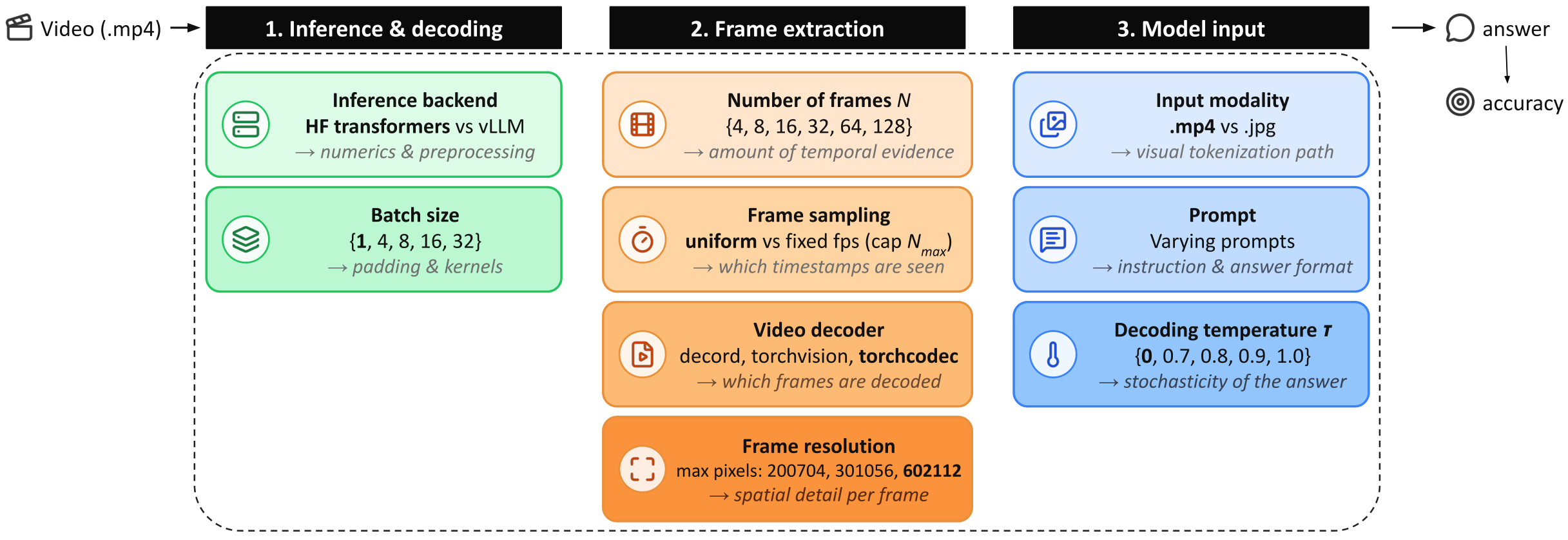
lmms_eval_video is a fork of lmms-eval for video benchmarks.
The same model checkpoint scores differently depending on how many frames it gets, which library decoded them,
how large they are, whether the backend sends a video or a list of images, and how the answer is decoded. Papers
rarely report these choices. This repository makes them explicit:
metav), a 1,000-question benchmark drawn from five video suites, filtered for questions that need the
video and selected to preserve model rankings at about 5x less compute than the full suites.git clone https://github.com/soumyasj/lmms_eval_video
cd lmms_eval_video
pip install -e . # or: uv pip install -e .
pip install -r eval_scripts/env/requirements-lock.txt # the exact versions the paper's numbers were produced with
Two environments cover all model families (see MODELS.md): transformers 4.57 / vLLM 0.11
for Qwen2.5-VL, Qwen3-VL and Gemma 3; transformers 5.16 / vLLM 0.28 for Qwen3.5, InternVL3.5 and GLM-V. Batch-invariant
vLLM runs need vLLM >= 0.11.1. Set HF_HOME to the cache that holds (or should receive) the benchmark videos, and HF_TOKEN
for gated datasets.
# Meta-Video, Qwen2.5-VL-7B, 32 frames, HF backend: the first run downloads the dataset (questions + 70 GB of videos)
python eval_scripts/run_eval.py configs/example.yaml

# see what would run (resolved settings, evaluation card, the final `python -m lmms_eval` command), run nothing
python eval_scripts/run_eval.py configs/example.yaml --dry_run

# override single keys without editing the file
python eval_scripts/run_eval.py configs/example.yaml --set model=qwen3vl_8b --set nframes=64 --set limit=20
Results land in logs/runs/<config name>/<task>/<model>/<run tag>/ with lmms_eval's *_results.json and per-sample
logs, plus config.json and evaluation_card.md. python eval_scripts/collect_results.py tabulates every finished run.
configs/example.yaml lists every key with its default. Four keys are toggles and may be
lists; the script runs the full grid. Everything else is fixed for the grid.
| group | key | values | what it changes |
|---|---|---|---|
| toggle | tasks | any video task or group (DATASETS.md) | the dataset |
| toggle | model | HF id or alias (MODELS.md) | the checkpoint and, through it, the runner family |
| toggle | nframes | int | frames per video (uniform sampling), or the cap in fps mode |
| toggle | backend | hf | vllm | hf_tiled | transformers generate, the vLLM engine, or InternVL's image tiler per frame |
| toggle | vllm_fix | bool | on vllm: forward the .mp4 to vLLM (one video, temporal merge, timestamps) instead of N separate images; Qwen2.5-VL only |
| input | input | video | frames | the .mp4 (the wrapper samples frames) or pre-extracted JPEGs (<task>_frames<N>, see 1.5) |
| input | frame_sampling, fps, max_frames | uniform | fps | exactly nframes frames, or fps frames per second capped at max_frames |
| input | frame_sampler | uniform | random | which positions out of the decoded frames (Qwen2.5-VL hf only, seeded) |
| input | video_reader | decord | torchvision | torchcodec | the decoding library; they do not return identical frames |
| input | max_pixels, min_pixels | int | per-frame pixel budget (tokens per frame = pixels / patch area); default per family |
| input | max_patches, min_patches | int | InternVL: 448x448 tiles per frame |
| runtime | batch_size, batch_invariant | int, bool | batch size; VLLM_BATCH_INVARIANT=1 so vLLM answers do not depend on the batch |
| runtime | num_gpus, tensor_parallel_size, gpu_memory_utilization, max_model_len, max_num_seqs | data parallel replicas; vLLM engine settings | |
| runtime | env, attn | path, str | environment bin dir to run in; attention implementation (hf) |
| decoding | temperature, max_new_tokens | null = the task yaml's generation_kwargs (temperature 0, 16 tokens for most MCQ tasks) | |
| decoding | enable_thinking | bool | Qwen3.5 / thinking checkpoints: emit the answer directly (default) or a reasoning trace first |
| decoding | seed | int | lmms_eval seed, also the frame-sampler seed |
| decoding | prompt | {variant, post_prompt, option_style, layout} | Meta-Video only: prompt variant per model family, a replacement answer instruction, option label style, text/visual order |
| bookkeeping | name, output_root, resume, limit, include_path, extra_model_args | run-set name, where results go, skip finished runs, smoke tests |
What the script does with it, for every point of the grid:
qwen25vl, qwen3vl, qwen35, internvl, glm, gemma);max_patches on InternVL's
stock video path (ignored there), a raw .mp4 for Gemma 3 (its wrapper applies no frame budget). A run never silently
uses an uncontrolled setting;eval_scripts/runners/, which builds the --model_args string and the
python -m lmms_eval command (MODELS.md lists them per family and backend);evaluation_card.md: model, task, backend, batch, frames and how they were sampled, decoder, resolution,
tokens per frame, decoding settings, prompt, seed, environment, command. Put it next to any number you report.The defaults in configs/example.yaml are the protocol every number in the paper uses:
| setting | value | why |
|---|---|---|
| backend | HF transformers | the reference path; stock vLLM sends N images instead of a video (1.3) |
| input | .mp4, uniform sampling, exactly nframes frames | 1 fps sampling costs 3 to 5 points on short-clip benchmarks |
| decoder | torchcodec | decoders disagree on which frames they return; torchvision drops MVBench by 10 points |
| resolution | family default (max_pixels 602112 for Qwen2.5-VL, 524288 Qwen3-VL, 131072 Qwen3.5; 1 tile for InternVL) | under 1 point of effect, but it sets the token count |
| batch size | 1 (or any, on hf) | score-neutral within a backend on hf; vLLM needs batch_invariant |
| decoding | temperature 0, the task's token cap, thinking off | temperature 1 costs 5 points on Video-MME |
| seed | 22 |
configs/metav_protocol.yaml reproduces the paper's standardized comparison (five
models, 4 to 128 frames, Meta-Video); configs/source_benchmarks.yaml runs one model
on the seven source benchmarks; configs/backend_comparison.yaml compares HF, stock
vLLM and the vLLM video fix.
hf: lmms_eval's transformers wrapper of the family. The .mp4 goes through the model's own video processor:
Qwen2.5-VL / Qwen3-VL merge frame pairs and (Qwen3-VL) write <t seconds> timestamps into the prompt; InternVL
resizes every frame to one 448x448 tile; see MODELS.md.vllm: lmms_eval's generic vLLM wrapper decodes the video client-side and sends the frames as N separate
images. Qwen2.5-VL then sees N x <|image_pad|>: no temporal merge, no video position ids, no timestamps. HF and
stock vLLM differ by 4 to 6 points on TempCompass, MVBench and Meta-Video because of this.vllm + vllm_fix: true: the out-of-tree plugin eval_scripts/runners/vllm_fix/ hands vLLM a file:// URL,
so vLLM decodes the video server-side through the model's own processor and builds the same single <|video_pad|>
block as the hf path. Qwen2.5-VL only. batch_invariant: true makes vLLM answers independent of the batch (vLLM >= 0.11.1).hf_tiled (InternVL): the model card's load_video(max_num=M) recipe, every frame through the image tiler, so
max_patches tiles per frame actually apply.The one-knob-at-a-time sweeps behind the paper's tables are scripts over the same runners and resume automatically:
bash eval_scripts/sweep_params.sh --model qwen25vl_7b --task videomme     # exp1..exp8: backend, batch size, decoder, frame positions, fps vs uniform, frames, pixels, .mp4 vs frames, temperature
bash eval_scripts/sweep_frames.sh --model qwen3vl_8b                      # accuracy vs 4..128 frames, .mp4 and pre-extracted frames, every task in TASKS
bash eval_scripts/sweep_vllm_fix.sh --model Qwen/Qwen2.5-VL-7B-Instruct --task metav   # hf vs stock vLLM vs vllm_fix over batch sizes and seeds
python eval_scripts/collect_results.py --csv runs.csv                     # one table per sweep / task / model / experiment
Each script's header documents its grid and environment knobs.
python eval_scripts/make_frames_task.py --task videomme     # hours for long benchmarks; --workers N
python eval_scripts/make_frames_task.py --task metav
Extracts 128 uniform frames per video into data/frames/videos/, writes data/frames/<task>_frames<N>.parquet for
N = 4 ... 128 and registers the tasks <task>_frames<N> (same prompt and metric as the source task, JPEG frames instead
of the video). input: frames in a config selects them. This is the only video input GLM-V and Gemma 3 accept on hf.
Every change is listed with its cause in MODELS.md and DATASETS.md. The short version:
nframes larger than a clip crashed the Qwen wrappers and is now clamped;vllm_fix plugin and the metav task.metav)Five video benchmarks recombined into one evaluation set of 1,000 questions on 791 videos (none longer than 60
minutes, at most 3 questions per video). The data is the Hugging Face dataset
soumyasj/Meta-Video: config meta_v holds the questions, videos/
the 791 videos (70 GB). The first run downloads it to $HF_HOME/meta_video; nothing else is needed.
| source | full set | in metav | subtask |
|---|---|---|---|
| Video-MME | 2,700 | 312 | metav_videomme |
| LongVideoBench (val, video) | 1,337 | 240 | metav_longvideobench_val_v |
| LVBench | 1,549 | 146 | metav_lvbench |
| VideoMMMU (perception / comprehension / adaptation) | 300 / 300 / 300 | 60 / 60 / 60 | metav_video_mmmu_{perception,comprehension,adaptation} |
| VSI-Bench | 5,130 | 122 | metav_vsibench |
How it was built. Three models (Qwen2.5-VL-7B, Qwen3-VL-8B, InternVL3.5-8B) were run with black frames instead of the video; every question that at least two of them still answered correctly was removed. From the remaining pool, items were selected per source category so that the subset orders models the way the full benchmarks do (a newer family beats the older one, a larger model beats a smaller one), with a cap of three questions per video. 937 questions are multiple choice (564 with four options, 185 with five, 157 with ten) and 63 ask for a number; the correct letters are balanced, so guessing scores 20.3. Videos: 335 short (< 5 min), 281 medium (5 to 20 min), 175 long (20 to 60 min).
Scoring. Each subtask maps the Meta-Video rows back onto its source task's document schema and re-uses the source's parser and metric, so an item is scored exactly as in its benchmark (VSI-Bench numerical items use mean relative accuracy). The Meta-Video score is the macro average over the five sources, VideoMMMU counting once as the mean of its three tracks. Scores are lower than on the source benchmarks by construction, since the questions language priors solve are gone: compare models by rank and by Meta-Video score, not against published numbers.
Running it.
python eval_scripts/run_eval.py configs/example.yaml                     # tasks: metav is the default
python eval_scripts/run_eval.py configs/metav_protocol.yaml              # the paper's five models x six frame budgets
python eval_scripts/score_metav.py --write logs/runs/*/metav/*/*/*/*_results.json   # macro score, written into the results file

# or plain lmms_eval, any wrapper
python -m lmms_eval --model qwen2_5_vl --model_args pretrained=Qwen/Qwen2.5-VL-7B-Instruct,max_num_frames=32 \
       --tasks metav --batch_size 1 --log_samples --output_path logs/metav_try
Prompts. The prompt text of every item is materialized once (lmms_eval/tasks/metav/data/metav_prompts.json), so
hf and vLLM runs of the same checkpoint see the same prompt (in lmms_eval, prompt blocks are otherwise keyed by the
registered model name). The prompt: keys of the config select a variant (default, qwen3_vl), replace the answer
instruction (post_prompt), restyle the option labels (option_style) or change the order of video and text
(layout: vt | tvt | vtv, frames input only).
Files. lmms_eval/tasks/metav/: one YAML per source, utils.py (schema mapping, response cleaning, the numeric
fallback for VSI-Bench), data/ (items with selection metadata, ids per source, materialized prompts).
METAV_VIDEO_ROOT=<dir> points the task at another copy of the dataset repo.
Non-blind splits. The same black-frame filter applied to the full source benchmarks, plus MVBench, TempCompass,
MMVU and SciVideoBench, is released as
soumyasj/video-benchmarks-nonblind: one config per
lmms_eval task, original columns, so a task can be pointed at it with dataset_path / dataset_name / test_split: nonblind.
The code follows the lmms-eval license. The Meta-Video item lists and prompts are released under CC BY 4.0. The videos belong to the source benchmarks and keep their licenses.
@misc{jahagirdar2026metavideo,
  title={Meta-Video: Efficient Standardized Evaluation for Video Understanding},
  author={Jahagirdar, Soumya Shamarao and Kukleva, Anna and Udandarao, Vishaal and Thomas, Samuel and Kingsbury, Brian and Feris, Rogerio and Glass, James R. and Prabhu, Ameya and Kuehne, Hilde},
  year={2026},
  note={Preprint}
}
cleaned lmms eval for video reasoning/qa benchmarks
Python
1
15 commits
updated Oct 14, 2026
Soumya Shamarao Jahagirdar1
Anna Kukleva2
Vishaal Udandarao1
Samuel Thomas3
Brian Kingsbury3
Rogerio Feris3,5
James R. Glass4
Ameya Prabhu6
Hilde Kuehne1,5,6
1University of Tübingen 2Max Planck Institute for Informatics, SIC 3IBM Research 4MIT 5MIT-IBM Computing Research Lab 6Tübingen AI Center
lmms_eval_video is a fork of lmms-eval for video benchmarks.
The same model checkpoint scores differently depending on how many frames it gets, which library decoded them,
how large they are, whether the backend sends a video or a list of images, and how the answer is decoded. Papers
rarely report these choices. This repository makes them explicit:
metav), a 1,000-question benchmark drawn from five video suites, filtered for questions that need the
video and selected to preserve model rankings at about 5x less compute than the full suites.git clone https://github.com/soumyasj/lmms_eval_video
cd lmms_eval_video
pip install -e . # or: uv pip install -e .
pip install -r eval_scripts/env/requirements-lock.txt # the exact versions the paper's numbers were produced with
Two environments cover all model families (see MODELS.md): transformers 4.57 / vLLM 0.11
for Qwen2.5-VL, Qwen3-VL and Gemma 3; transformers 5.16 / vLLM 0.28 for Qwen3.5, InternVL3.5 and GLM-V. Batch-invariant
vLLM runs need vLLM >= 0.11.1. Set HF_HOME to the cache that holds (or should receive) the benchmark videos, and HF_TOKEN
for gated datasets.
# Meta-Video, Qwen2.5-VL-7B, 32 frames, HF backend: the first run downloads the dataset (questions + 70 GB of videos)
python eval_scripts/run_eval.py configs/example.yaml

# see what would run (resolved settings, evaluation card, the final `python -m lmms_eval` command), run nothing
python eval_scripts/run_eval.py configs/example.yaml --dry_run

# override single keys without editing the file
python eval_scripts/run_eval.py configs/example.yaml --set model=qwen3vl_8b --set nframes=64 --set limit=20
Results land in logs/runs/<config name>/<task>/<model>/<run tag>/ with lmms_eval's *_results.json and per-sample
logs, plus config.json and evaluation_card.md. python eval_scripts/collect_results.py tabulates every finished run.
configs/example.yaml lists every key with its default. Four keys are toggles and may be
lists; the script runs the full grid. Everything else is fixed for the grid.
| group | key | values | what it changes |
|---|---|---|---|
| toggle | tasks | any video task or group (DATASETS.md) | the dataset |
| toggle | model | HF id or alias (MODELS.md) | the checkpoint and, through it, the runner family |
| toggle | nframes | int | frames per video (uniform sampling), or the cap in fps mode |
| toggle | backend | hf | vllm | hf_tiled | transformers generate, the vLLM engine, or InternVL's image tiler per frame |
| toggle | vllm_fix | bool | on vllm: forward the .mp4 to vLLM (one video, temporal merge, timestamps) instead of N separate images; Qwen2.5-VL only |
| input | input | video | frames | the .mp4 (the wrapper samples frames) or pre-extracted JPEGs (<task>_frames<N>, see 1.5) |
| input | frame_sampling, fps, max_frames | uniform | fps | exactly nframes frames, or fps frames per second capped at max_frames |
| input | frame_sampler | uniform | random | which positions out of the decoded frames (Qwen2.5-VL hf only, seeded) |
| input | video_reader | decord | torchvision | torchcodec | the decoding library; they do not return identical frames |
| input | max_pixels, min_pixels | int | per-frame pixel budget (tokens per frame = pixels / patch area); default per family |
| input | max_patches, min_patches | int | InternVL: 448x448 tiles per frame |
| runtime | batch_size, batch_invariant | int, bool | batch size; VLLM_BATCH_INVARIANT=1 so vLLM answers do not depend on the batch |
| runtime | num_gpus, tensor_parallel_size, gpu_memory_utilization, max_model_len, max_num_seqs | data parallel replicas; vLLM engine settings | |
| runtime | env, attn | path, str | environment bin dir to run in; attention implementation (hf) |
| decoding | temperature, max_new_tokens | null = the task yaml's generation_kwargs (temperature 0, 16 tokens for most MCQ tasks) | |
| decoding | enable_thinking | bool | Qwen3.5 / thinking checkpoints: emit the answer directly (default) or a reasoning trace first |
| decoding | seed | int | lmms_eval seed, also the frame-sampler seed |
| decoding | prompt | {variant, post_prompt, option_style, layout} | Meta-Video only: prompt variant per model family, a replacement answer instruction, option label style, text/visual order |
| bookkeeping | name, output_root, resume, limit, include_path, extra_model_args | run-set name, where results go, skip finished runs, smoke tests |
What the script does with it, for every point of the grid:
qwen25vl, qwen3vl, qwen35, internvl, glm, gemma);max_patches on InternVL's
stock video path (ignored there), a raw .mp4 for Gemma 3 (its wrapper applies no frame budget). A run never silently
uses an uncontrolled setting;eval_scripts/runners/, which builds the --model_args string and the
python -m lmms_eval command (MODELS.md lists them per family and backend);evaluation_card.md: model, task, backend, batch, frames and how they were sampled, decoder, resolution,
tokens per frame, decoding settings, prompt, seed, environment, command. Put it next to any number you report.The defaults in configs/example.yaml are the protocol every number in the paper uses:
| setting | value | why |
|---|---|---|
| backend | HF transformers | the reference path; stock vLLM sends N images instead of a video (1.3) |
| input | .mp4, uniform sampling, exactly nframes frames | 1 fps sampling costs 3 to 5 points on short-clip benchmarks |
| decoder | torchcodec | decoders disagree on which frames they return; torchvision drops MVBench by 10 points |
| resolution | family default (max_pixels 602112 for Qwen2.5-VL, 524288 Qwen3-VL, 131072 Qwen3.5; 1 tile for InternVL) | under 1 point of effect, but it sets the token count |
| batch size | 1 (or any, on hf) | score-neutral within a backend on hf; vLLM needs batch_invariant |
| decoding | temperature 0, the task's token cap, thinking off | temperature 1 costs 5 points on Video-MME |
| seed | 22 |
configs/metav_protocol.yaml reproduces the paper's standardized comparison (five
models, 4 to 128 frames, Meta-Video); configs/source_benchmarks.yaml runs one model
on the seven source benchmarks; configs/backend_comparison.yaml compares HF, stock
vLLM and the vLLM video fix.
hf: lmms_eval's transformers wrapper of the family. The .mp4 goes through the model's own video processor:
Qwen2.5-VL / Qwen3-VL merge frame pairs and (Qwen3-VL) write <t seconds> timestamps into the prompt; InternVL
resizes every frame to one 448x448 tile; see MODELS.md.vllm: lmms_eval's generic vLLM wrapper decodes the video client-side and sends the frames as N separate
images. Qwen2.5-VL then sees N x <|image_pad|>: no temporal merge, no video position ids, no timestamps. HF and
stock vLLM differ by 4 to 6 points on TempCompass, MVBench and Meta-Video because of this.vllm + vllm_fix: true: the out-of-tree plugin eval_scripts/runners/vllm_fix/ hands vLLM a file:// URL,
so vLLM decodes the video server-side through the model's own processor and builds the same single <|video_pad|>
block as the hf path. Qwen2.5-VL only. batch_invariant: true makes vLLM answers independent of the batch (vLLM >= 0.11.1).hf_tiled (InternVL): the model card's load_video(max_num=M) recipe, every frame through the image tiler, so
max_patches tiles per frame actually apply.The one-knob-at-a-time sweeps behind the paper's tables are scripts over the same runners and resume automatically:
bash eval_scripts/sweep_params.sh --model qwen25vl_7b --task videomme     # exp1..exp8: backend, batch size, decoder, frame positions, fps vs uniform, frames, pixels, .mp4 vs frames, temperature
bash eval_scripts/sweep_frames.sh --model qwen3vl_8b                      # accuracy vs 4..128 frames, .mp4 and pre-extracted frames, every task in TASKS
bash eval_scripts/sweep_vllm_fix.sh --model Qwen/Qwen2.5-VL-7B-Instruct --task metav   # hf vs stock vLLM vs vllm_fix over batch sizes and seeds
python eval_scripts/collect_results.py --csv runs.csv                     # one table per sweep / task / model / experiment
Each script's header documents its grid and environment knobs.
python eval_scripts/make_frames_task.py --task videomme     # hours for long benchmarks; --workers N
python eval_scripts/make_frames_task.py --task metav
Extracts 128 uniform frames per video into data/frames/videos/, writes data/frames/<task>_frames<N>.parquet for
N = 4 ... 128 and registers the tasks <task>_frames<N> (same prompt and metric as the source task, JPEG frames instead
of the video). input: frames in a config selects them. This is the only video input GLM-V and Gemma 3 accept on hf.
Every change is listed with its cause in MODELS.md and DATASETS.md. The short version:
nframes larger than a clip crashed the Qwen wrappers and is now clamped;vllm_fix plugin and the metav task.metav)Five video benchmarks recombined into one evaluation set of 1,000 questions on 791 videos (none longer than 60
minutes, at most 3 questions per video). The data is the Hugging Face dataset
soumyasj/Meta-Video: config meta_v holds the questions, videos/
the 791 videos (70 GB). The first run downloads it to $HF_HOME/meta_video; nothing else is needed.
| source | full set | in metav | subtask |
|---|---|---|---|
| Video-MME | 2,700 | 312 | metav_videomme |
| LongVideoBench (val, video) | 1,337 | 240 | metav_longvideobench_val_v |
| LVBench | 1,549 | 146 | metav_lvbench |
| VideoMMMU (perception / comprehension / adaptation) | 300 / 300 / 300 | 60 / 60 / 60 | metav_video_mmmu_{perception,comprehension,adaptation} |
| VSI-Bench | 5,130 | 122 | metav_vsibench |
How it was built. Three models (Qwen2.5-VL-7B, Qwen3-VL-8B, InternVL3.5-8B) were run with black frames instead of the video; every question that at least two of them still answered correctly was removed. From the remaining pool, items were selected per source category so that the subset orders models the way the full benchmarks do (a newer family beats the older one, a larger model beats a smaller one), with a cap of three questions per video. 937 questions are multiple choice (564 with four options, 185 with five, 157 with ten) and 63 ask for a number; the correct letters are balanced, so guessing scores 20.3. Videos: 335 short (< 5 min), 281 medium (5 to 20 min), 175 long (20 to 60 min).
Scoring. Each subtask maps the Meta-Video rows back onto its source task's document schema and re-uses the source's parser and metric, so an item is scored exactly as in its benchmark (VSI-Bench numerical items use mean relative accuracy). The Meta-Video score is the macro average over the five sources, VideoMMMU counting once as the mean of its three tracks. Scores are lower than on the source benchmarks by construction, since the questions language priors solve are gone: compare models by rank and by Meta-Video score, not against published numbers.
Running it.
python eval_scripts/run_eval.py configs/example.yaml                     # tasks: metav is the default
python eval_scripts/run_eval.py configs/metav_protocol.yaml              # the paper's five models x six frame budgets
python eval_scripts/score_metav.py --write logs/runs/*/metav/*/*/*/*_results.json   # macro score, written into the results file

# or plain lmms_eval, any wrapper
python -m lmms_eval --model qwen2_5_vl --model_args pretrained=Qwen/Qwen2.5-VL-7B-Instruct,max_num_frames=32 \
       --tasks metav --batch_size 1 --log_samples --output_path logs/metav_try
Prompts. The prompt text of every item is materialized once (lmms_eval/tasks/metav/data/metav_prompts.json), so
hf and vLLM runs of the same checkpoint see the same prompt (in lmms_eval, prompt blocks are otherwise keyed by the
registered model name). The prompt: keys of the config select a variant (default, qwen3_vl), replace the answer
instruction (post_prompt), restyle the option labels (option_style) or change the order of video and text
(layout: vt | tvt | vtv, frames input only).
Files. lmms_eval/tasks/metav/: one YAML per source, utils.py (schema mapping, response cleaning, the numeric
fallback for VSI-Bench), data/ (items with selection metadata, ids per source, materialized prompts).
METAV_VIDEO_ROOT=<dir> points the task at another copy of the dataset repo.
Non-blind splits. The same black-frame filter applied to the full source benchmarks, plus MVBench, TempCompass,
MMVU and SciVideoBench, is released as
soumyasj/video-benchmarks-nonblind: one config per
lmms_eval task, original columns, so a task can be pointed at it with dataset_path / dataset_name / test_split: nonblind.
The code follows the lmms-eval license. The Meta-Video item lists and prompts are released under CC BY 4.0. The videos belong to the source benchmarks and keep their licenses.
@misc{jahagirdar2026metavideo,
  title={Meta-Video: Efficient Standardized Evaluation for Video Understanding},
  author={Jahagirdar, Soumya Shamarao and Kukleva, Anna and Udandarao, Vishaal and Thomas, Samuel and Kingsbury, Brian and Feris, Rogerio and Glass, James R. and Prabhu, Ameya and Kuehne, Hilde},
  year={2026},
  note={Preprint}
}





