
README
Covered
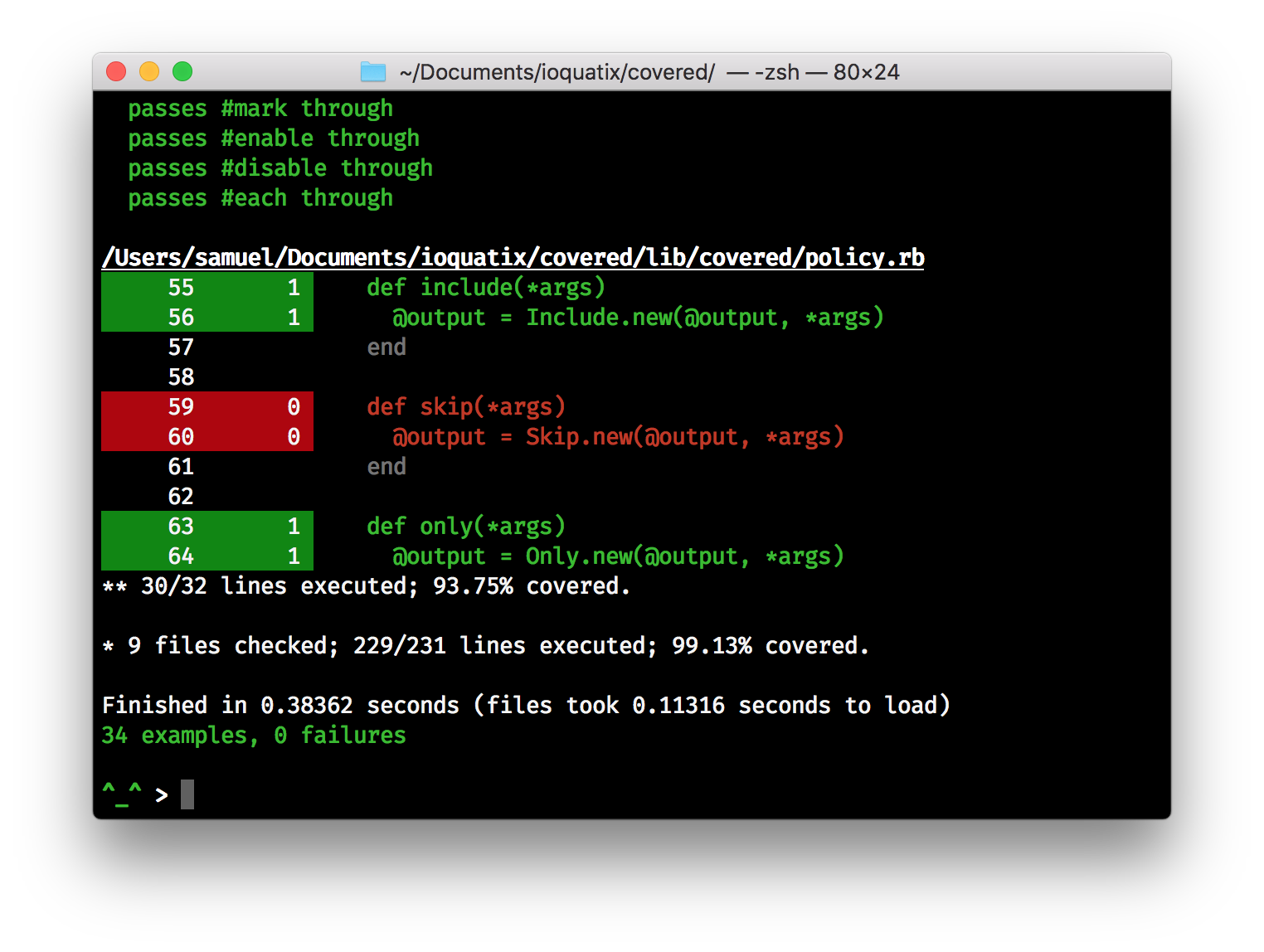
Covered uses modern Ruby features to generate comprehensive coverage, including support for templates which are compiled into Ruby.
- Incremental coverage - if you run your full test suite, and the run a subset, it will still report the correct coverage - so you can incrementally work on improving coverage.
- Integration with Sus, Git, RSpec and Minitest- no need to configure anything - out of the box support for these platforms.
- Supports coverage of views - templates compiled to Ruby code can be tracked for coverage reporting.

Motivation
Originally, Ruby coverage tools were unable to handle evaled code. This is because the coverage module built into
Ruby doesn't expose the necessary hooks to capture it. Using the parser gem and
trace points allows us to do our own source code analysis to compute executable lines, thus making it possible to
compute coverage for "templates".
After this concept prooved useful, it was integrated directly into Ruby.
Usage
Please see the project documentation for more details.
-
Getting Started - This guide explains how to get started with
coveredand integrate it with your test suite. -
Configuration - This guide will help you to configure covered for your project's specific requirements.
Releases
Please see the project releases for all releases.
v0.30.0
- Ignore files under
integration/when evaluating coverage.
v0.29.0
- Prefer
ruby-coverageovercoveragefor improved coverage tracking.
v0.28.5
- Make coverage validation quiet when no reports are configured.
v0.28.4
- Ensure coverage validation loads explicit coverage databases without reloading the default persisted database.
v0.28.3
- Ignore nil coverage reports so validation can run without
COVERAGEconfigured.
v0.28.2
- Ensure bake coverage validation loads persisted coverage using project configuration.
v0.28.0
- List files that have 100% coverage in
PartialSummaryoutput.
v0.27.0
- Drop development dependeny on
trenniand add dependeny onxrb.
See Also
- simplecov – one of the original coverage implementations for Ruby, uses
the built-in
coveragelibrary. - sus - a test framework which uses
coveredto generate coverage reports.
Contributing
We welcome contributions to this project.
- Fork the repository.
- Create your feature branch (
git checkout -b my-new-feature). - Commit your changes (
git commit -am 'Add some feature.'). - Push to the branch (
git push origin my-new-feature). - Create a new pull request.
Running Tests
To run the test suite:
bundle exec sus
Making Releases
To make a new release:
bundle exec bake gem:release:patch # or minor or major
Developer Certificate of Origin
In order to protect users of this project, we require all contributors to comply with the Developer Certificate of Origin. This ensures that all contributions are properly licensed and attributed.
Community Guidelines
This project is best served by a collaborative and respectful environment. Treat each other professionally, respect differing viewpoints, and engage constructively. Harassment, discrimination, or harmful behavior is not tolerated. Communicate clearly, listen actively, and support one another. If any issues arise, please inform the project maintainers.
Contributors




Similar repos


Languages
Ruby
100.0%
README
Covered
Covered uses modern Ruby features to generate comprehensive coverage, including support for templates which are compiled into Ruby.
- Incremental coverage - if you run your full test suite, and the run a subset, it will still report the correct coverage - so you can incrementally work on improving coverage.
- Integration with Sus, Git, RSpec and Minitest- no need to configure anything - out of the box support for these platforms.
- Supports coverage of views - templates compiled to Ruby code can be tracked for coverage reporting.
Motivation
Originally, Ruby coverage tools were unable to handle evaled code. This is because the coverage module built into
Ruby doesn't expose the necessary hooks to capture it. Using the parser gem and
trace points allows us to do our own source code analysis to compute executable lines, thus making it possible to
compute coverage for "templates".
After this concept prooved useful, it was integrated directly into Ruby.
Usage
Please see the project documentation for more details.
-
Getting Started - This guide explains how to get started with
coveredand integrate it with your test suite. -
Configuration - This guide will help you to configure covered for your project's specific requirements.
Releases
Please see the project releases for all releases.
v0.30.0
- Ignore files under
integration/when evaluating coverage.
v0.29.0
- Prefer
ruby-coverageovercoveragefor improved coverage tracking.
v0.28.5
- Make coverage validation quiet when no reports are configured.
v0.28.4
- Ensure coverage validation loads explicit coverage databases without reloading the default persisted database.
v0.28.3
- Ignore nil coverage reports so validation can run without
COVERAGEconfigured.
v0.28.2
- Ensure bake coverage validation loads persisted coverage using project configuration.
v0.28.0
- List files that have 100% coverage in
PartialSummaryoutput.
v0.27.0
- Drop development dependeny on
trenniand add dependeny onxrb.
See Also
- simplecov – one of the original coverage implementations for Ruby, uses
the built-in
coveragelibrary. - sus - a test framework which uses
coveredto generate coverage reports.
Contributing
We welcome contributions to this project.
- Fork the repository.
- Create your feature branch (
git checkout -b my-new-feature). - Commit your changes (
git commit -am 'Add some feature.'). - Push to the branch (
git push origin my-new-feature). - Create a new pull request.
Running Tests
To run the test suite:
bundle exec sus
Making Releases
To make a new release:
bundle exec bake gem:release:patch # or minor or major
Developer Certificate of Origin
In order to protect users of this project, we require all contributors to comply with the Developer Certificate of Origin. This ensures that all contributions are properly licensed and attributed.
Community Guidelines
This project is best served by a collaborative and respectful environment. Treat each other professionally, respect differing viewpoints, and engage constructively. Harassment, discrimination, or harmful behavior is not tolerated. Communicate clearly, listen actively, and support one another. If any issues arise, please inform the project maintainers.
Similar repos
Contributors
Languages
Ruby
100.0%