
[ICLR 2025 Oral] Official Implementation for "Do Vision-Language Models Represent Space and How? Evaluating Spatial Frame of Reference Under Ambiguities"
See the codeREADME
🛋️ Do Vision-Language Models Represent Space and How? Evaluating Spatial Frame of Reference Under Ambiguities



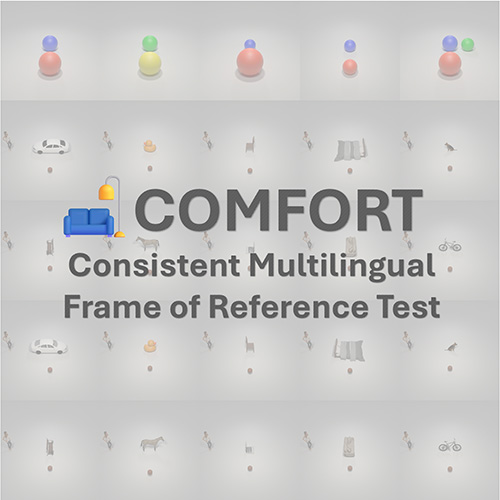
This repository provides the code and instructions for using the evaluation protocol to systematically assess the spatial reasoning capabilities of VLMs, COnsistent Multilingual Frame Of Reference Test (COMFORT). Follow the steps below to set up the environment, generate data (optional), and run experiments. Feel free to create an issue if you encounter any problems. We also welcome pull requests.
Table of Contents
- Setup Environment
- Prepare Data
- Add API Credentials
- Run Experiments
- Run Evaluations
- Evaluate More Models
- Common Problems and Solutions
Setup Environment
Clone the repository and create a conda environment using the provided environment.yml file:
git clone https://github.com/sled-group/COMFORT.git
cd comfort_utils
conda env create -f environment.yml
After creating the environment:
conda activate comfort
Then, install editable packages:
cd models/GLAMM
pip install -e .
cd models/llava
pip install -e .
cd models/InternVL/internvl_chat
pip install -e .
You can also use Poetry to setup the environment.
Prepare data
Firstly, make a data directory:
mkdir data
(Option 1.) Download data from Huggingface
wget https://huggingface.co/datasets/sled-umich/COMFORT/resolve/main/comfort_ball.zip?download=true -O data/comfort_ball.zip
unzip data/comfort_ball.zip -d data/
wget https://huggingface.co/datasets/sled-umich/COMFORT/resolve/main/comfort_car_ref_facing_left.zip?download=true -O data/comfort_car_ref_facing_left.zip
unzip data/comfort_car_ref_facing_left.zip -d data/
wget https://huggingface.co/datasets/sled-umich/COMFORT/resolve/main/comfort_car_ref_facing_right.zip?download=true -O data/comfort_car_ref_facing_right.zip
unzip data/comfort_car_ref_facing_right.zip -d data/
(Option 2.) Data generation
pip install gdown
python download_assets.py
chmod +x generate_dataset.sh
./generate_dataset.sh
Add API Credentials
touch comfort_utils/model_utils/api_keys.py
-
Prepare OpenAI and DeepL API keys and add below to api_keys.py
APIKEY_OPENAI = <YOUR_API_KEY> APIKEY_DEEPL = <YOUR_API_KEY> -
Prepare Google Cloud Translate API credentials (.json)
Run Experiments
./run_english_ball_experiments.sh
./run_english_car_left_experiments.sh
./run_english_car_right_experiments.sh

export GOOGLE_APPLICATION_CREDENTIALS="your_google_application_credentials_path.json"
./run_multilingual_ball_experiments.sh
./run_multilingual_car_left_experiments.sh
./run_multilingual_car_right_experiments.sh
Run Evaluations
English
- Preferred Coordinate Transformation (Table 2 & Table 7):
python gather_results.py --mode cpp --cpp convention - Preferred Frame of Reference (Table 3 & Table 8):
python gather_results.py --mode cpp --cpp preferredfor - Perspective Taking (Table 4 & Table 9):
python gather_results.py --mode cpp --cpp perspective - Comprehensive Evaluation (Table 5):
python gather_results.py --mode comprehensive
Multilingual (Figure 8 & Table 10)
python gather_results_multilingual.py
After evaluation completes:
cd results/eval
python eval_multilingual_preferredfor_raw.py
Evaluate More Models
We refer to Model Wrapper.
Common Problems and Solutions
- ImportError: libcupti.so.11.7: cannot open shared object file: No such file or directory
pip install torch==2.0.0+cu118 torchvision==0.15.1+cu118 torchaudio==2.0.1 --index-url https://download.pytorch.org/whl/cu118
Citation :fountain_pen:
@misc{zhang2024visionlanguagemodelsrepresentspace,
       title={Do Vision-Language Models Represent Space and How? Evaluating Spatial Frame of Reference Under Ambiguities},
       author={Zheyuan Zhang and Fengyuan Hu and Jayjun Lee and Freda Shi and Parisa Kordjamshidi and Joyce Chai and Ziqiao Ma},
       year={2024},
       eprint={2410.17385},
       archivePrefix={arXiv},
       primaryClass={cs.CL},
       url={https://arxiv.org/abs/2410.17385},
     }
Similar repos


Languages
Python
76.0%
Jupyter Notebook
21.9%
Shell
1.7%
[ICLR 2025 Oral] Official Implementation for "Do Vision-Language Models Represent Space and How? Evaluating Spatial Frame of Reference Under Ambiguities"
See the codeREADME
🛋️ Do Vision-Language Models Represent Space and How? Evaluating Spatial Frame of Reference Under Ambiguities
This repository provides the code and instructions for using the evaluation protocol to systematically assess the spatial reasoning capabilities of VLMs, COnsistent Multilingual Frame Of Reference Test (COMFORT). Follow the steps below to set up the environment, generate data (optional), and run experiments. Feel free to create an issue if you encounter any problems. We also welcome pull requests.
Table of Contents
- Setup Environment
- Prepare Data
- Add API Credentials
- Run Experiments
- Run Evaluations
- Evaluate More Models
- Common Problems and Solutions
Setup Environment
Clone the repository and create a conda environment using the provided environment.yml file:
git clone https://github.com/sled-group/COMFORT.git
cd comfort_utils
conda env create -f environment.yml
After creating the environment:
conda activate comfort
Then, install editable packages:
cd models/GLAMM
pip install -e .
cd models/llava
pip install -e .
cd models/InternVL/internvl_chat
pip install -e .
You can also use Poetry to setup the environment.
Prepare data
Firstly, make a data directory:
mkdir data
(Option 1.) Download data from Huggingface
wget https://huggingface.co/datasets/sled-umich/COMFORT/resolve/main/comfort_ball.zip?download=true -O data/comfort_ball.zip
unzip data/comfort_ball.zip -d data/
wget https://huggingface.co/datasets/sled-umich/COMFORT/resolve/main/comfort_car_ref_facing_left.zip?download=true -O data/comfort_car_ref_facing_left.zip
unzip data/comfort_car_ref_facing_left.zip -d data/
wget https://huggingface.co/datasets/sled-umich/COMFORT/resolve/main/comfort_car_ref_facing_right.zip?download=true -O data/comfort_car_ref_facing_right.zip
unzip data/comfort_car_ref_facing_right.zip -d data/
(Option 2.) Data generation
pip install gdown
python download_assets.py
chmod +x generate_dataset.sh
./generate_dataset.sh
Add API Credentials
touch comfort_utils/model_utils/api_keys.py
-
Prepare OpenAI and DeepL API keys and add below to api_keys.py
APIKEY_OPENAI = <YOUR_API_KEY> APIKEY_DEEPL = <YOUR_API_KEY> -
Prepare Google Cloud Translate API credentials (.json)
Run Experiments
./run_english_ball_experiments.sh
./run_english_car_left_experiments.sh
./run_english_car_right_experiments.sh

export GOOGLE_APPLICATION_CREDENTIALS="your_google_application_credentials_path.json"
./run_multilingual_ball_experiments.sh
./run_multilingual_car_left_experiments.sh
./run_multilingual_car_right_experiments.sh
Run Evaluations
English
- Preferred Coordinate Transformation (Table 2 & Table 7):
python gather_results.py --mode cpp --cpp convention - Preferred Frame of Reference (Table 3 & Table 8):
python gather_results.py --mode cpp --cpp preferredfor - Perspective Taking (Table 4 & Table 9):
python gather_results.py --mode cpp --cpp perspective - Comprehensive Evaluation (Table 5):
python gather_results.py --mode comprehensive
Multilingual (Figure 8 & Table 10)
python gather_results_multilingual.py
After evaluation completes:
cd results/eval
python eval_multilingual_preferredfor_raw.py
Evaluate More Models
We refer to Model Wrapper.
Common Problems and Solutions
- ImportError: libcupti.so.11.7: cannot open shared object file: No such file or directory
pip install torch==2.0.0+cu118 torchvision==0.15.1+cu118 torchaudio==2.0.1 --index-url https://download.pytorch.org/whl/cu118
Citation :fountain_pen:
@misc{zhang2024visionlanguagemodelsrepresentspace,
       title={Do Vision-Language Models Represent Space and How? Evaluating Spatial Frame of Reference Under Ambiguities},
       author={Zheyuan Zhang and Fengyuan Hu and Jayjun Lee and Freda Shi and Parisa Kordjamshidi and Joyce Chai and Ziqiao Ma},
       year={2024},
       eprint={2410.17385},
       archivePrefix={arXiv},
       primaryClass={cs.CL},
       url={https://arxiv.org/abs/2410.17385},
     }
Similar repos
Languages
Python
76.0%
Jupyter Notebook
21.9%
Shell
1.7%