learn database internals by building a storage engine in Rust
See the code

Mini-LSM is a hands-on course in database internals for systems and backend engineers. Build an LSM-tree storage engine from memtables and SSTs through compaction, crash recovery, MVCC, and transactions.
Start the guided three-week course · Try the coding-agent track
Week 1 produces a working storage engine. Weeks 2 and 3 add production-inspired compaction, durability, concurrency control, and multi-version transactions.
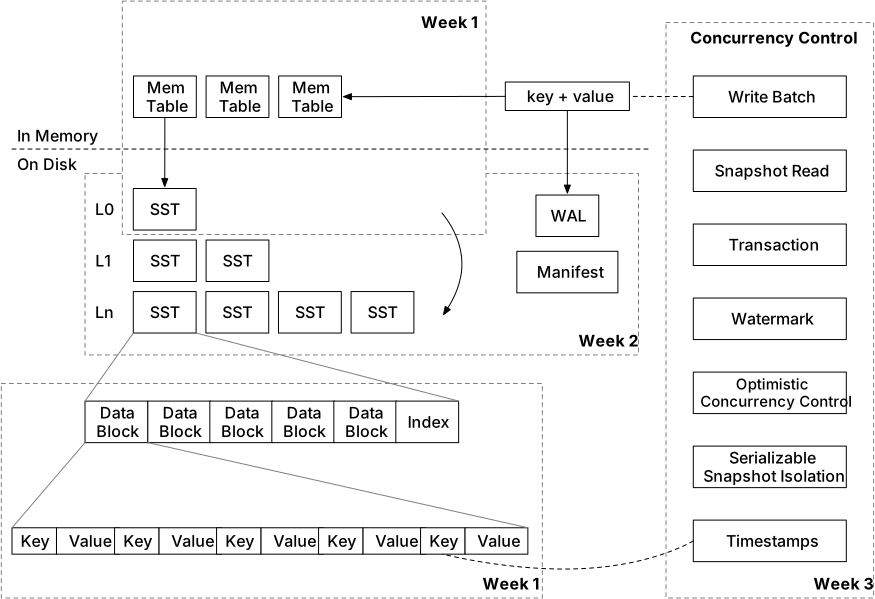
By the end of the course, your engine will include:
Mini-LSM focuses on the storage layer of a database. It does not cover SQL parsing, query optimization, replication, or distributed consensus.
| Path | Best for | Format | Status |
|---|---|---|---|
| Guided course | Learners who want to implement and reason through each subsystem | Three weeks, with seven chapters per week | Complete |
| Coding-agent track | Learners who want an agent to handle mechanical implementation without outsourcing system design | Three planned days built around decision stops, focused code slices, and adversarial tests | Days 1–3 available |
You need basic Rust, but you do not need prior knowledge of LSM trees, compaction, MVCC, or transaction isolation. The course is a good fit if you have used systems such as PostgreSQL, MySQL, Redis, or RocksDB and want to understand what happens below their APIs.
You may join skyzh's Discord server and study with the mini-lsm community.

Add Your Solution
If you finished at least one full week of this course, you can add your solution to the community solution list at SOLUTIONS.md by submitting a pull request.
For Students
You should modify code in mini-lsm-starter directory.
cargo x install-tools
cargo x copy-test --week 1 --day 1
cargo x scheck
cargo run --bin mini-lsm-cli
cargo run --bin compaction-simulator
For Course Developers
You should modify mini-lsm and mini-lsm-mvcc
cargo x install-tools
cargo x check
cargo x book
If you changed public API in the reference solution, you might also need to synchronize it to the starter crate.
To do this, use cargo x sync.
We have another repo mini-lsm-solution-checkpoint at https://github.com/skyzh/mini-lsm-solution-checkpoint. In this repo, each commit corresponds to a chapter in the course. We will not update the solution checkpoint very often.
You can run the reference solution by yourself to gain an overview of the system before you start.
cargo run --bin mini-lsm-cli-ref
cargo run --bin mini-lsm-cli-mvcc-ref
And we have a compaction simulator to experiment with your compaction algorithm implementation,
cargo run --bin compaction-simulator-ref
cargo run --bin compaction-simulator-mvcc-ref
The guided course has three complete weeks.
| Week + Chapter | Topic |
|---|---|
| 1.1 | Memtable |
| 1.2 | Merge Iterator |
| 1.3 | Block |
| 1.4 | Sorted String Table (SST) |
| 1.5 | Read Path |
| 1.6 | Write Path |
| 1.7 | SST Optimizations: Prefix Key Encoding + Bloom Filters |
| 2.1 | Compaction Implementation |
| 2.2 | Simple Compaction Strategy (Traditional Leveled Compaction) |
| 2.3 | Tiered Compaction Strategy (RocksDB Universal Compaction) |
| 2.4 | Leveled Compaction Strategy (RocksDB Leveled Compaction) |
| 2.5 | Manifest |
| 2.6 | Write-Ahead Log (WAL) |
| 2.7 | Batch Write and Checksums |
| 3.1 | Timestamp Key Encoding |
| 3.2 | Snapshot Read - Memtables and Timestamps |
| 3.3 | Snapshot Read - Transaction API |
| 3.4 | Watermark and Garbage Collection |
| 3.5 | Transactions and Optimistic Concurrency Control |
| 3.6 | Serializable Snapshot Isolation |
| 3.7 | Compaction Filters |
mini-lsm inspired several projects used in production.
The Mini-LSM starter code and solution are under Apache 2.0 license. The author reserves the full copyright of the course materials (markdown files and figures).
(top 24 of 135)
3,114 followers · starred Dec 2022
739 followers · starred Nov 2024
634 followers · starred Aug 2023
294 followers · starred Aug 2024
learn database internals by building a storage engine in Rust
See the code
Mini-LSM is a hands-on course in database internals for systems and backend engineers. Build an LSM-tree storage engine from memtables and SSTs through compaction, crash recovery, MVCC, and transactions.
Start the guided three-week course · Try the coding-agent track
Week 1 produces a working storage engine. Weeks 2 and 3 add production-inspired compaction, durability, concurrency control, and multi-version transactions.
By the end of the course, your engine will include:
Mini-LSM focuses on the storage layer of a database. It does not cover SQL parsing, query optimization, replication, or distributed consensus.
| Path | Best for | Format | Status |
|---|---|---|---|
| Guided course | Learners who want to implement and reason through each subsystem | Three weeks, with seven chapters per week | Complete |
| Coding-agent track | Learners who want an agent to handle mechanical implementation without outsourcing system design | Three planned days built around decision stops, focused code slices, and adversarial tests | Days 1–3 available |
You need basic Rust, but you do not need prior knowledge of LSM trees, compaction, MVCC, or transaction isolation. The course is a good fit if you have used systems such as PostgreSQL, MySQL, Redis, or RocksDB and want to understand what happens below their APIs.
You may join skyzh's Discord server and study with the mini-lsm community.
Add Your Solution
If you finished at least one full week of this course, you can add your solution to the community solution list at SOLUTIONS.md by submitting a pull request.
For Students
You should modify code in mini-lsm-starter directory.
cargo x install-tools
cargo x copy-test --week 1 --day 1
cargo x scheck
cargo run --bin mini-lsm-cli
cargo run --bin compaction-simulator
For Course Developers
You should modify mini-lsm and mini-lsm-mvcc
cargo x install-tools
cargo x check
cargo x book
If you changed public API in the reference solution, you might also need to synchronize it to the starter crate.
To do this, use cargo x sync.
We have another repo mini-lsm-solution-checkpoint at https://github.com/skyzh/mini-lsm-solution-checkpoint. In this repo, each commit corresponds to a chapter in the course. We will not update the solution checkpoint very often.
You can run the reference solution by yourself to gain an overview of the system before you start.
cargo run --bin mini-lsm-cli-ref
cargo run --bin mini-lsm-cli-mvcc-ref
And we have a compaction simulator to experiment with your compaction algorithm implementation,
cargo run --bin compaction-simulator-ref
cargo run --bin compaction-simulator-mvcc-ref
The guided course has three complete weeks.
| Week + Chapter | Topic |
|---|---|
| 1.1 | Memtable |
| 1.2 | Merge Iterator |
| 1.3 | Block |
| 1.4 | Sorted String Table (SST) |
| 1.5 | Read Path |
| 1.6 | Write Path |
| 1.7 | SST Optimizations: Prefix Key Encoding + Bloom Filters |
| 2.1 | Compaction Implementation |
| 2.2 | Simple Compaction Strategy (Traditional Leveled Compaction) |
| 2.3 | Tiered Compaction Strategy (RocksDB Universal Compaction) |
| 2.4 | Leveled Compaction Strategy (RocksDB Leveled Compaction) |
| 2.5 | Manifest |
| 2.6 | Write-Ahead Log (WAL) |
| 2.7 | Batch Write and Checksums |
| 3.1 | Timestamp Key Encoding |
| 3.2 | Snapshot Read - Memtables and Timestamps |
| 3.3 | Snapshot Read - Transaction API |
| 3.4 | Watermark and Garbage Collection |
| 3.5 | Transactions and Optimistic Concurrency Control |
| 3.6 | Serializable Snapshot Isolation |
| 3.7 | Compaction Filters |
mini-lsm inspired several projects used in production.
The Mini-LSM starter code and solution are under Apache 2.0 license. The author reserves the full copyright of the course materials (markdown files and figures).
(top 24 of 135)
3,114 followers · starred Dec 2022
739 followers · starred Nov 2024
634 followers · starred Aug 2023
294 followers · starred Aug 2024



