
A transparent, single-file implementation for understanding GRPO (K1 in Rewards), free from the abstractions of large libraries.
Python
91
6 commits
updated Feb 14, 2026
README
Transparent GRPO
English Version | Chinese Version
A minimal, single-file implementation of Group Relative Policy Optimization (GRPO).
Current RLHF/RL libraries (TRL, OpenRLHF) are powerful but often hide the mathematical logic behind layers of abstraction, callbacks, and complex class inheritances. Transparent GRPO is designed for researchers and engineers who want to:
- Read everything in one flow: No jumping between 10 files to find where the
lossis actually calculated. - Debug mathematically: See exactly how the Advantages are normalized and how the KL penalty is applied.
- Prototype quickly: Modify the core algorithm (e.g., change the KL estimator) by changing just one line of code.
✨ Key Features
- < 400 Lines of Code: The entire logic (Environment, Dataset, Model, Training Loop) fits in a single file.
- Linear Logic Flow: The code reads from top to bottom.
Generate->Reward->Advantage->Update. - State-of-the-Art Implementation: Implements the K1 Estimator in Rewards (unbiased KL approximation) rather than the older K3-in-Loss approach. This aligns with recent findings (Shah et al., 2026) for lower variance and better stability in reasoning tasks.
- Zero Bloat: Depends only on
torch,transformers,accelerate, andnumpy. No heavy RL frameworks required. - Just Run It: The single file code includes a toy math environment (Piecewise Function Continuity), which ensures it trains quickly on a single GPU, allowing you to verify correctness in minutes.
Understand this repo
transparent_grpo.py: The main script containing the entire GRPO implementation. Read from top to bottom to understand the flow.logs/train_grpo_20260209_172905.log: my example training log showing the reward and loss progression.
No other things to worry about. No hidden files, no complex directory structure. Just one file to read and understand.
🚀 Quick Start
0. Hardware Requirements
Estimated VRAM usage for Qwen2.5-3B-Instruct (used in the code) with group_size=4, max_new_tokens=512, and DeepSpeed ZeRO-2:
| GPU Setup | Estimated VRAM per GPU | Status | Note |
|---|---|---|---|
| 1x A100 (80GB) | ~35 GB | ✅ Easy | Perfect for single-GPU debugging. |
| 2x RTX 3090/4090 (24GB) | ~22 GB | ⚠️ Tight | Requires ZeRO-2 to shard optimizer states. |
| 4x L4 (24GB) | ~16 GB | ✅ Safe | Optimizer states are well-distributed. |
| 1x RTX 4090 (24GB) | OOM | ❌ Fail | OOM unless you enable ZeRO-Offload (CPU). |
1. Installation
You only need standard PyTorch ecosystem libraries:
pip install torch transformers accelerate deepspeed numpy
2. Run Training
The script is configured to work out-of-the-box with Hugging Face Accelerate and DeepSpeed (ZeRO-2 recommended for the 3B model).
# Configure accelerate first if you haven't (select DeepSpeed/Zero2)
accelerate config

# Run the training script
nohup stdbuf -oL accelerate launch --use_deepspeed --zero_stage 2 transparent_grpo.py > logs/train_grpo_$(date +%Y%m%d_%H%M%S).log 2>&1 &
🧠 Understanding the Implementation
This repository strips away the magic. Here is where the core GRPO mechanics live in transparent_grpo.py:
| Component | Description |
|---|---|
| Generation | Standard model.generate() is called inside the loop. No hidden Actor classes. |
| Group Sampling | Config.group_size = 4. We generate $G$ outputs for every prompt. |
| Reward Function | A custom regular-expression based reward system for a specific algebra problem (ToyEnv in code). |
| Ref Model LogProbs | Calculate $\pi_{\text{ref}}(y | x)$ |
| KL Divergence | Calculate the per-token KL: $\log \pi_\theta(y | x) - \log \pi_{\text{ref}}(y | x)$ |
| The Advantage | Calculated simply as (rewards - mean) / std. |
| Loss Function | Standard PPO clipping: $\min(r_t A_t, \text{clip}(r_t, 1-\epsilon, 1+\epsilon) A_t)$. |
Compared with DeepSeekMath (Original GRPO paper), this implementation:
- Uses a toy environment instead of a large math dataset to ensure simplicity.
- Implements the K1 estimator (KL in rewards) instead of K3 (KL in loss) for better stability & performance (see Shah et al., 2026)
- Retains the signature Group Relative Advantage normalization and PPO-style Clipping, ensuring the algorithm behaves exactly as GRPO should.
The "K1 in Reward" Logic
Unlike older PPO implementations that put KL divergence in the loss function, this implementation follows Shah et al., 2026 that subtracts the KL penalty directly from the rewards:
# Code snippet from transparent_grpo.py
per_token_kl = token_log_probs.detach() - ref_token_log_probs.detach()
kl_penalty = (per_token_kl * loss_mask).sum(dim=1)
rewards_with_kl = rewards - Config.beta * kl_penalty
This approach (Unbiased K1 Estimator) provides better var & bias balanced gradients (more stable training) and better performance.
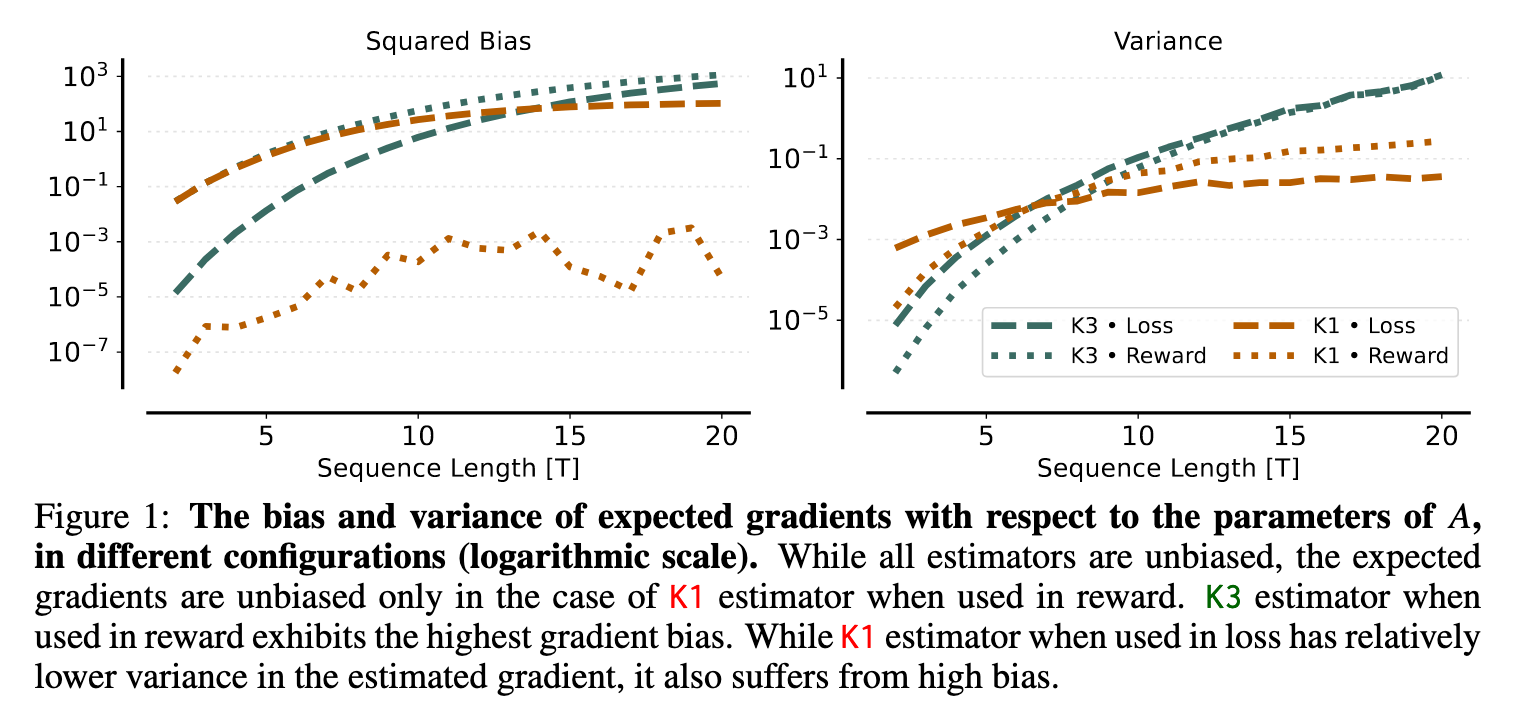
Image from Shah et al., 2026 showing the variance reduction benefits of K1 in Rewards vs K3 in Loss.
Toy Environment ToyEnv
To ensure the script runs quickly on modest hardware, it solves one specific Piecewise Function Continuity problem.
- Goal: Find $a+b$ such that the function is continuous.
- Ground Truth: $a=-3, b=3 \implies a+b=0$.
- Reward: Partial credits are given for identifying continuity points ($x=2, x=-2$), setting up correct equations, and solving for variables. This is needed for small scale testing.
Note: This acts as a unit test for the algorithm. If the loss drops and reward goes to 1.0, the GRPO implementation is correct.
Limitations & Roadmap
This implementation prioritizes readability and educational value over production efficiency.
- Generation Speed: Uses standard HF
generate(). For high-throughput training, integratevLLMorSGLang. - Memory Efficiency: Uses standard padding. Production runs should use Sequence Packing (Flash Attention varlen) to avoid computing on pad tokens.
- Scalability: Perfect for learning and debugging on 1-8 GPUs. For training 70B+ models on clusters, consider using this script as a logic reference to patch libraries like OpenRLHF or Verl.
📚 References
Similar repos


Languages
Python
100.0%
A transparent, single-file implementation for understanding GRPO (K1 in Rewards), free from the abstractions of large libraries.
Python
91
6 commits
updated Feb 14, 2026
README
Transparent GRPO
English Version | Chinese Version
A minimal, single-file implementation of Group Relative Policy Optimization (GRPO).
Current RLHF/RL libraries (TRL, OpenRLHF) are powerful but often hide the mathematical logic behind layers of abstraction, callbacks, and complex class inheritances. Transparent GRPO is designed for researchers and engineers who want to:
- Read everything in one flow: No jumping between 10 files to find where the
lossis actually calculated. - Debug mathematically: See exactly how the Advantages are normalized and how the KL penalty is applied.
- Prototype quickly: Modify the core algorithm (e.g., change the KL estimator) by changing just one line of code.
✨ Key Features
- < 400 Lines of Code: The entire logic (Environment, Dataset, Model, Training Loop) fits in a single file.
- Linear Logic Flow: The code reads from top to bottom.
Generate->Reward->Advantage->Update. - State-of-the-Art Implementation: Implements the K1 Estimator in Rewards (unbiased KL approximation) rather than the older K3-in-Loss approach. This aligns with recent findings (Shah et al., 2026) for lower variance and better stability in reasoning tasks.
- Zero Bloat: Depends only on
torch,transformers,accelerate, andnumpy. No heavy RL frameworks required. - Just Run It: The single file code includes a toy math environment (Piecewise Function Continuity), which ensures it trains quickly on a single GPU, allowing you to verify correctness in minutes.
Understand this repo
transparent_grpo.py: The main script containing the entire GRPO implementation. Read from top to bottom to understand the flow.logs/train_grpo_20260209_172905.log: my example training log showing the reward and loss progression.
No other things to worry about. No hidden files, no complex directory structure. Just one file to read and understand.
🚀 Quick Start
0. Hardware Requirements
Estimated VRAM usage for Qwen2.5-3B-Instruct (used in the code) with group_size=4, max_new_tokens=512, and DeepSpeed ZeRO-2:
| GPU Setup | Estimated VRAM per GPU | Status | Note |
|---|---|---|---|
| 1x A100 (80GB) | ~35 GB | ✅ Easy | Perfect for single-GPU debugging. |
| 2x RTX 3090/4090 (24GB) | ~22 GB | ⚠️ Tight | Requires ZeRO-2 to shard optimizer states. |
| 4x L4 (24GB) | ~16 GB | ✅ Safe | Optimizer states are well-distributed. |
| 1x RTX 4090 (24GB) | OOM | ❌ Fail | OOM unless you enable ZeRO-Offload (CPU). |
1. Installation
You only need standard PyTorch ecosystem libraries:
pip install torch transformers accelerate deepspeed numpy
2. Run Training
The script is configured to work out-of-the-box with Hugging Face Accelerate and DeepSpeed (ZeRO-2 recommended for the 3B model).
# Configure accelerate first if you haven't (select DeepSpeed/Zero2)
accelerate config

# Run the training script
nohup stdbuf -oL accelerate launch --use_deepspeed --zero_stage 2 transparent_grpo.py > logs/train_grpo_$(date +%Y%m%d_%H%M%S).log 2>&1 &
🧠 Understanding the Implementation
This repository strips away the magic. Here is where the core GRPO mechanics live in transparent_grpo.py:
| Component | Description |
|---|---|
| Generation | Standard model.generate() is called inside the loop. No hidden Actor classes. |
| Group Sampling | Config.group_size = 4. We generate $G$ outputs for every prompt. |
| Reward Function | A custom regular-expression based reward system for a specific algebra problem (ToyEnv in code). |
| Ref Model LogProbs | Calculate $\pi_{\text{ref}}(y | x)$ |
| KL Divergence | Calculate the per-token KL: $\log \pi_\theta(y | x) - \log \pi_{\text{ref}}(y | x)$ |
| The Advantage | Calculated simply as (rewards - mean) / std. |
| Loss Function | Standard PPO clipping: $\min(r_t A_t, \text{clip}(r_t, 1-\epsilon, 1+\epsilon) A_t)$. |
Compared with DeepSeekMath (Original GRPO paper), this implementation:
- Uses a toy environment instead of a large math dataset to ensure simplicity.
- Implements the K1 estimator (KL in rewards) instead of K3 (KL in loss) for better stability & performance (see Shah et al., 2026)
- Retains the signature Group Relative Advantage normalization and PPO-style Clipping, ensuring the algorithm behaves exactly as GRPO should.
The "K1 in Reward" Logic
Unlike older PPO implementations that put KL divergence in the loss function, this implementation follows Shah et al., 2026 that subtracts the KL penalty directly from the rewards:
# Code snippet from transparent_grpo.py
per_token_kl = token_log_probs.detach() - ref_token_log_probs.detach()
kl_penalty = (per_token_kl * loss_mask).sum(dim=1)
rewards_with_kl = rewards - Config.beta * kl_penalty
This approach (Unbiased K1 Estimator) provides better var & bias balanced gradients (more stable training) and better performance.
Image from Shah et al., 2026 showing the variance reduction benefits of K1 in Rewards vs K3 in Loss.
Toy Environment ToyEnv
To ensure the script runs quickly on modest hardware, it solves one specific Piecewise Function Continuity problem.
- Goal: Find $a+b$ such that the function is continuous.
- Ground Truth: $a=-3, b=3 \implies a+b=0$.
- Reward: Partial credits are given for identifying continuity points ($x=2, x=-2$), setting up correct equations, and solving for variables. This is needed for small scale testing.
Note: This acts as a unit test for the algorithm. If the loss drops and reward goes to 1.0, the GRPO implementation is correct.
Limitations & Roadmap
This implementation prioritizes readability and educational value over production efficiency.
- Generation Speed: Uses standard HF
generate(). For high-throughput training, integratevLLMorSGLang. - Memory Efficiency: Uses standard padding. Production runs should use Sequence Packing (Flash Attention varlen) to avoid computing on pad tokens.
- Scalability: Perfect for learning and debugging on 1-8 GPUs. For training 70B+ models on clusters, consider using this script as a logic reference to patch libraries like OpenRLHF or Verl.
📚 References
Similar repos
Languages
Python
100.0%