
An analytical database built for agents to use directly: columnar storage, a vectorized query engine, and MCP as a first-class interface
Rust
3
14 commits
updated Sep 24, 2026
See what people are saying
README
AgeDB



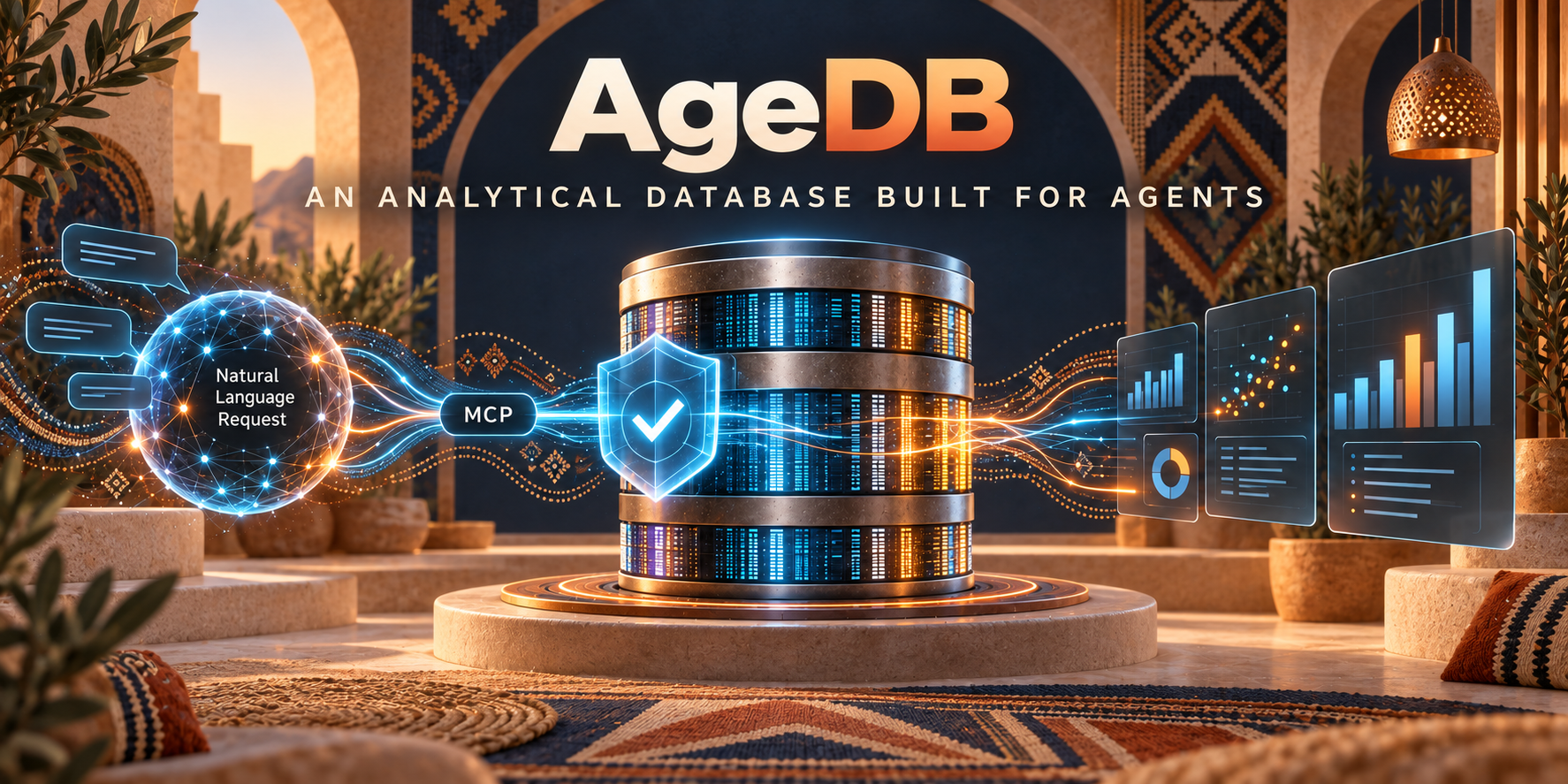
A database your AI agent can talk to, that tells you how it read the question and says so when it can't answer.
AI agents collect things as they work: leads, prices, support tickets, research notes. AgeDB gives them somewhere to keep those records and lets them ask questions in plain English, such as "which companies look most likely to convert?". It runs on your machine as one small program. There is no SQL to write, and no extra AI call is made to understand the question.
Agent:  "Create a table for the leads I'm collecting."
Agent:  "Store these 4,000 leads."
Agent:  "Which companies look most likely to convert?"
AgeDB:   acme 0.99, company 210 0.79, company 139 0.74, ...
         reading leads (grouped by company; avg(score); top 10)
Agent:  "Which of these leads became customers?"
AgeDB:   unsupported: that request spans 2 tables (customers and leads), which needs a
         join; v0.1 queries one table at a time
The last answer is the point. A system that answered from one table would return a confident, incomplete number. AgeDB refuses, says why, and the agent can ask a narrower question.
Status: v0.1, single node, 308 tests, written in Rust. AgeDB is a working name and may change.
What it does, in plain words
- Keeps what your agent collects. Tables whose columns say what they mean: this is money in USD, this is an identifier, this is when the lead arrived, this is what "score" means.
- Answers questions about it. In plain English or as an exact structured plan: counts, totals, averages, rankings, filters and time windows such as "in the last 90 days".
- Shows its working. Every answer comes back with the exact plan that ran, so the agent, or you, can check the question was read the way it was meant.
- Refuses rather than guesses. It refuses any question it cannot answer in full, and gives the reason. Nonsense such as adding up customer IDs is refused as meaningless.
- Stays in bounds. Each API key has its own permissions, its own row, byte and time budgets, and a tenant it cannot see past.
There is no language model inside. Plain-language questions are parsed in-process by deterministic rules. That takes about 17 microseconds per question on a laptop (Apple M1, release build). The same question over the same schema always gives the same plan, and nothing is sent anywhere. The agent calling AgeDB is usually already a language model, so AgeDB does not add a second one to every question.
Who it is for today
There are two starting points. Neither is proven yet.
- A local workspace for research and operations agents (primary). This suits agents that gather structured records while they work, such as lead lists, price checks, ticket triage or experiment logs. They need to keep those records outside their context window and run repeatable totals and rankings over them. It runs as one binary, over MCP on stdio.
- A governed data interface for B2B agent products (exploratory). This suits products whose agents answer questions over each customer's data, where tenant isolation, per-key permissions and query budgets are product requirements.
If an embedded database your agent already uses serves you well, that is a legitimate answer. See How it compares.
What AgeDB guarantees, and what it does not
| Guaranteed | How |
|---|---|
| A plan can only use tables and columns that exist | Every plan is validated against the live schema before anything runs. An unknown name comes back as not_found, with the real names listed |
| Meaningless aggregations are refused | Columns carry a semantic_type, so sum(customer_id) is rejected: "customer_id is a id column, not a measure" |
| You can see how a question was read | Every response carries the plan that ran, a one-line interpretation, and what was scanned and pruned |
| A question that needs two tables is refused, never half-answered | The translator refuses multi-table and "rows missing from another table" questions as unsupported. No model is in the path to substitute one table for two |
| One tenant cannot read another's rows | The tenant comes from the API key and selects the storage prefix. There is no WHERE tenant_id = ? for anyone to forget |
| A key does only what it is scoped to | database:read, schema:write, data:insert and so on live on the key, never in the request |
| Result size and data read are bounded | Row and byte budgets are enforced inside execution. A truncated result says so |
What AgeDB does not guarantee:
-
Business correctness. A valid plan can still:
- sum gross revenue when you meant net;
- use order date when you meant payment date;
- count duplicated records twice;
- cover the wrong reporting period.
Column descriptions and default aggregations reduce this, and the echoed plan is how you catch it. AgeDB knows only the business definitions your schema states.
-
Column-level authorization.
sensitivehides a column fromselect *, from schema context and from error suggestions. Any key that may query the table can still select the column by name. Keep data a caller must never see in a separate table, database or tenant. -
A hard time limit. The time budget is checked between batches and between execution stages. It is cooperative: a single sort or merge step already running finishes first, so a query can overrun its budget by the length of that step.
-
High availability. AgeDB v0.1 runs on a single node.
How it compares
A well-built existing stack can do much of this. PostgreSQL or DuckDB, with schema discovery, a read-only role and validated SQL, also rejects unknown columns and bounds queries. There is also direct competition:
- Cube offers a semantic layer consumed by analytics applications and AI agents.
- MotherDuck provides MCP access to DuckDB with read-only and read-write query tools.
MCP plus analytics plus semantics is not, on its own, a reason to choose AgeDB.
The bet is narrower:
- One enforcement point. Meaning, refusals, permissions, budgets and tenancy are enforced in one place, below the agent, and in the same way for every model and every front end.
- No model in the query path. Answers are fast and reproducible, and they do not change when someone upgrades a model.
- Nothing executable from the caller. An agent describes what it wants as data. The worst it can send is a plan that is refused.
Models will keep getting better at writing SQL, so "models struggle with SQL" is not a durable reason to exist. Enforced permissions, consistent definitions and predictable behaviour across models might be. Whether they are worth adopting a new dependency for is what the evidence plan tests.
Why its own storage engine?
Most of what is distinctive about AgeDB sits above storage.
The engine exists for three reasons:
- budgets are enforced inside execution: bytes are charged as segments open, and the deadline is checked between stages;
- tenant identity selects the storage prefix;
- segment statistics make pruning visible in every response.
Those are easier to guarantee when the executor is ours. That is a design reason, not evidence that users need it. Adopting AgeDB today also means adopting its recovery, upgrade and maintenance story, which is younger than any established database's.
So the next experiment is to put the same validated interface over an established engine (DuckDB) as a second backend, and see which one users choose. The custom engine stays only if users show they need what it does differently.
Quickstart
Requires Rust 1.90 or newer (rustup). There are no other dependencies, no server to install, and no Docker.
git clone https://github.com/sivsivsree/agedb
cd agedb
cargo build --release
See the whole thing work in about 40 seconds:
examples/demo.sh
The demo:
- starts a server;
- creates a table and loads 4,000 leads;
- asks six plain-language questions;
- shows what errors and refusals look like;
- replays the same tools over MCP on Streamable HTTP and on stdio.
As an MCP server on stdio
An agent launches the process and talks JSON-RPC over the pipe:
{
  "mcpServers": {
    "agedb": {
      "command": "/absolute/path/to/agedb",
      "args": ["--data-dir", "/absolute/path/to/data",
               "serve", "--transport", "stdio", "--tenant", "acme"]
    }
  }
}
As an MCP server over Streamable HTTP
./target/release/agedb --data-dir ./data \
  serve --transport http --port 8080 --api-key dev-key --tenant acme
{
  "mcpServers": {
    "agedb": {
      "type": "http",
      "url": "http://localhost:8080/mcp",
      "headers": { "Authorization": "Bearer dev-key" }
    }
  }
}
/mcp implements the MCP Streamable HTTP transport (revision 2025-06-18):
| Method | What it does |
|---|---|
POST | Answers a request as a server-sent event stream, or as plain JSON if the client does not accept streams |
GET | Opens an event stream for server-to-client messages |
DELETE | Ends a session |
Two more behaviours matter:
initializeissues anMcp-Session-Id.- Browser origins other than this machine are refused unless allowed with
--allow-origin. Allowed origins get CORS, so a browser client works.
Every request still needs its API key.
Over REST
The same server also speaks REST:
H=(-H 'authorization: Bearer dev-key' -H 'content-type: application/json')

curl -sS -X POST localhost:8080/v1/databases "${H[@]}" -d '{"database":"sales"}'

curl -sS -X POST localhost:8080/v1/databases/sales/tables "${H[@]}" -d '{
  "table":"orders","primary_key":["id"],
  "columns":[
    {"name":"id","type":"int64","nullable":false,"semantic_type":"id"},
    {"name":"customer_id","type":"int64","semantic_type":"id"},
    {"name":"country","type":"utf8","semantic_type":"country"},
    {"name":"amount","type":"float64","semantic_type":"currency","default_aggregation":"sum"}]}'

curl -sS -X POST localhost:8080/v1/databases/sales/tables/orders/rows "${H[@]}" -d '{
  "rows":[{"id":1,"customer_id":1,"country":"uae","amount":12000},
          {"id":2,"customer_id":2,"country":"usa","amount":8400},
          {"id":3,"customer_id":1,"country":"uae","amount":19300}]}'

curl -sS -X POST localhost:8080/v1/databases/sales/query "${H[@]}" \
  -d '{"request":"total amount by country in orders"}'
# 200 {"rows":[{"country":"uae","sum_amount":31300.0},{"country":"usa","sum_amount":8400.0}],
#      "interpretation":"reading orders (grouped by country; sum(amount))", "plan":{...}, ...}
The operator guide, including config files, scopes, limits and troubleshooting, is in
docs/usage.md.
The agent interface
There are fourteen tools, no query language, and no escape hatch. There is deliberately no
execute_arbitrary_query:
database_create   table_create     data_insert   data_query
database_list     table_list       data_upsert
database_delete   table_describe   data_get
                  table_drop       data_delete
                  schema_get
                  schema_update
data_query accepts plain language or a structured plan:
{ "request": "total revenue by country in the last 30 days" }
{
  "plan": {
    "operation": "aggregate",
    "table": "orders",
    "filters": [{ "column": "created_at", "op": "gte", "value": "2026-08-01" }],
    "group_by": ["country"],
    "metrics": [{ "function": "sum", "column": "amount", "alias": "revenue" }],
    "order_by": [{ "column": "revenue", "direction": "desc" }],
    "limit": 20
  }
}
Either way, the response carries the plan that ran, so an agent can check the interpretation and reuse or adjust it:
{
  "rows": [{ "country": "uae", "revenue": 3458839.12 }],
  "interpretation": "reading orders (grouped by country; sum(amount))",
  "plan": { "operation": "aggregate", "...": "..." },
  "stats": { "elapsed_ms": 1, "rows_scanned": 4000, "segments_pruned": 24 },
  "warnings": []
}
And when it cannot answer, it says so with a code the agent can branch on:
{ "error": { "code": "unsupported",
             "message": "unsupported in v0.1: that request spans 2 tables (customers and orders), which needs a join; v0.1 queries one table at a time" } }
{ "error": { "code": "bad_request",
             "message": "bad request: sum(customer_id) is not meaningful: customer_id is a id column, not a measure" } }
The plain-language layer handles:
- counts, sums, averages, min/max;
- group-bys, top-N and comparisons;
- null checks;
- relative and absolute time windows.
Anything else is refused with the available columns listed. That refusal is the cue for the calling agent to send a structured plan instead.
Architecture
Every front end converges on one validated Query IR. Natural language, structured plans and any future front end lower into the same representation. It is validated once, in one place, before anything executes.
                     Agents / LLMs
                           │
     MCP (stdio or Streamable HTTP)   REST
                           │        │
                  ┌────────▼────────▼────────┐
                  │  adb-mcp  /  adb-api     │  auth, scopes, sessions, per-key limits
                  └────────────┬─────────────┘
                               │
                  ┌────────────▼─────────────┐
                  │        adb-engine        │  catalog, tables, request context
                  └────────────┬─────────────┘
                               │
        ┌──────────────────────┼──────────────────────┐
        │                      │                      │
┌───────▼────────┐   ┌─────────▼────────┐   ┌──────────▼─────────┐
│   adb-query    │   │   adb-planner    │   │      adb-exec      │
│ NL to plan JSON│──▶│ plan to IR to    │──▶│ vectorized Arrow   │
│ (local rules)  │   │ validated plan   │   │ operators, budgets │
└────────────────┘   └──────────────────┘   └──────────┬─────────┘
                                                       │
                                            ┌──────────▼─────────┐
                                            │    adb-storage     │
                                            │ WAL, memtable,     │
                                            │ segments, manifest │
                                            └──────────┬─────────┘
                                                       │
                                              filesystem (S3-shaped keys)
| Crate | Responsibility |
|---|---|
adb-core | Identifiers, type system, semantic schema, versioned catalog, request context |
adb-storage | WAL, memtable, Parquet segments, manifests, key index, compaction |
adb-planner | Query IR, validator, optimizer, physical plan |
adb-exec | Vectorized operators over Arrow, budgets and statistics |
adb-query | Natural language to structured plan (deterministic rules), schema retrieval |
adb-engine | The facade: catalog, tables and the query path |
adb-mcp | MCP tools, JSON-RPC, API keys and scopes, stdio transport |
adb-api | REST, plus MCP over Streamable HTTP |
adb-server | The agedb binary |
Underneath:
- writes go to a write-ahead log, then a memtable;
- the memtable flushes into immutable Parquet segments that carry min/max statistics and bloom filters;
- updates suppress old rows by bitmap rather than rewriting files;
- queries prune segments from statistics before reading anything.
ARCHITECTURE.md has the design rationale, on-disk formats, the
concurrency model, and the list of what is deliberately missing.
Benchmarks, honestly
The numbers in ARCHITECTURE.md track the engine
against itself from change to change. Ingest is measured with WAL fsync off, and there is no
competitor run alongside it. They are useful for catching regressions. They prove nothing
about adoption.
The benchmark that matters is not built yet. It asks whether an agent using AgeDB completes real analytical tasks more accurately, cheaply and safely than the same agent using a well-configured alternative. The plan is to use the same model, the same data and the same task set on both sides, with equivalent metadata and reasonable configuration for the alternative, and to measure:
- correct answers, and confidently wrong answers;
- appropriate refusals on unsupported questions;
- tool calls, retries, tokens and total latency;
- permission enforcement;
- time to integrate.
The harness and the results will be published whichever way they come out.
Evidence and next steps
AgeDB has solid engineering and no customer evidence yet. No external team uses it every week. The next 30 days are about finding out whether one should, not about adding features.
- Fix silent partial answers. Done. The hosted-model translator was removed. It could answer a two-table question from one table. Multi-table questions are now refused.
- Document the safety boundaries precisely. Done: see what AgeDB does not guarantee.
- Recruit five external teams that already have an agent-data problem.
- Support one narrow workflow end to end, starting with the local workspace for research and operations agents.
- Run the controlled comparison described under Benchmarks, against an established database with an agent interface.
- Ask for a paid pilot once that workflow is useful.
The decision gate is:
- at least three teams keep using AgeDB without repeated prompting;
- there is a measurable advantage on their workloads;
- one team is willing to pay.
If the gate is not met, the direction changes. The most likely change is the validated interface over an established engine.
The questions the evidence has to answer:
- Which teams use it every week?
- What failed in their previous approach?
- What gets worse if they remove it?
- Why would they pay rather than build the interface themselves?
Deferred until a user is blocked on it. Each of these is a substantial programme of work:
- joins and
HAVING; - exact decimals;
- vector and full-text search;
- a SQL front end;
- S3, R2 and GCS backends;
- a control plane and dashboard;
- replication. The
LogStoreseam is ready for a Raft log, but snapshots, membership changes, read consistency, recovery and failure testing are each their own design work.
Known limitations today:
- no joins;
- money is
float64withsemantic_type: currency, not an exact decimal; - single node;
- the key index is rebuilt at startup;
- compaction runs inline after a flush;
- writes to one table are serialized.
Testing criteria
Every change must keep these green. CI runs all of them on each pull request:
cargo fmt --all --check                                   # formatting
cargo clippy --workspace --all-targets -- -D warnings     # no warnings, at all
cargo test --workspace                                    # 308 tests, about 15 seconds
examples/demo.sh                                          # end-to-end smoke test
The suite is built around four kinds of test, and a change is expected to extend whichever applies:
| Kind | Where | What it protects |
|---|---|---|
| Unit tests | next to the code, in #[cfg(test)] | Behaviour of one function, including its error cases |
| Correctness oracle | crates/adb-exec/tests/query.rs | The vectorized engine agreeing with a naive row-at-a-time implementation over the same data |
| Durability | crates/adb-engine/tests/engine.rs | Acknowledged writes surviving a hard kill, verified by aborting a child process mid-write |
| Protocol | crates/adb-mcp/tests/, crates/adb-api/tests/ | Real JSON-RPC frames, real HTTP requests and SSE streams, not internal function calls |
What a contribution is expected to bring:
- New behaviour: a test that fails without the change.
- A bug fix: a regression test that reproduces the bug first.
- Executor or planner changes: an oracle case, because subtle wrongness there is invisible otherwise.
- Storage format changes: a durability test, plus a note in
ARCHITECTURE.mdif the on-disk format moved. - Performance work: before and after numbers from
cargo run --release -p bench -- --rows 2000000.
Tests must be deterministic. Where data is generated, seed it (see Rng in
crates/adb-exec/tests/query.rs), and never depend on wall-clock time. The natural language
layer takes an injected clock for exactly this reason.
Contributing
Start with CONTRIBUTING.md. The short version: fork, branch, make the
four commands above pass, and open a pull request that explains why.
The most useful contributions right now are evidence, not features:
- Tell us about your agent-data problem. Open an issue describing the workflow, what you use today and where it breaks. That is worth more than any pull request at this stage.
- Add tasks to the evaluation: realistic questions with known answers, including ones that should be refused.
- Add cases to the natural language corpus in
crates/adb-query/tests/nl.rs. Every question an agent asks that gets refused, or read wrongly, is a small, self-contained improvement. - Improve an error message. Every error an agent reads is part of the interface.
One repository rule worth stating up front: no em dashes anywhere, in code, comments, documentation or commit messages. CI enforces it.
License
Apache License 2.0. See LICENSE.
Contributors

14 commits
Similar repos


Languages
Rust
100.0%
An analytical database built for agents to use directly: columnar storage, a vectorized query engine, and MCP as a first-class interface
Rust
3
14 commits
updated Sep 24, 2026
See what people are saying
README
AgeDB
A database your AI agent can talk to, that tells you how it read the question and says so when it can't answer.
AI agents collect things as they work: leads, prices, support tickets, research notes. AgeDB gives them somewhere to keep those records and lets them ask questions in plain English, such as "which companies look most likely to convert?". It runs on your machine as one small program. There is no SQL to write, and no extra AI call is made to understand the question.
Agent:  "Create a table for the leads I'm collecting."
Agent:  "Store these 4,000 leads."
Agent:  "Which companies look most likely to convert?"
AgeDB:   acme 0.99, company 210 0.79, company 139 0.74, ...
         reading leads (grouped by company; avg(score); top 10)
Agent:  "Which of these leads became customers?"
AgeDB:   unsupported: that request spans 2 tables (customers and leads), which needs a
         join; v0.1 queries one table at a time
The last answer is the point. A system that answered from one table would return a confident, incomplete number. AgeDB refuses, says why, and the agent can ask a narrower question.
Status: v0.1, single node, 308 tests, written in Rust. AgeDB is a working name and may change.
What it does, in plain words
- Keeps what your agent collects. Tables whose columns say what they mean: this is money in USD, this is an identifier, this is when the lead arrived, this is what "score" means.
- Answers questions about it. In plain English or as an exact structured plan: counts, totals, averages, rankings, filters and time windows such as "in the last 90 days".
- Shows its working. Every answer comes back with the exact plan that ran, so the agent, or you, can check the question was read the way it was meant.
- Refuses rather than guesses. It refuses any question it cannot answer in full, and gives the reason. Nonsense such as adding up customer IDs is refused as meaningless.
- Stays in bounds. Each API key has its own permissions, its own row, byte and time budgets, and a tenant it cannot see past.
There is no language model inside. Plain-language questions are parsed in-process by deterministic rules. That takes about 17 microseconds per question on a laptop (Apple M1, release build). The same question over the same schema always gives the same plan, and nothing is sent anywhere. The agent calling AgeDB is usually already a language model, so AgeDB does not add a second one to every question.
Who it is for today
There are two starting points. Neither is proven yet.
- A local workspace for research and operations agents (primary). This suits agents that gather structured records while they work, such as lead lists, price checks, ticket triage or experiment logs. They need to keep those records outside their context window and run repeatable totals and rankings over them. It runs as one binary, over MCP on stdio.
- A governed data interface for B2B agent products (exploratory). This suits products whose agents answer questions over each customer's data, where tenant isolation, per-key permissions and query budgets are product requirements.
If an embedded database your agent already uses serves you well, that is a legitimate answer. See How it compares.
What AgeDB guarantees, and what it does not
| Guaranteed | How |
|---|---|
| A plan can only use tables and columns that exist | Every plan is validated against the live schema before anything runs. An unknown name comes back as not_found, with the real names listed |
| Meaningless aggregations are refused | Columns carry a semantic_type, so sum(customer_id) is rejected: "customer_id is a id column, not a measure" |
| You can see how a question was read | Every response carries the plan that ran, a one-line interpretation, and what was scanned and pruned |
| A question that needs two tables is refused, never half-answered | The translator refuses multi-table and "rows missing from another table" questions as unsupported. No model is in the path to substitute one table for two |
| One tenant cannot read another's rows | The tenant comes from the API key and selects the storage prefix. There is no WHERE tenant_id = ? for anyone to forget |
| A key does only what it is scoped to | database:read, schema:write, data:insert and so on live on the key, never in the request |
| Result size and data read are bounded | Row and byte budgets are enforced inside execution. A truncated result says so |
What AgeDB does not guarantee:
-
Business correctness. A valid plan can still:
- sum gross revenue when you meant net;
- use order date when you meant payment date;
- count duplicated records twice;
- cover the wrong reporting period.
Column descriptions and default aggregations reduce this, and the echoed plan is how you catch it. AgeDB knows only the business definitions your schema states.
-
Column-level authorization.
sensitivehides a column fromselect *, from schema context and from error suggestions. Any key that may query the table can still select the column by name. Keep data a caller must never see in a separate table, database or tenant. -
A hard time limit. The time budget is checked between batches and between execution stages. It is cooperative: a single sort or merge step already running finishes first, so a query can overrun its budget by the length of that step.
-
High availability. AgeDB v0.1 runs on a single node.
How it compares
A well-built existing stack can do much of this. PostgreSQL or DuckDB, with schema discovery, a read-only role and validated SQL, also rejects unknown columns and bounds queries. There is also direct competition:
- Cube offers a semantic layer consumed by analytics applications and AI agents.
- MotherDuck provides MCP access to DuckDB with read-only and read-write query tools.
MCP plus analytics plus semantics is not, on its own, a reason to choose AgeDB.
The bet is narrower:
- One enforcement point. Meaning, refusals, permissions, budgets and tenancy are enforced in one place, below the agent, and in the same way for every model and every front end.
- No model in the query path. Answers are fast and reproducible, and they do not change when someone upgrades a model.
- Nothing executable from the caller. An agent describes what it wants as data. The worst it can send is a plan that is refused.
Models will keep getting better at writing SQL, so "models struggle with SQL" is not a durable reason to exist. Enforced permissions, consistent definitions and predictable behaviour across models might be. Whether they are worth adopting a new dependency for is what the evidence plan tests.
Why its own storage engine?
Most of what is distinctive about AgeDB sits above storage.
The engine exists for three reasons:
- budgets are enforced inside execution: bytes are charged as segments open, and the deadline is checked between stages;
- tenant identity selects the storage prefix;
- segment statistics make pruning visible in every response.
Those are easier to guarantee when the executor is ours. That is a design reason, not evidence that users need it. Adopting AgeDB today also means adopting its recovery, upgrade and maintenance story, which is younger than any established database's.
So the next experiment is to put the same validated interface over an established engine (DuckDB) as a second backend, and see which one users choose. The custom engine stays only if users show they need what it does differently.
Quickstart
Requires Rust 1.90 or newer (rustup). There are no other dependencies, no server to install, and no Docker.
git clone https://github.com/sivsivsree/agedb
cd agedb
cargo build --release
See the whole thing work in about 40 seconds:
examples/demo.sh
The demo:
- starts a server;
- creates a table and loads 4,000 leads;
- asks six plain-language questions;
- shows what errors and refusals look like;
- replays the same tools over MCP on Streamable HTTP and on stdio.
As an MCP server on stdio
An agent launches the process and talks JSON-RPC over the pipe:
{
  "mcpServers": {
    "agedb": {
      "command": "/absolute/path/to/agedb",
      "args": ["--data-dir", "/absolute/path/to/data",
               "serve", "--transport", "stdio", "--tenant", "acme"]
    }
  }
}
As an MCP server over Streamable HTTP
./target/release/agedb --data-dir ./data \
  serve --transport http --port 8080 --api-key dev-key --tenant acme
{
  "mcpServers": {
    "agedb": {
      "type": "http",
      "url": "http://localhost:8080/mcp",
      "headers": { "Authorization": "Bearer dev-key" }
    }
  }
}
/mcp implements the MCP Streamable HTTP transport (revision 2025-06-18):
| Method | What it does |
|---|---|
POST | Answers a request as a server-sent event stream, or as plain JSON if the client does not accept streams |
GET | Opens an event stream for server-to-client messages |
DELETE | Ends a session |
Two more behaviours matter:
initializeissues anMcp-Session-Id.- Browser origins other than this machine are refused unless allowed with
--allow-origin. Allowed origins get CORS, so a browser client works.
Every request still needs its API key.
Over REST
The same server also speaks REST:
H=(-H 'authorization: Bearer dev-key' -H 'content-type: application/json')

curl -sS -X POST localhost:8080/v1/databases "${H[@]}" -d '{"database":"sales"}'

curl -sS -X POST localhost:8080/v1/databases/sales/tables "${H[@]}" -d '{
  "table":"orders","primary_key":["id"],
  "columns":[
    {"name":"id","type":"int64","nullable":false,"semantic_type":"id"},
    {"name":"customer_id","type":"int64","semantic_type":"id"},
    {"name":"country","type":"utf8","semantic_type":"country"},
    {"name":"amount","type":"float64","semantic_type":"currency","default_aggregation":"sum"}]}'

curl -sS -X POST localhost:8080/v1/databases/sales/tables/orders/rows "${H[@]}" -d '{
  "rows":[{"id":1,"customer_id":1,"country":"uae","amount":12000},
          {"id":2,"customer_id":2,"country":"usa","amount":8400},
          {"id":3,"customer_id":1,"country":"uae","amount":19300}]}'

curl -sS -X POST localhost:8080/v1/databases/sales/query "${H[@]}" \
  -d '{"request":"total amount by country in orders"}'
# 200 {"rows":[{"country":"uae","sum_amount":31300.0},{"country":"usa","sum_amount":8400.0}],
#      "interpretation":"reading orders (grouped by country; sum(amount))", "plan":{...}, ...}
The operator guide, including config files, scopes, limits and troubleshooting, is in
docs/usage.md.
The agent interface
There are fourteen tools, no query language, and no escape hatch. There is deliberately no
execute_arbitrary_query:
database_create   table_create     data_insert   data_query
database_list     table_list       data_upsert
database_delete   table_describe   data_get
                  table_drop       data_delete
                  schema_get
                  schema_update
data_query accepts plain language or a structured plan:
{ "request": "total revenue by country in the last 30 days" }
{
  "plan": {
    "operation": "aggregate",
    "table": "orders",
    "filters": [{ "column": "created_at", "op": "gte", "value": "2026-08-01" }],
    "group_by": ["country"],
    "metrics": [{ "function": "sum", "column": "amount", "alias": "revenue" }],
    "order_by": [{ "column": "revenue", "direction": "desc" }],
    "limit": 20
  }
}
Either way, the response carries the plan that ran, so an agent can check the interpretation and reuse or adjust it:
{
  "rows": [{ "country": "uae", "revenue": 3458839.12 }],
  "interpretation": "reading orders (grouped by country; sum(amount))",
  "plan": { "operation": "aggregate", "...": "..." },
  "stats": { "elapsed_ms": 1, "rows_scanned": 4000, "segments_pruned": 24 },
  "warnings": []
}
And when it cannot answer, it says so with a code the agent can branch on:
{ "error": { "code": "unsupported",
             "message": "unsupported in v0.1: that request spans 2 tables (customers and orders), which needs a join; v0.1 queries one table at a time" } }
{ "error": { "code": "bad_request",
             "message": "bad request: sum(customer_id) is not meaningful: customer_id is a id column, not a measure" } }
The plain-language layer handles:
- counts, sums, averages, min/max;
- group-bys, top-N and comparisons;
- null checks;
- relative and absolute time windows.
Anything else is refused with the available columns listed. That refusal is the cue for the calling agent to send a structured plan instead.
Architecture
Every front end converges on one validated Query IR. Natural language, structured plans and any future front end lower into the same representation. It is validated once, in one place, before anything executes.
                     Agents / LLMs
                           │
     MCP (stdio or Streamable HTTP)   REST
                           │        │
                  ┌────────▼────────▼────────┐
                  │  adb-mcp  /  adb-api     │  auth, scopes, sessions, per-key limits
                  └────────────┬─────────────┘
                               │
                  ┌────────────▼─────────────┐
                  │        adb-engine        │  catalog, tables, request context
                  └────────────┬─────────────┘
                               │
        ┌──────────────────────┼──────────────────────┐
        │                      │                      │
┌───────▼────────┐   ┌─────────▼────────┐   ┌──────────▼─────────┐
│   adb-query    │   │   adb-planner    │   │      adb-exec      │
│ NL to plan JSON│──▶│ plan to IR to    │──▶│ vectorized Arrow   │
│ (local rules)  │   │ validated plan   │   │ operators, budgets │
└────────────────┘   └──────────────────┘   └──────────┬─────────┘
                                                       │
                                            ┌──────────▼─────────┐
                                            │    adb-storage     │
                                            │ WAL, memtable,     │
                                            │ segments, manifest │
                                            └──────────┬─────────┘
                                                       │
                                              filesystem (S3-shaped keys)
| Crate | Responsibility |
|---|---|
adb-core | Identifiers, type system, semantic schema, versioned catalog, request context |
adb-storage | WAL, memtable, Parquet segments, manifests, key index, compaction |
adb-planner | Query IR, validator, optimizer, physical plan |
adb-exec | Vectorized operators over Arrow, budgets and statistics |
adb-query | Natural language to structured plan (deterministic rules), schema retrieval |
adb-engine | The facade: catalog, tables and the query path |
adb-mcp | MCP tools, JSON-RPC, API keys and scopes, stdio transport |
adb-api | REST, plus MCP over Streamable HTTP |
adb-server | The agedb binary |
Underneath:
- writes go to a write-ahead log, then a memtable;
- the memtable flushes into immutable Parquet segments that carry min/max statistics and bloom filters;
- updates suppress old rows by bitmap rather than rewriting files;
- queries prune segments from statistics before reading anything.
ARCHITECTURE.md has the design rationale, on-disk formats, the
concurrency model, and the list of what is deliberately missing.
Benchmarks, honestly
The numbers in ARCHITECTURE.md track the engine
against itself from change to change. Ingest is measured with WAL fsync off, and there is no
competitor run alongside it. They are useful for catching regressions. They prove nothing
about adoption.
The benchmark that matters is not built yet. It asks whether an agent using AgeDB completes real analytical tasks more accurately, cheaply and safely than the same agent using a well-configured alternative. The plan is to use the same model, the same data and the same task set on both sides, with equivalent metadata and reasonable configuration for the alternative, and to measure:
- correct answers, and confidently wrong answers;
- appropriate refusals on unsupported questions;
- tool calls, retries, tokens and total latency;
- permission enforcement;
- time to integrate.
The harness and the results will be published whichever way they come out.
Evidence and next steps
AgeDB has solid engineering and no customer evidence yet. No external team uses it every week. The next 30 days are about finding out whether one should, not about adding features.
- Fix silent partial answers. Done. The hosted-model translator was removed. It could answer a two-table question from one table. Multi-table questions are now refused.
- Document the safety boundaries precisely. Done: see what AgeDB does not guarantee.
- Recruit five external teams that already have an agent-data problem.
- Support one narrow workflow end to end, starting with the local workspace for research and operations agents.
- Run the controlled comparison described under Benchmarks, against an established database with an agent interface.
- Ask for a paid pilot once that workflow is useful.
The decision gate is:
- at least three teams keep using AgeDB without repeated prompting;
- there is a measurable advantage on their workloads;
- one team is willing to pay.
If the gate is not met, the direction changes. The most likely change is the validated interface over an established engine.
The questions the evidence has to answer:
- Which teams use it every week?
- What failed in their previous approach?
- What gets worse if they remove it?
- Why would they pay rather than build the interface themselves?
Deferred until a user is blocked on it. Each of these is a substantial programme of work:
- joins and
HAVING; - exact decimals;
- vector and full-text search;
- a SQL front end;
- S3, R2 and GCS backends;
- a control plane and dashboard;
- replication. The
LogStoreseam is ready for a Raft log, but snapshots, membership changes, read consistency, recovery and failure testing are each their own design work.
Known limitations today:
- no joins;
- money is
float64withsemantic_type: currency, not an exact decimal; - single node;
- the key index is rebuilt at startup;
- compaction runs inline after a flush;
- writes to one table are serialized.
Testing criteria
Every change must keep these green. CI runs all of them on each pull request:
cargo fmt --all --check                                   # formatting
cargo clippy --workspace --all-targets -- -D warnings     # no warnings, at all
cargo test --workspace                                    # 308 tests, about 15 seconds
examples/demo.sh                                          # end-to-end smoke test
The suite is built around four kinds of test, and a change is expected to extend whichever applies:
| Kind | Where | What it protects |
|---|---|---|
| Unit tests | next to the code, in #[cfg(test)] | Behaviour of one function, including its error cases |
| Correctness oracle | crates/adb-exec/tests/query.rs | The vectorized engine agreeing with a naive row-at-a-time implementation over the same data |
| Durability | crates/adb-engine/tests/engine.rs | Acknowledged writes surviving a hard kill, verified by aborting a child process mid-write |
| Protocol | crates/adb-mcp/tests/, crates/adb-api/tests/ | Real JSON-RPC frames, real HTTP requests and SSE streams, not internal function calls |
What a contribution is expected to bring:
- New behaviour: a test that fails without the change.
- A bug fix: a regression test that reproduces the bug first.
- Executor or planner changes: an oracle case, because subtle wrongness there is invisible otherwise.
- Storage format changes: a durability test, plus a note in
ARCHITECTURE.mdif the on-disk format moved. - Performance work: before and after numbers from
cargo run --release -p bench -- --rows 2000000.
Tests must be deterministic. Where data is generated, seed it (see Rng in
crates/adb-exec/tests/query.rs), and never depend on wall-clock time. The natural language
layer takes an injected clock for exactly this reason.
Contributing
Start with CONTRIBUTING.md. The short version: fork, branch, make the
four commands above pass, and open a pull request that explains why.
The most useful contributions right now are evidence, not features:
- Tell us about your agent-data problem. Open an issue describing the workflow, what you use today and where it breaks. That is worth more than any pull request at this stage.
- Add tasks to the evaluation: realistic questions with known answers, including ones that should be refused.
- Add cases to the natural language corpus in
crates/adb-query/tests/nl.rs. Every question an agent asks that gets refused, or read wrongly, is a small, self-contained improvement. - Improve an error message. Every error an agent reads is part of the interface.
One repository rule worth stating up front: no em dashes anywhere, in code, comments, documentation or commit messages. CI enforces it.
License
Apache License 2.0. See LICENSE.
Similar repos
Contributors
14 commits
Languages
Rust
100.0%