
Mah Language
See the codeSee what people are saying
README
The Mah Language
ماه — "moon" in Persian.
Mah is a small programming language built from scratch, with a hand-written compiler, a portable bytecode VM, a static type checker, a standard library, reflection, an LSP server, a formatter, and editor integrations for Neovim and VS Code.
- Language: structs, enums, pattern matching, traits, closures that
capture by reference, lazy iterators,
async-styledetach/.await,defer, typedthrow/try/catcherrors, decorators, and runtime reflection. - Types: optional annotations, generics, and a static checker that infers most types (including which errors a function can throw). Types never change what a program does at runtime.
- Two runtimes for one bytecode format: the compiler emits portable
.mahcbytecode (fully specified indocs/MAHC_FORMAT.md), which runs on a Python VM or on a native Rust VM. The Rust VM can also produce a single self-contained executable. - Standard library:
std:math,json,csv,path,regex,random,collections,time,async,fs,process,reflect, andtest, mostly written in Mah itself. - Tooling:
mah run/build/check/test/format/init, project manifests, andmah lsp(diagnostics, typed hover, completion, go to definition, cross-file rename, formatting).
Website and docs: mahlang.dev.
Why it's built this way
Mah is a from-the-ground-up exploration of how a language and its tooling actually work, so a few choices run through the whole project on purpose:
- Hand-written, not generated. Lexer, recursive-descent parser,
resolver, type checker, codegen, and formatter are all written by hand.
There's no grammar DSL feeding a parser generator. An earlier version
of this project worked that way;
compiler-generator/anddocs/GRAMMAR_DSL.mdare kept only as history. It's slower to build, but every stage is something you can read end to end. - Few dependencies. The compiler, Python VM, formatter, and language
server use only the Python standard library: no parser library, no LSP
framework, no CLI library. Clone the repo and
python -m mahworks with nothing topip install. The Rust runtime uses the Rust standard library plus theregexcrate. The only Node code is the optional VS Code extension client and the website. - The bytecode is the contract. Both VMs run only
.mahc, and its format is written down in enough detail to implement a third VM in any language. The two existing ones run the same test suite. - Heap-allocated closures over a native call stack. Every function
call gets a heap-allocated
Framelinked to its lexically enclosing frame by a static chain pointer (the classic SCP/DCP activation-record technique). That's what lets closures capture outer variables by reference, like JavaScript: a closure that outlives its call still sees later changes to what it captured. There's no garbage collector yet, but the object model is shaped so one can be added without a redesign. - A forgiving parser, for tooling's sake. The parser recovers from a syntax error instead of stopping, so the language server can report every mistake in a file in one pass. (Running a file still refuses outright if there's any parse error.)
A quick tour
# closures capture by reference
let counter = fn() {
    let count = 0
    fn() {
        count = count + 1
        count
    }
}
let next = counter()
print(next())   # 1
print(next())   # 2

# structs, enums, pattern matching
struct Point { x, y }
enum Shape {
    Circle { r },
    Square { s },
    Empty
}

fn area(s) {
    match s {
        Shape.Circle { r } => { 3 * r * r }
        Shape.Square { s } => { s * s }
        Shape.Empty => { 0 }
    }
}
print(area(Shape.Circle { r: 5 }))      # 75

# if/match/blocks are expressions; a function body's last expression is
# its return value
fn abs(n) { if n < 0 { -n } else { n } }

# defer: block-scoped, LIFO, runs on every exit path
fn process(name) {
    print("opening " + name)
    defer print("closing " + name)
    if name == "bad" { return }
    print("using " + name)
}
process("bad")     # opening bad / closing bad
Traits, iterators, collections, keyword arguments, and async:
struct Rect { w, h }
trait Shape {
    fn area(self)
    fn describe(self) { "a shape with area " + self.area() }
}
impl Shape for Rect {
    fn area(self) { self.w * self.h }
}
print(Rect { w: 2, h: 3 }.describe())   # a shape with area 6

let odd_squares = (1..=5).map(fn(n) { n * n }).filter(fn(n) { n % 2 == 1 }).reduce()
print(odd_squares)                      # [1, 9, 25]
let ages = ["ada": 36, "alan": 41]
for let name, let i in ages {
    print(i, name, ages[name])          # 0 ada 36, then 1 alan 41
}

fn greet(name, greeting = "Hello") { greeting + ", " + name + "!" }
print(greet("Mah", greeting: "Salam"))  # Salam, Mah!

fn slow(n) { sleep_async(10); n * 2 }
let a = detach slow(21)
let b = detach { sleep_async(5); "from a block" }
print(a.await, b.await)                 # 42 from a block
Types and errors. Annotations are optional. The checker infers the rest,
including which errors each function can throw, and mah check reports
anything left unhandled:
fn first<T>(v: Vector<T>) -> T { v[0] }
print(first([7, 8]))                    # 7

enum ParseError { Empty, BadDigit }
impl Error for ParseError {}

fn first_digit(s: String) -> String {   # inferred: throws ParseError
    if s.len() == 0 { throw ParseError.Empty }
    let c = s.char_at(0)
    if c < "0" | c > "9" { throw ParseError.BadDigit }
    c
}

print(try { first_digit("") } catch {
    ParseError.Empty => { "was empty" }
    e: ParseError => { "other: " + e.message() }
})                                      # was empty
print(try first_digit("x") else "none") # none
Decorators and reflection. A decorator is a plain value attached to a
declaration, and std:reflect reads it back along with the declaration's
written types and doc comments. A decorator whose type implements a hook
trait can also wrap a function, transform an argument, or validate a
struct:
import reflect from "std:reflect"

struct Route { method: String, path: String }
fn get(path: String) -> Route { Route { method: "GET", path: path } }

## Fetch one user.
@get("/users/{id}")
fn get_user(id: Number, verbose: Bool = false) -> Number { id }

let sig = reflect.signature(get_user)
print(sig.doc)                          # Fetch one user.
match reflect.find(sig.decorators, Route) {
    some(route) => { print(route.method, route.path) }   # GET /users/{id}
    none => { print("not a route") }
}
See examples/*.mh for much more (modules, strings, files, processes,
regex, JSON/CSV, timers, hooks, tests), and the docs listed at the end.
Modules
# mathlib.mh
export fn square(n) { n ** 2 }
export let answer = 42
fn helper() { 1 }            # private: not visible to importers
import math from "mathlib"   # namespaced: math.square(4), math.answer
import "mathlib"             # or flat: square(4) directly in scope
import json from "std:json"  # standard library modules use the std: prefix
Only exported names are reachable. Each file is included at most once, so
diamond imports and cycles are safe, and errors inside an imported file are
reported with their real file:line:column.
Getting started
python -m mah run ./examples/prime_numbers.mh        # compile and run a file, from a repo checkout
python -m mah build ./examples/structs.mh            # compile to portable bytecode: structs.mahc
python -m mah build ./examples/structs.mh --target release -o out.mahc   # no debug info
python -m mah runc ./examples/structs.mahc           # run compiled bytecode
python -m mah dis ./examples/structs.mahc            # show it as readable instructions
python -m mah format ./examples                      # rewrite .mh files in the standard layout
python -m mah check ./examples/structs.mh            # run the static type checker
mah format only ever changes whitespace, and checks that before writing
(--check lists files that would change instead; see docs/FORMAT.md).
There's also a native runtime written in Rust (standard library only, plus
the regex crate for std:regex), with the same behavior as the Python VM:
make vm                                              # build it (needs cargo)
python -m mah run --vm rust ./examples/structs.mh    # run on it (also: runc --vm rust)
python -m mah build --self-contained ./examples/structs.mh -o structs
./structs                                            # one file, runs without mah installed
A self-contained build is a small shell script with the runtime and the
bytecode appended; it runs on machines with the same OS and CPU. See
docs/RUST_VM.md.
mah <file> (no subcommand) is shorthand for mah run <file> (or mah runc for a .mahc file). mah build output starts with a
#!/usr/bin/env -S mah runc line and is marked executable, so with mah on
your PATH you can run it directly: ./structs.mahc. The .mahc format is specified in
docs/MAHC_FORMAT.md, in enough detail to write a VM for it in any
language.
Projects
mah init my-app        # or `mah init` to turn the current directory into a project
cd my-app
mah run                # runs the entry point from mah-project.toml (src/main.mh)
mah build              # writes every [[target]], e.g. build/my-app.mahc
mah build --target release
mah check              # runs the static type checker, at the project's [types] check level
mah test               # runs every *.test.mh file (std:test; see docs/MAH_TEST.md)
mah init creates mah-project.toml (package name, version, entry point,
and build targets, each with a debug or release profile and optionally
self-contained = true for a standalone executable; [run] vm = "rust"
makes mah run use the Rust runtime; [types] check sets the static
type-checking level -- "loose" (default, warnings only), "strict"
(compile errors), or "explicit" ("strict" plus required annotations
where types can't be inferred) -- see mah check above), src/main.mh,
a .gitignore, and docs for coding agents: AGENTS.md (plus a CLAUDE.md
that imports it) and docs/mah-language.md, a complete language reference
written so an LLM can write correct Mah without guessing. mah run and
mah build find the manifest from any subdirectory. The templates live in
mah/project/templates/ and must be kept in sync with the language (see
.claude/skills/mah-add-feature/SKILL.md step 9). [dependencies] is
reserved for third-party packages, which aren't supported yet.
Installing the mah command
make install-mah      # installs into ~/.local/lib/mah, links ~/.local/bin/mah
                      # (run `make vm` first to install the Rust runtime too)
make uninstall-mah
(PREFIX defaults to ~/.local — make sure ~/.local/bin is on your
PATH.) Afterwards, from anywhere:
mah path/to/program.mh
mah build path/to/program.mh
mah init my-app
mah lsp                # starts the language server (see below) -- editors run this for you
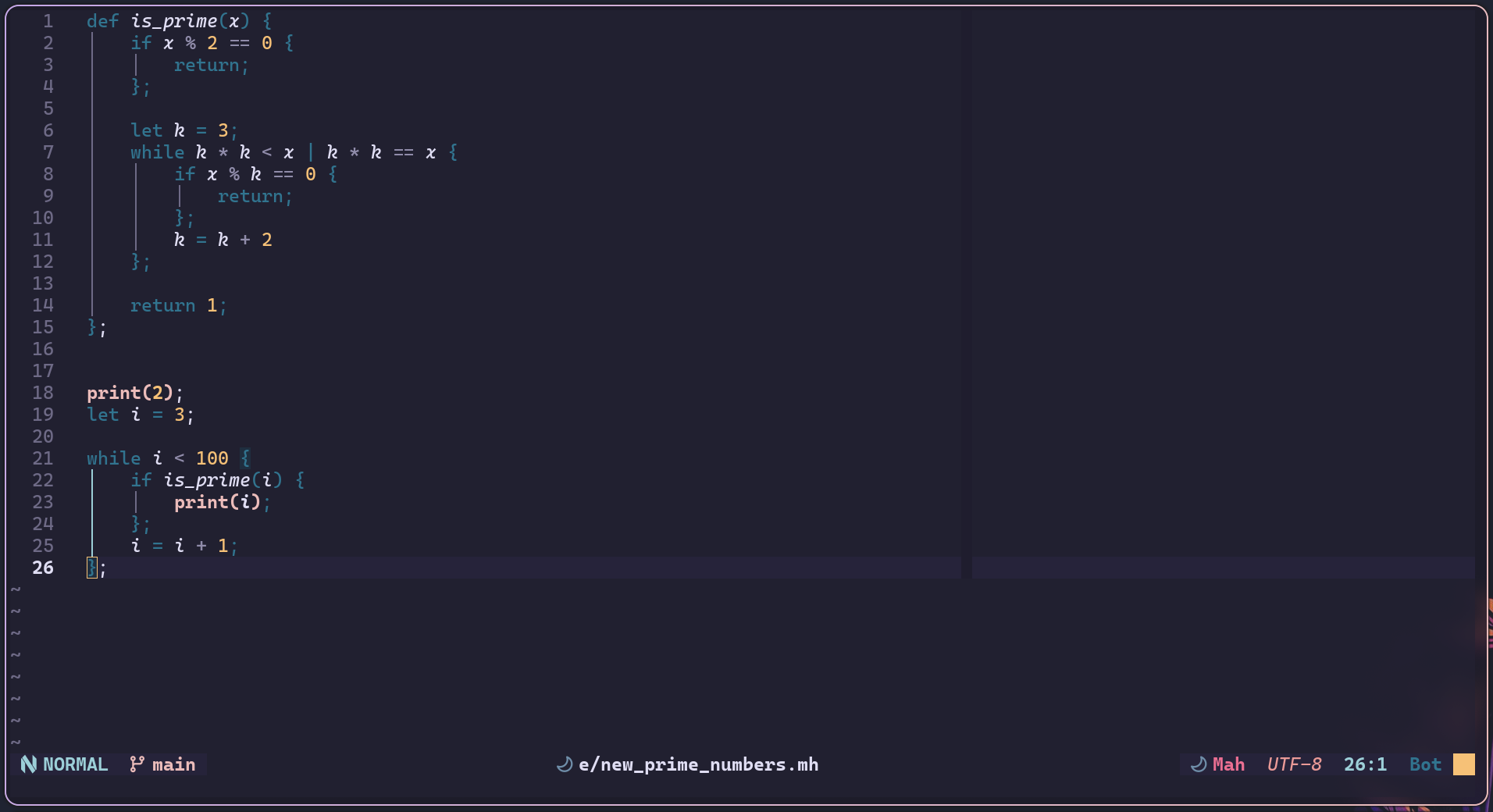
Editor support
Neovim
make install-nvim      # tree-sitter syntax highlighting + the LSP ftplugin
make uninstall-nvim
This builds the syntax-highlight/ tree-sitter grammar into your Neovim
config and drops in an ftplugin that starts the language server (mah lsp)
for every .mh buffer via vim.lsp.start — so make install-mah needs to
run first (or just run make install, which installs both, in order).
VS Code
A VS Code extension lives in editors/vscode/ — a TextMate grammar for
syntax highlighting, the same mah lsp server wired in as an LSP client,
and a custom file icon for .mh files. Build and install it locally with:
make build-vscode
code --install-extension editors/vscode/mah-language-*.vsix
See editors/vscode/README.md for details (not yet published to the
Marketplace).
Any other editor
Any LSP client can run the server directly over stdio:
mah lsp
Point your editor's LSP client at that command for .mh files.
The language server
mah lsp implements the Language Server Protocol using only the Python
standard library, on top of the same resolver and type checker the
compiler uses, not a second analysis of the source. It provides:
- live diagnostics as you type: syntax, resolve and type errors, including ones inside imported files
- hover: docs for keywords and builtins, inferred types, the declaration a name resolved to (with its doc comment), struct/enum shapes, and trait and method signatures
- completion: keywords, builtins, names in scope, imported and namespaced
names, methods/fields after a
.based on the receiver's type, and.mhfiles andstd:modules inside animport "..."string - go to definition, scope-aware and across imports
- rename: variables and functions across every file that imports them, and struct/enum/variant/field names (including in type annotations)
- document formatting, the same as
mah format
Testing
make test          # the Python implementation (stdlib unittest)
make test-rust     # the Rust runtime against the same programs
Every language feature and LSP capability ships with automated tests, not
just an example file; see docs/TESTING.md. (For testing Mah programs,
see mah test and docs/MAH_TEST.md.)
How it's built
source --> preprocessor --> lexer --> parser --> resolver --> type checker
           (imports)                  (AST)      (scopes,     (advisory; never
                                                  addresses)   feeds codegen)
                                                      |
                                                      v
                                    codegen --> lower --> .mahc --> Python VM
                                   (flat IR)                    \-> Rust VM
mah/preprocessor.pyinlinesimport/export(andstd:modules) into one combined source, keeping original file positions for errors.mah/compiler/lexer.py/parser.pytokenize and parse into an AST (ast_nodes.py), recovering from syntax errors.mah/compiler/resolve.pygives every variable a(depth, slot)address in its function's frame and builds the symbol table the LSP reads.mah/compiler/typecheck.py/types.pyare the static checker: inference, generics, traits, and error sets. Its output is diagnostics only, so the bytecode is the same whatever it decides.mah/compiler/codegen.pylowers the AST into a flat IR, andmah/bytecode/lower.pyturns that into.mahc.mah/code_interpreter.pyis the Python VM;runtime/is the Rust VM (mah-vm). Both use heapFrames with a static chain for closures, tagged heap values for structs/enums, and a single-threaded task scheduler fordetach/.awaitand async I/O.mah/std/*.mhis the standard library, written in Mah over a small set of native functions (extern fn) that each VM implements.mah/format/ismah format, andmah/lsp/is the language server.
docs/V2_DESIGN.md and the per-feature design docs record every milestone
(M0 through M41c so far) with its reasoning, deviations, and test coverage.
Where this is going
Next, mostly in service of a NestJS/FastAPI-style web framework written in Mah (routes from decorators, request binding and OpenAPI from types):
Bytes, thenstd:socket,std:urland an HTTP client- An HTTP server (with form and multipart bodies)
- Third-party packages (
[dependencies]in the manifest is already reserved for them)
Further out (docs/NEXT_PHASES.md, docs/TYPES.md): the rest of the
checker's trait and completion work, pattern matching on Vectors and
match exhaustiveness, nullable types, formatter settings in
mah-project.toml, document symbols and code actions in the LSP, and a
garbage collector.
Docs
The website at mahlang.dev has the user-facing guide and changelog. The design docs in this repo:
docs/V2_DESIGN.md: the language design and milestone-by-milestone build logdocs/TYPES.md: the static type system (syntax, inference, strictness levels, generics)docs/ERRORS.md:throw/try/catchand checked error setsdocs/TRAITS.md: traits,impl, method dispatch, and system traitsdocs/STDLIB.md: the standard library, module by moduledocs/REFLECTION.md: type values, metadata, decorators, and hooksdocs/MAH_TEST.md:std:testandmah testdocs/FORMAT.md:mah formatand its whitespace-only guaranteedocs/MAHC_FORMAT.md: the portable.mahcbytecode format (normative)docs/RUST_VM.md: the Rust runtime,--vm rust, self-contained executablesdocs/NEXT_PHASES.md: design notes for future workdocs/TESTING.md: how the implementation itself is testeddocs/DEVELOPMENT_WORKFLOW.md: how this project's development is split across planning, implementation, and verification
Similar repos


Languages
Python
78.2%
Rust
17.3%
JavaScript
1.5%
Svelte
1.5%
Mah Language
See the codeSee what people are saying
README
The Mah Language
ماه — "moon" in Persian.
Mah is a small programming language built from scratch, with a hand-written compiler, a portable bytecode VM, a static type checker, a standard library, reflection, an LSP server, a formatter, and editor integrations for Neovim and VS Code.
- Language: structs, enums, pattern matching, traits, closures that
capture by reference, lazy iterators,
async-styledetach/.await,defer, typedthrow/try/catcherrors, decorators, and runtime reflection. - Types: optional annotations, generics, and a static checker that infers most types (including which errors a function can throw). Types never change what a program does at runtime.
- Two runtimes for one bytecode format: the compiler emits portable
.mahcbytecode (fully specified indocs/MAHC_FORMAT.md), which runs on a Python VM or on a native Rust VM. The Rust VM can also produce a single self-contained executable. - Standard library:
std:math,json,csv,path,regex,random,collections,time,async,fs,process,reflect, andtest, mostly written in Mah itself. - Tooling:
mah run/build/check/test/format/init, project manifests, andmah lsp(diagnostics, typed hover, completion, go to definition, cross-file rename, formatting).
Website and docs: mahlang.dev.
Why it's built this way
Mah is a from-the-ground-up exploration of how a language and its tooling actually work, so a few choices run through the whole project on purpose:
- Hand-written, not generated. Lexer, recursive-descent parser,
resolver, type checker, codegen, and formatter are all written by hand.
There's no grammar DSL feeding a parser generator. An earlier version
of this project worked that way;
compiler-generator/anddocs/GRAMMAR_DSL.mdare kept only as history. It's slower to build, but every stage is something you can read end to end. - Few dependencies. The compiler, Python VM, formatter, and language
server use only the Python standard library: no parser library, no LSP
framework, no CLI library. Clone the repo and
python -m mahworks with nothing topip install. The Rust runtime uses the Rust standard library plus theregexcrate. The only Node code is the optional VS Code extension client and the website. - The bytecode is the contract. Both VMs run only
.mahc, and its format is written down in enough detail to implement a third VM in any language. The two existing ones run the same test suite. - Heap-allocated closures over a native call stack. Every function
call gets a heap-allocated
Framelinked to its lexically enclosing frame by a static chain pointer (the classic SCP/DCP activation-record technique). That's what lets closures capture outer variables by reference, like JavaScript: a closure that outlives its call still sees later changes to what it captured. There's no garbage collector yet, but the object model is shaped so one can be added without a redesign. - A forgiving parser, for tooling's sake. The parser recovers from a syntax error instead of stopping, so the language server can report every mistake in a file in one pass. (Running a file still refuses outright if there's any parse error.)
A quick tour
# closures capture by reference
let counter = fn() {
    let count = 0
    fn() {
        count = count + 1
        count
    }
}
let next = counter()
print(next())   # 1
print(next())   # 2

# structs, enums, pattern matching
struct Point { x, y }
enum Shape {
    Circle { r },
    Square { s },
    Empty
}

fn area(s) {
    match s {
        Shape.Circle { r } => { 3 * r * r }
        Shape.Square { s } => { s * s }
        Shape.Empty => { 0 }
    }
}
print(area(Shape.Circle { r: 5 }))      # 75

# if/match/blocks are expressions; a function body's last expression is
# its return value
fn abs(n) { if n < 0 { -n } else { n } }

# defer: block-scoped, LIFO, runs on every exit path
fn process(name) {
    print("opening " + name)
    defer print("closing " + name)
    if name == "bad" { return }
    print("using " + name)
}
process("bad")     # opening bad / closing bad
Traits, iterators, collections, keyword arguments, and async:
struct Rect { w, h }
trait Shape {
    fn area(self)
    fn describe(self) { "a shape with area " + self.area() }
}
impl Shape for Rect {
    fn area(self) { self.w * self.h }
}
print(Rect { w: 2, h: 3 }.describe())   # a shape with area 6

let odd_squares = (1..=5).map(fn(n) { n * n }).filter(fn(n) { n % 2 == 1 }).reduce()
print(odd_squares)                      # [1, 9, 25]
let ages = ["ada": 36, "alan": 41]
for let name, let i in ages {
    print(i, name, ages[name])          # 0 ada 36, then 1 alan 41
}

fn greet(name, greeting = "Hello") { greeting + ", " + name + "!" }
print(greet("Mah", greeting: "Salam"))  # Salam, Mah!

fn slow(n) { sleep_async(10); n * 2 }
let a = detach slow(21)
let b = detach { sleep_async(5); "from a block" }
print(a.await, b.await)                 # 42 from a block
Types and errors. Annotations are optional. The checker infers the rest,
including which errors each function can throw, and mah check reports
anything left unhandled:
fn first<T>(v: Vector<T>) -> T { v[0] }
print(first([7, 8]))                    # 7

enum ParseError { Empty, BadDigit }
impl Error for ParseError {}

fn first_digit(s: String) -> String {   # inferred: throws ParseError
    if s.len() == 0 { throw ParseError.Empty }
    let c = s.char_at(0)
    if c < "0" | c > "9" { throw ParseError.BadDigit }
    c
}

print(try { first_digit("") } catch {
    ParseError.Empty => { "was empty" }
    e: ParseError => { "other: " + e.message() }
})                                      # was empty
print(try first_digit("x") else "none") # none
Decorators and reflection. A decorator is a plain value attached to a
declaration, and std:reflect reads it back along with the declaration's
written types and doc comments. A decorator whose type implements a hook
trait can also wrap a function, transform an argument, or validate a
struct:
import reflect from "std:reflect"

struct Route { method: String, path: String }
fn get(path: String) -> Route { Route { method: "GET", path: path } }

## Fetch one user.
@get("/users/{id}")
fn get_user(id: Number, verbose: Bool = false) -> Number { id }

let sig = reflect.signature(get_user)
print(sig.doc)                          # Fetch one user.
match reflect.find(sig.decorators, Route) {
    some(route) => { print(route.method, route.path) }   # GET /users/{id}
    none => { print("not a route") }
}
See examples/*.mh for much more (modules, strings, files, processes,
regex, JSON/CSV, timers, hooks, tests), and the docs listed at the end.
Modules
# mathlib.mh
export fn square(n) { n ** 2 }
export let answer = 42
fn helper() { 1 }            # private: not visible to importers
import math from "mathlib"   # namespaced: math.square(4), math.answer
import "mathlib"             # or flat: square(4) directly in scope
import json from "std:json"  # standard library modules use the std: prefix
Only exported names are reachable. Each file is included at most once, so
diamond imports and cycles are safe, and errors inside an imported file are
reported with their real file:line:column.
Getting started
python -m mah run ./examples/prime_numbers.mh        # compile and run a file, from a repo checkout
python -m mah build ./examples/structs.mh            # compile to portable bytecode: structs.mahc
python -m mah build ./examples/structs.mh --target release -o out.mahc   # no debug info
python -m mah runc ./examples/structs.mahc           # run compiled bytecode
python -m mah dis ./examples/structs.mahc            # show it as readable instructions
python -m mah format ./examples                      # rewrite .mh files in the standard layout
python -m mah check ./examples/structs.mh            # run the static type checker
mah format only ever changes whitespace, and checks that before writing
(--check lists files that would change instead; see docs/FORMAT.md).
There's also a native runtime written in Rust (standard library only, plus
the regex crate for std:regex), with the same behavior as the Python VM:
make vm                                              # build it (needs cargo)
python -m mah run --vm rust ./examples/structs.mh    # run on it (also: runc --vm rust)
python -m mah build --self-contained ./examples/structs.mh -o structs
./structs                                            # one file, runs without mah installed
A self-contained build is a small shell script with the runtime and the
bytecode appended; it runs on machines with the same OS and CPU. See
docs/RUST_VM.md.
mah <file> (no subcommand) is shorthand for mah run <file> (or mah runc for a .mahc file). mah build output starts with a
#!/usr/bin/env -S mah runc line and is marked executable, so with mah on
your PATH you can run it directly: ./structs.mahc. The .mahc format is specified in
docs/MAHC_FORMAT.md, in enough detail to write a VM for it in any
language.
Projects
mah init my-app        # or `mah init` to turn the current directory into a project
cd my-app
mah run                # runs the entry point from mah-project.toml (src/main.mh)
mah build              # writes every [[target]], e.g. build/my-app.mahc
mah build --target release
mah check              # runs the static type checker, at the project's [types] check level
mah test               # runs every *.test.mh file (std:test; see docs/MAH_TEST.md)
mah init creates mah-project.toml (package name, version, entry point,
and build targets, each with a debug or release profile and optionally
self-contained = true for a standalone executable; [run] vm = "rust"
makes mah run use the Rust runtime; [types] check sets the static
type-checking level -- "loose" (default, warnings only), "strict"
(compile errors), or "explicit" ("strict" plus required annotations
where types can't be inferred) -- see mah check above), src/main.mh,
a .gitignore, and docs for coding agents: AGENTS.md (plus a CLAUDE.md
that imports it) and docs/mah-language.md, a complete language reference
written so an LLM can write correct Mah without guessing. mah run and
mah build find the manifest from any subdirectory. The templates live in
mah/project/templates/ and must be kept in sync with the language (see
.claude/skills/mah-add-feature/SKILL.md step 9). [dependencies] is
reserved for third-party packages, which aren't supported yet.
Installing the mah command
make install-mah      # installs into ~/.local/lib/mah, links ~/.local/bin/mah
                      # (run `make vm` first to install the Rust runtime too)
make uninstall-mah
(PREFIX defaults to ~/.local — make sure ~/.local/bin is on your
PATH.) Afterwards, from anywhere:
mah path/to/program.mh
mah build path/to/program.mh
mah init my-app
mah lsp                # starts the language server (see below) -- editors run this for you
Editor support
Neovim
make install-nvim      # tree-sitter syntax highlighting + the LSP ftplugin
make uninstall-nvim
This builds the syntax-highlight/ tree-sitter grammar into your Neovim
config and drops in an ftplugin that starts the language server (mah lsp)
for every .mh buffer via vim.lsp.start — so make install-mah needs to
run first (or just run make install, which installs both, in order).
VS Code
A VS Code extension lives in editors/vscode/ — a TextMate grammar for
syntax highlighting, the same mah lsp server wired in as an LSP client,
and a custom file icon for .mh files. Build and install it locally with:
make build-vscode
code --install-extension editors/vscode/mah-language-*.vsix
See editors/vscode/README.md for details (not yet published to the
Marketplace).
Any other editor
Any LSP client can run the server directly over stdio:
mah lsp
Point your editor's LSP client at that command for .mh files.
The language server
mah lsp implements the Language Server Protocol using only the Python
standard library, on top of the same resolver and type checker the
compiler uses, not a second analysis of the source. It provides:
- live diagnostics as you type: syntax, resolve and type errors, including ones inside imported files
- hover: docs for keywords and builtins, inferred types, the declaration a name resolved to (with its doc comment), struct/enum shapes, and trait and method signatures
- completion: keywords, builtins, names in scope, imported and namespaced
names, methods/fields after a
.based on the receiver's type, and.mhfiles andstd:modules inside animport "..."string - go to definition, scope-aware and across imports
- rename: variables and functions across every file that imports them, and struct/enum/variant/field names (including in type annotations)
- document formatting, the same as
mah format
Testing
make test          # the Python implementation (stdlib unittest)
make test-rust     # the Rust runtime against the same programs
Every language feature and LSP capability ships with automated tests, not
just an example file; see docs/TESTING.md. (For testing Mah programs,
see mah test and docs/MAH_TEST.md.)
How it's built
source --> preprocessor --> lexer --> parser --> resolver --> type checker
           (imports)                  (AST)      (scopes,     (advisory; never
                                                  addresses)   feeds codegen)
                                                      |
                                                      v
                                    codegen --> lower --> .mahc --> Python VM
                                   (flat IR)                    \-> Rust VM
mah/preprocessor.pyinlinesimport/export(andstd:modules) into one combined source, keeping original file positions for errors.mah/compiler/lexer.py/parser.pytokenize and parse into an AST (ast_nodes.py), recovering from syntax errors.mah/compiler/resolve.pygives every variable a(depth, slot)address in its function's frame and builds the symbol table the LSP reads.mah/compiler/typecheck.py/types.pyare the static checker: inference, generics, traits, and error sets. Its output is diagnostics only, so the bytecode is the same whatever it decides.mah/compiler/codegen.pylowers the AST into a flat IR, andmah/bytecode/lower.pyturns that into.mahc.mah/code_interpreter.pyis the Python VM;runtime/is the Rust VM (mah-vm). Both use heapFrames with a static chain for closures, tagged heap values for structs/enums, and a single-threaded task scheduler fordetach/.awaitand async I/O.mah/std/*.mhis the standard library, written in Mah over a small set of native functions (extern fn) that each VM implements.mah/format/ismah format, andmah/lsp/is the language server.
docs/V2_DESIGN.md and the per-feature design docs record every milestone
(M0 through M41c so far) with its reasoning, deviations, and test coverage.
Where this is going
Next, mostly in service of a NestJS/FastAPI-style web framework written in Mah (routes from decorators, request binding and OpenAPI from types):
Bytes, thenstd:socket,std:urland an HTTP client- An HTTP server (with form and multipart bodies)
- Third-party packages (
[dependencies]in the manifest is already reserved for them)
Further out (docs/NEXT_PHASES.md, docs/TYPES.md): the rest of the
checker's trait and completion work, pattern matching on Vectors and
match exhaustiveness, nullable types, formatter settings in
mah-project.toml, document symbols and code actions in the LSP, and a
garbage collector.
Docs
The website at mahlang.dev has the user-facing guide and changelog. The design docs in this repo:
docs/V2_DESIGN.md: the language design and milestone-by-milestone build logdocs/TYPES.md: the static type system (syntax, inference, strictness levels, generics)docs/ERRORS.md:throw/try/catchand checked error setsdocs/TRAITS.md: traits,impl, method dispatch, and system traitsdocs/STDLIB.md: the standard library, module by moduledocs/REFLECTION.md: type values, metadata, decorators, and hooksdocs/MAH_TEST.md:std:testandmah testdocs/FORMAT.md:mah formatand its whitespace-only guaranteedocs/MAHC_FORMAT.md: the portable.mahcbytecode format (normative)docs/RUST_VM.md: the Rust runtime,--vm rust, self-contained executablesdocs/NEXT_PHASES.md: design notes for future workdocs/TESTING.md: how the implementation itself is testeddocs/DEVELOPMENT_WORKFLOW.md: how this project's development is split across planning, implementation, and verification
Similar repos
Languages
Python
78.2%
Rust
17.3%
JavaScript
1.5%
Svelte
1.5%