Skeleton code from https://github.com/ricardorei/lightning-text-classification
In this project we attempt to circumvent the heavy pre-processing, truncation, etc. of health records instances seen in recent work.
Using novel pre-training of Transformer encoders, this project tackles whole-document embedding for the clinical domain. Additionally, we propose a fine-tuning process on electronic healthcare records for transformer models and a novel medical coding benchmark task. We release our best-performing encoder model and suggest future investigation with regard to the natural language tasks in this domain.
class RobertaLongSelfAttention(LongformerSelfAttention):
    def forward(
        self,
        hidden_states,
        attention_mask=None,
        head_mask=None,
        encoder_hidden_states=None,
        encoder_attention_mask=None,
        output_attentions=False,
    ):
      attention_mask = attention_mask.squeeze(dim=2).squeeze(dim=1)
      # These lines may be required for newer versions of HF!
      ###
      # is index masked or global attention
      is_index_masked = attention_mask < 0
      is_index_global_attn = attention_mask > 0
      is_global_attn = any(is_index_global_attn.flatten())
      ###
      return super().forward(hidden_states, attention_mask=attention_mask, output_attentions=output_attentions)

class RobertaLongForMaskedLM(RobertaForMaskedLM):
    def __init__(self, config):
        super().__init__(config)
        for i, layer in enumerate(self.roberta.encoder.layer):
            # replace the `modeling_bert.BertSelfAttention` object with `LongformerSelfAttention`
            layer.attention.self = RobertaLongSelfAttention(config, layer_id=i)
RobertaLongForMaskedLM.from_pretrained('simonlevine/clinical-longformer')RobertaForMaskedLM with a different task-specific RoBERTa from Huggingface, such as RobertaForSequenceClassification.pandas
tensorboard
torch
transformers
pytorch-lightning
pytorch-nlp
loguru
download the data.
run ICD classification task:
Run masked-language modeling (generate your own clinical encoder!):
-Run MedNLI: -in Progress
build a hierarchical classifier head
get x-transformer trained on our best model.
The x-transformer pipeline uses the state-of-the-art extreme multilabel classification with label clustering and PIFA-TFIDF features to amke good use of label descriptions. ICD code labels not only have 'ICD9_CODE' labels, but also 'LONG_TITLE' labels with rich semantic information.
try different losses: For the multi-label classification, you can try tanh+hinge with {-1, 1} values in labels like (1, -1, -1, 1). Or sigmoid + hamming loss with {0, 1} values in labels like (1, 0, 0, 1). In some cases, sigmoid + focal loss with {0, 1} values in labels like (1, 0, 0, 1) worked well. You can check this paper https://arxiv.org/abs/1708.02002.
MIMIC-III/CXR data requires credentialed access. This pipeline requires:
We also provide a General Equivalence Mapping if translating codes to ICD10 is desired (these data are relevant but quite old, MIMIC-IV is in the works).
Data should be in the main working directory, in the "data" folder.
In preprocessing_pipeline, run:
format_notes.py
format_data_for_training.py , OR, format_data_for_for_multilabel.py
Finally, in longformer_gen, if you don't want to pull our models from https://huggingface.co/simonlevine:
The classifier_pipeline folder contains scrits for ICD classification and a requirements.txt
Run the pytorch-lightning trainer from either training_multilabel.py or training_onelabel.py.
This project is the course project for Fall 2020, 11-785: Deep Learning, at Carnegie Mellon University.
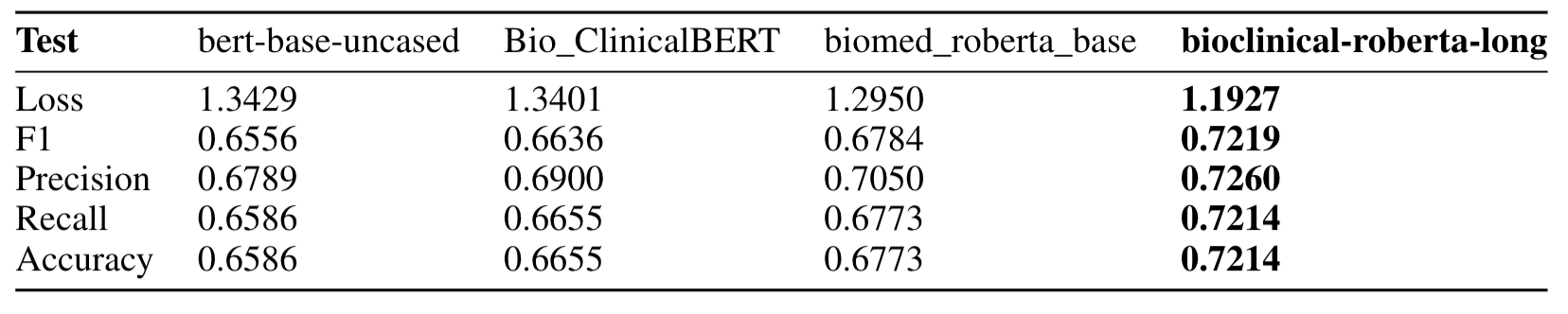
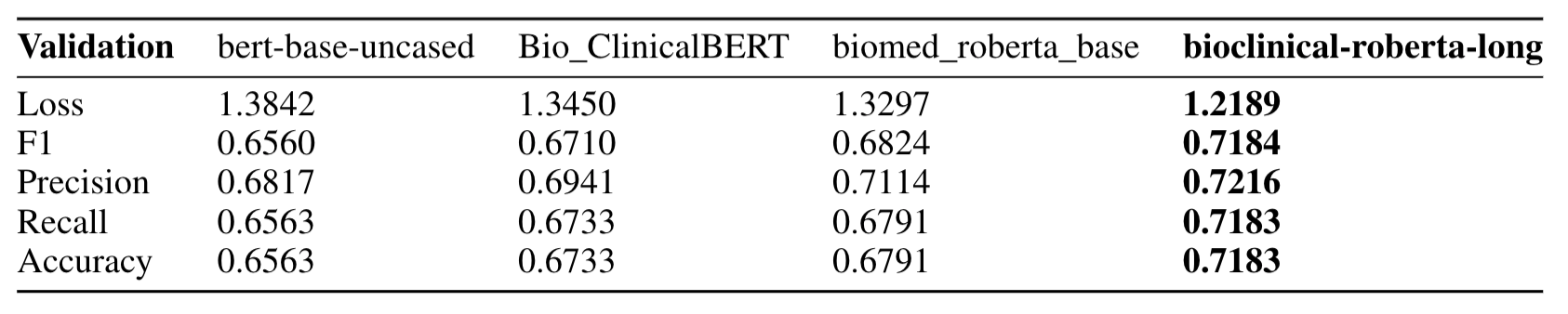
Here, we benchmark various Transformer-based encoders (BERT, RoBERTa, Longformer) on electronic health records data from the MIMIC-III data lake. We also benchmark our new pipeline against another novel pipeline developed in 2020 by Simon Levine and Jeremy Fisher, auto-icd-Transformers.
We use base-BERT-uncased as a baseline transformer. We then try bio-clinical-BERT, biomed-RoBERTa, and finally our bespoke "Longformer" bioclinical-roberta-long.
This latter model is simply allenAI's biomed-roberta with global attention, such that documents of up to 4096 token length are able to be used without truncation, a critical aspect of free-text EHR data).
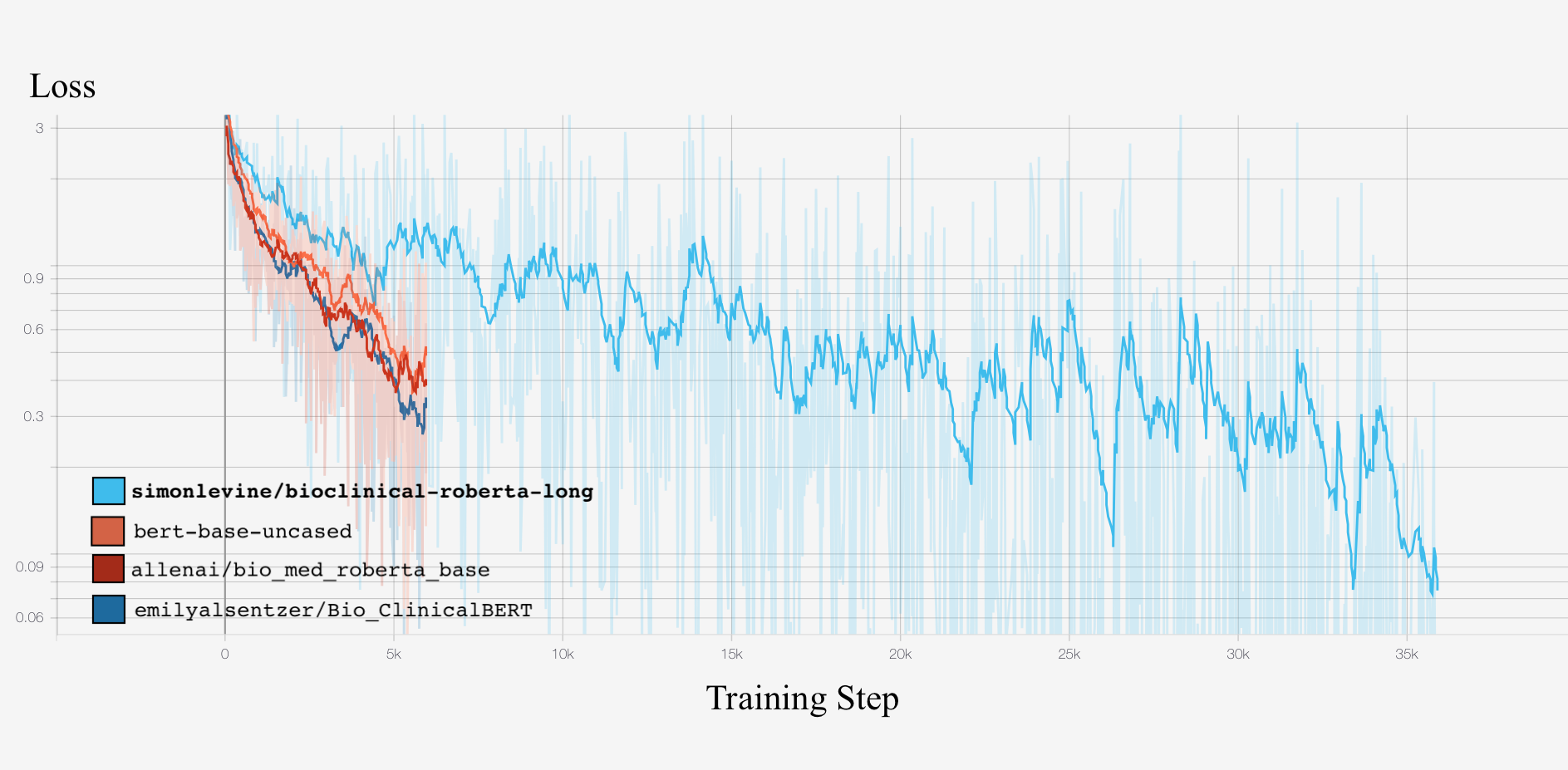
Note that we pre-train allenAI/biomed-RoBERTa-base on MIMIC-III + MIMIC-CXR data for ~1000 epochs (no global attention). Global attention was not used in MLM because this is costly. We had out of memory issues on a 200gb machine with FP16, gradient checkpointing, and batch size of 1. Note that A corpus even of this size is likely not sufficient to have dramatic increases in performance, per AllenAI, but it couldn't hurt to try.
So, global attention is used in the end-to-end stage. We recommend you repeat MLM with more data and global attention if you have the resources.
For each transformer, we build a classifier head. As a baseline,, we use
nn.Linear(self.encoder_features, self.encoder_features * 2), nn.Tanh(), nn.Linear(self.encoder_features * 2, self.encoder_features), nn.Tanh(), nn.Linear(self.encoder_features, self.data.label_encoder.vocab_size),
where encoder features = 768, vocab_size is simply the number of unique ICDs in the training set (50).
We ignore label descriptions (see above: this direction was attempted previously by Simon Levine and Jeremy Fisher, adapting the X-transformer pipeline).
For ICD-10-CM and ICD-10-PCS, the single-label case is first analyzed. That is, ICD "SEQ_NUM==1" is looked at, as this is generally the most clinically relevant code assigned per patient visit.
For the multi-label case, the label space grows. Hence, an "extreme multilabel" classifier is required. We begin with one-hot encoded ICD codes per instance, with our base 3-layer dense classifier.
Future work should make use of exotic methods for classification in this domain, perhaps hierarchical classification schemes or other (extreme) multilabel implementations.
Skeleton code from https://github.com/ricardorei/lightning-text-classification
In this project we attempt to circumvent the heavy pre-processing, truncation, etc. of health records instances seen in recent work.
Using novel pre-training of Transformer encoders, this project tackles whole-document embedding for the clinical domain. Additionally, we propose a fine-tuning process on electronic healthcare records for transformer models and a novel medical coding benchmark task. We release our best-performing encoder model and suggest future investigation with regard to the natural language tasks in this domain.
class RobertaLongSelfAttention(LongformerSelfAttention):
    def forward(
        self,
        hidden_states,
        attention_mask=None,
        head_mask=None,
        encoder_hidden_states=None,
        encoder_attention_mask=None,
        output_attentions=False,
    ):
      attention_mask = attention_mask.squeeze(dim=2).squeeze(dim=1)
      # These lines may be required for newer versions of HF!
      ###
      # is index masked or global attention
      is_index_masked = attention_mask < 0
      is_index_global_attn = attention_mask > 0
      is_global_attn = any(is_index_global_attn.flatten())
      ###
      return super().forward(hidden_states, attention_mask=attention_mask, output_attentions=output_attentions)

class RobertaLongForMaskedLM(RobertaForMaskedLM):
    def __init__(self, config):
        super().__init__(config)
        for i, layer in enumerate(self.roberta.encoder.layer):
            # replace the `modeling_bert.BertSelfAttention` object with `LongformerSelfAttention`
            layer.attention.self = RobertaLongSelfAttention(config, layer_id=i)
RobertaLongForMaskedLM.from_pretrained('simonlevine/clinical-longformer')RobertaForMaskedLM with a different task-specific RoBERTa from Huggingface, such as RobertaForSequenceClassification.pandas
tensorboard
torch
transformers
pytorch-lightning
pytorch-nlp
loguru
download the data.
run ICD classification task:
Run masked-language modeling (generate your own clinical encoder!):
-Run MedNLI: -in Progress
build a hierarchical classifier head
get x-transformer trained on our best model.
The x-transformer pipeline uses the state-of-the-art extreme multilabel classification with label clustering and PIFA-TFIDF features to amke good use of label descriptions. ICD code labels not only have 'ICD9_CODE' labels, but also 'LONG_TITLE' labels with rich semantic information.
try different losses: For the multi-label classification, you can try tanh+hinge with {-1, 1} values in labels like (1, -1, -1, 1). Or sigmoid + hamming loss with {0, 1} values in labels like (1, 0, 0, 1). In some cases, sigmoid + focal loss with {0, 1} values in labels like (1, 0, 0, 1) worked well. You can check this paper https://arxiv.org/abs/1708.02002.
MIMIC-III/CXR data requires credentialed access. This pipeline requires:
We also provide a General Equivalence Mapping if translating codes to ICD10 is desired (these data are relevant but quite old, MIMIC-IV is in the works).
Data should be in the main working directory, in the "data" folder.
In preprocessing_pipeline, run:
format_notes.py
format_data_for_training.py , OR, format_data_for_for_multilabel.py
Finally, in longformer_gen, if you don't want to pull our models from https://huggingface.co/simonlevine:
The classifier_pipeline folder contains scrits for ICD classification and a requirements.txt
Run the pytorch-lightning trainer from either training_multilabel.py or training_onelabel.py.
This project is the course project for Fall 2020, 11-785: Deep Learning, at Carnegie Mellon University.
Here, we benchmark various Transformer-based encoders (BERT, RoBERTa, Longformer) on electronic health records data from the MIMIC-III data lake. We also benchmark our new pipeline against another novel pipeline developed in 2020 by Simon Levine and Jeremy Fisher, auto-icd-Transformers.
We use base-BERT-uncased as a baseline transformer. We then try bio-clinical-BERT, biomed-RoBERTa, and finally our bespoke "Longformer" bioclinical-roberta-long.
This latter model is simply allenAI's biomed-roberta with global attention, such that documents of up to 4096 token length are able to be used without truncation, a critical aspect of free-text EHR data).
Note that we pre-train allenAI/biomed-RoBERTa-base on MIMIC-III + MIMIC-CXR data for ~1000 epochs (no global attention). Global attention was not used in MLM because this is costly. We had out of memory issues on a 200gb machine with FP16, gradient checkpointing, and batch size of 1. Note that A corpus even of this size is likely not sufficient to have dramatic increases in performance, per AllenAI, but it couldn't hurt to try.
So, global attention is used in the end-to-end stage. We recommend you repeat MLM with more data and global attention if you have the resources.
For each transformer, we build a classifier head. As a baseline,, we use
nn.Linear(self.encoder_features, self.encoder_features * 2), nn.Tanh(), nn.Linear(self.encoder_features * 2, self.encoder_features), nn.Tanh(), nn.Linear(self.encoder_features, self.data.label_encoder.vocab_size),
where encoder features = 768, vocab_size is simply the number of unique ICDs in the training set (50).
We ignore label descriptions (see above: this direction was attempted previously by Simon Levine and Jeremy Fisher, adapting the X-transformer pipeline).
For ICD-10-CM and ICD-10-PCS, the single-label case is first analyzed. That is, ICD "SEQ_NUM==1" is looked at, as this is generally the most clinically relevant code assigned per patient visit.
For the multi-label case, the label space grows. Hence, an "extreme multilabel" classifier is required. We begin with one-hot encoded ICD codes per instance, with our base 3-layer dense classifier.
Future work should make use of exotic methods for classification in this domain, perhaps hierarchical classification schemes or other (extreme) multilabel implementations.