MEND: RL for Flow Models via Proximal Velocity Matching. Official code, public model weights and inference. arXiv:2610.05954.
See the code






Shreshth Saini1,2, Neil Birkbeck2, Yilin Wang2, Balu Adsumilli2, Alan C. Bovik1,3
1The University of Texas at Austin, 2Google, 3University of Colorado Boulder
arXiv:2610.05954, 2026.
MEND is a reinforcement learning method for reward post-training of flow-matching image models, built on proximal velocity matching. Within each prompt group it caps rewards at a quantile, so samples that already score well receive no move. Below the cap it proposes moves along the reward gradient and accepts one only when its capped reward gain exceeds a quadratic displacement price. The model then regresses onto the resulting velocity targets. There is no KL term, no frozen reference model in the loss, and no advantage weighting. This repository contains the training code for Stable Diffusion 3.5 Medium and Z-Image-Turbo, the evaluation suite, the baseline trainers used for comparison, and CPU tests.
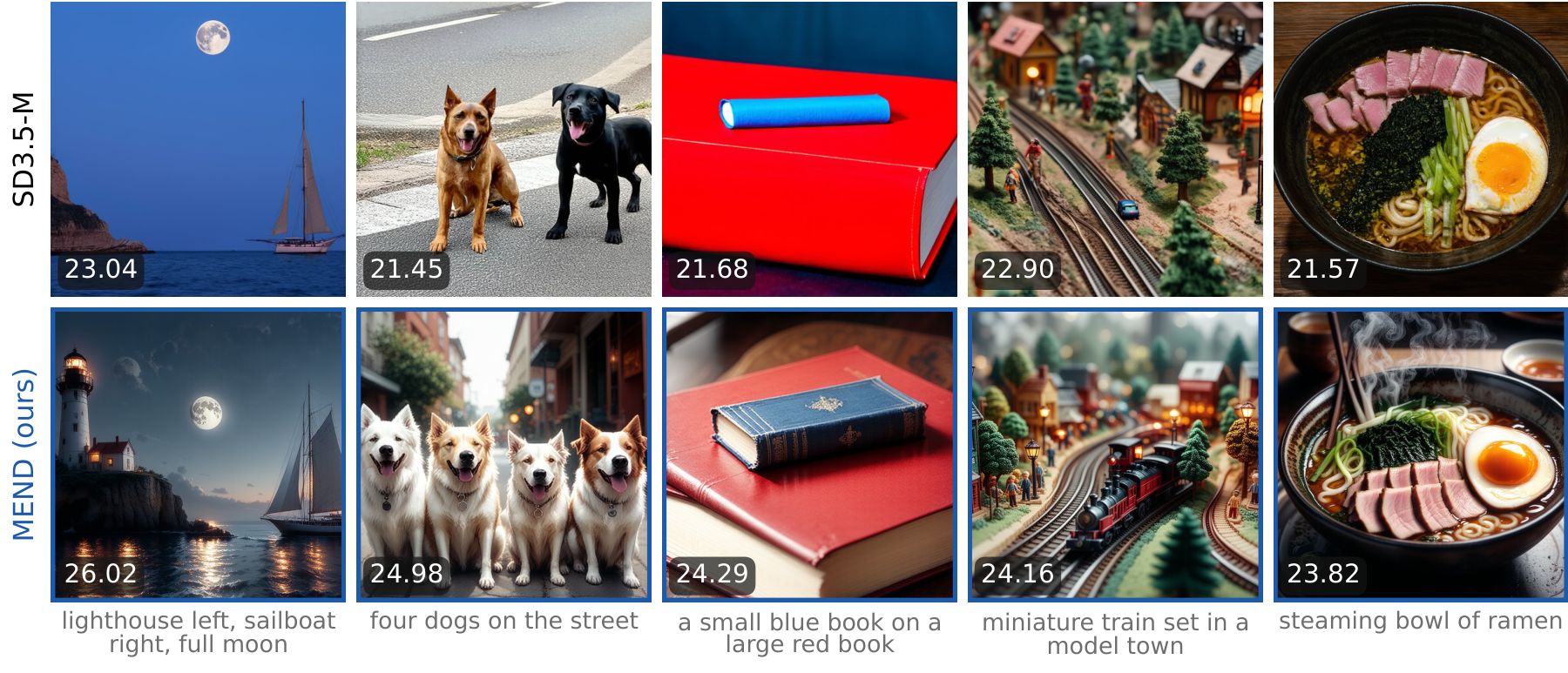
SD3.5-M (top) and MEND after 100 updates (bottom), same prompt and initial noise. The number on each tile is its PickScore.
The official Hugging Face collection groups the adapters, paper, and project Space. Each model includes the original PEFT adapter, an equivalent Diffusers LoRA, checksums, sampling settings and citation.
| Adapter | Download | Updates | Guidance |
|---|---|---|---|
mend_pickscore | MEND-SD3.5M-PickScore | 100 | 4.5 |
mend_open3 | MEND-SD3.5M-ThreeReward | 300 | 1.0 |
mend_hpsv2 | MEND-SD3.5M-HPSv2.1 | 100 | 1.0 |
mend_clipscore | MEND-SD3.5M-CLIPScore | 100 | 1.0 |
mend_imagereward | MEND-SD3.5M-ImageReward | 100 | 1.0 |
mend_sd3m_pickscore_s1 | MEND-SD3M-PickScore-Seed1 | 100 | 1.0 |
mend_sd3m_pickscore_s2 | MEND-SD3M-PickScore-Seed2 | 100 | 1.0 |
mend_zimage_pickscore | MEND-Z-Image-Turbo-PickScore | 100 | 0.0 |
mend_zimage_hpsv2 | MEND-Z-Image-Turbo-HPSv2.1 | 100 | 0.0 |
SD3.5-M and SD3-M adapters use 512 pixels and 40 steps. Z-Image-Turbo uses 1024 pixels, 9 steps and guidance 0. mend_open3 trains on PickScore, HPSv2.1 and CLIPScore. The aliases pin a Hub commit and check the original adapter's SHA256 hashes. The adapters are public; gated base models require accepting their terms. Start generating with the commands below or use pipe.load_lora_weights(...) as shown in INFERENCE.md. The generator selects the matching base for SD3 aliases; Z-Image uses its own pipeline and generation example.
Main comparison on DrawBench, 200 prompts x 5 seeds, 512 px, 40 Euler steps (Table 1 of the paper). "Dist. to base" is the DreamSim distance to the base model's image for the same prompt, noise and sampling settings; lower is closer.
| Method | Rewards | Updates | PickScore | HPSv2.1 | HPSv3 | ImageReward | CLIPScore | Aesthetic | Dist. to base |
|---|---|---|---|---|---|---|---|---|---|
| SD3.5-M | none | 0 | 22.35 | 0.280 | 2.72 | 0.83 | 0.283 | 5.39 | 0 |
| Flow-GRPO | PickScore | ~4k | 23.52 | 0.316 | 7.04 | 1.27 | 0.280 | 5.90 | 0.313 |
| DiffusionNFT | five | 1.7k | 23.82 | 0.331 | 7.50 | 1.49 | 0.292 | 6.02 | 0.538 |
| MEND | PickScore | 100 | 23.70 | 0.319 | 7.15 | 1.32 | 0.291 | 5.88 | 0.313 |
| MEND | three | 300 | 23.89 | 0.344 | 5.87 | 1.28 | 0.300 | 5.92 | 0.488 |
The rows use each model's own sampling setting: guidance 4.5 for SD3.5-M, Flow-GRPO and the PickScore MEND row, guidance 1 for DiffusionNFT and the three-reward MEND row. Flow-GRPO and DiffusionNFT rows are the authors' released adapters, evaluated in this repository's pipeline. Each main-table MEND configuration has one training seed. The remaining tables and their protocols are in guides/REPRODUCING.md.
Included:
mend/, configs/mend.py).mend/eval/).baselines/).data/).tests/).Not included:
Training was not rerun from this packaged tree, and bitwise equality with the paper's runs is not claimed.
Training and evaluation need Linux and CUDA GPUs. The CPU tests run anywhere. The validated stack is Python 3.11, PyTorch 2.6 or newer, and Transformers 4.51.
git clone https://github.com/shreshthsaini/MEND-RL.git
cd MEND-RL
uv venv --python 3.11 .venv
source .venv/bin/activate
uv pip install torch torchvision --index-url https://download.pytorch.org/whl/cu128   # pick the build for your CUDA
uv pip install -e ".[rewards,dev]"
Reward weights and training prompts:
export REWARD_CKPT_PATH="$PWD/reward_ckpts"
bash scripts/download_reward_weights.sh
python -m mend.data.prepare_pickapic
python -m mend.rewards.check_setup --backbone sd35 --reward pickscore
guides/INSTALL.md covers ImageReward, HPSv3, DreamSim, Z-Image-Turbo and the environment variables.
For generation, install the core package with uv pip install -e .; reward models and training data are unnecessary. Accept the SD3.5 Medium terms and run hf auth login before its first download.
Generate immediately with the released PickScore adapter:
python scripts/generate.py --lora mend_pickscore \
  --prompt "a small blue book on a large red book" --seeds 0 \
  --guidance_scale 4.5 --num_steps 40 --resolution 512 --batch_size 1 \
  --out_dir outputs/samples/mend_pickscore
For the three-reward model, use --lora mend_open3 --guidance_scale 1.0 and a separate output directory. Generation automatically downloads the adapter and base pipeline. python scripts/download_weights.py --list lists the pinned releases; python scripts/download_weights.py mend_pickscore downloads and validates the adapter without loading a model. Local PEFT adapters and namespace/repo[/subfolder] also work. See the inference guide for Diffusers, offline use and revision pinning.
Check the target-selection math on CPU, with no model download:
python -m pytest -q tests/test_mend_cpu.py tests/test_mend_ablation_cpu.py
Train the PickScore recipe of the paper on SD3.5-M (three GPUs, 100 updates, 48 prompts x 24 images per update):
NPROC=3 UPDATES=100 OUTPUT_DIR=outputs/mend_pickscore \
bash scripts/train_mend.sh pickscore \
  --config.mend.proposal=explicit \
  --config.mend.target_mode=single_state_x0 \
  '--config.mend.etas_explicit=(0.1,0.2,0.4)' \
  --config.mend.q=0.75 \
  --config.mend.lambda_keep=10 \
  --config.mend.d_fixed_rms=0.0 \
  --config.train.adam_epsilon=1e-12
Generate images with the trained adapter:
python scripts/generate.py \
  --lora outputs/mend_pickscore/checkpoints/checkpoint-100/lora \
  --prompt "a small blue book on a large red book" \
  --seeds 0,1,2,3 --guidance_scale 4.5 --out_dir outputs/samples/mend_pickscore
Evaluate it on DrawBench:
python -m mend.eval.suite all --run mend_pickscore_F \
  --lora outputs/mend_pickscore/checkpoints/checkpoint-100/lora \
  --protocol flowgrpo --train_reward pickscore \
  --metrics pickscore,hpsv2,hpsv3,imagereward,clipscore,aesthetic,diversity \
  --out outputs/eval/mend_pickscore_F.json
| Guide | Contents |
|---|---|
| guides/INSTALL.md | Environment, reward models, data, environment variables |
| guides/TRAINING.md | Method summary, the paper recipe, other rewards and backbones, resuming, ablation switches, baselines |
| guides/INFERENCE.md | Generating images with a trained adapter |
| guides/EVALUATION.md | The six evaluators, base distance, diversity, paired tables |
| guides/REPRODUCING.md | Paper tables, the commands behind each row, and what is reported from other papers |
| guides/TESTING.md | CPU tests, shell tests, continuous integration |
| guides/INFRA.md | Optional Slurm task spool used for the paper runs |
mend/
  algorithm/    cap, proposals, proximal verdict, price controller, regression targets, diagnostics
  train/        MEND trainers for SD3.5-M (sd3.py) and Z-Image-Turbo (zimage.py), config dry run
  sampling/     rollout pipelines and ODE solvers
  rewards/      reward models, the scoring registry, differentiable Z-Image reward bridges
  eval/         evaluation suite, image metrics, VLM judge, bootstrap tables
  analysis/     base distance, diversity and collapse statistics, theory probes, figure builders
  tracking/     Weights & Biases logging helpers
  data/         prompt preparation
  utils/        EMA, checkpoint and resume, metric logging, profiling
baselines/      DiffusionOPSD, Flow-GRPO, DiffusionNFT and ReFL trainers and launchers
configs/        ml_collections presets (mend.py and the shared protocol presets), best_mend.env
scripts/        launchers and entry points: train_mend.sh, generate.py, evaluate.py
infra/          optional Slurm fleet jobs and a resumable task spool
data/           prompt recipes and evaluation prompt lists
tests/          CPU tests and shell tests
guides/         documentation
docs/           project page (GitHub Pages)
If you use MEND, please cite the arXiv paper.
@misc{saini2026mend,
  title         = {{MEND}: {RL} For Flow Models via Proximal Velocity Matching},
  author        = {Saini, Shreshth and Birkbeck, Neil and Wang, Yilin and Adsumilli, Balu and Bovik, Alan C.},
  year          = {2026},
  eprint        = {2610.05954},
  archivePrefix = {arXiv},
  primaryClass  = {cs.LG},
  doi           = {10.48550/arXiv.2610.05954},
  url           = {https://arxiv.org/abs/2610.05954}
}
The code is released under the Apache License 2.0. NOTICE lists the files derived from other projects. Released SD3.5-M adapters use the Stability AI Community License, SD3-M adapters use the Stability AI Non-Commercial Research Community License, and Z-Image-Turbo adapters use Apache-2.0. Each model includes its license and notice. Powered by Stability AI. Base models, reward models and datasets keep their own terms.
The training harness, sampling code, reward scorers and baseline trainers are adapted from DiffusionOPSD (Apache-2.0). The compared methods are Flow-GRPO, DiffusionNFT and ReFL from ImageReward. We thank their authors for releasing code and checkpoints.
MEND: RL for Flow Models via Proximal Velocity Matching. Official code, public model weights and inference. arXiv:2610.05954.
See the code
Shreshth Saini1,2, Neil Birkbeck2, Yilin Wang2, Balu Adsumilli2, Alan C. Bovik1,3
1The University of Texas at Austin, 2Google, 3University of Colorado Boulder
arXiv:2610.05954, 2026.
MEND is a reinforcement learning method for reward post-training of flow-matching image models, built on proximal velocity matching. Within each prompt group it caps rewards at a quantile, so samples that already score well receive no move. Below the cap it proposes moves along the reward gradient and accepts one only when its capped reward gain exceeds a quadratic displacement price. The model then regresses onto the resulting velocity targets. There is no KL term, no frozen reference model in the loss, and no advantage weighting. This repository contains the training code for Stable Diffusion 3.5 Medium and Z-Image-Turbo, the evaluation suite, the baseline trainers used for comparison, and CPU tests.
SD3.5-M (top) and MEND after 100 updates (bottom), same prompt and initial noise. The number on each tile is its PickScore.
The official Hugging Face collection groups the adapters, paper, and project Space. Each model includes the original PEFT adapter, an equivalent Diffusers LoRA, checksums, sampling settings and citation.
| Adapter | Download | Updates | Guidance |
|---|---|---|---|
mend_pickscore | MEND-SD3.5M-PickScore | 100 | 4.5 |
mend_open3 | MEND-SD3.5M-ThreeReward | 300 | 1.0 |
mend_hpsv2 | MEND-SD3.5M-HPSv2.1 | 100 | 1.0 |
mend_clipscore | MEND-SD3.5M-CLIPScore | 100 | 1.0 |
mend_imagereward | MEND-SD3.5M-ImageReward | 100 | 1.0 |
mend_sd3m_pickscore_s1 | MEND-SD3M-PickScore-Seed1 | 100 | 1.0 |
mend_sd3m_pickscore_s2 | MEND-SD3M-PickScore-Seed2 | 100 | 1.0 |
mend_zimage_pickscore | MEND-Z-Image-Turbo-PickScore | 100 | 0.0 |
mend_zimage_hpsv2 | MEND-Z-Image-Turbo-HPSv2.1 | 100 | 0.0 |
SD3.5-M and SD3-M adapters use 512 pixels and 40 steps. Z-Image-Turbo uses 1024 pixels, 9 steps and guidance 0. mend_open3 trains on PickScore, HPSv2.1 and CLIPScore. The aliases pin a Hub commit and check the original adapter's SHA256 hashes. The adapters are public; gated base models require accepting their terms. Start generating with the commands below or use pipe.load_lora_weights(...) as shown in INFERENCE.md. The generator selects the matching base for SD3 aliases; Z-Image uses its own pipeline and generation example.
Main comparison on DrawBench, 200 prompts x 5 seeds, 512 px, 40 Euler steps (Table 1 of the paper). "Dist. to base" is the DreamSim distance to the base model's image for the same prompt, noise and sampling settings; lower is closer.
| Method | Rewards | Updates | PickScore | HPSv2.1 | HPSv3 | ImageReward | CLIPScore | Aesthetic | Dist. to base |
|---|---|---|---|---|---|---|---|---|---|
| SD3.5-M | none | 0 | 22.35 | 0.280 | 2.72 | 0.83 | 0.283 | 5.39 | 0 |
| Flow-GRPO | PickScore | ~4k | 23.52 | 0.316 | 7.04 | 1.27 | 0.280 | 5.90 | 0.313 |
| DiffusionNFT | five | 1.7k | 23.82 | 0.331 | 7.50 | 1.49 | 0.292 | 6.02 | 0.538 |
| MEND | PickScore | 100 | 23.70 | 0.319 | 7.15 | 1.32 | 0.291 | 5.88 | 0.313 |
| MEND | three | 300 | 23.89 | 0.344 | 5.87 | 1.28 | 0.300 | 5.92 | 0.488 |
The rows use each model's own sampling setting: guidance 4.5 for SD3.5-M, Flow-GRPO and the PickScore MEND row, guidance 1 for DiffusionNFT and the three-reward MEND row. Flow-GRPO and DiffusionNFT rows are the authors' released adapters, evaluated in this repository's pipeline. Each main-table MEND configuration has one training seed. The remaining tables and their protocols are in guides/REPRODUCING.md.
Included:
mend/, configs/mend.py).mend/eval/).baselines/).data/).tests/).Not included:
Training was not rerun from this packaged tree, and bitwise equality with the paper's runs is not claimed.
Training and evaluation need Linux and CUDA GPUs. The CPU tests run anywhere. The validated stack is Python 3.11, PyTorch 2.6 or newer, and Transformers 4.51.
git clone https://github.com/shreshthsaini/MEND-RL.git
cd MEND-RL
uv venv --python 3.11 .venv
source .venv/bin/activate
uv pip install torch torchvision --index-url https://download.pytorch.org/whl/cu128   # pick the build for your CUDA
uv pip install -e ".[rewards,dev]"
Reward weights and training prompts:
export REWARD_CKPT_PATH="$PWD/reward_ckpts"
bash scripts/download_reward_weights.sh
python -m mend.data.prepare_pickapic
python -m mend.rewards.check_setup --backbone sd35 --reward pickscore
guides/INSTALL.md covers ImageReward, HPSv3, DreamSim, Z-Image-Turbo and the environment variables.
For generation, install the core package with uv pip install -e .; reward models and training data are unnecessary. Accept the SD3.5 Medium terms and run hf auth login before its first download.
Generate immediately with the released PickScore adapter:
python scripts/generate.py --lora mend_pickscore \
  --prompt "a small blue book on a large red book" --seeds 0 \
  --guidance_scale 4.5 --num_steps 40 --resolution 512 --batch_size 1 \
  --out_dir outputs/samples/mend_pickscore
For the three-reward model, use --lora mend_open3 --guidance_scale 1.0 and a separate output directory. Generation automatically downloads the adapter and base pipeline. python scripts/download_weights.py --list lists the pinned releases; python scripts/download_weights.py mend_pickscore downloads and validates the adapter without loading a model. Local PEFT adapters and namespace/repo[/subfolder] also work. See the inference guide for Diffusers, offline use and revision pinning.
Check the target-selection math on CPU, with no model download:
python -m pytest -q tests/test_mend_cpu.py tests/test_mend_ablation_cpu.py
Train the PickScore recipe of the paper on SD3.5-M (three GPUs, 100 updates, 48 prompts x 24 images per update):
NPROC=3 UPDATES=100 OUTPUT_DIR=outputs/mend_pickscore \
bash scripts/train_mend.sh pickscore \
  --config.mend.proposal=explicit \
  --config.mend.target_mode=single_state_x0 \
  '--config.mend.etas_explicit=(0.1,0.2,0.4)' \
  --config.mend.q=0.75 \
  --config.mend.lambda_keep=10 \
  --config.mend.d_fixed_rms=0.0 \
  --config.train.adam_epsilon=1e-12
Generate images with the trained adapter:
python scripts/generate.py \
  --lora outputs/mend_pickscore/checkpoints/checkpoint-100/lora \
  --prompt "a small blue book on a large red book" \
  --seeds 0,1,2,3 --guidance_scale 4.5 --out_dir outputs/samples/mend_pickscore
Evaluate it on DrawBench:
python -m mend.eval.suite all --run mend_pickscore_F \
  --lora outputs/mend_pickscore/checkpoints/checkpoint-100/lora \
  --protocol flowgrpo --train_reward pickscore \
  --metrics pickscore,hpsv2,hpsv3,imagereward,clipscore,aesthetic,diversity \
  --out outputs/eval/mend_pickscore_F.json
| Guide | Contents |
|---|---|
| guides/INSTALL.md | Environment, reward models, data, environment variables |
| guides/TRAINING.md | Method summary, the paper recipe, other rewards and backbones, resuming, ablation switches, baselines |
| guides/INFERENCE.md | Generating images with a trained adapter |
| guides/EVALUATION.md | The six evaluators, base distance, diversity, paired tables |
| guides/REPRODUCING.md | Paper tables, the commands behind each row, and what is reported from other papers |
| guides/TESTING.md | CPU tests, shell tests, continuous integration |
| guides/INFRA.md | Optional Slurm task spool used for the paper runs |
mend/
  algorithm/    cap, proposals, proximal verdict, price controller, regression targets, diagnostics
  train/        MEND trainers for SD3.5-M (sd3.py) and Z-Image-Turbo (zimage.py), config dry run
  sampling/     rollout pipelines and ODE solvers
  rewards/      reward models, the scoring registry, differentiable Z-Image reward bridges
  eval/         evaluation suite, image metrics, VLM judge, bootstrap tables
  analysis/     base distance, diversity and collapse statistics, theory probes, figure builders
  tracking/     Weights & Biases logging helpers
  data/         prompt preparation
  utils/        EMA, checkpoint and resume, metric logging, profiling
baselines/      DiffusionOPSD, Flow-GRPO, DiffusionNFT and ReFL trainers and launchers
configs/        ml_collections presets (mend.py and the shared protocol presets), best_mend.env
scripts/        launchers and entry points: train_mend.sh, generate.py, evaluate.py
infra/          optional Slurm fleet jobs and a resumable task spool
data/           prompt recipes and evaluation prompt lists
tests/          CPU tests and shell tests
guides/         documentation
docs/           project page (GitHub Pages)
If you use MEND, please cite the arXiv paper.
@misc{saini2026mend,
  title         = {{MEND}: {RL} For Flow Models via Proximal Velocity Matching},
  author        = {Saini, Shreshth and Birkbeck, Neil and Wang, Yilin and Adsumilli, Balu and Bovik, Alan C.},
  year          = {2026},
  eprint        = {2610.05954},
  archivePrefix = {arXiv},
  primaryClass  = {cs.LG},
  doi           = {10.48550/arXiv.2610.05954},
  url           = {https://arxiv.org/abs/2610.05954}
}
The code is released under the Apache License 2.0. NOTICE lists the files derived from other projects. Released SD3.5-M adapters use the Stability AI Community License, SD3-M adapters use the Stability AI Non-Commercial Research Community License, and Z-Image-Turbo adapters use Apache-2.0. Each model includes its license and notice. Powered by Stability AI. Base models, reward models and datasets keep their own terms.
The training harness, sampling code, reward scorers and baseline trainers are adapted from DiffusionOPSD (Apache-2.0). The compared methods are Flow-GRPO, DiffusionNFT and ReFL from ImageReward. We thank their authors for releasing code and checkpoints.



