[NeurIPS 2026] Official code for "Rethinking Contrastive Loss in CLIP Post-training". ComCLIP is a single-epoch recipe that freezes the text encoder and refines the CLIP vision encoder with contrastive (τ=0.01) + MSE anchoring + DINOv2 relational distillation.
See the codeOfficial implementation of the NeurIPS 2026 paper Rethinking Contrastive Loss in CLIP Post-training: A Complementary Framework with Frozen Text Encoder by Zidan Wang, Yaqian Li, Xiaokai Zhang, Kaiwen Long, Kun He, and Hanpeng Liu.
Recent CLIP post-training methods avoid the standard contrastive loss. They argue that small batches give too few negatives and cause catastrophic forgetting. We revisit this premise and find that, for InfoNCE, the forgetting comes mainly from the magnitude of the contrastive temperature $\tau$, not from batch size.
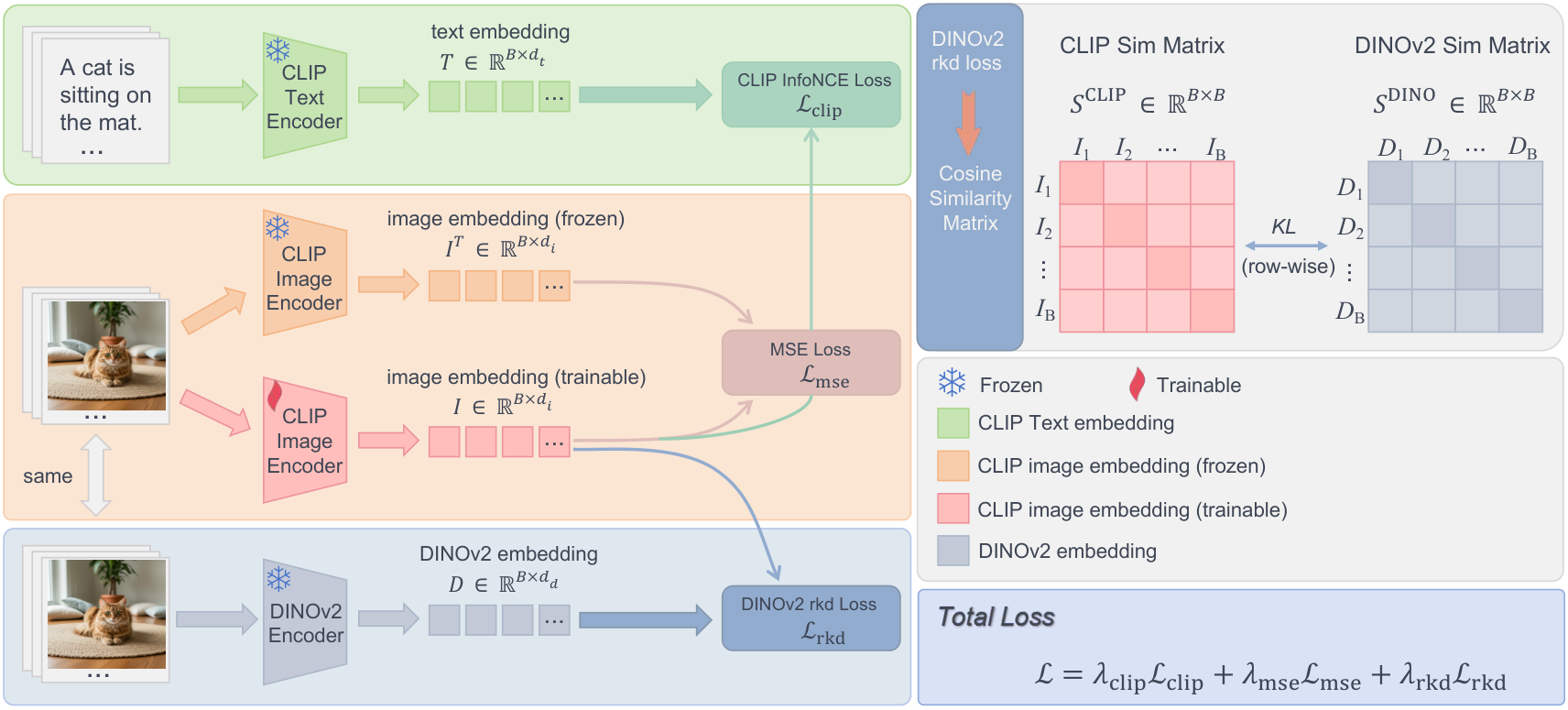
Building on these findings, ComCLIP is a lightweight single-epoch post-training recipe. It freezes the CLIP text encoder and trains only the vision encoder with three losses on the post-projection embedding:
$$ \mathcal{L}{\text{ComCLIP}} = \lambda{\text{clip}}\mathcal{L}{\text{clip}} + \lambda{\text{mse}}\mathcal{L}{\text{mse}} + \lambda{\text{rkd}}\mathcal{L}_{\text{rkd}} $$
| Loss | Role | Code |
|---|---|---|
| $\mathcal{L}_{\text{clip}}$ | Symmetric InfoNCE against the frozen text encoder, with $\tau$ fixed at 0.01 | --clip_weight, --scale, --scale_learn False |
| $\mathcal{L}_{\text{mse}}$ | MSE anchoring to a frozen copy of the original CLIP vision encoder | --fdimg_weight |
| $\mathcal{L}_{\text{rkd}}$ | Row-wise KL between batch similarity distributions of CLIP and DINOv2 ($T = 0.1$) | --dinorkd_weight |
The refined vision encoder has the same architecture and inference cost as the original. It is a drop-in replacement for CLIP, including inside LLaVA-1.5.
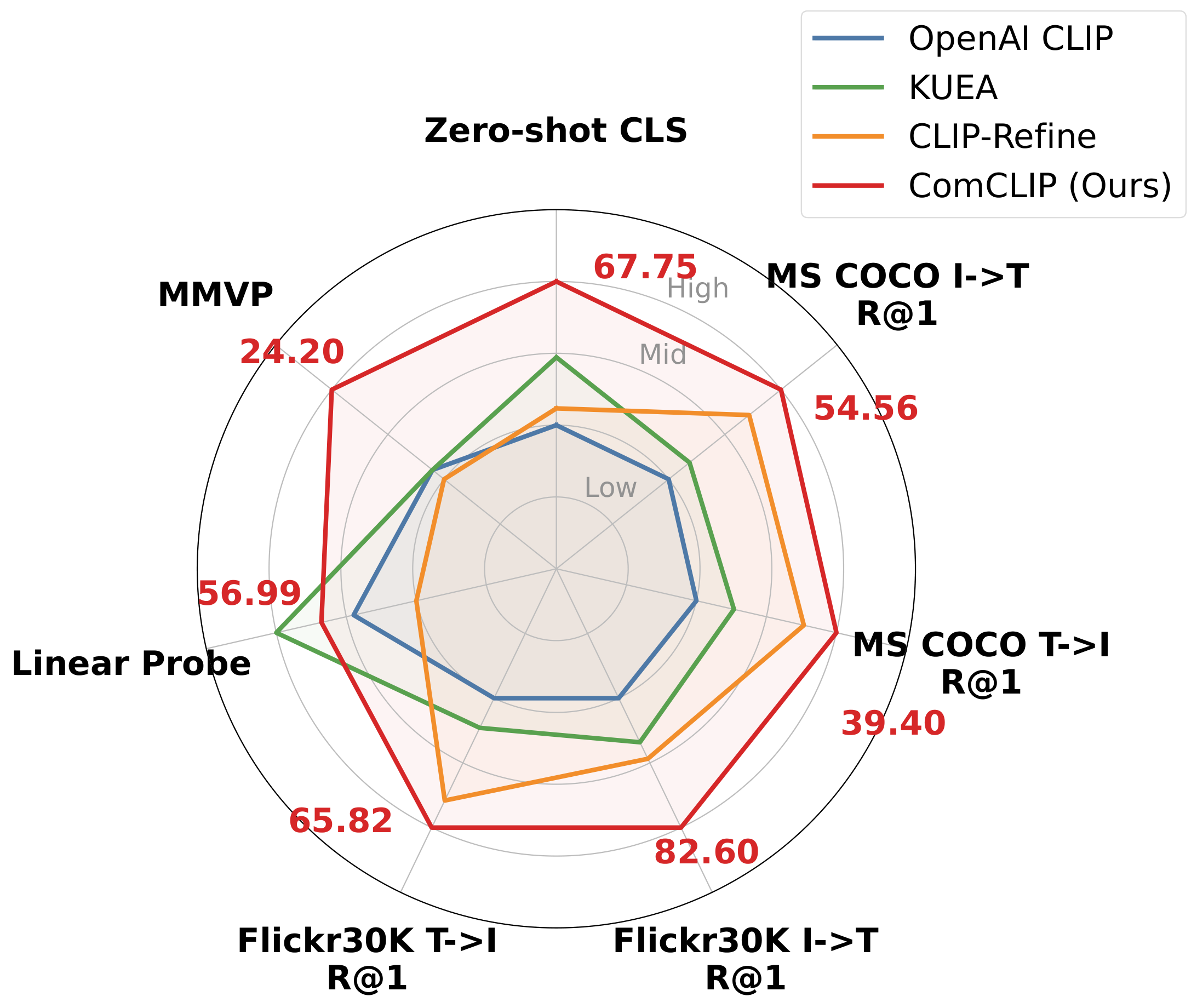
ViT-B/16 rows marked with ± are means over 3 seeds. CLIP-Refine and KUEA are each reported in their strongest setting; see the paper for dataset-matched comparisons.
| Backbone | Method | Zero-shot (12 avg) | COCO I→T | COCO T→I | Flickr I→T | Flickr T→I | Linear Probe (5 avg) | MMVP |
|---|---|---|---|---|---|---|---|---|
| ViT-B/16 | OpenAI CLIP | 61.82 | 48.16 | 31.47 | 74.70 | 57.10 | 44.70 | 12.59 |
| + KUEA (ImageNet-1K) | 62.07 | 48.48 | 31.99 | 75.00 | 57.62 | 44.65 | 11.85 | |
| + CLIP-Refine (COCO) | 62.87±0.11 | 54.17±0.28 | 37.72±0.07 | 81.30±0.40 | 64.45±0.21 | 42.28±0.62 | 16.05±1.14 | |
| + ComCLIP (CC3M) | 63.00±0.13 | 52.49±0.28 | 36.17±0.02 | 77.80±0.00 | 63.11±0.09 | 48.99±0.35 | 14.81±2.97 | |
| ViT-L/14 | OpenAI CLIP | 66.12 | 50.04 | 34.29 | 77.90 | 59.80 | 54.90 | 17.78 |
| + KUEA (ImageNet-1K) | 66.89 | 50.88 | 35.66 | 79.50 | 61.18 | 59.92 | 17.78 | |
| + CLIP-Refine (COCO) | 66.31 | 53.28 | 38.21 | 80.10 | 64.56 | 50.83 | 17.04 | |
| + ComCLIP (CC3M) | 67.75 | 54.56 | 39.40 | 82.60 | 65.82 | 56.99 | 24.20±0.86 |
When used as a drop-in vision encoder for LLaVA-1.5-7B, with the projector and LLM kept frozen, ComCLIP produces no net change across 8 VLM benchmarks (mean relative change +0.02%). The refinement does not break downstream compatibility.
git clone https://github.com/showstarpro/ComCLIP.git
cd ComCLIP
conda create -n comclip python=3.10
conda activate comclip

# PyTorch 2.0.1 + torchvision 0.15.2 (CUDA 11.8)
pip install torch==2.0.1 torchvision==0.15.2 --index-url https://download.pytorch.org/whl/cu118
pip install -r requirements.txt
The main dependencies are torch==2.0.1, torchvision==0.15.2, open-clip-torch==2.19.0, and
webdataset==0.2.48. If you cannot reach the PyTorch index, download the wheel for your platform
from https://download.pytorch.org/whl/cu118/torchvision/ and install it with
pip install torchvision-0.15.2+cu118-cp310-cp310-linux_x86_64.whl.
No weights are bundled with the repository. All of them are downloaded automatically on first use. For offline machines, download them in advance as described below.
OpenAI CLIP (student). OpenCLIP downloads the weights automatically when you pass
--pretrained openai. To pre-download them, run:
python -c "import open_clip; open_clip.create_model_and_transforms('ViT-B-16', pretrained='openai'); open_clip.create_model_and_transforms('ViT-L-14', pretrained='openai')"
DINOv2 (teacher). The teacher is loaded with
torch.hub.load('facebookresearch/dinov2', '<model_name>'), where --model_name defaults to
dinov2_vitl14_reg. This needs two items in the torch.hub cache (~/.cache/torch/hub by default,
or $TORCH_HOME/hub):
The DINOv2 code. We used commit
7b187bd.
Without internet access, torch.hub (torch 2.0.1) looks for it under the folder name
facebookresearch_dinov2_main:
mkdir -p ~/.cache/torch/hub && cd ~/.cache/torch/hub
wget https://github.com/facebookresearch/dinov2/archive/7b187bd4df8efce2cbcbbb67bd01532c19bf4c9c.zip -O dinov2.zip
unzip dinov2.zip && mv dinov2-7b187bd4df8efce2cbcbbb67bd01532c19bf4c9c facebookresearch_dinov2_main && rm dinov2.zip
The DINOv2 weights, from the official DINOv2 release:
mkdir -p ~/.cache/torch/hub/checkpoints && cd ~/.cache/torch/hub/checkpoints
# ViT-L/14 with registers (default teacher, used in the paper)
wget https://dl.fbaipublicfiles.com/dinov2/dinov2_vitl14/dinov2_vitl14_reg4_pretrain.pth
# ViT-B/14 with registers (optional, for --model_name dinov2_vitb14_reg)
wget https://dl.fbaipublicfiles.com/dinov2/dinov2_vitb14/dinov2_vitb14_reg4_pretrain.pth
| Dataset | Format | Arguments |
|---|---|---|
| CC3M | WebDataset shards | --dataset cc3m --wds_path ".../cc3m-train-{0000..0575}.tar" --wds_train_length 3000000 |
| CC12M | WebDataset shards | --dataset cc12m --wds_path ... |
| COCO Caption | train2017 images + captions_train2017.json | --dataset coco --coco_img_dir ... --coco_annotation_file ... |
--imagenet_root points to ImageNet-1K. It is only used for zero-shot monitoring during training.
The default ComCLIP recipe is 1 epoch on 8 GPUs with a global batch size of 1,024 (128 × 8). It uses AdamW (lr 1e-6, weight decay 0.1, 410 warm-up steps), a fixed $\tau = 0.01$, and all loss weights set to 1.0.
All experiments in the paper are wrapped in train.sh. Set the dataset and output paths at the top of the script, then run an experiment by name:
bash train.sh comclip_vitb16_cc3m              # ComCLIP, ViT-B/16, CC3M
bash train.sh comclip_vitl14_coco              # ComCLIP, ViT-L/14, COCO Caption
SEED=42 bash train.sh comclip_vitb16_cc3m      # another seed
bash train.sh                                  # list all experiments
| Experiment | Paper |
|---|---|
comclip_{vitb16,vitl14}_{cc3m,coco,cc12m} | Main results (Table 1) |
comclip_siglip_cc3m | SigLIP backbone (Appendix) |
clip_only_tau / clip_only_batch_size / clip_only_learnable_tau | Finding 1: temperature vs. batch size vs. learnability |
ablation_loss / ablation_loss_weights | Loss decoupling and loss weights |
ablation_teacher / ablation_before_proj / ablation_2ep | Teacher choice, $\mathcal{L}_{\text{rkd}}$ position, 2 epochs |
NUM_GPUS and BATCH_SIZE (per GPU) can be overridden from the environment. Keep their product at
1,024 to match the paper. For example, ComCLIP on ViT-B/16 and CC3M expands to:
torchrun --nproc_per_node=8 -m train.align_training_clip \
    --clip_model_name ViT-B-16 --pretrained openai \
    --dataset cc3m --wds_path "/path/to/data/cc3m/cc3m-train-{0000..0575}.tar" --wds_train_length 3000000 \
    --imagenet_root /path/to/data/imagenet-1k --template std --output_normalize False \
    --total_epochs 1 --warmup 410 --batch_size 128 --opt adamw --lr 1e-6 --wd 0.1 \
    --scale 0.01 --scale_learn False --seed 0 --wandb False \
    --output_dir /path/to/output --experiment_name comclip_vitb16_cc3m_seed0 \
    --log_freq 1 --eval_freq 10 \
    --clip_weight 1.0 --fdimg_weight 1.0 --dinorkd_weight 1.0
Key arguments:
--scale: the contrastive temperature $\tau$; the logit scale is $1/\tau$. Values with
$50 \le 1/\tau \le 200$ all improve zero-shot accuracy over the base model.--scale_learn False: keeps $\tau$ fixed during post-training.--clip_weight, --fdimg_weight, --dinorkd_weight: $\lambda_{\text{clip}}$,
$\lambda_{\text{mse}}$, and $\lambda_{\text{rkd}}$. Setting a weight to 0 gives the loss-decoupling
ablations from the paper.--oriclip: trains with $\mathcal{L}_{\text{clip}}$ only. Combine it with --scale for the
temperature study (Finding 1).--model_name: the DINOv2 teacher. The default is dinov2_vitl14_reg. Use
--vision_model mae for the MAE-Large teacher.--before_proj True: computes $\mathcal{L}_{\text{rkd}}$ on the pre-projection embedding (an
appendix ablation).The final checkpoint is saved to
<output_dir>/<model>_openai_<dataset>_..._<experiment_name>_<id>/checkpoints/final.pt.
The KUEA and CLIP-Refine baselines were reproduced with their official codebases and are not included in this repository.
We evaluate with a modified version of CLIP_benchmark.
cd CLIP_benchmark
Prepare the benchmark datasets in WebDataset format under CLIP_benchmark/datasets/. If they
already exist elsewhere, setup_dataset_symlinks.sh can
create the expected symlinks.
List the models to evaluate in benchmark/models.txt, one architecture,checkpoint pair per
line. Use openai for the original CLIP:
ViT-B-16,openai
ViT-B-16,/path/to/output/<run_name>/checkpoints/final.pt
Run the evaluation. Results are saved as JSON files under SAVE_DIR, which defaults to
results/:
SAVE_DIR=results/comclip ./bash/run_benchmark_clean.sh   # zero-shot classification (12 datasets, benchmark/datasets.txt)
SAVE_DIR=results/comclip ./bash/run_benchmark_rt.sh      # image-text retrieval on MS COCO and Flickr30K
SAVE_DIR=results/comclip ./bash/run_benchmark_lp.sh      # linear probing (5 datasets, benchmark/datasets_lp.txt)
To summarize the results into Markdown, CSV, and JSON tables, run:
python collect_results.py --result_dir results/comclip --model_file benchmark/models.txt \
    --output_dir output --add_openai_baseline
MMVP (MMVP-VLM):
python -m clip_benchmark.metrics.evaluate_mmvp \
    --model_name ViT-L-14 \
    --pretrained /path/to/output/<run_name>/checkpoints/final.pt \
    --benchmark_dir /path/to/MMVP_VLM
MMVP has only 135 image pairs, so one pair is 0.74 points. Report means over multiple seeds.
The evaluation datasets are:
To test drop-in compatibility, replace the vision tower of LLaVA-1.5-7B with a post-trained ViT-L/14
checkpoint, keeping the projector and LLM frozen, and evaluate on AI2D, POPE, RefCOCOg, V*, MME,
ScienceQA-IMG, OCRBench, and TextVQA. The LLaVA folder is adapted from the
official LLaVA repository. Set the --vision_tower field to
your checkpoint, and see LLaVA/scripts/v1_5/eval/ for the evaluation scripts.
Post-trained ComCLIP checkpoints (ViT-B/16 and ViT-L/14) will be released soon.
This codebase builds on KUEA, CLIP_benchmark, OpenCLIP, DINOv2, LLaVA, and OpenFlamingo. We thank the authors for releasing their code.
If you find this work useful, please cite:
@inproceedings{wang2026rethinking,
  title     = {Rethinking Contrastive Loss in CLIP Post-training: A Complementary Framework with Frozen Text Encoder},
  author    = {Wang, Zidan and Li, Yaqian and Zhang, Xiaokai and Long, Kaiwen and He, Kun and Liu, Hanpeng},
  booktitle = {Advances in Neural Information Processing Systems (NeurIPS)},
  year      = {2026}
}
[NeurIPS 2026] Official code for "Rethinking Contrastive Loss in CLIP Post-training". ComCLIP is a single-epoch recipe that freezes the text encoder and refines the CLIP vision encoder with contrastive (τ=0.01) + MSE anchoring + DINOv2 relational distillation.
See the codeOfficial implementation of the NeurIPS 2026 paper Rethinking Contrastive Loss in CLIP Post-training: A Complementary Framework with Frozen Text Encoder by Zidan Wang, Yaqian Li, Xiaokai Zhang, Kaiwen Long, Kun He, and Hanpeng Liu.
Recent CLIP post-training methods avoid the standard contrastive loss. They argue that small batches give too few negatives and cause catastrophic forgetting. We revisit this premise and find that, for InfoNCE, the forgetting comes mainly from the magnitude of the contrastive temperature $\tau$, not from batch size.
Building on these findings, ComCLIP is a lightweight single-epoch post-training recipe. It freezes the CLIP text encoder and trains only the vision encoder with three losses on the post-projection embedding:
$$ \mathcal{L}{\text{ComCLIP}} = \lambda{\text{clip}}\mathcal{L}{\text{clip}} + \lambda{\text{mse}}\mathcal{L}{\text{mse}} + \lambda{\text{rkd}}\mathcal{L}_{\text{rkd}} $$
| Loss | Role | Code |
|---|---|---|
| $\mathcal{L}_{\text{clip}}$ | Symmetric InfoNCE against the frozen text encoder, with $\tau$ fixed at 0.01 | --clip_weight, --scale, --scale_learn False |
| $\mathcal{L}_{\text{mse}}$ | MSE anchoring to a frozen copy of the original CLIP vision encoder | --fdimg_weight |
| $\mathcal{L}_{\text{rkd}}$ | Row-wise KL between batch similarity distributions of CLIP and DINOv2 ($T = 0.1$) | --dinorkd_weight |
The refined vision encoder has the same architecture and inference cost as the original. It is a drop-in replacement for CLIP, including inside LLaVA-1.5.
ViT-B/16 rows marked with ± are means over 3 seeds. CLIP-Refine and KUEA are each reported in their strongest setting; see the paper for dataset-matched comparisons.
| Backbone | Method | Zero-shot (12 avg) | COCO I→T | COCO T→I | Flickr I→T | Flickr T→I | Linear Probe (5 avg) | MMVP |
|---|---|---|---|---|---|---|---|---|
| ViT-B/16 | OpenAI CLIP | 61.82 | 48.16 | 31.47 | 74.70 | 57.10 | 44.70 | 12.59 |
| + KUEA (ImageNet-1K) | 62.07 | 48.48 | 31.99 | 75.00 | 57.62 | 44.65 | 11.85 | |
| + CLIP-Refine (COCO) | 62.87±0.11 | 54.17±0.28 | 37.72±0.07 | 81.30±0.40 | 64.45±0.21 | 42.28±0.62 | 16.05±1.14 | |
| + ComCLIP (CC3M) | 63.00±0.13 | 52.49±0.28 | 36.17±0.02 | 77.80±0.00 | 63.11±0.09 | 48.99±0.35 | 14.81±2.97 | |
| ViT-L/14 | OpenAI CLIP | 66.12 | 50.04 | 34.29 | 77.90 | 59.80 | 54.90 | 17.78 |
| + KUEA (ImageNet-1K) | 66.89 | 50.88 | 35.66 | 79.50 | 61.18 | 59.92 | 17.78 | |
| + CLIP-Refine (COCO) | 66.31 | 53.28 | 38.21 | 80.10 | 64.56 | 50.83 | 17.04 | |
| + ComCLIP (CC3M) | 67.75 | 54.56 | 39.40 | 82.60 | 65.82 | 56.99 | 24.20±0.86 |
When used as a drop-in vision encoder for LLaVA-1.5-7B, with the projector and LLM kept frozen, ComCLIP produces no net change across 8 VLM benchmarks (mean relative change +0.02%). The refinement does not break downstream compatibility.
git clone https://github.com/showstarpro/ComCLIP.git
cd ComCLIP
conda create -n comclip python=3.10
conda activate comclip

# PyTorch 2.0.1 + torchvision 0.15.2 (CUDA 11.8)
pip install torch==2.0.1 torchvision==0.15.2 --index-url https://download.pytorch.org/whl/cu118
pip install -r requirements.txt
The main dependencies are torch==2.0.1, torchvision==0.15.2, open-clip-torch==2.19.0, and
webdataset==0.2.48. If you cannot reach the PyTorch index, download the wheel for your platform
from https://download.pytorch.org/whl/cu118/torchvision/ and install it with
pip install torchvision-0.15.2+cu118-cp310-cp310-linux_x86_64.whl.
No weights are bundled with the repository. All of them are downloaded automatically on first use. For offline machines, download them in advance as described below.
OpenAI CLIP (student). OpenCLIP downloads the weights automatically when you pass
--pretrained openai. To pre-download them, run:
python -c "import open_clip; open_clip.create_model_and_transforms('ViT-B-16', pretrained='openai'); open_clip.create_model_and_transforms('ViT-L-14', pretrained='openai')"
DINOv2 (teacher). The teacher is loaded with
torch.hub.load('facebookresearch/dinov2', '<model_name>'), where --model_name defaults to
dinov2_vitl14_reg. This needs two items in the torch.hub cache (~/.cache/torch/hub by default,
or $TORCH_HOME/hub):
The DINOv2 code. We used commit
7b187bd.
Without internet access, torch.hub (torch 2.0.1) looks for it under the folder name
facebookresearch_dinov2_main:
mkdir -p ~/.cache/torch/hub && cd ~/.cache/torch/hub
wget https://github.com/facebookresearch/dinov2/archive/7b187bd4df8efce2cbcbbb67bd01532c19bf4c9c.zip -O dinov2.zip
unzip dinov2.zip && mv dinov2-7b187bd4df8efce2cbcbbb67bd01532c19bf4c9c facebookresearch_dinov2_main && rm dinov2.zip
The DINOv2 weights, from the official DINOv2 release:
mkdir -p ~/.cache/torch/hub/checkpoints && cd ~/.cache/torch/hub/checkpoints
# ViT-L/14 with registers (default teacher, used in the paper)
wget https://dl.fbaipublicfiles.com/dinov2/dinov2_vitl14/dinov2_vitl14_reg4_pretrain.pth
# ViT-B/14 with registers (optional, for --model_name dinov2_vitb14_reg)
wget https://dl.fbaipublicfiles.com/dinov2/dinov2_vitb14/dinov2_vitb14_reg4_pretrain.pth
| Dataset | Format | Arguments |
|---|---|---|
| CC3M | WebDataset shards | --dataset cc3m --wds_path ".../cc3m-train-{0000..0575}.tar" --wds_train_length 3000000 |
| CC12M | WebDataset shards | --dataset cc12m --wds_path ... |
| COCO Caption | train2017 images + captions_train2017.json | --dataset coco --coco_img_dir ... --coco_annotation_file ... |
--imagenet_root points to ImageNet-1K. It is only used for zero-shot monitoring during training.
The default ComCLIP recipe is 1 epoch on 8 GPUs with a global batch size of 1,024 (128 × 8). It uses AdamW (lr 1e-6, weight decay 0.1, 410 warm-up steps), a fixed $\tau = 0.01$, and all loss weights set to 1.0.
All experiments in the paper are wrapped in train.sh. Set the dataset and output paths at the top of the script, then run an experiment by name:
bash train.sh comclip_vitb16_cc3m              # ComCLIP, ViT-B/16, CC3M
bash train.sh comclip_vitl14_coco              # ComCLIP, ViT-L/14, COCO Caption
SEED=42 bash train.sh comclip_vitb16_cc3m      # another seed
bash train.sh                                  # list all experiments
| Experiment | Paper |
|---|---|
comclip_{vitb16,vitl14}_{cc3m,coco,cc12m} | Main results (Table 1) |
comclip_siglip_cc3m | SigLIP backbone (Appendix) |
clip_only_tau / clip_only_batch_size / clip_only_learnable_tau | Finding 1: temperature vs. batch size vs. learnability |
ablation_loss / ablation_loss_weights | Loss decoupling and loss weights |
ablation_teacher / ablation_before_proj / ablation_2ep | Teacher choice, $\mathcal{L}_{\text{rkd}}$ position, 2 epochs |
NUM_GPUS and BATCH_SIZE (per GPU) can be overridden from the environment. Keep their product at
1,024 to match the paper. For example, ComCLIP on ViT-B/16 and CC3M expands to:
torchrun --nproc_per_node=8 -m train.align_training_clip \
    --clip_model_name ViT-B-16 --pretrained openai \
    --dataset cc3m --wds_path "/path/to/data/cc3m/cc3m-train-{0000..0575}.tar" --wds_train_length 3000000 \
    --imagenet_root /path/to/data/imagenet-1k --template std --output_normalize False \
    --total_epochs 1 --warmup 410 --batch_size 128 --opt adamw --lr 1e-6 --wd 0.1 \
    --scale 0.01 --scale_learn False --seed 0 --wandb False \
    --output_dir /path/to/output --experiment_name comclip_vitb16_cc3m_seed0 \
    --log_freq 1 --eval_freq 10 \
    --clip_weight 1.0 --fdimg_weight 1.0 --dinorkd_weight 1.0
Key arguments:
--scale: the contrastive temperature $\tau$; the logit scale is $1/\tau$. Values with
$50 \le 1/\tau \le 200$ all improve zero-shot accuracy over the base model.--scale_learn False: keeps $\tau$ fixed during post-training.--clip_weight, --fdimg_weight, --dinorkd_weight: $\lambda_{\text{clip}}$,
$\lambda_{\text{mse}}$, and $\lambda_{\text{rkd}}$. Setting a weight to 0 gives the loss-decoupling
ablations from the paper.--oriclip: trains with $\mathcal{L}_{\text{clip}}$ only. Combine it with --scale for the
temperature study (Finding 1).--model_name: the DINOv2 teacher. The default is dinov2_vitl14_reg. Use
--vision_model mae for the MAE-Large teacher.--before_proj True: computes $\mathcal{L}_{\text{rkd}}$ on the pre-projection embedding (an
appendix ablation).The final checkpoint is saved to
<output_dir>/<model>_openai_<dataset>_..._<experiment_name>_<id>/checkpoints/final.pt.
The KUEA and CLIP-Refine baselines were reproduced with their official codebases and are not included in this repository.
We evaluate with a modified version of CLIP_benchmark.
cd CLIP_benchmark
Prepare the benchmark datasets in WebDataset format under CLIP_benchmark/datasets/. If they
already exist elsewhere, setup_dataset_symlinks.sh can
create the expected symlinks.
List the models to evaluate in benchmark/models.txt, one architecture,checkpoint pair per
line. Use openai for the original CLIP:
ViT-B-16,openai
ViT-B-16,/path/to/output/<run_name>/checkpoints/final.pt
Run the evaluation. Results are saved as JSON files under SAVE_DIR, which defaults to
results/:
SAVE_DIR=results/comclip ./bash/run_benchmark_clean.sh   # zero-shot classification (12 datasets, benchmark/datasets.txt)
SAVE_DIR=results/comclip ./bash/run_benchmark_rt.sh      # image-text retrieval on MS COCO and Flickr30K
SAVE_DIR=results/comclip ./bash/run_benchmark_lp.sh      # linear probing (5 datasets, benchmark/datasets_lp.txt)
To summarize the results into Markdown, CSV, and JSON tables, run:
python collect_results.py --result_dir results/comclip --model_file benchmark/models.txt \
    --output_dir output --add_openai_baseline
MMVP (MMVP-VLM):
python -m clip_benchmark.metrics.evaluate_mmvp \
    --model_name ViT-L-14 \
    --pretrained /path/to/output/<run_name>/checkpoints/final.pt \
    --benchmark_dir /path/to/MMVP_VLM
MMVP has only 135 image pairs, so one pair is 0.74 points. Report means over multiple seeds.
The evaluation datasets are:
To test drop-in compatibility, replace the vision tower of LLaVA-1.5-7B with a post-trained ViT-L/14
checkpoint, keeping the projector and LLM frozen, and evaluate on AI2D, POPE, RefCOCOg, V*, MME,
ScienceQA-IMG, OCRBench, and TextVQA. The LLaVA folder is adapted from the
official LLaVA repository. Set the --vision_tower field to
your checkpoint, and see LLaVA/scripts/v1_5/eval/ for the evaluation scripts.
Post-trained ComCLIP checkpoints (ViT-B/16 and ViT-L/14) will be released soon.
This codebase builds on KUEA, CLIP_benchmark, OpenCLIP, DINOv2, LLaVA, and OpenFlamingo. We thank the authors for releasing their code.
If you find this work useful, please cite:
@inproceedings{wang2026rethinking,
  title     = {Rethinking Contrastive Loss in CLIP Post-training: A Complementary Framework with Frozen Text Encoder},
  author    = {Wang, Zidan and Li, Yaqian and Zhang, Xiaokai and Long, Kaiwen and He, Kun and Liu, Hanpeng},
  booktitle = {Advances in Neural Information Processing Systems (NeurIPS)},
  year      = {2026}
}



