
Deterministic scanner that deletes tests that can never fail — asks the type checker instead of an LLM. TypeScript (Jest/Vitest/bun:test) + Python (pytest/mypy).
Python
13
81 commits
updated Sep 30, 2026
See what people are saying
README
Captain Obvious 🫡

AI agents write tests that can never fail. This skill deletes them.
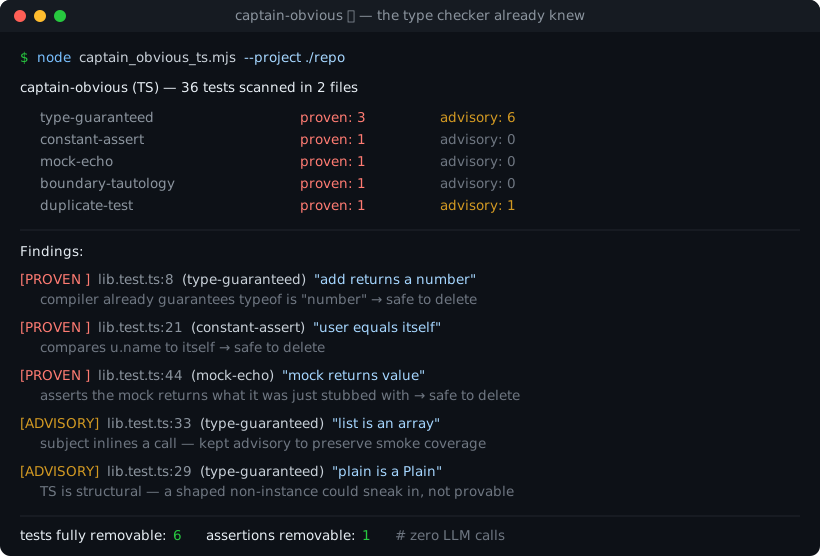
Every AI-generated test suite has them:
assert isinstance(add(1, 2), int) # the function is typed `-> int`. mypy knew.
expect(true).toBe(true); // bold claim
Tests like these can't catch a regression — they re-assert what the compiler already proved, or assert nothing at all. They burn CI minutes and inflate coverage into false confidence. Empirical studies find test smells in 38–100% of LLM-generated test suites.
🧠 The idea: ask the type checker, not another LLM
Detection is fully deterministic — no LLM in the loop, one script invocation per repo. Instead of asking an AI "is this test useful?", it asks the tools that already know:
- TypeScript: the project's own compiler API answers "what is the static
type of this expression?" — if
typeof result === 'number'is a fact of the type, the assertion is not a test. Plain-JS test files (.test.jsetc.) get the syntactic categories;type-guaranteedneeds TypeScript (or stays off withoutcheckJs). - Python: batched
mypy reveal_typeprobes (one mypy run for the whole repo) answer the same forisinstance(...)andis not None. - AST passes catch the rest: tautologies, mock-echo tests, assertions after
a
return, assertions swallowed by emptycatch/except: pass, duplicate bodies,len(x) >= 0.
✅ Proven vs ⚠️ advisory
Every finding is one of two tiers, and each tier is handled by whoever can actually decide it:
- proven — cannot fail, by construction. Auto-deleted by
--fix, no LLM involved. The scripts guard every known way types lie:any/unknown,ascasts, non-null!, index signatures, unchecked index access, structuralinstanceof(only nominal classes are provable),cast()/type: ignore. - advisory — almost certainly useless but not provable (structural
instanceof, mock-echo variants,pytest.raises(Exception), unawaited async assertions, rotten-green conditional asserts). The script writes down exactly why it's uncertain, and the coding agent running the skill adjudicates each one against the surrounding code — delete, keep, or rewrite — then proposes the calls for your approval before touching anything.
It also knows what not to flag: toBeDefined() on .find() results
(T | undefined — a real check), enum contract locks, custom assertion
helpers, deliberate determinism tests, and "must not raise" contract tests.
✍️ Before writing or removing a test
The skill now asks four questions the scanner cannot answer: What observable contract does the test protect? What regression would make it fail? Is that contract already covered at a stronger boundary? Does the test require a production seam used only by tests? For bug regressions, run the test against the pre-fix behavior when safe to confirm it fails for the intended reason.
This review catches leads such as copied implementation expectations, source
greps, and mocks that supply the asserted outcome. They require reading the
production path and existing tests; none become automatic deletions. See the
authoring gate and
prevention examples.
📊 Real-world results
- Internal repo, ~1,800 pytest tests: 124 lines deleted across 21 files — 111 assertions re-checking what mypy already guaranteed, plus one all-constant test. Type-checker and full CI green before and after; change auto-approved.
- TypeScript CLI repo, ~730 tests: zero deletions (it doesn't invent work)
— but it caught a real bug: a
.rejects.toThrow(...)neverawaited, so it silently never ran.
The honest headline isn't a line count — it's that --fix only removes what it
can prove, so whatever it deletes could never have caught a regression. Clone
it and run it on your own repo.
🚀 Install & use
npx skills add shmulc8/captain-obvious@captain-obvious
Also ships a .claude-plugin/plugin.json manifest, or copy
skills/captain-obvious/ into ~/.claude/skills/. Then ask your agent to
"clean up the useless tests" — or run the scanners directly:
# report-only (add --json out.json to save)
node    skills/captain-obvious/scripts/captain_obvious_ts.mjs --project <repo>
python3 skills/captain-obvious/scripts/captain_obvious_py.py  --path <repo> --mypy "uv run mypy"

# delete proven findings (needs a clean git tree — review the diff after)
node ... --fix

# confirm rotten-green asserts against real coverage (lcov / istanbul / coverage.py)
node    ... --coverage coverage/lcov.info
python3 ... --coverage coverage.json
With --coverage, a conditional-assert whose line never executed is promoted
to proven rotten; one that did execute is a confirmed false positive and is
dropped — the dynamic half of the ICSE'19 analysis, using coverage your runner
already emits.
Trust boundary: the scan runs the project's own toolchain — mypy (with whatever plugins the repo's config loads),
uv/poetryenvironments, the repo's owntypescriptpackage. Treat scanning like running the repo's type checker: only do it on code you trust.
Requires Python ≥ 3.9 for the Python scanner and hook; the TS scanner uses the target repo's own typescript and requires ≥ 4.0.
🛡️ Prevention (write-time hook)
Removing dead tests after the fact pays for them twice — once to write them,
once to clean them up. Installed as a plugin, captain-obvious also ships a
PreToolUse hook that catches them before they land: whenever the agent
writes or edits a test file, the pending content runs through a fast
syntactic-only single-file scan (--file --stdin; no mypy, no tsc, no
side effects), and the call is denied with a per-finding reason if it
would introduce proven can-never-fail patterns. The agent fixes the test on
the spot.
- Proven, newly-introduced findings only. Advisories never block, and a pre-existing finding elsewhere in the file never blocks an unrelated edit. TDD red is safe: a deliberately failing test is not a can-never-fail test.
- Fails open, always. Missing node, scanner crash, timeout, huge or syntactically-broken content — the write goes through.
- Configurable:
CAPTAIN_OBVIOUS_HOOK=off(default) |block|warn. - Skill-only installs (
npx skills add) don't get hooks — paste the test-writing rules fromskills/captain-obvious/references/prevention.mdinto yourCLAUDE.mdinstead.
CI gate (--check --base <ref>)
The write-time hook only fires inside an agent session. --check --base <ref>
is the CI twin of that hook — a correctness gate on new dead tests, not a
CI-time coverage optimizer. It is report-only (never writes; --check --fix is
rejected) and exits 1 only when a proven syntactic finding is newly
introduced vs <ref> in a changed test file — pre-existing findings never
gate, and it excludes type-guaranteed findings (the base-side scan is
syntactic-only). Any git trouble other than "file absent in base" (bad ref,
shallow clone, diff failure) fails open: a captain-obvious: note to stderr
and exit 0, so the tool can never invent a CI failure.
# .github/workflows/captain-obvious.yml
- uses: actions/checkout@v4
  with: { fetch-depth: 0 }        # need history to diff against the base
- uses: <owner>/captain-obvious@main
  with:
    base: ${{ github.event.pull_request.base.sha }}   # default: origin/main
A .pre-commit-hooks.yaml (id: captain-obvious-check, --base HEAD) ships
for pre-commit users. Both wrappers run --no-types for speed and syntactic
parity with the comparison.
🔍 Detector catalog
| Category | Example | Level |
|---|---|---|
type-guaranteed | expect(typeof f()).toBe('number') when f(): number; assert x is not None on non-Optional | proven |
constant-assert | expect(true).toBe(true), assert x == x (incl. self.assertEqual(1, 1)-style unittest assert-methods, report-only) | proven |
boundary-tautology | expect(arr.length).toBeGreaterThanOrEqual(0) | proven |
local-const-echo | const expected = 5; expect(expected).toBe(5) | proven |
mock-echo | stub returns 5 → assert it returns 5 | proven / advisory |
dead-assert / swallowed-assert / never-asserts | assertion after return, or inside try {} catch {} | proven |
missed-fail | a forced-fail marker (pytest.fail() / throw new Error) stuck in dead code — can never fire | proven |
missed-skip | a conditional early return/skip above the asserts — if it fires, they never run | advisory |
duplicate-test | identical body in the same suite | proven |
silent-smoke | assertion-free test whose every call is silently try/caught — or that contains no calls at all — it can do nothing and can never fail | proven |
no-assert | no assertion anywhere — a smoke test (legit by design, per ICSE '19), surfaced not deleted | advisory |
conditional-assert | assertion gated behind if — rotten green (ICSE '19) | advisory |
floating-async-assert | unawaited expect(p).rejects... (silent pass under Jest) | advisory |
smoke-only | expect(fn).not.toThrow() as the only check | advisory |
self-compare-call | expect(f(a)).toEqual(f(a)) | advisory |
broad-raises | pytest.raises(Exception) as the only check | advisory |
skipped-test | it.skip / xit / @pytest.mark.skip — never runs | advisory |
Full semantics, escape hatches, and false-positive guards — plus the academic
grounding (the rotten-green lineage: Delplanque ICSE '19 → RTj Java '19 →
Robinson ESEC/FSE '23 Google Test, which this tool extends to TS + Python) —
are in references/detectors.md.
⚠️ Honest limitations
- Cannot catch weak-but-executing assertions (
result.length >= 0is caught,result.length < 1e9is not) — only mutation testing proves those useless. - Cross-file duplicates are advisory-only; coverage-subsumption is out of scope.
- Dynamically-built assertions are invisible.
- "Deleted nothing" does not mean "your suite is sound."
Similar repos


Languages
Python
73.2%
JavaScript
26.8%
Deterministic scanner that deletes tests that can never fail — asks the type checker instead of an LLM. TypeScript (Jest/Vitest/bun:test) + Python (pytest/mypy).
Python
13
81 commits
updated Sep 30, 2026
See what people are saying
README
Captain Obvious 🫡
AI agents write tests that can never fail. This skill deletes them.
Every AI-generated test suite has them:
assert isinstance(add(1, 2), int) # the function is typed `-> int`. mypy knew.
expect(true).toBe(true); // bold claim
Tests like these can't catch a regression — they re-assert what the compiler already proved, or assert nothing at all. They burn CI minutes and inflate coverage into false confidence. Empirical studies find test smells in 38–100% of LLM-generated test suites.
🧠 The idea: ask the type checker, not another LLM
Detection is fully deterministic — no LLM in the loop, one script invocation per repo. Instead of asking an AI "is this test useful?", it asks the tools that already know:
- TypeScript: the project's own compiler API answers "what is the static
type of this expression?" — if
typeof result === 'number'is a fact of the type, the assertion is not a test. Plain-JS test files (.test.jsetc.) get the syntactic categories;type-guaranteedneeds TypeScript (or stays off withoutcheckJs). - Python: batched
mypy reveal_typeprobes (one mypy run for the whole repo) answer the same forisinstance(...)andis not None. - AST passes catch the rest: tautologies, mock-echo tests, assertions after
a
return, assertions swallowed by emptycatch/except: pass, duplicate bodies,len(x) >= 0.
✅ Proven vs ⚠️ advisory
Every finding is one of two tiers, and each tier is handled by whoever can actually decide it:
- proven — cannot fail, by construction. Auto-deleted by
--fix, no LLM involved. The scripts guard every known way types lie:any/unknown,ascasts, non-null!, index signatures, unchecked index access, structuralinstanceof(only nominal classes are provable),cast()/type: ignore. - advisory — almost certainly useless but not provable (structural
instanceof, mock-echo variants,pytest.raises(Exception), unawaited async assertions, rotten-green conditional asserts). The script writes down exactly why it's uncertain, and the coding agent running the skill adjudicates each one against the surrounding code — delete, keep, or rewrite — then proposes the calls for your approval before touching anything.
It also knows what not to flag: toBeDefined() on .find() results
(T | undefined — a real check), enum contract locks, custom assertion
helpers, deliberate determinism tests, and "must not raise" contract tests.
✍️ Before writing or removing a test
The skill now asks four questions the scanner cannot answer: What observable contract does the test protect? What regression would make it fail? Is that contract already covered at a stronger boundary? Does the test require a production seam used only by tests? For bug regressions, run the test against the pre-fix behavior when safe to confirm it fails for the intended reason.
This review catches leads such as copied implementation expectations, source
greps, and mocks that supply the asserted outcome. They require reading the
production path and existing tests; none become automatic deletions. See the
authoring gate and
prevention examples.
📊 Real-world results
- Internal repo, ~1,800 pytest tests: 124 lines deleted across 21 files — 111 assertions re-checking what mypy already guaranteed, plus one all-constant test. Type-checker and full CI green before and after; change auto-approved.
- TypeScript CLI repo, ~730 tests: zero deletions (it doesn't invent work)
— but it caught a real bug: a
.rejects.toThrow(...)neverawaited, so it silently never ran.
The honest headline isn't a line count — it's that --fix only removes what it
can prove, so whatever it deletes could never have caught a regression. Clone
it and run it on your own repo.
🚀 Install & use
npx skills add shmulc8/captain-obvious@captain-obvious
Also ships a .claude-plugin/plugin.json manifest, or copy
skills/captain-obvious/ into ~/.claude/skills/. Then ask your agent to
"clean up the useless tests" — or run the scanners directly:
# report-only (add --json out.json to save)
node    skills/captain-obvious/scripts/captain_obvious_ts.mjs --project <repo>
python3 skills/captain-obvious/scripts/captain_obvious_py.py  --path <repo> --mypy "uv run mypy"

# delete proven findings (needs a clean git tree — review the diff after)
node ... --fix

# confirm rotten-green asserts against real coverage (lcov / istanbul / coverage.py)
node    ... --coverage coverage/lcov.info
python3 ... --coverage coverage.json
With --coverage, a conditional-assert whose line never executed is promoted
to proven rotten; one that did execute is a confirmed false positive and is
dropped — the dynamic half of the ICSE'19 analysis, using coverage your runner
already emits.
Trust boundary: the scan runs the project's own toolchain — mypy (with whatever plugins the repo's config loads),
uv/poetryenvironments, the repo's owntypescriptpackage. Treat scanning like running the repo's type checker: only do it on code you trust.
Requires Python ≥ 3.9 for the Python scanner and hook; the TS scanner uses the target repo's own typescript and requires ≥ 4.0.
🛡️ Prevention (write-time hook)
Removing dead tests after the fact pays for them twice — once to write them,
once to clean them up. Installed as a plugin, captain-obvious also ships a
PreToolUse hook that catches them before they land: whenever the agent
writes or edits a test file, the pending content runs through a fast
syntactic-only single-file scan (--file --stdin; no mypy, no tsc, no
side effects), and the call is denied with a per-finding reason if it
would introduce proven can-never-fail patterns. The agent fixes the test on
the spot.
- Proven, newly-introduced findings only. Advisories never block, and a pre-existing finding elsewhere in the file never blocks an unrelated edit. TDD red is safe: a deliberately failing test is not a can-never-fail test.
- Fails open, always. Missing node, scanner crash, timeout, huge or syntactically-broken content — the write goes through.
- Configurable:
CAPTAIN_OBVIOUS_HOOK=off(default) |block|warn. - Skill-only installs (
npx skills add) don't get hooks — paste the test-writing rules fromskills/captain-obvious/references/prevention.mdinto yourCLAUDE.mdinstead.
CI gate (--check --base <ref>)
The write-time hook only fires inside an agent session. --check --base <ref>
is the CI twin of that hook — a correctness gate on new dead tests, not a
CI-time coverage optimizer. It is report-only (never writes; --check --fix is
rejected) and exits 1 only when a proven syntactic finding is newly
introduced vs <ref> in a changed test file — pre-existing findings never
gate, and it excludes type-guaranteed findings (the base-side scan is
syntactic-only). Any git trouble other than "file absent in base" (bad ref,
shallow clone, diff failure) fails open: a captain-obvious: note to stderr
and exit 0, so the tool can never invent a CI failure.
# .github/workflows/captain-obvious.yml
- uses: actions/checkout@v4
  with: { fetch-depth: 0 }        # need history to diff against the base
- uses: <owner>/captain-obvious@main
  with:
    base: ${{ github.event.pull_request.base.sha }}   # default: origin/main
A .pre-commit-hooks.yaml (id: captain-obvious-check, --base HEAD) ships
for pre-commit users. Both wrappers run --no-types for speed and syntactic
parity with the comparison.
🔍 Detector catalog
| Category | Example | Level |
|---|---|---|
type-guaranteed | expect(typeof f()).toBe('number') when f(): number; assert x is not None on non-Optional | proven |
constant-assert | expect(true).toBe(true), assert x == x (incl. self.assertEqual(1, 1)-style unittest assert-methods, report-only) | proven |
boundary-tautology | expect(arr.length).toBeGreaterThanOrEqual(0) | proven |
local-const-echo | const expected = 5; expect(expected).toBe(5) | proven |
mock-echo | stub returns 5 → assert it returns 5 | proven / advisory |
dead-assert / swallowed-assert / never-asserts | assertion after return, or inside try {} catch {} | proven |
missed-fail | a forced-fail marker (pytest.fail() / throw new Error) stuck in dead code — can never fire | proven |
missed-skip | a conditional early return/skip above the asserts — if it fires, they never run | advisory |
duplicate-test | identical body in the same suite | proven |
silent-smoke | assertion-free test whose every call is silently try/caught — or that contains no calls at all — it can do nothing and can never fail | proven |
no-assert | no assertion anywhere — a smoke test (legit by design, per ICSE '19), surfaced not deleted | advisory |
conditional-assert | assertion gated behind if — rotten green (ICSE '19) | advisory |
floating-async-assert | unawaited expect(p).rejects... (silent pass under Jest) | advisory |
smoke-only | expect(fn).not.toThrow() as the only check | advisory |
self-compare-call | expect(f(a)).toEqual(f(a)) | advisory |
broad-raises | pytest.raises(Exception) as the only check | advisory |
skipped-test | it.skip / xit / @pytest.mark.skip — never runs | advisory |
Full semantics, escape hatches, and false-positive guards — plus the academic
grounding (the rotten-green lineage: Delplanque ICSE '19 → RTj Java '19 →
Robinson ESEC/FSE '23 Google Test, which this tool extends to TS + Python) —
are in references/detectors.md.
⚠️ Honest limitations
- Cannot catch weak-but-executing assertions (
result.length >= 0is caught,result.length < 1e9is not) — only mutation testing proves those useless. - Cross-file duplicates are advisory-only; coverage-subsumption is out of scope.
- Dynamically-built assertions are invisible.
- "Deleted nothing" does not mean "your suite is sound."
Similar repos
Languages
Python
73.2%
JavaScript
26.8%