
README
FronTalk
Benchmarking Front-End Development as Conversational Code Generation with Multi-Modal Feedback
🌐 Project | 🤗 Dataset | 📖 Paper
🎉 FronTalk has been accepted to CoLM 2026! 🎉
Outline:
Introduction
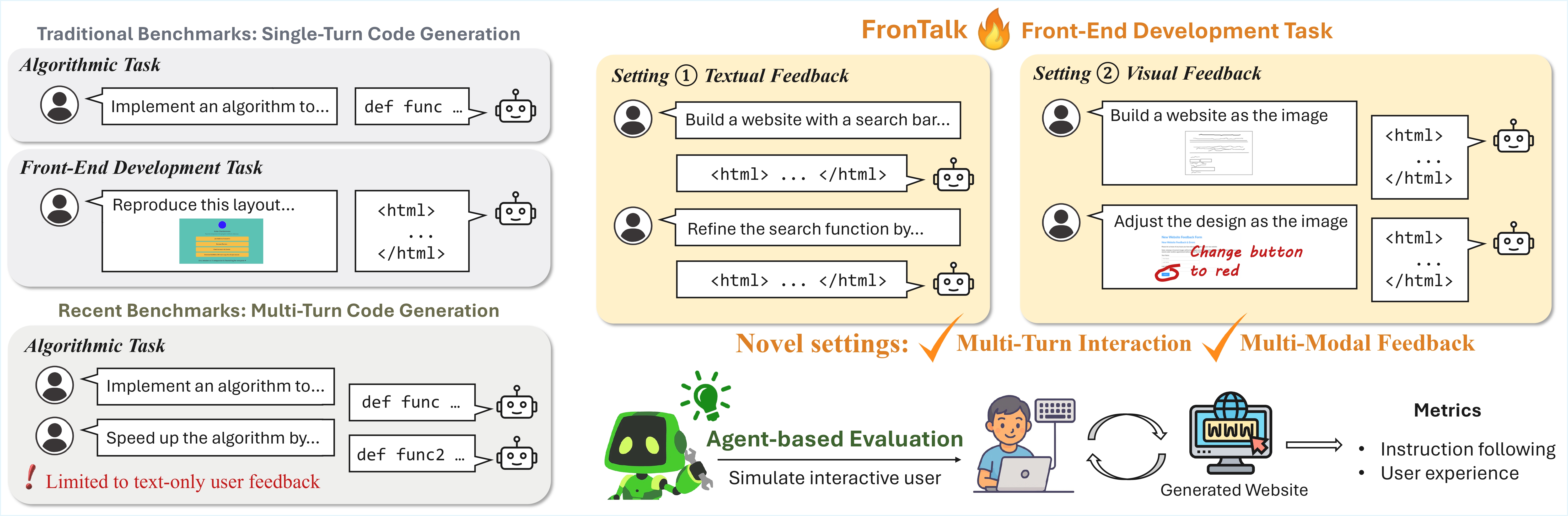
FronTalk is the first multi-turn benchmark for front-end coding, featuring:
- 1000 turns across 100 dialogues, consisting derived from real-world websites across diverse domains, and 3676 test cases to evaluate instruction following accuracy.
- User simulator powered by LLM to produce either textual or visual user instructions based on pre-curated user intents and dynamic conversational context.
- Agent-based evaluation that uses a web agent to evaluate pass rate (based on test cases) and user experience.
Data
The data is in the repo here and at huggingface. The data structure is as follows. Each data contains a summary of website goal, 10 turns of user intents, and the test cases associated with each turn.
{
  "id": "e4aa9d67d4a5e40cdffac7a3429994a8.html",
  "summary": {
    "purpose": "The website serves as an informational and promotional platform for PET Engineering College, providing..."
  },
  "cases": [
    {
      "instructions": "Build a website for PET Engineering College to serve as an informational and promotional hub. Include an \"Event Calendar\"...",
      "test_conditions": [
        {
          "condition": "Verify that the \"Event Calendar\" page is accessible from the homepage.",
          "pass": "The \"Event Calendar\" page is accessible from the homepage via clicking specific links or buttons.",
          "fail": "The page is missing or not accessible from the homepage."
        },
        ...CASES...
      ]
    },
    ...TURNS... (In total: 10 turns)
  ]
}
Installation
To setup pip environment:
pip install -r requirements.txt
If you don't have built-in Chrome, you may need to install chrome by testing manually, and pass the location to chrome and chromedriver to function def get_default_driver in webvoyager/run.py as arguments binary_location and service_location. You may also set environment path CHROME_BINARY and CHROME_DRIVER and the script will automatically access the path.
Additionally, please check that your system has font for emojis (as they are usually needed for front-end development). For example, you can install Noto Color Emoji by sudo apt install fonts-noto-color-emoji.
Note that this requirement does not include requirements for fast serving frameworks such as vllm, lmdeploy and sglang. To install these packages, please install pytorch and vllm according to their documentations.
Code
Inference
Run inference by python infer_multiturn_textual.py for textual instructions or python infer_multiturn_visual.py for visual instructions. The code will use openai.OpenAI client to request OpenAI server or OpenAI-compatible servers (e.g. served by vLLM).
Command line args:
out_dirname: output dirname. The intermediate outputs from each turn will be stored underout_dirname/t.?/. The final output will beout_dirname/t.9/.--local_openai_key: your openai or gemini API key. If left empty, the code will use theOPENAI_API_KEYenvironment argument.--local_openai_port: one or multiple ports, if you're serving your own LLM server (e.g. via vLLM). If left empty, the client will request openai's server and models.--openai_model: model to request. Update: we recommend users to usegemini-3.0-flash-previewfor visual simulator, rather than using defaultgpt-4o.
If you want to adapt to more clients, e.g. anthropic's claude client, you should modify def request_ in utils.py.
Calculation of Pass Rate and Forgetting
Run the following command:
python evaluate_all.py out_dirname
NOTE: please use out_dirname (not out_dirname/t.9/!)
The script will call openai_model (by default gpt-4o) to perform agent-based evaluation. It will first evaluate the pass rate of the final output out_dirname/t.9, and then evaluate the performance of each intermediate outputs (i.e. out_dirname/t.?) and calculate forgetting rate.
Calculation of Usability
Run the following command:
python usability.py out_dirname/t.9
NOTE: please use out_dirname/t.9/ (not out_dirname/!)
ACECoder
ACECoder employs agent-based critique to enhance user instructions, as in the image.
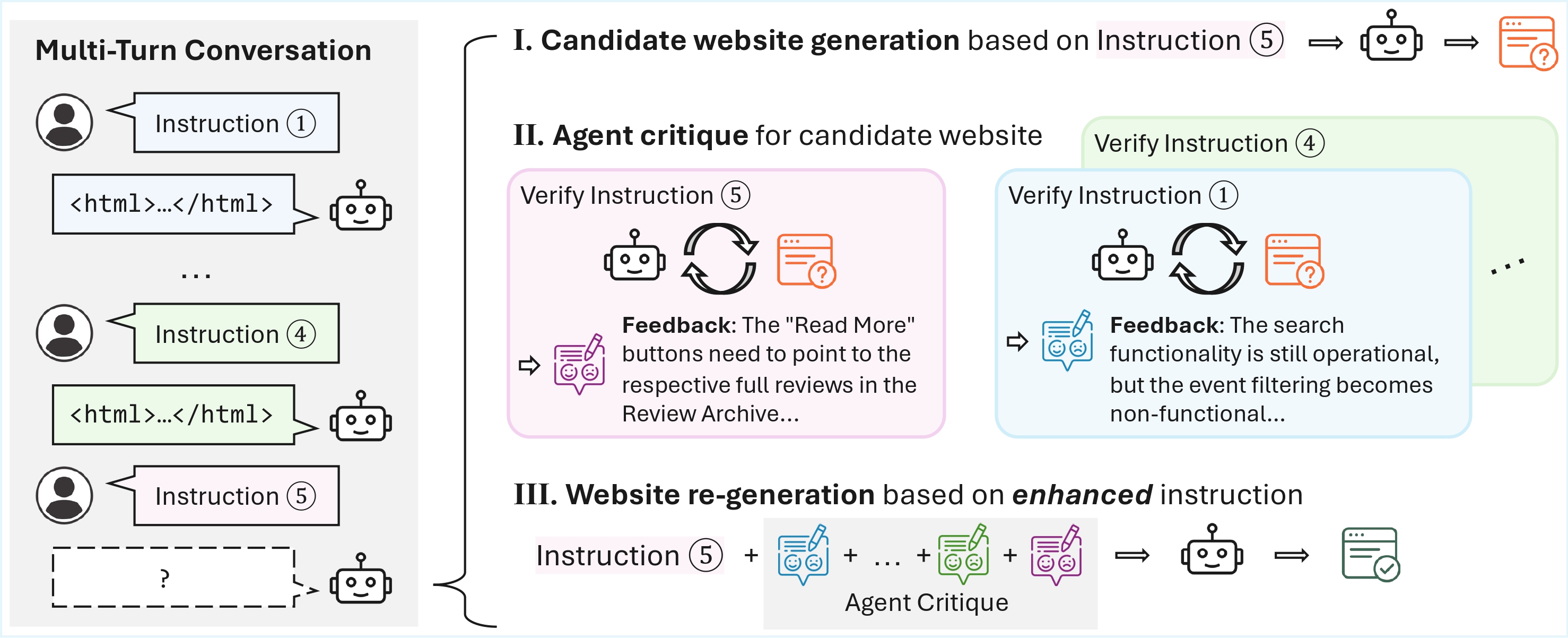
To run ACECoder, run python infer_acecoder_textual.py or python infer_acecoder_visual.py. The arguments are the same as infer_multiturn_{textual|visual}.py
Citation
Please cite our paper if this repository inspires your work!
@misc{wu2026frontalkbenchmarkingfrontenddevelopment,
      title={FronTalk: Benchmarking Front-End Development as Conversational Code Generation with Multi-Modal Feedback},
      author={Xueqing Wu and Zihan Xue and Da Yin and Shuyan Zhou and Kai-Wei Chang and Nanyun Peng and Yeming Wen},
      year={2026},
      eprint={2601.04203},
      archivePrefix={arXiv},
      primaryClass={cs.CL},
      url={https://arxiv.org/abs/2601.04203},
}
Contributors

3 commits
Similar repos






Languages
HTML
71.9%
Python
12.2%
CSS
12.1%
JavaScript
3.7%
README
FronTalk
Benchmarking Front-End Development as Conversational Code Generation with Multi-Modal Feedback
🌐 Project | 🤗 Dataset | 📖 Paper
🎉 FronTalk has been accepted to CoLM 2026! 🎉
Outline:
Introduction
FronTalk is the first multi-turn benchmark for front-end coding, featuring:
- 1000 turns across 100 dialogues, consisting derived from real-world websites across diverse domains, and 3676 test cases to evaluate instruction following accuracy.
- User simulator powered by LLM to produce either textual or visual user instructions based on pre-curated user intents and dynamic conversational context.
- Agent-based evaluation that uses a web agent to evaluate pass rate (based on test cases) and user experience.
Data
The data is in the repo here and at huggingface. The data structure is as follows. Each data contains a summary of website goal, 10 turns of user intents, and the test cases associated with each turn.
{
  "id": "e4aa9d67d4a5e40cdffac7a3429994a8.html",
  "summary": {
    "purpose": "The website serves as an informational and promotional platform for PET Engineering College, providing..."
  },
  "cases": [
    {
      "instructions": "Build a website for PET Engineering College to serve as an informational and promotional hub. Include an \"Event Calendar\"...",
      "test_conditions": [
        {
          "condition": "Verify that the \"Event Calendar\" page is accessible from the homepage.",
          "pass": "The \"Event Calendar\" page is accessible from the homepage via clicking specific links or buttons.",
          "fail": "The page is missing or not accessible from the homepage."
        },
        ...CASES...
      ]
    },
    ...TURNS... (In total: 10 turns)
  ]
}
Installation
To setup pip environment:
pip install -r requirements.txt
If you don't have built-in Chrome, you may need to install chrome by testing manually, and pass the location to chrome and chromedriver to function def get_default_driver in webvoyager/run.py as arguments binary_location and service_location. You may also set environment path CHROME_BINARY and CHROME_DRIVER and the script will automatically access the path.
Additionally, please check that your system has font for emojis (as they are usually needed for front-end development). For example, you can install Noto Color Emoji by sudo apt install fonts-noto-color-emoji.
Note that this requirement does not include requirements for fast serving frameworks such as vllm, lmdeploy and sglang. To install these packages, please install pytorch and vllm according to their documentations.
Code
Inference
Run inference by python infer_multiturn_textual.py for textual instructions or python infer_multiturn_visual.py for visual instructions. The code will use openai.OpenAI client to request OpenAI server or OpenAI-compatible servers (e.g. served by vLLM).
Command line args:
out_dirname: output dirname. The intermediate outputs from each turn will be stored underout_dirname/t.?/. The final output will beout_dirname/t.9/.--local_openai_key: your openai or gemini API key. If left empty, the code will use theOPENAI_API_KEYenvironment argument.--local_openai_port: one or multiple ports, if you're serving your own LLM server (e.g. via vLLM). If left empty, the client will request openai's server and models.--openai_model: model to request. Update: we recommend users to usegemini-3.0-flash-previewfor visual simulator, rather than using defaultgpt-4o.
If you want to adapt to more clients, e.g. anthropic's claude client, you should modify def request_ in utils.py.
Calculation of Pass Rate and Forgetting
Run the following command:
python evaluate_all.py out_dirname
NOTE: please use out_dirname (not out_dirname/t.9/!)
The script will call openai_model (by default gpt-4o) to perform agent-based evaluation. It will first evaluate the pass rate of the final output out_dirname/t.9, and then evaluate the performance of each intermediate outputs (i.e. out_dirname/t.?) and calculate forgetting rate.
Calculation of Usability
Run the following command:
python usability.py out_dirname/t.9
NOTE: please use out_dirname/t.9/ (not out_dirname/!)
ACECoder
ACECoder employs agent-based critique to enhance user instructions, as in the image.
To run ACECoder, run python infer_acecoder_textual.py or python infer_acecoder_visual.py. The arguments are the same as infer_multiturn_{textual|visual}.py
Citation
Please cite our paper if this repository inspires your work!
@misc{wu2026frontalkbenchmarkingfrontenddevelopment,
      title={FronTalk: Benchmarking Front-End Development as Conversational Code Generation with Multi-Modal Feedback},
      author={Xueqing Wu and Zihan Xue and Da Yin and Shuyan Zhou and Kai-Wei Chang and Nanyun Peng and Yeming Wen},
      year={2026},
      eprint={2601.04203},
      archivePrefix={arXiv},
      primaryClass={cs.CL},
      url={https://arxiv.org/abs/2601.04203},
}
Similar repos
Contributors
3 commits
Languages
HTML
71.9%
Python
12.2%
CSS
12.1%
JavaScript
3.7%