Diagnostic Reasoning Knowledge Graph for Large Language Model Diagnosis Prediction
Python
40
24 commits
updated Jul 16, 2025
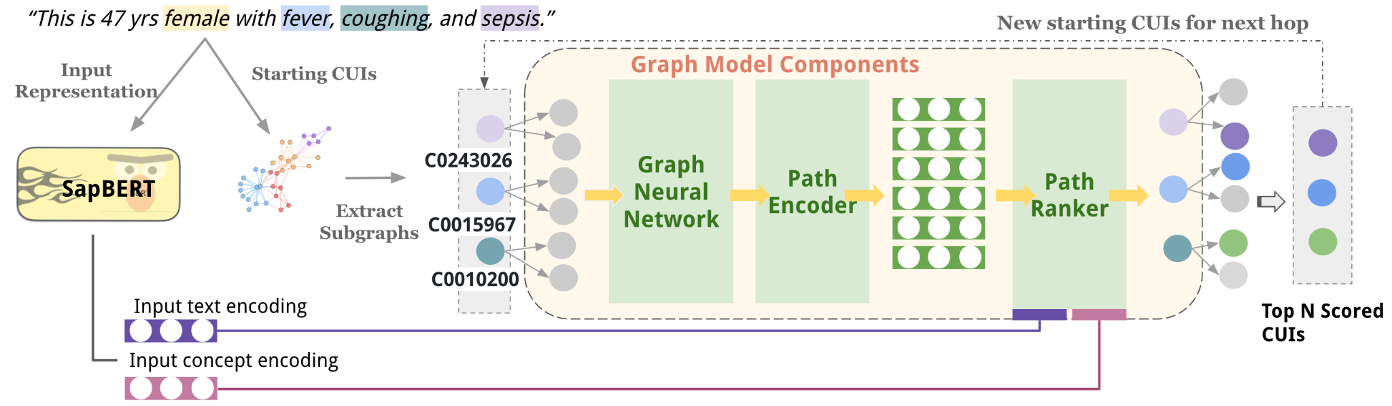
This is the code repository for our DR.Knows Paper. Please cite us if you are using this repo:
@article{gao2025leveraging,
  title={Leveraging Medical Knowledge Graphs Into Large Language Models for Diagnosis Prediction: Design and Application Study},
  author={Gao, Yanjun and Li, Ruizhe and Croxford, Emma and Caskey, John and Patterson, Brian W and Churpek, Matthew and Miller, Timothy and Dligach, Dmitriy and Afshar, Majid},
  journal={JMIR AI},
  volume={4},
  pages={e58670},
  year={2025},
  publisher={JMIR Publications Toronto, Canada}
}
OR
@article{gao2023large,
  title={Large language models and medical knowledge grounding for diagnosis prediction},
  author={Gao, Yanjun and Li, Ruizhe and Croxford, Emma and Tesch, Samuel and To, Daniel and Caskey, John and W. Patterson, Brian and M. Churpek, Matthew and Miller, Timothy and Dligach, Dmitriy and others},
  journal={medRxiv},
  pages={2023--11},
  year={2023},
  publisher={Cold Spring Harbor Laboratory Press}
}
The paper is currently under reviewed.
Before training, ensure that the following packages are installed:
Ensure your data files are prepared in the correct format before starting training. You will need:
Pre-build UMLS SNOMED CUI graph object (with physician selected relations pertinent to diagnosis): download This file is about 700 MB.
Pre-build Graph CUI Embedding (generated from SapBERT encoder): download For each CUI, we generated embedding using CUI Preferred Text 1 [SEP] CUI Preferred Text 2 [SEP] ... [SEP]. This gives us the best semantic representation in our preliminary experiments. This file is about 1.3 GB.
Besides the above files, we also provide the CUI-Preferred Text vocabulary (Download here).
You could also choose to generate your own CUI embedding file, using the generate_CUI_embedding.py script.
DR.Knows did not use all edge relations from UMLS. A board-certified physician scientist manually examined all relations in the UMLS, and refined the set of relations that are relevant to diagnostic reasoning. This excludes the concept hierarhchy such as parent or child relation. The resulted set of 108 relations are included in this repo: UMLS_refined_relations_DRKnows.csv.
We offer two trainer for DR.Knows: Multi-head Attention and Trilinear Attention. Both trainer scripts are optimized for MPI (training reduced to 2-3 hours on 5k notes input), so please have mpi4py installed.
The training parameters can be set directly in the command line or through the argument parser in the script. Key parameters include:
--lr: Learning rate for the model (default: 1e-5).
--max_k: Number of hops in the graph (default: 2).
--top_n: Number of top paths per iteration (default: 8).
--epoch: Number of training epochs (default: 10).
--gnn_update: Whether to update GNN layers during training (default: True).
--train_data: Path to the training data.
--dev_data: Path to the development data.
--cui_weight_path: Path to the CUI weights file.
--output_path: Path to save model checkpoints and outputs.
To start training, use the following command:
python triattn_trainer.py --lr 1e-5 --max_k 2 --top_n 8 --epoch 10 --train_data ./data/mimic_k2_train.json --dev_data ./data/mimic_k2_dev.json --output_path ./output/
The input data for clinical notes or patient records needs to be provided in a structured format that the model can process. The data will be loaded from a file (JSON or pickle format) and fed into the model for prediction.
Data Fields:
Input File Format Options:
  {
  "data_1": {
    "input text": "Patient has a history of hypertension and presents with chest pain.",
    "input A CUI": ["C0011847", "C0013404"],  # Hypertension and Chest Pain CUIs
    "paths": [
      ["C0011847", "C0013404"],  # Example path (CUI relationships)
      ["C0011847", "C0027051"]   # Another potential path
    ]
  },
  "data_2": {
    "input text": "Diabetes patient with kidney failure.",
    "input A CUI": ["C0011849", "C0022658"],  # Diabetes and Kidney Failure CUIs
    "paths": [
      ["C0011849", "C0022658"]
    ]
  }
}
test_stack_triattn.py: DR.Knows with TriAttntest_stack.py: DR.Knows with MultiAttnIn this step, you will need the saved checkpoints from training, they are:
gmodel.pth: the saved state of the graph model (referred to as gmodel in the code), which is a key component of the system used for reasoning over clinical data.encoder.pth is the saved state of a pretrained language modelLoad the pretrained models as shown in the script:
tokenizer = AutoTokenizer.from_pretrained("/home/ygao/LAB_SHARED/home/ygao/nlp_models/SapBERT-from-PubMedBERT-fulltext")
model = AutoModel.from_pretrained("/home/ygao/LAB_SHARED/home/ygao/nlp_models/SapBERT-from-PubMedBERT-fulltext")

pretrained_model_path = "/home/ygao/LAB_SHARED/PROJECTS/049-Clinical_Diagnostic_Reasoning/Sandbox/ygao_KG/Models/Wisc_Models/k2_N12_H3_CL_V4_CosinewBERT_TRATTN_Weight_Stack_Flat_Oracle01-06-23-21/"
trainer.gmodel.load_state_dict(torch.load(pretrained_model_path + "gmodel.pth"))
trainer.encoder.load_state_dict(torch.load(pretrained_model_path + "encoder.pth"))
gmodel.pth and encoder.pth work together during inference?The output will be a JSON file containing the predicted clinical concept paths for each input note. An example output file format is as follows:
{
    "note1": ["C0006826 --> causes --> C0002871"],
    "note2": ["C0018801 --> results_in --> C0002871"]
}
The target (destination) CUIs are the predicted CUIs. You will need to use the CUI-Preferred Text to convert back the preferred text before injecting them into LLMs.
Diagnostic Reasoning Knowledge Graph for Large Language Model Diagnosis Prediction
Python
40
24 commits
updated Jul 16, 2025
This is the code repository for our DR.Knows Paper. Please cite us if you are using this repo:
@article{gao2025leveraging,
  title={Leveraging Medical Knowledge Graphs Into Large Language Models for Diagnosis Prediction: Design and Application Study},
  author={Gao, Yanjun and Li, Ruizhe and Croxford, Emma and Caskey, John and Patterson, Brian W and Churpek, Matthew and Miller, Timothy and Dligach, Dmitriy and Afshar, Majid},
  journal={JMIR AI},
  volume={4},
  pages={e58670},
  year={2025},
  publisher={JMIR Publications Toronto, Canada}
}
OR
@article{gao2023large,
  title={Large language models and medical knowledge grounding for diagnosis prediction},
  author={Gao, Yanjun and Li, Ruizhe and Croxford, Emma and Tesch, Samuel and To, Daniel and Caskey, John and W. Patterson, Brian and M. Churpek, Matthew and Miller, Timothy and Dligach, Dmitriy and others},
  journal={medRxiv},
  pages={2023--11},
  year={2023},
  publisher={Cold Spring Harbor Laboratory Press}
}
The paper is currently under reviewed.
Before training, ensure that the following packages are installed:
Ensure your data files are prepared in the correct format before starting training. You will need:
Pre-build UMLS SNOMED CUI graph object (with physician selected relations pertinent to diagnosis): download This file is about 700 MB.
Pre-build Graph CUI Embedding (generated from SapBERT encoder): download For each CUI, we generated embedding using CUI Preferred Text 1 [SEP] CUI Preferred Text 2 [SEP] ... [SEP]. This gives us the best semantic representation in our preliminary experiments. This file is about 1.3 GB.
Besides the above files, we also provide the CUI-Preferred Text vocabulary (Download here).
You could also choose to generate your own CUI embedding file, using the generate_CUI_embedding.py script.
DR.Knows did not use all edge relations from UMLS. A board-certified physician scientist manually examined all relations in the UMLS, and refined the set of relations that are relevant to diagnostic reasoning. This excludes the concept hierarhchy such as parent or child relation. The resulted set of 108 relations are included in this repo: UMLS_refined_relations_DRKnows.csv.
We offer two trainer for DR.Knows: Multi-head Attention and Trilinear Attention. Both trainer scripts are optimized for MPI (training reduced to 2-3 hours on 5k notes input), so please have mpi4py installed.
The training parameters can be set directly in the command line or through the argument parser in the script. Key parameters include:
--lr: Learning rate for the model (default: 1e-5).
--max_k: Number of hops in the graph (default: 2).
--top_n: Number of top paths per iteration (default: 8).
--epoch: Number of training epochs (default: 10).
--gnn_update: Whether to update GNN layers during training (default: True).
--train_data: Path to the training data.
--dev_data: Path to the development data.
--cui_weight_path: Path to the CUI weights file.
--output_path: Path to save model checkpoints and outputs.
To start training, use the following command:
python triattn_trainer.py --lr 1e-5 --max_k 2 --top_n 8 --epoch 10 --train_data ./data/mimic_k2_train.json --dev_data ./data/mimic_k2_dev.json --output_path ./output/
The input data for clinical notes or patient records needs to be provided in a structured format that the model can process. The data will be loaded from a file (JSON or pickle format) and fed into the model for prediction.
Data Fields:
Input File Format Options:
  {
  "data_1": {
    "input text": "Patient has a history of hypertension and presents with chest pain.",
    "input A CUI": ["C0011847", "C0013404"],  # Hypertension and Chest Pain CUIs
    "paths": [
      ["C0011847", "C0013404"],  # Example path (CUI relationships)
      ["C0011847", "C0027051"]   # Another potential path
    ]
  },
  "data_2": {
    "input text": "Diabetes patient with kidney failure.",
    "input A CUI": ["C0011849", "C0022658"],  # Diabetes and Kidney Failure CUIs
    "paths": [
      ["C0011849", "C0022658"]
    ]
  }
}
test_stack_triattn.py: DR.Knows with TriAttntest_stack.py: DR.Knows with MultiAttnIn this step, you will need the saved checkpoints from training, they are:
gmodel.pth: the saved state of the graph model (referred to as gmodel in the code), which is a key component of the system used for reasoning over clinical data.encoder.pth is the saved state of a pretrained language modelLoad the pretrained models as shown in the script:
tokenizer = AutoTokenizer.from_pretrained("/home/ygao/LAB_SHARED/home/ygao/nlp_models/SapBERT-from-PubMedBERT-fulltext")
model = AutoModel.from_pretrained("/home/ygao/LAB_SHARED/home/ygao/nlp_models/SapBERT-from-PubMedBERT-fulltext")

pretrained_model_path = "/home/ygao/LAB_SHARED/PROJECTS/049-Clinical_Diagnostic_Reasoning/Sandbox/ygao_KG/Models/Wisc_Models/k2_N12_H3_CL_V4_CosinewBERT_TRATTN_Weight_Stack_Flat_Oracle01-06-23-21/"
trainer.gmodel.load_state_dict(torch.load(pretrained_model_path + "gmodel.pth"))
trainer.encoder.load_state_dict(torch.load(pretrained_model_path + "encoder.pth"))
gmodel.pth and encoder.pth work together during inference?The output will be a JSON file containing the predicted clinical concept paths for each input note. An example output file format is as follows:
{
    "note1": ["C0006826 --> causes --> C0002871"],
    "note2": ["C0018801 --> results_in --> C0002871"]
}
The target (destination) CUIs are the predicted CUIs. You will need to use the CUI-Preferred Text to convert back the preferred text before injecting them into LLMs.



