
The OKF toolkit for Claude Code — author, maintain, validate & visualize Open Knowledge Format bundles. Plugin, agent skills, and a GitHub Action.
See the codeSee what people are saying (1)
README
okf: the Open Knowledge Format toolkit for Claude Code
Teach your coding agent to author, maintain, validate and visualize portable knowledge bundles: markdown your team and your agents both read.




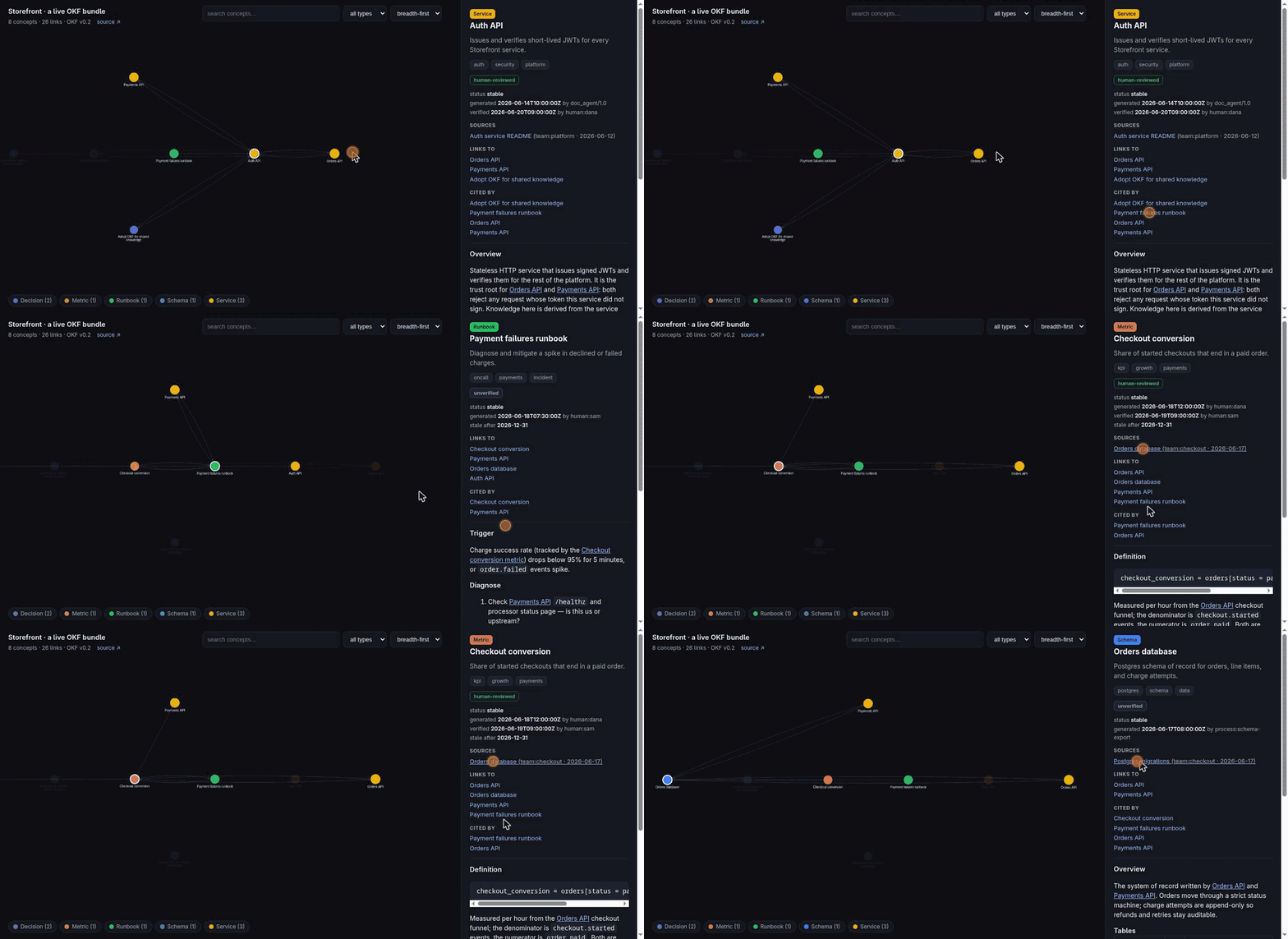
Open the live demo: a real bundle as an interactive graph. Click a node for the rendered concept, its derived trust tier and staleness, its sources and backlinks. Nothing leaves the page.
OKF is an
open, vendor-neutral format from Google Cloud (announced June 2026)
that stores the knowledge around your systems as a directory of markdown files
with YAML frontmatter. No schema registry, no runtime, no SDK: cat reads it,
git clone ships it. v0.2 adds trust, provenance and staleness signals to the
frontmatter, so an agent can tell a verified fact from a stale guess.
This repo is the Claude Code-native toolchain for it. Claude learns to produce, maintain, consume, validate, visualize and backfill OKF bundles as part of how it already works, driven by the vendored spec and backed by a deterministic conformance checker. It ships four ways: a Claude Code plugin, agent skills for 20+ agents via skills.sh, a GitHub Action for repos with no agent, and a read-only MCP server for hosts whose agents cannot read files.
This repo documents itself in OKF: its architecture and decisions live in
.okf/, rendered as a live self-graph
and validated on every push.
Install
| Channel | Command | Notes |
|---|---|---|
| Claude Code plugin | /plugin marketplace add scaccogatto/okf-skills then /plugin install okf@scaccogatto | Skills, subagents, Stop hook and MCP server. The full toolchain. |
| Agent skills (skills.sh) | npx skills add scaccogatto/okf-skills | Claude Code, Cursor, Codex and 20+ agents. Installs the okf, validate, visualize and backfill skills; backfill needs the plugin's subagents, see below. |
| GitHub Action | uses: scaccogatto/okf-skills@v1 | Validates a bundle in CI, no agent needed. |
| MCP server | uv run servers/okf_mcp.py .okf | Any MCP host. Bundled with the plugin, nothing to configure there. |
| Local development | claude --plugin-dir /path/to/okf-skills | No marketplace. |
The scripts need uv (or python3 with pyyaml).
One repo serves both layouts: .claude-plugin/ makes it a marketplace,
skills/<name>/SKILL.md makes it skills.sh-discoverable, and scripts resolve
through ${CLAUDE_SKILL_DIR} so they run from either path. The backfill skill
dispatches the two subagents in agents/, which live outside skills/, so
backfill works from the plugin install only.
Use it
Capture knowledge. Ask Claude to "document the auth service in OKF", or:
/okf:okf produce .okf
Backfill a repo that predates the bundle. Event-sources git history and Claude session transcripts into concepts, with a deterministic extractor and an auditable map/reduce over subagents:
/okf:backfill .
Validate before committing. The checker is deterministic, §11 of the spec,
not an eyeball pass. --migrate rewrites v0.1 constructs in place:
/okf:validate .okf --strict
uv run skills/validate/scripts/okf_validate.py .okf --strict      # zero-config
uv run skills/validate/scripts/okf_validate.py .okf --max-warnings 5
Gate it in CI with the composite action. @v1 tracks the latest release
while the repo is pre-1.0; pin @okf--v<version> to freeze it. The step exposes
the validator's JSON as the report output.
- uses: scaccogatto/okf-skills@v1
  with:
    bundle: .okf
    strict: "true"      # or: max-warnings: "5"
Visualize the graph as a self-contained viz.html
(live example). Every concept gets
a deep link (viz.html#services/auth-api), and each panel shows two derived
badges: the §5.3 trust tier and staleness once stale_after has passed. OKF
stores neither, so both are computed at render time. Above 1000 concepts the
layout falls back to linear; --layout cose overrides, --max-nodes N refuses.
/okf:visualize .okf
uv run skills/visualize/scripts/okf_visualize.py .okf -o viz.html \
  --title "My project" --link "https://github.com/me/project"
Read a bundle over MCP. Three read-only tools; nothing writes and no id
resolves outside the bundle root. Inside Claude Code the server starts with the
plugin on ./.okf and appears as mcp__plugin_okf_bundle__*. For Claude Code
it duplicates Read and Grep, and the decision record
says so; it ships for the hosts that have nothing else.
| Tool | Returns |
|---|---|
search_concepts(query, limit) | Concept cards (id, type, title, description, status, stale_after); metadata hits rank above body hits. |
read_concept(concept_id) | One concept verbatim, frontmatter included. The id is the bundle path without .md. |
get_neighbors(concept_id) | outgoing and incoming cards from markdown links and bundle-internal sources. |
Any other host: run uv run servers/okf_mcp.py <bundle> as a stdio server
(a bundle path, else $OKF_BUNDLE, else ./.okf).
Keep it up to date. Two opt-in modes. Soft: paste
templates/CLAUDE-okf.md into your CLAUDE.md so
Claude consults .okf/ before a task and writes back after. Enforced: add
upkeep: enforced to .okf/index.md's frontmatter to arm the plugin's dormant
Stop hook, which blocks finishing when tracked files changed but .okf/log.md
did not. OKF_HOOK=off overrides any bundle. Details:
stop-hook concept.
What's inside
| Component | What it does |
|---|---|
skills/okf/ | Produce / maintain / consume bundles from the spec and templates; auto-triggers in repos that have one. scripts/okf_init.py scaffolds a starter bundle. |
skills/validate/ | scripts/okf_validate.py: standalone §11 conformance checker, --strict, --max-warnings, --json, --migrate. |
skills/visualize/ | scripts/okf_visualize.py: bundle to viz.html. |
skills/backfill/ | Reconstruct a bundle from history. scripts/okf_backfill_events.py extracts events and emits capped diffs deterministically. |
agents/ | event-analyzer (map, cheap tier) and bundle-weaver (reduce, the only writer) for the backfill. |
servers/okf_mcp.py | The read-only MCP server, wired by .mcp.json. |
hooks/ | The dormant Stop hook, armed by upkeep: enforced. |
action.yml | Composite GitHub Action around the validator. |
templates/CLAUDE-okf.md | The soft-mode snippet. |
skills/okf/reference/SPEC.md | OKF v0.2, vendored verbatim: the source of truth. |
examples/sample-bundle/ | The bundle behind the live demo. |
benchmark/ | Three published experiments, protocols and runs. |
How a bundle looks
A concept's path is its id. The only hard rule is YAML frontmatter with a
non-empty type; everything else is optional.
.okf/
├── index.md                  # progressive disclosure (root carries okf_version)
├── log.md                    # ISO-dated change history, newest first
├── services/auth-api.md      # one concept = one file
└── decisions/use-okf.md
---
type: Service
title: Auth API
description: Issues and verifies short-lived access tokens.
status: stable
stale_after: 2026-12-31T00:00:00Z
generated: { by: doc_agent/1.0, at: 2026-06-14T10:00:00Z }
verified: { by: human:dana, at: 2026-06-20T09:00:00Z }
sources:
  - id: auth-readme
    resource: https://github.com/acme/auth#readme
    last_modified: 2026-06-12T00:00:00Z
---

# Endpoints
Tokens live 15 minutes.[^auth-readme]

[^auth-readme]: Auth service README
What v0.2 adds, all optional, all in frontmatter. Normative detail in
SPEC.md.
| Family | Fields | Answers |
|---|---|---|
| Provenance | sources[] with author, usage_count, last_modified, usage_window | Where did this come from, how credible is it? |
| Trust | generated: {by, at}, verified[], actor prefixes human: / process: / agent/version | Who wrote it, who confirmed it? |
| Lifecycle | status, stale_after | Is it current, is it still true? |
| Attestation | type: Attested Computation with runtime, parameters, executor, attester | Was this number produced the sanctioned way? |
Upgrading from v0.1: the tools read both, flag the old forms as warnings, and
okf_validate.py --migrate rewrites them in place.
What has been measured
Three experiments in benchmark/, each published with its
protocol, runs and the defects it exposed. None of them estimates what OKF is
worth in a real repository, where prose and history already carry recency.
- Trust metadata (results, pre-registered): with v0.2 lifecycle fields present the consumer never asserted a superseded fact, and read the fields unprompted. The primary contrast is invalid under the protocol's own rule, because the control refused to answer rather than answering wrong.
- Write-side gate (results, pre-registered): a
process gate and an expired
stale_aftereach reduced stale answers, and the two are not distinguishable on 20 items. Ungated writers left docs untouched 57% of the time, which is where the metadata acts. - Backfill map tier (results, engineering
A/B, one run per arm): batching small events eight per call cut the map phase by
a third; the cheap tier matched
sonneton commits once two instructions were made explicit.
A third party measures a different claim, sufficiency:
aws-samples/sample-okf-llm-wiki
scores EX 74.0 on BIRD mini_dev (500 text-to-SQL questions) from the bundle alone.
Contributing
Issues and PRs welcome. CI validates the manifests, both bundles, the action,
the docs regeneration and the test suites on every push. Releases are automatic:
bump version in .claude-plugin/plugin.json, add a ## [<version>] section to
CHANGELOG.md, and merging to main tags okf--v<version>. A PR touching the
shipped surface (.claude-plugin/, skills/, agents/, hooks/, servers/,
templates/, action.yml, .mcp.json) fails CI without both; one touching
skills/*/scripts/, agents/ or hooks/ must also update .okf/. The
skip-version-check label bypasses all three. This repo's bundle sets
upkeep: enforced, so the Stop hook blocks finishing until .okf/log.md
records your change; OKF_HOOK=off opts out.
Credits & license
- The Open Knowledge Format specification is by the Google Cloud Data Cloud
team, Apache-2.0, at GoogleCloudPlatform/open-knowledge-format
(the earlier copy under
knowledge-catalog/okfis a frozen snapshot).skills/okf/reference/SPEC.mdis vendored verbatim with attribution. - This plugin's own code and content: MIT © Marco Boffo (@scaccogatto).
Contributors


Similar repos


Languages
Python
96.5%
JavaScript
2.7%
The OKF toolkit for Claude Code — author, maintain, validate & visualize Open Knowledge Format bundles. Plugin, agent skills, and a GitHub Action.
See the codeSee what people are saying (1)
README
okf: the Open Knowledge Format toolkit for Claude Code
Teach your coding agent to author, maintain, validate and visualize portable knowledge bundles: markdown your team and your agents both read.
Open the live demo: a real bundle as an interactive graph. Click a node for the rendered concept, its derived trust tier and staleness, its sources and backlinks. Nothing leaves the page.
OKF is an
open, vendor-neutral format from Google Cloud (announced June 2026)
that stores the knowledge around your systems as a directory of markdown files
with YAML frontmatter. No schema registry, no runtime, no SDK: cat reads it,
git clone ships it. v0.2 adds trust, provenance and staleness signals to the
frontmatter, so an agent can tell a verified fact from a stale guess.
This repo is the Claude Code-native toolchain for it. Claude learns to produce, maintain, consume, validate, visualize and backfill OKF bundles as part of how it already works, driven by the vendored spec and backed by a deterministic conformance checker. It ships four ways: a Claude Code plugin, agent skills for 20+ agents via skills.sh, a GitHub Action for repos with no agent, and a read-only MCP server for hosts whose agents cannot read files.
This repo documents itself in OKF: its architecture and decisions live in
.okf/, rendered as a live self-graph
and validated on every push.
Install
| Channel | Command | Notes |
|---|---|---|
| Claude Code plugin | /plugin marketplace add scaccogatto/okf-skills then /plugin install okf@scaccogatto | Skills, subagents, Stop hook and MCP server. The full toolchain. |
| Agent skills (skills.sh) | npx skills add scaccogatto/okf-skills | Claude Code, Cursor, Codex and 20+ agents. Installs the okf, validate, visualize and backfill skills; backfill needs the plugin's subagents, see below. |
| GitHub Action | uses: scaccogatto/okf-skills@v1 | Validates a bundle in CI, no agent needed. |
| MCP server | uv run servers/okf_mcp.py .okf | Any MCP host. Bundled with the plugin, nothing to configure there. |
| Local development | claude --plugin-dir /path/to/okf-skills | No marketplace. |
The scripts need uv (or python3 with pyyaml).
One repo serves both layouts: .claude-plugin/ makes it a marketplace,
skills/<name>/SKILL.md makes it skills.sh-discoverable, and scripts resolve
through ${CLAUDE_SKILL_DIR} so they run from either path. The backfill skill
dispatches the two subagents in agents/, which live outside skills/, so
backfill works from the plugin install only.
Use it
Capture knowledge. Ask Claude to "document the auth service in OKF", or:
/okf:okf produce .okf
Backfill a repo that predates the bundle. Event-sources git history and Claude session transcripts into concepts, with a deterministic extractor and an auditable map/reduce over subagents:
/okf:backfill .
Validate before committing. The checker is deterministic, §11 of the spec,
not an eyeball pass. --migrate rewrites v0.1 constructs in place:
/okf:validate .okf --strict
uv run skills/validate/scripts/okf_validate.py .okf --strict      # zero-config
uv run skills/validate/scripts/okf_validate.py .okf --max-warnings 5
Gate it in CI with the composite action. @v1 tracks the latest release
while the repo is pre-1.0; pin @okf--v<version> to freeze it. The step exposes
the validator's JSON as the report output.
- uses: scaccogatto/okf-skills@v1
  with:
    bundle: .okf
    strict: "true"      # or: max-warnings: "5"
Visualize the graph as a self-contained viz.html
(live example). Every concept gets
a deep link (viz.html#services/auth-api), and each panel shows two derived
badges: the §5.3 trust tier and staleness once stale_after has passed. OKF
stores neither, so both are computed at render time. Above 1000 concepts the
layout falls back to linear; --layout cose overrides, --max-nodes N refuses.
/okf:visualize .okf
uv run skills/visualize/scripts/okf_visualize.py .okf -o viz.html \
  --title "My project" --link "https://github.com/me/project"
Read a bundle over MCP. Three read-only tools; nothing writes and no id
resolves outside the bundle root. Inside Claude Code the server starts with the
plugin on ./.okf and appears as mcp__plugin_okf_bundle__*. For Claude Code
it duplicates Read and Grep, and the decision record
says so; it ships for the hosts that have nothing else.
| Tool | Returns |
|---|---|
search_concepts(query, limit) | Concept cards (id, type, title, description, status, stale_after); metadata hits rank above body hits. |
read_concept(concept_id) | One concept verbatim, frontmatter included. The id is the bundle path without .md. |
get_neighbors(concept_id) | outgoing and incoming cards from markdown links and bundle-internal sources. |
Any other host: run uv run servers/okf_mcp.py <bundle> as a stdio server
(a bundle path, else $OKF_BUNDLE, else ./.okf).
Keep it up to date. Two opt-in modes. Soft: paste
templates/CLAUDE-okf.md into your CLAUDE.md so
Claude consults .okf/ before a task and writes back after. Enforced: add
upkeep: enforced to .okf/index.md's frontmatter to arm the plugin's dormant
Stop hook, which blocks finishing when tracked files changed but .okf/log.md
did not. OKF_HOOK=off overrides any bundle. Details:
stop-hook concept.
What's inside
| Component | What it does |
|---|---|
skills/okf/ | Produce / maintain / consume bundles from the spec and templates; auto-triggers in repos that have one. scripts/okf_init.py scaffolds a starter bundle. |
skills/validate/ | scripts/okf_validate.py: standalone §11 conformance checker, --strict, --max-warnings, --json, --migrate. |
skills/visualize/ | scripts/okf_visualize.py: bundle to viz.html. |
skills/backfill/ | Reconstruct a bundle from history. scripts/okf_backfill_events.py extracts events and emits capped diffs deterministically. |
agents/ | event-analyzer (map, cheap tier) and bundle-weaver (reduce, the only writer) for the backfill. |
servers/okf_mcp.py | The read-only MCP server, wired by .mcp.json. |
hooks/ | The dormant Stop hook, armed by upkeep: enforced. |
action.yml | Composite GitHub Action around the validator. |
templates/CLAUDE-okf.md | The soft-mode snippet. |
skills/okf/reference/SPEC.md | OKF v0.2, vendored verbatim: the source of truth. |
examples/sample-bundle/ | The bundle behind the live demo. |
benchmark/ | Three published experiments, protocols and runs. |
How a bundle looks
A concept's path is its id. The only hard rule is YAML frontmatter with a
non-empty type; everything else is optional.
.okf/
├── index.md                  # progressive disclosure (root carries okf_version)
├── log.md                    # ISO-dated change history, newest first
├── services/auth-api.md      # one concept = one file
└── decisions/use-okf.md
---
type: Service
title: Auth API
description: Issues and verifies short-lived access tokens.
status: stable
stale_after: 2026-12-31T00:00:00Z
generated: { by: doc_agent/1.0, at: 2026-06-14T10:00:00Z }
verified: { by: human:dana, at: 2026-06-20T09:00:00Z }
sources:
  - id: auth-readme
    resource: https://github.com/acme/auth#readme
    last_modified: 2026-06-12T00:00:00Z
---

# Endpoints
Tokens live 15 minutes.[^auth-readme]

[^auth-readme]: Auth service README
What v0.2 adds, all optional, all in frontmatter. Normative detail in
SPEC.md.
| Family | Fields | Answers |
|---|---|---|
| Provenance | sources[] with author, usage_count, last_modified, usage_window | Where did this come from, how credible is it? |
| Trust | generated: {by, at}, verified[], actor prefixes human: / process: / agent/version | Who wrote it, who confirmed it? |
| Lifecycle | status, stale_after | Is it current, is it still true? |
| Attestation | type: Attested Computation with runtime, parameters, executor, attester | Was this number produced the sanctioned way? |
Upgrading from v0.1: the tools read both, flag the old forms as warnings, and
okf_validate.py --migrate rewrites them in place.
What has been measured
Three experiments in benchmark/, each published with its
protocol, runs and the defects it exposed. None of them estimates what OKF is
worth in a real repository, where prose and history already carry recency.
- Trust metadata (results, pre-registered): with v0.2 lifecycle fields present the consumer never asserted a superseded fact, and read the fields unprompted. The primary contrast is invalid under the protocol's own rule, because the control refused to answer rather than answering wrong.
- Write-side gate (results, pre-registered): a
process gate and an expired
stale_aftereach reduced stale answers, and the two are not distinguishable on 20 items. Ungated writers left docs untouched 57% of the time, which is where the metadata acts. - Backfill map tier (results, engineering
A/B, one run per arm): batching small events eight per call cut the map phase by
a third; the cheap tier matched
sonneton commits once two instructions were made explicit.
A third party measures a different claim, sufficiency:
aws-samples/sample-okf-llm-wiki
scores EX 74.0 on BIRD mini_dev (500 text-to-SQL questions) from the bundle alone.
Contributing
Issues and PRs welcome. CI validates the manifests, both bundles, the action,
the docs regeneration and the test suites on every push. Releases are automatic:
bump version in .claude-plugin/plugin.json, add a ## [<version>] section to
CHANGELOG.md, and merging to main tags okf--v<version>. A PR touching the
shipped surface (.claude-plugin/, skills/, agents/, hooks/, servers/,
templates/, action.yml, .mcp.json) fails CI without both; one touching
skills/*/scripts/, agents/ or hooks/ must also update .okf/. The
skip-version-check label bypasses all three. This repo's bundle sets
upkeep: enforced, so the Stop hook blocks finishing until .okf/log.md
records your change; OKF_HOOK=off opts out.
Credits & license
- The Open Knowledge Format specification is by the Google Cloud Data Cloud
team, Apache-2.0, at GoogleCloudPlatform/open-knowledge-format
(the earlier copy under
knowledge-catalog/okfis a frozen snapshot).skills/okf/reference/SPEC.mdis vendored verbatim with attribution. - This plugin's own code and content: MIT © Marco Boffo (@scaccogatto).
Similar repos
Contributors
Languages
Python
96.5%
JavaScript
2.7%